Themes like the Mediterranean, cobblestone streets, French bistros, cafes, and orchestras are Rozenvain’ s favourites subjects. His colour scheme is rich and sultry, inviting the onlooker to hop into the painting for either a glass of wine or an espresso. Rozenvain applies many layers of paint, thus creating the illusion of depth through his highly textured canvas. His sense of composition and his agile paintbrush strokes are all elements that distinguish this artist and have made him famous worldwide. More on Michael Rozenvain
The central challenge of history painting lay in selecting a particular subject that could engage the heart and instruct the mind. Grand settings and symbolic accessories proved the artist’s grasp of perspective depth and still-life draftsmanship. Compositions and color schemes had to be carefully conceived to accentuate the principal characters and to clarify the meanings of the incidents. National Gallery
01 Painting, Streets of Paris, by the artists of the time, Part 33 - With Footnotes
Themes like the Mediterranean, cobblestone streets, French bistros, cafes, and orchestras are Rozenvain’ s favourites subjects. His colour scheme is rich and sultry, inviting the onlooker to hop into the painting for either a glass of wine or an espresso. Rozenvain applies many layers of paint, thus creating the illusion of depth through his highly textured canvas. His sense of composition and his agile paintbrush strokes are all elements that distinguish this artist and have made him famous worldwide. More on Michael Rozenvain
01 Paintings by the Orientalist Artists in the Nineteenth-Century, with footnotes, 24
EDITORIAL - cultural networking website!
01 Paintings by the Orientalist Artists in the Nineteenth-Century, with footnotes, 27
The city is located about 40 km south of the Algerian capital Algiers in a valley of Tellatlas. The coast of the Mediterranean is about 30 km away. In 1838 , Blidah was captured by French troops who set up a garrison there. In 1825 and 1867 , the city was destroyed by earthquakes. Today there is a university ( Université Saad Dahlab Blida ). More on Blidah
Please visit my other blogs: Art Collector, Mythology, Marine Art, Portrait of a Lady, The Orientalist, Art of the Nude and The Canals of Venice, Middle East Artists, 365 Saints, 365 Days, and Biblical Icons, also visit my Boards on Pinterest
Images are copyright of their respective owners, assignees or others.
Some Images may be subject to copyright
I don't own any of these images - credit is always given when due unless
it is unknown to me. if I post your images without your permission, please tell
me.
I do not sell art, art prints, framed posters or reproductions. Ads are
shown only to compensate the hosting expenses.
If you enjoyed this post, please share with friends and family.
Thank you for visiting my blog and also for liking its posts and pages.
Please note that the content of this post primarily consists of articles
available from Wikipedia or other free sources online.
01 Paintings by the Orientalist Artists in the Nineteenth-Century, with footnotes, 26
He chose to follow the innovative road marked by Mariano Fortuny. Starting in 1877 Gustavo Simoni traveled extensively, going to France, Spain and Africa, where he stayed several times in Algeria, Tunisia and Morocco. He settled for many years in the ancient city of Tlemcen, in Algeria, in an isolated house where he welcomed friends who came from Rome. He had relationships with authoritative personalities of the place. His fame was gained among collectors and connoisseurs. He won the Gold Medal at the Paris Salon of 1889 and was again awarded in 1895, at the Exposition of Fine Arts in Rome.
He became a member of the Accademia di San Luca . In the late nineteenth century he opened a studio in Paris, where he attended the main exponents of symbolism, satisfying the requests for the orientalist genre in watercolor and, in large sizes, in oil. Back in Rome, he founded his own school of Orientalist painting. He lived in a farmhouse in Via di Villa Patrizi. More on Gustavo Simoni
01 Paintings by the Orientalist Artists in the Nineteenth-Century, with footnotes, 23
01 Painting, Streets of Paris, by the artists of the time, Part 31 - With Footnotes
The Porte Saint-Martin was designed by architect Pierre Bullet at the order of Louis XIV in honor of his victories on the Rhine and in Franche-Comté. Built in 1674, it replaced a medieval gate in the city walls built by Charles V. It was restored in 1988. More on The Porte Saint-Martin
Professionally he went to Berlin in 1891 , in 1895 at the Berlin Bauakademie , in 1895 he exhibited at the Great Art Exhibition in Berlin. In 1896 he moved to Laboe, in 1912 to Kiel, in 1926 to Regensburg , where he lived and worked in the palatial Künstlerhaus Wittelsbacher Straße 9 . Lindemann-Frommel painted mainly seascapes with ships of the German fleet, these also as murals for city halls. More on Manfred Lindemann-Frommel
I do not sell art, art prints, framed posters or reproductions. Ads are shown only to compensate the hosting expenses.
If you enjoyed this post, please share with friends and family.
Thank you for visiting my blog and also for liking its posts and pages.
Tate blockbuster to prove Pierre Bonnard was a great Modern painter | The Art Newspaper
Pierre Bonnard (French: [bɔnaʁ]; 3 October 1867 – 23 January 1947) was a French painter, illustrator and printmaker, known especially for the stylized decorative qualities of his paintings and his bold use of color. A founding member of the Post-Impressionist group of avant-garde painters Les Nabis, his early work was strongly influenced by the work of Paul Gauguin, as well as the prints of Hokusai and other Japanese artists. Bonnard was a leading figure in the transition from Impressionism to Modernism. He painted landscapes, urban scenes, portraits and intimate domestic scenes, where the backgrounds, colors and painting style usually took precedence over the subject More on Pierre Bonnard
Please visit my other blogs: Art Collector, Mythology, Marine Art, Portrait of a Lady, The Orientalist, Art of the Nude and The Canals of Venice, Middle East Artists, 365 Saints, 365 Days,
and Biblical Icons,
also visit my Boards on Pinterest and deviantart
Images are copyright of their respective owners, assignees or others.
Some Images may be subject to copyright
I don't own any of these images - credit is always given when due unless
it is unknown to me. if I post your images without your permission, please tell
me.
I do not sell art, art prints, framed posters or reproductions. Ads are
shown only to compensate the hosting expenses.
If you enjoyed this post, please share with friends and family.
Thank you for visiting my blog and also for liking its posts and pages.
Please note that the content of this post primarily consists of articles
available from Wikipedia or other free sources online.
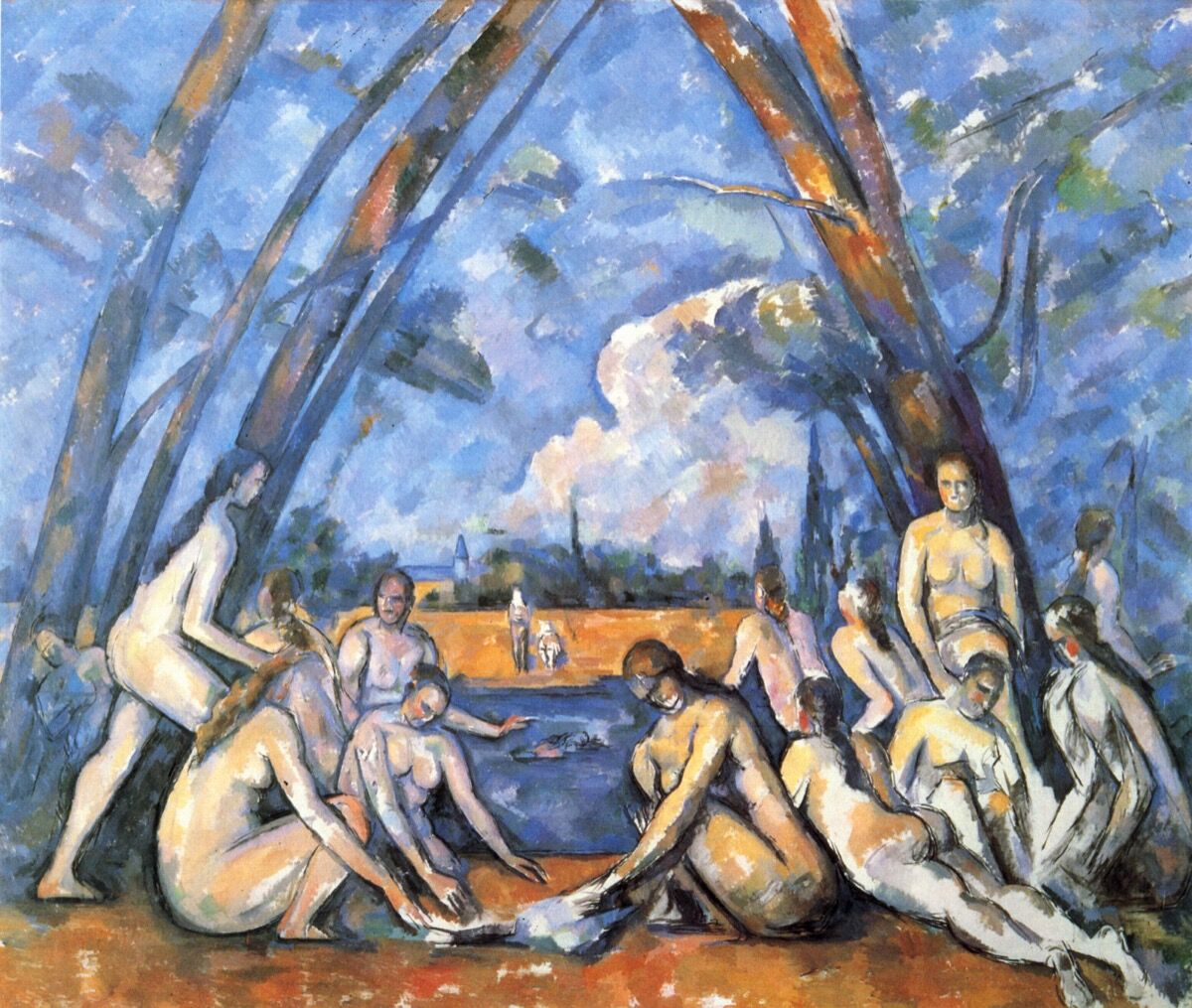
Why Art History Is Full of People Taking Baths - Artsy

The Large Bathers, 1900–06
Courtesy of the Philadelphia Museum of Art.
Why Art History Is Full of People Taking Baths - Artsy: It’s one of the most common human activities—yet artists from the ancient Greeks to the Surrealists and beyond have been fascinated by bathing.
The figure of the bather is one of the most common visual tropes in Western art history. From ancient Athens to 1920s Paris and beyond, painters and sculptors have presented bathing in a variety of ways with myriad different aims, whether instructional, titillating, or allegorical...
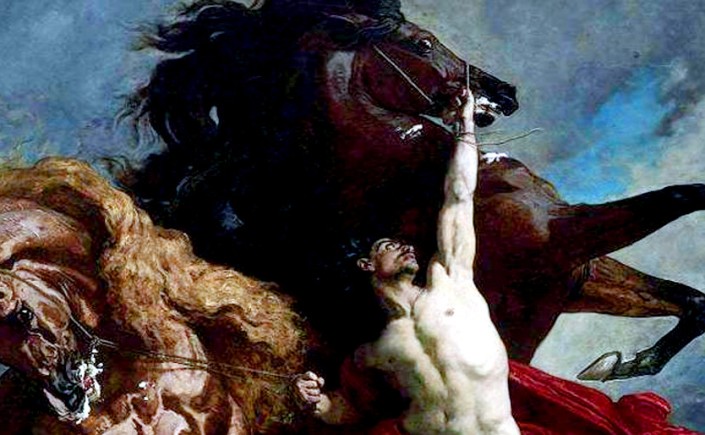
Social media doesn't want you to see Rubens' paintings
01 Paintings by the Orientalist Artists in the Nineteenth-Century, with footnotes, 22
01 Painting, Streets of Paris, by the artists of the time, Part 32 - With Footnotes
Here two beautiful, fashionable young ladies are shown passing a quiet afternoon in a Louis XVI-decorated study. A Flemish Classical Triumph tapestry, from Brussels of Bruges of the 16th Century, forms the backdrop to the composition, while an Anatolian single-niche prayer rug of lustrous colour is laid out on the floor. The brunette is distracted by events unfolding outside the window, while the blonde model, Berthe – Boldini's lover and muse – reads quietly. Adding to the period décor are the open secrétaire à abattant and desk chair, as well as the Gobelins woven tapestry adorning the walls. Berthe reads Le Figaro and holds a lit cigarette, her casual, relaxed position denoting an air of confidence. Le Figaro, France's oldest newspaper, was founded in 1826 as a satirical weekly and took its name and motto from The Marriage of Figaro. More on this painting
Emil Nolde (born Emil Hansen; 7 August 1867 – 13 April 1956) was a German-Danish painter and printmaker
Nolde's intense preoccupation with the subject of flowers reflected his interest in the art of Vincent van Gogh. More on Emil Nolde
C.P. Cavafy: The Horses of Achilles – A New Translation by Kathleen Vail – THE SHIELD OF ACHILLES

Artistic Reconstruction and Original Translation From Homer's "Iliad" by Kathleen Vail
01 Paintings, The amorous game, Part 19 - With Footnotes
Glimpses of Aleppo in an Exile’s Vision of an Elegant, Eerie Realm
01 Paintings, The amorous game, Part 16 - With Footnotes
We do not sell art, art prints, framed posters or reproductions. Ads are shown only to compensate the hosting expenses.
If you enjoyed this post, please share with friends and family.
01 Paintings by the Orientalist Artists, Paul Joanowits' Bashi-bazouks before the gate, with footnotes, #21
Both men are armed with Ottoman flintlock rifles from Algeria, and the standing guard smokes an Ottoman chibouk pipe with a tophane bowl. More on Bashi-bazouks
Please visit my other blogs: Art Collector, Mythology, Marine Art, Portrait of a Lady, The Orientalist, Art of the Nude and The Canals of Venice, Middle East Artists, 365 Saints and 365 Days, also visit my Boards on Pinterest
Images are copyright of their respective owners, assignees or others.
Some Images may be subject to copyright
I don't own any of these images - credit is always given when due unless
it is unknown to me. if I post your images without your permission, please tell
me.
I do not sell art, art prints, framed posters or reproductions. Ads are
shown only to compensate the hosting expenses.
If you enjoyed this post, please share with friends and family.
Thank you for visiting my blog and also for liking its posts and pages.
Please note that the content of this post primarily consists of articles
available from Wikipedia or other free sources online.
01 Paintings by the Orientalist Artists in the Nineteenth-Century, with footnotes, 20
Nafisa al-Bayda began her life as a slave and then was married in the mid 1700s to a man of power in the state named Ali Bey. Afterwards, she married the wealthy Murad Bey who was at first a Mamluk, but then later rose to power in 1784 and became the leader of the resistance against the Napoleon Bonaparte invasion.
Lady Nafisa al-Bayda, meaning the white one, was a woman of beauty, wealth, charity and known to be of great culture. She is also a symbol for womens participation in those days to the political life. During her husbands resistance, she played a major role in helping him acting as an intermediate between him and Napoleon. More on Nafisa al-Bayda