Showing posts with label Feminine. Show all posts

01 Photograph, Albert Watson's Linda at The 75th season for the Yankees, with Footnotes

Albert Watson (Scottish, b. 1942)
Detail; Linda, New York, c. 1977

Albert Watson (Scottish, b. 1942)
Linda, New York, c. 1977
Gelatin silver print
12 x 9-7/8 inches (30.5 x 25.1 cm)
Private collection

The 1977 New York Yankees season was the 75th season for the Yankees. The team finished with a record of 100–62 and won the World Series. The series victory was the 21st title in franchise history and the first under the ownership of George Steinbrenner. New York was managed by Billy Martin and played at Yankee Stadium in The Bronx. The season was brought to life years later in the book and drama-documentary The Bronx is Burning. The Yankees also hosted the 1977 Major League Baseball All-Star Game. To date, this is the most recent time the All-Star Game host team has won the World Series the same year. More on the 1977 New York Yankees season

Albert Watson OBE (born 1942) is a Scottish fashion, celebrity and art photographer. He has shot over 100 covers of Vogue and 40 covers of Rolling Stone magazine since the mid-1970s, and has created major advertising campaigns for clients such as Prada, Chanel and Levis. Watson has also taken some well-known photographs, from the portrait of Steve Jobs that appeared on the cover of his biography, a photo of Alfred Hitchcock holding a plucked goose, and a portrait of a nude Kate Moss taken on her 19th birthday.

Watson's prints of his photography are exhibited in galleries and museums worldwide. Photo District News named him one of the 20 most influential photographers of all time, along with Richard Avedon and Irving Penn, among others. Watson has won numerous honors, including a Lucie Award, a Grammy Award, the Hasselblad Masters Award and three ANDY Awards. He was awarded The Royal Photographic Society's Centenary Medal and Honorary Fellowship in recognition of a sustained, significant contribution to the art of photography in 2010. Queen Elizabeth II awarded Watson an Order of the British Empire in June 2015 for 'services to photography'. More on Albert Watson


Please visit my other blogs: Art Collector, Mythology, Marine Art, Portrait of a Lady, The Orientalist, Art of the Nude and The Canals of Venice, Middle East Artists, 365 Saints, 365 Days, and Biblical Icons, also visit my Boards on Pinterest and my art stores at  deviantart and Aaroko

Images are copyright of their respective owners, assignees or others. Some Images may be subject to copyright

I don't own any of these images - credit is always given when due unless it is unknown to me. if I post your images without your permission, please tell me.

Ads are shown only to compensate the hosting expenses.

If you enjoyed this post, please share with friends and family.

Thank you for visiting my blog and also for liking its posts and pages.

Please note that the content of this post primarily consists of articles available from Wikipedia or other free sources online.


05 Works, The Art of War, Marilyn Monroe Goes to Gaza, with footnotes

Unknown artist
Marilyn Monroe Goes to Gaza 1
AI Generated
davinci

While it’s an interesting premise to imagine a figure like Marilyn Monroe stepping into a contemporary political crisis, it’s essential to acknowledge the complexities of such situations. Monroe, known for her glamorous Hollywood persona, could be portrayed as a symbol of compassion and advocacy for peace.

Unknown artist
Marilyn Monroe Goes to Gaza 2
AI Generated
nightcafe

In this scenario, she might use her fame to raise awareness, organize humanitarian efforts, or provide support for those in need. With her charisma and influence, Monroe could draw attention to the struggles faced by people in Gaza, emphasizing the importance of empathy, dialogue, and peaceful resolutions.

Unknown artist
Marilyn Monroe Goes to Gaza 3
AI Generated
nightcafe

As if stepping onto the stage of a modern tragedy, she would encounter the harsh realities of conflict, but also the resilience of the human spirit. Her efforts could involve collaborating with local organizations, engaging in cultural exchanges, and promoting messages of hope and solidarity.

Unknown artist
Marilyn Monroe Goes to Gaza 4
AI Generated
nightcafe

Ultimately, Monroe's journey would highlight the power of compassion in the face of adversity, advocating for a world where voices are heard, and humanity prevails over discord.

Unknown artist
Marilyn Monroe Goes to Gaza 5
AI Generated
freepik

Marilyn Monroe (June 1, 1926 – August 4, 1962) was an American actress and model. Known for playing "blonde bombshell" characters, she became one of the most popular sex symbols of the 1950s and early 1960s, as well as an emblem of the era's sexual revolution. She was a top-billed actress for a decade, and her films grossed $200 million (equivalent to $2 billion in 2023) by the time of her death in 1962. More on Marilyn Monroe


Please visit my other blogs: Art Collector, Mythology, Marine Art, Portrait of a Lady, The Orientalist, Art of the Nude and The Canals of Venice, Middle East Artists, 365 Saints, 365 Days, and Biblical Icons, also visit my Boards on Pinterest and deviantart

Images are copyright of their respective owners, assignees or others. Some Images may be subject to copyright

I don't own any of these images - credit is always given when due unless it is unknown to me. if I post your images without your permission, please tell me.

Ads are shown only to compensate the hosting expenses.

If you enjoyed this post, please share with friends and family.

Thank you for visiting my blog and also for liking its posts and pages.

Please note that the content of this post primarily consists of articles available from Wikipedia or other free sources online.

01 Work, The art of War, Suhair Sibai's Damascus Queen #3, with Footnotes

Suhair Sibai
Damascus Queen #3, c. 2012
Paint on Canvas
48 W x 48 H

Originally listed for C$9,108

Suhair Sibai was born in Syria in 1956. Through her work, Suhair explores the concepts of identity and the Self, using the female form as her preferred medium. According to Suhair, who was educated as an artist in the sprawling metropolis of Los Angeles, the level of multiculturalism and diversity to which many of us are exposed to these days has the potential to cause the discord, displacement, and division of the Self.

Suhair strives to determine who we are as individuals, and how we came to end up in our current predicament. Using emotionally-charged colours, Suhair intentionally provides a contrast to the melancholic narratives, which are intended to ‘create alienation among audiences’. As well, the relatively large sizes of her works are meant to engage her viewers, and ultimately, by combining the emotional elements of her work with their own ‘biases’, Suhair’s audiences are able to experience something totally unique.

Suhair currently resides in Los Angeles, where she works as an artist full-time, and exhibits her work. In addition to LA, Suhair’s work has been received with great enthusiasm elsewhere around the world in Europe and the Middle East. More on Suhair Sibai


Please visit my other blogs: Art Collector, Mythology, Marine Art, Portrait of a Lady, The Orientalist, Art of the Nude and The Canals of Venice, Middle East Artists, 365 Saints, 365 Days, and Biblical Icons, also visit my Boards on Pinterest

Images are copyright of their respective owners, assignees or others. Some Images may be subject to copyright

I don't own any of these images - credit is always given when due unless it is unknown to me. if I post your images without your permission, please tell me.

I do not sell art, art prints, framed posters or reproductions. Ads are shown only to compensate the hosting expenses.

If you enjoyed this post, please share with friends and family.

Thank you for visiting my blog and also for liking its posts and pages.

Please note that the content of this post primarily consists of articles available from Wikipedia or other free sources online.


01 Work, The Art of War, Sara Madandar's A Common Thread, with footnotes

Sara Madandar, United States
A Common Thread Artwork
Mixed Media, Acrylic on Canvas
36 W x 44 H x 1.5 D in

For sale for C$5,296 in November 2023

Let us Believe In… is a collection of life-size portraits depicting a strong, diverse group of women. Starting with photographic prints on canvas, I paint, collage, write, spray, and sew onto their portraits. Much of my work has deployed the aesthetics of clothing and bodies to portray my own experiences as an Iranian woman migrating to the United States. In this series, I tell the stories of the women behind each portrait, letting their own narratives guide the techniques and materials used in each painting.

While they stand in separate portraits, the women of Let us Believe In… are not alone: they are connected through a social geography. All have lived in or are from New Orleans. This spatial connection is represented by a common thread woven through the paintings: the use of plaid patterns, which recall the latitude and longitude lines on a map. In each portrait, you will find a connection between the woman, the place, and the artist. More on this painting


Sara Madandar is an Iranian multi-disciplinary artist and educator based in New Orleans. She received her MFA from the University of Texas at Austin and her BA in painting from Azad University of Art and Architecture in Tehran. Through a range of media such as painting, video, installation, and performance, Madandar explores migration and the human experience of living between cultures, using the aesthetics of language, clothing, and bodies to study the complexities of cross-cultural experiences. Most recently, she was in residency at Joan Mitchell Center and Santa Fe Art Institute (SFAI). Sara is also a co-founder of the Parlour Gallery and Camp Street Studios, an artist-run space in the heart of New Orleans' downtown art district. Some of her accolades include an award from the Texas Visual Artists Association (TVAA) and an award from the Southeastern College Art Conference (SECAC) for work presented in an exhibition curated by Jessica Beck of the Andy Warhol Museum. Sara’s work has been featured at New Orleans Museum of Art, New Orleans Contemporary Art Center, Austin City Hall, Elisabeth Ney Museum, Elga Wimmer PCC (NYC), and many others. More on Sara Madandar


Please visit my other blogs: Art Collector, Mythology, Marine Art, Portrait of a Lady, The Orientalist, Art of the Nude and The Canals of Venice, Middle East Artists, 365 Saints, 365 Days, and Biblical Icons, also visit my Boards on Pinterest

Images are copyright of their respective owners, assignees or others. Some Images may be subject to copyright

I don't own any of these images - credit is always given when due unless it is unknown to me. if I post your images without your permission, please tell me.

I do not sell art, art prints, framed posters or reproductions. Ads are shown only to compensate the hosting expenses.

If you enjoyed this post, please share with friends and family.

Thank you for visiting my blog and also for liking its posts and pages.

Please note that the content of this post primarily consists of articles available from Wikipedia or other free sources online.


01 painting, Portrait of a Lady, Harold Von Schmidt's Friendly Persuasion, with Footnotes

Harold Von Schmidt, 1893-1982
Friendly Persuasion, c. 1922
Gouache on board
15 by 33 inches
Private collection

Sold for  $1,300 USD in April 2017

The Friendly Persuasion is an American novel published in 1945 by Jessamyn West. It was adapted as the motion picture Friendly Persuasion in 1956. The book is about a Quaker farming family living near the town of Vernon in southern Indiana along "the banks of the Muscatatuck, where once the woods stretched, dark row on row." More on Friendly Persuasion

Even though the painting appears to show a scene from Jessamyn West's story; the painting is dated over 20 years before the book was published!

Harold von Schmidt (May 19, 1893 – June 3, 1982) was an American illustrator, who specialized in magazine interior illustrations.

Born in Alameda, California in 1893, he was orphaned at the age of five. After a year in an orphanage, he went to live with his Aunt Lily Von Schmidt, an artist in her own right. As a youth, von Schmidt worked as a cowhand and a construction worker. In 1920 and 1924, he was on the United States Olympic Rugby team along with his cousin Charles Lee Tilden Jr. Although the United States team won the gold medal both years, von Schmidt did not play in the only game in 1920, and was sidelined by an injury in the final practice in 1924.

Von Schmidt began his art studies at the California School of Arts and Crafts while he was still in high school. In 1924, he entered the Grand Central School of Art in New York City. He moved to the suburban community of New Rochelle which was a well-known artist colony and home to many of the top commercial illustrators of the day such as Frank and J. C. Leyendecker and Norman Rockwell. Also in residence was N. C. Wyeth would become leaders in the field.

He later married and moved to Westport, Connecticut.

Harold von Schmidt's work appeared primarily in Collier's Weekly, Cosmopolitan, Liberty, The Saturday Evening Post, and Sunset. Although he preferred magazine work and illustrated few books, he spent two years preparing sixty illustrations for a deluxe edition of Willa Cather's Death Comes for the Archbishop. In 1948, he was recruited by Albert Dorne to be one of the founding faculty for the Famous Artists School. He was awarded the first gold medal by the trustees of the National Cowboy Hall of Fame in 1968.

Harold died on June 3, 1982 in Westport, Connecticut. More on Harold von Schmidt


Please visit my other blogs: Art Collector, Mythology, Marine Art, Portrait of a Lady, The Orientalist, Art of the Nude and The Canals of Venice, Middle East Artists, 365 Saints and 365 Days, also visit my Boards on Pinterest

Images are copyright of their respective owners, assignees or others. Some Images may be subject to copyright

I don't own any of these images - credit is always given when due unless it is unknown to me. if I post your images without your permission, please tell me.

I do not sell art, art prints, framed posters or reproductions. Ads are shown only to compensate the hosting expenses.

If you enjoyed this post, please share with friends and family.

Thank you for visiting my blog and also for liking its posts and pages.

Please note that the content of this post primarily consists of articles available from Wikipedia or other free sources online.


01 painting, The amorous game, Alexandre Marie Guillemin's Spinning a yarn, with Footnotes #93

Alexandre Marie Guillemin (French, 1817-1880)
Spinning a yarn
Oil on canvas
47 x 38.4cm (18 1/2 x 15 1/8in)
Private collection

This work was Sold for £1,100 on Nov 22, 2022

Alexandre Marie Guillemin was born in 1817 in Paris. He was a student of the prominent French painter Antoine Jean Gros. Guillemin was especially known as genre artist specializing in the themes from the lives of peasants and petit bourgeois from Brittany to Pyrenees, frequently captured in humorous settings.

From 1840 to 1879 he regularly exhibited at the Parisian Salon. In 1845 he received an exhibition medal, in 1869 he was awarded the Order of the Legion d'Honneur. Works of Alexandre Marie Guillemin can be viewed in museums worldwide such as the National Academy of Design, New York, the Museum of Fine Arts, Montreal or the Hermitage, and Saint Petersburg. More on Alexandre Marie Guillemin


Please visit my other blogs: Art Collector, Mythology, Marine Art, Portrait of a Lady, The Orientalist, Art of the Nude and The Canals of Venice, Middle East Artists, 365 Saints, 365 Days, and Biblical Icons, also visit my Boards on Pinterest

Images are copyright of their respective owners, assignees or others. Some Images may be subject to copyright

I don't own any of these images - credit is always given when due unless it is unknown to me. if I post your images without your permission, please tell me.

I do not sell art, art prints, framed posters or reproductions. Ads are shown only to compensate the hosting expenses.

If you enjoyed this post, please share with friends and family.

Thank you for visiting my blog and also for liking its posts and pages.

Please note that the content of this post primarily consists of articles available from Wikipedia or other free sources online.


01 Painting by the Orientalist Artists of the Nineteenth-Century, with footnotes, 36

Studio of Ferdinand Bol
An Elegant Lady at a Window
Oil on canvas
103.5 x 80 cm
Private collection

Ferdinand Bol (24 June 1616 – 24 August 1680) was a Dutch painter, etcher and draftsman. Although his surviving work is rare, it displays Rembrandt's influence; like his master, Bol favored historical subjects, portraits, numerous self-portraits, and single figures in exotic finery.

Ferdinand Bol was first an apprentice of Jacob Cuyp in his hometown and/or of Abraham Bloemaert in Utrecht. After 1630 he studied with Rembrandt, living in his house in Sint Antoniesbreestraat. In 1641 Bol started his own studio.

In 1652 he became a burgher of Amsterdam, and in 1653 he married Elisabeth Dell, whose father held positions with the Admiralty of Amsterdam and the wine merchants' guild, both institutions that later gave commissions to the artist. Within a few years (1655) he became the head of the guild and received orders to deliver two chimney pieces for rooms in the new town hall designed by Jacob van Campen, and four more for the Admiralty of Amsterdam.

Around this time, Bol was a popular and successful painter. His palette had lightened, his figures possessed greater elegance, and by the middle of the decade he was receiving more official commissions than any other artist in Amsterdam.

Probably his best known painting is a portrait of Elisabeth Bas, the wife of the naval officer Joachim Swartenhondt and an innkeeper near the Dam square. This and many other of his paintings would in the 19th century be falsely attributed to Rembrandt. More on Ferdinand Bol


Please visit my other blogs: Art Collector, Mythology, Marine Art, Portrait of a Lady, The Orientalist, Art of the Nude and The Canals of Venice, Middle East Artists, 365 Saints and 365 Days, also visit my Boards on Pinterest

Images are copyright of their respective owners, assignees or others. Some Images may be subject to copyright

I don't own any of these images - credit is always given when due unless it is unknown to me. if I post your images without your permission, please tell me.

I do not sell art, art prints, framed posters or reproductions. Ads are shown only to compensate the hosting expenses.

If you enjoyed this post, please share with friends and family.

Thank you for visiting my blog and also for liking its posts and pages.

Please note that the content of this post primarily consists of articles available from Wikipedia or other free sources online.

01 Paintings, The amorous game, Part 37 - With Footnotes

Achille Mollica (Italian 19th Century)
Playing hard to get
Oil on canvas 
52.1 x 73.7cm (20 1/2 x 29in).
Private collection

Achille Mollica (1832-1885) was an Italian painter of both canvases and ceramics. Achille was born to a family who manufactured maiolica ceramics. His father, Giovanni, had established the factory of "Mollica Ceramiche", which employed Achille's brothers, Ciro and Alessandro. Achille was however the greatest talent, studying ceramics at the Institute of Fine Arts of Naples.

He was a resident of Naples. In 1887 at Naples, he exhibited: a terra-cotta Amphora; in 1880 at Turin he exhibited some paintings: Ritorno and Ricordi del ballo; in 1881 at Milan, he exhibited I primi bocconi; Zobeide, bello studio di testa; Clorinda, painted on maiolica; at Rome in 1883: Diversi amori; Prima di un convito : Scala a Posillipo, a Turin, in 1884: Amore e Veduta a Posillipo. He also completed many portraits. He also exhibited in 1874 at Naples: Un tunisino; in 1875, La pesca and in 1876, Lo scacciapensieri. He also participated in the 1988 Esposizione Italiana at London. More on Achille Mollica


Please visit my other blogs: Art Collector, Mythology, Marine Art, and The Canals of Venice

Images are copyright of their respective owners, assignees or others. Some Images may be subject to copyright

I don't own any of these images - credit is always given when due unless it is unknown to me. if I post your images without your permission, please tell me.

I do not sell art, art prints, framed posters or reproductions. Ads are shown only to compensate the hosting expenses.

If you enjoyed this post, please share with friends and family.

Thank you for visiting my blog and also for liking its posts and pages.

18 Paintings, PORTRAIT OF A LADY FROM SAVOY , from the 18th & 19th C., with Footnotes. #3

French School (15th century)
Francoise-Madeleine d'Orleans (1648-64) Duchess of Savoy, c. 1664
 prior to her marriage
Oil on canvas
60 x 73 cm (23,6 x 28,7 inches)
Chateau de Versailles

Françoise Madeleine d'Orléans (13 October 1648 – 14 January 1664) was born a Princess of France and was the Duchess of Savoy as the first wife of Charles Emmanuel II. She was a first cousin of Louis XIV as well of her husband. She was the shortest-serving Savoyard consort, dying at the age of fifteen, childless.

Orléans was born in Paris in 1648. She was the youngest surviving daughter of Gaston d'Orléans and his second wife Marguerite of Lorraine. From birth, she was styled Mademoiselle de Valois, derived from one of her father's subsidiary titles. She grew up in the company of her sisters and Mademoiselle de La Vallière, future mistress of Louis XIV. She resided at the Château de Blois. Her father died in 1660 and her mother remained unmarried.

As French court etiquette dictated, she held the status of a Granddaughter of France.

Orléans married the Duke of Savoy by proxy at the Palais du Louvre on 4 March 1663. The couple met for the first time at Annecy on 3 April 1663 where they were married officially. The couple travelled to Turin, capital of Savoy, where they arrived on 15 June 1663. She was known as Francesca Maddalena d'Orléans in her adopted Savoy.

The duchess soon died on 14 Jan 1664 at the Royal Palace of Turin, leaving her husband without an heir. She was 15 years old. More on Françoise Madeleine d'Orléans

The French Renaissance was the cultural and artistic movement in France between the 15th and early 17th centuries. The period is associated with the pan-European Renaissance, a word first used by the French historian Jules Michelet to define the artistic and cultural "rebirth" of Europe.

Notable developments during the French Renaissance include the spread of humanism, early exploration of the "New World" (as New France by Giovanni da Verrazzano and Jacques Cartier); the development of new techniques and artistic forms in the fields of printing, architecture, painting, sculpture, music, the sciences and literature; and the elaboration of new codes of sociability, etiquette and discourse.

The French Renaissance traditionally extends from (roughly) the French invasion of Italy in 1494 during the reign of Charles VIII until the death of Henry IV in 1610. This chronology notwithstanding, certain artistic, technological or literary developments associated with the Renaissance arrived in France earlier; however, the Black Death of the 14th century and the Hundred Years' War kept France economically and politically weak until the late 15th century.

The reigns of Francis I of France (from 1515 to 1547) and his son Henry II (from 1547 to 1559) are generally considered the apex of the French Renaissance. More on French School (15th century)


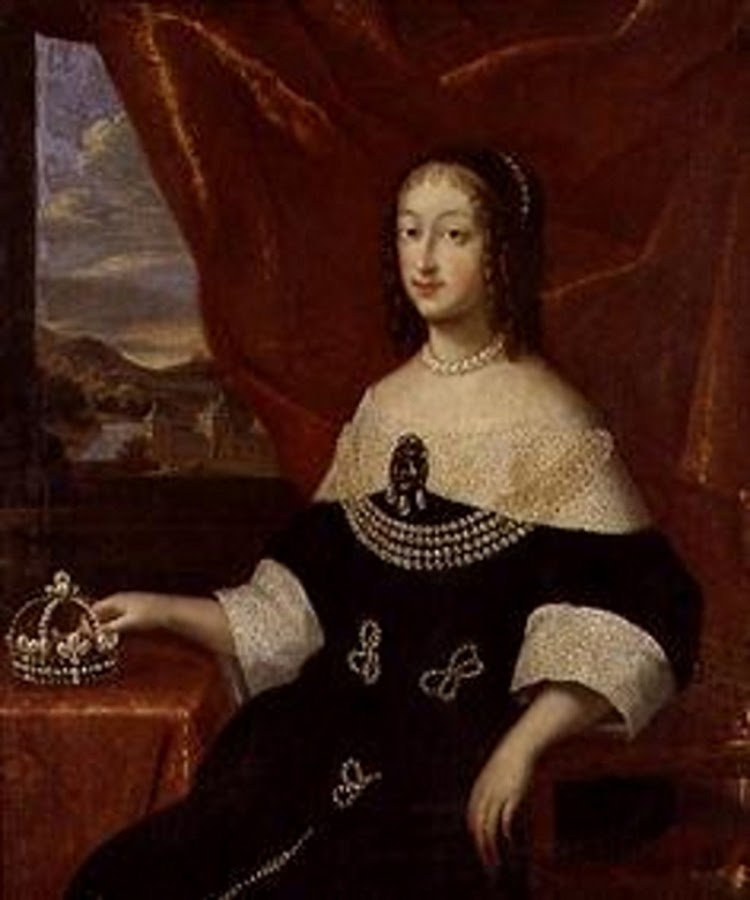
French School circa 1680, follower of Beaubrun
FRANCES-MADELEINE ORLEANS, DUCHESS OF SAVOY, CIRCA 1680
Oil on canvas 
upper right Inscriptions FRANÇOISE MADELEINE ORLEANS Duchess of Savoye / 1664 / 197BIS
the collection of brand back of King Louis-Philippe and No. 175 
107.5 x 91 cm; 42 1/4 by 35 5/8 in

Orléans was born at the Château de Saint Germain en Laye outside Paris in 1648.


Le Saint-Germain-en-Laye et la rampe des grottes

She was the youngest surviving daughter of Gaston d'Orléans and his second wife Marguerite of Lorraine. 


Anthony van Dyck (1599–1641)
Portrait of Gaston of France, duke of Orleans (1608-1660), c. 1632 or 1634
Father
Oil on canvas
193 × 119 cm (76 × 46.9 in)
Musée Condé

Sir Anthony van Dyck, ( 22 March 1599 – 9 December 1641) was a Flemish Baroque artist who became the leading court painter in England, after enjoying great success in Italy and Flanders. He is most famous for his portraits of Charles I of England and his family and court, painted with a relaxed elegance that was to be the dominant influence on English portrait-painting for the next 150 years. He also painted biblical and mythological subjects, displayed outstanding facility as a draughtsman, and was an important innovator in watercolour and etching. The Van Dyke beard is named after him. More Sir Anthony van Dyck


Anthony van Dyck (1599–1641)
Portrait of Margaret of Lorraine
Mother
Oil on canvas
203 × 115 cm (79.9 × 45.3 in)
Uffizi Gallery

From birth, she was styled Mademoiselle de Valois, derived from one of her father's subsidiary titles. She was the favourite sister of La Grande Mademoiselle, the famous heiress. She grew up in the company of her sisters and Mademoiselle de La Vallière, future mistress of Louis XIV. She resided at the Château de Blois. Her father died in 1660 and her mother remained unmarried.


School of Pierre Mignard (1612–1695)
Portrait of Anne Marie Louise d'Orléans, Duchess of Montpensier, also referred to as La Grande Mademoiselle
Oil on panel
140 × 110 cm (55.1 × 43.3 in)
Palace of Versailles

As French court etiquette dictated, she held the status of a Granddaughter of France as a male line descendant of the late king Henry IV of France. She was styled as a petite-fille de France.

Pierre Mignard (17 November 1612 – 30 May 1695), was a French painter known for his religious and mythological scenes and portraits. He was a near-contemporary of the Premier Peintre du Roi Charles Le Brun with whom he engaged in a bitter, life-long rivalry.

Pierre Mignard was born at Troyes in 1612. He came from a family of artisans. He was the younger brother of Nicolas, who became a painter and etcher. Mignard trained in Bourges with the Mannerist painter Jean Boucher. He then studied for a period in the studio of Simon Vouet. Mignard left for Rome in 1635 where he would stay about 22 years. 

In Rome he painted religious commissions. He was particularly known for his many images of the Madonna and Child. They were so popular that they were referred to as "Mignardises." He also painted altarpieces. His compatriot Nicolas Poussin hired Mignard to make copies of is works. He was also active as a reproductive engraver making copies after Annibale Carracci. Mignard's life-long interest in portrait painting was also developed at this time and he painted portraits of subsequent popes, cardinals and prominent members of the Italian nobility. He also travelled to Northern Italy where he visited Bologna, Parma, Mantua, Florence and Venice.

His reputation was such that he was summoned to Paris in 1657. In Paris he became a popular portrait painter. He found favor with king Louis XIV who sat for many portraits. Mignard became a rival of the leading French painter of that time and first painter to the King, Charles Le Brun. He declined to enter the Academy of which Le Brun was the head. Mignard also opposed the authority of the Academy. 


With the death of Le Brun in 1690, Mignard succeeded to all the posts held by his opponent. He died in 1695 at Paris as he was about to begin work on the cupola of the Invalides. More on Pierre Mignard


Anonymous (Italy)
Portrait of Christine Marie, Dowager Duchess of Savoy, c. 1633
Oil on canvasil
Staatsgalerie im Neuen Schloss, Schleißheim

Under the influence of her paternal aunt Christine Marie, Dowager Duchess of Savoy, she was engaged to her first cousin Charles Emmanuel II, Duke of Savoy. Christine Marie had chosen her as she had wanted to maintain her power and influence in government having previously been regent for her son since 1637. 


Pierre Mignard (1612–1695)
Portrait of cardinal Jules Mazarin (1602-1661)
Oil on canvas
65 × 55.5 cm (25.6 × 21.9 in)
Musée Condé, Château de Chantilly, Chantilly

The match was approved of by Cardinal Mazarin who had previously rejected Marie Jeanne of Savoy, another candidate for Charles Emmanuel II. Orléans proved suitably docile and was chosen over Marie Jeanne.


Unknown
Marie Jeanne of Savoy (1644-1724) some time after her marriage holding the Savoyard crown
Oil on canvas
Location Unknown

Orléans married the Duke of Savoy by proxy at the Palais du Louvre on 4 March 1663. The couple met for the first time at Annecy on 3 April 1663 where they were married officially. The couple travelled to Turin, capital of Savoy, where they arrived on 15 June 1663. She was known as Francesca Maddalena d'Orléans in her adopted Savoy.


Piedmontese School, 17th Century
Charles Emanuel II, the Duke of Savoy, in armour
Oil on canvas
 41.34 X 32.28 in (105 X 82 cm)
Private Collection

The duchess soon died on 14 Jan 1664 at the Royal Palace of Turin, leaving her husband without an heir.She was buried at Turin Cathedral where she rests today. Her husband, inconsolable at her death, ordered a lavish funeral. After Orléans' death, Louis XIV tried to engage La Grande Mademoiselle to Charles Emmanuel II who refused the match. He later married again to Marie Jeanne of Savoy by whom he had a son.


Unknown artist
Charles Dauphin - Carlo Emanuele II (1634-1675), son and heir of Vittorio Amedeo I, his wife Jeanne de Nemours (1644-1724) and his son, the future Vittorio Amedeo II (1666-1732), c. 1666
Oil on Canvas
Museo del Prado, Madrid

BRAMBILLA GIOVANNI BATTISTA
Duke Carlo Emanuele II of Savoy; Vittorio Amedeo II Prince of Piedmont, C.1675
340 CM x 282 CM
OIL ON CANVAS
PALAZZO MADAMA, Turin, Italy

Giovanni Battista Brambilla (active 1770) was an Italian painter. He was a native of Piedmont. He was a pupil of Carlo Delfino. He painted for churches in Turin, including a Martyrdom of St. Dalmazio for the church dedicated to that saint. He also painted altarpieces for churches in Villafranca. The Equestrian Portrait of Carlo Emanuele II, Duke of Savoy and of Vittorio Amedeo II, Prince of Piedmont (c. 1675) are on exhibit at the Palazzo Madama of Turin. More on Giovanni Battista Brambilla


Acknowledgment: Sotheby's, 

Images are copyright of their respective owners, assignees or others