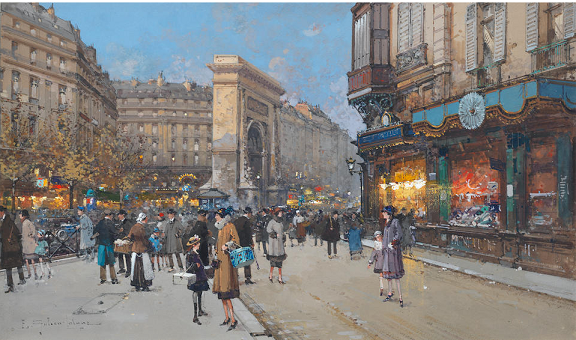
The central challenge of history painting lay in selecting a particular subject that could engage the heart and instruct the mind. Grand settings and symbolic accessories proved the artist’s grasp of perspective depth and still-life draftsmanship. Compositions and color schemes had to be carefully conceived to accentuate the principal characters and to clarify the meanings of the incidents. National Gallery
01 Paintings by the Orientalist Artists in the Nineteenth-Century, with footnotes, 22
01 Painting, Streets of Paris, by the artists of the time, Part 32 - With Footnotes
Here two beautiful, fashionable young ladies are shown passing a quiet afternoon in a Louis XVI-decorated study. A Flemish Classical Triumph tapestry, from Brussels of Bruges of the 16th Century, forms the backdrop to the composition, while an Anatolian single-niche prayer rug of lustrous colour is laid out on the floor. The brunette is distracted by events unfolding outside the window, while the blonde model, Berthe – Boldini's lover and muse – reads quietly. Adding to the period décor are the open secrétaire à abattant and desk chair, as well as the Gobelins woven tapestry adorning the walls. Berthe reads Le Figaro and holds a lit cigarette, her casual, relaxed position denoting an air of confidence. Le Figaro, France's oldest newspaper, was founded in 1826 as a satirical weekly and took its name and motto from The Marriage of Figaro. More on this painting
Emil Nolde (born Emil Hansen; 7 August 1867 – 13 April 1956) was a German-Danish painter and printmaker
Nolde's intense preoccupation with the subject of flowers reflected his interest in the art of Vincent van Gogh. More on Emil Nolde
C.P. Cavafy: The Horses of Achilles – A New Translation by Kathleen Vail – THE SHIELD OF ACHILLES

Artistic Reconstruction and Original Translation From Homer's "Iliad" by Kathleen Vail
01 Paintings, The amorous game, Part 19 - With Footnotes
Glimpses of Aleppo in an Exile’s Vision of an Elegant, Eerie Realm
01 Paintings, The amorous game, Part 16 - With Footnotes
We do not sell art, art prints, framed posters or reproductions. Ads are shown only to compensate the hosting expenses.
If you enjoyed this post, please share with friends and family.
01 Paintings by the Orientalist Artists, Paul Joanowits' Bashi-bazouks before the gate, with footnotes, #21
Both men are armed with Ottoman flintlock rifles from Algeria, and the standing guard smokes an Ottoman chibouk pipe with a tophane bowl. More on Bashi-bazouks
Please visit my other blogs: Art Collector, Mythology, Marine Art, Portrait of a Lady, The Orientalist, Art of the Nude and The Canals of Venice, Middle East Artists, 365 Saints and 365 Days, also visit my Boards on Pinterest
Images are copyright of their respective owners, assignees or others.
Some Images may be subject to copyright
I don't own any of these images - credit is always given when due unless
it is unknown to me. if I post your images without your permission, please tell
me.
I do not sell art, art prints, framed posters or reproductions. Ads are
shown only to compensate the hosting expenses.
If you enjoyed this post, please share with friends and family.
Thank you for visiting my blog and also for liking its posts and pages.
Please note that the content of this post primarily consists of articles
available from Wikipedia or other free sources online.
01 Paintings by the Orientalist Artists in the Nineteenth-Century, with footnotes, 20
Nafisa al-Bayda began her life as a slave and then was married in the mid 1700s to a man of power in the state named Ali Bey. Afterwards, she married the wealthy Murad Bey who was at first a Mamluk, but then later rose to power in 1784 and became the leader of the resistance against the Napoleon Bonaparte invasion.
Lady Nafisa al-Bayda, meaning the white one, was a woman of beauty, wealth, charity and known to be of great culture. She is also a symbol for womens participation in those days to the political life. During her husbands resistance, she played a major role in helping him acting as an intermediate between him and Napoleon. More on Nafisa al-Bayda
01 Painting, Streets of Paris, School of Paris' Parisian Grand Boulevard, Part 30 - With Footnotes
Parisian boulevards and avenues are usually tree-lined on one or both sides, which is rarely the case for smaller roads. More on Boulevards of Paris
Please visit my other blogs: Art Collector, Mythology, Marine Art, Portrait of a Lady, The Orientalist, Art of the Nude and The Canals of Venice, Middle East Artists, 365 Saints and 365 Days, also visit my Boards on Pinterest
Images are copyright of their respective owners, assignees or others.
Some Images may be subject to copyright
I don't own any of these images - credit is always given when due unless
it is unknown to me. if I post your images without your permission, please tell
me.
I do not sell art, art prints, framed posters or reproductions. Ads are
shown only to compensate the hosting expenses.
If you enjoyed this post, please share with friends and family.
Thank you for visiting my blog and also for liking its posts and pages.
Please note that the content of this post primarily consists of articles
available from Wikipedia or other free sources online.
01 Painting, Streets of Paris, by the artists of the time, Part 29 - With Footnotes
Stupar has participated in juried exhibitions since 1966 when he won the Silver Medal at the Center of Diffusion of the Cote-d'Azur. He regularly participates in the Salon d'Automne*, the Salon National des Beaux-Arts, the Salon des Artistes Français* and the Salon Comparaison.
Among his other honors, Stupar has won both the Silver and Gold medals of the Salon des Artistes Français.? One-man exhibitions of Stupar's work have been held in cities all over the world including Paris, Geneva, Lyon, Osaka, Dusseldorf, Strasbourg, Zagreb, Annecy, Havre, New York, Philadelphia, Dallas, and Houston. More on Marko Stupar
We do not sell art, art prints, framed posters or reproductions. Ads are shown only to compensate the hosting expenses.
If you enjoyed this post, please share with friends and family.
01 Painting, Streets of Paris, by the artists of the time, Part 38 - With Footnotes
I don't own any of these images - credit is always given when due unless it is unknown to me. if I post your images without your permission, please tell me.
I do not sell art, art prints, framed posters or reproductions. Ads are shown only to compensate the hosting expenses.
If you enjoyed this post, please share with friends and family.
Thank you for visiting my blog and also for liking its posts and pages.
02 Painting, Streets of Paris, by the artists of the time, Part 37 - With Footnotes
There is a covered as well as open-air section and it is fascinating to wander the pretty orangerie style pavilions, which are over 100 years old, that line the market, filled with flowers, plants and quirky gifts. Parisians come here to buy flowers for their balconies, for their homes and gardens and it is a truly unique and endearing place for a walk and for visitors to get a feel for the real pulse of the city. This vibrant, colourful little market is also a favourite with artists who come here for inspiration. More on La Madeleine
I don't own any of these images - credit is always given when due unless it is unknown to me. if I post your images without your permission, please tell me.
I do not sell art, art prints, framed posters or reproductions. Ads are shown only to compensate the hosting expenses.
If you enjoyed this post, please share with friends and family.
Thank you for visiting my blog and also for liking its posts and pages.
01 Paintings, The amorous game, Part 18 - With Footnotes
01 Paintings, The amorous game, Part 17 - With Footnotes
01 Painting, Streets of Paris, by the artists of the time, Part 28 - With Footnotes
I don't own any of these images - credit is always given when due unless it is unknown to me. if I post your images without your permission, please tell me.
I do not sell art, art prints, framed posters or reproductions. Ads are shown only to compensate the hosting expenses.
If you enjoyed this post, please share with friends and family.
Thank you for visiting my blog and also for liking its posts and pages.
01 Paintings by the Orientalist Artists in the Nineteenth-Century, with footnotes, 15
By 1840 he'd been admitted to the École des Beaux-Arts and was competing for the Prix de Rome, which he won in 1841 for a history painting, St. Peter Healing a Lame Man at the Door of the Temple. Although in poor health, Pils then spent the customary three years at the French Academy in Rome at the Villa Medici, which then had Jean Auguste Dominique Ingres as its director. While in Italy he visited Naples, Venice, and Florence.
After experiences travelling with French troops through the Crimea, his themes took on military and nationalistic subjects. He later produced many military scenes during the siege of Paris during the Franco-Prussian War of 1870.
Pils was appointed professor of painting at the École des Beaux-Arts in 1863 but left the same year for two years in Algeria. In 1868 he was elected to Académie des Beaux-Arts. More on Isidore-Alexandre-Augustin Pils
We do not sell art, art prints, framed posters or reproductions. Ads are shown only to compensate the hosting expenses.
If you enjoyed this post, please share with friends and family.