Showing posts with label Eugène Galien-Laloue. Show all posts

02 Paintings, Streets of Paris, Frank Boggs and Eugène Galien- Laloue's Images of Notre-Dame Cathedral in Paris , with footnotes, Part 95

Frank Boggs
Boats on the River Seine with Notre Dame in the Background
Oil on Canvas
21 x 26" (54 x 67cm)

Available for £6,800 in Dec 2024

Notre-Dame Cathedral , commonly known as Notre-Dame , is one of the most iconic monuments in Paris and France. It is located on the Île de la Cité and is a Catholic place of worship , seat of the Archdiocese of Paris , dedicated to the Virgin Mary. More on Notre-Dame Cathedral

Frank Myers Boggs was born in Springfield, Ohio, but left Ohio in 1876 for study with Jean-Léon Gérôme at the École des Beaux Arts in Paris. He lived in Paris and New York, residing the last thirty years of his life in Paris. In Paris he won wide recognition for his atmospheric paintings of the ports of France and the quays along the Seine. His works were exhibited frequently in France. Between 1879 and 1916, his work was also shown in the United States, most often at the National Academy of Design, in New York, and at the Pennsylvania Academy of the Fine Arts, in Philadelphia.

Known as a master of plein-air painting, Boggs delighted in capturing the fleeting effects of the constantly changing skies of northern France and southern England. With lush and broad brush strokes, Boggs created rich and spacious paintings, orchestrating a subtle and restrained palette of grays, deep and dusty blues, and earthy tans. Although his palette is more subtle and tonal than that of the French Impressionist Claude Monet, Boggs’ paintings demonstrate clear affinities with the early French Impressionist school. Like his fellow Impressionists, it was the transitory aspects of nature, as well as the documentation of everyday reality, to which Boggs was keenly sensitive. More on Frank Myers Boggs

Eugène Galien- Laloue (French, 1854-1941)
Notre Dame de Paris, vue du Quai de Montebello
Gouache on paper
9-1/2 x 12 inches (24.1 x 30.5 cm)
Private collection

Sold  for $16,250.00 in Dec 2024 

Eugène Galien-Laloue (1854–1941) was a French artist of French-Italian parents and was born in Paris on December 11, 1854. He was a populariser of street scenes, usually painted in autumn or winter. His paintings of the early 1900s accurately represent the era in which he lived: a happy, bustling Paris, la Belle Époque, with horse-drawn carriages, trolley cars and its first omnibuses. Galien-Laloue's works are valued not only for their contribution to 20th-century art, but for the actual history, which they document. His work can be seen at the Musée des Beaux-Arts, Louvier; Musée des Beaux-Arts, La Rochelle; Mulhouse, France.

A typical Galien-Laloue painting depicts sidewalks and avenues crowded with people or tourists mingling before the capital's monuments. He also painted the landscapes of Normandy and Seine-et-Marne, as well as military scenes he was commissioned to produce in 1914. The Republic of France selected Galien-Laloue to work as a 'war artist,' both during the Franco-Prussian War and World War I, chiefly in watercolor. More on Eugène Galien-Laloue


01 Painting, Streets of Paris, by the artists of their time, Part 66 - With Footnotes

Eugène Galien-Laloue, French, 1854-1941
Communiantes a Paris
Gouache over pencil on paper
30.5 by 18.5cm., 12 by 7½in.
Private collection

Communicants are people who partake or are entitled to partake of the Eucharist; a member of a church.

Eugène Galien-Laloue (1854–1941) was a French artist of French-Italian parents and was born in Paris on December 11, 1854. He was a populariser of street scenes, usually painted in autumn or winter. His paintings of the early 1900s accurately represent the era in which he lived: a happy, bustling Paris, la Belle Époque, with horse-drawn carriages, trolley cars and its first omnibuses. Galien-Laloue's works are valued not only for their contribution to 20th-century art, but for the actual history, which they document. His work can be seen at the Musée des Beaux-Arts, Louvier; Musée des Beaux-Arts, La Rochelle; Mulhouse, France.

A typical Galien-Laloue painting depicts sidewalks and avenues crowded with people or tourists mingling before the capital's monuments. He also painted the landscapes of Normandy and Seine-et-Marne, as well as military scenes he was commissioned to produce in 1914. The Republic of France selected Galien-Laloue to work as a 'war artist,' both during the Franco-Prussian War and World War I, chiefly in watercolor. More on Eugène Galien-Laloue


Images are copyright of their respective owners, assignees or others. Some Images may be subject to copyright

I don't own any of these images - credit is always given when due unless it is unknown to me. if I post your images without your permission, please tell me.

I do not sell art, art prints, framed posters or reproductions. Ads are shown only to compensate the hosting expenses.

If you enjoyed this post, please share with friends and family.

Thank you for visiting my blog and also for liking its posts and pages.

Please note that the content of this post primarily consists of articles available from Wikipedia or other free sources online.

01 Painting, Streets of Paris, by the artists of the time, Part 57 - With Footnotes

Eugène Galien-Laloue, (1854-1941) 
View of the flower market Place de la Madeleine 
Gouache on paper 
23.4 x 31 CM - 9 1/4 x 12 1/4 in. 
Private collection

The Boulevard de la Madeleine is one of the four 'grands boulevards' of Paris, France, a chain of roads running east-west that includes the boulevard de la Madeleine, the boulevard des Capucines, the boulevard des Italiens and the boulevard Montmartre.

The boulevard is named after the nearby Église de la Madeleine. More on Place de la Madeleine

Eugène Galien-Laloue (1854–1941) was a French artist of French-Italian parents and was born in Paris on December 11, 1854. He was a populariser of street scenes, usually painted in autumn or winter. His paintings of the early 1900s accurately represent the era in which he lived: a happy, bustling Paris, la Belle Époque, with horse-drawn carriages, trolley cars and its first omnibuses. Galien-Laloue's works are valued not only for their contribution to 20th-century art, but for the actual history, which they document. His work can be seen at the Musée des Beaux-Arts, Louvier; Musée des Beaux-Arts, La Rochelle; Mulhouse, France.

A typical Galien-Laloue painting depicts sidewalks and avenues crowded with people or tourists mingling before the capital's monuments. He also painted the landscapes of Normandy and Seine-et-Marne, as well as military scenes he was commissioned to produce in 1914. The Republic of France selected Galien-Laloue to work as a 'war artist,' both during the Franco-Prussian War and World War I, chiefly in watercolor. More on Eugène Galien-Laloue


Please visit my other blogs: Art Collector, Mythology, Marine Art, Portrait of a Lady, The Orientalist, Art of the Nude and The Canals of Venice, And visit my Boards on Pinterest


Images are copyright of their respective owners, assignees or others. Some Images may be subject to copyright

I don't own any of these images - credit is always given when due unless it is unknown to me. if I post your images without your permission, please tell me.

I do not sell art, art prints, framed posters or reproductions. Ads are shown only to compensate the hosting expenses.

If you enjoyed this post, please share with friends and family.


Thank you for visiting my blog and also for liking its posts and pages.

01 Painting, Streets of Paris, by the artists of the time, Part 36 - With Footnotes

Eugène Galien-Laloue, 1854-1941, FRENCH
LE MARCHÉ AUX FLEURS
Watercolour and gouache on paper
20.5 by 33cm., 8 by 13in.
Private property

The famous “Flowers and Birds Market (Marché aux fleurs et aux oiseaux)” has been located since 1808 on the Ile de la Cité, Place Louis Lépine, and Quai de la Corse along the Seine. Halfway between a covered and open-air market, the flower market is made up of six 1900-era pavilions, around tree-lined walkways. In these stalls, you can find a very wide variety of flowers, plants, and shrubs, and even decorative items, especially around Christmas. 

Since June 7, 2014, on the occasion of the state visit of the British Queen Elizabeth II who came to commemorate the 70th anniversary of D-Day, this market has been renamed. Indeed, during her visit to the market, the British head of state unveiled a new street sign with the name “Marché aux fleurs Reine Elizabeth II (Queen Elizabeth II Flower Market)”, which does nothing to detract from the authenticity of the place. More on the Marché aux fleurs


Eugène Galien-Laloue (1854–1941) was a French artist of French-Italian parents and was born in Paris on December 11, 1854. He was a populariser of street scenes, usually painted in autumn or winter. His paintings of the early 1900s accurately represent the era in which he lived: a happy, bustling Paris, la Belle Époque, with horse-drawn carriages, trolley cars and its first omnibuses. Galien-Laloue's works are valued not only for their contribution to 20th-century art, but for the actual history, which they document. His work can be seen at the Musée des Beaux-Arts, Louvier; Musée des Beaux-Arts, La Rochelle; Mulhouse, France. 


A typical Galien-Laloue painting depicts sidewalks and avenues crowded with people or tourists mingling before the capital's monuments. He also painted the landscapes of Normandy and Seine-et-Marne, as well as military scenes he was commissioned to produce in 1914. The Republic of France selected Galien-Laloue to work as a 'war artist,' both during the Franco-Prussian War and World War I, chiefly in watercolor. More on Eugène Galien-Laloue


Please visit my other blogs: Art Collector, Mythology, Marine Art, and The Canals of Venice

Images are copyright of their respective owners, assignees or others. Some Images may be subject to copyright

I don't own any of these images - credit is always given when due unless it is unknown to me. if I post your images without your permission, please tell me.

I do not sell art, art prints, framed posters or reproductions. Ads are shown only to compensate the hosting expenses.

If you enjoyed this post, please share with friends and family.


Thank you for visiting my blog and also for liking its posts and pages.

01 Painting, Streets of Paris, Eugène Galien-Laloue's Arc de Triomphe, Part 35 - With Footnotes

Eugène Galien-Laloue, 1854-1941, FRENCH
Arc de Triomphe
Gouache and watercolour over pencil on paper
18.5 by 30cm., 7¼ by 11¾in.
Private collection

Estimate at 5,000 - 7,000 USD in  October 2021

The Arc de Triomphe de l'Étoile is one of the most famous monuments in Paris, standing at the western end of the Champs-Élysées at the center of Place Charles de Gaulle, formerly named Place de l'Étoile — the étoile or "star" of the juncture formed by its twelve radiating avenues.

Inspired by the Roman Arch of Titus, the Arc de Triomphe has an overall height of 50 metres (164 ft), width of 45 m (148 ft), and depth of 22 m (72 ft), while its large vault is 29.19 m (95.8 ft) high and 14.62 m (48.0 ft) wide. The smaller transverse vaults are 18.68 m (61.3 ft) high and 8.44 m (27.7 ft) wide. Three weeks after the Paris victory parade in 1919 (marking the end of hostilities in World War I), Charles Godefroy flew his Nieuport biplane under the arch's primary vault, with the event captured on newsreel.

Paris's Arc de Triomphe was the tallest triumphal arch until the completion of the Monumento a la Revolución in Mexico City in 1938. More on L'Arc de Triomphe

Eugène Galien-Laloue (1854–1941) was a French artist of French-Italian parents and was born in Paris on December 11, 1854. He was a populariser of street scenes, usually painted in autumn or winter. His paintings of the early 1900s accurately represent the era in which he lived: a happy, bustling Paris, la Belle Époque, with horse-drawn carriages, trolley cars and its first omnibuses. Galien-Laloue's works are valued not only for their contribution to 20th-century art, but for the actual history, which they document. His work can be seen at the Musée des Beaux-Arts, Louvier; Musée des Beaux-Arts, La Rochelle; Mulhouse, France.

A typical Galien-Laloue painting depicts sidewalks and avenues crowded with people or tourists mingling before the capital's monuments. He also painted the landscapes of Normandy and Seine-et-Marne, as well as military scenes he was commissioned to produce in 1914. The Republic of France selected Galien-Laloue to work as a 'war artist,' both during the Franco-Prussian War and World War I, chiefly in watercolor. More on Eugène Galien-Laloue


Please visit my other blogs: Art Collector, Mythology, Marine Art, Portrait of a Lady, The Orientalist, Art of the Nude and The Canals of Venice, Middle East Artists, 365 Saints, 365 Days, and Biblical Icons, also visit my Boards on Pinterest

Images are copyright of their respective owners, assignees or others. Some Images may be subject to copyright

I don't own any of these images - credit is always given when due unless it is unknown to me. if I post your images without your permission, please tell me.

I do not sell art, art prints, framed posters or reproductions. Ads are shown only to compensate the hosting expenses.

If you enjoyed this post, please share with friends and family.

Thank you for visiting my blog and also for liking its posts and pages.

Please note that the content of this post primarily consists of articles available from Wikipedia or other free sources online.

01 Painting, Streets of Paris, by the artists of the time, Part 28 - With Footnotes

Eugène Galien-Laloue, (French, 1854-1941)
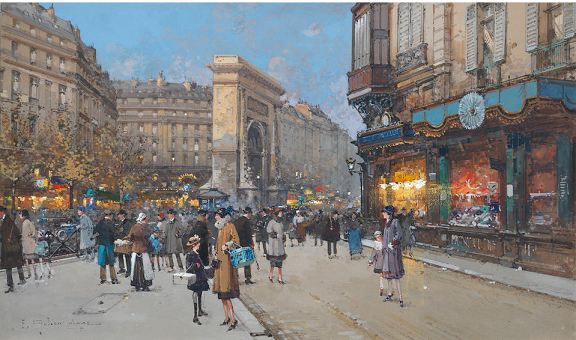
Porte Saint-Martin, Paris 
Gouache over traces of pencil
26.5 x 45.5cm (10 7/16 x 17 15/16in).
Private collection

The Porte Saint-Martin is a Parisian monument located at the site of one of the gates of the now-destroyed fortifications of Paris. It is located at the crossing of Rue Saint-Martin, Rue du Faubourg Saint-Martin and the grands boulevards Boulevard Saint-Martin and Boulevard Saint-Denis.

The Porte Saint-Martin was designed by architect Pierre Bullet at the order of Louis XIV in honor of his victories on the Rhine and in Franche-Comté. Built in 1674, it replaced a medieval gate in the city walls built by Charles V. It was restored in 1988. More on The Porte Saint-Martin

Eugène Galien-Laloue (1854–1941) was a French artist of French-Italian parents and was born in Paris on December 11, 1854. He was a populariser of street scenes, usually painted in autumn or winter. His paintings of the early 1900s accurately represent the era in which he lived: a happy, bustling Paris, la Belle Époque, with horse-drawn carriages, trolley cars and its first omnibuses. Galien-Laloue's works are valued not only for their contribution to 20th-century art, but for the actual history, which they document. His work can be seen at the Musée des Beaux-Arts, Louvier; Musée des Beaux-Arts, La Rochelle; Mulhouse, France.

A typical Galien-Laloue painting depicts sidewalks and avenues crowded with people or tourists mingling before the capital's monuments. He also painted the landscapes of Normandy and Seine-et-Marne, as well as military scenes he was commissioned to produce in 1914. The Republic of France selected Galien-Laloue to work as a 'war artist,' both during the Franco-Prussian War and World War I, chiefly in watercolor. More on Eugène Galien-Laloue


Images are copyright of their respective owners, assignees or others. Some Images may be subject to copyright

I don't own any of these images - credit is always given when due unless it is unknown to me. if I post your images without your permission, please tell me.

I do not sell art, art prints, framed posters or reproductions. Ads are shown only to compensate the hosting expenses.

If you enjoyed this post, please share with friends and family.

Thank you for visiting my blog and also for liking its posts and pages.


01 Painting, Streets of Paris, by the artists of the time, Part 27 - With Footnotes

Eugène Galien-Laloue, (French, 1854-1941)
Théâtre du Châtelet 
Gouache over traces of pencil 
19 x 30.5cm (7 1/2 x 12in)
Private collection

The Théâtre du Châtelet is a theatre and opera house, located in the place du Châtelet in the 1st arrondissement of Paris, France.
The theatre is one of two apparent twins constructed along the quays of the Seine, facing each other across the open Place du Châtelet and its ornate fountain. Their external architecture is essentially Palladian entrances under arcades. At the centre of the plaza is a sphinx-endowed fountain, erected in 1808, which commemorates Napoleon's victory in Egypt. More on Théâtre du Châtelet

Eugène Galien-Laloue (1854–1941) was a French artist of French-Italian parents and was born in Paris on December 11, 1854. He was a populariser of street scenes, usually painted in autumn or winter. His paintings of the early 1900s accurately represent the era in which he lived: a happy, bustling Paris, la Belle Époque, with horse-drawn carriages, trolley cars and its first omnibuses. Galien-Laloue's works are valued not only for their contribution to 20th-century art, but for the actual history, which they document. His work can be seen at the Musée des Beaux-Arts, Louvier; Musée des Beaux-Arts, La Rochelle; Mulhouse, France.

A typical Galien-Laloue painting depicts sidewalks and avenues crowded with people or tourists mingling before the capital's monuments. He also painted the landscapes of Normandy and Seine-et-Marne, as well as military scenes he was commissioned to produce in 1914. The Republic of France selected Galien-Laloue to work as a 'war artist,' both during the Franco-Prussian War and World War I, chiefly in watercolor. More on Eugène Galien-Laloue


Images are copyright of their respective owners, assignees or others. Some Images may be subject to copyright

We do not sell art, art prints, framed posters or reproductions. Ads are shown only to compensate the hosting expenses.


If you enjoyed this post, please share with friends and family.


01 Painting, Streets of Paris, by the artists of the time, Part 22 - With Footnotes

Eugène Galien-Laloue, (French, 1854-1941)
Le Quai de la Seine 
Gouache
26 x 44.5cm (10 1/4 x 17 1/2in).
Private collection

The Seine is an important commercial waterway within the Paris Basin, flowing through Paris and into the English Channel at Le Havre.

It’s impossible to miss the old barges that are lined up along the banks of the Seine. Also known as self-propelled barges, these boat-homes are an original way of living at the heart of the capital that allows owners to benefit from one of the most beautiful settings Paris has to offer. More on Le Quai de la Seine


Eugène Galien-Laloue (1854–1941) was a French artist of French-Italian parents and was born in Paris on December 11, 1854. He was a populariser of street scenes, usually painted in autumn or winter. His paintings of the early 1900s accurately represent the era in which he lived: a happy, bustling Paris, la Belle Époque, with horse-drawn carriages, trolley cars and its first omnibuses. Galien-Laloue's works are valued not only for their contribution to 20th-century art, but for the actual history, which they document. His work can be seen at the Musée des Beaux-Arts, Louvier; Musée des Beaux-Arts, La Rochelle; Mulhouse, France.


A typical Galien-Laloue painting depicts sidewalks and avenues crowded with people or tourists mingling before the capital's monuments. He also painted the landscapes of Normandy and Seine-et-Marne, as well as military scenes he was commissioned to produce in 1914. The Republic of France selected Galien-Laloue to work as a 'war artist,' both during the Franco-Prussian War and World War I, chiefly in watercolor. More on Eugène Galien-Laloue


Images are copyright of their respective owners, assignees or others. Some Images may be subject to copyright

We do not sell art, art prints, framed posters or reproductions. Ads are shown only to compensate the hosting expenses.

If you enjoyed this post, please share with friends and family.

01 Painting, Streets of Paris, by the artists of the time, Part 21 - With Footnotes

Eugène Galien-Laloue, (French, 1854-1941)
La fontaine du Palmier, place du Châtelet 
Gouache
26 x 44.5cm (10 1/4 x 17 1/2in).
Private collection

The Fontaine du Palmier (1806-1808) or Fontaine de la Victoire is a monumental fountain located in the Place du Châtelet, between the Théâtre du Châtelet and the Théâtre de la Ville, in the First Arrondissement of Paris. It was designed to provide fresh drinking water to the population of the neighborhood and to commemorate the victories of Napoleon Bonaparte. It is the largest fountain built during Napoleon's reign still in existence. More on The Fontaine du Palmier

Eugène Galien-Laloue (1854–1941) was a French artist of French-Italian parents and was born in Paris on December 11, 1854. He was a populariser of street scenes, usually painted in autumn or winter. His paintings of the early 1900s accurately represent the era in which he lived: a happy, bustling Paris, la Belle Époque, with horse-drawn carriages, trolley cars and its first omnibuses. Galien-Laloue's works are valued not only for their contribution to 20th-century art, but for the actual history, which they document. His work can be seen at the Musée des Beaux-Arts, Louvier; Musée des Beaux-Arts, La Rochelle; Mulhouse, France.


A typical Galien-Laloue painting depicts sidewalks and avenues crowded with people or tourists mingling before the capital's monuments. He also painted the landscapes of Normandy and Seine-et-Marne, as well as military scenes he was commissioned to produce in 1914. The Republic of France selected Galien-Laloue to work as a 'war artist,' both during the Franco-Prussian War and World War I, chiefly in watercolor. More on Eugène Galien-Laloue


Images are copyright of their respective owners, assignees or others. Some Images may be subject to copyright

We do not sell art, art prints, framed posters or reproductions. Ads are shown only to compensate the hosting expenses.

If you enjoyed this post, please share with friends and family.

05 Painting, Streets of Paris, by the artists of the time, Part 16 - With Footnotes

Manfred Lindemann-Frommel, 1852 - 1939, GERMAN
THE PORTE SAINT MARTIN, c. 1891
Oil on canvas
59 by 73.5cm., 23 by 29in.
Private collection

The Porte Saint-Martin is a Parisian monument located at the site of one of the gates of the now-destroyed fortifications of Paris. It is located at the crossing of Rue Saint-Martin, Rue du Faubourg Saint-Martin and the grands boulevards Boulevard Saint-Martin and Boulevard Saint-Denis.

The Porte Saint-Martin was designed by architect Pierre Bullet at the order of Louis XIV in honor of his victories on the Rhine and in Franche-Comté. Built in 1674, it replaced a medieval gate in the city walls built by Charles V. It was restored in 1988. More on The Porte Saint-Martin 

Eugène Galien-Laloue, (1854-1941)
Quais de Paris, Oil, c. 1920
Oil on canvas
44 x 65.5 cm
Private collection


The painting shows a part of the Seine dockside with fishermen, merchants, ships and the cityscape in the background

Eugène Galien-Laloue (1854–1941) was a French artist of French-Italian parents and was born in Paris on December 11, 1854. He was a populariser of street scenes, usually painted in autumn or winter. His paintings of the early 1900s accurately represent the era in which he lived: a happy, bustling Paris, la Belle Époque, with horse-drawn carriages, trolley cars and its first omnibuses. Galien-Laloue's works are valued not only for their contribution to 20th-century art, but for the actual history, which they document. His work can be seen at the Musée des Beaux-Arts, Louvier; Musée des Beaux-Arts, La Rochelle; Mulhouse, France.

A typical Galien-Laloue painting depicts sidewalks and avenues crowded with people or tourists mingling before the capital's monuments. He also painted the landscapes of Normandy and Seine-et-Marne, as well as military scenes he was commissioned to produce in 1914. The Republic of France selected Galien-Laloue to work as a 'war artist,' both during the Franco-Prussian War and World War I, chiefly in watercolor. More on Eugène Galien-Laloue

Eugene Galien-Laloue, (French, 1854-1941)
Au Bord de la Seine
Oil on canvas
19 x 25 inches.
Private collection


From the Louvre to the Eiffel Tower, from the Place de la Concorde to the Grand and Petit Palais, the evolution of Paris and its history can be seen from the River Seine. The Cathedral of Notre-Dame and the Sainte Chapelle are architectural masterpieces while Haussmann's wide squares and boulevards influenced late 19th- and 20th-century town planning the world over. More on Banks of the Seine

Eugene Galien-Laloue, (French, 1854-1941), see above


Pascale Taurua, France, b. 1961
du côté de Paris
Oil on canvas
 47.2 H x 47.2 W x 1.2 in

 A french girl taking a break on a "haussmannien" balcony.

Haussmann's renovation of Paris was a vast public works program commissioned by Emperor Napoléon III and directed by his prefect of the Seine, Georges-Eugène Haussmann, between 1853 and 1870. It included the demolition of medieval neighborhoods that were deemed overcrowded and unhealthy by officials at the time; the building of wide avenues; new parks and squares; the annexation of the suburbs surrounding Paris; and the construction of new sewers, fountains and aqueducts. Haussmann's work was met with fierce opposition, and he was finally dismissed by Napoleon III in 1870; but work on his projects continued until 1927. The street plan and distinctive appearance of the center of Paris today is largely the result of Haussmann's renovation. More on "haussmannien" architecture

Pascale Taurua is a painter born in 1961, in the French Polynesia. Her father was a carpenter, so she had access from an early age to different materials, which influenced her to start making her first creations. But it was her grandmother and her passion for fabrics, which taught Pascale everything about colors.

After studying at the Conservatory of Art in Papeete,Tahiti, Pascale decided to travel a lot in order to discover new sources of inspiration, colors and patterns, it was as well an opportunity for her to turn definitively to the field of design and painting.

It was also during her trips that Pascale experimented with a new technique that consisted in taking off posters and then modified them by adding paint, following the dripping technique inspired by Jackson Pollock.


Between paintings and collages, Pascale Taurua's pieces are a combination of street art and a more academic art, the artist loves the balance between softness and vitality, tenderness and strength which can be appreciated in all her pieces. More on Pascale Taurua

FRANCOIS GEROME, French (b. 1895) 
Portrait of Woman with Dog at Les Champs Elysee Paris
Oil on canvas

24 x 30 inches 
Private collection

The Avenue des Champs-Élysées is an avenue in the 8th arrondissement of Paris, running between the Place de la Concorde and the Place Charles de Gaulle, where the Arc de Triomphe is located. It is known for its theatres, cafés, and luxury shops, for the annual Bastille Day military parade, and as the finish of the Tour de France cycle race. The name is French for the Elysian Fields, the paradise for dead heroes in Greek mythology. It is one of the most famous streets in the world. More on the Champs-Élysées

François Gérôme (born 1895 in Paris) was a French painter. He is best known for his paintings of women depicted at picturesque spots throughout Paris including the Place de la Concorde and in front of the Opéra. In these representations, the women usually engage the viewer with their frontal pose and direct gaze outward. Gerome used oils, typically on canvas or on board. He signed his paintings with his first initial and last name, but was also known to sign in his alias B. Kovacs. More on François Gérôme 


Images are copyright of their respective owners, assignees or others

We do not sell art, art prints, framed posters or reproductions. Ads are shown only to compensate the hosting expenses.

If you enjoyed this post, please share with friends and family.

10 Paintings, Streets of Paris, by its Artists from 1850-1910 - Part 9 - With Footnotes

Paris, France's capital, is a major European city and a global center for art, fashion, gastronomy and culture. Its 19th-century cityscape is crisscrossed by wide boulevards and the River Seine. Beyond such landmarks as the Eiffel Tower and the 12th-century, Gothic Notre-Dame cathedral, the city is known for its cafe culture and designer boutiques along the Rue du Faubourg Saint-Honoré. Wikipedia

Jean Dufy, 1888 - 1964
LA PLACE DE LA CONCORDE
Oil on canvas
21 3/4 by 18 1/8 in., 55.1 by 46 cm
Private collection

The Place de la Concorde is one of the major public squares in Paris. Measuring 8.64 hectares (21.3 acres) in area, it is the largest square in the French capital. It is located at the eastern end of the Champs-Élysées. During the French Revolution in 1789 it was renamed Place de la Révolution. The new revolutionary government erected the guillotine in the square, and it was here that King Louis XVI was executed on 21 January 1793. More on The Place de la Concorde

Jean Dufy (b Le Havre, France, 1888; d La Boissière, 1964) French Painter. Following his service in the military, from 1910-1912, Jean Dufy relocated to Paris. Inspired by the work of Braque and Picasso, Dufy created watercolors that expressed a heightened understanding of color and light. In the mid-1920s, Jean Dufy became captivated by the music of the time, such as Darius Millaud and Francis Poulenc, and incorporated this interest into his artwork. While depicting orchestral and musical subjects, Dufy later became enchanted by the coast of Northern France and began to create majestic and effecting landscapes. Throughout the 1950s Dufy explored Western Europe and North America, but inevitably returned to his watercolors and oils of Paris. Just two months after the death of his wife, Ismérie, Jean Dufy died in 1964 in La Boissiere. More Jean Dufy

Émile Othon Friesz, 1879 - 1949
QUAI DE SEINE, PARIS, c. 1906
Oil on canvas
23 5/8 by 28 3/4 in., 60 by 73 cm
Painted in 1906.
Private collection

Although the artists associated with the Fauve movement worked closely together, Friesz’s paintings shared greater affiliations with the work of Raoul Dufy and Braque than with the oeuvre of Derain and Vlaminck. Friesz, Dufy and Braque all studied with Léon Bonnet at the École des beaux-arts in Paris; Friesz and Dufy even shared a studio in Paris for a time in the early 1900s. More on this painting

Achille-Émile Othon Friesz (6 February 1879 – 10 January 1949), who later called himself Othon Friesz, a native of Le Havre, was a French artist of the Fauvist movement. Friesz was the son of a long line of shipbuilders and sea captains. He went to school in his native city. It was while he was at the Lycée that he met his lifelong friend Raoul Dufy. He and Dufy studied at the Le Havre School of Fine Arts in 1895-96 and then went to Paris together for further study. In Paris, Friesz met Henri Matisse, Albert Marquet, and Georges Rouault. Like them, he rebelled against the academic teaching of Bonnat and became a member of the Fauves, exhibiting with them in 1907. The following year, Friesz returned to Normandy and to a much more traditional style of painting, since he had discovered that his personal goals in painting were firmly rooted in the past. He opened his own studio in 1912 and taught until 1914 at which time he joined the army for the duration of the war. He resumed living in Paris in 1919 and remained there, except for brief trips to Toulon and the Jura Mountains, until his death in 1949.

During the last thirty years of his life, he painted in a style completely removed from that of his earlier colleagues and his contemporaries. Having abandoned the lively arabesques and brilliant colors of his Fauve years, Friesz returned to the more sober palette he had learned in Le Havre from his professor Charles Lhuillier and to an early admiration for Poussin, Chardin, and Corot. He painted in a manner that respected Cézanne's ideas of logical composition, simple tonality, solidity of volume, and distinct separation of planes. A faint baroque flavor adds vigor to his (most known for) landscapes, still lifes, and figure paintings.

Othon Friesz died in Paris. He is buried in the Cimetière du Montparnasse. His pupils included the painter Marthe Rakine. More on Achille-Émile Othon Friesz

Pierre-Eugène Montézin, 1874-1946
TRAMWAY SOUS LA NEIGE À NEUILLY
Oil on paper laid down on canvas
28 3/4 by 28 3/4 in., 73 by 73 cm
Private collection

Neuilly-sur-Seine is a French commune just west of Paris, in the department of Hauts-de-Seine. A suburb of Paris, Neuilly is immediately adjacent to the city and directly extends it. The area is composed of mostly wealthy, select residential neighbourhoods, and many corporate headquarters are located there. More on Neuilly

Pierre-Eugene Montezin, French, 1874-1946, had a long and distinguished career as a landscape painter working in the style and according to the theories and principles, of the Impressionists.

Montézin was born in Paris, his father being a designer of lace who apprenticed his son to the workshop of a decorator specializing in murals. However, Montézin also studied under the painter Ernest Quost (1844-1931) and it was Quost together with Montézin’s interest in the Impressionists that persuaded him to embark on a career as a painter.

Montézin first exhibited at the Paris Salon in 1903 and continued to do so, being awarded a third class medal in 1907 and a second class medal in 1910. Montézin enlisted in 1914 and served throughout the Great War. On his return to painting he spent a year at Dreux and at Moret, painting landscapes of the region. In 1920 he was awarded the Rosa Bonheur prize at the Salon but exhibited more frequently at the Salon des Artistes Française. Here he was awarded the medal of honour and subsequently elected to the Jury Committee of the Artistes Française and also elected a member of the Academie des Beaux-Arts. In 1923 he was made Chevalier d’Honneur.

Montézin’s style was a continuation of that of the Impressionists, distinguished by spontaneity of brushwork and a clarity of light. More on Pierre-Eugene Montezin

Eugène Galien-Laloue, 1854-1941, FRENCH
BOULEVARD ANIMÉ À PARIS
Gouache on paper
19 by 31cm., 7½ by 12in.
Private collection

Eugène Galien-Laloue (1854–1941) was a French artist of French-Italian parents and was born in Paris on December 11, 1854. He was a populariser of street scenes, usually painted in autumn or winter. His paintings of the early 1900s accurately represent the era in which he lived: a happy, bustling Paris, la Belle Époque, with horse-drawn carriages, trolley cars and its first omnibuses. Galien-Laloue's works are valued not only for their contribution to 20th-century art, but for the actual history, which they document. His work can be seen at the Musée des Beaux-Arts, Louvier; Musée des Beaux-Arts, La Rochelle; Mulhouse, France.

A typical Galien-Laloue painting depicts sidewalks and avenues crowded with people or tourists mingling before the capital's monuments. He also painted the landscapes of Normandy and Seine-et-Marne, as well as military scenes he was commissioned to produce in 1914. The Republic of France selected Galien-Laloue to work as a 'war artist,' both during the Franco-Prussian War and World War I, chiefly in watercolor. More

Sigismund Ivanowski, 1875 - 1944
WINDOW SHOPPERS
Oil on canvas
20 by 32 in., 50.5 by 81.4 cm
Private collection

The subject matter of the present work celebrates some of the important cultural themes of the Gilded Age: the growth of a consumerist culture and the advent of department stores, as well as ready-to-wear fashions such as the woman’s shirtwaist dress, and indeed the general joie de vivre that went with rapid industrialization and the associated enhanced quality of life. More on the Gilded Age


Sigismund Ivanowski, 1875 - 1944, was a portraitist and illustrator who immigrated from the Ukraine to American in 1902. Before coming to America, he had served as court painter to Nicholas II.  A 1907 interview by the New York Times states, "the thing that impresses you at once about him is his vital energy", which he found greatly reinforced in America. The free but exact brushwork, strong rhythms and luminous coloration are exhibited in work.

Ivanowski began his tutelage in Poland in 1887. He was a gold medalist student at St. Petersburg Academy of Fine Arts.  He further studied in Munich; Ecole des Beaux-Arts in Paris; Académie Julian in Paris from 1897 to 1898 under Jean Paul Laurens (1838-1921) and Benjamin Constant (1845-1902); and in London with James Abbott McNeill Whistler.  In America, he lived in Westfield, NJ, and kept a studio at the Hotel des Artistes in New York City. More on Sigismund Ivanowski

Jean Béraud, 1849 - 1935, FRENCH
LES GRANDS BOULEVARDS, LE THÉÂTRE DES VARIÉTÉS
Oil on canvas 
15 3/8 by 21 5/8 in., 39 by 55 cm
Private collection

As Béraud depicts in the present work, the Café de Suède was well located on the busy boulevard Montmartre and next door to the Théâtre des Variétés, founded in 1807 and still in operation today. Throughout the Belle Époque cafés could almost always be found neighboring a theater, each establishment taking advantage of the foot traffic and frequent turn-over of clientele from the other. Before it closed in 1901, the Café de Suède was known for its warm hospitality and diverse clientele— from actors to baccarat and billiard players, diamond merchants and, given the reported quality of its absinthe, those who “dreamily smoke or read or gaze, with goblets of a greenish liquor before them on the marble tables”. More on Café de Suède

Jean Béraud (January 12, 1849 – October 4, 1935) was a French painter, noted for his paintings of Parisian life during the Belle Époque. He was renowned in Paris society due to his numerous paintings depicting the life of Paris, and the nightlife of Paris society. He also painted religious subjects in a contemporary setting. Pictures of the Champs Elysees, cafeés, Montmartre and the banks of the Seine are precisely detailed illustrations of everyday Parisian era of the "Belle Époque". More Jean Béraud,

Jean Béraud, 1849 - 1935, FRENCH
LA MARSEILLAISE, c. 1880
Oil on canvas
14 3/4 by 22 in., 37.5 by 55.8 cm
Private collection

This spirited, light-filled painting shows Bastille Day in Paris in 1880. Exuberantly singing the Marseillaise, a group of workmen, artists, students and shopkeepers parade westward along the flag-draped rue St. Antoine from the Place de la Bastille towards the center of town.  In the background rises the Colonne de Juillet, erected on the former site of the Bastille prison as a memorial to the July Revolution of 1830. Like most of Jean Béraud’s paintings, in La Marseillaise the artist has created a terrific spectacle as well as an absorbing historical document. More on Bastille Day

Victor Gabriel Gilbert, 1847 - 1935, FRENCH
JEUNES FEMMES AUX MARCHÉ, c. 1878
Oil on panel
16 5/8 by 24 in., 42 by 60.8 cm
Private collection

Frank Myers Boggs, American, 1855-1926 
The Seine at Paris
Oil on canvas 
53.98 cm (21.25 in.), Width: 64.77 cm (25.5 in.)
Private Collection


Frank Myers Boggs (* 6. December 1855 in Springfield , Ohio ; † August 8, 1926 in Meudon , Hauts-de-Seine )  was active, and naturalized in France .  He was a painter of urban landscapes, marine. Watercolorist , engraver , draftsman.

Mixing tonalist and impressionist elements, Frank Myers Boggs forged a novel artistic style at the juncture of fin-de-siècle American and European traditions. Born in Ohio, Boggs trained at the École des Beaux-Arts under Jean Léon Gerôme and spent the majority of his life in Paris. There, he accomplished the rare feat of gaining prominence in both the French and American art worlds. By the end of his life, Boggs had essentially transformed himself into a French impressionist: he became a French citizen in 1923 and earned the French Legion of Honor three years later. 

Boggs won a prize from the American Art Association in 1884 and silver medals from the Paris Universal Exposition of 1889 and the Chicago World’s Columbian Exposition of 1893. His paintings are now in the Metropolitan Museum of Art, Brooklyn Museum of Art, and Museum of Fine Arts, Boston, as well as the Réunion des Musées Nationaux of Paris, Luxembourg Museum, and Museum of Nantes in France. More on Frank Myers Boggs

EDUARDO GARCÍA BENITO, (VALLADOLID, 1891 - 1981)
Rue de Lappe, Paris, c. 1925
Watercolour and ink pen on paper
22,5 x 27 cm
Private Collection


Rue de Lappe. You can almost hear the music from the 1930's dance halls pouring out onto the street. Here in the Bastille neighborhood of Paris, Rue de Lappe is still quite the lively nightspot. With any number of bars, cafes, creperies, restaurants and clubs to choose from... you can keep going into the wee hours, whether you're eating, drinking...  More on Rue de Lappe

EDUARDO GARCÍA BENITO (VALLADOLID, 1891 - 1981) was an Art Deco painter and illustrator and the greatest Spanish exponent of the style. Born in 1881 in Valladolid and began his career as a painter at an early age, at age 12.


At the age of twenty-one, he was awarded a scholarship by the Valladolid city council to further his studies in Paris, where he quickly entered the artistic modernity circles, making friends with artists such as Pablo Gargallo , Picasso , José Clara , Juan Gris , Modigliani and Gauguin; which  would influence his work of artistic currents of Modernity. There he established himself as a portrait painter, a decorative artist and illustrator.


In 1917 he had his first exhibition in the gallery du Fauburg Saint-Honoré. From that date he exhibited regularly in the official salons of Paris : the Société Nationale des Beaux Arts and the Salon d'Automne.


At the time the best known work was as an illustrator for numerous newspapers: Gaceta du Bon Ton , Le Gout du Jour , La Guirlande and Les Feuillets and shortly thereafter regularly illustrated for Vogue and Vanity Fair, making many memorable covers and contributing to the aesthetics of Art Decós.


He lived between Paris and New York and made portraits of high society like that of actress Gloria Swanson. His contract with Vogue continued in the interwar period, but declined in the war years. In 1945 when the war ended, his drawings appear again with the latest fashions in Paris and he continued to contribute with Vogue until the end of the 40's. In his last years, Benito Benito focused on his facet of painter, as a muralist and portraitist. In 1962 he returned to Spain permanently and settled in Valladolid .


In 1974, the United States Congress passed a motion congratulating him for the cultural work he carried out in that country. He died in his hometown on December 1 , 1981. More on EDUARDO GARCÍA BENITO


Acknowledgement: Sotheby's,  and others

Images are copyright of their respective owners, assignees or others

We do not sell art prints, framed posters or reproductions. Ads are shown only to compensate the hosting expenses.