01 Painting by the Orientalist Artists of the Nineteenth-Century, with footnotes, 35

Edmund Aubrey Hunt, 1855 - 1922, AMERICAN
ARAB FANTASIA
Oil on canvas laid on panel 
37.5 by 54.5cm., 14¾ by 21½in.
Private collection

Fantasia is a traditional exhibition of horsemanship in the Maghreb performed during cultural festivals and to close Maghrebi wedding celebrations. "Fantasia" is an imported name, the actual traditional term used is lab el baroud.

The performance consists of a group of horse riders, all wearing traditional clothes, who charge along a straight path at the same speed so as to form a line, and then at the end of the charge (about two hundred meters) fire into the sky using old muskets or muzzle-loading rifles The difficulty of the performance is in synchronizing the movement of the horses during acceleration of the charge, and especially in firing the guns simultaneously so that one single shot is heard. The horse is referred to as a fantasia horse and are of Arabian, Andalusian or Barb stock. More on Fantasia 


Edmund Aubrey Hunt, 1855-1922, was an active exhibitor. He was elected a member of the Society of British Artists in 1884, a society of which JW was President between 1886 and 1888.

JW greatly admired Hunt's work. In 1881 he wrote to Charles Deschamps: 'Now about Aubrey Hunt - I want Sir Coutts very much to see his picture - I am sure that it will be charming and really most important in the Grosvenor - His work is most brilliant and full of delightful quality - far more artistically rare than all the Ellis and Easts and Wyllies... put together'. Hunt was amongst those invited to a dinner organised by W. C. Symons to congratulate JW on becoming an Honorary Member of the Royal Academy of Munich, a dinner which was to be held at the Criterion in Piccadilly on 1 May 1889. More on Edmund Aubrey Hunt


Please visit my other blogs: Art Collector, Mythology, Marine Art, and The Canals of Venice

Images are copyright of their respective owners, assignees or others. Some Images may be subject to copyright

I don't own any of these images - credit is always given when due unless it is unknown to me. if I post your images without your permission, please tell me.

I do not sell art, art prints, framed posters or reproductions. Ads are shown only to compensate the hosting expenses.

If you enjoyed this post, please share with friends and family.

Thank you for visiting my blog and also for liking its posts and pages.

01 Painting by the Orientalist Artists of the Nineteenth-Century, with footnotes, 34

Henri Rousseau, 1875-1933, FRENCH
THE GAZELLE HUNT
Oil on canvas
54.5 by 73cm., 21 by 28in.
Private collection

Henri Rousseau Henry, Emilien Rousseau (Cairo 1875 - Aix-en-Provence in 1933) was an Orientalist painter. A pupil of Jean-Léon Gérôme at the Beaux Arts in Paris, he won the second Grand Prix de Rome in 1900 and a travel grant at the Salon of French Artists. He traveled to Belgium, the Netherlands, North Africa, Spain and Italy where he admired the great masters (Rubens, Rembrandt, Velasquez, Murillo, the Titian, Raphael etc ...)


After this initiatory journey, he settled in Versailles and set up his studio at the Villa des Arts in Paris. In 1919 he moved to Aix in Provence with his large family (seven children). Knight of the Legion of Honour in arts. His work  is dedicated to Tunisia, Algeria and especially Morocco, Provence and the Camargue remained its anchor points. His success was with a bourgeois and wealthy clientele, where he sold his work at numerous exhibitions in Paris, Brussels, Stockholm, Marseilles. More Henri Rousseau


Please visit my other blogs: Art Collector, Mythology, Marine Art, and The Canals of Venice

Images are copyright of their respective owners, assignees or others. Some Images may be subject to copyright

I don't own any of these images - credit is always given when due unless it is unknown to me. if I post your images without your permission, please tell me.

I do not sell art, art prints, framed posters or reproductions. Ads are shown only to compensate the hosting expenses.

If you enjoyed this post, please share with friends and family.


Thank you for visiting my blog and also for liking its posts and pages.

01 Paintings by the Orientalist Artists in the Nineteenth-Century, with footnotes, 33

Alberto Pasini, 1826 - 1899, ITALIAN
MARKET IN CONSTANTINOPLE
Oil on canvas
38.5 by 46cm., 15¼ by 18¼in.
Private collection


It is common to think that the western terminus of the Silk Road was Rome in Italy. However, whilst Rome was indeed an important destination for Chinese silk during the first two or three centuries of the Silk Road (perhaps until 200 AD), from the 4th century onwards, the “Rome” to which all roads led in the Mediterranean world was “Eastern Rome” or Constantinople. Even in its long centuries of decline down to its conquest by the Ottoman Turks in 1453, the wealth of Constantinople was legendary, and its location ensured it a very important role in the trade with the East. Renamed Istanbul under the Turks, the city again became the capital of a great empire and played a central role in east-west cultural and economic exchange. More on the MARKET IN CONSTANTINOPLE

Alberto Pasini (Busseto, 3 September 1826 – Cavoretto, 15 December 1899) was an Italian painter. He was enrolled at the age of 17 years, in the Academy of Fine Art of Parma, studying landscape painting and drawing. In Parma, he was helped early on by Antonio Pasini, who painted for the local nobility and collaborated with the publishing house established by Giovanni Battista Bodoni. By 1852, he exhibited a series of thirty designs, made into lithographs, depicting various castles around Piacenza, Lunigiana and Parma. He was noticed by the artist Paolo Toschi, who encouraged Pasini to travel to Paris, where Pasini first joined the workshop of Charles and Eugène Ciceri, of the so-called School of Barbizon.

In 1853 his lithograph of The Evening gained him admittance to the Paris Salon, and to the workshop of the famous Théodore Chassériau. The eruption of the Crimean War offered a new opportunity, when in February 1855, this latter painter recommended Pasini to replace him on the entourage of the French plenipotentiary minister Nicolas Prosper Bourée to Persia. Pasini accompanied him, returning through the north of Persia and Armenia before reaching the port of Trebizond. In subsequent trips, he visited Egypt, the Red Sea, Arabia, Istanbul, and Persia. Pasini parlayed his exposures during this trip into numerous highly detailed paintings of orientalist subjects. He left again for Istanbul in October 1867, summoned by the French Ambassador Bourée. He returned to Turkey in 1876 to execute the four paintings commissioned by Sultan Abdul Aziz. He was about to return to Istanbul the next year, when his patron, the Sultan, died.


In 1865, he spent some time in Cannes, painted landscapes of the Riviera. During the Franco-Prussian War of 1870, he returned to Italy, settling in Cavoretto, on the hills around Turin. He continued to travel, closer to his home, with trips to Venice and two sojourns in Spain in 1879 and 1883. More Alberto Pasini 


Please visit my other blogs: Art Collector, Mythology, Marine Art, and The Canals of Venice

Images are copyright of their respective owners, assignees or others. Some Images may be subject to copyright

I don't own any of these images - credit is always given when due unless it is unknown to me. if I post your images without your permission, please tell me.

I do not sell art, art prints, framed posters or reproductions. Ads are shown only to compensate the hosting expenses.

If you enjoyed this post, please share with friends and family.


Thank you for visiting my blog and also for liking its posts and pages.

01 Painting, Streets of Paris, by the artists of the time, Part 33 - With Footnotes

Ernst Josephson, 1851 - 1906, SWEDISH
14 JUILLET, c. 1883
Oil on canvas
90 by 119cm., 35½ by 47in.
Private collection

Bastille Day is the common name given in English-speaking countries/lands to the French National Day, which is celebrated on the 14th of July each year. In France, it is formally called la Fête nationale and commonly and legally le 14 Juillet.


The French National Day commemorates the first anniversary of Storming of the Bastille on 14 July 1789, a turning point of the French Revolution, as well as the Fête de la Fédération which celebrated the unity of the French people on 14 July 1790. Celebrations are held throughout France. The oldest and largest regular military parade in Europe is held on the morning of 14 July, on the Champs-Élysées in Paris in front of the President of the Republic, along with other French officials and foreign guests. More on Bastille Day

Ernst Josephson (16 April 1851, Stockholm, Sweden – 22 November 1906) was a Swedish painter whose main work was done on portraits and paintings of folk life.

He did his art studies in Italy, France and the Netherlands, among others, and is reputed to have said at the age of 20: "I will become Sweden's Rembrandt or die."

However, his life was marred by illness. He contracted syphilis at a relatively young age, and in 1888 he became mentally ill during a visit to Brittany, having religious hallucinations and believing that he was God and Christ.

He was later taken to hospital in Uppsala and diagnosed with schizophrenia, but continued working throughout his disease, often while in a trance-like state.

He also wrote poetry, in the collections Svarta rosor (1888, Black Roses) and Gula rosor (1896, Yellow Roses). His main work, Näcken (1884, the Nix), was refused by the Swedish National Museum in Stockholm – however, Prince Eugén, Duke of Närke, bought the painting in fury over the decision.

Josephson's painting "Strömkarlen" shows the strong influence he has had on the current crop of Scandinavian figurative painters, most notably the Norwegian Odd Nerdrum. More on Ernst Josephson


Please visit my other blogs: Art Collector, Mythology, Marine Art, and The Canals of Venice

Images are copyright of their respective owners, assignees or others. Some Images may be subject to copyright

I don't own any of these images - credit is always given when due unless it is unknown to me. if I post your images without your permission, please tell me.

I do not sell art, art prints, framed posters or reproductions. Ads are shown only to compensate the hosting expenses.

If you enjoyed this post, please share with friends and family.


Thank you for visiting my blog and also for liking its posts and pages.

01 Paintings by the Orientalist Artists in the Nineteenth-Century, with footnotes, 32

Victor Huguet, 1835 - 1902, FRENCH
Riders in a Ravine 
Oil on canvas
118 by 100cm., 46½ by 39¼in.
Private collection

Victor Pierre Huguet , born Lude the 1 st May 1835 and died in Paris August 16, 1902, was a French, landscape and genre painter.. He was a pupil of Emile Loubon in Marseille and received advice from Fromentin in Paris.

In 1852, aged 17, he traveled to Egypt, then to Crimea where he accompanied Durand-Brager before the siege of Sebastopol. He was profoundly influenced by the landscapes he passes through and that will influence his inspiration to Orientalism, where he soon made a name. Discovering Algeria a few years later, he drew from many sources of inspiration.

He exhibited at the Salons de Marseille and Paris in 1859 and the Salon of French Orientalist Painters at its inception in 1893. He was the leading Orientalist artists of Provence. More Victor Pierre Huguet


Please visit my other blogs: Art Collector, Mythology, Marine Art, and The Canals of Venice

Images are copyright of their respective owners, assignees or others. Some Images may be subject to copyright

I don't own any of these images - credit is always given when due unless it is unknown to me. if I post your images without your permission, please tell me.

I do not sell art, art prints, framed posters or reproductions. Ads are shown only to compensate the hosting expenses.

If you enjoyed this post, please share with friends and family.

Thank you for visiting my blog and also for liking its posts and pages.

01 Paintings by the Orientalist Artists in the Nineteenth-Century, with footnotes, 30

Gyula Tornai (Hungarian, 1861-1928)
The new necklace 
Oil on canvas
53 3/4 x 83 3/4in (136.5 x 213cm)
Private collection

It is typically characteristic of Tornai to depict a crowded, richly furnished interior. The sensually stretched out woman, and several types of human characters are also typical of a Tornai composition. More on this painting

Harem a sacred inviolable place; for female members of the family. Harem properly refers to domestic spaces that are reserved for the women of the house in a Muslim family and are inaccessible to adult males except for close relations. Similar institutions have been common in other Mediterranean and Middle Eastern civilizations, especially among royal and upper-class families and the term is sometimes used in non-Islamic contexts. The structure of the harem and the extent of monogamy or polygamy has varied depending on the family's personalities, socio-economic status, and local customs. A harem may house a man's wife—or wives and concubines, as in royal harems of the past.


In the West, Orientalist imaginary conceptions of the harem as a fantasy world of forbidden sexuality where numerous women lounged in suggestive poses have influenced many paintings, stage productions, films and literary works. Several European Renaissance paintings dating to the 16th century defy Orientalist tropes and portray the women of the Ottoman harem as individuals of status and political significance. In many periods of Islamic history women in the harem exercised various degrees of political power. More on the Harem

Gyula Tornai (1861 in Görgő – 1928 in Budapest) was a Hungarian painter, now featured in the Hungarian National Gallery.

Gyula Tornai was a great Hungarian orientalist painter. Tornai studied painting at three different academies: Vienna, Munich, and Budapest. He then traveled to India, China, and Japan before settling in Morocco. He stayed in Tangier between 1890-1891. He participated in the Exposition Universelle in Paris in 1900, where he received a bronze medal. He died in Budapest in 1928. More on Gyula Tornai


Please visit my other blogs: Art Collector, Mythology, Marine Art, and The Canals of Venice

Images are copyright of their respective owners, assignees or others. Some Images may be subject to copyright

I don't own any of these images - credit is always given when due unless it is unknown to me. if I post your images without your permission, please tell me.

I do not sell art, art prints, framed posters or reproductions. Ads are shown only to compensate the hosting expenses.

If you enjoyed this post, please share with friends and family.

Thank you for visiting my blog and also for liking its posts and pages.

01 Paintings by the Orientalist Artists in the Nineteenth-Century, with footnotes, 29

Ferencz Eisenhut, 1857 - 1903, HUNGARIAN
IN THE HAREM, c. 1889
Oil on panel
49 by 32.5cm., 19 by 12¾in.
Private collection


Harem a sacred inviolable place; for female members of the family. Harem properly refers to domestic spaces that are reserved for the women of the house in a Muslim family and are inaccessible to adult males except for close relations. Similar institutions have been common in other Mediterranean and Middle Eastern civilizations, especially among royal and upper-class families and the term is sometimes used in non-Islamic contexts. The structure of the harem and the extent of monogamy or polygamy has varied depending on the family's personalities, socio-economic status, and local customs. A harem may house a man's wife—or wives and concubines, as in royal harems of the past.

In the West, Orientalist imaginary conceptions of the harem as a fantasy world of forbidden sexuality where numerous women lounged in suggestive poses have influenced many paintings, stage productions, films and literary works. Several European Renaissance paintings dating to the 16th century defy Orientalist tropes and portray the women of the Ottoman harem as individuals of status and political significance. In many periods of Islamic history women in the harem exercised various degrees of political power. More on the Harem

Franz Eisenhut (25 January 1857 – 2 June 1903) was a prominent Danube Swabian Realist and Orientalist painter. He is considered one of Austria-Hungary's greatest academic painters in the second half of the 19th century. His works can be found in many European museums across the continent.

Franz Eisenhut was born in Nova Palanka, Voivodeship of Serbia and Banat of Temeschwar, Austrian Empire. His father had hoped for Franz to become a merchant, but the Hungarian painter He studied at Hungarian Royal Drawing School in Budapest from 1875 until 1877. Afterwards, he became a student of the Royal Academy of Fine Arts in Munich. He studied there until 1883.

After finishing the Academy, he went on a trip to the Orient for the first time, visiting the Caucasus. The next year, he held his first exhibition in Budapest. The Orient became his main source of inspiration and Orientalist paintings will become his most famous works. His first great success was the 1886 painting "Healing through the Koran in Beirut".

Franz Eisenhut's most famous work is the painting "Battle of Zenta", made in 1896 for the Hungarian Millennium Exhibition, celebrating 1000 years since the Hungarian settlement in the Great Hungarian Plain. More on Franz Eisenhut


Please visit my other blogs: Art Collector, Mythology, Marine Art, and The Canals of Venice

Images are copyright of their respective owners, assignees or others. Some Images may be subject to copyright

I don't own any of these images - credit is always given when due unless it is unknown to me. if I post your images without your permission, please tell me.

I do not sell art, art prints, framed posters or reproductions. Ads are shown only to compensate the hosting expenses.

If you enjoyed this post, please share with friends and family.

Thank you for visiting my blog and also for liking its posts and pages.

18 Paintings, PORTRAIT OF A LADY FROM SAVOY , from the 18th & 19th C., with Footnotes. #3

French School (15th century)
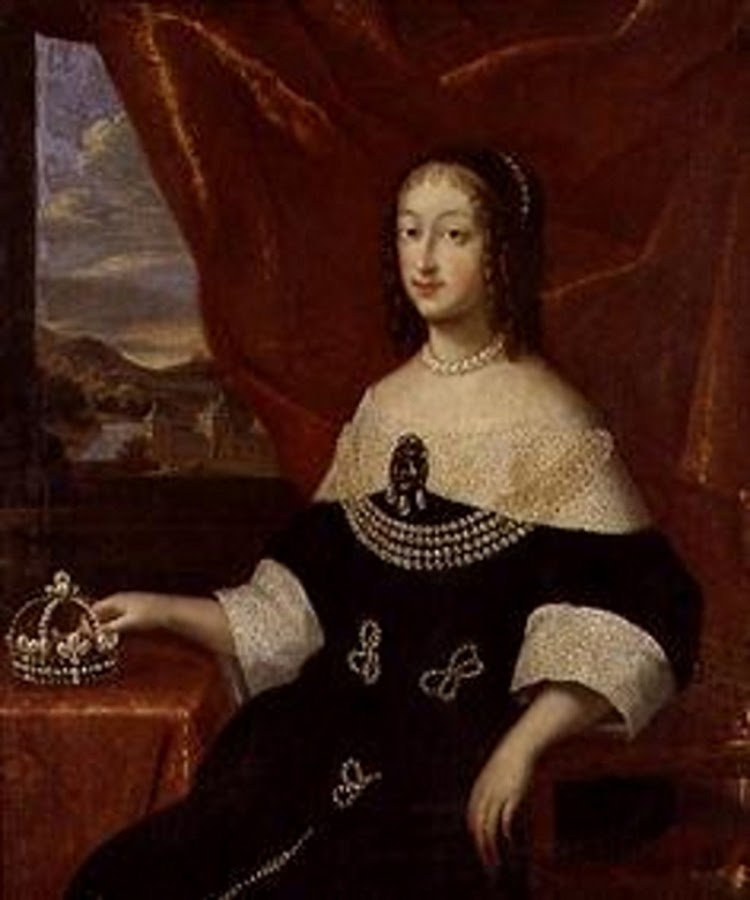
Francoise-Madeleine d'Orleans (1648-64) Duchess of Savoy, c. 1664
 prior to her marriage
Oil on canvas
60 x 73 cm (23,6 x 28,7 inches)
Chateau de Versailles

Françoise Madeleine d'Orléans (13 October 1648 – 14 January 1664) was born a Princess of France and was the Duchess of Savoy as the first wife of Charles Emmanuel II. She was a first cousin of Louis XIV as well of her husband. She was the shortest-serving Savoyard consort, dying at the age of fifteen, childless.

Orléans was born in Paris in 1648. She was the youngest surviving daughter of Gaston d'Orléans and his second wife Marguerite of Lorraine. From birth, she was styled Mademoiselle de Valois, derived from one of her father's subsidiary titles. She grew up in the company of her sisters and Mademoiselle de La Vallière, future mistress of Louis XIV. She resided at the Château de Blois. Her father died in 1660 and her mother remained unmarried.

As French court etiquette dictated, she held the status of a Granddaughter of France.

Orléans married the Duke of Savoy by proxy at the Palais du Louvre on 4 March 1663. The couple met for the first time at Annecy on 3 April 1663 where they were married officially. The couple travelled to Turin, capital of Savoy, where they arrived on 15 June 1663. She was known as Francesca Maddalena d'Orléans in her adopted Savoy.

The duchess soon died on 14 Jan 1664 at the Royal Palace of Turin, leaving her husband without an heir. She was 15 years old. More on Françoise Madeleine d'Orléans

The French Renaissance was the cultural and artistic movement in France between the 15th and early 17th centuries. The period is associated with the pan-European Renaissance, a word first used by the French historian Jules Michelet to define the artistic and cultural "rebirth" of Europe.

Notable developments during the French Renaissance include the spread of humanism, early exploration of the "New World" (as New France by Giovanni da Verrazzano and Jacques Cartier); the development of new techniques and artistic forms in the fields of printing, architecture, painting, sculpture, music, the sciences and literature; and the elaboration of new codes of sociability, etiquette and discourse.

The French Renaissance traditionally extends from (roughly) the French invasion of Italy in 1494 during the reign of Charles VIII until the death of Henry IV in 1610. This chronology notwithstanding, certain artistic, technological or literary developments associated with the Renaissance arrived in France earlier; however, the Black Death of the 14th century and the Hundred Years' War kept France economically and politically weak until the late 15th century.

The reigns of Francis I of France (from 1515 to 1547) and his son Henry II (from 1547 to 1559) are generally considered the apex of the French Renaissance. More on French School (15th century)


French School circa 1680, follower of Beaubrun
FRANCES-MADELEINE ORLEANS, DUCHESS OF SAVOY, CIRCA 1680
Oil on canvas 
upper right Inscriptions FRANÇOISE MADELEINE ORLEANS Duchess of Savoye / 1664 / 197BIS
the collection of brand back of King Louis-Philippe and No. 175 
107.5 x 91 cm; 42 1/4 by 35 5/8 in

Orléans was born at the Château de Saint Germain en Laye outside Paris in 1648.


Le Saint-Germain-en-Laye et la rampe des grottes

She was the youngest surviving daughter of Gaston d'Orléans and his second wife Marguerite of Lorraine. 


Anthony van Dyck (1599–1641)
Portrait of Gaston of France, duke of Orleans (1608-1660), c. 1632 or 1634
Father
Oil on canvas
193 × 119 cm (76 × 46.9 in)
Musée Condé

Sir Anthony van Dyck, ( 22 March 1599 – 9 December 1641) was a Flemish Baroque artist who became the leading court painter in England, after enjoying great success in Italy and Flanders. He is most famous for his portraits of Charles I of England and his family and court, painted with a relaxed elegance that was to be the dominant influence on English portrait-painting for the next 150 years. He also painted biblical and mythological subjects, displayed outstanding facility as a draughtsman, and was an important innovator in watercolour and etching. The Van Dyke beard is named after him. More Sir Anthony van Dyck


Anthony van Dyck (1599–1641)
Portrait of Margaret of Lorraine
Mother
Oil on canvas
203 × 115 cm (79.9 × 45.3 in)
Uffizi Gallery

From birth, she was styled Mademoiselle de Valois, derived from one of her father's subsidiary titles. She was the favourite sister of La Grande Mademoiselle, the famous heiress. She grew up in the company of her sisters and Mademoiselle de La Vallière, future mistress of Louis XIV. She resided at the Château de Blois. Her father died in 1660 and her mother remained unmarried.


School of Pierre Mignard (1612–1695)
Portrait of Anne Marie Louise d'Orléans, Duchess of Montpensier, also referred to as La Grande Mademoiselle
Oil on panel
140 × 110 cm (55.1 × 43.3 in)
Palace of Versailles

As French court etiquette dictated, she held the status of a Granddaughter of France as a male line descendant of the late king Henry IV of France. She was styled as a petite-fille de France.

Pierre Mignard (17 November 1612 – 30 May 1695), was a French painter known for his religious and mythological scenes and portraits. He was a near-contemporary of the Premier Peintre du Roi Charles Le Brun with whom he engaged in a bitter, life-long rivalry.

Pierre Mignard was born at Troyes in 1612. He came from a family of artisans. He was the younger brother of Nicolas, who became a painter and etcher. Mignard trained in Bourges with the Mannerist painter Jean Boucher. He then studied for a period in the studio of Simon Vouet. Mignard left for Rome in 1635 where he would stay about 22 years. 

In Rome he painted religious commissions. He was particularly known for his many images of the Madonna and Child. They were so popular that they were referred to as "Mignardises." He also painted altarpieces. His compatriot Nicolas Poussin hired Mignard to make copies of is works. He was also active as a reproductive engraver making copies after Annibale Carracci. Mignard's life-long interest in portrait painting was also developed at this time and he painted portraits of subsequent popes, cardinals and prominent members of the Italian nobility. He also travelled to Northern Italy where he visited Bologna, Parma, Mantua, Florence and Venice.

His reputation was such that he was summoned to Paris in 1657. In Paris he became a popular portrait painter. He found favor with king Louis XIV who sat for many portraits. Mignard became a rival of the leading French painter of that time and first painter to the King, Charles Le Brun. He declined to enter the Academy of which Le Brun was the head. Mignard also opposed the authority of the Academy. 


With the death of Le Brun in 1690, Mignard succeeded to all the posts held by his opponent. He died in 1695 at Paris as he was about to begin work on the cupola of the Invalides. More on Pierre Mignard


Anonymous (Italy)
Portrait of Christine Marie, Dowager Duchess of Savoy, c. 1633
Oil on canvasil
Staatsgalerie im Neuen Schloss, Schleißheim

Under the influence of her paternal aunt Christine Marie, Dowager Duchess of Savoy, she was engaged to her first cousin Charles Emmanuel II, Duke of Savoy. Christine Marie had chosen her as she had wanted to maintain her power and influence in government having previously been regent for her son since 1637. 


Pierre Mignard (1612–1695)
Portrait of cardinal Jules Mazarin (1602-1661)
Oil on canvas
65 × 55.5 cm (25.6 × 21.9 in)
Musée Condé, Château de Chantilly, Chantilly

The match was approved of by Cardinal Mazarin who had previously rejected Marie Jeanne of Savoy, another candidate for Charles Emmanuel II. Orléans proved suitably docile and was chosen over Marie Jeanne.


Unknown
Marie Jeanne of Savoy (1644-1724) some time after her marriage holding the Savoyard crown
Oil on canvas
Location Unknown

Orléans married the Duke of Savoy by proxy at the Palais du Louvre on 4 March 1663. The couple met for the first time at Annecy on 3 April 1663 where they were married officially. The couple travelled to Turin, capital of Savoy, where they arrived on 15 June 1663. She was known as Francesca Maddalena d'Orléans in her adopted Savoy.


Piedmontese School, 17th Century
Charles Emanuel II, the Duke of Savoy, in armour
Oil on canvas
 41.34 X 32.28 in (105 X 82 cm)
Private Collection

The duchess soon died on 14 Jan 1664 at the Royal Palace of Turin, leaving her husband without an heir.She was buried at Turin Cathedral where she rests today. Her husband, inconsolable at her death, ordered a lavish funeral. After Orléans' death, Louis XIV tried to engage La Grande Mademoiselle to Charles Emmanuel II who refused the match. He later married again to Marie Jeanne of Savoy by whom he had a son.


Unknown artist
Charles Dauphin - Carlo Emanuele II (1634-1675), son and heir of Vittorio Amedeo I, his wife Jeanne de Nemours (1644-1724) and his son, the future Vittorio Amedeo II (1666-1732), c. 1666
Oil on Canvas
Museo del Prado, Madrid

BRAMBILLA GIOVANNI BATTISTA
Duke Carlo Emanuele II of Savoy; Vittorio Amedeo II Prince of Piedmont, C.1675
340 CM x 282 CM
OIL ON CANVAS
PALAZZO MADAMA, Turin, Italy

Giovanni Battista Brambilla (active 1770) was an Italian painter. He was a native of Piedmont. He was a pupil of Carlo Delfino. He painted for churches in Turin, including a Martyrdom of St. Dalmazio for the church dedicated to that saint. He also painted altarpieces for churches in Villafranca. The Equestrian Portrait of Carlo Emanuele II, Duke of Savoy and of Vittorio Amedeo II, Prince of Piedmont (c. 1675) are on exhibit at the Palazzo Madama of Turin. More on Giovanni Battista Brambilla


Acknowledgment: Sotheby's, 

Images are copyright of their respective owners, assignees or others

01 Paintings by the Orientalist Artists in the Nineteenth-Century, with footnotes, 25

Frederick Arthur Bridgman, 1847 - 1928, AMERICAN
ALGERIAN SPAHI ON HORSEBACK, c. 1900
Watercolour and pencil on paper
41 by 30cm., 16 by 11¾in.
Private collection

Spahis were light cavalry regiments of the French army recruited primarily from the indigenous populations of Algeria, Tunisia and Morocco. 

Following the French occupation of Algiers in 1830, detachments of locally recruited irregular horsemen were attached to the regiments of light cavalry assigned to North African service. These auxiliaries were designated as chasseurs spahis. In 1834 they were organised into four squadrons of regular spahis. In 1841 the 14 squadrons by then in existence were brought together in a single corps of spahis. Finally, in 1845 three separate Spahi regiments were created: the 1st of Algiers; the 2nd of Oran and the 3rd of Constantine.


The spahi regiments saw extensive service in the French conquest of Algeria, in the Franco-Prussian War, in Tonkin towards the end of the Sino-French War (1885), in the occupation of Morocco and Syria, and in both World Wars. A detachment of Spahis served as the personal escort of Marshal Jacques Leroy de Saint Arnaud in the Crimean War. A contingent of Spahis also participated in the North China campaign of 1860. During the Franco-Prussian War of 1870-71 one detached squadrons of Spahis formed part of the forces defending Paris, while a provisional regiment comprising three squadrons was attached to the Army of the Loire. A serious rising against French rule in Algeria during 1871–72 was sparked off by the mutiny of a squadron of Spahis who had been ordered to France to reinforce those units already there.  More on Spahis


Frederick Arthur Bridgman (November 10, 1847 - 1928) was an American artist, born in Tuskegee, Alabama. The son of a physician, Bridgman would become one of the United States' most well-known and well-regarded painters and become known as one of the world's most talented "Orientalist" painters. He began as a draughtsman in New York City, for the American Bank Note Company in 1864-1865, and studied art in the same years at the Brooklyn Art Association and at the National Academy of Design; but he went to Paris in 1866 and became a pupil of Jean-Leon Gerome. Paris then became his headquarters. A trip to Egypt in 1873-1874 resulted in pictures of the East that attracted immediate attention, and his large and important composition, The Funeral Procession of a Mummy on the Nile, in the Paris Salon (1877), bought by James Gordon Bennett, brought him the Cross of the Legion of Honor. Other paintings by him were An American Circus in Normandy, Procession of the Bull Apis (now in the Corcoran Gallery of Art, Washington, D.C.), and a Rumanian Lady (in the Temple collection, Philadelphia, Pennsylvania). More on Frederick Arthur Bridgman


Please visit my other blogs: Art Collector, Mythology, Marine Art, Portrait of a Lady, The Orientalist, Art of the Nude and The Canals of Venice, Middle East Artists, 365 Saints, 365 Days, and Biblical Icons, also visit my Boards on Pinterest and deviantart

Images are copyright of their respective owners, assignees or others. Some Images may be subject to copyright

I don't own any of these images - credit is always given when due unless it is unknown to me. if I post your images without your permission, please tell me.

I do not sell art, art prints, framed posters or reproductions. Ads are shown only to compensate the hosting expenses.

If you enjoyed this post, please share with friends and family.

Thank you for visiting my blog and also for liking its posts and pages.

Please note that the content of this post primarily consists of articles available from Wikipedia or other free sources online.

01 Paintings, The amorous game, Part 20 - With Footnotes

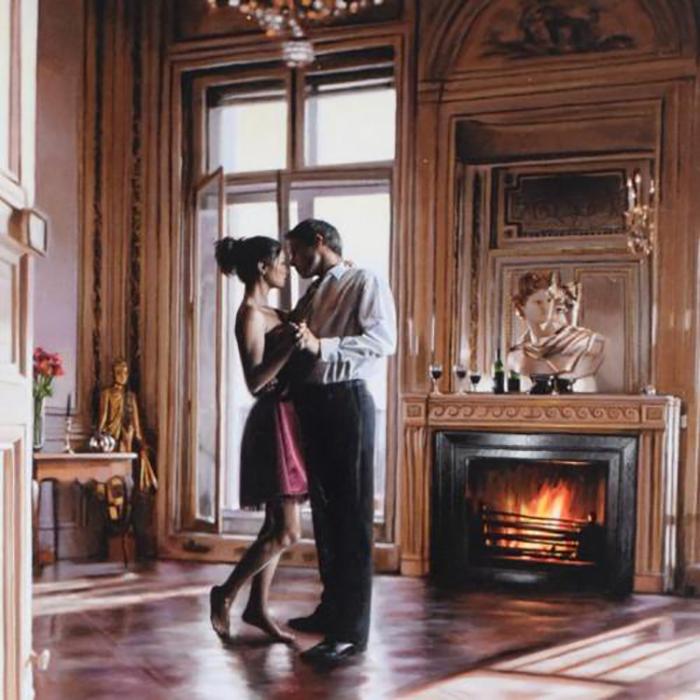
Rob Hefferan, (b. 1968)
Dancing by the Fire
Hand Embellished Giclee Canvas
20" x 28.25"
Private collection

Born in Manchester in 1968, Rob Hefferan, was a true free spirit from the very beginning. Desperate to follow an artistic career he found discouragement round every corner. Ignoring the advice of his elders, he gained a place at university to study for a degree in illustration, but after a year he began to feel constrained by the limitations of the course and decided to go it alone. 


Rob spent a challenging year putting together a portfolio, then set out to find work utilising his design skills in order to finance his dream of being an artist. His exceptional versatility as a designer and illustrator won him a number of major contracts, ranging from high profile advertising campaigns to providing the artwork for childrens books, and he soon found himself in the gratifying position of making a large amount of money from doing something he really enjoyed. Yet he never allowed his considerable success to deflect him from his original aim of becoming a full time artist, and continued to spend much of his spare time painting. More on Rob Hefferan


Images are copyright of their respective owners, assignees or others. Some Images may be subject to copyright

I don't own any of these images - credit is always given when due unless it is unknown to me. if I post your images without your permission, please tell me.

I do not sell art, art prints, framed posters or reproductions. Ads are shown only to compensate the hosting expenses.

If you enjoyed this post, please share with friends and family.

Thank you for visiting my blog and also for liking its posts and pages.