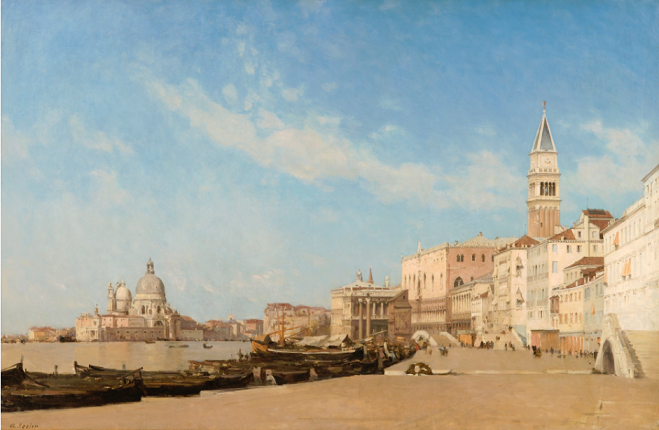
Thomas Moran, 1837 - 1926
VIEW OF VENICE, c. 1897
Oil on canvas
11 1/8 by 17 1/8 inches, (28.3 by 43.5 cm)
Private collection
Thomas Moran (February 12, 1837 – August 25, 1926) from Bolton, England was an American painter and printmaker of the Hudson River School in New York whose work often featured the Rocky Mountains. Moran and his family, wife Mary Nimmo Moran and daughter Ruth, took residence in New York where he obtained work as an artist. He was a younger brother of the noted marine artist Edward Moran, with whom he shared a studio. A talented illustrator and exquisite colorist, Thomas Moran was hired as an illustrator at Scribner's Monthly. During the late 1860s, he was appointed the chief illustrator for the magazine, a position that helped him launch his career as one of the premier painters of the American landscape, in particular, the American West.
Moran along with Albert Bierstadt, Thomas Hill, and William Keith are sometimes referred to as belonging to the Rocky Mountain School of landscape painters because of all of the Western landscapes made by this group. More on Thomas Moran
OLIVER DENNETT GROVER, 1861 - 1927
View of Venice, c. 1912
Oil on canvas laid down on panel
18 by 24 inches (45.7 by 60.9 cm)
Private collection
Oliver Dennett Grover (1861 Earlville, Illinois – 1927 Chicago), was an American landscape and mural painter. Grover's family moved to Chicago early in his life. There he spent much of his time sketching at the Academy of Design. Showing great promise he was enrolled at Munich’s Royal Academy in 1879, where he studied under Frank Duveneck. At the age of 19 he exhibited at Munich’s International Exposition. Grover followed Duveneck to Venice and Florence, and then went on to study in Paris from 1883 to 1885 under Gustave Boulanger, Jean-Paul Laurens and Lefebvre.
He returned to Chicago in 1885 and was appointed as an instructor at the Art Institute of Chicago for five years, also opening a studio and founding the Western Art Association. Between 1887 and 1892 he served on the faculty of the Chicago Art Academy. Ada Walter Shulz was among his pupils.
Grover became an Associate of the National Academy of Design in 1913. During the last years of his life, he also became a board member of the Association of Arts and Industries which was a major influence in Chicago design in the 1920s and 1930s. More on Oliver Dennett Grover
Martín Rico y Ortega, 1833 - 1908, SPANISH
RIO SAN BARNABA, VENICE
Oil on canvas
27 1/2 by 19 in., 70 by 48.2 cm
Private collection
The rio di ( or San Barnaba) ( canal of San Barnabé ) is a canal of Venice in the Dorsoduro (Sestiere of Venice). It connects the rio dell'Avogaria in the east with the Grand Canal. More on RIO SAN BARNABA
Martín Rico y Ortega (12 November 1833, El
Escorial – 13 April 1908, Venice, Italy) was a Spanish painter of landscapes and cityscapes. Rico was one of
the most important artists of the second half of the nineteenth century in his
native country, and enjoyed wide international recognition.
Rico was
born in Madrid and received his earliest formal training at the city’s Real
Academia de Bellas Artes de San Fernando, where he studied under Jenaro Pérez
Villaamil, the Academy’s first professor of landscape painting. Under the
tutelage of Pérez Villaamil, Rico’s earliest works show him influenced by
Romanticism, the style for which his teacher was known. In 1860, having been
awarded a government-sponsored scholarship, Rico moved to Paris to continue his
studies.
His
landscapes from this decade depict the French and Swiss countryside in a fully
accomplished Realist style. Toward the end of 1870, due to political and social
unrest caused by the outbreak of the Franco-Prussian War, Rico decided to leave
France and return to his native Spain.
At the invitation of his good friend and
colleague Marià Fortuny, Rico moved to the southern city of Granada, joining
Fortuny and his wife Cecilia, as well as the painter Ricardo de Madrazo. The
three artists worked closely during this period, with the styles of Rico and
Fortuny overlapping so much that their watercolors—a specialty for both
artists—were often confused for one another. It was during this time that,
through Fortuny’s influence, Rico’s paintings began to reveal a newfound sense
of luminosity and color. His time in Andalucía was, according to his memoirs,
one of his happiest, and also one of his most artistically productive periods. More
Ortega
Konstantin Ivanovich, (1876 Stavropol - 1945 Berlin)
La Guidecca Venedig
Aquatint on opaque white over pencil on thin cardboard
32, 4 x 41, 7 cm
Private collection
Konstantin Ivanovich (1876 Stavropol - 1945 Berlin) was a Russian post-impressionist painter. Gorbatov was born in Stavropol. He lived in Riga from 1896 to 1903, and studied civil engineering before painting. Gorbatov moved to St. Petersburg in 1904 and studied at the Baron Stieglitz Central School for Technical Draftsmanship. He initially entered the architecture department of the Imperial Academy of Arts before switching to paintin. Gorbatov received a scholarship and studied art in Rome and Capri. He returned to St. Petersburg and participated in the Peredvizhniki exhibitions.
Gorbatov left Russia permanently in 1922 following the Russian Revolution of 1917 and settled on the Italian island of Capri. He moved to Berlin in 1926, where he remained until his death. Gorbatov became a member of a Russian emgiree artistic circle. He became a well-known established artist. Gorbatov traveled throughout Europe during the late 1930s, visited Palestine and Syria in 1934 and 1935, and often came by Italy. Gorbatov's art became unneeded in the Nazi Germany and the family soon became impoverished. As a Russian émigré, he was forbidden to leave Germany during World War II. Gorbatov died shortly after the allied victory over Germany on 12 May 1945.
Gorbatov bequeathed to the Academy of Arts in Leningrad. The works were delivered to the Moscow Regional Museum of history and Arts near the New Jerusalem Monastery, where they have since been exhibite. More on Konstantin Ivanovich
John Singer Sargent, (1856–1925)
A Street in Venice, c. 1880-82
Oil on canvas
75.1 × 52.4 cm (29.6 × 20.6 in)
Clark Art Institute, Williamstown, Massachusetts, United States
John Singer Sargent, American, 1856-1925, Florence, Italy, based in Paris & London. A popular society portraitist and landscape painter, John Singer Sargent was born in Florence to wealthy American parents. He studied painting in France, where he enjoyed both critical acclaim and important patronage. Although he spent most of his time in Europe, he frequently accepted commissions from collectors in the United States. Whether rendered in oil, watercolor, or charcoal, Sargent’s works are characterized by naturalism, lively mark-making, and a sense of immediacy. Influenced by his friendship with Claude Monet, Sargent loved working en plein air, depicting the various places he traveled, including Italy, rural England, Giverny, the Mediterranean, northern Africa, and the Alps. During his later years, Sargent completed several mural projects, as well as working as an artist-correspondent during World War I. More on John Singer Sargent
John Singer Sargent, (1856–1925)
A Street in Venice, c. 1882
Oil on wood
45.1 x 53.9 cm (17 3/4 x 21 1/4 in.)
National Gallery of Art, Washington D.C.
John Singer Sargent , (1856–1925), see above
John Singer Sargent, (1856–1925)
On the Canal, c. 1903
Watercolor on paper
34.29 x 49.53 cm (13.5 x 19.5 in)
Musée du Petit Palais, Paris, France
John Singer Sargent, (1856–1925), see above
Amédée Rosier, MEAUX 1831 - 1898
ESCLAVON BANKS, VENICE
Oil on canvas
97,5 x 150 cm ; 38 3/8 by 59 in.
Private collection
Étienne Amédée Rosier, born on the 20 August 1831 in Meaux and died on November 1914 in Boulogne-Billancourt was a French orientaliste painter. Rosier was the pupil of the painters Léon Cogniet and Carolus-Duran . His first painting presented to the Salon of 1857 was a painting of history, The Naval Combat in Sevastopol . He traveled extensively in Venice and Constantinople . It also crosses Egypt and North Africa .
He received a third-class medal at the Salon of 1876 with The Lagoon at night in Venice 4 . He was awarded a bronze medal at the 1889 World Exposition for Venice, the Grand Canal. More on Étienne Amédée Rosier
Francesco Guardi, (Venice 1712-1793)
Venice: the Rialto Bridge with the Palazzo dei Camerlenghi, c. late 1760s
Oil on canvas
21 in. × 33 3/4 in. (53.3 × 85.7 cm)
The Metropolitan Museum of Art
Guardi depicts the Rialto Bridge with the Palazzo dei Camerlenghi at the center and a vegetable market beneath a series of canopies at the right. The seemingly arbitrary cropping of buildings creates an effect of snapshotlike immediacy; the open windows tempt the eye inside, even as the composition unfolds across the vista of the Grand Canal with its flurry of gondolas. More on this painting
Rialto Bridge. The first dry crossing of the Grand Canal was a pontoon bridge built in 1181 by Nicolò Barattieri. It was called the Ponte della Moneta, presumably because of the mint that stood near its eastern entrance.
The development and importance of the Rialto market on the eastern bank increased traffic on the floating bridge, so it was replaced in 1255 by a wooden bridge.[2] This structure had two inclined ramps meeting at a movable central section, that could be raised to allow the passage of tall ships. The connection with the market eventually led to a change of name for the bridge. During the first half of the 15th century, two rows of shops were built along the sides of the bridge. The rents brought an income to the State Treasury, which helped maintain the bridge. More on the Rialto Bridge
Palazzo dei Camerlenghi is a Renaissance palace in Venice, northern Italy, located in the sestiere (quarter) of San Polo. It faces the Canal Grande, adjacent to the Rialto Bridge.
The palace was built from 1525 to 1528 under design by Guglielmo dei Grigi, who was inspired by the style of Mauro Codussi and Pietro Lombardo. It was the seat of several financial magistrates, including the Camerlenghi whom it takes its name from, the Consuls of the Traders and the Supra-Consuls of the Traders. Due to this function, the lower floor was used as a jail for the insolvents: the location nearby the crowded Rialto Bridge served as an admonition for the people passing there.
Francesco Lazzaro Guardi (October 5, 1712 –
January 1, 1793) was an
Italian painter of veduta, nobleman, and a member of the Venetian School. He is
considered to be among the last practitioners of the classic Venetian school of
painting.
In 1735,
Guardi moved to the workshop of Michele Marieschi, where he remained until
1743. His first certain works are from 1738, for a parish at Vigo d'Anuania, in
Trentino. In this period he worked alongside his older brother.
His works
in this period included both landscapes and figure compositions. In 1763 he
worked in Murano, in the church of San Pietro Martire, finishing a Miracle of a
Dominican Saint.
Francesco
Guardi's most important later works include the Doge's Feasts, a series of
twelve canvases celebrating the ceremonies held in 1763 for the election of
Doge Alvise IV Mocenigo. In circa 1778, he painted the severe Holy Trinity
Appearing to Sts. Peter and Paul in the parish church of Roncegno.
In 1782
Guardi was commissioned by the Venetian government six canvases to celebrate
the visit of the Russian Archdukes in the city, of which only two remain, and
two others for that of Pope Pius VI. On September 12 of that year he was
admitted to the Fine Art Academy of Venice.
Please visit my other blogs: Art Collector, Mythology, Marine Art, Portrait of a Lady, The Orientalist, Art of the Nude and The Canals of Venice, Middle East Artists, 365 Saints and 365 Days, also visit my Boards on Pinterest
Images are copyright of their respective owners, assignees or others.
Some Images may be subject to copyright
I don't own any of these images - credit is always given when due unless
it is unknown to me. if I post your images without your permission, please tell
me.
I do not sell art, art prints, framed posters or reproductions. Ads are
shown only to compensate the hosting expenses.
If you enjoyed this post, please share with friends and family.
Thank you for visiting my blog and also for liking its posts and pages.
Please note that the content of this post primarily consists of articles
available from Wikipedia or other free sources online.

 Posts
Posts