Showing posts with label OLIVER DENNETT GROVER. Show all posts

12 Orientalist Paintings by Artists from the 19th Century, with footnotes, #17

Orientalism is a term that is used for the depiction of aspects in Middle Eastern cultures. It refers to the works of the Western artists on Oriental subjects, produced from their travels in Western Asia, during the 19th century. Depictions of Islamic "Moors" and "Turks" can be found in Medieval, Renaissance, and Baroque art. A creative apprehension of a completely different world with its own laws, customs, special attitude towards life and death, love, feelings, and beauty. Wikipedia/Yana Naumovna Lukashevskaya

Arthur Melville, (1858–1904)
A Moorish Procession, Tangier, c. 1893
Watercolour on paper
59.30 x 79.80 cm
National Galleries of Scotland

Melville conveys the atmospheric clamour of a local parade led by drummers and pipers. He evokes its exotic character, underlined by the colourful clothes and hooded cloaks of the participants, with his 'blottesque' technique. The resulting blurred edges and striking accents of pure colour, from pigment applied onto wet paper, suggest a wonderful sense of movement in brilliant sunlight. The vibrant city of Tangier attracted many artists, and Melville, inspired by his friend the painter Joseph Crawhall, visited it twice in the spring of 1890 and 1893. More on this painting

Arthur Melville (1858–1904) was a Scottish painter, best remembered for his Orientalist subjects. He was born in Guthrie, Angus in 1858 and brought up in East Lothian. He attended the Royal Scottish Academy Schools before studying in Paris and Greece. The colour-sense which is so notable a feature of his work developed during his travels in Persia, Egypt and Turkey between 1880 and 1882. To convey strong Middle Eastern light, he developed a technique of using watercolour on a base of wet paper with gouache applied to it.

Melville, little known during his lifetime, was one of the most powerful influences in the contemporary art of his day, especially in his broad decorative treatment with water-colour, which influenced the Glasgow Boys. Though his vivid impressions of color and movement are apparently recorded with feverish haste, they are the result of careful deliberation and selection. He was at his best in his watercolors of Eastern life and colour and his Venetian scenes, but he also painted several striking portraits in oils. More on Arthur Melville

ALFRED AGACHE (1843 - 1915)
Enigme, c.  1888
Oil on canvas, 
2,80 m x 1,69 m, 
Musée des Beaux Arts de Rouen.

The title of the work, Enigma, is explicit: the picture itself is this enigma. In the Salon of 1888 where it is presented, it is was accompanied by a poem by Edmond Haraucourt (1856-1941)  "Priestess of the enigma and daughter of the mystery / I keep under heaven the secrets which he wishes to make / And I know the future as a fait accompli. / But I have closed my austere soul / In the pride of silence and the peace of forgetfulness. ".

The modernity of the energetic pattern of this canvas still strikes us today; The planes are largely brushed and articulated angularly. The contrasts of light and color are brought to their paroxysm. The iconographic elements are rare and deliberately chosen, whether it be the Egyptian motif painted on the wall or the admirable giant poppy flowers, the red blood of which slices on the orange of the background. 

ALFRED AGACHE, (1843 - 1915)
Enigme, c.  1888
Detail

This mysterious woman could be a Parque, a subject dear to Agache, or Isis as the hieroglyphic suggests, or an archetype of the femme fatale. In any case this flower of forgetfulness thrown on the steps, this mask that the woman has just taken off. More on Enigma

Alfred-Pierre Joseph Agache (29 August 1843 – 15 September 1915), also known simply as Alfred Agache, was a French academic painter. Little is known of Agache's life. He was born in Lille, France, and exhibited his work frequently in Paris until his death. He seems to have specialized in portraits and large-scale allegorical paintings. He was a member of the Société des Artistes Français, and won a third-class medal in 1885 for his work. He may have been friends with American painter James Abbott McNeill Whistler and French writer Auguste Angellier; the latter dedicated a book to him around 1893.

Two of his pieces, "Vanity" and "The Annunciation", were shown at the World's Columbian Exposition in Chicago, 1893. He was awarded the Légion d'honneur. He died in Lille in 1915. More on Alfred-Pierre Joseph Agache

Alfred Choubrac, PARIS 1853 - 1902
SCHEHERAZADE AND THE SULTAN, c. 1878 
Oil on canvas
131 x 90 cm 51 1/2 by 35 1/2 in.
Private collection

Alfred Choubrac (1853–1902) was a French painter, illustrator, draughtsman, and poster artist.

His posters were very influential and famous during World War II. His most famous poster is that of Au Joyeux Moulin Rouge, based on the popular Parisian nightclub Moulin Rouge. He contributed to the satirical weekly Le Courrier français.

He was the younger brother of Léon Choubrac, also a poster artist. More on Alfred Choubrac

Oliver Dennett Grover, 1861 - 1927
Harem Scene (also known as The Finishing Touch), c. 1899
Oil on canvas 
195.58 cm (77 in.), Width: 167.64 cm (66 in.)
Swope Art Museum  (United States - Terre Haute, Indiana)

Oliver Dennett Grover (1861 Earlville, Illinois – 1927 Chicago), was an American landscape and mural painter. Grover's family moved to Chicago early in his life. There he spent much of his time sketching at the Academy of Design. Showing great promise he was enrolled at Munich’s Royal Academy in 1879, where he studied under Frank Duveneck. At the age of 19 he exhibited at Munich’s International Exposition. Grover followed Duveneck to Venice and Florence, and then went on to study in Paris from 1883 to 1885 under Gustave Boulanger, Jean-Paul Laurens and Lefebvre.

He returned to Chicago in 1885 and was appointed as an instructor at the Art Institute of Chicago for five years, also opening a studio and founding the Western Art Association. Between 1887 and 1892 he served on the faculty of the Chicago Art Academy. Ada Walter Shulz was among his pupils.

Grover became an Associate of the National Academy of Design in 1913. During the last years of his life, he also became a board member of the Association of Arts and Industries which was a major influence in Chicago design in the 1920s and 1930s.  More on Oliver Dennett Grover

GUILLAUME SEIGNAC, (1870–1924) 
Odalisque
Oil on canvas
55.5 by 46.5cm., 22 by 18¼in.
Private collection

An odalisque was a chambermaid or a female attendant in a Turkish seraglio, particularly the court ladies in the household of the Ottoman sultan. An odalık was not a concubine of the harem, but a maid, although it was possible that she could become one. An odalık was ranked at the bottom of the social stratification of a harem, serving not the man of the household, but rather, his concubines and wives as personal chambermaids. Odalık were usually slaves given as gifts to the sultan by wealthy Turkish men. Generally, an odalık was never seen by the sultan but instead remained under the direct supervision of his mother, the Valide Sultan. More on An odalisque

Guillaum Seignac (1870–1924) was a French academic painter. He was born in Rennes in 1870, and died in Paris in 1924. He started training at the Académie Julian in Paris, where he spent 1889 through 1895. He had many teachers there, including Gabriel Ferrier, William-Adolphe Bouguereau, and Tony Robert-Fleury. In addition to his training in the academic style, much of Seignac's work displayed classical themes and style, for example, his use of diaphanous drapery covering a woman's body is reminiscent of classical style, in particular the sculptor Phidias. In 1897, Guillaume Seignac regularly exhibited at the Salon and won several honors, including in 1900 honorable mention and in 1903 a Third Class medal. More Guillaum Seignac


Jean-Léon Gérôme, French, 1824-1904
LA GRANDE PISCINE À BRUSA (THE GREAT BATH AT BURSA)
Oil on canvas
70 by 100.5cm., 27 1/2 by 39 1/2 in.
Private collection

This splendid evocation of ladies lounging around an octagonal hot pool in a Turkish bath is set under the great dome of the caldarium in Yeni Kaplica, Bursa’s ‘New Baths’ built in 1552 from designs possibly by the Master Builder Sinan. Bursa had been the ancient capital of the Ottoman Empire before the conquest of Constantinople in 1453. By the time the present work was executed in 1885 Gérôme had moved away from heroic history painting towards archeological accuracy and objective realism. More on this painting

Jean-Léon Gérôme (11 May 1824 – 10 January 1904) was a French painter and sculptor in the style now known as Academicism. The range of his oeuvre included historical painting, Greek mythology, Orientalism, portraits and other subjects, bringing the Academic painting tradition to an artistic climax. He is considered one of the most important painters from this academic period, and in addition to being a painter, he was also a teacher with a long list of students. More on Jean-Léon Gérôme

GEORGES ROCHEGROSSE, (1859–1938)
Idle Moments, c. 1888
Oil on canvas
54 by 65cm., 21¼ by 25¾in.
Private collection


Georges Antoine Rochegrosse (1859–1938) was a French historical and decorative painter. He was born at Versailles and studied in Paris with Jules Joseph Lefebvre and Gustave Clarence Rodolphe Boulanger. His themes are generally historical, and he treated them on a colossal scale and in an emotional naturalistic style, with a distinct revelling in horrible subjects and details. He made his Paris Salon début in 1882 with Vitellis traîné dans les rues de Rome par la populace (Vitellius dragged through the streets of Rome by the people) (1882; Sens). He followed this the year afterwards with Andromaque (1882–83; Musée des Beaux-Arts de Rouen), which won that year's prestigious Prix du Salon. There followed La Jacquerie (1885; Untraced), Le mort de Babylone (The fall of Babylon) (1891; Untraced), The death of the Emperor Geta (1899; Musée de Picardie, Amiens), and Barbarian ambassadors at the Court of Justinian (1907; untraced), all of which exemplify his strong and spirited but sensational and often brutal painting. In quite another style and beautiful in color is his Le Chevalier aux Fleurs (The Knight of Flowers) (1894; Musée d'Orsay, Paris; RF 898). More on Georges Antoine Rochegrosse


RICARDO VILLEGAS CORDERO, 1849 - 1896
The storyteller
Oil on canvas
58 by 41cm., 23 by 16in.
Private collection

Ricardo Villegas Cordero ( Seville , 1849 - 1896 ) was a Spanish painter. He was the brother of painter Jose Villegas Cordero , better known than he. 2 He drowned in the river Guadalquivir , after falling from the boat where he traveled.

His presented works at the National Exhibition of 1887. He received a gold medal second class at the International Exhibition of Munich in 1888. In the National Exhibition of 1890 he presented a painting titled La muerte de Viriato , which represented the assassination of the Lusitanian leader. He also produced painting in the orientalist and North African Style. More on Ricardo Villegas Cordero 

Lalla Essaydi, Moroccan, b. 1956
Les Femmes du Maroc: Harem #11, 2009
Chromogenic prints (c-print) mounted on aluminum, in three parts
40 x 30 in. (101.6 x 76.2 cm.)
Private collection

Moroccan born photographer Lalla Essaydi explores Arab female identity by hand-painting Arabic calligraphy in henna on different surfaces such as female bodies, fabric and walls. Through her compositions, Essaydi references nineteenth century Orientalist style and rejects traditional objectified representations of Arab women. The artist critiques French painters such as Jean Auguste Dominique Ingres and Eugène Delacroix who often painted middle-eastern harems filled with eroticized Arab female bodies. Her photographs address and deconstruct the complex power structures imposed on the Arab female body by alluding to historical stereotypes. 

Lalla Essaydi, Moroccan, b. 1956
Harem, #12

In her series Harem, Essaydi refers to the dangerous nature of the harem, contrasting the idealistic setting that Western artists previously depicted. The artist places her figures within the Moroccan Palace Dar El Basha and dresses them in patterns similar to the palace’s mosaics, wood carvings and stained glass. By camouflaging the women’s bodies into the background, Essaydi illustrates how women seemingly appear as another piece of décor in the room. To counter societal norms, Essaydi utilizes calligraphy and applies henna to adorn the female bodies. The text is not necessarily meant to be read or understood, but rather alludes symbolically to the restrictions faced by women in today’s societies and how they find their voice despite all imposed restrictions. Through the perspective of an Arab woman living in a Western world, Lalla Essaydi redefines Arab female identity. More on Lalla Essaydi

Lalla Essaydi, Moroccan, b. 1956
Harem, #15 (2009)

Théodore Chassériau,  (1819–1856)
Orientalist Interior: Nude in a Harem, c. between 1850 and 1852
Oil on panel
Height: 46 cm (18.1 in). Width: 38 cm (15 in).
Private collection

Théodore Chassériau (September 20, 1819 – October 8, 1856) was a French Romantic painter noted for his portraits, historical and religious paintings, allegorical murals, and Orientalist images inspired by his travels to Algeria.

Chassériau was born in El Limón, Samaná, in the Spanish colony of Santo Domingo (now the Dominican Republic). In December 1820 the family left Santo Domingo for Paris, where the young Chassériau soon showed precocious drawing skills. He was accepted into the studio of Jean-Auguste-Dominique Ingres in 1830, at the age of eleven, and became the favorite pupil of the great classicist, who regarded him as his truest disciple.

After Ingres left Paris in 1834 to become director of the French Academy in Rome, Chassériau fell under the influence of Eugène Delacroix, whose brand of painterly colorism was anathema to Ingres. Chassériau's art has often been characterized as an attempt to reconcile the classicism of Ingres with the romanticism of Delacroix. He first exhibited at the Paris Salon in 1836, and was awarded a third-place medal in the category of history painting. In 1840 Chassériau travelled to Rome and met with Ingres, whose bitterness at the direction his student's work was taking led to a decisive break.

In 1846 Chassériau made his first trip to Algeria. From sketches made on this and subsequent trips he painted such subjects as Arab Chiefs Visiting Their Vassals and Jewish Women on a Balcony...

After a period of ill health, exacerbated by his exhausting work on commissions for murals to decorate the Churches of Saint-Roch and Saint-Philippe-du-Roule, Chassériau died at the age of 37 in Paris, on October 8, 1856. More on Théodore Chassériau


Please visit my other blogs: Art CollectorMythologyMarine ArtPortrait of a Lady, The OrientalistArt of the Nude and The Canals of VeniceMiddle East Artists365 Saints365 Days, and Biblical Icons, also visit my Boards on Pinterest

Images are copyright of their respective owners, assignees or others. Some Images may be subject to copyright

I don't own any of these images - credit is always given when due unless it is unknown to me. if I post your images without your permission, please tell me.

I do not sell art, art prints, framed posters or reproductions. Ads are shown only to compensate the hosting expenses.

If you enjoyed this post, please share with friends and family.

Thank you for visiting my blog and also for liking its posts and pages.

Please note that the content of this post primarily consists of articles available from Wikipedia or other free sources online.

09 Paintings of the Canals of Venice by Amédée Rosier, Francesco Guardi, John Singer Sargent, Konstantin Ivanovich, Martín Rico y Ortega, OLIVER DENNETT GROVER, THOMAS MORAN, with foot notes. #7

Thomas Moran, 1837 - 1926
VIEW OF VENICE, c. 1897
Oil on canvas
11 1/8 by 17 1/8 inches, (28.3 by 43.5 cm)
Private collection

Thomas Moran (February 12, 1837 – August 25, 1926) from Bolton, England was an American painter and printmaker of the Hudson River School in New York whose work often featured the Rocky Mountains. Moran and his family, wife Mary Nimmo Moran and daughter Ruth, took residence in New York where he obtained work as an artist. He was a younger brother of the noted marine artist Edward Moran, with whom he shared a studio. A talented illustrator and exquisite colorist, Thomas Moran was hired as an illustrator at Scribner's Monthly. During the late 1860s, he was appointed the chief illustrator for the magazine, a position that helped him launch his career as one of the premier painters of the American landscape, in particular, the American West.

Moran along with Albert Bierstadt, Thomas Hill, and William Keith are sometimes referred to as belonging to the Rocky Mountain School of landscape painters because of all of the Western landscapes made by this group. More on Thomas Moran

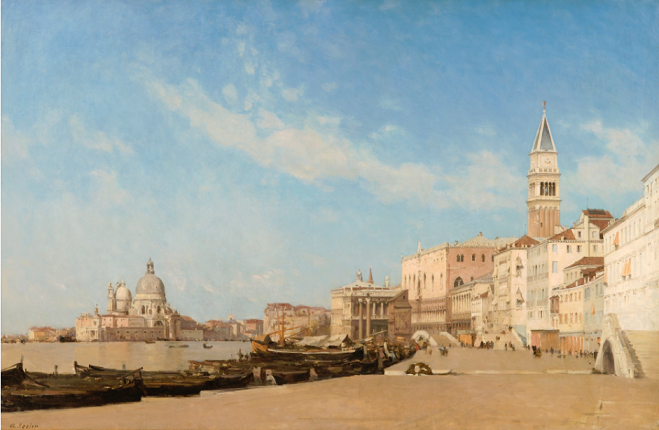
OLIVER DENNETT GROVER, 1861 - 1927
View of Venice, c. 1912
Oil on canvas laid down on panel 
18 by 24 inches (45.7 by 60.9 cm)
Private collection

Oliver Dennett Grover (1861 Earlville, Illinois – 1927 Chicago), was an American landscape and mural painter. Grover's family moved to Chicago early in his life. There he spent much of his time sketching at the Academy of Design. Showing great promise he was enrolled at Munich’s Royal Academy in 1879, where he studied under Frank Duveneck. At the age of 19 he exhibited at Munich’s International Exposition. Grover followed Duveneck to Venice and Florence, and then went on to study in Paris from 1883 to 1885 under Gustave Boulanger, Jean-Paul Laurens and Lefebvre.

He returned to Chicago in 1885 and was appointed as an instructor at the Art Institute of Chicago for five years, also opening a studio and founding the Western Art Association. Between 1887 and 1892 he served on the faculty of the Chicago Art Academy. Ada Walter Shulz was among his pupils.

Grover became an Associate of the National Academy of Design in 1913. During the last years of his life, he also became a board member of the Association of Arts and Industries which was a major influence in Chicago design in the 1920s and 1930s.  More on Oliver Dennett Grover

Martín Rico y Ortega, 1833 - 1908, SPANISH
RIO SAN BARNABA, VENICE
Oil on canvas
27 1/2 by 19 in., 70 by 48.2 cm
Private collection

The rio di ( or San Barnaba) ( canal of San Barnabé ) is a canal of Venice in the Dorsoduro (Sestiere of Venice).  It connects the rio dell'Avogaria in the east with the Grand Canal. More on RIO SAN BARNABA

Martín Rico y Ortega (12 November 1833, El Escorial – 13 April 1908, Venice, Italy) was a Spanish painter of landscapes and cityscapes. Rico was one of the most important artists of the second half of the nineteenth century in his native country, and enjoyed wide international recognition.

Rico was born in Madrid and received his earliest formal training at the city’s Real Academia de Bellas Artes de San Fernando, where he studied under Jenaro Pérez Villaamil, the Academy’s first professor of landscape painting. Under the tutelage of Pérez Villaamil, Rico’s earliest works show him influenced by Romanticism, the style for which his teacher was known. In 1860, having been awarded a government-sponsored scholarship, Rico moved to Paris to continue his studies.

His landscapes from this decade depict the French and Swiss countryside in a fully accomplished Realist style. Toward the end of 1870, due to political and social unrest caused by the outbreak of the Franco-Prussian War, Rico decided to leave France and return to his native Spain.

At the invitation of his good friend and colleague Marià Fortuny, Rico moved to the southern city of Granada, joining Fortuny and his wife Cecilia, as well as the painter Ricardo de Madrazo. The three artists worked closely during this period, with the styles of Rico and Fortuny overlapping so much that their watercolors—a specialty for both artists—were often confused for one another. It was during this time that, through Fortuny’s influence, Rico’s paintings began to reveal a newfound sense of luminosity and color. His time in Andalucía was, according to his memoirs, one of his happiest, and also one of his most artistically productive periods. More Ortega

Konstantin Ivanovich, (1876 Stavropol - 1945 Berlin) 
La Guidecca Venedig
Aquatint on opaque white over pencil on thin cardboard
32, 4 x 41, 7 cm
Private collection

Konstantin Ivanovich (1876 Stavropol - 1945 Berlin)  was a Russian post-impressionist painter. Gorbatov was born in Stavropol. He lived in Riga from 1896 to 1903, and studied civil engineering before painting. Gorbatov moved to St. Petersburg in 1904 and studied at the Baron Stieglitz Central School for Technical Draftsmanship. He initially entered the architecture department of the Imperial Academy of Arts before switching to paintin. Gorbatov received a scholarship and studied art in Rome and Capri. He returned to St. Petersburg and participated in the Peredvizhniki exhibitions.

Gorbatov left Russia permanently in 1922 following the Russian Revolution of 1917 and settled on the Italian island of Capri. He moved to Berlin in 1926, where he remained until his death. Gorbatov became a member of a Russian emgiree artistic circle. He became a well-known established artist. Gorbatov traveled throughout Europe during the late 1930s, visited Palestine and Syria in 1934 and 1935, and often came by Italy. Gorbatov's art became unneeded in the Nazi Germany and the family soon became impoverished. As a Russian émigré, he was forbidden to leave Germany during World War II. Gorbatov died shortly after the allied victory over Germany on 12 May 1945. 

Gorbatov bequeathed to the Academy of Arts in Leningrad. The works were delivered to the Moscow Regional Museum of history and Arts near the New Jerusalem Monastery, where they have since been exhibite. More on Konstantin Ivanovich

John Singer Sargent,  (1856–1925)
A Street in Venice, c. 1880-82
Oil on canvas
75.1 × 52.4 cm (29.6 × 20.6 in)
Clark Art Institute,  Williamstown, Massachusetts, United States

John Singer Sargent, American, 1856-1925, Florence, Italy, based in Paris & London. A popular society portraitist and landscape painter, John Singer Sargent was born in Florence to wealthy American parents. He studied painting in France, where he enjoyed both critical acclaim and important patronage. Although he spent most of his time in Europe, he frequently accepted commissions from collectors in the United States. Whether rendered in oil, watercolor, or charcoal, Sargent’s works are characterized by naturalism, lively mark-making, and a sense of immediacy. Influenced by his friendship with Claude Monet, Sargent loved working en plein air, depicting the various places he traveled, including Italy, rural England, Giverny, the Mediterranean, northern Africa, and the Alps. During his later years, Sargent completed several mural projects, as well as working as an artist-correspondent during World War I. More on John Singer Sargent

John Singer Sargent,  (1856–1925)
A Street in Venice, c. 1882
Oil on wood
45.1 x 53.9 cm (17 3/4 x 21 1/4 in.)
National Gallery of Art, Washington D.C.

John Singer Sargent , (1856–1925), see above

John Singer Sargent,  (1856–1925)
On the Canal, c. 1903 
Watercolor on paper 
34.29 x 49.53 cm (13.5 x 19.5 in)
Musée du Petit Palais, Paris, France 

John Singer Sargent,  (1856–1925), see above

Amédée Rosier, MEAUX 1831 - 1898
ESCLAVON BANKS, VENICE
Oil on canvas
97,5 x 150 cm ; 38 3/8 by 59 in.
Private collection

Étienne Amédée Rosier, born on the 20 August 1831 in Meaux and died on November 1914 in  Boulogne-Billancourt was a  French orientaliste painter.  Rosier was the pupil of the painters Léon Cogniet and Carolus-Duran . His first painting presented to the Salon of 1857 was a painting of history, The Naval Combat in Sevastopol . He traveled extensively in Venice and Constantinople . It also crosses Egypt and North Africa .

He received a third-class medal at the Salon of 1876 with The Lagoon at night in Venice 4 . He was awarded a bronze medal at the 1889 World Exposition for Venice, the Grand Canal. More on Étienne Amédée Rosier

Francesco Guardi, (Venice 1712-1793)
Venice: the Rialto Bridge with the Palazzo dei Camerlenghi, c. late 1760s
Oil on canvas
21 in. × 33 3/4 in. (53.3 × 85.7 cm)
 The Metropolitan Museum of Art

Guardi depicts the Rialto Bridge with the Palazzo dei Camerlenghi at the center and a vegetable market beneath a series of canopies at the right. The seemingly arbitrary cropping of buildings creates an effect of snapshotlike immediacy; the open windows tempt the eye inside, even as the composition unfolds across the vista of the Grand Canal with its flurry of gondolas. More on this painting

Rialto Bridge. The first dry crossing of the Grand Canal was a pontoon bridge built in 1181 by Nicolò Barattieri. It was called the Ponte della Moneta, presumably because of the mint that stood near its eastern entrance.

The development and importance of the Rialto market on the eastern bank increased traffic on the floating bridge, so it was replaced in 1255 by a wooden bridge.[2] This structure had two inclined ramps meeting at a movable central section, that could be raised to allow the passage of tall ships. The connection with the market eventually led to a change of name for the bridge. During the first half of the 15th century, two rows of shops were built along the sides of the bridge. The rents brought an income to the State Treasury, which helped maintain the bridge. More on the Rialto Bridge

Palazzo dei Camerlenghi is a Renaissance palace in Venice, northern Italy, located in the sestiere (quarter) of San Polo. It faces the Canal Grande, adjacent to the Rialto Bridge.

The palace was built from 1525 to 1528 under design by Guglielmo dei Grigi, who was inspired by the style of Mauro Codussi and Pietro Lombardo. It was the seat of several financial magistrates, including the Camerlenghi whom it takes its name from, the Consuls of the Traders and the Supra-Consuls of the Traders. Due to this function, the lower floor was used as a jail for the insolvents: the location nearby the crowded Rialto Bridge served as an admonition for the people passing there.

The palace currently houses the regional seat of the Italian Comptroller and Auditor General. More on Palazzo dei Camerlenghi 

Francesco Lazzaro Guardi (October 5, 1712 – January 1, 1793) was an Italian painter of veduta, nobleman, and a member of the Venetian School. He is considered to be among the last practitioners of the classic Venetian school of painting.

In 1735, Guardi moved to the workshop of Michele Marieschi, where he remained until 1743. His first certain works are from 1738, for a parish at Vigo d'Anuania, in Trentino. In this period he worked alongside his older brother.

His works in this period included both landscapes and figure compositions. In 1763 he worked in Murano, in the church of San Pietro Martire, finishing a Miracle of a Dominican Saint.

Francesco Guardi's most important later works include the Doge's Feasts, a series of twelve canvases celebrating the ceremonies held in 1763 for the election of Doge Alvise IV Mocenigo. In circa 1778, he painted the severe Holy Trinity Appearing to Sts. Peter and Paul in the parish church of Roncegno.

In 1782 Guardi was commissioned by the Venetian government six canvases to celebrate the visit of the Russian Archdukes in the city, of which only two remain, and two others for that of Pope Pius VI. On September 12 of that year he was admitted to the Fine Art Academy of Venice.

Guardi died at Campiello de la Madona in Cannaregio (Venice) in 1793. More on Francesco Guardi


Acknowledgement: Neumeister  , and others

Please visit my other blogs: Art CollectorMythologyMarine ArtPortrait of a Lady, The OrientalistArt of the Nude and The Canals of VeniceMiddle East Artists365 Saints and 365 Days, also visit my Boards on Pinterest

Images are copyright of their respective owners, assignees or others. Some Images may be subject to copyright

I don't own any of these images - credit is always given when due unless it is unknown to me. if I post your images without your permission, please tell me.

I do not sell art, art prints, framed posters or reproductions. Ads are shown only to compensate the hosting expenses.

If you enjoyed this post, please share with friends and family.

Thank you for visiting my blog and also for liking its posts and pages.

Please note that the content of this post primarily consists of articles available from Wikipedia or other free sources online.