Apollonio Facchinetti, called Domenichini, VENICE 1715 - 1757
VENICE, A VIEW OF THE GRAND CANAL
oil on canvas
11 1/2 by 18 1/8 in.; 29.2 by 46.1 cm.
Private collection
Apollonio Domenichini, alternatively referred to as the Maestro della Fondazione Langmatt, or Menichini or il Menichino (Venice, 1715 - c.1770) was an Italian painter of vedute, active in Venice, Italy, between 1740 and 1770.
He was a pupil of Luca Carlevarijs and Johan Richter. He is best known for his pictorial representations of views of Venice and its surroundings. His name is recorded in the records of the fraglia or guild of Venetian painters in 1757, and it often appears as the painter of many works sent by the art dealer Giovanni Maria Sasso to the English minister John Strange in the second half of the eighteenth century. His name was proposed as the "master of the Langmatt Foundation" name from the series of thirteen vedute owned by the Langmatt Foundation in Baden near Zurich. More on Apollonio Domenichini
Master of the Langmatt Foundation, possibly Apollonio Domenichini (1715–1770)
Venice, view of the Fondamenta Nuove from the island of San Michele with the Ospedale and the church of San Lazzaro dei Mendicanti as well as the Canale Fondamento Nuovo and the Ponte dei Mendicanti, c. 1770
Oil on canvas
58 x 62 cm
Palais Dorotheum
The Fondamente Nove or Nuove (New Foundations) form a long series of quays forming the northern limit of the city of Venice and located on the horses of the sestieri of Cannaregio and Castello.
Approximately one kilometer long, the Nove Fondamente were made in the XVI th. century after the burial of the lagoon band between the Canale della Misericordia and the area of Giustina Santa .
A decree by the Senate of 1589 established that the quays were to be made of stone. In the famous town plan made by Jacopo de 'Barbari in 1500, it is possible to see how the boundary between the city and the lagoon was receded by more than one hundred meters, compared to the present. On this band, won over from the sea, were built a series of dwellings on the luays that face the lagoon to the north.
Currently, the Nove Fundamentals are mostly known as the starting point for ferries to the north of the lagoon and the airport. They also run alongside the civil hospital of Venice. More on The Fondamente Nove
Apollonio Domenichini (1715–1770), see above
Master of the Langmatt Foundation Views, possibly Apollonio Domenichini (1715–1770)
Venice, view of the Fondamenta Nuove from the island of San Michele with the Ospedale and the church of San Lazzaro dei Mendicanti as well as the Canale Fondamento Nuovo and the Ponte dei Mendicanti, c. 1770
The church of San Lazzaro dei Mendicanti
Detail
San Lazzaro dei Mendicanti is an ancient church in the sestiere of Castello, Venice, with a facade facing a Rio of the same name. It now serves as the chapel of the Civic Hospital of Venice.
By 1224, a hospital for lepers, dedicated to St Lazarus patron saint of those afflicted with the disease, was found adjacent to the church of San Trovaso in the sestiere of Dorsoduro. In 1262, a Leper Colony was quarantined to an island in the Lagoon, then called Isola di San Lazzaro.
In 1500, funds left over after the construction of the Basilica of Santi Giovanni e Paolo, were allocated to build an adjacent leper Hospital of San Lazaro. It was one of the four main hospitals (Ospedali Maggiori) in Venice. The term Mendicanti could be derived from two sources: first in 1601, the Mendicant Friars commissioned the building of this churchi. Second, the hospital appears to have served as a shelter for beggars (mendicanti), as well as lepers.
The father of Antonio Vivaldi taught violin at the music school here from 1689 to 1693. Like the Ospedale della Pietà, it took in abandoned girls who studied music and were trained to sing and play. The church still has a metal grille behind which the orphan girls (figlie del coro in Italian) sang.
Guglielmo Ciardi, 1842 - 1917, ITALIAN
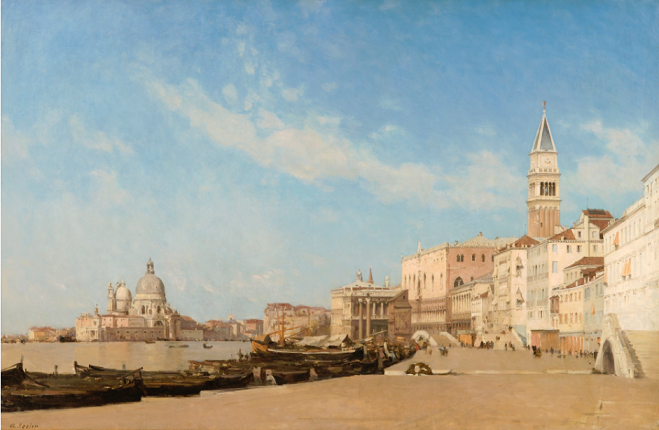
A VIEW OF ST MARKS BASIN WITH THE PUNTA DELLA DOGANA
Oil on board
62 by 102cm., 24½ by 40in.
Private collection
Having trained in Venice, in 1868 Ciardi left for Florence where, with the help of Federico Zandomeneghi and Telemaco Signorini, he was admitted to the Caffé Michelangelo and became acquainted with the Macchiaioli. It was this experience that expanded his horizons beyond the teachings of the Accademia and led him to develop a more modern style.
Some of the key monuments of La Serenissima are visible in the distance, the Campanile of San Giorgio Maggiore and the Basilica of Santa Maria della Salute to the left and the Campanile di San Marco towards the centre of the composition. The peacefulness and stillness of this view, along with the bright warm colours are in clear Venetian tradition. However, Ciardi focuses on the description of light, of water and its reflections, rethinking the typical venetian vedute into lyrical landscapes.
Ciardi was a famous and prolific artist during his lifetime. He exhibited in numerous cities including at the Venice Biennale, at the International Exposition in Munich in 1884, in London and Glasgow. More this painting
Guglielmo Ciardi (13 September 1842 – 5 October 1917) was an Italian painter. He was born in Venice, the son of an official of the Austrian government. Ciardi enrolled in 1861 at the Venice Academy of Fine Arts, where he studied perspective with Federico Moja and landscape and seascape with Domenico Bresolin, taking over the latter’s teaching post in 1894. He went to Florence in 1868 and formed friendships with Giovanni Costa and the Macchiaioli painters. After spending some time in the countryside around Rome, he then arrived in Naples and came into contact with Filippo Palizzi and the artists of the Resina School. On his return to Venice the following year, he resumed his regular participation in the exhibitions of the Academy and the Società Promotrice di Belle Arti. Works were also sent to exhibitions in Milan, Turin, Genoa, Florence and Naples in the 1870s and 1880s. The following decade saw participation in the Milan Triennale, the Turin Exhibition of 1898 and the Venice Biennale from 1895 to 1914, with a solo show in 1909. Views of the Venetian lagoon and the countryside around Treviso were accompanied by mountain landscapes painted during his numerous stays in towns in Veneto, Trentino and Lombardy. Awarded a gold medal in 1915 at the San Francisco Exhibition, where the participants included his children Beppe and Emma, he was struck down by paralysis and died two years later. More on Guglielmo Ciardi

Francesco Guardi, (1712–1793)
The Rialto Bridge with the Palazzo dei Camerlenghi, circa 1763
Oil on canvas
Height: 60 cm (23.6 in). Width: 91 cm (35.8 in).
Private collection
Taking its vantage point from what is today the view from the Palazzo Sernagiotto, Guardi illustrates iconic landmarks of the Venetian landscape including the Palazzo Civran, the Fondaco dei Tedeschi, long famous for its murals by Giorgione and Titian, the Palazzo dei Camerlenghi, the Fruit Market and the supremely elegant Rialto Bridge itself, built in 1588–91 to the design of Antonio da Ponte. This was the spectacular scene that would have greeted tourists in the eighteenth century as they entered Venice from the south. Through his flickering delicacy of touch and masterful suffusing of colour, Guardi creates an expression of atmosphere like no other view painter of his time. More on this Painting
Francesco Lazzaro Guardi (October 5, 1712 –
January 1, 1793) was an
Italian painter of veduta, nobleman, and a member of the Venetian School. He is
considered to be among the last practitioners of the classic Venetian school of
painting.
In 1735,
Guardi moved to the workshop of Michele Marieschi, where he remained until
1743. His first certain works are from 1738, for a parish at Vigo d'Anuania, in
Trentino. In this period he worked alongside his older brother.
His works
in this period included both landscapes and figure compositions. In 1763 he
worked in Murano, in the church of San Pietro Martire, finishing a Miracle of a
Dominican Saint.
Francesco
Guardi's most important later works include the Doge's Feasts, a series of
twelve canvases celebrating the ceremonies held in 1763 for the election of
Doge Alvise IV Mocenigo. In circa 1778, he painted the severe Holy Trinity
Appearing to Sts. Peter and Paul in the parish church of Roncegno.
In 1782
Guardi was commissioned by the Venetian government six canvases to celebrate
the visit of the Russian Archdukes in the city, of which only two remain, and
two others for that of Pope Pius VI. On September 12 of that year he was
admitted to the Fine Art Academy of Venice.
Guardi died at Campiello de la Madona in
Cannaregio (Venice) in 1793. More Francesco Lazzaro Guardi
Giovanni Antonio Canal, called Canaletto
Venice, a view of the equestrian monument to Bartolomeo Colleoni and the church of Santi Giovanni e Paolo
Oil on canvas
height: 41.4 cm (16.2 in); width: 33.7 cm (13.2 in)
Private collection
The Equestrian statue of Bartolomeo Colleoni. In 1475 the Condottiero Colleoni, a former Captain General of the Republic of Venice, died and by his will left a substantial part of his estate to the Republlic on condition that a statue of himself should be commissioned and set up in the Piazza San Marco. In 1479 the Republic announced that it would accept the legacy, but that the statue would be placed in front of the Scuola of San Marco. A competition was arranged to enable a sculptor to be selected. In 1483 the contract was awarded to Bartolomeo Colleoni. He then opened a workshop in Venice and made the final wax model which was ready to be cast in bronze, but he died in 1488, before this was done.
The statue was eventually erected on a pedestal made by Leopardi in the Campo SS. Giovanni e Paolo where it stands today. More on the statue of Bartolomeo Colleoni
Canaletto, by name of Giovanni Antonio Canal
(born Oct. 18, 1697, Venice—died April 20, 1768, Venice) Italian
topographical painter whose masterful expression of atmosphere in his detailed
views (vedute) of Venice and London and of English country homes influenced
succeeding generations of landscape artists.
Canaletto was born into a noble family whose
coat of arms he occasionally used as a signature. How he came to be known as
Canaletto is uncertain, however; perhaps the name was first used to distinguish
him from his father, Bernardo Canal (below), a theatrical scene painter in whose studio
Canaletto assisted. More
Canaletto's
early works remain his most coveted and, according to many authorities, his
best. One of his early pieces is The Stonemason's Yard (1729, London, the
National Gallery) which depicts a humble working area of the city.
Later Canaletto painted grand scenes of the
canals of Venice and the Doge's Palace. His large-scale landscapes portrayed
the city's pageantry and waning traditions, making innovative use of
atmospheric effects and strong local colors. For these qualities, his works may
be said to have anticipated Impressionism. More on Canaletto
Bernardo Canal, VENICE 1674 - 1744
THE GRAND CANAL: LOOKING SOUTH FROM PALAZZI FOSCARI AND MORO-LIN TO SANTA MARIA DELLA CARITÀ
oil on canvas, unframed
72.5 x 111.3 cm.; 28 1/2 x 43 7/8 in.
Private Collection
The Grand Canal in Venice, Italy forms one
of the major water-traffic corridors in the city. Public transport is provided
by water buses and private water taxis, and many tourists explore the canal by
gondola.
One end of the canal leads into the lagoon near
the Santa Lucia railway station and the other end leads into Saint Mark Basin;
in between, it makes a large reverse-S shape through the central districts of
Venice. More
Grand Canal
Santa Maria della Carità . The first documented church and convent on this site were founded in 1134 by an Augustinian order of friars from Ravenna, although it is said there was a wooden church on the site before this, erected to house a miracle-working Madonna. It was consecrated by Pope Alexander II on April 5th 1177, following the six months he spent hiding in the convent from Frederick Barbarossa. In 1260 the buildings passed to the Scuola Grande di Santa Maria della Carità, making it the oldest of the six Scuole Grande in Venice. The church at this time had an external portico, once a common feature in Venice but the only two remaining are on San Nicolò dei Mendicoli and San Giacomo di Rialto. More on Santa Maria della Carità
Bernardo Canal (Venice, Italy, 1664-1744) was an Italian painter of the 17th century. He was the father of the well-known painter Canaletto (Giovanni Antonio Canal, above) and follower of Luca Carlevarijs (1663-1730).
In 1695 he married Artemisia Barbieri. In 1717 he is registered for the first time in the guild of Venetian painters where he is recognized as a Member of the College of painters. On December 28, 1739, this organization awarded him the title of prior. He had two sons named Cristoforo and Antonio, the latter, became the great painter Canaletto, who began painting with his father.
Canal was mainly dedicated to painting stage sets for works by Vivaldi , Chelleri, Pollarolo and Orlandini in Venetian theaters in Sant'Angelo and San Cassiano. He later began painting urban scenes of Venice, joining, like his son, the movement of veduttismo.
His style, was characterized by the meticulousness in the architectural detail and the technical of luminosity. More on Bernardo Canal

Thomas Bush Hardy
Santa Maria De La Salute, Venice, c. 1887
Watercolour heightened with bodycolour
58.4 x 88.9cm (23 x 35in)
Private Collection
Santa Maria della Salute (English: Saint Mary of Health), commonly known simply as the Salute, is a Roman Catholic church and minor basilica located at Punta della Dogana in the Dorsoduro sestiere of the city of Venice, Italy.
It stands on the narrow finger of Punta della Dogana, between the Grand Canal and the Giudecca Canal, at the Bacino di San Marco, making the church visible when entering the Piazza San Marco from the water. The Salute is part of the parish of the Gesuati and is the most recent of the so-called plague churches.
In 1630, Venice experienced an unusually devastating outbreak of the plague. As a votive offering for the city's deliverance from the pestilence, the Republic of Venice vowed to build and dedicate a church to Our Lady of Health (or of Deliverance, Italian: Salute). The church was designed in the then fashionable baroque style by Baldassare Longhena. Construction began in 1631. Most of the objects of art housed in the church bear references to the Black Death.
The dome of the Salute was an important addition to the Venice skyline and soon became emblematic of the city, inspiring artists like Canaletto, J. M. W. Turner, John Singer Sargent, and the Venetian artist Francesco Guardi. More on Santa Maria della Salute
Thomas Bush Hardy (1842, Sheffield – 1897, Maida Vale,
London) was a British marine painter and watercolourist. As a young man
he travelled in the Netherlands and Italy. In 1884 Hardy was elected a Member
of the Royal Society of British Artists. He exhibited with the Society and also
at the Royal Academy.
His
paintings feature coastal scenes in England and the Netherlands, the French
Channel ports and the Venetian Lagoon.
Hardy had nine children. His son Dudley Hardy was a
painter, illustrator and poster designer. His daughter Dorothy received an MBE
after working as a nurse in the First World War. He died on 15 December 1897 in
Maida Vale, London. More on Thomas Bush Hardy
Edward William Cooke
Sunset on the Lagune of Venice
San Giorgio in Alga and the Euganean Hills beyond, c. 1857
Oil on paper laid on canvas
11 ½ x 16 ¾ in. (29.2 x 42.5 cm.)
Private Collection
Edward William Cooke, R.A., F.R.S., F.Z.S.,
F.S.A., F.G.S. (27 March 1811 – 4 January 1880) was an English landscape and marine painter, and gardener. Cooke was
born in Pentonville, London. He was raised in the company of artists. He was a
precocious draughtsman and a skilled engraver from an early age, displayed an
equal preference for marine subjects and published his "Shipping and
Craft" – a series of
accomplished engravings – when
he was 18, in 1829. Cooke began painting in oils in 1833, and first exhibited
at the Royal Academy and British Institution in 1835, by which time his style
was essentially formed.
He went on to travel and paint with great
industry at home and abroad, indulging his love of the 17th-century Dutch
marine artists with a visit to the Netherlands in 1837. He returned regularly
over the next 23 years, studying the effects of the coastal landscape and
light, as well as the works of the country's Old Masters, resulting in highly
successful paintings. He went on to travel in Scandinavia, Spain, North Africa
and, above all, to Venice. In 1858, he was elected into the National Academy of
Design as an Honorary Academician. . More
Edward William Cooke
Jules BASTIEN-LEPAGE, (1848-1884)
Venise : la nuit sur la lagune
RMN-Grand Palais (musée Magnin) / René-Gabriel Ojéda
Here, the painter produces a highly synthetic painting with great economy of means. An analytical approach and feeling for detail bring it closer to Naturalism. Jeanne Magnin speaks of a “symphony in blue where the artist has not sought to create an effect, but has expressed a personal impression of his only trip to Venice, undertaken in 1880, when he was already suffering the early stages of the illness that would lead to his death. His heightened awareness conveys the emotion that the magical blue night sky on the blue sea aroused in him; the unbroken line of small islands is silhouetted between the sea and the sky, where the clouds are blown along by the sea breeze, obscuring and revealing the silver stars. The very modern choice to move towards monochrome, and the differentiation of planes that soften the central motif set further back, was probably a result of Bastien-Lepage’s visit to the Grosvenor Gallery where, in July 1881, the artist Whistler was exhibiting several works inspired by Venice. More la nuit sur la lagune
Jules Bastien-Lepage (1 November 1848 – 10 December 1884) was a French painter closely associated with the beginning of naturalism, an artistic style that emerged from the later phase of the Realist movement. He was born in the village of Damvillers, Meuse, and spent his childhood there. Bastien took an early liking to drawing, and his parents fostered his creativity by buying prints of paintings for him to copy.
Jules's first formal training was at Verdun, and prompted by a love of art he went to Paris in 1867, where he was admitted to the École des Beaux-arts, working under Cabanel. He was awarded first place for drawing but spent most of his time working alone, only occasionally appearing in class. During the Franco-Prussian war in 1870, Bastien fought and was wounded. After the war, he returned home to paint the villagers and recover from his wound. In 1873 he painted his grandfather in the garden, a work that would bring the artist his first success at the Paris Salon.
His initial success was confirmed in 1875 by the First Communion, a picture of a little girl minutely worked up. The last picture, Haymaking (Les Foins), now in the Musée d'Orsay, was widely praised by critics and the public alike. It secured his status as one of the first painters in the Naturalist school.
Between 1880 and 1883 he traveled in Italy. The artist, long ailing, had tried in vain to re-establish his health in Algiers. He died in Paris in 1884, when planning a new series of rural subjects. More Jules Bastien-Lepage
ANDRE BOUVARD dit MARC ALDINE, (1875-1957)
Venice
Oil on canvas
46 x 55 cm
Private Collection
ANDRE BOUVARD dit MARC ALDINE, (1875-1957). Antoine Bouvard Senior, also known as Marc Aldine was born at St. Jean-de-Bournay in L'Isere. He trained as an architect and studied art and architecture at the Ecole des Beaux-Arts in Paris. He became the Director of Architectural Services for the Seine, and was responsible for the construction of the Bourse du Travail and the Boulevard Morland in Paris.
His paintings show the influence of Felix Ziem, reflecting his love of Venice in the delicacy and fluidity of his use of colour, capturing in his paintings, the warmth and beauty that he found there. Known as a painter of Venetian subjects, he worked during the early part of the 20th century, becoming one of the most prolific painters of Venetian genre from this period. Bouvard’s works are broad and confidently painted, capturing all the atmosphere and charm of one of the most beautiful cities in the world. He exhibited throughout France and Italy as well as in many provincial European galleries during his own lifetime. His popularity has continued to the present day, placing him amongst the most recognized and respected painters of Venetian subjects. More on Marc Aldine.
Ludolfs Liberts, Latvian, 1895-1959
Carnival, Venice
Oil on canvas
30 1/2 x 25 3/8 inches (77.5 x 64.5 cm)
Private Collection
The Carnival of Venice is an annual festival. The Carnival ends with the Christian celebration of Lent, forty days before Easter, the day before Ash Wednesday. The festival is world famous for its elaborate masks.
Ludolfs Liberts, 1895-1959, Latvian, was born in Tirza, Latvia in 1895. He studied art in Moscow and the Kazan Art School. He was featured in the Latvian-State organized traveling exhibition in Europe that appeared in several capitals. He also exhibited in France, Belgium, Germany and Sweden. He was awarded the Latvian Cultural Fund in 1924 and 1927 as well as gold medals at exhibitions in Barcelona and Paris. His art consists of portraits and landscapes, and was a highly regarded theater decorator in his native Latvia. In Sweden, he painted mostly cityscapes from Stockholm, Gothenburg and Malmö. Liberts is represented at museums in Latvia, France, Belgium, Finland, Russia and the costume drawings at the National Museum. He died in New York on March 11, 1959. More on Ludolfs Liberts
Canaletto (Giovanni Antonio Canal) (Italian, 1697 - 1768)
Venice: Feast Day of Saint Roch, about 1735
Oil on canvas Dimensions
147.7 × 199.4 cm (58 1/8 × 78 1/2 in.)
The National Gallery, London
In Venice the feast day of Saint Roch on 16 August commemorated the end of the terrible plague of 1576 (in which Titian died). On this day the Doge would hear mass in San Rocco where Saint Roch was buried, to celebrate his intercession in bringing the plague to an end. Canaletto's painting shows the grand procession of state dignitaries and ambassadors emerging from the church. The participants all carry nosegays, which were presented to them on arrival as a memorial of the plague. The Doge carries a parasol and wears gold and ermine ceremonial robes. Awnings give protection from the sun. More on Feast Day of Saint Roc
Canaletto, byname of Giovanni Antonio Canal
(born Oct. 18, 1697, Venice—died April 20, 1768, Venice) Italian
topographical painter whose masterful expression of atmosphere in his detailed
views (vedute) of Venice and London and of English country homes influenced
succeeding generations of landscape artists.
Canaletto was born into a noble family whose
coat of arms he occasionally used as a signature. How he came to be known as
Canaletto is uncertain, however; perhaps the name was first used to distinguish
him from his father, Bernardo Canal, a theatrical scene painter in whose studio
Canaletto assisted.
Canaletto's
early works remain his most coveted and, according to many authorities, his
best. One of his early pieces is The Stonemason's Yard (1729, London, the
National Gallery) which depicts a humble working area of the city.
Later Canaletto painted grand scenes of the
canals of Venice and the Doge's Palace. His large-scale landscapes portrayed
the city's pageantry and waning traditions, making innovative use of
atmospheric effects and strong local colors. For these qualities, his works may
be said to have anticipated Impressionism. More on Canaletto
Canaletto (Giovanni Antonio Canal) (Italian, 1697 - 1768)
Venice: Feast Day of Saint Roch, about 1735
Detail
Canaletto (Giovanni Antonio Canal) (Italian, 1697 - 1768)
Venice: Feast Day of Saint Roch, about 1735
Detail
Please visit my other blogs: Art Collector, Mythology, Marine Art, Portrait of a Lady, The Orientalist, Art of the Nude and The Canals of Venice, Middle East Artists, 365 Saints, 365 Days, and Biblical Icons, also visit my Boards on Pinterest
Images are copyright of their respective owners, assignees or others.
Some Images may be subject to copyright
I don't own any of these images - credit is always given when due unless
it is unknown to me. if I post your images without your permission, please tell
me.
I do not sell art, art prints, framed posters or reproductions. Ads are
shown only to compensate the hosting expenses.
If you enjoyed this post, please share with friends and family.
Thank you for visiting my blog and also for liking its posts and pages.
Please note that the content of this post primarily consists of articles
available from Wikipedia or other free sources online.

 Posts
Posts




.jpg)


.jpg)

.jpg)

