Showing posts with label ships. Show all posts

05 Works, Marine Art, Walter Langley's perils of fishing life in a Cornish Village, with Footnotes, #87

Walter Langley, R.I. (1852-1922)
Waiting for the Boats, c. 1885
Pencil and watercolour
16 x 47 in. (42 x 119.5 cm.)
Private collection

Sold for GBP 109,300 in June 1999

The quayside by the seawall in the last few moments of leisure when they are able to share news, knit and read letters from relatives as they await the arrival of the herring fleet that has been away at sea and is returning with the day's catch. All is still and peaceful before these women's strenuous daily work begins and the women have to unload and clean the fish. The youngest of the women appears to be concerned about the arrival of the boats, perhaps nervous that not all of them will return; many men were killed in ocean storms. The anxious expression on her young face is in contrast to the weather-beaten skin of the older women who are used to sitting and waiting for the boats. More on this painting

Walter Langley (1852–1922)
In a Cornish Fishing Village – Departure of the Fleet for the North, c. 1886
Watercolour over graphite, with scratching out, on paper
121.9x926 mm
Birmingham Museums and Art Gallery

This painting is the first in a series of three works, depicting the perils of fishing life. In this work, the fleet is watched by villagers as it heads off to the fishing grounds. 

Walter Langley (1852–1922)
Disaster! Scene in a Cornish fishing village, c 1889
Watercolour over graphite, with scratching out, on paper
121.9x76.5 cms
Birmingham Museums and Art Gallery

Walter Langley devoted his life as a painter to scenes in the lives of fishing people in Cornwall. This work, from 1889, is slightly more dramatic than some in its depiction of off-stage events at sea impacting on people at home. Like many of his paintings this watercolour is now in the possession of the City Museum and Art Gallery in Birmingham, Langley's home town, More on this painting

Walter Langley (1852–1922)
Among the Missing – Scene in a Cornish Fishing Village, c. 1884
Watercolour over graphite, with scratching out, on paper
H 118 x W 85 cm
Penlee House Gallery & Museum

This watercolour is the third in a series of three works showing the perils of fishing life. On the wall of the post office is a list of all the men who have been lost at sea. This scene is still one that is all too frequent amidst fishing communities today. More on this painting

Walter Langley (1852–1922)
Sketch for 'Among the Missing – Scene in a Cornish Fishing Village'
Watercolour over graphite, with scratching out, on paper
H 20.2 x W 11 cm
Penlee House Gallery & Museum

Walter Langley, RI (1852–1922), often described as a pioneer of the Newlyn artists in Cornwall, was born in Birmingham in 1852. His father was a tailor, and the typically large Victorian family lived in poor circumstances. The boy attended a mission school there, taking evening classes at Birmingham School of Design from the age of ten, and becoming an apprentice to a commercial lithographer in Birmingham while still attending classes. His life might have gone on like that, only a few steps further up the social ladder than his father's. But, on his own initiative, Langley picked up watercolour painting, and showed three of his watercolours at the Royal Birmingham Society of Artists in 1873. A scholarship to the National Art Training Schools of South Kensington followed, to study decorative design, and, after another spell as a lithographer, Langley set out on his independent career as an artist.

Although he was very active in Birmingham, where he and others founded the Birmingham Art Circle, Langley was attracted by the trend established in France, to paint villagers among scenes of daily life in rural or coastal communities. In 1880, he and Henry Martin Pope (1843-1908), a fellow-founder member of the Art Circle, visited Newlyn in Cornwall, which was then beginning to have something of a reputation as an artist's colony. When Langley decided to move there with his young family in 1882, he became the first artist of any note to do so. He retained his ties with Birmingham, but eventually settled there permanently. His connection was confirmed when, after the death of his first wife, he married a Cornish woman in 1897. He died in Penzance in 1922, a well-known artist  — Jacqueline Banerjee


Please visit my other blogs: Art CollectorMythologyMarine ArtPortrait of a Lady, The OrientalistArt of the Nude and The Canals of VeniceMiddle East Artists365 Saints365 Days, and Biblical Icons, also visit my Boards on Pinterest and my art stores at  deviantart and Aaroko

Images are copyright of their respective owners, assignees or others. Some Images may be subject to copyright

I don't own any of these images - credit is always given when due unless it is unknown to me. if I post your images without your permission, please tell me.

Ads are shown only to compensate the hosting expenses.

If you enjoyed this post, please share with friends and family.

Thank you for visiting my blog and also for liking its posts and pages.

Please note that the content of this post primarily consists of articles available from Wikipedia or other free sources online.


03 Classic Works of Art, Marine Paintings - Ports of Call, with Footnotes

Rubens Santoro, (Italian, 1859-1942)
Palazzo Donn Anna, Bay of Naples 
Oil on canvas
44.5 x 84.5cm (17 1/2 x 33 1/4in)
Private collection

Palazzo donn'anna, in the background, is a historical residence palace in naples, italy

Rubens Santoro (October 26, 1859 in Mongrassano, Province of Cosenza, Calabria – 1942 in Naples) was an Italian painter. He moved to Naples at 10 years of age, to study literature, but his inclination was painting. He only briefly enrolled at the Neapolitan Academy, instead, real life was his model. His first work was a small and simple genre piece: A Girl who Laughs, exhibited at the Promotrice. Domenico Morelli took note and encouraged him.
 
Santoro continually changed his vistas, painting in Torre Annunziata, Castellammare di Stabia, Procida, the Amalfi Coast, and Resina. During the long trips to the open countryside, he distracted himself by playing the mandolin. Many of his Amalfi landscapes were bought by the Goupil Gallery. Two were displayed at the 1877 Exposition at Naples: Marina di Maiuri and Grotta degli Zingari.  He moved to Paris, and after an excursion in England, returned to Naples even more prolifict. His painting Verona, exhibited at 1911 exhibition of Barcelona was awarded a Silver medal. More on Rubens Santoro

Nicolaes Pieterszoon Berchem, (1621/1622–1683)
A Southern Harbour, c. 1657 and 1659
A depiction of the sheep port of the Orangian protectorate
Oil on canvas
Height: 83 cm (32.7 in). Width: 104 cm (40.9 in).
Wallace Collection, London

Typical of Berchem’s decorative and exotic harbour scenes, the harbour was imaginatively identified with the port of Genoa by Jean Aliamet, who engraved the picture in the eighteenth century. The picture’s distinguished provenance demonstrates the artist’s appeal to collectors in the eighteenth and nineteenth centuries; its owners included the duc de Berry and Anatole Demidoff, Prince of San Donato. The 4th Marquess of Hertford paid the considerable price of 42,000 francs (about £1,680) for the painting at the latter’s sale in 1868. More on this painting

Nicolaes Pieterszoon Berchem (1 October 1620 – 18 February 1683) was a highly esteemed and prolific Dutch Golden Age painter of pastoral landscapes, populated with mythological or biblical figures, but also of a number of allegories and genre pieces.

He was a member of the second generation of "Dutch Italianate landscape" painters. These were artists who travelled to Italy, or aspired to, in order to soak up the romanticism of the country, bringing home sketchbooks full of drawings of classical ruins and pastoral imagery. His paintings, of which he produced an immense number, were in great demand, as were his 80 etchings and 500 drawings. His landscapes, painted in the Italian style of idealized rural scenes, with hills, mountains, cliffs and trees in a golden dawn are sought after. Berchem also painted inspired and attractive human and animal figures in works of other artists, like Allaert van Everdingen, Jan Hackaert, Gerrit Dou, Meindert Hobbema and Willem Schellinks. More Nicolaes Pieterszoon Berchem

Old Master Dutch Painting 17th Century Baroque
Untitled, (Fishing Village) mid 17th century
Oil on canvas
28" x 39" 
Private collection

Dutch Golden Age painting is the painting of the Dutch Golden Age, a period in Dutch history roughly spanning the 17th century, during and after the later part of the Eighty Years' War (1568–1648) for Dutch independence.

The new Dutch Republic was the most prosperous nation in Europe and led European trade, science, and art. The northern Netherlandish provinces that made up the new state had traditionally been less important artistic centres than cities in Flanders in the south. The upheavals and large-scale transfers of population of the war, and the sharp break with the old monarchist and Catholic cultural traditions, meant that Dutch art had to reinvent itself almost entirely, a task in which it was very largely successful. The painting of religious subjects declined very sharply, but a large new market for all kinds of secular subjects grew up. More on Dutch Golden Age

Old Master Dutch Painting 17th Century Baroque
Setail; Untitled, (Fishing Village) mid 17th century
Oil on canvas
28" x 39" 
Private collection


Please visit my other blogs: Art CollectorMythologyMarine ArtPortrait of a Lady, The OrientalistArt of the Nude and The Canals of VeniceMiddle East Artists365 Saints and 365 Days, also visit my Boards on Pinterest

Images are copyright of their respective owners, assignees or others. Some Images may be subject to copyright

I don't own any of these images - credit is always given when due unless it is unknown to me. if I post your images without your permission, please tell me.

I do not sell art, art prints, framed posters or reproductions. Ads are shown only to compensate the hosting expenses.

If you enjoyed this post, please share with friends and family.

Thank you for visiting my blog and also for liking its posts and pages.

Please note that the content of this post primarily consists of articles available from Wikipedia or other free sources online.

11 Classic Works of Art by the Old Masters, Marine Paintings - With Footnotes, #21

Henry Bacon
La Bretagne
Oil on board
10 1/2 x 13 3/4in (26.8 x 35cm)
Private Collection

SS La Bretagne was an ocean liner that sailed for the Compagnie Générale Transatlantique (CGT) from her launch in 1886 to 1912, sailing primarily in transatlantic service on the North Atlantic. Sold to Compagnie de Navigation Sud-Atlantique in 1912, she sailed for that company under her original name and, later, as SS Alesia on France–South America routes. The liner was sold for scrapping in the Netherlands in December 1923, but was lost while being towed. More on La Bretagne

Henry Bacon (1839 in Haverhill, Massachusetts – 13 March 1912 in Cairo) was an American painter and author. Hewas born in Haverhill, Massachusetts in 1839. During the American Civil War, he and acted as a field artist for Frank Leslie's Weekly while he served as a soldier within the 13th Massachusetts Infantry. Badly wounded at Bull Run, he was discharged on 19 December 1862.

After the war, he studied art with Walter Gay, who suggested that he travel to Paris to undertake a formal art education. In 1864, he went to Paris. He was admitted to the National School of Fine Arts and was one of Alexandre Cabanel's scholars. 

He exhibited at the salon from 1868 through to 1896 with genre works which had found favour with the American market. He also worked as a journalist sending reports of events in Paris to the Boston Daily Evening Transcript. In 1897, he travelled to Egypt for the first time and began regularly spending Winters there. At that time, he switched from oils to watercolours which he believed was the optimal medium to capture the transparent light of the Middle East.

Bacon died of a heart attack in Cairo, Egypt in 1912. More on Henry Bacon

Adolf Heinrich Wriggers
Port Of Hamburg
Oil on board
15-1/2 x 22 in. (39.3 x 55.8 cm.)
Private Collection

The Port of Hamburg is a sea port on the river Elbe in Hamburg, Germany, 110 kilometres from its mouth on the North Sea. The port is almost as old as the history of Hamburg itself. Founded on 7 May 1189 by Frederick I for its strategic location, it has been Central Europe's main port for centuries and enabled Hamburg to develop early into a leading city of trade with a rich and proud bourgeoisie. More on Hamburg Harbor

Adolf Henry Wriggers (born April 27, 1896 in Hamburg , † November 30, 1984 ibid) was a German painter and graphic artist , who worked mainly in the style of impressionism.

n 1913 he received a scholarship for the School of Applied Arts Hamburg. Because of a hearing damage, he was used in wartime service as a coachman in East Prussia from 1915 to 1918 and then continued his education at the now so renamed Landeskunstschule with Carl Schroeder. From 1919 he lived freelance in Hamburg.
During the period of National Socialism , he was repeatedly imprisoned and temporarily taken into protective custody. Wriggers supported the resistance activities of the White Rose Hamburg . In 1949 he founded the Kleiner Hamburger Künstlerring with a number of other artists.

In 1956, he lost an eye during an operation, increasingly blinded until he was completely blinded in 1968. During this time, the forms and motifs of his works were increasingly coarsened. Already in the 1920s and then again from 1950 he had dealt with woodcuts and etchings, but mainly painted in impressionist style, even in small-format works. His subject was often the Port of Hamburg, which earned him the epithet “port painter”, also industrial landscapes and landscape painting in oil and watercolor.

Adolf Wiggers died in November 1984 in his hometown Hamburg. More on Adolf Henry Wriggers

Wilson Irvine
Low Tide
Oil on canvas
24 x 27in
Private Collection

Wilson Henry Irvine (28 February 1869 – 1936) was a master American Impressionist landscape painter. Irvine spent his early career near Chicago, a product of the School of the Art Institute of Chicago. Irvine also painted across Western Europe — where he produced outstanding American Impressionist versions of the local countryside.

Irvine is best known for his mastery of light and texture. Sometimes Irvine's obsession with light led him to paint rather pedestrian subjects — landscapes depicting little more than some trees, or a road or fence. But a number of Irvine masterpieces depict well-composed scenes including houses, boats, bridges — even a handful of portraits, including at least one self-portrait and a nude.

In 1914 Irvine packed up and moved his family to Old Lyme, Connecticut, becoming part of the famed Florence Griswold circle, now recognized as the "American Barbizon," hub of American Impressionism. It is as an Old Lyme painter that Irvine is best remembered today. More on Wilson Henry Irvine

Charles Haigh Wood
Mending the sail
Oil on canvas
12 x 18in (30.4 x 45.7cm)
Private Collection

Charles Haigh-Wood,  (British, 1856-1927) was a genre painter, who lived in London, Bury and Taplow, Buckinghamshire.

Haigh-Wood’s enchanting visions of romance, with attractive girls and pretty dresses are some of the most endearing and popular of all images. His patrons adored them, a successful businessman of Haigh-Wood’s day with any pretension to artistic taste had to own one.

He exhibited from 1874 to 1904, at the Royal Academy from 1879 to 1904, Suffolk Street, New Watercolour Society and elsewhere.

Titles at the Royal Academy include “The Harvest Moon” 1879, “Chatterboxes” 1889 and “The Old Love and the New” 1901. More on Charles Haigh-Wood

Joaquin Sorolla y Bastida (Spanish, 1863-1923) 
Net menders in Valencia, c. 1909 
Oil on canvas laid down on board 
15 x 22½ in. (38.1 x 57.1 cm.) 
Private Collection

Joaquín Sorolla y Bastida (27 February 1863 – 10 August 1923) was a Spanish painter. Sorolla excelled in the painting of portraits, landscapes, and monumental works of social and historical themes. His most typical works are characterized by a dexterous representation of the people and landscape under the sunlight of his native land. More on Joaquín Sorolla y Bastida

Ernest Slingeneyer (1820-1894),  Belgian
Fighting on the Sea, C. 1857
Oil on canvas
293 x 370 cm
Private Collection

The painting depicts a true incident from the war of the first French republic, as the artist remarks in the catalog of the exhibition in The Hague 1857. The French ship ‘Le Feu’ sank during a campaign in the North Sea, only five sailors managed to enter a raft. After two days they were spotted by a British ship which sent a sloop to them. But the French sailors defended themselves until death to avoid captivity. The subject of the painting with shipwrecked men, crowded together on a raft goes back to the famous painting ‘The Raft of the Medusa’ by Théodore Géricault (1819). But while Gericault chose to show a blameful, scandalous incident within the French navy, Slingeneyer decided to depict a heroic story with great pathos. More on this painting

Ernest Slingeneyer (1820-1894). His artistic training was at the academy of Antwerp by Gustave Wappers. From the beginning he prefered to paint historic themes. With only 19 years he exhibited his first painting. The colossal painting ‘Le Vengeur’, exhibited in 1845 at the ‘Salon of Brussels’, was admired by the Belgian king. He was showered with honours and received numerous orders. In 1878 he was in charge of executing 13 painting for the great hall of the ‘Academiënpalais’ in Brussels and was paid with a record payment of 122.000 Belgian Franc. His great success and influence led to a late political career in the Belgian Parliament. More on Ernest Slingeneyer

Arthur David McCormick
The Return of the Pirates, c. 1925
Oil on canvas
28 1/4 x 36 1/4in.
Private Collection

Arthur David McCormick FRGS (Coleraine 14 October 1860 – 1943) was a notable British illustrator and painter of landscapes, historical scenes, naval subjects, and genre scenes.

McCormick was born in Ulster and, after education at local schools, went to London. McCormick was educated at the Royal College of Art in 1883–1886. He worked for The English Illustrated Magazine. He was in 1892–1893 an artist on Sir Martin Conway's expedition to the Karakoram subrange of the Himalayas and in 1895 an artist on Clinton T. Dent's expedition to the Caucasus Mountains. His first exhibition at the Royal Academy of Art was in 1889, and through the end of 1904 he exhibited there eleven paintings. In 1927 he painted the Head of a Sailor for John Player & Sons for the promotion of Player's Navy Cut cigarettes. More on Arthur David McCormick

Leo Putz, 1869 - 1940, GERMAN
WALDESRUHE (FOREST CALM)
Oil on canvas
69 by 76.5 cm., 27 by 30in.
Private Collection

Painted in Gauting circa 1925 after the artist's return from exile in the Netherlands during the First World War, this painting exemplifies Putz's freely painted compositions of nudes and bathers by the water's edge. The setting for this and so many of Putz's paintings was the lake country around Schloss Hartmannsberg, where the artist and his family summered annually before the War, and again in the 1920s. More on this painting

Leo Putz (18 June 1869, in Merano – 21 July 1940, in Merano) was a Tyrolean painter. His work encompasses Art Nouveau, Impressionism and the beginnings of Expressionism. Figures, nudes and landscapes are his predominant subjects.

He began his studies at the age of sixteen at the Academy of Fine Arts Munich. His father then sent him to the Académie Julian in Paris. After military service, he returned to Munich and studied with Paul Hoecker. He opened his first studio in 1897. That same year, he became a member of the Munich Secession. He worked with the weekly magazine Jugend and many of his paintings were reproduced on the magazine's title page. During this time, he also worked as a commercial artist, creating many posters in Art Nouveau style and billboards for the Moderne Galerie München.

He became an honorary citizen of Bavaria in 1909; a prerequisite for becoming a Professor, which appointment he received that same year. Between 1909 and 1914, he spent his summers at Schloss Hartmannsberg near Chiemgau to practice plein-air painting. It was there that he created his best-known works; the two series known as the "Boat Pictures" and the "Bathers". 

He accepted an invitation to move to Brazil in 1929. At the request of Lúcio Costa, he took a professorship at the Escola Nacional de Belas Artes in 1931. During his stay, his colors took on a more tropical flavor and the exotic plant life became a favorite subject.  He returned to Germany in 1933.

He became an opponent of National Socialism and his art was labelled "degenerate". Beginning in 1936, he was repeatedly interrogated by the Gestapo and was forced to flee back to his native region, the South Tyrol. In 1937, he was officially banned from working in Germany. For the remainder of his life, he concentrated on painting castles, villages and benign landscapes.

He died in 1940. More on Leo Putz 


Henri Montassier, 1880 - 1946, FRENCH
REPOS AU BORD DU LAC, c. 1912
Oil on canvas
122 by 204cm., 48 by 80¼in.
Private Collection

Henri Montassier, born on June 27 , 1880 in Courlon-sur-Yonne and died on June 7 , 1946 in Paris, was a French painter , caricaturist and illustrator of  the 20th century.

His father sent him to study law in Paris, but he decided to join the studio of Luc-Olivier Merson , head of the studio at the École nationale supérieure des beaux-arts. He lived in Montmartre then other districts of Paris .

On February 1918, he married Céline Rambach.

In 1934, he moved with his wife to the Gers . He did not return to Paris until the end of the Second World War and died there of his lung disease in 1946. More on Henri Montassier

Michael Zeno Diemer, 1867 - 1939, GERMAN
TALL SHIP OFF CRETE
Oil on canvas
90.5 by 120.5cm., 35½ by 47½in.
Private Collection

Michael Zeno Diemer (* 8. February 1867 in Munich ; † 28. February 1939 in Oberammergau ) was a German painter. He studied from 1884 in Munich with Gabriel Hackl and Sándor Liezen-Mayer . Diemer was known for his impressive battles scenes. An arisen in 1896 Panorama he described the battle for Bazeilles during the Battle of Sedan in the Franco-German War . It was shown in a specially constructed building in Mannheim. For the German Museum in Munich, he made several paintings, including a representation of a Roman aqueduct for the department "Hydraulic Engineering", an ideal image of a medieval herb garden and the landing of the Zeppelin in Munich 1909 . In Stuttgart he painted the Brauereigaststätte Ketterer with a cycle of 14 large-scale paintings on the history of Swabian Emigrants. Diemer also submitted numerous landscapes and marine pictures, watercolors (also including representations of airships), poster designs and postcard views.

He was also a musician and composer. More Michael Zeno Diemer

Johannes Hermanus Koekkoek, 1778 - 1851, DUTCH
A MERCHANTMAN OFF VEERE
Oil on canvas
164.5 by 84cm., 64½ by 33in.
Private Collection

Veere is a municipality in the southwestern Netherlands, in the region of Walcheren in the province of Zeeland.

The name Veere means "ferry": Wolfert Van Borssele established a ferry and ferry house there in 1281. More on Veere

Johannes Hermanus Koekkoek, (Veere, 17 August 1778 – Amsterdam, 9 January 1851) was a Dutch painter and draughtsman. He was the head of an artistic family. His sons were all successful artists; the first two specialized in marine art, and Marinus was primarily a landscape painter. His grandson Johannes Hermanus Barend Koekkoek also became an artist.

ohannes Hermanus Koekkoek initially trained under Thomas Gaal, working in a wallpaper factory. He became primarily a marine art and genre art painter. He was active between 1793 and 1851, and worked in Middelburg, Durgerdam, Amsterdam (1833–1851), and Medemblik (1838) and Katwijk aan Zee. More Johannes Hermanus Koekkoek


Please visit my other blogs: Art CollectorMythologyMarine ArtPortrait of a Lady, The OrientalistArt of the Nude and The Canals of VeniceMiddle East Artists365 Saints and 365 Days, also visit my Boards on Pinterest

Images are copyright of their respective owners, assignees or others. Some Images may be subject to copyright

I don't own any of these images - credit is always given when due unless it is unknown to me. if I post your images without your permission, please tell me.

I do not sell art, art prints, framed posters or reproductions. Ads are shown only to compensate the hosting expenses.

If you enjoyed this post, please share with friends and family.

Thank you for visiting my blog and also for liking its posts and pages.

Please note that the content of this post primarily consists of articles available from Wikipedia or other free sources online.


22 Classic Works of Art, Marine and Seascape Paintings - Ludolf Bakhuizen (1630 – 1708) - 5

Ludolf Bakhuizen (or Backhuysen) (28 December 1630 – 17 November 1708) was a German-born Dutch Golden Age painter who was the leading Dutch painter of maritime subjects after the two Willem van de Veldes (father and son) left for England in 1672. 

Ludolf Bakhuizen (1631-1708)
View of Amsterdam with boats on the IJ, c. 1666
Oil on canvas
Height: 128 cm. Width: 221 cm.
Musée du Louvre

Ludolf Backhuysen - Tsar Peter the Great's boeier off Amsterdam
Ludolf Bakhuizen (Emden 1630-1708 Amsterdam) 
A view of the IJ with the East Indiaman 'Kattendyck', a States Yacht and various other ships, the harbour of Amsterdam beyond
signed with initials, and dated '1703'
oil on canvas 
88.6 x 117.5 cm. 

He was born in Emden, East Frisia, and came to Amsterdam in about 1650, working as a merchant's clerk and a calligrapher. He discovered so strong a genius for painting that he relinquished the business and devoted himself to art from the late 1650s, and soon became celebrated for his sea-pieces.

Follower of Ludolf Backhuysen 
Shipping on a calm sea 
oil on canvas 
14½ x 20¼ in. (36.8 x 51.4 cm.)

He was an ardent student of nature, and frequently exposed himself on the sea in an open boat in order to study the effects of storms. His compositions, which are numerous, are nearly all variations of one subject, the sea, and in a style peculiarly his own, marked by intense realism or faithful imitation of nature. In his later years Bakhuizen employed his skills in etching.

File:Dutchmen Embarking onto a Yacht by Ludolf Backhuysen (Dutch,, 1670s.jpg
Ludolf Bakhuizen (1631–1708)
Dutchmen Embarking into a Yacht, c. 1670
oil on canvas 
Cincinnati Art Museum

Ludolf Bakhuizen (1631–1708)
An Embarkation Scene, c. 1660
oil on canvas 

Ludolf Bakhuizen (1631–1708)
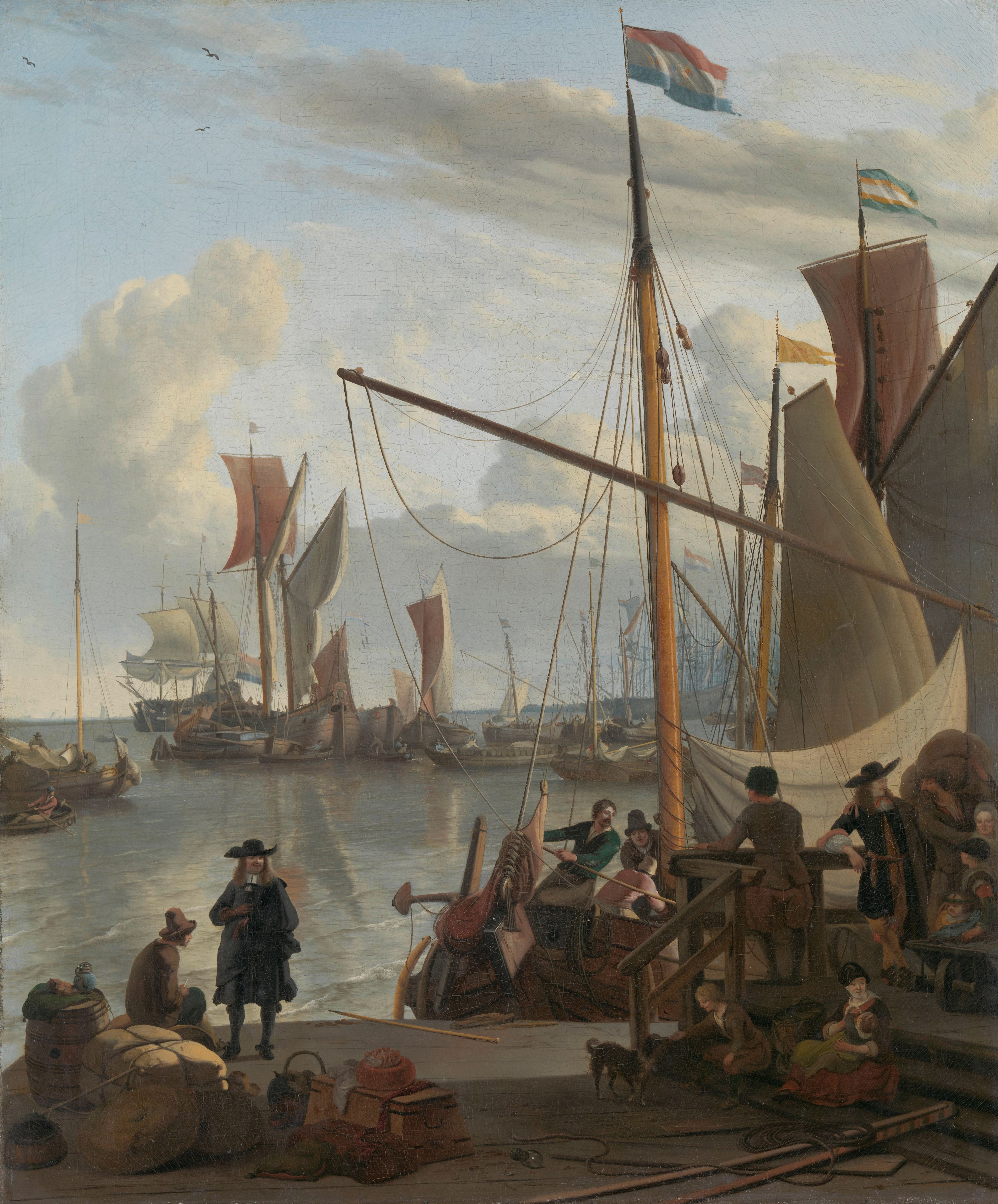
The Y at Amsterdam, seen from the Mosselsteiger (mussel pier) c. 1673
Medium oil on canvas
Height: 81 cm (31.9 in). Width: 67 cm (26.4 in).
Rijksmuseum Amsterdam

Ludolf Bakhuizen (1631–1708)
The Y at Amsterdam, with the frigate ‘De Ploeg’, circa 1690
oil on canvas
68 × 81 cm (26.8 × 31.9 in)
Rijksmuseum Amsterdam

View of a port with many larger and smaller ships including the tall ship ‘De Ploeg’ (The Plough, a frigate with a ploughing farmer painted on her stern). The city can be identified as Amsterdam though its buildings (from left to right: Oude Kerk, Royal Palace, Haringpakkerstoren and Westertoren). In the foreground various people, on the right a jetty. More

Ludolf Bakhuizen (1631–1708)
The Foundering of the 'Coronation' 90 Guns at Rame Head, c. 1691
Oil on canvas
147.3 x 231.1 cm
Sir Max Aitken Museum

Coronation was a 90-gun second-rate ship of the line of the English Royal Navy, built at Portsmouth Dockyard as part of the '30 great ships programme' of 1677, and launched in 1685.


Coronation was commissioned on 14 February 1690 under Captain John Munden, as flagship of Vice-Admiral Sir Ralph Delavall, under whom she took part in the Battle of Beachy Head on 30 June 1690. On 29 October 1690 Captain Charles Skelton took command. Coronation was dismasted and wrecked in a storm off Rame Head on 3 September 1691; approximately 600 men drowned, including Skelton. Only 20 survived. More

Ludolf Bakhuizen (1631–1708)
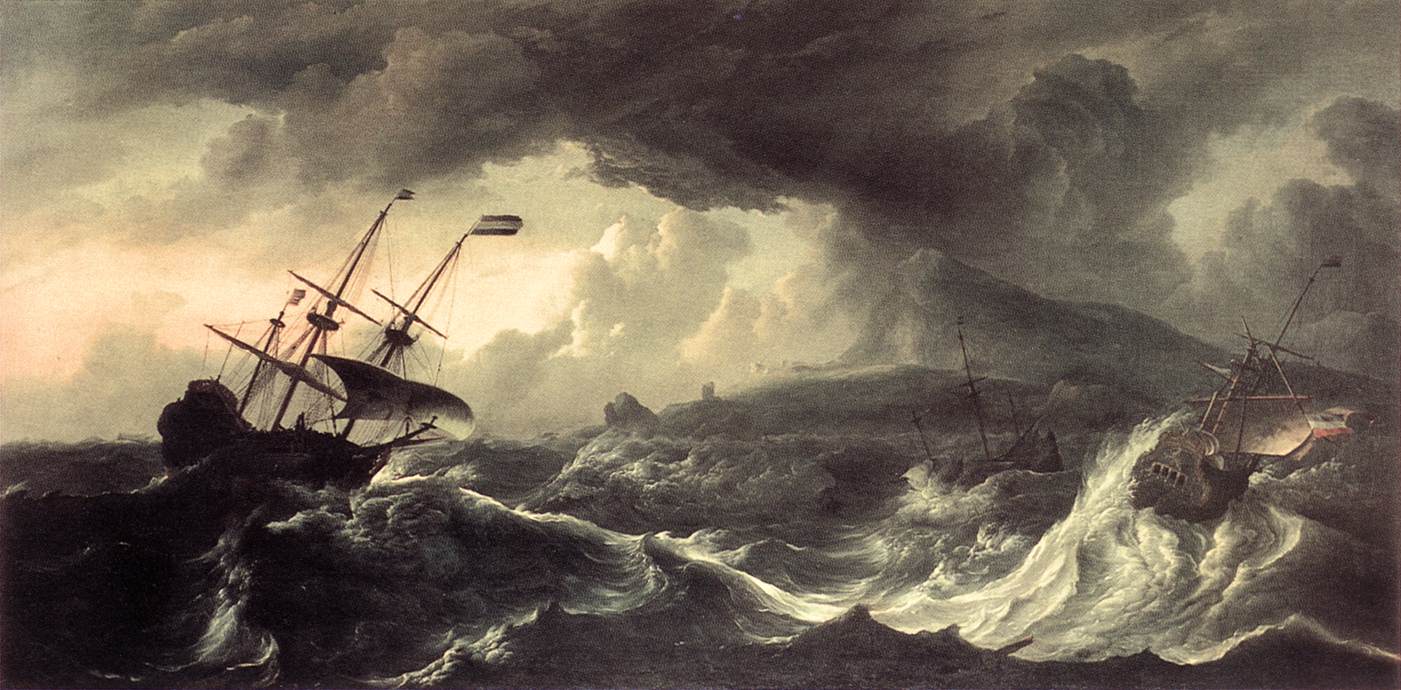
Ships Running Aground in a Storm, c. 1690s
Medium oil on canvas
59 x 89 1/4 inches
Royal Museums of Fine Arts of Belgium

While Dutch primacy in merchant shipping offered high rewards, its risks were equally significant. On their long journeys to the Mediterranean, the New World, Africa, and the East, merchant vessels were perennially endangered by warfare, piracy, treacherous shores, and storms. Several painters, most dramatically Ludolf Backhuysen, specialized in ships adrift in tempests. Backhuysen executed this painting (his largest surviving one) as if he were observing the disaster in the midst of the roiling seas, thus engaging beholders in the unfolding tragedy, encouraging them to empathize with the ships and their crews and to contemplate the powers of God, beyond full comprehension. But even as such paintings acknowledge the fragility of Dutch seaborne success, their distant shafts of sunlight usually hold out hope for reversals of misfortune. A brighter future may still save Backhuysen's ship at left, its Dutch flag unfurled against lightening skies. Collectors occasionally hung a tempest painting opposite a sunny shipping scene, implying that the power of God and nature, whether terrifying or benevolent, is always magnificent. More 

Ludolf Bakhuizen (1631–1708)
Ships in Distress in a Heavy Storm, circa 1695
oil on canvas
150 × 227 cm (59.1 × 89.4 in)
Rijksmuseum Amsterdam

The man-of-war ‘Ridderschap’ (right) and ‘Hollandia’ (left) on the rocks during a storm in the Strait of Gibraltar

Ludolf Bakhuizen (Emden 1630-1708 Amsterdam) 
Ships in Distress off a Rocky Coast (1667) 
oil on canvas 

The large cargo ship in the centre is managing to make way along the perilous coast, while on the right, two vessels are in even greater danger. Later his storms become melodramatic, his chiaroscuro effects exaggerated, and his gigantic waves rather schematic and glass-like. 

File:Bakhuizen Storm in the Sea.jpg
Ludolf Bakhuizen (1631–1708)
A Storm in the Sea, c. 1702
Medium oil on canvas
97.8 × 128.5 cm (38.5 × 50.6 in)
Royal Castle in Warsaw

This painting depicts two British and one Dutch ship during the War of the Spanish Succession.

Backhuysen, Ludolf (1631-1708)
Boats in a Storm, 1696
oil on canvas
24 3/4 x 31 inches (63 x 79 cm)
The Bridgeman Art Library

File:Ludolf Bakhuizen - Fishing Boats and Coasting Vessel in Rough Weather - WGA01132.jpg
Ludolf Bakhuizen (1631–1708)
Fishing Boats and Coasting Vessel in Rough Weather, between 1660 and 1663
oil on canvas
Height: 46 cm (18.1 in). Width: 66 cm (26 in).
Louvre Museum

File:Het oorlogsschip 'Brielle' op de Maas voor Rotterdam - The warship 'Brielle' on the Maas before Rotterdam (Ludolf Backhuysen, 1689).jpg
Ludolf Backhuysen (1630-1708)
The warship Brielle on the Maas before Rotterdam, c. 1689
Oil on canvas
Height: 130 cm (51.2 in). Width: 197 cm (77.6 in).
Rijksmuseum Amsterdam

In the center of this painting is the Brielle, a 50-gun warship sailing by the Admiralty Buildings in Rotterdam. Her stern is decorated with a shield bearing the portrait of William III, Prince of Orange, with arms of England and Scotland on either side. The main mast is flying the flag of the Prince and a splitted pennant. To the right is a VOC yacht (possibly with Princess Mary, the Prince’s wife, on board) firing a salute. Two boats are accompanying the yacht, one of them is under the flag of the States-General. In the background one can see Rotterdam: the western and the eastern New Main Gate to the Leuvehaven, the St. Lawrence Church, City Hall and the old warehouse of the Admiralty. More

Ludolf Bakhuizen (1631–1708)
The Eendracht and Dutch fleet of men-of-war before the wind’-ca 1670 
Medium oil on canvas
London-National Gallery

A Dutch battle fleet and its flagship the Eendracht are the subject of this impressive work by Ludolph Backhuysen. The Eendracht was built in 1653 – 1655 in Rotterdam at the Admiralty of de Maze and her construction costs were shared by all seven provinces of the Republic. She had served as a flagship for Admiral Jakob van Wassenaer van Obdam during the Swedish Campaign of 1658-1659 and later participated in the Battle of Lowestoft on June 3rd 1665 where she blew up causing much disarray among the Dutch thus contributing to the English victory. On this painting she is shown flying a long tricolor wimple indicating the presence of an admiral on board.


The depiction of the Eendracht’s ornate stern here is not accurate. In reality the lion was carved rampant and set within a fence symbolizing the borders of the Dutch Republic that he protected. This inaccuracy suggests that the painting was created after the loss of the Eendracht, probably in the early 1670s. This painting is on display in the National Gallery in London. More

File:Ludolf Bakhuizen - The Battle of Barfleur, 19 May 1692.jpg
Ludolf Bakhuizen (1631–1708)
The Battle of Barfleur, 19 May 1692
oil on canvas
158.5 × 234.5 cm (62.4 × 92.3 in)
National Maritime Museum

Early in 1692, James II was at Cherbourg, preparing to re-invade England with French help. On 17 May the French fleet sailed from Brest and were attacked by a superior Anglo-Dutch force under Admiral Russell, off Cape Barfleur. The French escaped but a few days later the allies burnt three of their ships including their flagship the 'Soleil Royal', 104 guns, in Cherbourg Bay. On 23-24 May, James II saw 12 more French ships and most of his transports burnt in the Bay of La Hogue. This ended all real hope of regaining his throne. The French commander off Barfleur was the Comte de Tourville. With a force half the size of the Anglo-Dutch fleet and hampered by fog, put up a brave fight. The focal point in the painting is de Tourville's flagship 'Soleil Royal', shown in the middle distance to the left of centre and in starboard-quarter view, in close action with the allied fleet flagship 'Britannia', on her starboard side. She is running before the wind, as are the fleets in general. This interpretation ignores the presence of fog and falsely indicates that the visibility is good. Astern of the 'Soleil Royal', firing her chase guns, is the flagship of Vice-Admiral-General van Callenburgh, and close on her port side a Dutch ship is also in chase. Beyond them and behind are other Dutch ships with, in the middle, an English smack-rigged royal yacht beating across them on the starboard tack. In the left foreground is a sinking French ship and to the right a number of boats and barges. A burnt-out wreck smoulders on the extreme right foreground. More

Ludolf Bakhuizen (Emden 1630-1708 Amsterdam) 
The merchant shipping anchorage southeast of Texel by Ludolph Backhuysen, 1661
oil on canvas 
28*23 cm. 

This painting shows the merchant anchorage off the island of Texel, where ships of the Dutch East Indian Company used to gather before setting sail for East Indies. In the center there are three vessels, a boyer, a kaag and a pink, full of people loading cargo. The smaller boats are delivering supplies to the larger boyer, while its crew is busy hoisting sails.

The scene is full of dynamism in the style that distinguishes Backhuysen from his contemporaries.  The light-colored sail directs viewer’s attention to the events on board of the pink where a family of one of the departing mariners is captured in the height of excitement. More

Ludolf Bakhuizen (1631–1708)
The Merchant Shipping Anchorage off Texel Island with Oudeschild in the Distance, c. 1665
oil on canvas
1065 mm x 1650 mm
National Maritime Museum, London

The setting for this painting is the merchant shipping roadstead off the eastern coast of Texel, one of a group of northern islands guarding the entrance to the Zuider Zee. Texel Island can be seen ahead with the village of Oude Schild to the far right. The village is identified as Oude Schild by the distinctive tower of the Hervormde Kerk. On the horizon, beyond the merchant ship furthest left, is the channel between the islands into the North Sea. The roughly diagonal compositional rhythm extends from the lower left-hand corner of the painting towards the masthead of the large three-masted fluyt. Then it moves towards the land on the horizon. The artist has intentionally arranged a cross section of coastal craft to demonstrate the significance of the sea. On the right a kaag, a common type of ferry boat, with brown and cream sails is running before the wind with sprit-rigged mainsail and foresail. To the left is a fluyt under sail with a larger ship passing which is hidden beyond and to the right. Further back a Dutch warship lies at anchor. Another fluyt lies at anchor on the far right. Backhuysen’s fidelity to nature is evident in the careful rendering of the figures aboard the ships, in particular their clothes and lifelike gestures. On the far left, one man blows a trumpet in signal or salutation to the vessel departing under the stern of the fluyt. A barrel afloat in the water is decorated with the ‘Rode Leeuw’ (red lion) from the coat of arms of the Province of Holland. 


The painting, executed in 1665, was produced at the height of Backhuysen’s career. More

Ludolf Bakhuizen (1631–1708) 
The Battle of Vigo Bay, 12 October 1702
Medium oil on canvas
483 × 686 mm (19.02 × 27.01 in)
National Maritime Museum

The Battle of Vigo Bay depicts the Battle fought by Anglo-Dutch and Franco-Spanish forces on 23 October 1702 during the War of the Spanish Succession  between an Anglo-Dutch fleet commanded by Admiral Sir George Rooke, and a combined French and Spanish fleet commanded by Admirals François Louis Rousselet de Chateau-Renault and Manuel de Velasco.

Rooke had been sent with a large Anglo-Dutch force to capture Cádiz in Spain but retreated in defeat on 29 September 1702. When the returning fleet put in to water at Lagos, Portugal, Rooke learned that the 1702 Spanish treasure fleet, one of the richest ever assembled, had sailed on 24 July from Havana, Cuba, and had been diverted from Cadiz to Vigo, where it had arrived on 23 September.

Determined to salvage something from the disaster at Cádiz, Rooke set out for Vigo, where he found that the treasure fleet was protected by a Franco-Spanish fleet of about 30 ships. Chateau-Renault had fortified the harbour by laying a boom of masts, covered by guns from forts in the town and on the island of San Simón, near the town of Redondela.

On October 23 Rooke attacked.The battle was a complete victory for Rooke: the forts were captured, and all the Spanish and French ships were burned by their own side. The victors recovered silver to the value of about £14,000, but a far larger sum — perhaps three million pounds — had been unloaded and taken away before the battle. Jan Lettens 23/10/2010

Ludolf Backhuysen EMDEN 1630 - 1708 AMSTERDAM A MAN-O-WAR, TOGETHER WITH BOATS AND FISHERMEN HAULING IN THEIR CATCH signed lower right: Lud. Backh a penschilderij, pen, ink and oil on oak panel 32.5 by 41.2 cm.; 11 7/8  by 16 1/4  in.
Ludolf Backhuysen - EMDEN 1630 - 1708 AMSTERDAM
A MAN-O-WAR, TOGETHER WITH BOATS AND FISHERMEN HAULING IN THEIR CATCH
signed lower right: Lud. Backh
a penschilderij, pen, ink and oil on oak panel
32.5 by 41.2 cm.; 11 7/8  by 16 1/4  in.

Ludolf Backhuysen - EMDEN 1630 - 1708 AMSTERDAM
The Shipyard of the Amsterdam Admiralty
Pen on panel
38 cm × w 69 cm