Jean-Léon Gérôme (11 May 1824 – 10 January 1904) was a French painter, teacher, and sculptor. The range of his work included historical painting, Greek mythology, Orientalism, portraits and other subjects.
He was one of the most famous French painters of his day. In the course of his long career, he was the subject of controversy and bitter criticism, in particular for defending the conventions of the waning genre of Academic painting, under attack by Realists and Impressionists.
He was born at Vesoul, Haute-Saône, and went to Paris in 1840 where he studied under Paul Delaroche. Like many other students of Delaroche, he joined the atelier of Charles Gleyre and studied there for a brief time. He then attended the Ecole des Beaux-Arts. In 1846 he tried to enter the prestigious Prix de Rome, but failed in the final stage because his figure drawing was inadequate.
JEAN-LÉON GÉRÔME (1824-1904)
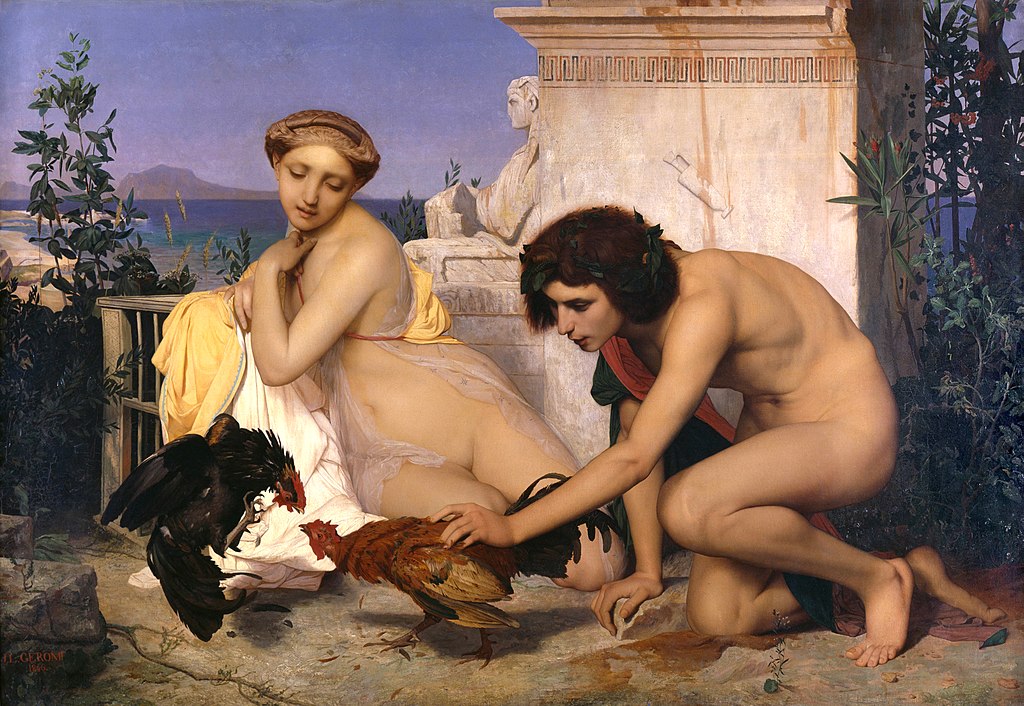
Jóvenes griegos presenciando una pelea de gallos/The Cockfight
Oil on Canvas
143 x 204 cm
Musée d'Orsay, Paris
1 January 1846
Gérôme started work on this canvas in 1846 when he was still smarting from his failure to win the Prix de Rome which would have opened the doors of the Villa Medicis to him. He feared a new rebuff and hesitated to exhibit his Young Greeks Attending a Cock Fight. But, encouraged by his master, the academic painter Delaroche, he finally entered his painting in the Salon of 1847, where it was a great success. More
He improve his skills and painted The Cockfight (1846), depicting a nude young man and a lightly draped young woman with two fighting cocks and in the background the Bay of Naples. He sent this painting to the Salon of 1847, where it gained him a third-class medal, and public success. The work was seen as the epitome of the Neo-Grec movement, and was championed by the influential French critic Théophile Gautier.
Jean Leon Gerome (1824-1904)
The Virgin the Infant Jesus and St. John
Oil on canvas, 1848
75 x 108 cm (29.53" x 3' 6.52")
private collection
c. 1848
In 1848 his paintings, The Virgin, the Infant Jesus and St John, (private collection) and Anacreon, Bacchus and Cupid (Musée des Augustins, Toulouse, France) took a second-class medal.
Jean-Leon Gerome (1824-1904)
Anacréon, Bacchus et l'amour
Oil on canvas, 1848
203 x 134 cm (6' 7.92" x 4' 4.76")
Musee des Augustins (Toulouse, France)
Anacreon, author of Odes anacreontic - praise of wine, love and nature - was one of the most famous lyric poets of anchient Greece. During the first half of the nineteenth century many interpretations of this work are born in France. This rare subject became major step for Gérôme; the Greek Revival aesthetic. On a festive bacchanalian background, Anacreon, standing in the center, crowned with myrtle, playing a seven-string lyre. A young bacchante accompanies the poet with his flute while Bacchus and his Love Children embody the hedonism of Anacreon. A twilight scene in an ancient landscape with archaeologically correct references. More
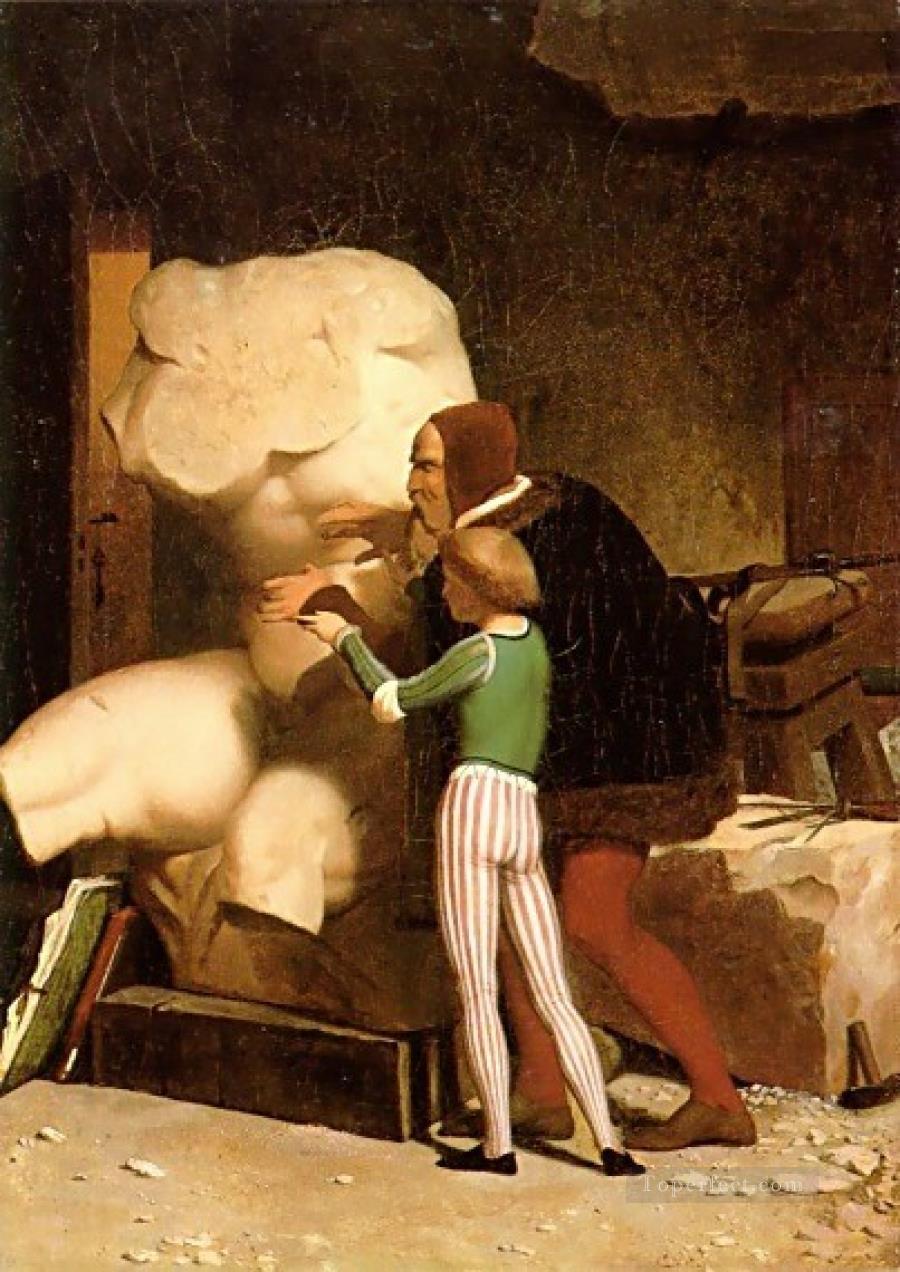
In 1849, he produced the paintings Michelangelo (also called In his studio) (now in private collection) and A portrait of a Lady (Musée Ingres, Montauban).
Jean-Leon Gerome (1824-1904)
Michelangelo being shown the Belvedere Torso
Oil on canvas, 1849
45 x 51.5 cm (17.72" x 20.28")
Private collection
This painting, by a still unknown Gérôme, is rich in contrasts: old age and youth; touch and sight; and, most intriguingly, the muscular white marble torso and the delicate, colorfully attired apprentice. It is a scene of an aspiring artist contemplating his artistic roots while giving testimony to his future career. Gérôme must have identified with the apprentice, who is in awe of the great Renaissance master, and through him the artist pays tribute to his own classical ideal. The portfolios and tools also allude to the concepts of learning and creation, as both an intellectual and sensory process. More
 Jean-Léon Gérôme (1824–1904)
Portrait of a Woman, 1851
canvas and oil
c. 1849
114 x 86 cms (443/4 x 333/4 ins)
Musée Ingres
Jean-Léon Gérôme (1824–1904)
Portrait of a Woman, 1851
canvas and oil
c. 1849
114 x 86 cms (443/4 x 333/4 ins)
Musée Ingres
In 1851, he decorated a vase, later offered by Emperor Napoleon III of France to Prince Albert, now part of the Royal Collection at St. James's Palace, London.
Jean-Leon Gerome (1824-1904)
FRIESLAND ON A COMMEMORATIVE VASE OF THE LONDON EXHIBITION
MUSEE D'ORSAY (PARIS)
Jean-Leon Gerome (1824-1904)
Drunken Bacchus and Cupid
Oil on canvas
c. 1850
113 x 149 cm (3' 8.49" x 4' 10.66")
Musee des Beaux-Arts (Bordeaux)
He exhibited Bacchus and Love (Above), Drunken Bacchus and Cupid, a Greek Interior and Souvenir d'Italie, in 1851;
Jean-Léon Gérôme (1824–1904)
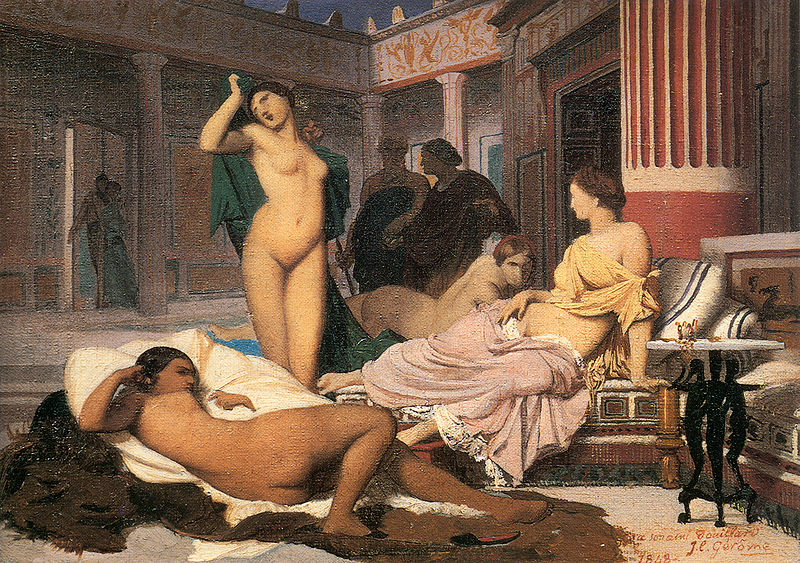
Greek Interior
c. 1848
Oil on canvas
21 × 15.5 cm (8.3 × 6.1 in)
Orsay Museum
Prince Napoleon buys the painting which has been qualified by Theophile Gautier as the only painting that can reach the greatness of the Ingres "Statonice"; a depiction of a brothel in the Pompeian manner.
Jean-Léon Gérôme (1824–1904)
Souvenir d'Italie
c. 1849
Oil on canvas
88.3 x 67.9 cm
Paris, Musée d'Orsay
View of Paestum (1852);
Jean-Léon Gérôme (1824–1904)
View of Paestum
Oil on canvas
c. 1852
81 x 66.5 cm (31.89" x 26.18")
Private collection
Paestum is an archaelogical site located south of Naples in the Campania region of Southern Italy. Its magnificent remains are associated with Magna Graecia, which refers to the Greek colonies of southern Italy established in the 8th century B.C.E. The name “Paestum” is the Romanized form of Poseidonia, which is what the original Greek settlers called the town in honor of Poseidon. More
and An Idyll (1853).
Jean-Léon Gérôme (1824–1904)
An Idyll (Daphnis and Chloe)
c. 1852
Oil on canvas
212.1 × 155.9 cm (83.5 × 61.4 in)
Musée Massey
Daphnis and Chloe is the only known work of the 2nd century AD Greek novelist and romancer Longus. It is set on the isle of Lesbos during the 2nd century AD, which is also assumed to be the author's home. Its style is rhetorical and pastoral; its shepherds and shepherdesses are wholly conventional, but the author imparts human interest to this idealized world. Daphnis and Chloe resembles a modern novel more than does its chief rival among Greek erotic romances, the Aethiopica of Heliodorus, which is remarkable more for its plot than for its characterization. More
In 1852, Gérôme received a commission by the Surintendant des Beaux-Arts to the court of Napoleon III, for the painting of a large historical canvas, the Age of Augustus.
Jean-Léon Gérôme (1824–1904)
The Age of Augustus, the Birth of Christ
c. 1852 - 1854
Oil on canvas
37.1 x 55.2 cm (14 5/8 x 21 3/4 in.)
J. Paul Getty
In 1852, Jean-Léon Gérôme received a state commission to paint a large mural of an allegorical subject of his choosing. In selecting this subject, Gérôme perhaps sought to flatter Emperor Napoleon III, whose government commissioned the painting and who was identified as a "new Augustus."
In preparation for his large mural, Gérôme traveled all over to find the appropriate ethnic types to portray the different peoples of the ancient world. When The Age of Augustus, The Birth of Christ was shown in 1855 at the Universal Exposition, his skill in depicting various nationalities led some to remark that Gérôme gave a lesson whenever he painted a picture. More
In this canvas he combines the birth of Christ with conquered nations paying homage to Augustus. Thanks to a considerable down payment, he was able to travel in 1853 to Constantinople. This would be the first of several travels to the East: in 1854 he made another journey to Greece and Turkey and the shores of the Danube.
Jean-Léon Gérôme (1824–1904)
The Last Communion of Saint Jerome
Oil on plaster
c. 1854
235 x 525 cm (7' 8.52" x 17' 2.69")
Church of Saint-Severin, Saint Jerome Chapel (Paris, France)
In 1854, he completed another important commission of decorating the Chapel of St. Jerome in the church of St. Séverin in Paris. His Last communion of St. Jerome in this chapel reflects the influence of the school of Ingres on his religious works.
Jean-Léon Gérôme (1824–1904)
Pifferaro
Oil on plaster
c. 1856
235 x 525 cm (7' 8.52" x 17' 2.69")
Musée des Beaux-Arts de Nantes (France - Nantes)
The Pifferari are strolling Italian musicians/shepherds who plays the piffero/bagpipes in memory of the shepherds of Bethlehem at Christmas time in front of the pictures of the Madonna.
The Pifferari usually go in pairs. One plays the bagpipes, the other rustic oboe or bassoon. In Italy they play in cities at Christmas time and asking alms to play the serenade. After they returned to their flocks. Gérôme was in Italy at the beginning of the 1840s, where one could hire the services of Pifferari for the holidays. This may be one of them that he used as a model. Gérôme painted the Pifferari alone or in groups. It is difficult to accurately determine the origin of these paintings, as the painter often simply titled them of Pifferari (Pifferaro singular). More
To the exhibition of 1855 he contributed; Pifferaro,
Jean-Léon Gérôme (1824–1904)
The Syrian Shepherd
Oil on canvas
c. 1856
83.50x46.00 cm
Private Collection
The Syrian Shepherd,
Jean-Léon Gérôme (1824–1904)
A Russian Concert
Oil on canvas
c. 1855
In 1854 Genome made a journey to Greece, Turkey and the shores of the Danube, where he was present at a concert of Russian conscripts, making music under the threat of a lash.
A Russian Concert, and The Age of Augustus & the Birth of Christ (Above). However the modest painting, A Russian Concert (also called Recreation in the Camp) was more appreciated than his huge canvases.
In 1856, Gérôme visited Egypt for the first time. This would herald the start of many orientalist paintings depicting Arab religion, genre scenes and North African landscapes.
Jean-Léon Gérôme (1824–1904)
Duel After a Masquerade Ball
c. 1859
Oil on canvas
68 x 99 cm.
Hermitage Museum
In this painting, showing the outcome of a duel after a costume ball, Gérôme replicates, with slight variations, a composition he had executed for the Duc d'Aumale in 1857. It is dawn on a wintry day in the Bois de Boulogne, Paris, and Pierrot succumbs in the arms of the Duc de Guise. A Venetian doge examines Pierrot's wound while Domino clasps his head in despair. To the right, the victorious American Indian departs, accompanied by Harlequin. More
Gérôme's reputation was greatly enhanced at the Salon of 1857 by a collection of works of a more popular kind: the Duel: after the Masked Ball,
Jean-Léon Gérôme (1824–1904)
Egyptian Recruits Crossing the Desert, c. 1857
Oil on canvas
64 x 109.8 cm
Private collection
Egyptian Recruits crossing the Desert, The Egyptian Recruting Office,
Jean-Léon Gérôme (1824–1904)
The Egyptian recruting officer, c. 1861
Oil on panel
11 x 16 in. (28 x 40.5 cm.)
Private collection
The present works represents a scene common in Egypt during the nineteenth century, when young men from the villages were conscripted into the army of the Khalif, a process which dated back to the first attempt by Mohammed Ali Pasha, to build up a regular army in 1824. As seen in the paintings, the recruits trudge across the desert, escorted by the Arnaut guard, and challenge the heat and wind making their journey long and painful. Characteristic of Gérôme's most acclaimed orientalist paintings, this intense realism prompted the French critic Théophile Gautier to note that Gérôme succeeded in capturing the peculiar qualities of light and heat unique to the Egyptian desert. He further remarked that, contrary to the current fashion for representing hot countries as torrid and highly coloured, Gérôme had observed that extreme light drains all colours from objects and renders the sky and land white. More
Jean-Léon Gérôme (1824–1904)
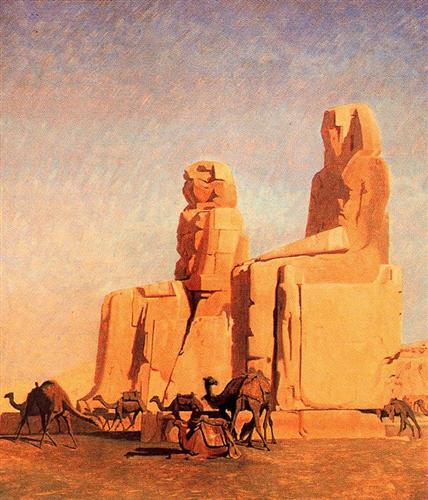
«Les Colosses de Thèbes, Memnon et Sésostris»
c. 1856
Huile sur toile
Musée Georges-Garret
Jean-Léon Gérôme (1824–1904)
Memnon and Sesostris
c. 1856
Oil on canvas
Height: 35 cm (13.78 in.), Width: 49.5 cm (19.49 in.)
Private collection
The Colossi of Memnon have stood guard at the ancient necropolis of Thebes since 1350 BC. Standing at a towering height of 18 meters, they were intentionally imposing and would have made a powerful impression on any visitor. Gérôme was known to have painted the subject a number of times, including a view from the side in The Colossi of Thebes, Memnon and Sesostris (1856, Musée Georges Garrett de Vesoul), Caravan Passing the Colossi of Memnon, Thebes (1857. Musée des Beaux-Arts, Nantes), and the oil sketch of the present view, Memnon and Sesostris (1856, Private Collection). More
Memnon and Sesostris,
Jean-Léon Gérôme (1824–1904)
Camels Watering
c. 1856
20" x 16" (50.8 x 40.6 cm)
"Camels at the Watering Place" is among the earliest and least staged of Gérôme's "orientales", inspired by the artist's first trip to Egypt from July to October 1856 with Auguste Bartholdi, future sculptor of the Statue of Liberty, and two orientalist painters, Léon Belly and Narcisse Berchère. The work was one of a group of six Egyptian paintings Gérôme sent to the Salon of 1857, where the critic Théophile Gautier praised its Realist qualities of straightforward representation. More
and Camels Watering.
In 1858, he helped to decorate the Paris house of Prince Napoléon Joseph Charles Paul Bonaparte in the Pompeian style. The prince had bought his Greek Interior (1850), a depiction of a brothel also in the Pompeian manner (shown above).
Jean-Léon Gérôme (1824–1904)
The Death of Caesar
Oil on Canvas
c. 1867
215.9 x 368.3 cm
Walters Art Museum
Julius Caesar was assassinated in Rome on the Ides of March (March 15). Concerned about detail, but constantly disrupting the context, Gérôme was markedly indifferent to the expression of the passions that had long been a part of historical representations. Differing significantly on this point from Delaroche, in whose work pathos was expressed on faces, Gérôme took a panoramic vision-the panoramic format being his favorite-of history, built on the anonymity of the crows of Rome or courtiers of Versailles, made up by endlessly interchangeable walk-ons.” More
In Caesar (1859) Gérôme tried to return to a more severe class of work, the painting of Classical subjects, but the picture failed to interest the public.
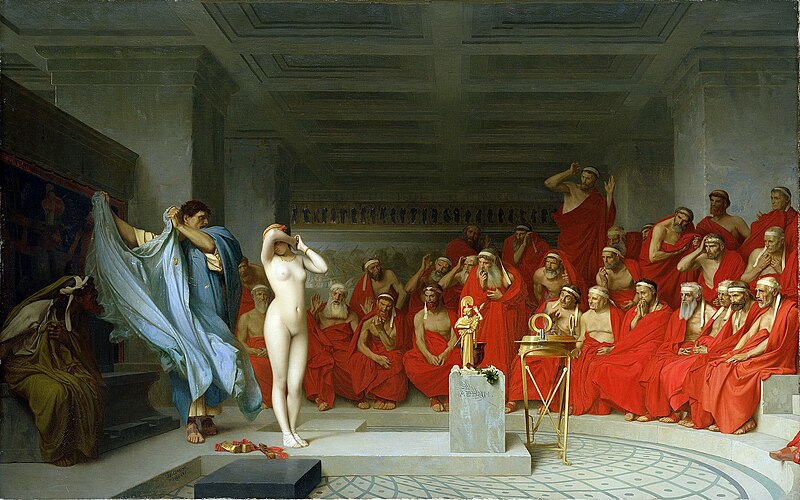
Jean-Léon Gérôme
Oil on canvas
80 × 128 cm (31.5 × 50.4 in)
Kunsthalle Hamburg
Phryne before the Areopagus, King Candaules and Socrates finding Alcibiades in the House of Aspasia (1861) gave rise to some scandal by reason of the subjects selected by the painter.
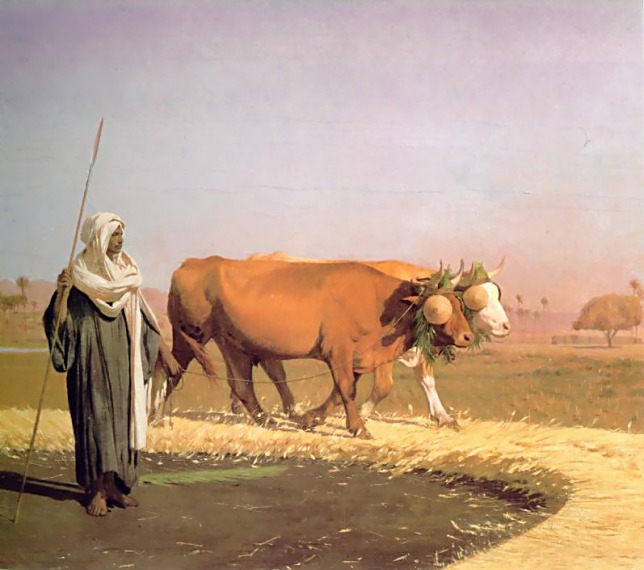
Jean-Léon Gérôme (1824–1904)
Treading out the Grain in Egypt
Oil on Panel
c. 1859
Height: 30.5 cm (12.01 in.), Width: 39.25 cm (15.45 in.)
Gérôme made his first of many trips to Egypt in 1856, where he spent four months navigating the Nile and then another four months residing at the home of Soliman Pasha in Cairo. He was immediately taken with the people, land and local culture and continued to visit Egypt, as well as Turkey, Palestine and Algeria, numerous times throughout the remainder of his life. More
Jean-Léon Gérôme (1824–1904)
Egyptian Grain-cutters
Oil on Panel
c. 1859
In this small, elegant composition Gérôme depicts two Egyptian Fellahs or peasants cutting grain in the cool, clear light of the morning sun. The frieze-like composition, featuring the figures and animals in strict profile, and shallow foreground space impart a classical quality to the image, which is further enhanced by the limited palette and abbreviated brushstrokes. The area depicted appears to be the middle to upper region of Egypt where the cliffs are located near the valley of the Nile River, unlike the flatter delta region in the south. Small pools of water are evidence of the Nile's flooding of the valley from June until October, allowing the farmers to cultivate the land in the following months. More
At the same Salon he exhibited the Egyptian Chopping Straw, and Rembrandt Biting an Etching, two very minutely finished works.
Jean-Léon Gérôme (1824–1904)
Rembrandt Etching a Plate in His Atelier
c. 1861
Oil on Panel
16.1x13.2 in, 41x34 cm
Jean-Léon Gérôme died in his atelier on 10 January 1904. He was found in front of a portrait of Rembrandt and close to his own painting The Truth.
He started an independent atelier at his house in the Rue de Bruxelles between 1860 and 1862.
Gérôme was elected a member of the Institut de France in 1865. Already a knight in the Légion d'honneur, he was promoted to an officer in 1867. In 1869, he was elected an honorary member of the British Royal Academy. The King of Prussia Wilhelm I awarded him the Grand Order of the Red Eagle, Third Class. His fame had become such that he was invited, along with the most eminent French artists, to the opening of the Suez Canal in 1869.
Jean-Léon Gérôme (1824–1904)
7 December 1815, Nine o’clock in the Morning. The execution of
Marshall Ney
c. 1867
Oil on canvas
65.2 x 104.2 cm
Museums Sheffield
Michel Ney, 1st Duc d'Elchingen, 1st Prince de la Moskowa (10 January 1769 – 7 December 1815), was a French soldier and military commander during the French Revolutionary Wars and the Napoleonic Wars. He was one of the original 18 Marshals of the Empire created by Napoleon.
At Waterloo Ney ordered a mass cavalry charge against the Anglo-Allied line. Ney's cavalry overran the enemy cannons, but found the infantry formed in cavalry-proof square formations. Ney, without infantry or artillery support, failed to break the squares. The action earned Ney criticism, and some argue that it led to Napoleon's defeat at Waterloo.
Ney was arrested (on 3 August 1815). He was tried (4 December 1815) for treason by the Chamber of Peers. On 6 December 1815, he was condemned, and executed by firing squad in Paris, an event that deeply divided the French public. He refused to wear a blindfold and was allowed the right to give the order to fire.
Ney's execution was an example intended for Napoleon's other marshals and generals, many of whom were eventually exonerated by the Bourbon monarchy. Ney is buried in Paris at Père Lachaise Cemetery. More
The theme of his Death of Caesar (1867) was repeated in his historical canvas Death of Marshall Ney, that was exhibited at the Salon of 1867, despite official pressure to withdraw it as it raised painful memories.
Jean-Léon Gérôme (1824–1904)
L'Eminence Grise
c. 1873
68.6 x 101 cm (27 x 39 3/4 in.)
Oil on canvas
Museum of Fine Arts, Boston
L’Eminence Grise recreates the palace of Cardinal Richelieu, the “Red Cardinal,” virtual ruler of France during the childhood of Louis XIII. Descending the staircase is Richelieu’s chief adviser, François Le Clerc du Trembly, a Capuchin friar known as L’Eminence grise (the Gray Cardinal), a term that has come to mean “the power behind the throne.” More
Gérôme returned successfully to the Salon in 1873 with his painting L'Eminence Grise, a colorful depiction of the main stair hall of the palace of Cardinal Richelieu, popularly known as the Red Cardinal, who was France's de facto ruler under King Louis XIII beginning in 1624.
Jean-Léon Gérôme (1824–1904)
Truth Rising from Her Well to Shame Mankind
c. 1896
Oil on canvas
90.81 X 71.76 cm
Musée Anne de Beaujeu - Moulins (France)
In 1896 Gérôme painted Truth Rising from her Well, an attempt to describe the transparency of an illusion. He therefore welcomed the rise of photography as an alternative to his photographic painting. In 1902, he said "Thanks to photography, Truth has at last left her well."
Jean-Léon Gérôme died in his atelier on 10 January 1904. He was found in front of a portrait of Rembrandt and close to his own painting "The Truth". At his own request, he was given a simple burial service without flowers. But the Requiem Mass given in his memory was attended by a former president of the Republic, most prominent politicians, and many painters and writers. He was buried in the Montmartre Cemetery in front of the statue Sorrow that he had cast for his son Jean who had died in 1891.
Images are copyright of their
respective owners, assignees or others. Some Images may be subject to copyright
I don't own any of these images -
credit is always given when due unless it is unknown to me. if I post your
images without your permission, please tell me.
I do not sell art, art prints, framed
posters or reproductions. Ads are shown only to compensate the hosting
expenses.
If you enjoyed this post, please share
with friends and family.
Thank you for visiting my blog and also
for liking its posts and pages.
Please note that the content of this post primarily consists of articles
available from Wikipedia or other free sources online.

 Posts
Posts


.jpg)