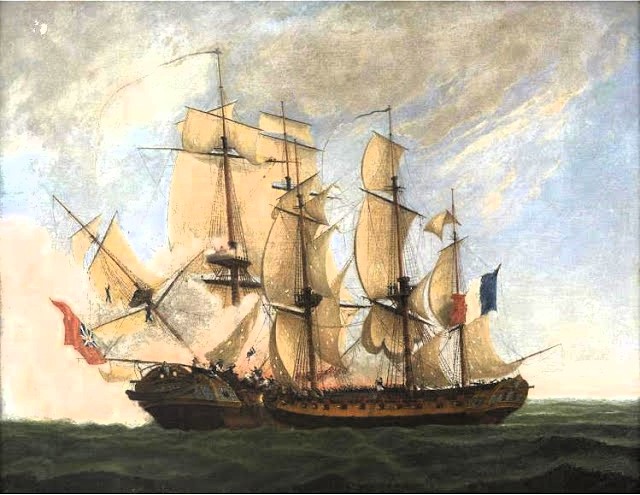
FOLLOWER OF ANGE-JOSEPH-ANTOINE ROUX, (french 1765-1835)
"ACTION BETWEEN H.M FRIGATE ''AMBUSCADE'' AND THE FRENCH FRIGATE ''BAYONNAISE''"
Oil on canvas
23 3/8 x 30 in. (59.4 x 76.2cm)
Private Collection
Estimated at $2,000 - $3,000 in Jun, 2017
HMS Ambuscade was a 32-gun fifth-rate frigate of the Royal Navy, built in 1773. The French captured her in 1798 but the British recaptured her in 1803. She was broken up in 1810.
On 13 December 1798, Ambuscade captured a French merchantman, Faucon, with a cargo of sugar and coffee bound for Bordeaux. Disaster struck the following day. Ambuscade was blockading Rochefort, when the smaller French corvette Bayonnaise captured her at the Action of 14 December 1798. The court martial exonerated Captain Henry Jenkins of Ambuscade, though a good case could be made that he exhibited poor leadership and ship handling. The French brought her into service as Embuscade.
On 28 May 1803, HMS Victory recaptured her. She had a crew of 187 men under the command of capitaine de vaisseau Fradin, and was 30 days out of Cap Francais, bound for Rochefort. The Royal Navy took her back into service as Ambuscade.
In March 1805, she was attached to Sir James Craig's military expedition to Italy. Along with Dragon, Craig's flagship, and Lively, Ambuscade escorted a fleet of transports to Malta. On 4 March 1807, Ambuscade captured the ship Istria. Unité, Melpomene, Bittern and Weazel (or Weazle) were in company and shared in the prize money. More on the Ambuscade
Jean François Hue, (French, 1751-1823)
French corvette Bayonnaise boarding HMS Ambuscade during the Action of 14 December 1798
Bayonnaise was a 24-gun corvette of the French Navy, launched in 1793. Bayonnaise was being built as a privateer when the Ministry of Marine requisitioned her in 1793 before she sailed. The Ministry assumed the construction contracts and purchased her in March 1794. Her hull was coppered in 1795 in Brest. She was officially renamed Brême that year, but apparently the new name was roundly ignored.
She became famous for the Action of 14 December 1798, in which she captured the much stronger 32-gun Ambuscade off the Gironde. Ambuscade was blockading Rochefort, when the smaller Bayonnaise captured her. Ambuscade had ten men killed, including her first lieutenant and master, and 36 wounded, including her captain. Bayonnaise had 30 killed, and 30 badly wounded, including Richer and his first lieutenant.
On 28 November 1803, Ardent gave chase to Bayonnaise in Finisterre Bay. The corvette's crew ran her ashore and then set fire to her prevent the British from capturing her. Captain Winthrop of Ardent described Bayonnaise as a frigate of 32 guns and 220 men, which had been sailing from Havana to Ferrol. Actually, Bayonnaise was armed en flute with only six 8-pounder guns, and was returning from the Antilles.
Archaeologists of the "Finisterre Project" in August 2010 located Bayonnaise's wreck on Langosteira beach, Finisterre. More on the Bayonnaise
Ange-Joseph Antoine Roux,
"Antoine Roux" (1765–1835) was a French fine art painter who specialised in
maritime painting, sometimes referred to as marine art. Roux came from a family of
artists and primarily worked in Marseille. Early in life he was apprenticed to
his father, Joseph Roux (1752–93), an hydrographer as well as an artist in his
own right, spending his leisure hours painting and drawing. He died of cholera in
Marseille in 1835. More Roux
Jean-François Hue ( Saint-Arnoult-en-Yvelines , December 2, 1751 - Paris, 26 December 1823) was a French landscape painter of the eighteenth and nineteenth centuries. He was received at the Royal Academy in 1782. His main sources of inspiration for his works are his great voyages.
He entered the studio of Joseph Vernet as a painter and landscape designer; He painted four views of the castle of Mousseaux and it's gardens.
Having specialized in landscapes and marines, his talent allowed him to become an official Navy painter, following in the footsteps of his master Joseph Vernet . Thus, in 1791 , the Constituent Assembly entrusted him with the task of completing the series representing the ports of France, commissioned at Vernet from 1753 .
Between 1792 and 1798 , he executed a series of six paintings on the theme of the ports of Brittany . More on Jean-François Hue
Thomas Bush Hardy
Scarborough, c. 1895
watercolour
22cm x 71cm
Private Collection
Scarborough is a town on the North Sea coast of North Yorkshire, England. The town lies between 10–230 feet (3–70 m) above sea level, rising steeply northward and westward from the harbour onto limestone cliffs.
The most striking feature of the town's geography is a high rocky promontory pointing eastward into the North Sea. The promontory supports the 11th century ruins of Scarborough Castle and separates the seafront into two bays, to the north and south. More on Scarborough
Thomas Bush Hardy (1842, Sheffield
– 1897, Maida Vale, London) was a British marine painter and
watercolourist. As a young man he travelled in the Netherlands and Italy. In
1884 Hardy was elected a Member of the Royal Society of British Artists. He
exhibited with the Society and also at the Royal Academy.
His paintings feature coastal scenes in England and the
Netherlands, the French Channel ports and the Venetian Lagoon.
Hardy had nine children. His son Dudley Hardy was a
painter, illustrator and poster designer. His daughter Dorothy received an MBE
after working as a nurse in the First World War. He died on 15 December 1897 in
Maida Vale, London. More on Thomas Bush
Hardy
Charles Dixon, 1872 - 1934
In Mid Atlantic, c. 1921
Watercolour heightened with body colour
43.5cm x 76.5cm
Private Collection
Charles Edward Dixon (8 December 1872 - 12 September 1934) was a British maritime painter of the late
nineteenth and early twentieth centuries, whose work was highly successful and
regularly exhibited at the Royal Academy. Several of his paintings are held by
the National Maritime Museum and he was a regular contributing artist to
magazines and periodicals. He lived at Itchenor in Sussex and died in 1934. More on Charles Edward Dixon
Charles Dixon, 1872 - 1934
Tower Bridge, 1910
Watercolour and bodycolour on paper on paper
535 x 372mm
Private Collection
Tower Bridge is a combined bascule and suspension bridge in London built between 1886 and 1894. The bridge crosses the River Thames close to the Tower of London.
In the second half of the 19th century, an advertisement in the East End of London led to a hiring for a new river crossing downstream of London Bridge. A traditional fixed bridge at street level could not be built because it would cut off access by sailing ships to the port facilities in the Pool of London, between London Bridge and the Tower of London. More on the Tower Bridge

Lyonel Feininger, 1910 - 2011
Romance at the seaside, 1943
Watercolour and ink on paper
24 x 31.5 cm.
Private Collection
T. Lux Feininger (June 11, 1910 Berlin — July 7,
2011 Cambridge) was an American
painter, avant-garde photographer, author, and art teacher who was born in
Berlin to Julia Berg and Lyonel Charles Feininger, an American living in
Germany from the age of sixteen. His father was the first faculty appointment
made to the Bauhaus in Weimar by its founder, Walter Gropius, in 1919. He had
two older full brothers, including Andreas Feininger, and two half sisters,
even older, by Clara Fürst and his father (from his first marriage). More Lyonel Feininger
Lyonel Feininger, 1910 - 2011
Untitled - sailing boat, c. 1934
ink, watercolour on paper
16.1 x 19 cm
Private Collection
William Lee Hankey, (1869–1952)
Sardine Boats at Douarnenez, France
Oil on canvas
63 x 76cm (24 3/4 x 29 7/8in.)
Private Collection
William Lee Hankey (1869–1952)
RWS,RI,ROI,RE,NS was a
British painter and book illustrator. He specialised in landscapes, character
studies and portraits of pastoral life, particularly in studies of mothers with
young children.
He was
born in Chester and worked as a designer after leaving school. He studied art
in the evenings at the Chester School of Art, then at the Royal College of Art.
Later in Paris he became influenced by the work of Jules Bastien-Lepage, who
also favoured rustic scenes depicted in a realistic but sentimental style. He
first exhibited at the Royal Academy in 1896 and was President of the London
Sketch Club from 1902 to 1904. He stayed in France in the early 1900s, painting
many of his works in Brittany and Normandy. From 1904 until well after World
War I he maintained a studio at the Etaples art colony.
It was
Hankey's black and white and coloured etchings of the people of Étaples, which
gained him a reputation as 'one of the most gifted of the figurative
printmakers working in original drypoint during the first thirty years of the
20th century'. One that is particularly striking for its stylistic presentation
was "The Refugees", his contribution to raising awareness of the
consequences for ordinary people of the German invasion of France and Belgium
in 1914. He went on to serve with the Artists' Rifles from 1915 to 1918.
In Britain he had been associated with the
Newlyn School, a group of English artists based in the titular village in
Cornwall who were themselves influenced by the romantic poets such as
Wordsworth and Keats. More on William Lee Hankey
Michael Peter Ancher (1849–1927)
The Lifeboat is Taken through the Dunes, c. 1883
Oil on canvas
171 × 221 cm (67.3 × 87 in)
Museum for Kunst, Copenhagen
Michael Peter Ancher (9 June 1849 – 19 September 1927) was a Danish realist artist. He is remembered above all for his paintings of fishermen and other scenes from the Danish fishing community in Skagen. Ancher was born on the island of Bornholm. He attended school in Rønne but was unable to complete his secondary education as his father ran into financial difficulties. In 1866, he met the painters Theodor Philipsen and Vilhelm Groth. Impressed with his own early work, they encouraged him to take up painting as a profession. In 1871, he spent a short period at C.V Nielsen's art school as a preliminary to joining the Royal Danish Academy of Art in Copenhagen later in the year. Although he spent some time at the academy, he left in 1875 without graduating.
Michael Peter Ancher (1849–1927)
Will he round the point? c. 1885
Oil on canvas
110x142 cm.
Private Collection
He achieved his artistic breakthrough in 1879 with the painting Vil han klare pynten (Will He Round the Point?) (above). Michael Ancher's works depict Skagen's heroic fishermen and their dramatic experiences at sea. More on Michael Peter Ancher
N. C. Wyeth, 1882 - 1945
Deep Cove Lobster Man, ca.1938
Oil on gessoed board (Renaissance Panel)
16 1/4 x 22 3/4 in.
Pennsylvania Academy of the Fine Arts, Philadelphia, Pennsylvania
Newell Convers Wyeth (October 22, 1882 – October 19, 1945), known as N. C. Wyeth, was an American artist and illustrator. During his lifetime, Wyeth created over 3,000 paintings and illustrated 112 books, 25 of them for Scribner's, the Scribner Classics, which is the work for which he is best known. The first of these, Treasure Island, was one of his masterpieces and the proceeds paid for his studio. Wyeth was a realist painter just as the camera and photography began to compete with his craft. Sometimes seen as melodramatic, his illustrations were designed to be understood quickly. He is notably the father of painter Andrew Wyeth and the grandfather of Jamie Wyeth, both celebrated American painters. More on Newell Convers Wyeth
Joaquín Sorolla y Bastida, 1863 - 1923
Breakwater, San Sebastian, 1918
Oil on canvas
81 x 104.5 cm
Sorolla Museum, Madrid, Spain
San Sebastián is a coastal city and municipality located in the Basque Autonomous Community, Spain. It lies on the coast of the Bay of Biscay, 20 km from the French border. San Sebastián's picturesque shoreline makes it a popular beach resort. The seaside environment is enhanced by hilly surroundings that are easily accessible. More on San Sebastián
Joaquín Sorolla y Bastida (27
February 1863 – 10 August 1923) was a Spanish painter.
Sorolla excelled in the painting of portraits, landscapes, and monumental works
of social and historical themes. His most typical works are characterized by a
dexterous representation of the people and landscape under the sunlight of his
native land. More on Joaquín Sorolla y Bastida
Unknown artist (20TH CENTURY)
STEAM SHIP
Oil on panel
8 x 10 in.
Private Collection
Please visit my other blogs: Art Collector, Mythology, Marine Art, Portrait of a Lady, The Orientalist, Art of the Nude and The Canals of Venice, Middle East Artists, 365 Saints, 365 Days, and Biblical Icons, also visit my Boards on Pinterest
Images are copyright of their respective owners, assignees or others.
Some Images may be subject to copyright
I don't own any of these images - credit is always given when due unless
it is unknown to me. if I post your images without your permission, please tell
me.
I do not sell art, art prints, framed posters or reproductions. Ads are
shown only to compensate the hosting expenses.
If you enjoyed this post, please share with friends and family.
Thank you for visiting my blog and also for liking its posts and pages.
Please note that the content of this post primarily consists of articles
available from Wikipedia or other free sources online.

 Posts
Posts