Showing posts with label Lyonel Feininger. Show all posts

09 Paintings, Streets of Paris, by its Artists , - Part 11 - With Footnotes

Paris, France's capital, is a major European city and a global center for art, fashion, gastronomy and culture. Its 19th-century cityscape is crisscrossed by wide boulevards and the River Seine. Beyond such landmarks as the Eiffel Tower and the 12th-century, Gothic Notre-Dame cathedral, the city is known for its cafe culture and designer boutiques along the Rue du Faubourg Saint-Honoré. More on Paris
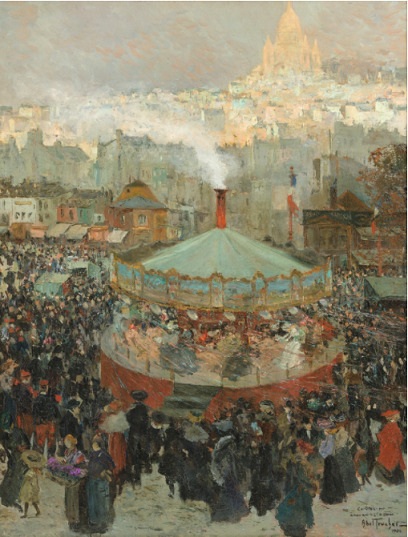
Louis Abel-Truchet, VERSAILLES 1857 - 1918 AUXERRE
FAIRGROUND WITH THE SACRÉ-COEUR IN THE BACKGROUND, c. 1904
Oil on canvas
90,5 x 70 cm ; 35 5/8 by 27 1/2 in.
Private collection

The Basilica of the Sacred Heart of Paris is a Roman Catholic church and minor basilica, dedicated to the Sacred Heart of Jesus. The basilica is located at the summit of the butte Montmartre, the highest point in the city. Sacré-Cœur is a double monument, political and cultural, both a national penance for the defeat of France in the 1871 Franco-Prussian War and the socialist Paris Commune of 1871 crowning its most rebellious neighborhood, and an embodiment of conservative moral order

The Sacré-Cœur Basilica was designed by Paul Abadie. Construction began in 1875 and was finished in 1914. It was consecrated after the end of World War I in 1919. More on the Basilica

Louis Abel-Truchet, 1857 - 1918,  was an important French painter, etcher and lithographer in his lifetime. He was born in 1857 in Versailles. He is predominantly known for his paintings depicting Paris at the turn of the century, with cafés, theatres, shops, everyday life and fashionable Parisians forming an essential part of the subject matter.

He exhibited from 1891 in various salons and was a founding member of the Salon d'Automne and the Societe des Humoristes. He also exhibited at the Salon des Artistes Français and the Société Nationale des Beaux-Arts, becoming a member in 1910.
Though influenced by impressionism, Abel-Truchet is also satirical at times and his work focused on the Belle Epoque, linking him with artists such as Galien-Laloue, Forain and Steinlen.

In 1914, aged fifty seven, he volunteered to fight in the World War One. He was to produce a series of lithographs depicting scenes from his experiences. He commanded a section of fighting troops during the war and was awarded the Legion of Honour and La Croix de Guerre. Abel-Truchet died in service in the last few months of the war. More on Louis Abel-Truchet

Louis Abel-Truchet, VERSAILLES 1857 - 1918 AUXERRE
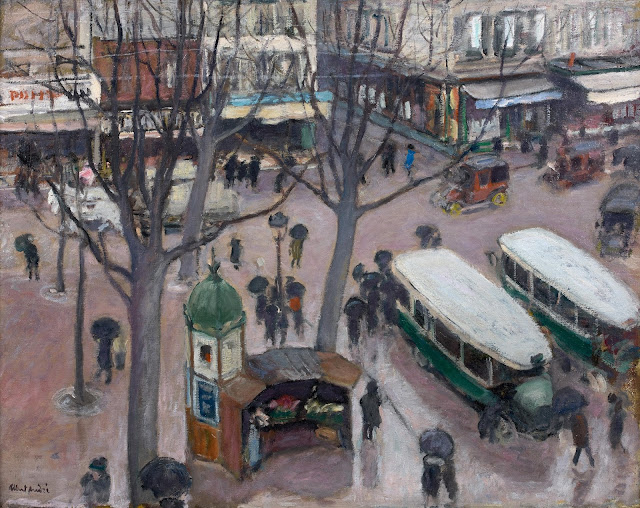
Paris, les autobus, place Pigalle - 1920 
Oil on canvas
65 x 81 cm 
Private collection

Louis Abel-Truchet, VERSAILLES 1857 - 1918 AUXERRE, FRENCH
FAIRGROUND, PLACE PIGALLE
Oil on canvas
46 x 38 cm ; 18 by 15 in.
Private collection

The Place Pigalle is a public square located in the 9th arrondissement of Paris, between the Boulevard de Clichy and the Boulevard de Rochechouart, near Sacré-Cœur, at the foot of the Montmartre hill. The place takes its name from the sculptor, Jean-Baptiste Pigalle (1714–1785), and it is the best-known district of the Quartier Pigalle, the Pigalle district.

The square and the surrounding streets were, at the end of the 19th century, a neighbourhood of painters' studios and literary cafés. More on The Place Pigalle

Louis Abel-Truchet, see above

Abraham de Verwer, HAARLEM 1585 - 1650 AMSTERDAM
VIEW OF PARIS FROM THE PONT-ROYAL WITH THE GRANDE GALERIE DU LOUVRE, THE PONT-NEUF AND THE NESLE TOWER, c. 1664
Oil on panel
54 x 90 cm ; 21 1/4  by 35 1/2  in
Private collection

The Pont Royal is a bridge crossing the river Seine in Paris. It is the third oldest bridge in Paris, after the Pont Neuf and the Pont Marie. The Pont Royal links the Right Bank by the Pavillon de Flore with the Left Bank of Paris between rue du Bac and the rue de Beaune. The bridge is constructed with five elliptical arches en plein cintre. A hydrographic ladder, indicating floods' highest level in Paris, is visible on the last pier nearest each bank. More on The Pont Royal

Abraham de Verwer (1585, Haarlem – 1650, Amsterdam), was a Dutch Golden Age painter of cityscapes, (river) landscapes and seascapes. He was also called Abraham de Verweer van Burghstrate. He travelled in northern France and when he returned, he settled in Amsterdam. It is unknown who taught him to paint, but he was noted in his wife's testament in Haarlem in 1607 as a "schrijnwerker" or cabinet-maker, and in 1614 he was noted in an Amsterdam estate inventory as a painter. He travelled in France from 1637-1639. He was the father of the Amsterdam poet Catharina Verwers and the Amsterdam painter Justus de Verwer.  More on Abraham de Verwer 

Lucien GENIN, 1894 - 1958 
At the restaurant 
Gouache on paper 
Height: 23,50 Width: 31 cm 
Private collection

Lucien Génin (9 November 1894 in Rouen – 26 August 1953 in Paris) was a French painter in the milieu of pre-World War I, and 1920s Montmartre and Saint-Germain-des-Prés. 

After the devastation of the First World War, Lucien left his provincial home in the autumn of 1919 to find his fortune among the lively Parisians in the heart of Montmartre. Not concerning himself with producing “art”, he beautifully captured the spirit if Paris between the wars while enjoying a truly Bohemian existence. Genin’s works in all their forms, perfectly convey these eclectic and friendly characters of the city and he was so well loved that one collector said “separate me from my Vlaminck, my foujita, my Derain, my Dunoyer de Segonzac and I will survive…but my Genin, never!”. More on Lucien Génin

Francois Gerome, French, 1895-? 
Boulevard Montparnasse, Paris 
Oil on canvas 
24 x 30 inches
Private collection

The Boulevard du Montparnasse is a two-way boulevard in Montparnasse, in the 6th, 14th & 15th arrondissements in Paris. Students in the 17th century who came to recite poetry in the hilly neighbourhood nicknamed it after "Mount Parnassus", home to the nine Muses of arts and sciences in Greek mythology.

The hill was levelled to construct the Boulevard Montparnasse in the 18th century. During the French Revolution many dance halls and cabarets opened their doors.

The area is also known for cafés and bars, such as the Breton restaurants specialising in crêpes located a few blocks from the Gare Montparnasse. More on The Boulevard du Montparnasse 

François Gérôme (born 1895 in Paris) was a French painter. He is best known for his paintings of women depicted at picturesque spots throughout Paris including the Place de la Concorde and in front of the Opéra. In these representations, the women usually engage the viewer with their frontal pose and direct gaze outward. Gerome used oils, typically on canvas or on board. He signed his paintings with his first initial and last name, but was also known to sign in his alias B. Kovacs. More on François Gérôme 

Ramon PICHOT GIRONES, 1872 - 1925 
Gitanes on the plaza 
Watercolor, pastel and charcoal on paper mounted on cardboard 
Height: 44 Width: 32 cm 
Private collection

Ramon Pichot Gironès (Catalan; 1871 – 1 March 1925) was a Catalan and Spanish artist. He painted in an impressionist style. He was a good friend of Pablo Picasso and an early mentor to young Salvador Dalí. Dalí met Pichot in Cadaqués, Spain, when was only 10 years old. Pichot also made many trips to France. Once in a while, Dalí and his family would go on a trip with Pichot and his family.

He married Germaine Pichot, a well-known artist's model, in 1906. Together they had a restaurant near the Bateau Lavoir, called La maison rose. Pichot left Paris after World War I but returned often to buy books, as he had turned into a bibliophile. On such a trip, he suddenly died on 1 March 1925. Picasso was so shaken by this that he included Pichot's figure in the painting "Three Dancers", on which he was working at the time. More on Ramon Pichot Gironè

John Duncan Fergusson, Scottish (1874 - 1961)
La Terrasse, Café d'Harcourt, c. 1908 - 1909
 Oil on canvas
108.60 x 122.00 cm
Scottish National Gallery Of Modern Art

This painting depicts the terrace of the fashionable Café d'Harcourt, on the Boulevard St Michel, opposite the Sorbonne University in Paris. Fergusson immensely enjoyed being part of the 'café society.' An outgoing character, he was part of a group of Anglo-American artists who made the café the centre of their social and intellectual life. Fergusson has flattened the perspective in this painting, drawing attention to surface pattern. The use of flat, bright areas of colour in particular, the green shadows in the face of the man on the right of the painting shows the influence of Matisse and the fauvist painters. More on this painting

John Duncan Fergusson, (b Leith , 9 Mar. 1874; d Glasgow, 30 Jan. 1961). Scottish painter (mainly of landscapes and figure subjects) and occasional sculptor, the best known of the Scottish Colourists. From about 1895 he made regular visits to Paris and he lived there 1907–14. His early work was Whistlerian and he then came under the influence of Manet, but by 1907 he had adopted the bold palette of Fauvism and became the most uncompromising adherent to the style among British artists (Blue Beads, 1910, Tate, London). More on John Duncan Fergusson

Lyonel Feininger
Strasse in Paris - Streets in Paris , 1918
Woodblock on Kozo paper
33.375 x 26.75 in
Private collection

Lyonel Charles Feininger (July 17, 1871 – January 13, 1956) was a German-American painter, and a leading exponent of Expressionism. He also worked as a caricaturist and comic strip artist. He was born and grew up in New York City, traveling to Germany at 16 to study and perfect his art. He started his career as a cartoonist in 1894 and met with much success in this area. He was also a commercial caricaturist for 20 years for magazines and newspapers in the USA and Germany. At the age of 36, he started to work as a fine artist. He also produced a large body of photographic works between 1928 and the mid 1950s, but he kept these primarily within his circle of friends. He was also a pianist and composer, with several piano compositions and fugues for organ extant. More on Lyonel Charles Feininger


Images are copyright of their respective owners, assignees or others

We do not sell art, art prints, framed posters or reproductions. Ads are shown only to compensate the hosting expenses.

If you enjoyed this post, please share with friends and family.


13 Classic Works of Art, Marine Paintings - With Footnotes, #31

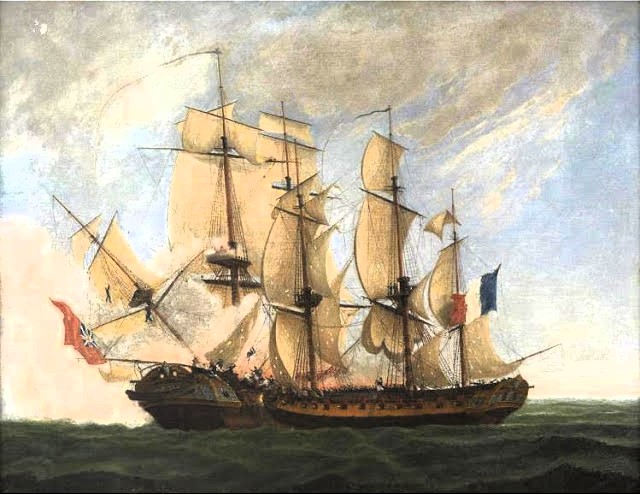
FOLLOWER OF ANGE-JOSEPH-ANTOINE ROUX, (french 1765-1835) 
"ACTION BETWEEN H.M FRIGATE ''AMBUSCADE'' AND THE FRENCH FRIGATE ''BAYONNAISE''" 
Oil on canvas 
23 3/8 x 30 in. (59.4 x 76.2cm)
Private Collection

Estimated at $2,000 - $3,000 in Jun, 2017

HMS Ambuscade was a 32-gun fifth-rate frigate of the Royal Navy, built in 1773. The French captured her in 1798 but the British recaptured her in 1803. She was broken up in 1810.

On 13 December 1798, Ambuscade captured a French merchantman, Faucon, with a cargo of sugar and coffee bound for Bordeaux. Disaster struck the following day. Ambuscade was blockading Rochefort, when the smaller French corvette Bayonnaise captured her at the Action of 14 December 1798. The court martial exonerated Captain Henry Jenkins of Ambuscade, though a good case could be made that he exhibited poor leadership and ship handling. The French brought her into service as Embuscade.

On 28 May 1803, HMS Victory recaptured her. She had a crew of 187 men under the command of capitaine de vaisseau Fradin, and was 30 days out of Cap Francais, bound for Rochefort. The Royal Navy took her back into service as Ambuscade.

In March 1805, she was attached to Sir James Craig's military expedition to Italy. Along with Dragon, Craig's flagship, and Lively, Ambuscade escorted a fleet of transports to Malta. On 4 March 1807, Ambuscade captured the ship Istria. Unité, Melpomene, Bittern and Weazel (or Weazle) were in company and shared in the prize money. More on the Ambuscade

Jean François Hue, (French, 1751-1823)
French corvette Bayonnaise boarding HMS Ambuscade during the Action of 14 December 1798

Bayonnaise was a 24-gun corvette of the French Navy, launched in 1793. Bayonnaise was being built as a privateer when the Ministry of Marine requisitioned her in 1793 before she sailed. The Ministry assumed the construction contracts and purchased her in March 1794. Her hull was coppered in 1795 in Brest. She was officially renamed Brême that year, but apparently the new name was roundly ignored.

She became famous for the Action of 14 December 1798, in which she captured the much stronger 32-gun Ambuscade off the Gironde. Ambuscade was blockading Rochefort, when the smaller Bayonnaise captured her. Ambuscade had ten men killed, including her first lieutenant and master, and 36 wounded, including her captain. Bayonnaise had 30 killed, and 30 badly wounded, including Richer and his first lieutenant.

On 28 November 1803, Ardent gave chase to Bayonnaise in Finisterre Bay. The corvette's crew ran her ashore and then set fire to her prevent the British from capturing her. Captain Winthrop of Ardent described Bayonnaise as a frigate of 32 guns and 220 men, which had been sailing from Havana to Ferrol. Actually, Bayonnaise was armed en flute with only six 8-pounder guns, and was returning from the Antilles.

Archaeologists of the "Finisterre Project" in August 2010 located Bayonnaise's wreck on Langosteira beach, Finisterre. More on the Bayonnaise

Ange-Joseph Antoine Roux, "Antoine Roux" (1765–1835) was a French fine art painter who specialised in maritime painting, sometimes referred to as marine art. Roux came from a family of artists and primarily worked in Marseille. Early in life he was apprenticed to his father, Joseph Roux (1752–93), an hydrographer as well as an artist in his own right, spending his leisure hours painting and drawing. He died of cholera in Marseille in 1835. More Roux

Jean-François Hue ( Saint-Arnoult-en-Yvelines , December 2, 1751 - Paris, 26 December 1823) was a French landscape painter of the eighteenth and nineteenth centuries. He was received at the Royal Academy in 1782. His main sources of inspiration for his works are his great voyages.

He entered the studio of Joseph Vernet as a painter and landscape designer; He painted four views of the castle of Mousseaux and it's gardens.

Having specialized in landscapes and marines, his talent allowed him to become an official Navy painter, following in the footsteps of his master Joseph Vernet . Thus, in 1791 , the Constituent Assembly entrusted him with the task of completing the series representing the ports of France, commissioned at Vernet from 1753 .

Between 1792 and 1798 , he executed a series of six paintings on the theme of the ports of Brittany . More on Jean-François Hue

Thomas Bush Hardy
Scarborough, c. 1895
watercolour
22cm x 71cm
Private Collection

Scarborough is a town on the North Sea coast of North Yorkshire, England. The town lies between 10–230 feet (3–70 m) above sea level, rising steeply northward and westward from the harbour onto limestone cliffs. 


The most striking feature of the town's geography is a high rocky promontory pointing eastward into the North Sea. The promontory supports the 11th century ruins of Scarborough Castle and separates the seafront into two bays, to the north and south. More on Scarborough 

Thomas Bush Hardy (1842, Sheffield – 1897, Maida Vale, London) was a British marine painter and watercolourist. As a young man he travelled in the Netherlands and Italy. In 1884 Hardy was elected a Member of the Royal Society of British Artists. He exhibited with the Society and also at the Royal Academy.
His paintings feature coastal scenes in England and the Netherlands, the French Channel ports and the Venetian Lagoon.

Hardy had nine children. His son Dudley Hardy was a painter, illustrator and poster designer. His daughter Dorothy received an MBE after working as a nurse in the First World War. He died on 15 December 1897 in Maida Vale, London. More on Thomas Bush Hardy

Charles Dixon, 1872 - 1934
In Mid Atlantic, c. 1921
Watercolour heightened with body colour
43.5cm x 76.5cm
Private Collection

Charles Edward Dixon (8 December 1872 - 12 September 1934) was a British maritime painter of the late nineteenth and early twentieth centuries, whose work was highly successful and regularly exhibited at the Royal Academy. Several of his paintings are held by the National Maritime Museum and he was a regular contributing artist to magazines and periodicals. He lived at Itchenor in Sussex and died in 1934. More on Charles Edward Dixon

Charles Dixon, 1872 - 1934
Tower Bridge, 1910
Watercolour and bodycolour on paper on paper
535 x 372mm
Private Collection

Tower Bridge is a combined bascule and suspension bridge in London built between 1886 and 1894. The bridge crosses the River Thames close to the Tower of London. 

In the second half of the 19th century, an advertisement in the East End of London led to a hiring for a new river crossing downstream of London Bridge. A traditional fixed bridge at street level could not be built because it would cut off access by sailing ships to the port facilities in the Pool of London, between London Bridge and the Tower of London. More on the Tower Bridge

Lyonel Feininger, 1910 - 2011
Romance at the seaside, 1943
Watercolour and ink on paper
24 x 31.5 cm.
Private Collection

T. Lux Feininger (June 11, 1910 Berlin — July 7, 2011 Cambridge) was an American painter, avant-garde photographer, author, and art teacher who was born in Berlin to Julia Berg and Lyonel Charles Feininger, an American living in Germany from the age of sixteen. His father was the first faculty appointment made to the Bauhaus in Weimar by its founder, Walter Gropius, in 1919. He had two older full brothers, including Andreas Feininger, and two half sisters, even older, by Clara Fürst and his father (from his first marriage). More Lyonel Feininger 

Lyonel Feininger, 1910 - 2011
Untitled - sailing boat, c. 1934
ink, watercolour on paper
16.1 x 19 cm
Private Collection

William Lee Hankey, (1869–1952) 
Sardine Boats at Douarnenez, France
Oil on canvas
63 x 76cm (24 3/4 x 29 7/8in.)
Private Collection

William Lee Hankey (1869–1952) RWS,RI,ROI,RE,NS was a British painter and book illustrator. He specialised in landscapes, character studies and portraits of pastoral life, particularly in studies of mothers with young children.

He was born in Chester and worked as a designer after leaving school. He studied art in the evenings at the Chester School of Art, then at the Royal College of Art. Later in Paris he became influenced by the work of Jules Bastien-Lepage, who also favoured rustic scenes depicted in a realistic but sentimental style. He first exhibited at the Royal Academy in 1896 and was President of the London Sketch Club from 1902 to 1904. He stayed in France in the early 1900s, painting many of his works in Brittany and Normandy. From 1904 until well after World War I he maintained a studio at the Etaples art colony.

It was Hankey's black and white and coloured etchings of the people of Étaples, which gained him a reputation as 'one of the most gifted of the figurative printmakers working in original drypoint during the first thirty years of the 20th century'. One that is particularly striking for its stylistic presentation was "The Refugees", his contribution to raising awareness of the consequences for ordinary people of the German invasion of France and Belgium in 1914. He went on to serve with the Artists' Rifles from 1915 to 1918.

In Britain he had been associated with the Newlyn School, a group of English artists based in the titular village in Cornwall who were themselves influenced by the romantic poets such as Wordsworth and Keats. More on William Lee Hankey

Michael Peter Ancher  (1849–1927)
The Lifeboat is Taken through the Dunes, c. 1883
Oil on canvas
171 × 221 cm (67.3 × 87 in)
Museum for Kunst,  Copenhagen

Michael Peter Ancher (9 June 1849 – 19 September 1927) was a Danish realist artist. He is remembered above all for his paintings of fishermen and other scenes from the Danish fishing community in Skagen. Ancher was born on the island of Bornholm. He attended school in Rønne but was unable to complete his secondary education as his father ran into financial difficulties. In 1866, he met the painters Theodor Philipsen and Vilhelm Groth. Impressed with his own early work, they encouraged him to take up painting as a profession. In 1871, he spent a short period at C.V Nielsen's art school as a preliminary to joining the Royal Danish Academy of Art in Copenhagen later in the year. Although he spent some time at the academy, he left in 1875 without graduating.

Michael Peter Ancher  (1849–1927)
Will he round the point? c. 1885
Oil on canvas
110x142 cm.
Private Collection

He achieved his artistic breakthrough in 1879 with the painting Vil han klare pynten (Will He Round the Point?) (above). Michael Ancher's works depict Skagen's heroic fishermen and their dramatic experiences at sea. More on Michael Peter Ancher 

N. C. Wyeth, 1882 - 1945
Deep Cove Lobster Man, ca.1938
Oil on gessoed board (Renaissance Panel)
16 1/4 x 22 3/4 in.
Pennsylvania Academy of the Fine Arts, Philadelphia, Pennsylvania

Newell Convers Wyeth (October 22, 1882 – October 19, 1945), known as N. C. Wyeth, was an American artist and illustrator. During his lifetime, Wyeth created over 3,000 paintings and illustrated 112 books, 25 of them for Scribner's, the Scribner Classics, which is the work for which he is best known. The first of these, Treasure Island, was one of his masterpieces and the proceeds paid for his studio. Wyeth was a realist painter just as the camera and photography began to compete with his craft. Sometimes seen as melodramatic, his illustrations were designed to be understood quickly. He is notably the father of painter Andrew Wyeth and the grandfather of Jamie Wyeth, both celebrated American painters. More on Newell Convers Wyeth

Joaquín Sorolla y Bastida, 1863 - 1923
Breakwater, San Sebastian, 1918
Oil on canvas
81 x 104.5 cm
Sorolla Museum,  Madrid, Spain

San Sebastián is a coastal city and municipality located in the Basque Autonomous Community, Spain. It lies on the coast of the Bay of Biscay, 20 km from the French border. San Sebastián's picturesque shoreline makes it a popular beach resort. The seaside environment is enhanced by hilly surroundings that are easily accessible. More on San Sebastián

Joaquín Sorolla y Bastida (27 February 1863 – 10 August 1923) was a Spanish painter. Sorolla excelled in the painting of portraits, landscapes, and monumental works of social and historical themes. His most typical works are characterized by a dexterous representation of the people and landscape under the sunlight of his native land. More on Joaquín Sorolla y Bastida

Unknown artist (20TH CENTURY)
STEAM SHIP
Oil on panel
8 x 10 in.
Private Collection


Please visit my other blogs: Art Collector, Mythology, Marine Art, Portrait of a Lady, The Orientalist, Art of the Nude and The Canals of Venice, Middle East Artists, 365 Saints, 365 Days, and Biblical Icons, also visit my Boards on Pinterest

Images are copyright of their respective owners, assignees or others. Some Images may be subject to copyright

I don't own any of these images - credit is always given when due unless it is unknown to me. if I post your images without your permission, please tell me.

I do not sell art, art prints, framed posters or reproductions. Ads are shown only to compensate the hosting expenses.

If you enjoyed this post, please share with friends and family.
Thank you for visiting my blog and also for liking its posts and pages.

Please note that the content of this post primarily consists of articles available from Wikipedia or other free sources online.

15 Classic Works of Art, Marine Paintings - With Footnotes, #29

Henri Le Sidaner, 1862 - 1939
BATEAUX DANS LA LAGUNE/ BOATS IN THE LAGOON, ETAPLES, c. 1885
Oil on wood panel
6 1/4 by 10 1/2 in., 15.9 by 26.7 cm
Painted in 1885.
Private Collection

Étaples or Étaples-sur-Mer is a commune in the Pas-de-Calais department in northern France. It is a fishing and leisure port on the Canche river.During the ninth century the coast was subject to raids and settlement by Norsemen. From their point of view, this off-shore site, protected by mud flats and marsh, was ideal as a base from which to conduct raids elsewhere, assemble the booty and ship it home.  More on Étaples

Henri Eugène Augustin Le Sidaner (7 August 1862 – July 1939) was an intimist painter. Sidaner was born to a French family in Port Louis, Mauritius. In 1870 he and his family settled in Dunkirk. Le Sidaner received most of his tutelage from the École des Beaux-Arts under the instruction of Alexandre Cabanel but later broke away due to artistic differences.

Between 1885 and 1894 Le Sidaner lived the year round at the Etaples art colony and was joined there by his childhood friend Eugène Chigot (1860–1923), who shared his interest in atmospheric light. Later Le Sidaner traveled extensively throughout France. He also visited many cities around the globe, as well as villages throughout Europe. He exhibited at the Salon, the Galeries Georges Petit in Paris and the Goupil Gallery in London, and settled in Gerberoy.

Marcel Proust's mention of Le Sidaner's work in his novel In Search of Lost Time confirms its later reputation. In Sodom and Gomorrah, the narrator mentions that an eminent barrister from Paris had devoted his income to collecting the paintings of the "highly distinguished" but "not great" Le Sidaner. More on Henri Eugène Augustin Le Sidaner

Montague Dawson, RMSA, FRSA (1890–1973) 
Brisk Weather off the Needles, Isle of Wight
oil on canvas
24 x 36 in. (61 x 91.4 cm.)
Private Collection

The Needles is a row of three distinctive stacks of chalk that rise about 30m out of the sea off the western extremity of the Isle of Wight, United Kingdom, close to Alum Bay. The Needles Lighthouse stands at the outer, western end of the formation. Built in 1859, it has been automated since 1994.[5]

The formation takes its name from a fourth needle-shaped pillar called Lot's Wife, that collapsed in a storm in 1764.[6] The remaining rocks are not at all needle-like, but the name has stuck. More on The Needles 

Montague Dawson RMSA, FRSA (1890–1973) was a British painter who was renowned as a maritime artist. His most famous paintings depict sailing ships, usually clippers or warships of the 18th and 19th centuries. Montague was the son of a keen yachtsman and the grandson of the marine painter Henry Dawson (1811–1878), born in Chiswick, London. Much of his childhood was spent on Southampton Water where he was able to indulge his interest in the study of ships. For a brief period around 1910 Dawson worked for a commercial art studio in Bedford Row, London, but with the outbreak of the First World War he joined the Royal Navy. Whilst serving with the Navy in Falmouth he met Charles Napier Hemy (1841–1917), who considerably influenced his work. In 1924 Dawson was the official artist for an Expedition to the South Seas by the steam yacht St.George. During the expedition he provided illustrated reports to the Graphic magazine.

After the War, Dawson established himself as a professional marine artist, concentrating on historical subjects and portraits of deep-water sailing ships. During the Second World War, he was employed as a war artist. Dawson exhibited regularly at the Royal Society of Marine Artists, of which he became a member, from 1946 to 1964, and occasionally at the Royal Academy between 1917 and 1936. By the 1930s he was considered one of the greatest living marine artists, whose patrons included two American Presidents, Dwight D Eisenhower and Lyndon B Johnson, as well as the British Royal Family. Also in the 1930s, he moved to Milford-Upon-Sea in Hampshire, living there for many years. Dawson is noted for the strict accuracy in the nautical detail of his paintings which often sell for six figures.

The work of Montague Dawson is represented in the National Maritime Museum, Greenwich and the Royal Naval Museum, Portsmouth. More

Kamel Mustafa Mohamed, (b 1917 – d 1982)
Untitled (The Fisherman)
Oil On Panel
25 cm x  35 cm
Private Collection

Kamel Mustafa, (b 1917 – d 1982), graduated from the Faculty of Fine Art in 1941. Also in 1950, he had a diploma in restoration technique of oil painting. He was Professor and Head of Painting Department at the Faculty of Fine Arts, Alexandria then Dean of the Faculty from 1969 to 1977, thus preserving the liberated values spread by the late artist Ahmad Othman, who established the college.

He was an Impressionist painter who leaned towards academic realism. He belonged to the second generation of Modern Egyptian artists. From 1936, the artist spent ten years working in Cairo painting a wide-range of subjects, including traditional scenes from the city and rural life.

Kamel Mustafa Mohamed, (b 1917 – d 1982)
Untitled
Oil On Panel
: 25 cm x  20 cm
Private Collection

Between 1946 and 1950 Mustafa travelled to Italy for further study. There he was exposed to various trends, including post-impressionism. By the beginning of the 1950s his work passed through a distinctly modernist phase, where composition and execution were carefully controlled.

He drew the attention of critics when he exhibited his works at Alexandria Biennale (two sessions) and Venice Biennale (three sessions). He was the Guest of Honor of 19th Alexandria Biennale in 1997. Kamel Mustafa also exhibited his works in Italy, Warsaw, Poland; and Berlin, Germany. More Kamel Mustafa

François Gall, 1912 - 1987
LECTURE ET DÉTENTE, PLAGE DE TROUVILLE, c. 1965
Signed F.Gall and inscribed Trouville (lower right)
Oil on canvas
10 1/8 by 18 1/8 in., 25.7 by 46 cm
Private Collection

Trouville-sur-Mer, commonly referred to as Trouville, is a commune in the Calvados department in the Normandy region in northwestern France. Trouville-sur-Mer borders Deauville. This village of fishermen is a popular tourist attraction in Normandy. More on Trouville

François Gall (1912–1987) was a Hungarian painter. He became an impressionist painter in the pure French tradition after he moved to Paris in 1936. He was born in Kolozsvar in the former region of Transylvania on March 22, 1912 and began studying all media at the Royal Academy of Fine Arts in Rome while working menial jobs to secure a living. In 1939, the Hungarian government awarded Gall with a scholarship for his artistic merit.

Six years later, Francois Gall established himself in Paris and became a student of Devambez at the National Academy of Fine Arts. He greatly admired the first generation of Impressionists and adopted their concepts for his own interpretations. Parisian scenes and and portrayals of women engaged in typically feminine activities were amoung his preferred subjects. Francois was a modern impressionist, bringing his own unique personality to this most enduring style.

Gall participated in various Salon exhibitions in Paris and became a favorite with the public. In 1963, he was honoured with the Francis Smith Prize. He died in 1987. More on François Gall

EDWARD MORAN, American, (1829-1901)
Sailing in the Moonlight
Oil on canvas
20 x 30 inches
Private Collection

Edward Moran (August 19, 1829 in Bolton, Lancashire, England – June 8, 1901 in New York City) was an American artist of maritime paintings. Moran was born in England on August 19, 1829. Following in the footsteps of his father's profession, he learned to operate a hand-loom at a young age, though he would often be found sketching with charcoal on the white fabric instead of plying the shuttle. His family first emigrated to Maryland in 1844, and then to Philadelphia a year later.

It was in Philadelphia around 1845 that Edward apprenticed under James Hamilton and landscape painter Paul Weber; Hamilton guided Moran specifically in the style of marine paintings. In the 1850s Moran began to make a name for himself in the Philadelphia artistic scene; working in the same studio as his younger brother, famous American painter Thomas Moran, Edward received commissions and even completed some lithographic work. In 1862, he traveled to London and became a pupil in the Royal Academy. 

In 1885, at the height of his career, Moran began on what would be considered his most important work - a series of 13 paintings representing the Marine History of the United States. He chose to have thirteen paintings in the series because of the significance of the number in American history (13 colonies, 13 stars and stripes on the original US flag, etc.). The subjects include Leif Ericsson, Christopher Columbus, Hernando de Soto, Henry Hudson, and Admiral Dewey, among others. Not long after their completion, the series was displayed at the 1893 World's Fair in Chicago. More

LYONEL FEININGER, 1871-1956
Three Sailing Boats, 1933
Watercolour and Indian ink on paper
8 7/10 × 11 1/2 in, 22.1 × 29.1 cm
Private Collection

Though originally from New York, Lyonel Feininger spent a great deal of his career in Germany and is closely associated with the German Expressionist movement as well as the Bauhaus, where he was an active teacher and practitioner. Early Cubism and Futurism acted as significant sources of inspiration in the development of Feininger’s personal style, characterized by angular lines and transparent intersecting planes. When the Bauhaus was dissolved by the Nazi party in the late 1930s, Feininger returned to his native New York, adding a series of skylines and seascapes to his already prolific body of work.


T. Lux Feininger (June 11, 1910 Berlin — July 7, 2011 Cambridge) was an American painter, avant-garde photographer, author, and art teacher who was born in Berlin to Julia Berg and Lyonel Charles Feininger, an American living in Germany from the age of sixteen. His father was the first faculty appointment made to the Bauhaus in Weimar by its founder, Walter Gropius, in 1919. He had two older full brothers, including Andreas Feininger, and two half sisters, even older, by Clara Fürst and his father (from his first marriage). More Lyonel Feininger 

Frank Myers Boggs, American, 1855-1926 
Harbor Scene 
Oil on canvas 
25 x 34 1/2 inches 
Private Collection

Frank Myers Boggs (* 6. December 1855 in Springfield , Ohio ; † August 8, 1926 in Meudon , Hauts-de-Seine )  was active, and naturalized in France .  He was a painter of urban landscapes, marine. Watercolorist , engraver , draftsman.

Mixing tonalist and impressionist elements, Frank Myers Boggs forged a novel artistic style at the juncture of fin-de-siècle American and European traditions. Born in Ohio, Boggs trained at the École des Beaux-Arts under Jean Léon Gerôme and spent the majority of his life in Paris. There, he accomplished the rare feat of gaining prominence in both the French and American art worlds. By the end of his life, Boggs had essentially transformed himself into a French impressionist: he became a French citizen in 1923 and earned the French Legion of Honor three years later. 

Frank Myers Boggs, American, 1855-1926 
In Port
Oil on canvas 
38.1 cm (15 in.), Width: 54.93 cm (21.63 in.)
Private Collection

Boggs won a prize from the American Art Association in 1884 and silver medals from the Paris Universal Exposition of 1889 and the Chicago World’s Columbian Exposition of 1893. His paintings are now in the Metropolitan Museum of Art, Brooklyn Museum of Art, and Museum of Fine Arts, Boston, as well as the Réunion des Musées Nationaux of Paris, Luxembourg Museum, and Museum of Nantes in France. More on Frank Myers Boggs

David Davidovich Burliuk, American/Russian Federation, 1882-1967 
Florida Fishing 
Oil on canvas 
12 x 16 inches 
Private Collection

David Davidovich Burliuk (Ukrainian and Russian: Дави́д Дави́дович Бурлю́к; 21 July 1882 – 15 January 1967) was born on the farmstead of Semirotovshchina in the Kharkov province (now Ukraine) in 1882. Died in Long Island, USA in 1967. This artist is a member of the well-known Burliuk art dynasty. He was a painter and poet, an art critic, and one of the theoreticians of Russian Futurism. He studied at the Kazan and Odessa art schools, at Aschbe’s school and the Royal Academy in Munich, in Cormon’s studio in Paris, and at the Moscow School of Painting, Sculpture and Architecture. He was the organizer of numerous exhibitions and the “Gilea” group. He was a member of the German “Sturm” and “Blaue Reiter” (Blue Rider) associations of artists. In 1920, he immigrated to Japan via Siberia, and from 1922 lived in the USA. In addition to landscapes, he painted portraits, still life, and allegoric compositions in his own invariable impasto style. More on David Davidovich Burliuk

Claude Monet, French, 1840 - 1926
The Rocks at Pourville, Low Tide, 1882
Oil on canvas
25 5/16 in. x 31 in. (64.29 cm x 78.74 cm)
Memorial Art Gallery of the University of Rochester

In Rocks at low tide, Pourville writhing contours form abstract rocks. Monet’s mobile brushstrokes create a sense of the rock forms beneath the water by suggesting the movement of water around them. More on Rocks at low tide, Pourville

A former fishing village, became Pourville-sur-Mer the early nineteenth century, a popular resort in Normandy. The village, depending on Hautot-sur-Mer, near Dieppe, has also attracted many talented painters in his time, like Claude Monet who made several landscapes.
After a significant development in the interwar period, the station was indeed one of the favorite destinations of the Parisian art world, thanks to the presence of a casino and other luxury hotels. Surrounded by cliffs, the village of Pourville-sur-Mer also impresses with its pebble and sand, overlooking the English Channel, as well as its breathtaking view of Dieppe and its surroundings. More on Pourville-sur-Mer

Oscar-Claude Monet (14 November 1840 – 5 December 1926) was a founder of French Impressionist painting, and the most consistent and prolific practitioner of the movement's philosophy of expressing one's perceptions before nature, especially as applied to plein-air landscape painting. The term "Impressionism" is derived from the title of his painting Impression, soleil levant (Impression, Sunrise), which was exhibited in 1874 in the first of the independent exhibitions mounted by Monet and his associates as an alternative to the Salon de Paris.

Monet's ambition of documenting the French countryside led him to adopt a method of painting the same scene many times in order to capture the changing of light and the passing of the seasons. From 1883 Monet lived in Giverny, where he purchased a house and property and began a vast landscaping project which included lily ponds that would become the subjects of his best-known works. In 1899 he began painting the water lilies, first in vertical views with a Japanese bridge as a central feature, and later in the series of large-scale paintings that was to occupy him continuously for the next 20 years of his life. More Oscar-Claude Monet


Wael Abdel Sabour
The Harbor, c. 2010
Mixed Media on paper
90x120 cm
Private Collection

I could not find any useful information on Wael Abdel Sabour.

Hamed Said, (Egypt, 1908-2006)
Women along a beach, circa early 1940s
Oil on panel
60 x 120cm (23 5/8 x 47 1/4in).
Private Collection

Hamed Said, Egypt, 1908-2006, was considered an intellectual and theoretical figure within the Egyptian Fine Art movement.

He obtained a state scholarship to England between 1936 and 1939, studying at the Chelsea College of Arts. 

In 1946 he founded the "Art & Life Group" which focused in boosting the awareness of the relationship between art and everyday life in the aim of reviving Egyptian identity. The group achieved great success in the seven exhibitions it held and participated in the 
Venice Biennale in 1956 . The famous British writer and art critic Herbert Read praised the groups "sincerity and independence ". In 1981 he he received a State Award for his contribution to the arts. More Hamed Said

Eugene-Marie Salanson, (French, 1864-1892)
The fisher girl 
Oil on canvas
53 1/2 x 31 3/4in (136 x 80.5cm)
Private Collection

Eugénie Alexandrine Marie Salanson (15 December 1836, Albert - 23 July 1912, Saint-Pair-sur-Mer) was a French painter in the Academic style. Her father came from Ispagnac to Albert to serve as a tariff collector. The family later moved to Saint-Valery-sur-Somme, where her twin sisters were born, then on to Saint-Omer, where her father had been appointed Receiver (head tax collector).

It was near there, in Calais, that she took her first art lessons from a local artist named Crocher. She then went to Paris to continue her studies but, at that time, the École des Beaux-arts did not accept female applicants, so she attended the Académie Julian, where she studied with William Bouguereau. Later, she took private lessons from Léon Cogniet. In 1877, she exhibited her portrait of Cogniet at the Salon, which brought her numerous commissions. The following year, she participated in the Exposition Universelle.

Soon, she was exhibiting throughout France and abroad. In 1882 she, Camille Claudel, Jessie Lipscomb and others set up their own studio on the Rue Notre-Dame-des-Champs.

By the end of the 1880s, she was able to acquire the "Villa Saint-Joseph" in the growing seaside resort of Saint-Pair-sur-Mer. This inspired her to create her best known paintings, depicting the young fisherwomen who worked nearby. Her painting "A marée basse" (Low tide) was one of the works featured in Women Painters of the World by Walter Shaw Sparrow (1905); one of the first books that treated female artists as worthy of serious attention..

She divided her time between Paris and her villa, and died there at the age of seventy-five. Most of her works are in private collections. More on Eugénie Alexandrine Marie Salanson

Sir William Russell Flint, RA, PRWS (British, 1880-1969)
The shrimper 
Watercolor on paper
19 1/8 x 26 3/16in (48.5 x 66.5cm)
Private Collection

Sir William Russell Flint (4 April 1880 – 30 December 1969) was a Scottish artist and illustrator who was known especially for his watercolour paintings of women. He also worked in oils, tempera, and printmaking. He was born in Edinburgh then educated at Daniel Stewart's College and Edinburgh Institution. From 1894 to 1900 Flint apprenticed as a lithographic draughtsman while taking classes at the Royal Institute of Art, Edinburgh. From 1900 to 1902 he worked as a medical illustrator in London while studying part-time at Heatherley's Art School. He furthered his art education by studying independently at the British Museum. 

Flint was elected president of Britain’s Royal Society of Painters in Watercolours (now the Royal Watercolour Society) in 1936 to 1956, and knighted in 1947. More on Sir William Russell Flint


Acknowledgement: Bonhams   , and others

Images are copyright of their respective owners, assignees or others

We do not sell art prints, framed posters or reproductions. Ads are shown only to compensate the hosting expenses.

If you enjoyed this post, please share with friends and family.