01 Painting, Streets of Paris, by the artists of the time, Part 31 - With Footnotes

Manfred Lindemann-Frommel, 1852 - 1939, GERMAN
THE PORTE SAINT MARTIN, c. 1891
Oil on canvas
59 by 73.5cm., 23 by 29in.
Private collection

The Porte Saint-Martin is a Parisian monument located at the site of one of the gates of the now-destroyed fortifications of Paris. It is located at the crossing of Rue Saint-Martin, Rue du Faubourg Saint-Martin and the grands boulevards Boulevard Saint-Martin and Boulevard Saint-Denis.


The Porte Saint-Martin was designed by architect Pierre Bullet at the order of Louis XIV in honor of his victories on the Rhine and in Franche-Comté. Built in 1674, it replaced a medieval gate in the city walls built by Charles V. It was restored in 1988. More on The Porte Saint-Martin 

Manfred Lindemann-Frommel (born November 18, 1852 in Munich , † June 15, 1939 in Regensburg ) was a German marine painter, architect and art professor. He first studied architecture in Karlsruhe. He was a student from 1875 to 1883 at the Technical University of Munich by Adolf Heinrich Lier . He then continued his studies at the State Academy of Fine Arts in Karlsruhe under Hermann Baisch and Gustav Schoenleber. He also attended the School of Applied Arts in Dresden .


Professionally he went to Berlin in 1891 , in 1895 at the Berlin Bauakademie , in 1895 he exhibited at the Great Art Exhibition in Berlin. In 1896 he moved to Laboe, in 1912 to Kiel, in 1926 to Regensburg , where he lived and worked in the palatial Künstlerhaus Wittelsbacher Straße 9 . Lindemann-Frommel painted mainly seascapes with ships of the German fleet, these also as murals for city halls. More on Manfred Lindemann-Frommel


Images are copyright of their respective owners, assignees or others. Some Images may be subject to copyright

I do not sell art, art prints, framed posters or reproductions. Ads are shown only to compensate the hosting expenses.

If you enjoyed this post, please share with friends and family.

Thank you for visiting my blog and also for liking its posts and pages.

Tate blockbuster to prove Pierre Bonnard was a great Modern painter | The Art Newspaper

Pierre Bonnard
Dining Room in the Country (1913)
Oil on canvas
64 3/4 x 81 in. (164.47 x 205.74 cm)
Minneapolis Institute of Art

In 1912, Pierre Bonnard bought a country house called Ma Roulotte ("My Caravan") at Vernonnet, a small town on the Seine. This painting shows the dining room there, with cats perching on the chairs and Marthe de Méligny, the artist's wife, leaning on the windowsill. Bonnard, who considered himself "the last of the Impressionists," emphasized the expressive qualities of bright colors and loose brushstrokes in this picture. He united the interior with the exterior through the open window and door, and linked the forms by bathing them in related hues. Unlike the Impressionists, however, Bonnard painted entirely from memory. And like the Symbolists, he wanted his works to reflect his subjective response to the subject. More on this painting

Pierre Bonnard (French: [bɔnaʁ]; 3 October 1867 – 23 January 1947) was a French painter, illustrator and printmaker, known especially for the stylized decorative qualities of his paintings and his bold use of color. A founding member of the Post-Impressionist group of avant-garde painters Les Nabis, his early work was strongly influenced by the work of Paul Gauguin, as well as the prints of Hokusai and other Japanese artists. Bonnard was a leading figure in the transition from Impressionism to Modernism. He painted landscapes, urban scenes, portraits and intimate domestic scenes, where the backgrounds, colors and painting style usually took precedence over the subject More on Pierre Bonnard


Please visit my other blogs: Art Collector, Mythology, Marine Art, Portrait of a Lady, The Orientalist, Art of the Nude and The Canals of Venice, Middle East Artists, 365 Saints, 365 Days, and Biblical Icons, also visit my Boards on Pinterest and deviantart

Images are copyright of their respective owners, assignees or others. Some Images may be subject to copyright

I don't own any of these images - credit is always given when due unless it is unknown to me. if I post your images without your permission, please tell me.

I do not sell art, art prints, framed posters or reproductions. Ads are shown only to compensate the hosting expenses.

If you enjoyed this post, please share with friends and family.

Thank you for visiting my blog and also for liking its posts and pages.

Please note that the content of this post primarily consists of articles available from Wikipedia or other free sources online.

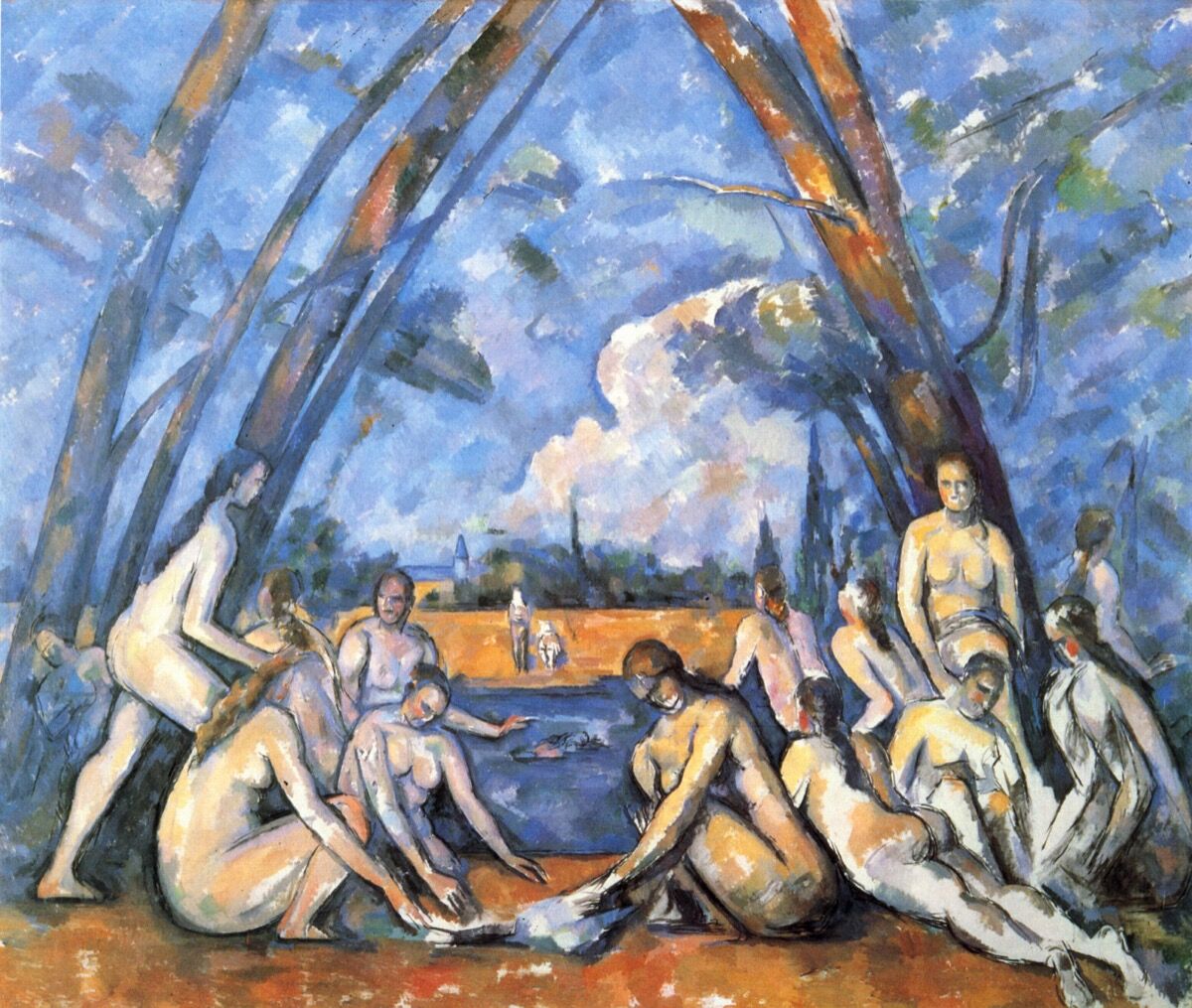
Why Art History Is Full of People Taking Baths - Artsy

Paul Cézanne, The Large Bathers, 1900–06. Courtesy of the Philadelphia Museum of Art.
Paul Cézanne
The Large Bathers, 1900–06
Courtesy of the Philadelphia Museum of Art.


Why Art History Is Full of People Taking Baths - Artsy: It’s one of the most common human activities—yet artists from the ancient Greeks to the Surrealists and beyond have been fascinated by bathing.

The figure of the bather is one of the most common visual tropes in Western art history. From ancient Athens to 1920s Paris and beyond, painters and sculptors have presented bathing in a variety of ways with myriad different aims, whether instructional, titillating, or allegorical...


Please visit my other blogs: Art Collector, Mythology, Marine Art, and The Canals of Venice

Images are copyright of their respective owners, assignees or others. Some Images may be subject to copyright

I don't own any of these images - credit is always given when due unless it is unknown to me. if I post your images without your permission, please tell me.

I do not sell art, art prints, framed posters or reproductions. Ads are shown only to compensate the hosting expenses.

If you enjoyed this post, please share with friends and family.

Thank you for visiting my blog and also for liking its posts and pages.

Social media doesn't want you to see Rubens' paintings


Flanders – the perfect destination to enjoy the Flemish Masters in all their glory – is denouncing artistic censorship on social media platforms in a playful manner. At the Rubens House, ‘nudity viewers’ with a Facebook account were blocked from viewing nudity by a group of “social media police agents”.

01 Paintings by the Orientalist Artists in the Nineteenth-Century, with footnotes, 22

Henri Rousseau, 1844 - 1910, FRENCH
A DESERT ENCAMPMENT, c. 1908
Oil on canvas
87 by 127.5cm., 34½ by 50¼in.
Private collection

Henri Rousseau Henry, Emilien Rousseau (Cairo 1875 - Aix-en-Provence in 1933) is an Orientalist painter. A pupil of Jean-Léon Gérôme at the Beaux Arts in Paris, he won the second Grand Prix de Rome in 1900 and a travel grant at the Salon of French Artists. He traveled to Belgium, the Netherlands, North Africa, Spain and Italy where he admired the great masters (Rubens, Rembrandt, Velasquez, Murillo, the Titian, Raphael etc ...)


After this initiatory journey, he settled in Versailles and set up his studio at the Villa des Arts in Paris. In 1919 he moved to Aix in Provence with his large family (seven children). Knight of the Legion of Honour in arts. His work  is dedicated to Tunisia, Algeria and especially Morocco, Provence and the Camargue remained its anchor points. His success was with a bourgeois and wealthy clientele, where he sold his work at numerous exhibitions in Paris, Brussels, Stockholm, Marseilles. More Henri Rousseau


Please visit my other blogs: Art Collector, Mythology, Marine Art, and The Canals of Venice

Images are copyright of their respective owners, assignees or others. Some Images may be subject to copyright

I don't own any of these images - credit is always given when due unless it is unknown to me. if I post your images without your permission, please tell me.

I do not sell art, art prints, framed posters or reproductions. Ads are shown only to compensate the hosting expenses.


If you enjoyed this post, please share with friends and family.

01 Painting, Streets of Paris, by the artists of the time, Part 32 - With Footnotes

Giovanni Boldini, 1842 - 1931, ITALIAN
LES PARISIENNES
Oil on panel
31.5 by by 24¾cm., 12¼ by 9¼in.
Private collection

Les Parisiennes epitomises Boldini's compositions of the salons of Empire-period homes, providing a glimpse into the leisured lives of their elegantly costumed occupants. 


Here two beautiful, fashionable young ladies are shown passing a quiet afternoon in a Louis XVI-decorated study. A Flemish Classical Triumph tapestry, from Brussels of Bruges of the 16th Century, forms the backdrop to the composition, while an Anatolian single-niche prayer rug of lustrous colour is laid out on the floor. The brunette is distracted by events unfolding outside the window, while the blonde model, Berthe – Boldini's lover and muse – reads quietly. Adding to the period décor are the open secrétaire à abattant and desk chair, as well as the Gobelins woven tapestry adorning the walls. Berthe reads Le Figaro and holds a lit cigarette, her casual, relaxed position denoting an air of confidence. Le Figaro, France's oldest newspaper, was founded in 1826 as a satirical weekly and took its name and motto from The Marriage of Figaro. More on this painting


Giovanni Boldini (31 December 1842 in Ferrara, Italy – 11 July 1931 in Paris, France) was an Italian genre and portrait painter. According to a 1933 article in Time magazine, he was known as the "Master of Swish" because of his flowing style of painting. Boldini was born in Ferrara, the son of a painter of religious subjects, and in 1862 went to Florence for six years to study and pursue painting. He only infrequently attended classes at the Academy of Fine Arts, but in Florence, met other realist painters known as the Macchiaioli, who were Italian precursors to Impressionism. 

Moving to London, Boldini attained success as a portraitist. He completed portraits of premier members of society. From 1872 he lived in Paris, where he became a friend of Edgar Degas. He also became the most fashionable portrait painter in Paris in the late 19th century. He was nominated commissioner of the Italian section of the Paris Exposition in 1889, and received the Légion d'honneur for this appointment.


A Boldini portrait of his former muse Marthe de Florian, a French actress, was discovered in a Paris flat in late 2010, hidden away from view on the premises that were unvisited for 70 years. The portrait has never been listed, exhibited or published and the flat belonged to de Florian's granddaughter who went to live in the South of France at the outbreak of the Second World War and never returned. A love-note and a biographical reference to the work painted in 1888, when the actress was 24, cemented its authenticity. The full length portrait of the lady in the same clothing and accessories, but less provocative, hangs in the New Orleans Museum of Art. More on Giovanni Boldini


Please visit my other blogs: Art Collector, Mythology, Marine Art, and The Canals of Venice

Images are copyright of their respective owners, assignees or others. Some Images may be subject to copyright

I don't own any of these images - credit is always given when due unless it is unknown to me. if I post your images without your permission, please tell me.

I do not sell art, art prints, framed posters or reproductions. Ads are shown only to compensate the hosting expenses.

If you enjoyed this post, please share with friends and family.


Thank you for visiting my blog and also for liking its posts and pages.

Emil Nolde (born Emil Hansen; 7 August 1867 – 13 April 1956) was a German-Danish painter and printmaker

Emil Nolde

Emil Nolde (born Emil Hansen; 7 August 1867 – 13 April 1956) was a German-Danish painter and printmaker. He was one of the first Expressionists, a member of Die Brücke, and was one of the first oil painting and watercolor painters of the early 20th century to explore color. He is known for his brushwork and expressive choice of colors. Golden yellows and deep reds appear frequently in his work, giving a luminous quality to otherwise somber tones. His watercolors include vivid, brooding storm-scapes and brilliant florals.


Nolde's intense preoccupation with the subject of flowers reflected his interest in the art of Vincent van Gogh. More on Emil Nolde


Please visit my other blogs: Art Collector, Mythology, Marine Art, and The Canals of Venice

Images are copyright of their respective owners, assignees or others. Some Images may be subject to copyright

I don't own any of these images - credit is always given when due unless it is unknown to me. if I post your images without your permission, please tell me.

I do not sell art, art prints, framed posters or reproductions. Ads are shown only to compensate the hosting expenses.

If you enjoyed this post, please share with friends and family.

Thank you for visiting my blog and also for liking its posts and pages.

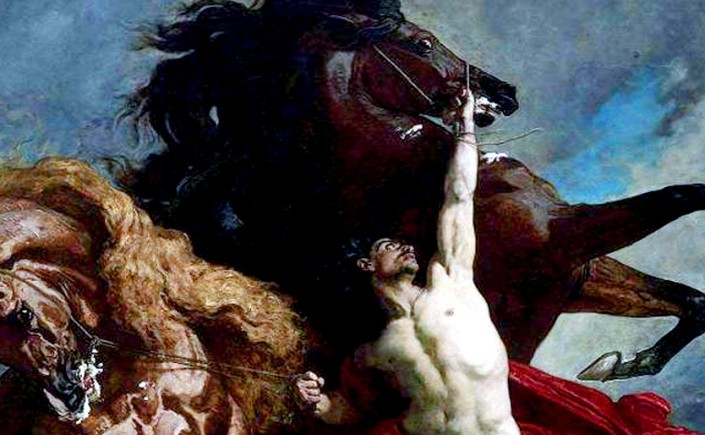
C.P. Cavafy: The Horses of Achilles – A New Translation by Kathleen Vail – THE SHIELD OF ACHILLES

Automedon with the Horses of Achilles, Henri Regnault, 1868
C.P. Cavafy: The Horses of Achilles – A New Translation by Kathleen Vail – THE SHIELD OF ACHILLES: Stepping into a legendary scene unfolding in Homer’s Iliad, C. P. Cavafy sheds new light on the angst that drives the horses of Achilles to tears…Continue reading


Artistic Reconstruction and Original Translation From Homer's "Iliad" by Kathleen Vail

01 Paintings, The amorous game, Part 19 - With Footnotes

Taeil Kim, South Korea
Waiting
Oil on Canvas.
20 H x 16 W x 0.7 in

Taeil Kim begins his art by thinking, "how will I observe and re-create the figure?" Influenced by his observations of peoples' daily interactions with nature, he is able to create moving and unique portraits. Kim is heavily influenced by the work of such masters as Rembrandt and 19th Century Impressionism. These influences are reflected in the expressive brushwork and heavy use of Chiaroscuro he employs to add drama and depth to his paintings. The result is a beautiful and cohesive body of work. Kim received his MFA in Fine Art, Illustration from the Academy of Art University in 2012. More on Taeil Kim


Please visit my other blogs: Art Collector, Mythology, Marine Art, and The Canals of Venice

Images are copyright of their respective owners, assignees or others. Some Images may be subject to copyright

I don't own any of these images - credit is always given when due unless it is unknown to me. if I post your images without your permission, please tell me.

I do not sell art, art prints, framed posters or reproductions. Ads are shown only to compensate the hosting expenses.

If you enjoyed this post, please share with friends and family.


Thank you for visiting my blog and also for liking its posts and pages.

Glimpses of Aleppo in an Exile’s Vision of an Elegant, Eerie Realm

Installation view of The Space Between by Mahmoud Merjan (image courtesy Galerie Tanit and Kevork Mourad)

BEIRUT — When artist Kevork Mourad thinks of his childhood in Aleppo, Syria he talks of the road he walked to reach the church attended by his family, in the city’s old quarter. The buildings lining the way, he recalls, crowded above one’s head in an indistinguishable tangle: synagogues, Roman Catholic churches, and mosques. “All these things are on top of each other, built like a puzzle,” he says. His destination was an old Armenian Orthodox church. “There was one stone that people would go and kiss. This stone was MELTED,” he says. “From kissing, melted! Amazing. Lips can melt stone.” More of this article


Please visit my other blogs: Art Collector, Mythology, Marine Art, and The Canals of Venice

Images are copyright of their respective owners, assignees or others. Some Images may be subject to copyright

I don't own any of these images - credit is always given when due unless it is unknown to me. if I post your images without your permission, please tell me.

I do not sell art, art prints, framed posters or reproductions. Ads are shown only to compensate the hosting expenses.

If you enjoyed this post, please share with friends and family.


Thank you for visiting my blog and also for liking its posts and pages.


01 Paintings, The amorous game, Part 16 - With Footnotes

Lawrence Alma-Tadema, (1836–1912) 
In the Tepidarium, c. 1881
Oil on canvas
24.2 × 33 cm (9.5 × 13 in)
Lady Lever Art Gallery, Port Sunlight Village, United Kingdom

The tepidarium was the warm bathroom of the Rome,  heated by an underfloor heating system.The specialty of a tepidarium is the pleasant feeling of constant radiant heat which directly affects the human body from the walls and floor.

Sir Lawrence Alma-Tadema, OM, RA (8 January 1836 – 25 June 1912) was a Dutch painter of special British denizenship.

Born in Dronrijp, the Netherlands, and trained at the Royal Academy of Antwerp, Belgium, he settled in England in 1870 and spent the rest of his life there. A classical-subject painter, he became famous for his depictions of the luxury and decadence of the Roman Empire, with languorous figures set in fabulous marbled interiors or against a backdrop of dazzling blue Mediterranean Sea and sky.

Though admired during his lifetime for his draftsmanship and depictions of Classical antiquity, his work fell into disrepute after his death, and only since the 1960s has it been re-evaluated for its importance within nineteenth-century English art. More on Sir Lawrence Alma-Tadema


Images are copyright of their respective owners, assignees or others. Some Images may be subject to copyright

We do not sell art, art prints, framed posters or reproductions. Ads are shown only to compensate the hosting expenses.

If you enjoyed this post, please share with friends and family.

01 Paintings by the Orientalist Artists, Paul Joanowits' Bashi-bazouks before the gate, with footnotes, #21

Paul Joanowits, 1859 - 1957, SERBIAN
Bashi-bazouks before the gate, c.  1887-88.
Oil on panel
46 by 35cm., 18 by 14¾in.
Private collection

Bashi-bazouks were irregulars in the Ottoman army and hailed from lands across the Ottoman empire, from Egypt to the Balkans. The strain on the Ottoman feudal system caused by the Empire's wide expanse required heavier reliance on irregular soldiers. They were armed and maintained by the government, but did not receive pay and did not wear uniforms or distinctive badges. Because not formally trained, they could not serve in major military operations, but were useful for other tasks such as reconnaissance and outpost duty.

Both men are armed with Ottoman flintlock rifles from Algeria, and the standing guard smokes an Ottoman chibouk pipe with a tophane bowl.  More on Bashi-bazouks

Paul Joanowits, 1859 - 1957, was born in Vršac, formerly southern Hungary and today Serbia. He studied at the Vienna Academy from 1876 to 1883 under K. L.Müller. From there he sent his first painting to the art society in Budapest, earning him a Hungarian state scholarship. Like his teacher, he painted oriental images, in Vienna and later in Munich. During the late 19th century he painted scenes of the Serbian uprising for King Alexander of Serbia. Back in Vienna, his main interest lay in painting portraits, amongst which is a picture of Emperor Francis Joseph I. Joanovitch exhibited in Vienna, Munich and Berlin and today his works can be found in museums in Belgrade, Budapest, London, Munich and Vienna. More on Paul Joanowits


Please visit my other blogs: Art Collector, Mythology, Marine Art, Portrait of a Lady, The Orientalist, Art of the Nude and The Canals of Venice, Middle East Artists, 365 Saints and 365 Days, also visit my Boards on Pinterest

Images are copyright of their respective owners, assignees or others. Some Images may be subject to copyright

I don't own any of these images - credit is always given when due unless it is unknown to me. if I post your images without your permission, please tell me.

I do not sell art, art prints, framed posters or reproductions. Ads are shown only to compensate the hosting expenses.

If you enjoyed this post, please share with friends and family.

Thank you for visiting my blog and also for liking its posts and pages.

Please note that the content of this post primarily consists of articles available from Wikipedia or other free sources online.


01 Paintings by the Orientalist Artists in the Nineteenth-Century, with footnotes, 20

Raphael von Ambros, 1845-1895, AUSTRIAN
MERCHANT BEFORE THE SABIL OF NAFISA AL-BAYDA, CAIRO
Oil on panel
46 by 31cm., 18 by 12¼in.
Private collection

This Ottoman building built by Nafisa al-Bayda dates back to the year of 1796 AD.

Nafisa al-Bayda began her life as a slave and then was married in the mid 1700s to a man of power in the state named Ali Bey. Afterwards, she married the wealthy Murad Bey who was at first a Mamluk, but then later rose to power in 1784 and became the leader of the resistance against the Napoleon Bonaparte invasion.


Lady Nafisa al-Bayda, meaning the white one, was a woman of beauty, wealth, charity and known to be of great culture. She is also a symbol for womens participation in those days to the political life. During her husbands resistance, she played a major role in helping him acting as an intermediate between him and Napoleon. More on Nafisa al-Bayda

Born in Prague, Raphael von Ambros was a pupil of Hans Makart (1840-1884) at the famous Vienna Academy, where he would have studied alongside an extraordinary generation of Orientalist painters such as Jean Discart (French, 1856-1944), Ludwig Deutsch (1855-1935) and Rudolf Ernst (1854-1932). Like his contemporaries, Ambros found the perfect audience for his Cairo street scenes at the Paris Salon, where he exhibited from 1887. More on Raphael von Ambros


Please visit my other blogs: Art Collector, Mythology, Marine Art, and The Canals of Venice

Images are copyright of their respective owners, assignees or others. Some Images may be subject to copyright

I don't own any of these images - credit is always given when due unless it is unknown to me. if I post your images without your permission, please tell me.

I do not sell art, art prints, framed posters or reproductions. Ads are shown only to compensate the hosting expenses.

If you enjoyed this post, please share with friends and family.


Thank you for visiting my blog and also for liking its posts and pages.

01 Painting, Streets of Paris, School of Paris' Parisian Grand Boulevard, Part 30 - With Footnotes

Unknown, School of Paris, 20th CENTURY 
Parisian Grand Boulevard
Oil on canvas
30" by 40"
Private collection

Boulevards of Paris are boulevards which form an important part of the urban landscape of Paris. The boulevards were constructed in several phases by central government initiative as infrastructure improvements, but are very much associated with strolling and leisurely enjoyment in the minds of Parisians.

Parisian boulevards and avenues are usually tree-lined on one or both sides, which is rarely the case for smaller roads. More on Boulevards of Paris

School of Paris refers to the French and émigré artists who worked in Paris in the first half of the 20th century. The School of Paris was not a single art movement or institution, but refers to the importance of Paris as a center of Western art in the early decades of the 20th century. Between 1900 and 1940 the city drew artists from all over the world and became a centre for artistic activity. School of Paris was used to describe this loose community, particularly of non-French artists, centered in the cafes, salons and shared workspaces and galleries of Montparnasse.

Before World War I the name was also applied to artists involved in the many collaborations and overlapping new art movements, between post-Impressionists and pointillism and Orphism, Fauvism and Cubism. In that period the artistic ferment took place in Montmartre and the well-established art scene there. But Picasso moved away, the war scattered almost everyone, by the 1920s Montparnasse become a center of the avant-garde. After World War II the name was applied to another different group of abstract artists. More on School of Paris


Please visit my other blogs: Art Collector, Mythology, Marine Art, Portrait of a Lady, The Orientalist, Art of the Nude and The Canals of Venice, Middle East Artists, 365 Saints and 365 Days, also visit my Boards on Pinterest

Images are copyright of their respective owners, assignees or others. Some Images may be subject to copyright

I don't own any of these images - credit is always given when due unless it is unknown to me. if I post your images without your permission, please tell me.

I do not sell art, art prints, framed posters or reproductions. Ads are shown only to compensate the hosting expenses.

If you enjoyed this post, please share with friends and family.

Thank you for visiting my blog and also for liking its posts and pages.

Please note that the content of this post primarily consists of articles available from Wikipedia or other free sources online.

01 Painting, Streets of Paris, by the artists of the time, Part 29 - With Footnotes


Marko Stupar, (1936 - * French) 
"Marche Mouffetard (Market Mouffetard)" 
Oil on masonite 
13" H x 9.5" W 
Private collection

Rue Mouffetard is a street in the 5th arrondissement of Paris, France. Situated in the fifth arrondissement of Paris, Rue Mouffetard is one of Paris's oldest and liveliest neighbourhoods. These days the area has many restaurants, shops, and cafés, and a regular open market. It is centered on the Place de la Contrescarpe, at the junction of the rue Mouffetard and the rue de Lacepede. Its southern terminus is at the Square Saint-Médard where there is a permanent open-air market. It is closed to normal motor traffic much of the week, and is predominantly a pedestrian avenue. More on Rue Mouffetard 

Marko Stupar was born in 1936 in Yugoslavia.  He chose France as his permanent home in 1964 after completing his studies at the Beaux-Arts of Belgrade. Today we find that the art of Marko Stupar is totally integrated into the School of Paris. Although his work continues to be very personal, the graphic nature of his Slavic background is now uniquely combined with the subtlety found in Pierre Bonnard.?

Stupar has participated in juried exhibitions since 1966 when he won the Silver Medal at the Center of Diffusion of the Cote-d'Azur. He regularly participates in the Salon d'Automne*, the Salon National des Beaux-Arts, the Salon des Artistes Français* and the Salon Comparaison. 


Among his other honors, Stupar has won both the Silver and Gold medals of the Salon des Artistes Français.? One-man exhibitions of Stupar's work have been held in cities all over the world including Paris, Geneva, Lyon, Osaka, Dusseldorf, Strasbourg, Zagreb, Annecy, Havre, New York, Philadelphia, Dallas, and Houston. More on Marko Stupar


Images are copyright of their respective owners, assignees or others. Some Images may be subject to copyright

We do not sell art, art prints, framed posters or reproductions. Ads are shown only to compensate the hosting expenses.

If you enjoyed this post, please share with friends and family.

01 Painting, Streets of Paris, by the artists of the time, Part 38 - With Footnotes

Victor Gabriel Gilbert, (1847–1933) 
A Parisian Flower Market
Oil on canvas
137.5 x 46.3 cm
Private collection

Victor Gabriel Gilbert born in Paris the 13 February 1847 and died in the 21 July 1933. He was a French painter. He is buried in Montmartre cemetery in Paris. In 1860 he apprenticed to a painter and decorator. He followed with evening art classes under the direction of Father Levasseur, the School of the City of Paris. In the late 1870s, his taste for naturalism is developed and he turned to genre painting with scenes of streets, cafes, markets, especially that of Halles . He obtained a second class medal at the Salon of 1880 and a silver medal at the 1889 World Fair . It becomes a member of the French Society of Artists in 1914.


Victor Gilbert was appointed Knight of the Legion of Honour in 1897, and received the Prix Léon Bonnat in 1926. More on Victor Gabriel Gilbert


Images are copyright of their respective owners, assignees or others. Some Images may be subject to copyright

I don't own any of these images - credit is always given when due unless it is unknown to me. if I post your images without your permission, please tell me.

I do not sell art, art prints, framed posters or reproductions. Ads are shown only to compensate the hosting expenses.

If you enjoyed this post, please share with friends and family.

Thank you for visiting my blog and also for liking its posts and pages.

02 Painting, Streets of Paris, by the artists of the time, Part 37 - With Footnotes

Edouard Henri Leon Cortès, (French, 1882-1969)
Flower stalls at La Madeleine 
Oil on canvas
13 x 18in (33 x 46cm)
Private collection

Located on Place La Madeleine, the flower market has attracted avid gardeners and curious passers-by since 1808.


There is a covered as well as open-air section and it is fascinating to wander the pretty orangerie style pavilions, which are over 100 years old, that line the market, filled with flowers, plants and quirky gifts. Parisians come here to buy flowers for their balconies, for their homes and gardens and it is a truly unique and endearing place for a walk and for visitors to get a feel for the real pulse of the city. This vibrant, colourful little market is also a favourite with artists who come here for inspiration. More on La Madeleine

Edouard Henri Leon Cortès (French, 1882-1969)
A flower market at La Madeleine 
Oil on canvas
20 X 26in (51 x 66cm)
Private collection

Edouard Léon Cortès (1882–1969) was a French post-impressionist artist of French and Spanish ancestry. He is known as "Le Poete Parisien de la Peinture" or "the Parisian Poet of Painting" because of his diverse Paris cityscapes in a variety of weather and night settings.
Cortes was born on August 8, 1882, in Lagny-sur-Marne, about twenty miles east of Paris. His father, Antonio Cortès, had been a painter for the Spanish Royal Court.
At the age of 17, Edouard began his studies at the École des Beaux-Arts in Paris. His first exhibition in 1901 brought him immediate recognition. Cortès stressed his independence. Once, in responding to a journalist who asked if he was a student of Luigi Loir, he replied in pun: "No, a student of myself only."
life he was awarded the prestigious Prix Antoine-Quinson from the Salon de Vincennes
In 1914 Cortès married Fernande Joyeuse, with whom he had a daughter in 1916.
Although Cortès was a pacifist, when war came close to his native village he was compelled to enlist in a French Infantry Regiment at the age of 32. As a contact agent Cortès was wounded by a bayonet, evacuated to a military hospital, and awarded the Croix de Guerre. After recovery he was the reassigned to utilize his artistic talent to sketch enemy positions. Later in life his convictions led him to refuse the Légion d'Honneur from the French Government. In 1919 he was demobilized.
His wife had died in 1918 and he soon married his sister-in-law Lucienne Joyeuse.

Cortès lived a simple life amid a close circle of friends. He died on November 28, 1969, in Lagny, and has a street named in his honor. More on Edouard Léon Cortès


Images are copyright of their respective owners, assignees or others. Some Images may be subject to copyright

I don't own any of these images - credit is always given when due unless it is unknown to me. if I post your images without your permission, please tell me.


I do not sell art, art prints, framed posters or reproductions. Ads are shown only to compensate the hosting expenses.


If you enjoyed this post, please share with friends and family.


Thank you for visiting my blog and also for liking its posts and pages.


01 Paintings, The amorous game, Part 18 - With Footnotes

Frederick Arthur Bridgman, 1847 - 1928, AMERICAN
Almeh Flirting With An Armenian Policeman in Cairo
Oil on canvas
 55.5 cm (21.85 in.), Width: 46 cm (18.11 in.)
Private collection

Almeh (Egyptian Arabic) was the name of a class of courtesans or female entertainers in Arab Egypt, women educated to sing and recite classical poetry and to discourse wittily, connected to the qayna slave singers of pre-Islamic Arabia. They were educated girls of good social standing, trained in dancing, singing and poetry, present at festivals and entertainments, and hired as mourners at funerals.

In the 19th century, almeh came to be used as a synonym of ghawazi, the erotic dancers of Dom ethnicity whose performances were banned in 1834 by Muhammad Ali of Egypt. As a result of the ban, the ghawazi dancers were forced to pretend that they were in fact awalim. Transliterated into French as almée, the term came to be synonymous with "belly dancer" in European Orientalism of the 19th century. More on Almeh

Frederick Arthur Bridgman (November 10, 1847 - 1928) was an American artist, born in Tuskegee, Alabama. The son of a physician, Bridgman would become one of the United States' most well-known and well-regarded painters and become known as one of the world's most talented "Orientalist" painters. He began as a draughtsman in New York City, for the American Bank Note Company in 1864-1865, and studied art in the same years at the Brooklyn Art Association and at the National Academy of Design; but he went to Paris in 1866 and became a pupil of Jean-Leon Gerome. Paris then became his headquarters. A trip to Egypt in 1873-1874 resulted in pictures of the East that attracted immediate attention, and his large and important composition, The Funeral Procession of a Mummy on the Nile, in the Paris Salon (1877), bought by James Gordon Bennett, brought him the Cross of the Legion of Honor. Other paintings by him were An American Circus in Normandy, Procession of the Bull Apis (now in the Corcoran Gallery of Art, Washington, D.C.), and a Rumanian Lady (in the Temple collection, Philadelphia, Pennsylvania). More on Frederick Arthur Bridgman


Images are copyright of their respective owners, assignees or others. Some Images may be subject to copyright

We do not sell art, art prints, framed posters or reproductions. Ads are shown only to compensate the hosting expenses.

If you enjoyed this post, please share with friends and family.