Showing posts with label Orientalists. Show all posts

08 Orientalist Paintings by Artists from the 19th Century, with footnotes, #18

Orientalism is a term that is used for the depiction of aspects in Middle Eastern cultures. It refers to the works of the Western artists on Oriental subjects, produced from their travels in Western Asia, during the 19th century. Depictions of Islamic "Moors" and "Turks" can be found in Medieval, Renaissance, and Baroque art. A creative apprehension of a completely different world with its own laws, customs, special attitude towards life and death, love, feelings, and beauty. Wikipedia/Yana Naumovna Lukashevskaya

Edouard Frederic Wilhelm Richter,1844 - 1913 
Scheherazade
Oil on canvas
Height: 151 cm (59.45 in.), Width: 211.5 cm (83.27 in.)
Private collection

Scheherazade is a character and the storyteller in One Thousand and One Nights. This book includes the tales of Aladdin, Ali Baba and many more.

The story goes that Shahryar found out one day that his first wife was unfaithful to him. Therefore, he resolved to marry a new virgin each day as well as behead the previous day's wife, so that she would have no chance to be unfaithful to him. He had killed 1,000 such women by the time he was introduced to Scheherazade, the vizier's daughter.

"Scheherazade had perused the books, annals and legends of preceding Kings, and the stories, examples and instances of bygone men and things; indeed it was said that she had collected a thousand books of histories relating to antique races and departed rulers. She had perused the works of the poets and knew them by heart; she had studied philosophy and the sciences, arts and accomplishments; and she was pleasant and polite, wise and witty, well read and well bred."

Edouard Frederic Wilhelm Richter,1844 - 1913 
Scheherazade
Detail

Against her father's wishes, Scheherazade volunteered to spend one night with the king. Once in the king's chambers, Scheherazade asked if she might bid one last farewell to her beloved sister, Dunyazade, who had secretly been prepared to ask Scheherazade to tell a story during the long night. The king lay awake and listened with awe as Scheherazade told her first story. The night passed by, and Scheherazade stopped in the middle of the story. The king asked her to finish, but Scheherazade said there was no time, as dawn was breaking. So, the king spared her life for one day to finish the story the next night. The following night, Scheherazade finished the story and then began a second, even more exciting tale, which she again stopped halfway through at dawn. Again, the king spared her life for one more day so she could finish the second story.

And so the king kept Scheherazade alive day by day, as he eagerly anticipated the finishing of the previous night's story. At the end of 1,001 nights, and 1,000 stories, Scheherazade told the king that she had no more tales to tell him. During these 1,001 nights, the king had fallen in love with Scheherazade. He spared her life, and made her his queen. More on Scheherazade

Édouard Frédéric Wilhelm Richter , born on June 18, 1844 in Paris, where he died on March 4, 1913 to a Dutch mother and German father. His extensive artistic education took him to the Hague Academy, then to Antwerp and finally to the Académie de Beaux-Arts in Paris where he trained under Léon Bonnat. Richter first exhibited a still-life at the Salon in 1866 and received honourable mention. However for the following fifty years, he submitted a range of subject matter including portraits, historical genre scenes and more specifically Orientalist subjects. 

Richter's favourite subject was the female. Whether European or Middle Eastern, he illustrated dignified, yet languid beauties at the centre of his compositions. His Orientalist subjects demonstrate a certain studied theatricality in the gesture of the figures and the composition as seen in the present lot, as well as an exquisite handling of the textures and colours. The young woman dressed in elaborate clothes is posed in front of a window. The sunlight defines the silhouette of body and adds an ethereal halo. The delicacy of her placed fingers and the soft pink in her dress contrasts with the geometric and vibrant design of the mosaics encircling her. More on Édouard Frédéric Wilhelm Richter

Edouard Frederic Wilhelm Richter,1844 - 1913 
A Moorish Dancer, c. 1877
Oil on canvas
Height: 92 cm (36.22 in.), Width: 74 cm (29.13 in.)
Private collection

Edouard Frederic Wilhelm Richter,1844 - 1913, see above

John William Waterhouse, 1849 - 1917
IN THE HAREM, AN ODALISQUE
Oil on canvas
46 by 27cm., 18 by 10½in
Private collection

John William Waterhouse (April 6, 1849 – February 10, 1917) was an English painter known for working in the Pre-Raphaelite style. He worked several decades after the breakup of the Pre-Raphaelite Brotherhood, which had seen its heyday in the mid-nineteenth century, leading to his sobriquet "the modern Pre-Raphaelite". Borrowing stylistic influences not only from the earlier Pre-Raphaelites but also from his contemporaries, the Impressionists, his artworks were known for their depictions of women from both ancient Greek mythology and Arthurian legend.
Born in Italy to English parents who were both painters, he later moved to London, where he enrolled in the Royal Academy of Art. He soon began exhibiting at their annual summer exhibitions, focusing on the creation of large canvas works depicting scenes from the daily life and mythology of ancient Greece. Later on in his career he came to embrace the Pre-Raphaelite style of painting despite the fact that it had gone out of fashion in the British art scene several decades before. More on John William Waterhouse

Léon François Comerre, 1850 - 1916
Femme au tambourin
oil on canvas
48 ½ x 30 3/8 in. (123 x 77 cm.)
Private collection

Léon François Comerre (10 October 1850 – 20 February 1916) was a French academic painter, famous for his portraits of beautiful women. Comerre was born in Trélon, in the Département du Nord, the son of a schoolteacher. He moved to Lille with his family in 1853. From an early age he showed an interest in art and became a student of Alphonse Colas at the École des Beaux-Arts in Lille, winning a gold medal in 1867. From 1868 a grant from the Département du Nord allowed him to continue his studies in Paris at the famous École nationale supérieure des Beaux-Arts in the studio of Alexandre Cabanel. There he came under the influence of orientalism.

Comerre first exhibited at the Paris Salon in 1871 and went on to win prizes in 1875 and 1881. In 1875 he won the Grand Prix de Rome. This led to a scholarship at the French Academy in Rome from January 1876 to December 1879. In 1885 he won a prize at the "Exposition Universelle" in Antwerp. He also won prestigious art prizes in the USA (1876) and Australia (1881 and 1897). He became a Knight of the Legion of Honour in 1903.

Gustav Bauernfeind, German, 1848 - 1904
Market in Jaffa, c. 1887
Oil on canvas
82 by 109cm., 32 by 43in.
Private collection

Market in Jaffa, now a part of Tel Aviv, was painted by Gustav Bauernfeind in 1887. Bauernfeind was extremely brave to paint in cities like Jaffa and Damascus. Jaffa was frequently under quarantine for plague and westerners could be attacked in the streets of Damascus by religious zealots. Bauernfeind would show up in these cities in western dress with bulky photographic equipment and somehow survive and get his work done. More on Market in Jaffa

Gustav Bauernfeind (4 September 1848, Sulz am Neckar - 24 December 1904, Jerusalem) was a German painter, illustrator and architect. He is considered to be one of the most notable Orientalist painters of Germany.

After completing his architectural studies in Stuttgart, he worked in the architectural firm of Professor Wilhelm Bäumer and later in that of Adolph Gnauth, where he also learned painting. In his earlier paintings, Bauernfeind focused on local views of Germany, as well as motifs from Italy. During his journey to the Levant from 1880 to 1882, he became interested in the Orient and repeated his travels again and again. In 1896 he moved with his wife and son all the way to Palestine and subsequently settled in Jerusalem in 1898. He also lived and worked in Lebanon and Syria.

Gustav Bauernfeind, (German, 1848–1904)
The market in Jaffa, 1887
Watercolor
39 x 53 cm. (15.4 x 20.9 in.)
Private collection

His work is characterized primarily by architectural views of Jerusalem and the Holy Land. The paintings of Bauernfeind are mostly meticulously crafted, intricately composed and almost photographically accurate cityscapes and images of known sanctuaries in oil. In addition, he produced landscape scenes and watercolours. During his lifetime he was the most popular Orientalist painter of Germany, but soon fell into oblivion after his death. However, since the early 1980s, Bauernfeind was gradually rediscovered. At his birthplace in Sulz am Neckar, the life and work of the painter is commemorated by the Gustav Bauernfeind Museum with a large permanent exhibition. More Gustav Bauernfeind

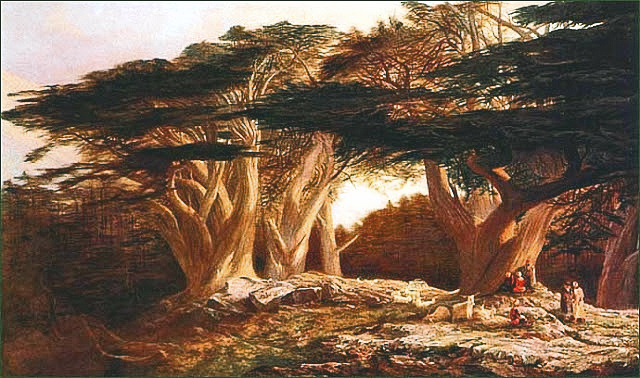
Edward Lear, 1812-1888
The Cedars of Lebanon, c. 1861
Oil on canvas
68cm high x 113.50cm (44.69 inches)

The cedar of Lebanon was prized throughout the ancient Near East. The Palermo Stone indicates cedar was imported to Egypt in the reign of the 4th dynasty king Sneferu, ca. 2613-2589 BC. One of its primary uses was for boat construction.

Commonly referred to in Scripture as the cedars of Lebanon, this aromatic, durable wood was highly desirable for building in Iron Age Israel. David used in it building his palace, and Solomon used it in the construction of the temple and a palace for himself. More history of the Cedars of Lebanon.

Edward Lear, 1812-1888
The Cedars of Lebanon, c. 1858
A preliminary sketch for the painting (above)
Oatlands Park Hotel, Weybridge

Although Lear had travelled in the Middle East, and indeed undertook his most extensive tour there in 1858, his time was limited. As in the case of other pictures, he found he still needed a more leisurely contemplation in order to work up his landscapes: "Individual foreground details and studies of foliage were often painted from local sources". Thus, to complete a view of the Cedars of Lebanon that had so impressed him, he went looking for good specimens when home again in England. Fortunately, some such specimens were to be found within easy reach of London. Lear could hardly have done better than the ancient and famous cedar trees on the estate of the Oatlands Park Hotel in north Surrey. The most imposing one now has a sign on it, that reads, "This is one of the first Cedars of Lebanon imported into England. It is believed to have been planted here by Prince Henry Otelands, the youngest son of King Charles the First." More on The Cedars of Lebanon


Please visit my other blogs: Art CollectorMythologyMarine ArtPortrait of a Lady, The OrientalistArt of the Nude and The Canals of VeniceMiddle East Artists365 Saints and 365 Days, also visit my Boards on Pinterest

Images are copyright of their respective owners, assignees or others. Some Images may be subject to copyright

I don't own any of these images - credit is always given when due unless it is unknown to me. if I post your images without your permission, please tell me.

I do not sell art, art prints, framed posters or reproductions. Ads are shown only to compensate the hosting expenses.

If you enjoyed this post, please share with friends and family.

Thank you for visiting my blog and also for liking its posts and pages.

Please note that the content of this post primarily consists of articles available from Wikipedia or other free sources online.


22 Orientalist Paintings, with foot notes, #6

The Orient—including present-day Turkey, Greece, the Middle East, and North Africa—exerted its allure on the Western artist’s imagination centuries prior to the turn of the nineteenth century...

Philippe-Jacques van Bree ANTWERP 1786 - 1871 BRUSSELS, BELGIUM SCHOOL GENTILE BELLINI À LA COUR DE MAHOMET II PHILIPPE-JACQUES VAN BREE; GIOVANNI BELLINI IN MAHOMET II'S COURT; SIGNED LOWER LEFT; OIL HEIGHTENED WITH GOLD ON PANEL Signed lower left P. van Bree Oil heightened with gold on panel  58.5 x 73.5 cm; 23 by 29 3/4 in:
Philippe-Jacques van Bree (1786 - 1871)
Gentile Bellini at the court of Mahomet II
Oil heightened with gold on panel 
58.5 x 73.5 cm; 23 by 29 3/4 in
Private collection

Sold for 25,000 EUR in October 2015

Sultan Mohammed II, famous conqueror who besieged and captured Constantinople in 1453, was an avid collector of works of art. He brought the famous Venetian painter Gentile Bellini (circa 1429-1507) in Constantinople, on the occasion of the peace agreements signed between the Republic of Venice and the Ottoman Empire in 1479. On that occasion, the famous Bellini executed portrait Mahomet II, now preserved in the National Gallery in London. More Sultan Mohammed II, (See below)

Philippe-Jacques van Bree (1786 - 1871), scholar of his brother Mattheas, was born at Antwerp in 1786. He studied at Antwerp, in Paris (where he became a scholar of Girodet), and at Rome; and also visited Germany and England. He employed himself on historical, fancy, and architectural subjects. Of the last, the Belgian Government purchased his 'View of the Interior of the Church of St. Peter at Rome,' and presented him with a gold medal in addition to the price. He was made conservator of the Museum at Brussels, where he died in 1871. More on Philippe-Jacques van Bree

Gentile Bellini (1429–1507) 
The Portrait of Ottoman Sultan Mehmed the Conqueror, 1480.
Oil on canvas
Height: 69.9 cm (27.5 in). Width: 52.1 cm (20.5 in).
Victoria and Albert Museum 

As ruler of the expanding Islamic Ottoman Empire, Sultan Mehmet II was one of the most powerful men in the world when this portrait was painted. Fascinated by portraiture and European culture, he sent a request for a painter to the Venetian authorities in 1479. Gentile Bellini, having recently completed a series of portraits of the doges (elected rulers) of Venice, was well qualified for the task. The majority of those portraits were painted in the traditional profile view, but here Gentile has shown the Sultan’s face and body turned slightly towards the viewer, a new fashion in Venice. We can see many meticulous details, like the embroidered cloth hanging over the marble ledge, its many gems and pearls a sign of wealth and magnificence. More on this painting

To further glorify the Sultan, Gentile included three golden crowns on either side of the arch – probably intended to represent Greece, Trebizond and Asia, which Mehmet ruled.

The attribution to Bellini is not proved, but the sitter is reasonably identified as Mehmet II (1432 - 1481). Gentile Bellini visited his court in Constantinople. There is insufficient evidence for deciding whether the picture is a copy or an original.

FRENCH SCHOOL OF NINETEENTH CENTURY FEMMES ET ENFANTS DANS UNE COUR INTÉRIEURE *** DURAND; WOMEN AND CHILDREN IN A COURTYARD; SIGNED LOWER RIGHT; WATERCOLOR ON PAPER; SEE ILLUSTRATION ON THE NEXT PAGE Signed lower right Durand Watercolour on paper  48 x 39.5 cm; 18 7/8 by 15 1/2 in:
French School, 19th Century
WOMEN AND CHILDREN IN A COURTYARD
Watercolour on paper 
48 x 39.5 cm; 18 7/8 by 15 1/2 in
Private collection

Art historian Marion Vidal-Bue was born and lived in Algiers until its independence. She comes from a family of builders established in the country in 1832. She has written books on painters of Algeria, especially to witness the artistic importance and influence of her native country at the time of the French presence. 

She participated in the artistic illustration of the works of the Scientific Exploration of Algeria, published in 1844-1867, commissioned by the Minister of War in 1837. These watercolours form a rare and interesting set which shows scenes of life in Algiers 1830-1840 years; in the early days of the arrival of the French in Algeria. 

ECOLE FRANÇAISE DU XIXE SIÈCLE FEMMES DANS UN INTÉRIEUR AVEC UNE NOURRICE S'OCCUPANT D'UN BÉBÉ *** DURAND; WOMEN IN AN INTERIOR WITH A SITTER NURSING A BABY; SIGNED LOWER LEFT; WATERCOLOR ON PAPER; SEE ILLUSTRATION ON THE NEXT PAGE Signé en bas à gauche Durand Aquarelle sur papier 48 x 39,5 cm ; 18 7/8 by 15 1/2 in:
French School, 19th Century
WOMEN IN AN INTERIOR WITH NURSE CONCERNED FOR A BABY 
Signed lower left Durand
Watercolour on paper 
48 x 39.5 cm; 18 7/8 by 15 1/2 in
Private collection

Durand FRENCH SCHOOL OF NINETEENTH CENTURY SCÈNE DE CAFÉ *** DURAND; SCENE IN A CAFE; SIGNED LOWER LEFT; WATERCOLOR ON PAPER Signed lower left Durand Watercolour on paper  48 x 39.5 cm; 18 7/8 by 15 1/2 in:
French School, 19th Century
SCENE IN A CAFE
Signed lower left Durand
Watercolour on paper 
48 x 39.5 cm; 18 7/8 by 15 1/2 in
Private collection

Durand FRENCH SCHOOL OF NINETEENTH CENTURY DANSEUSE ET MUSICIENNES *** DURAND; DANCER AND MUSICIANS; SIGNED, SITUATED AND DATED LOWER LEFT ALGER 1840 (?); WATERCOLOR ON PAPER; SEE ILLUSTRATION ON PREVIOUS PAGE Signed, located and dated lower left Durand Algiers in 1840 (?)  Watercolour on paper  48 x 39.5 cm; 18 7/8 by 15 1/2 in:
French School, 19th Century
DANCER AND MUSICIANS
Signed, located and dated lower left Durand Algiers in 1840 (?) 
Watercolour on paper 
48 x 39.5 cm; 18 7/8 by 15 1/2 in
Private collection

Durand FRENCH SCHOOL OF NINETEENTH CENTURY FÊTE DE NUIT DANS UN PALAIS *** DURAND; RECEPTION BY NIGHT IN A PALACE; SIGNED LOWER LEFT; WATERCOLOR ON PAPER. SEE ILLUSTRATION ON PREVIOUS PAGE. Signed lower left Durand Watercolour on paper  48 x 39.5 cm; 18 7/8 by 15 1/2 in:
French School, 19th Century
RECEPTION BY NIGHT IN A PALACE
Signed lower left Durand
Watercolour on paper 
48 x 39.5 cm; 18 7/8 by 15 1/2 in
Private collection

Durand ECOLE FRANÇAISE DU XIXE SIÈCLE MUSICIENS ET DANSEUSES AFRICAINES DANS LA COUR D'UN PALAIS *** DURAND; MUSICIANS AND AFRICAN DANCERS IN THE COURTYARD OF A PALACE; WATERCOLOR ON PAPER Aquarelle sur papier 48 x 39,5 cm ; 18 7/8 by 15 1/2 in:
French School, 19th Century
MUSICIANS AND AFRICAN DANCERS IN THE COURTYARD OF A PALACE
Watercolor on paper 
48 x 39.5 cm; 18 7/8 by 15 1/2 in
Private collection

Durand ECOLE FRANÇAISE DU XIXE SIÈCLE LES ACROBATES *** DURAND; ACROBATS; SIGNED LOWER RIGHT; WATERCOLOR ON PAPER Signé en bas à droite Durand Aquarelle sur papier 25,5 x 40 cm ; 10 by 15 3/4 in:
FRENCH SCHOOL OF NINETEENTH CENTURY
ACROBATS
Signed lower right Durand
Watercolour on paper 
25.5 x 40 cm; 10 by 15 3/4 in
Private collection

Jean-Leon Gerome VESOUL 1824 - 1904 PARIS STUDY FOR A MOORISH BATH, TURKISH WOMAN IN BATH  JOHN LEON GÉRÔME; STUDY FOR A Moorish BATH, TURKISH WOMAN BATHING; SIGNED AND DEDICATED LOWER LEFT HIS FRIEND BOURGAIN GÉRÔME JL; OIL ON CANVAS Signed and dedicated lower left To his friend Bourgain JL Gérôme Oil on canvas  50.5 x 40.5 cm; 20 by 16 in:
Jean-Leon Gerome, VESOUL 1824 - 1904 PARIS
STUDY FOR A MOORISH BATH, TURKISH WOMAN IN BATH 
Oil on canvas 
50.5 x 40.5 cm; 20 by 16 in
MFA Boston

This study is a preparatory sketch for the large painting (81,5 x 65,5cm) A Moorish bath, Turkish woman bathing, painted in the 1870s and kept in a private collection (See Below). There are some other known preparatory studies: a drawing of the same composition and the same dimensions as our sketch and two oil sketches, larger format than the one presented here.

For Gérôme, a good academician, the creative process was primarily intellectual. He reflected on a conception of the final composition, which he then seized on an initial study that was the basis for the further work. This  is probably the first study of a Turkish bath, a Turkish woman bathing, which explains its freshness and spontaneity.

Gérôme worked hard on the silhouette and the attitude of the nude bather.

In all known studies to a Turkish bath, a Turkish woman bathing, the African servant is outlined. It is only in the finished work that the face appears clearly. 

Gérôme tried to create an intense psychological relationship between bather's surprise at a specific time of her dress, and her maid; he is leaning over the basin, hands resting on the edge, tense, waiting impatiently for the moment when she will feel, just out of the bath, the delicious sensation of cold foam soap.

Studies and sketches of Gerome oils were often completed by other painters, to make them more commercial. Our sketch was lucky to escape the retouching and remain intact, unaltered and entirely Gérôme's hand. More on this painting

Jean-Léon Gérôme  (1824–1904)
Moorish Bath, c. 1870
Oil on canvas
height: 50.8 cm (20 in); width: 40.6 cm (15.9 in)
Museum of Fine Arts Boston 

Jean-Léon Gérôme
The Bath, ca. 1880-1885
Place of Creation
Oil on canvas
29 x 23 1/2 in. (73.7 x 59.7 cm)
Fine Arts Museums of San Francisco

Jean-Léon Gérôme (11 May 1824 – 10 January 1904) was a French painter and sculptor in the style now known as Academicism. The range of his oeuvre included historical painting, Greek mythology, Orientalism, portraits and other subjects, bringing the Academic painting tradition to an artistic climax. He is considered one of the most important painters from this academic period, and in addition to being a painter, he was also a teacher with a long list of students. More on Jean-Léon Gérôme

Jean-Leon Gerome
VESOUL 1824 - 1904 PARIS
A MOORISH BATH, TURKISH WOMAN IN BATH, 1885
The final painting
Private collection

Frederik-Jan-Pieter Portielje AMSTERDAM 1829 - 1895 ANTWERP, DUTCH SCHOOL JEUNE FILLE EN COSTUME MOYEN-ORIENTAL JAN-FREDERICK-PIETER PORTIELJE; YOUNG LADY WEARING A MIDDLE-EASTERN COSTUME; SIGNED LOWER RIGHT; OIL ON PANEL Signed lower right Portielje Oil on panel  59 x 48 cm; 23 1/4 by 18 7/8 in:
Frederik-Jan-Pieter Portielje
AMSTERDAM 1829 - 1895 ANTWERP, DUTCH SCHOOL
YOUNG LADY WEARING A MIDDLE-EASTERN COSTUME
Signed lower right Portielje
Oil on panel 
59 x 48 cm; 23 1/4 by 18 7/8 in
Private collection

Jan Frederik Pieter Portielje (Amsterdam, 1829 - 1908) was a Dutch-Belgian painter. He was the tenth child by Gerrit Portielje, bookseller and publisher in Amsterdam, and Jacoba Zeegers. He studied at the Academy of Amsterdam from 1842 to 1849 with, among others, Valentine Bing and Jan von Braet Uberfeldt. Between 1851 and 1853 he stayed several times for extended periods of time in Paris, possibly during the summer months when the Academy was closed due to holidays. He also worked as a portraitist and as such had a growing clientele in Brussels and Antwerp.

His oeuvre includes portraits, scenes of elegant ladies in gardens, parks, or luxurious interiors. The interiors are either heavy or elegant neo-Baroque Napoleon III. He painted Western and Southern or Oriental women, often adorned with jewels. His painting are realistic, with an eye for detail and texture, intended as an elegant genre painting without much depth.

On some paintings he collaborated with another artist. There are paintings known, together with Frans Lebret (1820-1909) and Eugène Remy Maes (1849-1931).


After his studies Portielje remained in Antwerp. He married there in 1853. More on Jan Frederik Pieter Portielje

Emile Régnault de Maulmain LONS-LE-SAUNIER 1836 - 1897 NEVY-SUR-SEILLE SCÈNE DE MARCHÉ DANS UNE RUE EMILE RÉGNAULT DE MAULMAIN; MARKET SCENE IN A STREET; SIGNED AND DATED LOWER RIGHT '78; OIL ON CANVAS Signed and dated lower right G. Regnault '78 Oil on canvas  55.5 x 40.8 cm; 21 7/8 by 16 in:
Emile Régnault de Maulmain
MARKET SCENE IN A STREET
Oil on canvas 
55.5 x 40.8 cm; 21 7/8 by 16 in
Private collection

Sold for 5,625 EUR in Oct 2015

Emile Regnault de Maulmain LONS-LE-SAUNIER 1836 - 1897 NEVY-SUR-SEILLE LA HALTE À L'OASIS EMILE REGNAULT DE MAULMAIN ; THE REST IN THE OASIS ; SIGNED LOWER LEFT ; OIL ON CANVAS Signed lower left Regnault Oil on canvas  47 x 73 cm; 18 1/2 by 28 3/4 in:
Emile Regnault de Maulmain
THE REST IN THE OASIS
Oil on canvas 
47 x 73 cm; 18 1/2 by 28 3/4 in
Private collection

Sold for 8,375 EUR in Nov 2013

Maulmain Emile Regnault, 1836-1897, French school. Maulmain was a pupil of Miss Lamotte Lobrichon and Alberto Pasini. He exhibited at the Salon from 1863 until 1882, especially scenes of Algeria.

Georges Washington MARSEILLE 1827 - 1910 PARIS SCÈNE DE COMBAT GEORGES WASHINGTON; BATTLE SCENE; SIGNED LOWER LEFT; OIL ON CANVAS Signé en bas à gauche G. Washington Huile sur toile 46 x 55 cm ; 18 1/8 by 21 2/3 in:
Georges Washington  1827 - 1910
BATTLE SCENE
Oil on canvas 
46 x 55 cm; 18 1/8 by 21 2/3 in
Private collection

Estimate for 15,000 - 20,000 EUR in Oct 2015

George Washington, born 15 September 1827 in Marseille and died November 19, 1901 in Douarnenez, was a French Orientalist painter. Like most aspiring artists, the young Georges Washington moved to Paris, where he trained at the Ecole des Beaux Arts under François-Edouard Picot (1786-1868). The artist’s exotic style was also indebted to Eugène Delacroix (1798-1863). Washington’s art conveys a similar feeling to the work of Eugène Fromentin (1820-76) who often painted naturalistic Middle Eastern scenes of rural and nomadic life. Washington’s love of the Middle East and its customs was further enhanced and encouraged by his father-in-law, the military and Orientalist painter Henri-Félix-Emmanuel Philippoteaux (1815-1884), whose daughter Anne-Léonie Philippoteaux married Washington in Paris on 6th August 1859.

Not long after finishing his training at the Ecole des Beaux Arts, Washington embarked on the first of a number of trips to Algeria and based on close observation of its inhabitants, their dress and customs in 1857 he made his Paris debut at the Salon des Artistes Français with a view of nomads titled Plaine du Hoiina (Sahara Algérien). From then up until 1901 Washington continued to be a popular exhibitor at the Salon; one of his first works shown there to gain critical acclaim was Nomades dans le Sahara en Hiver. In addition to Paris, Washington also showed his work in Moscow in 1881 and was later posthumously honoured when four of his paintings were included in the Exposition Coloniale de Marseille in 1906.

Following two commissions from a Belgian company, he travelled to Morocco and then subsequently visited Hungary, Bulgaria and Turkey, which were to inspire his varied subjects including battle scenes and cavalry skirmishes. His travels also took him to America for the unveiling in Philadelphia of a cyclorama (a monumental 360° panoramic view) of the Battle of Gettysburg by his brother-in-law Paul-Dominique Philippoteaux (1846-1923).

Following the death of his wife he retired to live with his daughter and son-in-law at Douarnenez on the Brittany coast, where he died shortly after on 19th November 1901. More George Washington

Henri Rousseau CAIRO 1875 - 1933 AIX EN PROVENCE THE FANTASIA OF NEMENCHAS, ALGERIA  HENRI-EMILIEN ROUSSEAU; NEMENCHAS FANTASIA, ALGERIA; SIGNED AND DATED LOWER LEFT AND TITLED ON THE BACK; ON THE BACK, WITH BEARS LABELS NUMERS; OIL ON CANVAS Signed and dated lower left Henri Rousseau '19; titrated back; the back door of old numbers 14, 804 and 3838 Oil on canvas 65 x 92 cm; 25 5/8 by 36 1/4 in:
Henri Rousseau
CAIRO 1875 - 1933 AIX EN PROVENCE
THE FANTASIA OF NEMENCHAS, ALGERIA 
Oil on canvas 
65 x 92 cm; 25 5/8 by 36 1/4 in
Private collection

Sold for 42,500 EUR in Oct 2015

Rousseau creates a  fantasy he chooses to place on the plateau of Nemenchas, Algeria. The tight framing on the group of riders launched in full immerses the viewer in the scene. The proximity thus created communicates a feeling of intense movement. The determination and pride of the riders and their horses, some of which rear up in a frenzy, is beautifully rendered in vibrant color buttons.

Henri Rousseau Henry, Emilien Rousseau (Cairo 1875 - Aix-en-Provence in 1933) is an Orientalist painter. A pupil of Jean-Léon Gérôme at the Beaux Arts in Paris, he won the second Grand Prix de Rome in 1900 and a travel grant at the Salon of French Artists. He traveled to Belgium, the Netherlands, North Africa, Spain and Italy where he admired the great masters (Rubens, Rembrandt, Velasquez, Murillo, the Titian, Raphael etc ...)

After this initiatory journey, he settled in Versailles and set up his studio at the Villa des Arts in Paris. In 1919 he moved to Aix in Provence with his large family (seven children). Knight of the Legion of Honour in arts. His work  is dedicated to Tunisia, Algeria and especially Morocco, Provence and the Camargue remained its anchor points. His success was with a bourgeois and wealthy clientele, where he sold his work at numerous exhibitions in Paris, Brussels, Stockholm, Marseilles. More on Henri Rousseau Henry, Emilien Rousseau

Jules-Pierre van Biesbroeck PORTICI 1873 - 1965 BRUXELLES, ECOLE BELGE FEMME À L'AMPHORE JULES-PIERRE VAN BIESBROECK; WOMAN CARRYING AN AMPHORA; SIGNED LOWER LEFT; OIL ON PANEL Signé en bas à gauche Van Biesbroeck Huile sur panneau 58 x 32,4 cm ; 22 4/5 by 12 1/4 in:
Jules-Pierre van Biesbroeck
PORTICI 1873 - 1965 BRUXELLES, ECOLE BELGE
WOMAN CARRYING AN AMPHORA
Oil on panel 
58 x 32.4 cm; 22 4/5 by 12 1/4 in
Private collection

Sold Oct 22, 2015

Jules Pierre van Biesbroeck was born in Italy in 1873.  His father was the Belgian painter Jules Evariste van Biesbroeck and like many artists of his time, he was working in Italy when his son Jules was born.  The child was two years old when the family returned to Ghent.

After a short period of practice with his father, van Biesbroeck was enrolled in the Academy of Fine Arts in Ghent.  He was a child prodigy and sold his first painting at the age of 14 during the Triennale Ghent Exhibition.  In 1888, when he was 15 years old, he made his debut at the Salon des Champs-Elysées in Paris with a monumental canvas which stood out because of his nude models.  The canvas scandalized the censors and the young artist was asked to cover his figures with drapery before the painting could be exhibited.  The jury gave Van Biesbroeck an honorable mention on the recommendation of William Bouguereau.  Van Biesbroeck won fame in sculpture as well as paintings and was rewarded with many commissions for the city of Ghent.

When German troops invaded Belgium during World War I, Van Biesbroeck went to Bordighera in Italy where he continued to paint and sculpt.  In 1926 he made a trip to North Africa, then in 1927, he visited Algeria.  The light and atmosphere of Maghreb caused him to change his palette and employ lighter colors and represent orientalist subjects, particularly the inhabitants of Bou-Saada.  Algiers had such an influence on the artist, that he lived there for nine years.  In 1938 he returned to Ghent, and continued to paint orientalist works.  Portrait of a Blind Arab dates from Van Biesbroeck’s early period in Algeria. More on Jules Pierre van Biesbroeck

Attributed to George Derville Rowlandson 1861 - 1928, ENGLISH SCHOOL CAVALIERS SORTANT PAR UNE PORTE FORTIFIÉE ATTRIBUTED TO GEORGE-DERVILLE ROWLANDSON; CAVALIERS COMING OUT OF A FORTIFIED GATE; SIGNED AND DATED LOWER LEFT 1888; OIL ON CANVAS Signed and dated lower left GD Rowlandson 1888 Oil on canvas  83.5 x 61 cm; 32 7/8 by 24 in:
Attributed to George Derville Rowlandson, 1861 - 1928
CAVALIERS COMING OUT OF A FORTIFIED GATE, c. 1888
Oil on canvas 
83.5 x 61 cm; 32 7/8 by 24 in
Private collection

Estimated for €4,000 EUR - €6,000 EUR in Oct 2015

George Derville Rowlandson (1861–1928) was a British painter. He is best known for his equestrian portraits. Some of his work can be found at the Museum of Polo and Hall of Fame in Lake Worth, Florida.

Rowlandson was born in India in 1861 and studied art at Gloucester Art School, Westminster and Paris. He exhibited at the Royal Institute of Painters in Watercolour between 1911 and 1918 from 22 Priory Road, Bedford Park, London. He contributed illustrations to The Illustrated London News and the English llustrated Magazine, his work being mostly military or equestrian subjects, and a number of hunting scenes. More on George Derville Rowlandson

Emmanuel Dieudonné GENEVA 1845 - 1889, SWISS SCHOOL OF NINETEENTH CENTURY LE MARCHAND D'ESCLAVES EMMANUEL DE DIEUDONNÉ; THE SLAVE MERCHANT; OIL ON CANVAS, UNFRAMED Oil on canvas, unframed  42 x 61 cm; 16 1/2 by 24 in:
Emmanuel Dieudonné
THE SLAVE MERCHANT
Oil on canvas, unframed 
42 x 61 cm; 16 1/2 by 24 in
Private collection

This is a preparatory sketch for the large painting, signed lower left E. DIEUDONNE, kept at the National Federation of André Maginot, Paris. A pupil of Cabanel, Emmanuel Dieudonné exhibited at the Salon from 1876. He made ​​many Orientalists compositions.

Karl Wilhelm Gentz ​​(1822 - 1890)
NUBIAN HUNTERS
​​Oil on canvas 
166 x 139 cm; 65 1/3 by 54 3/4 in
Private collection

Sold for 9,375 EUR Oct 2014

Karl Wilhelm Gentz ​​(1822 - 1890) was a German painter. The second child of Johann Christian Gentz. Initially enrolled at Berlin's Friedrich Wilhelm University, he decided at age 21 to study painting. He attended the prestigious Atelier Kloeber and studied in 1845 for nine months at the Antwerp Academy of Fine Arts. He entered the school Atelier Paul Delaroche, which was then under the direction of Charles Gleyre. In 1847 he traveled to Spain and Morocco Returning to Paris, he painted The Prodigal Son in the desert, a life-size figure. In 1850 he went to Marseille and Malta, then Egypt and the Sinai; on his way back he traveled over Asia Minor, the Greek archipelago, Constantinople and Vienna.

In 1852, while living temporarily in Berlin, his first paintings of  oriental life emerged: "Slave Market" and "Egyptian School".  Not satisfied, Gentz returned to Paris and joined the studio of Thomas Couture. There painted two religious images with life-size figures, Christ and Magdalene and Simon and Chris.

In 1858, again in Berlin, he created a long series of Oriental Paintings, mostly Egyptian, for the Berlin Academy of Fine Arts. The oeuvre of the artist are very large; sometimes the figures are primarily, the character of the land and people are sharply defined. More on Karl Wilhelm Gentz


Please visit my other blogs: Art CollectorMythologyMarine ArtPortrait of a Lady, The OrientalistArt of the Nude and The Canals of VeniceMiddle East Artists365 Saints365 Days, and Biblical Icons, also visit my Boards on Pinterest and my art stores at  deviantart and Aaroko

Images are copyright of their respective owners, assignees or others. Some Images may be subject to copyright

I don't own any of these images - credit is always given when due unless it is unknown to me. if I post your images without your permission, please tell me.

Ads are shown only to compensate the hosting expenses.

If you enjoyed this post, please share with friends and family.

Thank you for visiting my blog and also for liking its posts and pages.

Please note that the content of this post primarily consists of articles available from Wikipedia or other free sources online.