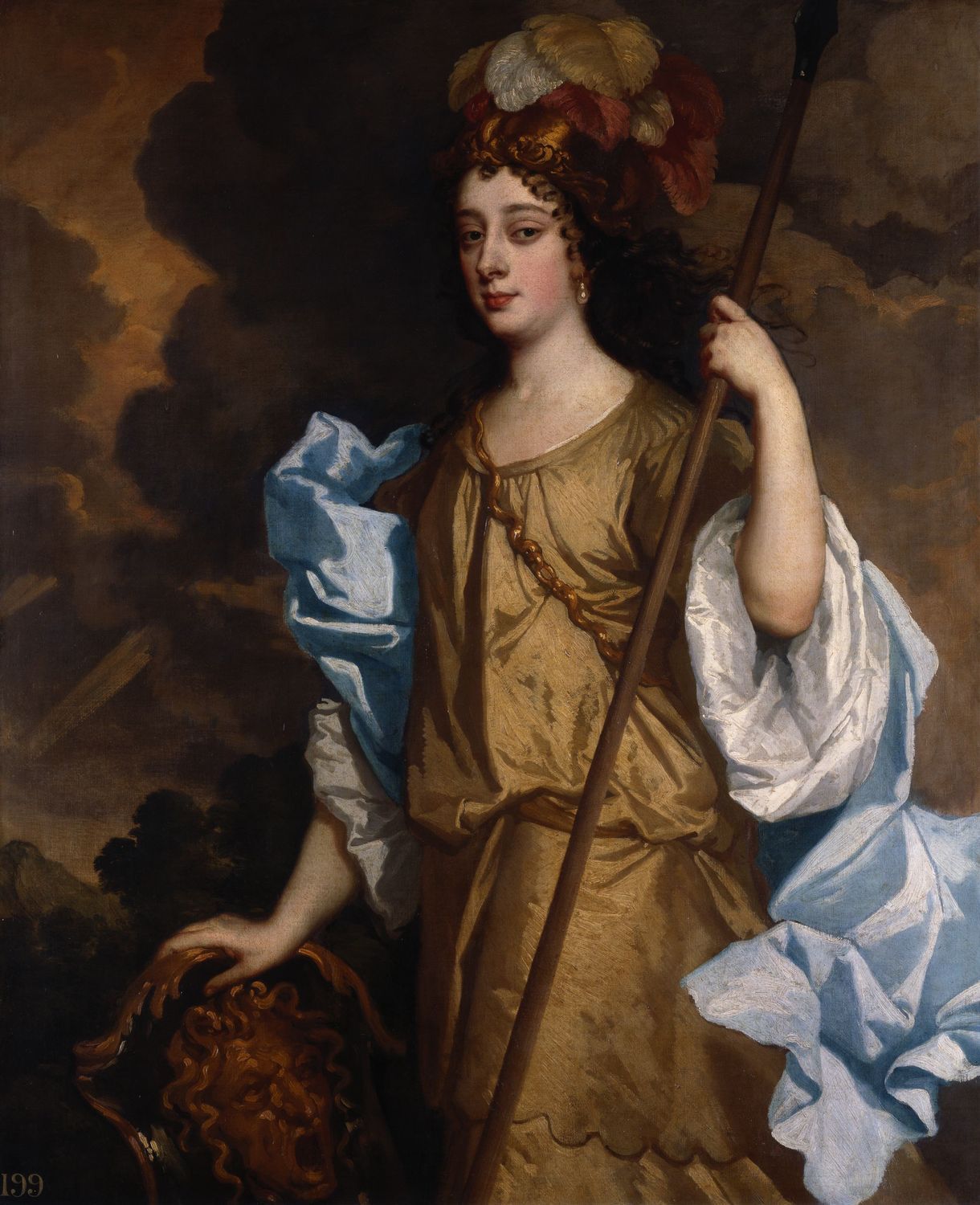
Barbara Palmer, 1st Duchess of Cleveland, Countess of Castlemaine, also known as Lady Castlemaine (27 November 1640 – 9 October 1709) was an English courtesan from the Villiers family and perhaps the most notorious of the many mistresses of King Charles II of England, by whom she had five children, all of whom were acknowledged and subsequently ennobled. Her influence was so great that she has been referred to as "The Uncrowned Queen."
Sir Peter Lely. A 17th Century
Portrait of Barbara Villiers
Oil on Canvas
28 ins x 23½ ins (71 cms x 60 cms)
Private collection
Sir Peter Lely (14 September 1618 – 30 November 1680) was a painter of Dutch origin, whose career was nearly all spent in England, where he became the dominant portrait painter to the court. Lely studied painting in Haarlem. He became a master of the Guild of Saint Luke in Haarlem in 1637.
He arrived in London in around 1641. His early English paintings, mainly mythological or religious scenes, or portraits. Lely's portraits were well received, and he succeeded Anthony van Dyck as the most fashionable portrait artist in England. He became a freeman of the Painter-Stainers' Company in 1647 and was portrait artist to Charles I. His talent ensured that his career was not interrupted by Charles's execution, and he served Oliver and Richard Cromwell. More on Sir Peter Lely
Barbara was the subject of many portraits, in particular by court painter Sir Peter Lely. Her extravagance, foul temper and promiscuity provoked diarist John Evelyn into describing her as the "curse of the nation", whereas Samuel Pepys often noted seeing her, admiringly.
Portrait of Barbara Palmer, 1st Duchess of Cleveland (1641-1709), mistress of Charles II of England, circa 1650-1700
Oil on canvas
height: 43 cm (16.9 in); width: 38 cm (14.9 in)
National Trust, Hatchlands Park
Henri Gascar (1635 – 1 Jan 1701) was a French-born portrait painter who achieved artistic success in England during the reign of Charles II. He painted many leading ladies at court, including several of the King's mistresses, before returning to Paris. He subsequently relocated to Rome, where he died in 1701. More on Henri Gascar
Barbara Palmer, 1st Duchess of Cleveland, Countess of Castlemaine (née Barbara Villiers, 27 November [O.S. 17 November] 1640 – 9 October 1709), was an English royal mistress of the Villiers family and perhaps the most notorious of the many mistresses of King Charles II of England, by whom she had five children, all of them acknowledged and subsequently ennobled. Barbara was the subject of many portraits, in particular by court painter Sir Peter Lely.
Born at the parish of St. Margaret's, Westminster, London, she was the only child of the 2nd Viscount Grandison, William Villiers, and his wife, Mary Bayning. On 20 September 1643, her father died in the English Civil War from a wound sustained at the Battle of Newbury while fighting for the Royalists; leaving his widow and daughter in straitened circumstances. Shortly after Lord Grandison's death, Barbara's mother married Charles Villiers, 2nd Earl of Anglesey, a cousin of her late husband.
Peter Lely (1618–1680)
Barbara Villiers as the penitent Magdalen, c. 17th century
Oil on canvas
1880 x 1283 mm (74 x 50 1/2 in)
Barbara Villiers was considered to be one of the most beautiful of the Royalist women, but her lack of fortune left her with reduced marriage prospects. On 14 April 1659 she married Roger Palmer (later 1st Earl of Castlemaine) against his family's wishes; his father predicted that she would make him one of the most miserable men in the world. Palmer was a Roman Catholic. The two separated in 1662, following the birth of her first son. They remained married for his lifetime.
after Sir Peter Lely
Barbara Palmer (née Villiers), Duchess of Cleveland, c. circa 1666
Oil on canvas
49 in. x 39 3/4 in. (1245 mm x 1010 mm)
National Portrait Gallery, London
Peter Lely (1618–1680)
Barbara Villiers, Duchess of Cleveland as St. Catherine of Alexandria, c.1665-70
Oil on canvas
height: 125.7 cm (49.4 in) ; width: 100 cm (39.3 in)
Private collection
Barbara became King Charles' mistress in 1660, while still married to Palmer, and whilst Charles was still in exile at The Hague. The Palmers had joined the ambitious group of supplicants who sailed for Brussels at the end of 1659. As a reward for her services, the King created her husband Baron Limerick and Earl of Castlemaine in 1661. In many contemporary accounts, including Pepys's Diary, she is referred to as "Lady Castlemaine".
John Michael Wright (died 1694)
Barbara Palmer (née Villiers), Duchess of Cleveland, circa 1670
Oil on canvas
height: 122.8 cm (48.3 in) ; width: 133 cm (52.3 in) Edit this at Wikidata
National Portrait Gallery
John Michael Wright (May 1617 – July 1694) was a portrait painter in the Baroque style. Described variously as English and Scottish, Wright trained in Edinburgh, and acquired a considerable reputation as an artist and scholar during a long sojourn in Rome. There he was admitted to the Accademia di San Luca, and was associated with some of the leading artists of his generation. He took up permanent residence in England from 1656, and served as court painter before and after the English Restoration. A convert to Roman Catholicism, he was a favourite of the restored Stuart court, a client of both Charles II and James II, and was a witness to many of the political maneuverings of the era. In the final years of the Stuart monarchy he returned to Rome as part of an embassy to Pope Innocent XI. More on John Michael Wright
By 1662, Barbara, the King's mistress, had more influence at the court than his queen consort, Catherine of Braganza. Barbara chose to give birth to their second child at Hampton Court Palace while he and the queen were honeymooning. In the summer of 1662 she was appointed Lady of the Bedchamber despite opposition from Queen Catherine and Edward Hyde, 1st Earl of Clarendon, chief advisor to the King and a bitter enemy of Barbara's.
Peter Lely (1618–1680)
Barbara Palmer, Duchess of Cleveland, circa 1666
Oil on canvas
height: 231 cm (90.9 in); width: 137 cm (53.9 in)
Private collection
Barbara's influence over the King waxed and waned. Her victory in being appointed as Lady of the Bedchamber was followed by rumours of an estrangement between her and the King, the result of his infatuation with Frances Stuart. In December 1663, Barbara announced her conversion to Roman Catholicism. Historians disagree as to why she did so. Some believe it was an attempt to consolidate her position with the King, and some believe it was a way of strengthening her ties with her Catholic husband. The King treated the matter lightly, saying that he was interested in ladies' bodies, but not their souls. The Court was equally flippant, the general view being that the Church of Rome gained nothing and the Church of England lost nothing.
style of, Peter Lely (1618–1680)
Called Barbara Villiers, Countess of Castlemaine and Duchess of Cleveland (1640-1709)
Oil on canvas,
1219 x 978 mm (49 x 38 1/2 in)
Sudbury Hall, Derbyshire
In June 1670 Charles created her Baroness Nonsuch (as she was the owner of Nonsuch Palace). She was also, briefly, granted the ownership of Phoenix Park in Dublin as a present from the King. She was made Countess of Castlemaine and Duchess of Cleveland in her own right. However, no one at court was sure if this was an indication that she was being jettisoned by Charles, or whether this was a sign that she was even higher in his favours. The dukedom was made with a special remainder which allowed it to be passed to her eldest son, Charles FitzRoy, despite his illegitimacy.
Peter Lely (1618–1680)
Barbara Villiers, Countess of Castlemaine and Duchess of Cleveland
Oil on canvas
UCL Art Museum
Barbara was known for her dual nature. Diarist John Evelyn called her "the curse of the nation"; yet, others described her as great fun, keeping a good table and with a heart to match her famous temper. Lady Barbara took advantage of her influence over the King, using it to her own benefit. She would help herself to money from the Privy Purse and take bribes from the Spanish and the French. She was famously extravagant and promiscuous.
Peter Lely (1618–1680)
Barbara Villiers, Countess of Castlemaine and Duchess of Cleveland
Oil on canvas
H 91.5 x W 105.5 cm
English Heritage, Audley End House
While the King had taken other mistresses, Barbara took other lovers too. Her lovers benefited financially from the arrangement. The King, who was no longer troubled by Barbara's infidelity. As the result of the 1673 Test Act, which essentially banned Catholics from holding office, Barbara lost her position as Lady of the Bedchamber, and the King cast her aside completely from her position as a mistress. The King advised Barbara to live quietly and cause no scandal, in which case he "cared not whom she loved".
Peter Lely (1618–1680)
Barbara Villiers, Countess of Castlemaine and Duchess of Cleveland
Oil on canvas
I have no further description, at this time
In 1676 she travelled to Paris with her four youngest children, but returned to England four years later. She was reconciled with the King, who was seen enjoying an evening in her company a week before he died in February 1685. She died at the age of 68 on 9 October 1709 at Chiswick Mall after suffering from oedema, known at the time as dropsy. Today, this would be described as oedema of the legs, with congestive heart failure.
Peter Lely (1618–1680)
Barbara Palmer, 1st Duchess of Cleveland as Minerva, the Roman goddess of war and wisdom, circa 1665
Oil on canvas
124.5 × 101.4 cm (49 × 39.9 in)
Hampton Court Palace
Of her six children, five were acknowledged by Charles as his:
- Lady Anne Palmer, later FitzRoy (1661–1722), probably daughter of Charles II, although some people believed she bore a resemblance to the Earl of Chesterfield. She later became the Countess of Sussex.
- Charles Palmer, later FitzRoy (1662–1730), styled Lord Limerick and later Earl of Southampton, created Duke of Southampton (1675), later 2nd Duke of Cleveland (1709)
- Henry FitzRoy (1663–1690), created Earl of Euston (1672) and Duke of Grafton (1675)
- Charlotte FitzRoy (1664–1718), later Countess of Lichfield. She gave birth to twenty children.
- George FitzRoy (1665–1716), created Earl of Northumberland (1674) and Duke of Northumberland (1683)
- Barbara (Benedicta) FitzRoy (1672–1737) – Barbara Villiers claimed that she was Charles's daughter, but she was probably the child of her mother's second cousin and lover, John Churchill, later Duke of Marlborough
Peter Lely (1618–1680)
Duchess of Cleveland with her son, Charles Fitzroy, as Madonna and Child, c. 1664
Oil on canvas
National Portrait Gallery
Peter Lely (1618–1680)
Barbara Villiers, Countess of Castlemaine and Duchess of Cleveland (1641-1709) with her Daughter, Lady Charlotte Fitz Roy (1664 - 1718), c. 1664 - 1666
Oil on canvas
1822 x 1283 mm (71 3/4 x 50 1/2 in)
Hatchlands Park, Surrey
William Sherwin
Barbara Villiers, Countess of Castlemaine and Duchess of Cleveland (1640-1709) as a Shepherdess
Oil on canvas
743 x 622 mm (29 1/4 x 24 1/2 in)
Blickling Hall, Norfolk
William Sherwin (1645–1709) was an English engraver, born at Wallington, Hertfordshire, where his father was rector around 1645. On his print of his father, dated 1672, he styles himself engraver to the king by patent. He married Elizabeth Pride, great-niece and ward of George Monck, 1st Duke of Albemarle, whose heir-at-law she eventually became, and there exists a pedigree of the Moncks of Potheridge engraved by Sherwin expressly to show his wife's claim to that position.
Between 1670 and 1711 he engraved in the line style a number of portraits. These comprise large plates of Charles II, Catherine of Braganza, Prince Rupert, Baron Gerard of Brandon, the Duchess of Cleveland, and Slingsby Bethell.
Sherwin was one of the first workers in mezzotint, a technique he learned from Prince Rupert. He dedicated to the Prince a pair of large portraits of Charles II and his queen engraved by the method; the former of these is dated 1669, the earliest found on an English mezzotint. More on William Sherwin

Peter Lely (1618–1680)
Barbara Villiers, Countess of Castlemaine, 1st Duchess of Cleveland
Oil on canvas
82½ x 52¾ in. (209.6 x 134 cm.)
Private collection
Peter Lely (1618–1680)
Barbara Villiers (1641–1709), Countess of Castlemaine and Duchess of Cleveland, Granddaughter of Barbara St John
Oil on canvas
123 x 101 cm
Lydiard House
Anonymous
Barbara Villiers, Countess of Castlemaine, 1st Duchess of Cleveland
I have no further description, at this time
Sir Godfrey Kneller (1646–1723)
Barbara Palmer (née Villiers), Duchess of Cleveland, circa 1705
Oil on canvas
49 in. x 39 3/4 in. (1245 mm x 1010 mm)
National Portrait Gallery, London
Sir Godfrey Kneller, 1st Baronet (born Gottfried Kniller; 8 August 1646 – 19 October 1723) was the leading portrait painter in England during the late 17th and early 18th centuries, and was court painter to English and British monarchs from Charles II to George I. His major works include The Chinese Convert (1687; Royal Collection, London); a series of four portraits of Isaac Newton painted at various junctures of the latter's life; a series of ten reigning European monarchs, including King Louis XIV of France; over 40 "Kit-cat portraits" of members of the Kit-Cat Club; and ten "beauties" of the court of William III, to match a similar series of ten beauties of the court of Charles II painted by his predecessor as court painter, Sir Peter Lely. More on Sir Godfrey Kneller
Please visit my other blogs: Art Collector, Mythology, Marine Art, Portrait of a Lady, The Orientalist, Art of the Nude and The Canals of Venice, Middle East Artists, 365 Saints and 365 Days, also visit my Boards on Pinterest
Images are copyright of their respective owners, assignees or others.
Some Images may be subject to copyright
I don't own any of these images - credit is always given when due unless
it is unknown to me. if I post your images without your permission, please tell
me.
I do not sell art, art prints, framed posters or reproductions. Ads are
shown only to compensate the hosting expenses.
If you enjoyed this post, please share with friends and family.
Thank you for visiting my blog and also for liking its posts and pages.
Please note that the content of this post primarily consists of articles
available from Wikipedia or other free sources online.

 Posts
Posts


.jpg)




,_Duchess_of_Cleveland_by_Sir_Peter_Lely.jpg)