Showing posts with label Artists biography. Show all posts

01 Work, The Art of War, Sliman Mansour's ON THE EDGE, with footnotes


Sliman Mansour, b. 1947, Palestinian
ON THE EDGE, c. 1985
Oil on canvas
80 by 70.5 cm.; 31½ by 27¾ in.
Private collection

Estimate for 30,000 - 40,000 GBP in March 2020

Sliman Mansour ( born 1947), is a Palestinian painter, considered an important figure among contemporary Palestinian artists. Mansour is considered an artist of intifada whose work captures to the cultural concept of sumud. Palestinian artist and scholar Samia Halaby has identified Mansour as part of the Liberation Art Movement and cites his important work as an artist and cultural practitioner before and after the Intifada.

During the Intifada, Mansour was part of the "New Visions" group of Palestinian artists that included Tayseer Barakat, Vera Tamari, and Nabil Anani. This collective turned to earthworks and mixed media and assemblage using materials derived from the Palestinian environment in order to boycott Israeli art supplies in protest of the ongoing occupation. In 1988 he made a series of four paintings on destroyed Palestinian villages, the four villages being Yibna, Yalo, Imwas and Bayt Dajan.

He is a co-author of Both Sides of Peace: Israeli and Palestinian Political Poster Art, published in 1998 by the Contemporary Art Museum with University of Washington Press. More on Sliman Mansour 


Please visit my other blogs: Art CollectorMythologyMarine ArtPortrait of a Lady, The OrientalistArt of the Nude and The Canals of VeniceMiddle East Artists365 Saints365 Days, and Biblical Icons, also visit my Boards on Pinterest

Images are copyright of their respective owners, assignees or others. Some Images may be subject to copyright

I don't own any of these images - credit is always given when due unless it is unknown to me. if I post your images without your permission, please tell me.

I do not sell art, art prints, framed posters or reproductions. Ads are shown only to compensate the hosting expenses.

If you enjoyed this post, please share with friends and family.

Thank you for visiting my blog and also for liking its posts and pages.

Please note that the content of this post primarily consists of articles available from Wikipedia or other free sources online.


01 Painting, MIDDLE EASTERN ART, With Footnotes - 48

Suleiman Mansour, (Palestinian, b. 1947)
And the Convoy Keeps Going, c. 2016
Oil and acrylic on canvas
50 7/8 x 64 1/3 in. (129.5 x 163.4cm.)
Private collection

Sliman Mansour (born 1947), is a Palestinian painter, considered an important figure among contemporary Palestinian artists. Mansour is considered an artist of the intifada whose work gave visual expression to the cultural concept of sumud. Palestinian artist and scholar Samia Halaby has identified Mansour as part of the Liberation Art Movement and cites his important work as an artist and cultural practitioner before and after the Intifada. During the Intifada, Mansour was part of the "New Visions" group of Palestinian artists. This collective turned to earthworks and mixed media and assemblage using materials derived from the Palestinian environment in order to boycott Israeli art supplies in protest of the ongoing occupation. In 1988 he made a series of four paintings on destroyed Palestinian villages, the four villages being Yibna, Yalo, Imwas and Bayt Dajan.

He is a co-author of Both Sides of Peace: Israeli and Palestinian Political Poster Art, published in 1998 by the Contemporary Art Museum with University of Washington Press. More on Suleiman Mansour


Please visit my other blogs: Art CollectorMythologyMarine ArtPortrait of a Lady, The OrientalistArt of the Nude and The Canals of VeniceAnd visit my Boards on Pinterest

Images are copyright of their respective owners, assignees or others. Some Images may be subject to copyright

I don't own any of these images - credit is always given when due unless it is unknown to me. if I post your images without your permission, please tell me.

I do not sell art, art prints, framed posters or reproductions. Ads are shown only to compensate the hosting expenses.

If you enjoyed this post, please share with friends and family.

Thank you for visiting my blog and also for liking its posts and pages.

Please note that the content of this post primarily consists of articles available from Wikipedia or other free sources online.

01 Painting, MIDDLE EASTERN ART, With Footnotes - 47

Mamdouh Kashlan, (Syrian, b. 1929)
Hammam Al Nissaa’s bil sham (Women’s public bath in Damascus), c. 1990
Oil on canvas
68 7/8 x 78 ¾ in. (175 x 200cm.)
Private collection

Damascus Public Baths (Hammams) were commonly used in Damascus as a civilized phenomena that denotes the interest of the Damascenes in their health, and cleanness of bodies. Going to the bath was a religious and social habit of life in the Orient in general and in Damascus in particular. 

With very limited means of entertainment in a closed society, women changed the visit to the bath into an opportunity to meet other women, and to deepen social relations. By time, public baths were linked to several social occasions like marriages, births, and preparations for feasts. Women used to spend long hours in the bath consuming all the time specified for them; usually from midday to the evening. More on Hammams

Mamdouh Kashlan (born 1929 in Damascus) is a Syrian painter. He has held more than 300 exhibitions in Syria and around the world and many of his paintings are on display in the National museums of Damascus, Aleppo and Deir Atieh and the presidential palace. His work is also on display in the Sorsoq Museum in Beirut, Lebanon, Modern art museum in Cairo, Egypt and has been displayed in Sofia, Bulgaria, Paris and Seinajoki, Finland. In 1996 he was awarded the pioneers prize from the ministry of culture. More on Mamdouh Kashlan


Please visit my other blogs: Art CollectorMythologyMarine ArtPortrait of a Lady, The OrientalistArt of the Nude and The Canals of VeniceAnd visit my Boards on Pinterest

Images are copyright of their respective owners, assignees or others. Some Images may be subject to copyright

I don't own any of these images - credit is always given when due unless it is unknown to me. if I post your images without your permission, please tell me.

I do not sell art, art prints, framed posters or reproductions. Ads are shown only to compensate the hosting expenses.

If you enjoyed this post, please share with friends and family.

Thank you for visiting my blog and also for liking its posts and pages.

Please note that the content of this post primarily consists of articles available from Wikipedia or other free sources online.

01 Painting, MIDDLE EASTERN ART, With Footnotes - 46

Ismail Shammout, (Palestinian, 1930-2006)
Al- Tariq (The Way), c. 1964
Oil on canvas
31 ½ x 23 ½ in. (79.9 X 59.9cm.)
Private collection

Ismail Shammout (1930 – 2006) was a Palestinian artist and art historian.

Shammout was born in 1930 in Lydda. On July 12, 1948, he and his family were amongst 25,000 residents of Lydda expelled from their homes by Israeli occupation. The Shammout family moved to the Gaza refugee camp of Khan-Younes. In 1950 Shammout went to Cairo and enrolled in the College of Fine Arts. After returning to Gaza in 1953, he held his first exhibition, which was a success.

Shammout and Palestinian artist Tamam al Akhal participated in the Palestine Exhibition of 1954 in Cairo. The exhibition was inaugurated by then Egyptian President Gamal Abdul Nasser. Later in 1954, he moved to Italy and enrolled at the Academia De Belle Arti in Rome. He married al Akhal in 1959. 

Shammout expressed his emotions, fears, sufferings, hopes and dreams, which are shared by all the Palestinian people, through his paintings. More on Shammout


Please visit my other blogs: Art CollectorMythologyMarine ArtPortrait of a Lady, The OrientalistArt of the Nude and The Canals of VeniceAnd visit my Boards on Pinterest

Images are copyright of their respective owners, assignees or others. Some Images may be subject to copyright

I don't own any of these images - credit is always given when due unless it is unknown to me. if I post your images without your permission, please tell me.

I do not sell art, art prints, framed posters or reproductions. Ads are shown only to compensate the hosting expenses.

If you enjoyed this post, please share with friends and family.

Thank you for visiting my blog and also for liking its posts and pages.

Please note that the content of this post primarily consists of articles available from Wikipedia or other free sources online.

01 Painting, MIDDLE EASTERN ART, With Footnotes - 45

Ahmed Moustafa, (Egyptian, b. 1943)
The Coiling of Day and Night, c. 2000
Oil and watercolour on paper
52 ¾ x 43 1/3 in. (134 x 110cm.)
Private collection

Ahmed Moustafa, (Egyptian, b. 1943) was born in Alexandria, Egypt Moustafa studied Fine Arts at Alexandria University, after which he obtained an MA and PhD from the Central School of Art and Design in London, where he still lives and works. Moustafa is a practicing calligrapher and scholar who transforms sacred Qur'anic texts into works of art, combining their religious significance with a modern interpretation of the traditional script. 

Employing repetition and other painterly techniques such as incorporating the text into a representational image, Moustafa has been able to lend calligraphy to a more universal reception. Moustafa is known for incorporating a bold color palette into his work as well as his fluid and spontaneous penmanship. The artist engages with a wide range of media such as paintings, tapestries, silk-screen prints and stained glass. His work is held in many private and public collections, such as the National Museums in both Britain and Egypt, the Ashmolean Museum in Oxford and the National Museum of Scotland. More on Ahmed Moustafa


Please visit my other blogs: Art CollectorMythologyMarine ArtPortrait of a Lady, The OrientalistArt of the Nude and The Canals of VeniceAnd visit my Boards on Pinterest

Images are copyright of their respective owners, assignees or others. Some Images may be subject to copyright

I don't own any of these images - credit is always given when due unless it is unknown to me. if I post your images without your permission, please tell me.

I do not sell art, art prints, framed posters or reproductions. Ads are shown only to compensate the hosting expenses.

If you enjoyed this post, please share with friends and family.

Thank you for visiting my blog and also for liking its posts and pages.

01 Painting, MIDDLE EASTERN ART, With Footnotes - 44

Willy Aractingi, (Lebanese, 1930-2003)
Blue Panther, c. 1994
Oil on canvas
31 ½ x 39 1/8 in. (80 x 99.5cm.)
Private collection

Willy Aractingi, (Lebanese, 1930-2003) was born in New York in 1930, Aractingi was raised in Cairo, studied in Grasse, before finally settling in Beirut in the late 1940s.
Aractingi undertook painting at a very young age. His works are often differentiated by his use of unique colour gradations, bold pigments and recurring use of nature. 

Aractingi’s greatest artistic achievement was painting Jean de la Fontaine's (French, 1621 - 1695) entire collection of 244 fables on individual canvases. He embarked on this mamoth project titled Magnum Opus in January 1989, whilst residing in France. Seven years and 244 canvases later, he completed the ambitious project in 1995 on the 300th anniversary of De La Fontaine’s death. 

Aractingi's works are extensively inspired by fictional stories and fables. He generously provides his audience a gateway into the creases of a fantasy world inhabited by folk creatures and copious animals; all brought to life using his vivid brushstrokes.  He continued to paint insistently up until his death in 2003; depicting Antar and Abla, Geha, Tarzan, Adam and Eve, and a plethora of animals throughout his oeuvre.  Following his death, the artist's family estate donated 230 of his works to the Sursock Museum in Beirut. In 2017, the museum mounted a retrospective curated by Yasmine Chemali who gathered some 120 works under the title Les Mondes de Willy Aractingi. Sotheby's is privileged to be offering this important and rare work from the estate of the artist. More on Willy Aractingi


Please visit my other blogs: Art CollectorMythologyMarine ArtPortrait of a Lady, The OrientalistArt of the Nude and The Canals of VeniceAnd visit my Boards on Pinterest

Images are copyright of their respective owners, assignees or others. Some Images may be subject to copyright

I don't own any of these images - credit is always given when due unless it is unknown to me. if I post your images without your permission, please tell me.

I do not sell art, art prints, framed posters or reproductions. Ads are shown only to compensate the hosting expenses.

If you enjoyed this post, please share with friends and family.

Thank you for visiting my blog and also for liking its posts and pages.

01 Painting, MIDDLE EASTERN ART, With Footnotes - 43

Khaled Hourani
Farewell, c. 2019
Acrylic on canvas
86 3/5 × 41 7/10 in, 220 × 106 cm
Private collection

Khaled Hourani, Born in Hebron, Palestine, in 1965. Khaled Hourani lives and works in Ramallah. He was Artistic Director (2007-2010) and Director (2010-2013) of the International Academy of Art Palestine, of which he is also one of the co-founders. He previously worked as the General Director of the Fine Arts Department of the Palestinian Ministry of Culture (2004-2006). Hourani has participated in many local and international exhibitions, most recently in a retrospective at Darat Al Funun in Amman , Jordan (2017).

In 2014, his first retrospective exhibition took place at the CCA in Glasgow and Gallery One in Ramallah. He exhibited works at the Times Museum in Guangzhou, China and in the 2nd CAFA Biennale of the CAFA Museum in Beijing. He also participated in dOCUMENTA (13) in Kassel, and KW Institute for Contemporary Art, Berlin. Moreover, Hourani was also one of the artists of the Sharjah Biennial in 2011. Hourani was the initiator of the 2011 Picasso in Palestine project. He has curated and organized several exhibitions, is an art critic and an active member and founder of a number of cultural and art institutions. Recently, he was the recipient of the Leonore Annenberg Prize, Creative Time for Art and Social Change in New York City.

Hourani has been working for over a year on a book project, which is itself based on a novel about a painting titled Jamal Al Mahamel by Palestinian artist Suleiman Mansour. This artwork was sold to  the former Libyan president Muammar al Gaddafi in the 1970s. Through this project, Hourani seeks to figure out what happened to the painting and the circumstances of its disappearance after the 2011 political upheavals in Libya. He also raises the question of the perception of art both in Palestine and Libya. More on Khaled Hourani


Please visit my other blogs: Art CollectorMythologyMarine ArtPortrait of a Lady, The OrientalistArt of the Nude and The Canals of VeniceAnd visit my Boards on Pinterest


Images are copyright of their respective owners, assignees or others. Some Images may be subject to copyright

I don't own any of these images - credit is always given when due unless it is unknown to me. if I post your images without your permission, please tell me.

I do not sell art, art prints, framed posters or reproductions. Ads are shown only to compensate the hosting expenses.

If you enjoyed this post, please share with friends and family.

Thank you for visiting my blog and also for liking its posts and pages.

Please note that the content of this post primarily consists of articles available from Wikipedia or other free sources online.

01 Painting, MIDDLE EASTERN ART, With Footnotes - 42

Ahmad Baitem, (Palestine)
Untitled, c. 1990
Oil on Canvas
76x56cm
Private collection

Ahmed Baitem is  a Palestinian visual artist born in Acre in the 1920s. He emigrated to Lebanon after the 1948 Nakba. A well respected artist he was contracted by the Saudi Fine Art Institutes as a teacher. He finished his career as a teacher at the Intermediate Institute of Fine Arts in Riyadh. He was the teacher of the first generation of Saudi artists, and he was the inspiration for the great artist Ali Rizeza, He held many solo and joint exhibitions in Saudi Arabia. More on Ahmed Baitem


Please visit my other blogs: Art CollectorMythologyMarine ArtPortrait of a Lady, The OrientalistArt of the Nude and The Canals of VeniceAnd visit my Boards on Pinterest

Images are copyright of their respective owners, assignees or others. Some Images may be subject to copyright

I don't own any of these images - credit is always given when due unless it is unknown to me. if I post your images without your permission, please tell me.

I do not sell art, art prints, framed posters or reproductions. Ads are shown only to compensate the hosting expenses.

If you enjoyed this post, please share with friends and family.

Thank you for visiting my blog and also for liking its posts and pages.

Please note that the content of this post primarily consists of articles available from Wikipedia or other free sources online.

02 works, MIDDLE EASTERN ART, With Footnotes - 40

Mounir Fatmi, Moroccan
Across the moon
B&W video, HD, stereo, 11’33’’

Mounir Fatmi, Moroccan, b. 1970,  examines human vulnerability. He constructs visual environments (comprising such objects as saw blades, stereo speakers, construction hard hats, and flags) and plays with language in a way that questions preconceptions of politics and religion and unearths injustices buried by history. In his 2009 work The Machinery, 30 aggressive-looking industrial saw blades are inscribed with elaborately drawn Islamic poems relaying a peaceful message. Using current events as content for projects, Fatmi investigates the origins of contemporary issues and crises. More on Mounir Fatmi 

Mounir Fatmi, Moroccan
Evolution or Death, 2013
C-print
53 7/10 × 80 7/10 in, 136.5 × 205 cm


Please visit my other blogs: Art CollectorMythologyMarine ArtPortrait of a Lady, The OrientalistArt of the Nude and The Canals of VeniceAnd visit my Boards on Pinterest

Images are copyright of their respective owners, assignees or others. Some Images may be subject to copyright

I don't own any of these images - credit is always given when due unless it is unknown to me. if I post your images without your permission, please tell me.

I do not sell art, art prints, framed posters or reproductions. Ads are shown only to compensate the hosting expenses.

If you enjoyed this post, please share with friends and family.

Thank you for visiting my blog and also for liking its posts and pages.

Please note that the content of this post primarily consists of articles available from Wikipedia or other free sources online.

01 work, MIDDLE EASTERN ART, With Footnotes - 41

Khaled Hourani
Crowd #1, 2019
Acrylic on canvas
45 3/10 × 40 1/5 in, 115 × 102 cm

Khaled Hourani, Born in Hebron, Palestine, in 1965. Khaled Hourani lives and works in Ramallah. He was Artistic Director (2007-2010) and Director (2010-2013) of the International Academy of Art Palestine, of which he is also one of the co-founders. He previously worked as the General Director of the Fine Arts Department of the Palestinian Ministry of Culture (2004-2006). Hourani has participated in many local and international exhibitions, most recently in a retrospective at Darat Al Funun in Amman , Jordan (2017).

In 2014, his first retrospective exhibition took place at the CCA in Glasgow and Gallery One in Ramallah. He exhibited works at the Times Museum in Guangzhou, China and in the 2nd CAFA Biennale of the CAFA Museum in Beijing. He also participated in dOCUMENTA (13) in Kassel, and KW Institute for Contemporary Art, Berlin. Moreover, Hourani was also one of the artists of the Sharjah Biennial in 2011. Hourani was the initiator of the 2011 Picasso in Palestine project. He has curated and organized several exhibitions, is an art critic and an active member and founder of a number of cultural and art institutions. Recently, he was the recipient of the Leonore Annenberg Prize, Creative Time for Art and Social Change in New York City.

Hourani has been working for over a year on a book project, which is itself based on a novel about a painting titled Jamal Al Mahamel by Palestinian artist Suleiman Mansour. This artwork was sold to  the former Libyan president Muammar al Gaddafi in the 1970s. Through this project, Hourani seeks to figure out what happened to the painting and the circumstances of its disappearance after the 2011 political upheavals in Libya. He also raises the question of the perception of art both in Palestine and Libya. More on Khaled Hourani


Please visit my other blogs: Art CollectorMythologyMarine ArtPortrait of a Lady, The OrientalistArt of the Nude and The Canals of VeniceAnd visit my Boards on Pinterest

Images are copyright of their respective owners, assignees or others. Some Images may be subject to copyright

I don't own any of these images - credit is always given when due unless it is unknown to me. if I post your images without your permission, please tell me.

I do not sell art, art prints, framed posters or reproductions. Ads are shown only to compensate the hosting expenses.

If you enjoyed this post, please share with friends and family.

Thank you for visiting my blog and also for liking its posts and pages.

Please note that the content of this post primarily consists of articles available from Wikipedia or other free sources online.

01 Painting, MIDDLE EASTERN ART, With Footnotes - 39

Effat Nagui, 1912-1994, EGYPTIAN
UNTITLED (GIRL WITH HER GOAT), c. 1950's
Oil on celotex
55 by 40cm.; 21 1/2 by 15 3/4 in.
Private collection

Effat Nagy (5 April 1905 – 4 October 1994) was an Egyptian artist who has a museum in Cairo devoted to her and her husband's works. The museum is called Museum of Saad El-Khadem and Effat Nagy

Effat Mousa Nagy was born in the Mediterranean port of Alexandria in 1905. She was fascinated by culture, she was trained in music and mathematics. She was taught art by a private tutor and her artistic brother Mohamed Nagy. Her formal training was at the Arts Academy in Rome in 1947. She worked in Egypt under André Lhote and they used Egyptian archaeology as subject matter.

She married Saad Al-Khadem in 1945. He was also an artist and a researcher. Her husband's research inspired her art.

In 1964 she exhibited her work at the High Dam Exhibition. This was a result of work that she had been commissioned to do the previous year. She was asked to record the archaeology that would be lost as it was submerged under the waters of the Aswan Dam as it was constructed. She was one of 64 artists chosen to do this work.

In 1968 the Mohamed Nagy Museum was founded and Nagy made a donation of forty of her brother's paintings to help create a collection of her brother's work.

Nagy died in 1994 although another source says 1997. More on Effat Nagy


Please visit my other blogs: Art CollectorMythologyMarine ArtPortrait of a Lady, The OrientalistArt of the Nude and The Canals of VeniceAnd visit my Boards on Pinterest

Images are copyright of their respective owners, assignees or others. Some Images may be subject to copyright

I don't own any of these images - credit is always given when due unless it is unknown to me. if I post your images without your permission, please tell me.

I do not sell art, art prints, framed posters or reproductions. Ads are shown only to compensate the hosting expenses.

If you enjoyed this post, please share with friends and family.

Thank you for visiting my blog and also for liking its posts and pages.

Please note that the content of this post primarily consists of articles available from Wikipedia or other free sources online.

01 Painting, MIDDLE EASTERN ART, With Footnotes - 38

Hassan Hajjaj, B. 1961, MOROCCAN
WINK, c. 2007
Metallic Lambda inset with kohl boxes mounted on board in artist's frame
94 by 66cm.; 37 by 26in.
Private collection

Hassan Hajjaj (b. Larache, Morocco in 1961) is a contemporary artist who lives and works between London, UK and Marrakech, Morocco, and is known as the “Andy Warhol of Marrakech.”

Hajjaj's work is in the collections of the Brooklyn Museum, New York; the British Museum, London; the Nasher Museum of Art, Duke University, Durham, NC; the Newark Museum, New Jersey; Los Angeles Museum of Contemporary Art, Los Angeles; the Victoria & Albert Museum, London; the Farjam Collection, Dubai; Institut des Cultures d’Islam, Paris; Kamel Lazaar Foundation, Tunisia; and Virginia Museum of Fine Art, Richmond, VA.

Hajjaj was the winner of the 2011 Sovereign Middle East and African Art Prize and was shortlisted for Victoria and Albert Museum's Jameel Prize in 2009. In 2013, Rose Issa Projects published a monograph of the artist exploring his upbringing in Morocco and London, his experiences in fashion and interior design, and his adventures in the music industry influence the vibrant colours, joyful spirit, and visual rhythm of his highly sought-after images.

Hajjaj's first feature-length film, Karima: A Day in the Life of a Henna Girl, premiered at the Los Angeles County Museum of Art in May 2015. The film takes viewers into the world of one Hajjaj’s most iconic series, Kesh Angels, depicting the henna girls of Marrakesh. The film will be subsequently shown at Art Basel in Basel, Switzerland in June 2015, curated by Cairo-based film curator and lecturer Maxa Zoller. More on Hassan Hajjaj


Please visit my other blogs: Art CollectorMythologyMarine ArtPortrait of a Lady, The OrientalistArt of the Nude and The Canals of VeniceAnd visit my Boards on Pinterest

Images are copyright of their respective owners, assignees or others. Some Images may be subject to copyright

I don't own any of these images - credit is always given when due unless it is unknown to me. if I post your images without your permission, please tell me.

I do not sell art, art prints, framed posters or reproductions. Ads are shown only to compensate the hosting expenses.

If you enjoyed this post, please share with friends and family.

Thank you for visiting my blog and also for liking its posts and pages.

Please note that the content of this post primarily consists of articles available from Wikipedia or other free sources online.

01 Painting, MIDDLE EASTERN ART, With Footnotes - 37

Hassan Sharif, (1951-2016) , EMIRIAN
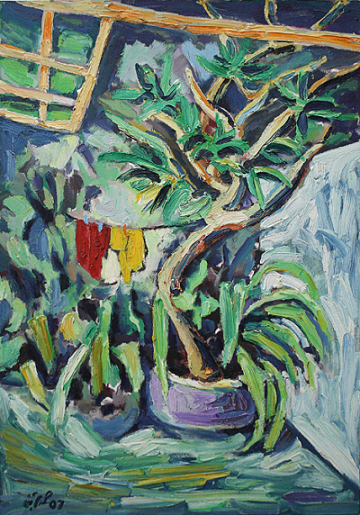
GARDEN #1, c. 2007
Oil on canvas 
100 by 70cm.; 39 3/8 by 27 1/2 in.
Private collection

Hassan Sharif (1951-2016) made a vital contribution to conceptual art and experimental practice in the Middle East through 40 years of performance, installation, drawing, painting and assemblage. Prior to leaving the UAE to study in London in 1979, Sharif gained attention for his cartoons published in the U­AE press - ironic, outspoken critiques of the rapid industrialisation of the Emirates and political deadlock of 1970s Arab Nationalism. As an artist, he rejected calligraphic abstraction, which was becoming the dominant discourse in the Middle East at that time, and pursued instead a pointedly contemporary vocabulary, drawing on the non-elitism and intermedia of Fluxus and the potential in British Constructionism's systemic processes of making.

Sharif graduated from The Byam Shaw School of Art in 1984 and returned to the UAE shortly after. He set about staging interventions and the first exhibitions of contemporary art in Sharjah, as well as translating art historical texts and manifestos into Arabic so as to provoke a local audience to engage with - or at least reject - contemporary art discourse. 

In addition to his own practice, he also encouraged and supported several generations of artists in the Emirates. Sharif was a founding member of the Emirates Fine Arts Society and the Art Atelier in the Youth Theatre and Arts in Dubai. In 2007, he was one of the four artists to establish The Flying House, a Dubai institution for promoting contemporary Emirati artists. More on Hassan Sharif


Please visit my other blogs: Art CollectorMythologyMarine ArtPortrait of a Lady, The OrientalistArt of the Nude and The Canals of VeniceAnd visit my Boards on Pinterest

Images are copyright of their respective owners, assignees or others. Some Images may be subject to copyright

I don't own any of these images - credit is always given when due unless it is unknown to me. if I post your images without your permission, please tell me.

I do not sell art, art prints, framed posters or reproductions. Ads are shown only to compensate the hosting expenses.

If you enjoyed this post, please share with friends and family.

Thank you for visiting my blog and also for liking its posts and pages.

Please note that the content of this post primarily consists of articles available from Wikipedia or other free sources online.