19 Paintings, Marine and Seascape Paintings - with footnotes -13

Marc-Aurèle Fortin
Marc-Aurèle Fortin, ARCA 1888 - 1970 Canadian
La Goélette
watercolour and charcoal on paper on card 
18 1/4 x 26 1/2 in  46.3 x 67.3 cm
Edward Burtynsky
Edward Burtynsky, OC RCA 1955 - Canadian
Shipyard #18, Qili Port, Zhejiang Province, China
chromogenic colour print 
22 x 18 in  55.9 x 45.7 cm

davis, stuart harbor scene | cityscape | sotheby's n09484lot8z4wcen:
Stuart Davis, 1892 - 1964
HARBOR SCENE
Oil on canvas
26 by 38 inches, (66 by 96.5 cm)

Stuart Davis (December 7, 1892 – June 24, 1964), was an early American modernist painter. He was well known for his jazz-influenced, proto pop art paintings of the 1940s and 1950s, bold, brash, and colorful, as well as his ashcan pictures in the early years of the 20th century. More

lever, hayley the president's yacht | maritime | sotheby's n09484lot8zpdben:
Hayley Lever, 1876 - 1958
THE PRESIDENT'S YACHT "THE MAYFLOWER" WITH BATTLESHIPS IN NEW YORK HARBOR
Oil on canvas
25 by 30 1/4 inches, (63.5 by 76.9 cm)

Richard Hayley Lever (28 September 1875 – 6 December 1958) was an Australian-American painter, etcher, lecturer and art teacher. Lever was born in Bowden, South Australia, the son of Albion W. Lever. He excelled in painting classes at Prince Alfred College under James Ashton and on leaving school continued to study under Ashton at his Norwood art school. He was a charter member of the Adelaide Easel Club in 1892.

Lever's maternal grandfather died in 1882, and the subsequent inheritance was sufficient for Lever to finance a trip to England in 1899 to further his career in painting. He moved to St. Ives. The town's reputation as a centre for marine painting. He shared a studio with Frederick Waugh, and studied painting techniques under the Impressionists Olsson and Algernon Talmage. Lever also painted in the French port villages of Douarnenez and Concarneau, Brittany, directly across the English Channel from St. Ives.

In late 1904 Lever made a trip back to Adelaide, where he staged several exhibitions, painted seascapes and taught. In 1906, upon returning to Europe, he married Aida Smith Gale in St. Ives’ Parish Church. 

In 1911, Ernest Lawson, an Impressionist painter, persuaded Lever to move to America, saying he would have greater success there. From 1919 to 1931, Lever taught art classes at the Art Students League of New York. He offered this message to his students: "Art is the re-creation of mood in line, form and color. If I were confined to my own back yard for the rest of my life, I'd still have more pictures in my mind than I would have time to paint. Art is nothing but having a good time." Lever went to Pittsburgh in 1922 as an art juror for the Carnegie International exhibition.


In 1924, Lever was commissioned to paint a portrait of the presidential yacht, Mayflower, which was subsequently presented to President Calvin Coolidge in the Cabinet Room of the White House. By 1930, Lever had moved to Caldwell, New Jersey, staying there until 1938, when he moved to Mount Vernon, New York. While living in New York, Lever painted marines and landscapes in New Jersey, Vermont, New England, New York and the Canadian Maritimes. Throughout his life, he traveled and painted extensively, including Nova Scotia and Grand Manan Island in Canada, the Bahamas and Florida, while often returning to Europe. In 1933, Hayley was named Director of the Green Mountains summer art school at Smugglers Notch, Stowe Vermont. Lever also taught painting classes at the Forum School of Art in Bronxville, New York from 1934 to 1935. More

cornwell, dean study of pirates | battle | sotheby's n09484lot8z2tren:
Dean Cornwell, 1892 - 1960
STUDY OF PIRATES
Oil on canvas
24 1/8 by 34 1/4 inches

Dean Cornwell (March 5, 1892 - December 4, 1960) was an American illustrator and muralist. His oil paintings were frequently featured in popular magazines and books as literary illustrations, advertisements, and posters promoting the war effort. Throughout the first half of the 20th century he was a dominant presence in American illustration. At the peak of his popularity he was nicknamed the "Dean of Illustrators". More

feininger, t. lux die lotsenkutter | maritime | sotheby's n09484lot8t2f4en:
T. Lux Feininger, 1910-2011
DIE LOTSENKUTTER, c. 1933
Oil on canvas
13 by 18 1/4 inches, (33 by 46.4 cm)

T. Lux Feininger (June 11, 1910 Berlin — July 7, 2011 Cambridge) was an American painter, avant-garde photographer, author, and art teacher who was born in Berlin to Julia Berg and Lyonel Charles Feininger, an American living in Germany from the age of sixteen. His father was the first faculty appointment made to the Bauhaus in Weimar by its founder, Walter Gropius, in 1919. He had two older full brothers, including Andreas Feininger, and two half sisters, even older, by Clara Fürst and his father (from his first marriage). More

sloane, eric ahead of the squall | maritime | sotheby's n09484lot75m85en:
Eric Sloane, 1910 - 1985
AHEAD OF THE SQUALL
Oil on Masonite
36 by 48 inches, (91.4 by 121.8 cm)

Eric Sloane (born Everard Jean Hinrichs) (27 February 1905 – 5 March 1985) was an American landscape painter, born in New York City, and author of illustrated works of cultural history and folklore. He is considered a member of the Hudson River School of painting.

As a child, he was a neighbor of noted sign painter and type designer Frederick W. Goudy. Sloane studied art and lettering with Goudy. While he attended the Art Students League of New York City, he changed his name because George Luks and John French Sloan suggested that young students should paint under an assumed name so that early inferior works would not be attached to them.

In the summer of 1925, Sloane ran away from home, working his way across the country as a sign painter, creating advertisements for everything from Red Man Tobacco to Bull Durham. Unique hand calligraphy and lettering became a characteristic of his illustrated books. Sloane eventually returned to New York and settled in the Merryall area of New Milford, Connecticut, where he began painting rustic landscapes in the tradition of the Hudson River School.
In the 1950s, he began spending part of the year in Taos, New Mexico, where he painted western landscapes and particularly luminous depictions of the desert sky.

In his career as a painter, he produced over 15,000 works. His fascination with the sky and weather led to commissions to paint works for the U.S.

Air Force and the production of a number of illustrated works on meteorology and weather forecasting. More

robinson, charles dorman "the wasp" | maritime | sotheby's n09484lot8zpdren:
Charles Dorman Robinson, 1847 - 1933
"THE WASP" AND "THE SERAPIS" IN BOSTON HARBOR AT NIGHT
Oil on canvas
48 by 72 inches, (121.9 by 182.9 cm)

Charles Dorman Robinson (alternate: Charles Dormon Robinson; nickname: C.D.) (July 17, 1847 - May 8, 1933) was an American panorama, cyclorama, landscape, and marine painter. He is known for his seascapes and landscapes of Northern California, including over a hundred paintings of Yosemite Valley. He was known as "the dean of Pacific Coast artists". More

peterson, jane fishing boat at a mo | maritime | sotheby's n09484lot75m6ben:
Jane Peterson, 1876 - 1965
FISHING BOAT AT A MOORING
Oil on canvas
24 by 30 inches, (61 by 76.2 cm)

Jane Peterson (1876–1965) was an American Impressionist and Expressionist painter. Her works are created in Impressionist and Expressionist styles using broad swaths of vibrant colors to combine an interest in light and in depiction of spontaneous moments and are well known for vivid, rich painted still life, beach scenes along the Massachusetts coast. More

farndon, walter new england harbor | seascape | sotheby's n09484lot8xnxnen:
Walter Farndon, 1876 - 1964
NEW ENGLAND HARBOR
Oil on Masonite
14 by 18 inches, (35.6 by 45.7 cm)

Walter Farndon, 1876-1964, was a New England plein-air painter best-known for impasto, Impressionist, sometimes near-Expressionist harbor and shore scenes, though he also painted portraits and figures. Born in Coventry, England, Farndon came to the United States, studying at the National Academy of Design, where he was later elected an Associate in 1928, and an Academician in 1937. He also studied with Robert Henri, and was a member of the Society of Independent Artists. He painted in Ridgefield, New Jersey in the 1920s.
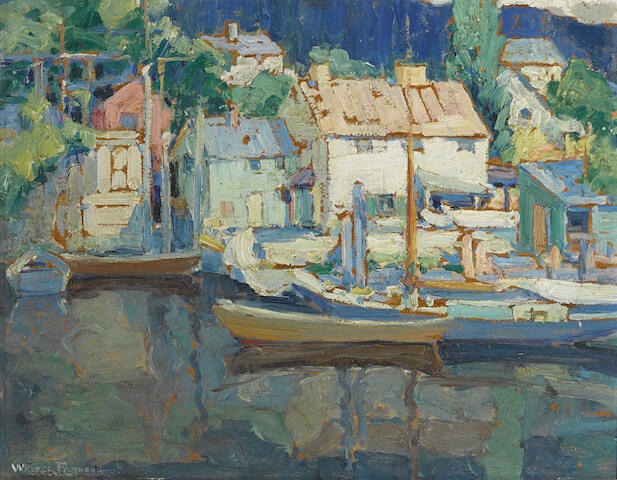
Walter Farndon (American, 1876-1964) Harbor 14 x 18in
Walter Farndon, (American, 1876-1964)
Harbor 
signed 'Walter Farndon' (lower left)
oil on board
14 x 18in

Walter Farndon (American, 1876-1964), see above

lever, hayley st. ives harbor | landscape | sotheby's n09484lot8zpd8en:
Hayley Lever, 1876 - 1958
ST. IVES HARBOR
Oil on panel
6 1/4 by 9 3/8 inches, (15.9 by 23.8 cm)

Hayley Lever, 1876 - 1958, see above

feininger, t. lux ships in the balt | maritime | sotheby's n09484lot8t2f6en:
T. Lux Feininger, 1910-2011
SHIPS IN THE BALTIC
Watercolor and charcoal on paper
11 by 18 1/2 inches (28 by 47 cm)

T. Lux Feininger, 1910-2011, see below

jacobsen, antonio belmont | maritime | sotheby's n09484lot8zg2hen:
Antonio Jacobsen, 1850-1921
BELMONT
Oil on paperboard
20 by 35 3/4 inches, (50.8 by 90.8 cm)

Antonio Nicolo Gasparo Jacobsen (November 2, 1850 – February 2, 1921) was a Danish-born American maritime artist known as the "Audubon of Steam Vessels". He was born in Copenhagen, Denmark where he attended the Royal Academy of Design before heading across the Atlantic Ocean. He arrived in the United States in August 1873 and settled in West Hoboken, New Jersey (now Union City, New Jersey), across the Hudson River from Manhattan and New York Harbor. Jacobsen got his start painting pictures of ships on safes, and as his reputation grew, he was asked to do portraits of ships by their owners, captains and crew members, with many of his works sold for five dollars.


Jacobsen painted more than 6,000 portraits of sail and steam vessels, making him "the most prolific of marine artists". Many of his commissions came from sea captains, and Jacobsen was chosen both for the accuracy of his work and his low fee. More

jacobsen, antonio the apache | maritime | sotheby's n09484lot8zmvben:
Antonio Jacobsen, 1850-1921
THE APACHE
Oil on canvas
30 by 50 inches, (76.2 by 127 cm)

Antonio Jacobsen, 1850-1921, see above


Paul Signac, 1863 - 1935
SAINT-TROPEZ. LA JETÉE ET LE PHARE, c. 1930
Watercolor, gouache and charcoal on paper laid down on card
10 7/8 by 17 1/8 in., 27.5 by 43.6 cm

Paul Signac, (born Nov. 11, 1863, Paris, France—died Aug. 15, 1935, Paris) French painter who, with Georges Seurat, developed the technique called pointillism.

When he was 18, Signac gave up the study of architecture for painting and, through Armand Guillaumin, became a convert to the colouristic principles of Impressionism. In 1884 Signac helped found the Salon des Indépendants. There he met Seurat, whom he initiated into the broken-colour technique of Impressionism. The two went on to develop the method they called pointillism, which became the basis of Neo-Impressionism. They continued to apply pigment in minute dabs of pure colour, as had the Impressionists, but they adopted an exact, almost scientific system of applying the dots, instead of the somewhat intuitive application of the earlier masters. In watercolours Signac used the principle in a much freer manner. After 1886 he took part regularly in the annual Salon des Indépendants, to which he sent landscapes, seascapes, and decorative panels. Being a sailor, Signac traveled widely along the European coast, painting the landscapes he encountered. In his later years he painted scenes of Paris, Viviers, and other French cities.

Signac produced much critical writing and was the author of From Eugène Delacroix to Neo-Impressionism (1899) and Jongkind (1927). The former book is an exposition of pointillism, while the latter is an insightful treatise on watercolour painting. More

Harbour Scene with Figures
12 X 20 in (30.48 X 50.8 cm)
watercolour
Creation Date:  1886
Signed


Thomas Bush Hardy
Portsmouth Harbour, c. 1893
15.25 X 38.5 in (38.74 X 97.79 cm)
Watercolor on paper

ROUGH SEAS, DOVER HARBOR

21 X 41 in (53.34 X 104.14 cm)


Images are copyright of their respective owners, assignees or others
Acknowledgement: Sothebey's

19 Paintings by the Masters, Women of 19th Century Europe

glackens, william james spanish lady | figure | sotheby's n09484lot8prgsen:
William James Glackens, 1870 - 1938
SPANISH LADY ON SOFA, c. 1907
Oil on canvas
14 1/8 by 18 1/4 inches, (36.2 by 46 cm)


William James Glackens (March 13, 1870 – May 22, 1938) was an American realist painter and one of the founders of the Ashcan School of American art. He is also known for his work in helping Albert C. Barnes to acquire the European paintings that form the nucleus of the famed Barnes Foundation in Philadelphia. His dark-hued, vibrantly painted street scenes and depictions of daily life in pre-WW I New York and Paris first established his reputation as a major artist. His later work was brighter in tone and showed the strong influence of Renoir. During much of his career as a painter, Glackens also worked as an illustrator for newspapers and magazines in Philadelphia and New York City. More

miller, richard edward black mant | figurative | sotheby's n09484lot92j5cen:
Richard Edward Miller, 1875-1943
BLACK MANTILLA, c. 1910
Oil on canvas
36 1/4 by 34 1/4 inches, (92.1 by 87 cm)


Richard E. Miller (March 22, 1875 – January 23, 1943) was an American Impressionist painter and a member of the Giverny Colony of American impressionists. Miller was primarily a figurative painter, known for his paintings of women posing languidly in interiors or outdoor settings. Miller grew up in St. Louis, studied in Paris, and then settled in Giverny. Upon his return to America, he settled briefly in Pasadena, California and then in the art colony of Provincetown, Massachusetts, where he remained for the rest of his life. Miller was a member of the National Academy of Design in New York and an award winning painter in his era, honored in both France and Italy, and a winner of France's Legion of Honor. Over the past several decades, he has been the subject of a retrospective exhibition and his work has been reproduced extensively in exhibition catalogs and featured in a number of books on American Impressionism. More

marquet, albert portrait de la mère | figures | sotheby's n09498lot8z59ten:
Albert Marquet, 1875 - 1947
PORTRAIT DE LA MÈRE DE L'ARTISTE AU BOUQUET, c. 1898
Oil on canvas
25 5/8 by 21 1/4 in., 65 by 54 cm


Albert Marquet (27 March 1875 – 14 June 1947) was a French painter, associated with the Fauvist movement. He initially became one of the Fauve painters and a lifelong friend of Henri Matisse. Marquet subsequently painted in a more naturalistic style, primarily landscapes, but also several portraits and, between 1910 and 1914, several female nude paintings. More

renoir, pierre-auguste femme en chem | figures | sotheby's n09498lot3zwm8en:
Pierre-Auguste Renoir, 1841-1919
FEMME EN CHEMISE BLANC, c. 1909
Oil on canvas
16 by 13 1/8 in., 40.6 by 33.4 cm


Pierre-Auguste Renoir, commonly known as Auguste Renoir (25 February 1841 – 3 December 1919), was a French artist who was a leading painter in the development of the Impressionist style. As a celebrator of beauty, and especially feminine sensuality, it has been said that "Renoir is the final representative of a tradition which runs directly from Rubens to Watteau."

He was the father of actor Pierre Renoir (1885–1952), filmmaker Jean Renoir (1894–1979) and ceramic artist Claude Renoir (1901–69). He was the grandfather of the filmmaker Claude Renoir (1913–1993), son of Pierre. More

renoir, pierre-auguste femme au cors | figures | sotheby's n09498lot3zwm6en:
Pierre-Auguste Renoir, 1841-1919
FEMME AU CORSAGE ROUGE, c 1893
Oil on canvas
15 3/4 by 12 3/8 in., 40 by 31.4 cm

bonnard, pierre deux dames avec chat | figures | sotheby's n09498lot63vn9en:
Pierre Bonnard, 1867 - 1947
DEUX DAMES AVEC CHAT À TABLE (LES DEUX SOEURS), c. 1906
Oil on cradled panel
18 1/8 by 14 5/8 in., 46 by 37.1 cm


Pierre Bonnard (3 October 1867 — 23 January 1947) was a French painter and printmaker, as well as a founding member of the Post-Impressionist group of avant-garde painters Les Nabis. Bonnard preferred to work from memory, using drawings as a reference, and his paintings are often characterized by a dreamlike quality. The intimate domestic scenes, for which he is perhaps best known, often include his wife Marthe de Meligny.

Bonnard has been described as "the most thoroughly idiosyncratic of all the great twentieth- century painters", and the unusual vantage points of his compositions rely less on traditional modes of pictorial structure than voluptuous color, poetic allusions and visual wit. Identified as a late practitioner of Impressionism in the early 20th century, Bonnard has since been recognized for his unique use of color and his complex imagery. "It’s not just the colors that radiate in a Bonnard", writes Roberta Smith, "there’s also the heat of mixed emotions, rubbed into smoothness, shrouded in chromatic veils and intensified by unexpected spatial conundrums and by elusive, uneasy figures. More

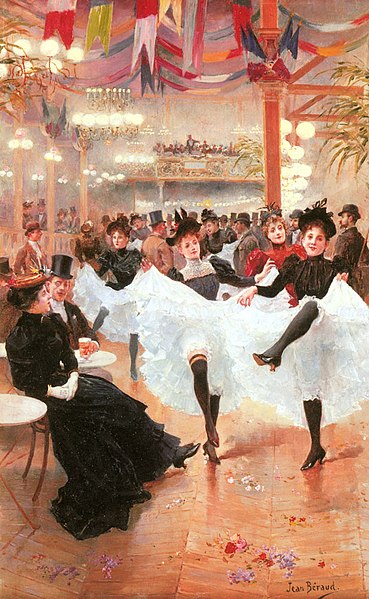
File:Jean Béraud Le Cafe de Paris.jpg
Jean Béraud, (1849–1935)
Le Cafe de Paris
Oil on panel
55.3 × 35 cm (21.8 × 13.8 in)


Café de Paris is a London nightclub, located in the West End, beside Leicester Square on Coventry Street, Piccadilly. It opened in 1924 and subsequently featured such performers as Dorothy Dandridge, Marlene Dietrich, Harry Gold, Harry Roy, Ken Snakehips Johnson and Maxine Cooper Gomberg. Louise Brooks made history when she worked there in December 1924, introducing the Charleston (dance) to London.

Much of the early success of the Café de Paris was due to the visit of the then Prince of Wales who became a regular guest, often dining with notables from high society across Europe. Cole Porter was a regular, as was the Aga Khan. More

Jean Béraud (January 12, 1849 – October 4, 1935) was a French painter, noted for his paintings of Parisian life during the Belle Époque. He was renowned in Paris society due to his numerous paintings depicting the life of Paris, and the nightlife of Paris society. He also painted religious subjects in a contemporary setting. Pictures of the Champs Elysees, cafés, Montmartre and the banks of the Seine are precisely detailed illustrations of everyday Parisian era of the "Belle Époque". More

toulouse lautrec, henri de au bois d | animals | sotheby's n09498lot3svfyen:
Henri de Toulouse-Lautrec, 1864 - 1901
AU BOIS DE BOULOGNE, c. 1901
Oil on canvas
22 by 18 1/4 in., 55.9 by 46.4 cm

Henri Marie Raymond de Toulouse-Lautrec-Monfa (24 November 1864 – 9 September 1901), also known as Henri de Toulouse-Lautrec was a French painter, printmaker, draughtsman and illustrator whose immersion in the colourful and theatrical life of Paris in the late 19th century allowed him to produce a collection of enticing, elegant and provocative images of the modern, sometimes decadent, life of those times. Toulouse-Lautrec is among the best-known painters of the Post-Impressionist period, alongside Cézanne, Van Gogh and Gauguin. In a 2005 auction at Christie's auction house, La Blanchisseuse, his early painting of a young laundress, sold for US$22.4 million and set a new record for the artist for a price at auction. More

boldini, giovanni portrait of celia | beauties | sotheby's n09499lot8wv89en:
Giovanni Boldini, 1842 - 1931
PORTRAIT OF CELIA TOBIN CLARK
Oil on canvas
86 5/8 by 47 1/2 in., 220 by 120 cm


MISS CELIA TOBIN WEDS C. W. CLARK, THE SON OF MONTANA MILLIONAIRE. With Unpretentious Rites, and in Presence of a Few Relatives, the Bride Is Married in the House Where She Was Born— They Will Live at San Mateo on the Walter Hobart Place Recently Purchased for a Residence

It was a very pleasant home wedding at which Miss Celia Tobin of this city yesterday became the wife of Charles W. Clark. The bride is the second daughter of Mrs. Mary Tobin, 1021 California street. The groom is the eldest son of Senator Clark, the multimillionaire mine owner of Montana. In accordance with the wishes of the young persons most interested, as well as of the relatives of Mrs. Clark, the wedding was wholly without ostentation and every feature was marked with the utmost simplicity. This was in perfect keeping with Miss Celia Tobin's quiet tastes. The city clocks marked the meridian hour when the bridal party took their places In the rose-decorated parlor before the famous copy of Murillo's masterpiece, the Madonna, from the Prado gallery in Madrid. Archbishop Montgomery, assisted by Vicar General Prendergast, spoke the words and received the responses that united Charles Clark and Celia Tobin in matrimony. R. N. Tobin acted as best man, while... California Digital Newspaper Collection

Giovanni Boldini (31 December 1842 in Ferrara, Italy – 11 July 1931 in Paris, France) was an Italian genre and portrait painter. According to a 1933 article in Time magazine, he was known as the "Master of Swish" because of his flowing style of painting. More

blaas, eugen von venetians at the b | beauties | sotheby's n09499lot9272fen:
Eugen von Blaas, 1843 - 1931
VENETIANS AT THE BALCONY
Oil on canvas
47 3/8 by 35 1/4 in., 120.3 by 89.5 cm


Eugene de Blaas, (24 July 1843 – 10 February 1932), was an Italian painter in the school known as Academic Classicism. He was born at Albano, near Rome, to Austrian parents. His father Karl, also a painter, was his teacher. The family moved to Venice when Karl became Professor at the Academy of Venice. He often painted scenes in Venice, but also portraits and religious paintings. More

lhermitte, léon-augustin maternité | children | sotheby's n09499lot85prlen:
Léon-Augustin Lhermitte, 1844 - 1925
MATERNITÉ
Oil on canvas
23 1/8 by 17 7/8 in., 58.8 by 45.4 cm


Léon Augustin Lhermitte (31 July 1844, Mont-Saint-Père – 28 July 1925, Paris) was a French realist painter and etcher whose primary subject matter was of rural scenes depicting the peasant worker. He was a student of Lecoq de Boisbaudran, he gained recognition after his show in the Paris Salon in 1864.

His many awards include the French Legion of Honour (1884) and the Grand Prize at the Exposition Universelle in 1889.

Lhermitte’s innovative use of pastels won him the admiration of his contemporaries. Vincent van Gogh wrote that "If every month Le Monde Illustré published one of his compositions ... it would be a great pleasure for me to be able to follow it. It is certain that for years I have not seen anything as beautiful as this scene by Lhermitte ... I am too preoccupied by Lhermitte this evening to be able to talk of other things." More

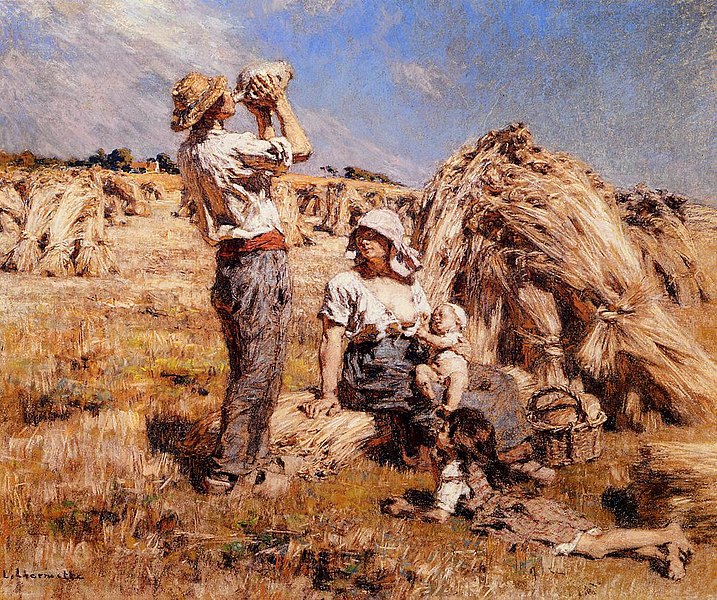
File:Léon Augustin Lhermitte, Motherhood.jpeg
Léon Augustin Lhermitte (1844–1925)
Motherhood, circa 1876
Pastel on paper

ribot, théodule la diseuse de bonne | figures | sotheby's n09499lot8tysren:
Théodule Ribot, 1823 - 1891
LA DISEUSE DE BONNE AVENTURE
The Fortune Teller
Oil on canvas
23 1/2 by 28 3/4 in., 59.7 by 73 cm


Théodule-Augustin Ribot (August 8, 1823 – September 11, 1891) was a French realist painter and printmaker. He was born in Saint-Nicolas-d'Attez, and studied at the École des Arts et Métiers de Châlons before moving to Paris in 1845. There he found work decorating gilded frames for a mirror manufacturer. Although he received a measure of artistic training while working as an assistant to Auguste-Barthélémy Glaize, Ribot was mostly self-taught as a painter. After a trip to Algeria around 1848, he returned in 1851 to Paris, where he continued to make his living as an artisan. In the late 1850s, working at night by lamplight, he began to paint seriously, depicting everyday subjects in a realistic style.

He made his Salon debut in 1861 with four paintings of kitchen subjects. Collectors purchased the works, and his paintings in the Salons of 1864 and 1865 were awarded medals.

Ribot painted domestic genre works, still-lifes, portraits, as well as religious scenes. His preference was for painting directly from nature, emphasizing the contrasts of light and dark. His use of chiaroscuro to suggest psychological states grew from his admiration for Spanish and Dutch baroque masters. Members of Ribot's family are the likely models for many of his figure compositions, in which the subjects engage in humble activities, such as preparing meals or gathering in groups to read to each other. The light draws attention to faces and hands, which emerge sharply from dimly lit surroundings.

Although the realism of Ribot's work aligns him with the most progressive artists of the generation preceding the Impressionists, he was no revolutionary, and his work met with a generally favorable response from the public and from critics.

In 1878 Ribot received the Légion d'honneur. At about this time, in ill health, he stopped painting and moved to Colombes, where he died in 1891. More

gervex, henri rolla | beauties | sotheby's l16101lot4w3x5en:
Henri Gervex, 1852 - 1929
ROLLA, 1878
oil on canvas
86 by 108.5 cm., 33¾ by 43¾ in
Musée des Beaux-Arts de Bordeaux

"Everyone trooped in front of the canvas which was already famous before it entered the Salon…However, hardly had it been hung on the wall when the surintendant des Beaux- Arts, Turquet, gave the order that it be removed on grounds of immorality, with the complicity of the Salon jury…that’s when an art dealer offered to exhibit Rolla at his shop on the Chaussée-d’Antin… For three months there was an uninterrupted procession of visitors with a queue of carriages backed up to the Opera'" - Henri Gervex. More

Henri Gervex (Paris 10 December 1852 – 7 June 1929) was a French painter who studied painting under Alexandre Cabanel, Pierre-Nicolas Brisset and Eugène Fromentin. His early work belonged almost exclusively to the mythological genre, which served as an excuse for the painting of the nude, but not always in the best of taste. His Rolla of 1878, based on a poem by Alfred de Musset, was rejected by the jury of the Salon de Paris for immorality, since it depicted a scene from the poem of a naked prostitute after having sex with her client.

Gervex afterwards devoted himself to representations of modern life and achieved signal success with his Dr Péan at the Salpétrière ("The Operation"), a modernized paraphrase, as it were, of Rembrandt's Anatomy Lesson. More

File:Gervex The operation.jpg
Henri Gervex, 1852 - 1929
 Jules-Émile Péan and his surgery class before the operation, 1889
oil on canvas
242x188 cm
Musee d'Orsay, Paris, France

Henri Gervex, 1852 - 1929, see above

boldini, giovanni signora diaz albe | portrait | sotheby's l16101lot8zwz7en:
Giovanni Boldini, 1842 - 1931
SIGNORA DIAZ ALBERTINI
oil on canvas
104.5 by 97.5 cm., 41 by 38½ in

Giovanni Boldini, 1842 - 1931, see above

blaas, eugen von a stolen glance | genre scene | sotheby's l16101lot8wtjyen:
Eugen von Blaas, 1843 - 1931
A STOLEN GLANCE
oil on panel
78 by 39 cm., 30¾ by 15¼ in.

Eugen von Blaas, 1843 - 1931, see above

stuck, franz von domino | portrait | sotheby's l16101lot8pj4sen:
Franz von Stuck. 1863 - 1928
DOMINO
oil on board
82.5 by 37.5 cm., 32½ by 14¾ in

Franz Stuck (February 23, 1863 – August 30, 1928) was a German painter, sculptor, engraver, and architect. In 1906, Stuck was awarded the Verdienstorden der Bayerischen Krone and was henceforth known as Franz Ritter von Stuck. More

wegmann, bertha tender moments | portrait | sotheby's l16101lot924jlen:
Bertha Wegmann, 1847 - 1926
TENDER MOMENTS
oil on canvas
114 by 93 cm., 45 by 36¾ in.

Bertha Wegmann (16 December 1846, Soglio, Switzerland – 22 February 1926, Copenhagen) was a Danish portrait painter of German ancestry. At the age of five, her family moved to Copenhagen, where her father became a merchant. He was an art lover and spent much of his spare time painting. She showed an interest in drawing at an early age, but received no formal education until she was nineteen, when she began taking lessons.

Two years later, with the support of her parents, she moved to Munich and lived there until 1881. At first, she studied with the historical painter Wilhelm von Lindenschmit the Younger, later with the genre painter Eduard Kurzbauer, but she was not satisfied with learning in a studio atmosphere and decided to study directly from nature. She made friends with the Swedish painter, Jeanna Bauck, and took several study trips to Italy with her. In 1881, they moved to Paris where Wegmann exhibited at several salons and received an "honorable mention".

The next year, she returned to Copenhagen, where she was already well-known from works she had been exhibiting at the Charlottenborg Palace since 1873. Four years later, she became the first woman to hold a chair at the Royal Danish Academy of Fine Arts. From that year through 1907, she was a member of the board for the "Tegne- og Kunstindustriskolen for Kvinder" (Drawing and Art Industrial School for Women). She continued to exhibit widely and represented Denmark at several world's fairs, including the World's Columbian Exhibition in Chicago. In 1892, she became one of the first women to receive the royal Ingenio et Arti medal. Wegmann died suddenly while at work in her studio. More


Images are copyright of their respective owners, assignees or others
Acknowledgement: Sothebey's, 

12 Paintings of the streets of Paris in the 19th C, by Jean Béraud, Eugène Galien-Laloue, Edouard Henri Leon Cortès, Antoine Blanchard, Gustave Loiseau, with footnotes

loiseau, gustave la rue du clignan | cityscape | sotheby's n09498lot8w3c9en:
Gustave Loiseau, 1865 - 1935
Rue Clignancourt, Paris, on 14th July, ca. 1925
Oil on canvas
23 7/8 by 19 5/8 in., 60.8 by 50 cm
El Museo Nacional Thyssen-Bornemisza

Here Gustave Loiseau chose to paint an area of Paris he had been familiar with for a long time. In 1887, when he had decided to devote himself to painting, Gustave Loiseau had settled in Montmartre, in rue de Ravignan. Rue Clignancourt is only a few steps away, at the foot of the hill it borders to the east. To describe it, the artist placed himself in the corner of the street and of boulevard de Rochechouart, where a brasserie now stands. The area, which is always very busy due to the nearby Tati stores, has changed very little. At the crossroads visible in the foreground, the cars have become more numerous than the strollers, and on the right a newspaper kiosk has replaced the old roundabout. 

But here again we can appreciate the precision with which the artist observed and recorded the topography of the area. We can easily recognise every detail transcribed on the canvas: the slightly chaotic succession of building façades of different periods and styles, as well as the chimneys and skylights that punctuate the buildings, are immediately identifiable. Flags liven up the scene and dot it with the colours blue, white and red. The crowd has invaded the boulevard, and the bright and clear light is that of a summer day in Paris. More on this painting

French Post-Impressionist painter Gustave Loiseau is best remembered for his scenes of evocative landscapes and bustling Paris streets. The artist used latticed brushstrokes to depict fleeting moments, blending the Impressionist pursuit of naturalistic depiction with a more modern desire for painterly expression.

Loiseau was born on October 3, 1865 in Paris. In his youth, he was apprenticed to a decorator, but soon received an inheritance from his grandmother, which allowed him to pursue his artistic passions. He enrolled at the École nationale supérieure des Arts Décoratifs, where he studied life drawing, but left after a year after quarreling with an instructor. He set out for the riparian vistas of Pont-Aven, where he befriended other artists including Paul Gauguin and Émile Bernard. There, he developed his signature approach to landscape painting, which involved painting directly from nature (en plein air) and using an idiosyncratic cross-hatching technique (en treillis) to convey subtleties of light and atmosphere. Loiseau took part in the 1890 Impressionists exhibition and from 1893 showed at the Salon des Indépendants. While Paris remained his home and his most frequent subject, he returned to Pont-Aven several times, and also visited coastal Normandy and the various tributaries of the Seine. In the 1920s, he added still lives of flowers, fruits and fish to his repertoire. He died in Paris on October 10, 1935. 

Today, Loiseau's work is represented in the collections of the Metropolitan Museum of Art in New York, the Museo Nacional Thyssen-Bornemisza in Madrid and the Tokyo Fuji Art Museum, among many other world institutions. More on Gustave Loiseau 

béraud, jean bois de boulogn | carriage scenes | sotheby's n09499lot8z5jzen:
Jean Béraud, 1849 - 1935
BOIS DE BOULOGNE 
Oil on canvas
18 by 23 in., 45.7 by 58.4 cm
Private collection

The Bois de Boulogne is a large public park located along the western edge of Paris. It was created between 1852 and 1858 during the reign of the Emperor Louis Napoleon. It is the second-largest park in Paris, about two and a half times the area of Central Park in New York.

Within the boundaries of the Bois de Boulogne are an English landscape garden with several lakes and a cascade; two smaller botanical and landscape gardens, the Château de Bagatelle and the Pré-Catelan; a zoo and amusement park in the Jardin d'Acclimatation; The Jardin des Serres d'Auteuil, a complex of greenhouses holding a hundred thousand plants; two tracks for horse racing, the Hippodrome de Longchamp and the Auteuil Hippodrome; a tennis stadium where the French Open tennis tournament is held each year; and other attractions. More on The Bois de Boulogne

Jean Béraud (January 12, 1849 – October 4, 1935) was a French painter renowned for his numerous paintings depicting the life of Paris, and the nightlife of Paris society. Pictures of the Champs Elysees, cafés, Montmartre and the banks of the Seine are precisely detailed illustrations of everyday Parisian life during the "Belle Époque". He also painted religious subjects in a contemporary setting.

Béraud became a student of Léon Bonnat, and exhibited his paintings at the Salon for the first time in 1872. However, he did not gain recognition until 1876, with his On the Way Back from the Funeral. He exhibited with the Society of French Watercolorists at the 1889 World's Fair in Paris.

Béraud's paintings often included truth-based humour and mockery of late 19th-century Parisian life, along with frequent appearances of biblical characters in then contemporary situations. Paintings such as Mary Magdalene in the House of the Pharisees aroused controversy when exhibited, because of these themes.

Towards the end of the 19th century, Béraud dedicated less time to his own painting but worked on numerous exhibition committees, including the Salon de la Société Nationale. Béraud never married and had no children. He died in Paris on October 4, 1935, and is buried in Montparnasse Cemetery beside his mother. More on Jean Béraud

béraud, jean les grands boulevards | cityscape | sotheby's n09499lot8z5jden:
Jean Béraud, 1849 - 1935
LES GRANDS BOULEVARDS (CAFÉ AMÉRICAIN)
Oil on panel
14 1/4 by 21 in., 36.2 by 53.3 cm
Private collection

As a testament to the vital role of the café in Paris society, Johnson’s Universal Cyclopaedia’s 1896 entry for the city carefully described each establishment and its patrons: the “bankers and brokers predominate at the Café Riche; at the Café de Madrid is the headquarters of journalists; actors are numerous at the Café de Suède and the Café des Variétés” while at “the Café Américain congregate literary men and painters” (“Paris,” Johnson’s Universal Cyclopaedia, vol. VI, New York, 1896, p. 442).

Jean Béraud, see above

béraud, jean refuge, la place de l | cityscape | sotheby's n09499lot8z5k8en:
Jean Béraud, 1849 - 1935
REFUGE, LA PLACE DE L'OPÉRA
Oil on Canvas
13 3/4 by 10 in., 35 by 25.4 cm
Private collection

The Place de l'Opéra is a square in Paris. It was built at the same time as the Opéra Garnier (designed by Charles Garnier), which is located on it, and after which it is named. Both structures were part of the Haussmannian redesign of Paris under Napoleon III of France. More on The Place de l'Opéra

Jean Béraud, see above

galien-laloue, eugène le march | architectural | sotheby's n09499lot8z5rren:
Jean Béraud, 1849 - 1935
LE MARCHÉ DES FLEURS À LA CITÉ
Gouache on cardbord
7 7/8 by 12 5/8 in., 20 by 32.1 cm
Private collection

Entirely dedicated to flowers, the Île de la Cité is located on Place Louis Lépine between the Notre-Dame Cathedral and Sainte-Chapelle chapel, the flower market has attracted avid gardeners and curious passers by since 1830. Both covered and open-air, the market is mainly formed by metal pavilion from the 1900s. More on Île de la Cité

Jean Béraud, see above

Edouard Henri Leon Cortès (French, 1882-1969) L'arc de triomphe 13 x 18in (33 x 45.7cm)
Edouard Henri Leon Cortès (French, 1882-1969)
L'arc de triomphe 
Oil on canvas
13 x 18in (33 x 45.7cm)
Private collection

The Arc de Triomphe de l'Étoile is one of the most famous monuments in Paris, France, standing at the western end of the Champs-Élysées at the centre of Place Charles de Gaulle, formerly named Place de l'Étoile—the étoile or "star" of the juncture formed by its twelve radiating avenues. The location of the arc and the plaza is shared between three arrondissements, 16th (south and west), 17th (north), and 8th (east). The Arc de Triomphe honours those who fought and died for France in the French Revolutionary and Napoleonic Wars, with the names of all French victories and generals inscribed on its inner and outer surfaces. Beneath its vault lies the Tomb of the Unknown Soldier from World War I. More on The Arc de Triomphe

Edouard Léon Cortès (1882–1969) was a French painter of French and Spanish ancestry. He is known as "Le Poète Parisien de la Peinture" or "the Parisian Poet of Painting" because of his diverse Paris cityscapes in a variety of weather and night settings. His father, Antonio Cortés, had been a painter for the Spanish Royal Court.

At the age of 17, Edouard began his studies at the École des Beaux-Arts in Paris. His first exhibition in 1901 brought him immediate recognition. 

Although Cortès was a pacifist, when war came close to his native village he was compelled to enlist in a French Infantry Regiment at the age of 32. Sent to the front lines, Cortès was wounded by a bayonet, evacuated to a military hospital, and awarded the Croix de Guerre. After recovery he was reassigned to use his artistic talent to sketch enemy positions. Later in life his convictions led him to refuse the Légion d'Honneur from the French Government. In 1919 he was demobilized.

His works were first exhibited in North America in 1945 and he subsequently achieved even greater success. In his last year of life he was awarded the prestigious Prix Antoine-Quinson from the Salon de Vincennes. More on Edouard Léon Cortès

Edouard Henri Leon Cortès (French, 1882-1969) La Porte St. Denis 13 x 18in (33 x 45.8cm)
Edouard Henri Leon Cortès (French, 1882-1969)
La Porte St. Denis 
Oil on canvas
13 x 18in (33 x 45.8cm)
Private collection

The Porte Saint-Denis (St. Denis Gate) is a Parisian monument located in the 10th arrondissement, at the site of one of the gates of the Wall of Charles V, one of Paris' former city walls. It is located at the crossing of the Rue Saint-Denis continued by the Rue du Faubourg Saint-Denis, with the Boulevard de Bonne-Nouvelle and the Boulevard Saint-Denis.

The Porte Saint-Denis was originally a gateway through the Wall of Charles V that was built between 1356 and 1383 to protect the Right Bank of Paris. However, with the advent of gunpowder the walls were eventually partly torn down in the 1640s to make way for the larger and more fortified Louis XIII Wall. In the 1670s, the remaining walls of Charles V were entirely demolished when Paris spread beyond the confines of its medieval boundaries.

To replace the old gateway of Porte Saint-Denis, Louis XIV commanded architect François Blondel and the sculptor Michel Anguier to build him a monumental archway that would honor the capture of Franche-Comté in 1668 and the victories on the Rhine during the Franco-Dutch War. Work began in 1672 and was paid for by the city of Paris. More on The Porte Saint-Denis

Edouard Henri Leon Cortès (French, 1882-1969) Bouquinistes along the Seine 13 x 18in (33 x 45.8cm)
Edouard Henri Leon Cortès (French, 1882-1969)
Bouquinistes along the Seine 
Oil on canvas
13 x 18in (33 x 45.8cm)
Private collection

Cortès captures the famed booksellers who ply their wares along the banks of the Seine in this oil on canvas. Known as bouquinistes, these booksellers are part of a long tradition that dates back to the 16th century, when market owners lined the famed Parisian river. Today, these booksellers have become a fixture on both the left and right banks of the Seine, thus leading the river to be described as "the only river in the world that runs between two bookshelves." Cortès perfectly evokes the vitality of the quaint atmosphere of these famed merchants, whom he captures on a crisp autumn day. More on the Bouquinistes

Antoine Blanchard (French, 1910-1988) Le Théâtre du Châtelet 13 x 18in (33 x 45.7cm)
Antoine Blanchard (French, 1910-1988)
Le Théâtre du Châtelet 
Oil on canvas
13 x 18in (33 x 45.7cm)
Private collection

The Imperial Theater of Châtelet was built between 1860 and 1862 by Gabriel Davioud at the request of Baron Haussmann, at the same time as the current Théâtre de la Ville which faces it on the other side of Place du Châtelet 2, on the site of the old fortress of the Grand Châtelet , which served as a prison and court under the Ancien Régime, and which was destroyed in 1808 during the reign of Napoleon I. The construction, undertaken as part of the transformations of Paris under the Second Empire , led to the removal of several public roads: rue Pierre-à-Poisson, rue de la Saunerie , rue de l'Arche-Pépin and part of rue Saint-Germain-l'Auxerrois . Two new ways were drilled to frame the building: the current rue Édouard-Colonne and the avenue Victoria. More on Le Théâtre du Châtelet

Antoine Blanchard (Marcel Masson) was born in France on November 15, 1910 in a small village near the banks of the Loire. He was the eldest of three children and his father, a carver, managed a small carpentry and furniture shop. Antoine would watch his father hand carve the furniture and began to display an artistic flair early in life - in an effort to promote this talent, his parents sent him to Blois for drawing lessons. He continued his training in Rennes at the Ecole des Beaux-Arts where he studied sculpture and drawing. Upon completion of his studies, he was awarded the schools highest award: Le Prix du Ministre.

By 1932 he left Rennes and traveled to Paris to study. He enrolled at the Ecole des Beaux-Arts and after a few years entered the competition for the Prix de Rome. It was in Paris that he developed a love for the city and it's street life.

Many of the subjects and scenes he portrayed were taken from images he collected of Paris during the 1890's and he would often work on paintings for days or months before he finally felt they were complete.

Like his contemporary, Edouard Cortès, he devoted his artistic career to the depiction of Paris through all its daily and seasonal changes. But he was not an imitator of Cortes, but rather depicted the life of Paris at the turn of the century from his own point of view and with his own, unique style.

Blanchard continued to paint until his death on August 10, 1988. More on Antoine Blanchard

galien-laloue, eugène la place de | cityscape | sotheby's n09499lot8z5ryen:
Jean Béraud, 1849 - 1935
LA PLACE DE LA RÉPUBLIQUE (NEIGE) 
Gouache on paper
8 3/8 by 13 1/4 in., 21.3 by 33.7 cm
Private collection


The Place de la République is a square in Paris. It is named after the French Republic and was called the Place du Château-d'Eau until 1879. As the Place du Château d'Eau, named after a huge fountain designed by Pierre-Simon Girard and built on the site in 1811. La Bédollière wrote that the water came from la Villette and that the fountain was "superb" in character. In 1867, Gabriel Davioud built a more impressive fountain in the square, which (like the first fountain) was decorated with lions. The square took its current shape as part of Baron Hausmann's vast renovation of Paris. Haussmann also built new barracks on the cities, to garrison troops useful in times of civil unrest.More on The Place de la République

Jean Béraud, see above

galien-laloue, eugène la place | architectural | sotheby's n09499lot8z5rven:
Eugène Galien-Laloue, 1854-1941
LA PLACE DE LA RÉPUBLIQUE
Gouache on paper
8 1/2 by 12 3/4 in., 21.6 by 32.4 cm
Private collection

The Place de la République, see above

Eugène Galien-Laloue (1854–1941) was a French artist of French-Italian parents and was born in Paris on December 11, 1854. He was a populariser of street scenes, usually painted in autumn or winter. His paintings of the early 1900s accurately represent the era in which he lived: a happy, bustling Paris, la Belle Époque, with horse-drawn carriages, trolley cars and its first omnibuses. Galien-Laloue's works are valued not only for their contribution to 20th-century art, but for the actual history, which they document. His work can be seen at the Musée des Beaux-Arts, Louvier; Musée des Beaux-Arts, La Rochelle; Mulhouse, France. More on Eugène Galien-Laloue

galien-laloue, eugène la gare | architectural | sotheby's n09499lot8z5rten:
Eugène Galien-Laloue, 1854-1941
LA GARE DE L'EST
Gouache on paper
7 1/2 by 12 1/4 in., 19 by 31 cm
Private collection

Gare de l'Est, ("East station" in English) is one of the six large train termini in Paris. It is in the 10th arrondissement, not far from the Gare du Nord, facing the Boulevard de Strasbourg, part of the north-south axis of Paris created by Baron Haussmann. It is one of the largest and the oldest railway stations in Paris, the western terminus of the Paris–Strasbourg railway and the Paris–Mulhouse railway.

The Gare de l'Est was opened in 1849 by the Compagnie du Chemin de Fer de Paris à Strasbourg (the Paris-Strasbourg Railway Company) under the name "Strasbourg platform." This platform corresponds today with the hall for main-line trains, and was designed by the architect François Duquesnay. It was renamed the "Gare de l'Est" in 1854, after the expansion of service to Mulhouse. More

Eugène Galien-Laloue, see above


Please visit my other blogs: Art CollectorMythologyMarine ArtPortrait of a Lady, The OrientalistArt of the Nude and The Canals of VeniceMiddle East Artists365 Saints and 365 Days, also visit my Boards on Pinterest

Images are copyright of their respective owners, assignees or others. Some Images may be subject to copyright

I don't own any of these images - credit is always given when due unless it is unknown to me. if I post your images without your permission, please tell me.

I do not sell art, art prints, framed posters or reproductions. Ads are shown only to compensate the hosting expenses.

If you enjoyed this post, please share with friends and family.

Thank you for visiting my blog and also for liking its posts and pages.

Please note that the content of this post primarily consists of articles available from Wikipedia or other free sources online.