Showing posts with label ANTONIO JACOBSEN. Show all posts

12 Classic Works of Art, Marine Paintings - With Footnotes, #26

William H. Yorke, (British, 1847-1921)
Canadian Brigantine *Aeronaut* from Nova Scotia, ca. 1888
Oil on canvas
60 x 90 cm (24 by 36 inch)

The Aeronaut flies the Canadian Merchant ensign with a crest in the middle of the red field. The crest, adopted in the mid 1880s, differentiates it from the British Merchant ensign however most Canadian vessels continued to use the standard British Merchant ensign. In size, composition, paint handling, the manner in which details of the ship are rendered and especially the reflection of the bow and stern in the water are all characteristic of W H Yorke. The wooden brigantine Aeronaut was built in 1886, Belliveau's Cove, Nova Scotia and measured 139.5 feet in length with 446 gross tonnage. More The Aeronaut 

William H. Yorke (British, 1847-1921)
Canadian Brigantine *Aeronaut* from Nova Scotia, ca. 1888
Detail, an enlarged detail view of the bow with the Skerries reef in the background

A skerry is a small rocky island, usually defined to be too small for human habitation; it may simply be a rocky reef. A skerry can also be called a low sea stack. More skerry

William H. Yorke (British, 1847-1921) see below

Antonio Jacobsen, 1850-1921
THE SURPRISE, c.  1919
Oil on paperboard
20 by 36 inches, (50.8 by 91.4 cm)
Private Collection

The second USS Surprise and third American naval ship of the name was a ketch that served in the United States Navy from 1815 to 1820.

Surprise was purchased by the U.S. Navy at New Orleans, Louisiana, in March 1815 for operations in a small squadron commanded by Commodore Daniel Todd Patterson against pirates and slave traders.

On 18 June 1818, Surprise, commanded by Lieutenant Isaac M'Keever, captured the schooners Merino and Louisa, which carried between them 25 slaves. M'Keever took the prizes to Mobile, Alabama, where they were condemned after prolonged litigation.

In the autumn of 1818, Surprise captured a buccaneer schooner which had been operating out of Galveston, Texas, under Mexican colors. On board the prize was General Humbert, a Frenchman, who was the head of the nest of pirates at Galveston. Surprise was sold at New Orleans in 1820. More The second USS Surprise 

Antonio Nicolo Gasparo Jacobsen (November 2, 1850 – February 2, 1921) was a Danish-born American maritime artist known as the "Audubon of Steam Vessels". He was born in Copenhagen, Denmark where he attended the Royal Academy of Design before heading across the Atlantic Ocean. He arrived in the United States in August 1873 and settled in West Hoboken, New Jersey (now Union City, New Jersey), across the Hudson River from Manhattan and New York Harbor. Jacobsen got his start painting pictures of ships on safes, and as his reputation grew, he was asked to do portraits of ships by their owners, captains and crew members, with many of his works sold for five dollars.
Jacobsen painted more than 6,000 portraits of sail and steam vessels, making him "the most prolific of marine artists". Many of his commissions came from sea captains, and Jacobsen was chosen both for the accuracy of his work and his low fee. More

William Howard Yorke,  Canada, 1847-1921 Liverpool, England
THE STARKING, c. 1892
Oil on canvas
21 by 31 inches, (53.3 by 78.7 cm)
Private Collection

William Howard Yorke (1847 - 1921) was a Liverpool ship portraitist working during the 19th and early 20th century.  The first recorded painting by Yorke is of the "Benares" and is dated 1858.  Little is known of Yorke's training, but it must be assumed that it was quite extensive as Yorke did become an accomplished and highly sought after artist.

Denys Brook-Hart, in his book British 19th Century Marine Painting pays tribute to Yorke's talent when he states that: 

[Yorke] paid great attention to his rendering of sea and sky as well as the
accurate detailing of the ship.

It was this rare ability that produced many commissions for Yorke.

Works by Yorke are in several Museum collections including the National Maritime Museum, Greenwich, London; Liverpool Museum; Manx Museum, Isle of Man; Mystic Seaport, Conn.; Mariners Museum, Newport News; Peabody Museum of Salem, Mass. and the San Francisco Maritime Museum. More William Howard Yorke

Abraham Hulk, 1813 - 1897
A FRESHENING BREEZE
Oil on panel
8 1/4 by 12 in.; 21 by 30.5 cm
Private Collection

Abraham Hulk Senior (1 May 1813 in London - 23 March 1897 in Zevenaar) was an Anglo Dutch painter, drawer and lithograph. Abraham became one of the well known marine painters of his time in the 19th century and with that the patriarch of a whole family of Anglo Dutch painters. He studied first to paint portraits under the portrait painter, Jean Augustin Daiwaille (1786–1850) and after that at the Rijksacademie in Amsterdam.

From 1833 to 1834 he traveled in America to New York and Boston where he exhibited in Boston. In 1834 he returned to the Netherlands where he first lived in Amsterdam and from 1834 to 1896 in The Hague and Leeuwarden. In the meantime from 1855 to 1856 first in Enkhuizen and afterwards in Oosterbeek and Haarlem, but returned for good in 1870 to England, where he lived till his death in 1897. Although most literature states that he died in London, he actually died on a short visit in Zevenaar in the Netherlands. He became well known because he seemed to have the ability to paint the sea and its ships in such a different way for which he became one of the great marine painters. Some of his portraits have survived. His work was exhibited in the Royal Academy in London from 1876 to 1890 where he entered three paintings of which two were Dutch seascapes. He also exhibited at the Suffolk Street Galleries in London and in Leeuwarden and The Hague in the Netherlands from 1843 to 1868. More Abraham Hulk Senior

Wilhelm Victor Bille, 1864 - 1908
SHIPPING AT COPENHAGEN
Oil on canvas
39 by 54 in.; 99 by 137.2 cm.
Private Collection

Vilhelm Victor Bille ( 12. september 1864 in Copenhagen - 28. February 1908 ibid) was a Danish marine painter .

He was the son of the marine painter Carl Bille and father of painter Willy Bille . Bille was a student of the danger and visited a short time the Art Academy . More Vilhelm Victor Bille

Pieter Mulier the Elder, HAARLEM CIRCA 1590/1615 - 1670
FISHING AND ROWING BOATS AMONG CHOPPY WATERS
oil on panel, unframed
19 3/4  by 28 1/2  in.; 50.2 by 72.5 cm.
Private Collection

Pieter Mulier the Elder  (ca.1610, Haarlem – 1659, Haarlem), a Dutch Golden Age painter. from Haarlem was a student of Simon de Vlieger. He was influenced by Jan Porcellis and Jan van Goyen and was a member of the Haarlem Guild of Saint Luke from 1638. His works were mostly of seascapes with rough waters and sailing vessels. His son Pieter Mulier the Younger was a student of his. More Pieter Mulier the Elder

Paul Signac, 1863 - 1935
SAINT-TROPEZ, TARTANES AU PORT, c. 1900
Watercolour and pencil on paper
12.3 by 17.4cm., 4 7/8 by 6 7/8 in.
Private Collection

A Tartane or tartan was a small ship used both as a fishing ship and for coastal trading in the Mediterranean. They were in use for over 300 years until the late 19th century. A tartane had a single mast on which was rigged a large lateen sail, and with a bowsprit and fore-sail. When the wind was aft a square sail was generally hoisted like a cross jack. More Tartane

Paul Signac, (born Nov. 11, 1863, Paris, France—died Aug. 15, 1935, Paris) French painter who, with Georges Seurat, developed the technique called pointillism.
When he was 18, Signac gave up the study of architecture for painting and, through Armand Guillaumin, became a convert to the colouristic principles of Impressionism. In 1884 Signac helped found the Salon des Indépendants. There he met Seurat, whom he initiated into the broken-colour technique of Impressionism. The two went on to develop the method they called pointillism, which became the basis of Neo-Impressionism. They continued to apply pigment in minute dabs of pure colour, as had the Impressionists, but they adopted an exact, almost scientific system of applying the dots, instead of the somewhat intuitive application of the earlier masters. In watercolours Signac used the principle in a much freer manner. After 1886 he took part regularly in the annual Salon des Indépendants, to which he sent landscapes, seascapes, and decorative panels. Being a sailor, Signac traveled widely along the European coast, painting the landscapes he encountered. In his later years he painted scenes of Paris, Viviers, and other French cities.
Signac produced much critical writing and was the author of From Eugène Delacroix to Neo-Impressionism (1899) and Jongkind (1927). The former book is an exposition of pointillism, while the latter is an insightful treatise on watercolour painting. More

Vittorio d'Auria, (1872-1939)
V. D'AURIA, c. 1920
Oil on canvas
23" x 47"
Private Collection

Gerrit Albertus Beneker, 1882 - 1934
Riding the Tide, Provincetown, c. 1925
Oil on canvas
24 by 20 inches, (61 by 50.8 cm)
Private Collection

Gerrit Albertus Beneker (January 26, 1882 – October 23, 1934) was an American painter and illustrator best known for his paintings of industrial scenes and for his poster work in World War I. Beneker was born on January 26, 1882 in Grand Rapids, Michigan. He first studied at the Chicago Art Institute; later he transferred to the Art Students League in New York. 

After working as an illustrator in New York, he became a student of Charles Webster Hawthorne in 1912 at the Cape Cod School of Art.

In July 1918, Beneker was hired, under the title of "Expert Aid, Navy Department", to create posters and illustrations for the war effort. It was in this period that he painted his most familiar work, "Sure We'll Finish the Job", which sold over three million copies. Later he spent four years painting workers of the Hydraulic Pressed Steel Company in Cleveland, Ohio as part of a labor-management relations improvement project; similar projects were carried out at the General Electric plant in Schenectady, New York and at the Rohm and Haas plant in Philadelphia.

Beneker was one of the founders of the Provincetown Art Association and Museum.[9] His papers are held by the Archives of American Art of the Smithsonian Institution. More Gerrit Albertus Beneker


Carlton Alfred Smith, 1853 - 1946
GOOD LUCK!
Oil on canvas
40 1/8  by 34 1/8  in.; 112 by 86.5 cm.
Private Collection

Carlton Alfred Smith, 1853 - 1946, was a British watercolourist, oil painter and genre artist who often made images of cottage interiors showing domestic life and figures in cottage interiors in a romantic manner towards the end of the nineteenth century. Smith studied at the Slade School of Art. He became one of the most technically accomplished watercolorists of the late Victorian period. With Charles Edward Wilson (fl. 1890-1930) he moved from London to join the artistic community founded by Myles Birket Foster Allingham (1848-1926) in the towns or villages surrounding Witley in Surrey. Smith began his career as a lithographer before the start of his better-known interior domestic views that are marked with strong sunshine . He exhibited mostly at Suffolk Street, London, but also at the New Watercolour Society and the Royal Society of British Artists from 1879 onward. He was a member of the Royal Academy of Art. More Carlton Alfred Smith

John Whorf, 1903 - 1959
White Boats in the Sun/Boys Fishing, No. 15
Watercolor on paper
15 by 22 1/2 inches, (38 by 57 cm)
Private Collection

John Whorf, 1903 - 1959, was a prolific American painter. Born and raised in Winthrop, Massachusetts, Whorf began his artistic education with informal studies with his father, Harry C. Whorf, a graphic designer. John’s mother, took an active interest in the development of their children’s creative pursuits. Whorf began his formal training in the Boston atelier of Sherman Kidd and at the Museum School, where he studied drawing with Philip Leslie Hall and painting with William James. 

Whorf spent summers in Provincetown, Massachusetts, which proved to have a significant influence on the development of his style. In 1919, Whorf traveled to France, Spain, Portugal, and Morocco, at which point he began to shift his focus away from oil painting and almost exclusively to watercolors. 

In the 30's, Whorf had permanently settled in Provincetown. Whorf enjoyed depicting a side of the summer resort town that vacationers seldom experienced, finding poetry in Cape Cod’s off-season beauty. 

His paintings may be found in numerous prestigious museum collections, among them the Smithsonian American Art Museum in Washington, D.C., The Metropolitan Museum of Art in New York, New York and The Art Institute of Chicago in Illinois, as well as in the Pitti Palace in Florence, Italy and the National Museum in Stockholm, Sweden. More John Whorf

Anthony Thieme, 1888 - 1954
Scavengers of the Sea
Oil on canvas
30 by 36 inches, (76.2 by 91.4 cm)
Private Collection

Anthony Thieme (20 February 1888 – 6 December 1954) was a landscape and marine painter and a major figure of the Rockport (MA) School of American regional art.

Born in Rotterdam on 20 February 1888, Thieme studied at the Academie of Fine Arts in Rotterdam for two years and then, briefly, at the Royal Academy, the Hague. He traveled widely in Europe, frequently finding work as a stage designer.

Thieme traveled to the United States at the age of 22. He quickly found work as a stage designer at the Century Theater in New York, designing sets for the Russian ballerina Anna Pavlova. When the commission ended, he traveled to South America, primarily Brazil and Argentina. Stage work again provided his livelihood. A return to Europe followed with further work in England, France, and Italy.

Returning to the United States with a contract for additional stage work, Thieme found himself in Boston. He discontinued work on the stage in 1928 and from then on made his living with the sales of his paintings and etchings. He established the Thieme School of Art. He exhibited his work frequently at the Grand Central Art Galleries in New York.

Thieme committed suicide on 6 December 1954 in Greenwich, CT. The circumstances of his death are not fully understood. There have been stories of deep depression or major illness, but no definitive rationale for his suicide has emerged.

Anthony Thieme was a full member of the American Watercolor Society, Art Alliance of America, the Salmagundi Club, the Boston Art Club, North Shore Art Association, Rockport Art Association, New York Water Color Club, Art Alliance of Philadelphia and the National Arts Club. More Anthony Thieme


Acknowledgement: Sotheby's,  and others

Images are copyright of their respective owners, assignees or others

We do not sell art prints, framed posters or reproductions. Ads are shown only to compensate the hosting expenses.


If you enjoyed this post, please share with friends and family.

19 Paintings, Marine and Seascape Paintings - with footnotes -13

Marc-Aurèle Fortin
Marc-Aurèle Fortin, ARCA 1888 - 1970 Canadian
La Goélette
watercolour and charcoal on paper on card 
18 1/4 x 26 1/2 in  46.3 x 67.3 cm
Edward Burtynsky
Edward Burtynsky, OC RCA 1955 - Canadian
Shipyard #18, Qili Port, Zhejiang Province, China
chromogenic colour print 
22 x 18 in  55.9 x 45.7 cm

davis, stuart harbor scene | cityscape | sotheby's n09484lot8z4wcen:
Stuart Davis, 1892 - 1964
HARBOR SCENE
Oil on canvas
26 by 38 inches, (66 by 96.5 cm)

Stuart Davis (December 7, 1892 – June 24, 1964), was an early American modernist painter. He was well known for his jazz-influenced, proto pop art paintings of the 1940s and 1950s, bold, brash, and colorful, as well as his ashcan pictures in the early years of the 20th century. More

lever, hayley the president's yacht | maritime | sotheby's n09484lot8zpdben:
Hayley Lever, 1876 - 1958
THE PRESIDENT'S YACHT "THE MAYFLOWER" WITH BATTLESHIPS IN NEW YORK HARBOR
Oil on canvas
25 by 30 1/4 inches, (63.5 by 76.9 cm)

Richard Hayley Lever (28 September 1875 – 6 December 1958) was an Australian-American painter, etcher, lecturer and art teacher. Lever was born in Bowden, South Australia, the son of Albion W. Lever. He excelled in painting classes at Prince Alfred College under James Ashton and on leaving school continued to study under Ashton at his Norwood art school. He was a charter member of the Adelaide Easel Club in 1892.

Lever's maternal grandfather died in 1882, and the subsequent inheritance was sufficient for Lever to finance a trip to England in 1899 to further his career in painting. He moved to St. Ives. The town's reputation as a centre for marine painting. He shared a studio with Frederick Waugh, and studied painting techniques under the Impressionists Olsson and Algernon Talmage. Lever also painted in the French port villages of Douarnenez and Concarneau, Brittany, directly across the English Channel from St. Ives.

In late 1904 Lever made a trip back to Adelaide, where he staged several exhibitions, painted seascapes and taught. In 1906, upon returning to Europe, he married Aida Smith Gale in St. Ives’ Parish Church. 

In 1911, Ernest Lawson, an Impressionist painter, persuaded Lever to move to America, saying he would have greater success there. From 1919 to 1931, Lever taught art classes at the Art Students League of New York. He offered this message to his students: "Art is the re-creation of mood in line, form and color. If I were confined to my own back yard for the rest of my life, I'd still have more pictures in my mind than I would have time to paint. Art is nothing but having a good time." Lever went to Pittsburgh in 1922 as an art juror for the Carnegie International exhibition.


In 1924, Lever was commissioned to paint a portrait of the presidential yacht, Mayflower, which was subsequently presented to President Calvin Coolidge in the Cabinet Room of the White House. By 1930, Lever had moved to Caldwell, New Jersey, staying there until 1938, when he moved to Mount Vernon, New York. While living in New York, Lever painted marines and landscapes in New Jersey, Vermont, New England, New York and the Canadian Maritimes. Throughout his life, he traveled and painted extensively, including Nova Scotia and Grand Manan Island in Canada, the Bahamas and Florida, while often returning to Europe. In 1933, Hayley was named Director of the Green Mountains summer art school at Smugglers Notch, Stowe Vermont. Lever also taught painting classes at the Forum School of Art in Bronxville, New York from 1934 to 1935. More

cornwell, dean study of pirates | battle | sotheby's n09484lot8z2tren:
Dean Cornwell, 1892 - 1960
STUDY OF PIRATES
Oil on canvas
24 1/8 by 34 1/4 inches

Dean Cornwell (March 5, 1892 - December 4, 1960) was an American illustrator and muralist. His oil paintings were frequently featured in popular magazines and books as literary illustrations, advertisements, and posters promoting the war effort. Throughout the first half of the 20th century he was a dominant presence in American illustration. At the peak of his popularity he was nicknamed the "Dean of Illustrators". More

feininger, t. lux die lotsenkutter | maritime | sotheby's n09484lot8t2f4en:
T. Lux Feininger, 1910-2011
DIE LOTSENKUTTER, c. 1933
Oil on canvas
13 by 18 1/4 inches, (33 by 46.4 cm)

T. Lux Feininger (June 11, 1910 Berlin — July 7, 2011 Cambridge) was an American painter, avant-garde photographer, author, and art teacher who was born in Berlin to Julia Berg and Lyonel Charles Feininger, an American living in Germany from the age of sixteen. His father was the first faculty appointment made to the Bauhaus in Weimar by its founder, Walter Gropius, in 1919. He had two older full brothers, including Andreas Feininger, and two half sisters, even older, by Clara Fürst and his father (from his first marriage). More

sloane, eric ahead of the squall | maritime | sotheby's n09484lot75m85en:
Eric Sloane, 1910 - 1985
AHEAD OF THE SQUALL
Oil on Masonite
36 by 48 inches, (91.4 by 121.8 cm)

Eric Sloane (born Everard Jean Hinrichs) (27 February 1905 – 5 March 1985) was an American landscape painter, born in New York City, and author of illustrated works of cultural history and folklore. He is considered a member of the Hudson River School of painting.

As a child, he was a neighbor of noted sign painter and type designer Frederick W. Goudy. Sloane studied art and lettering with Goudy. While he attended the Art Students League of New York City, he changed his name because George Luks and John French Sloan suggested that young students should paint under an assumed name so that early inferior works would not be attached to them.

In the summer of 1925, Sloane ran away from home, working his way across the country as a sign painter, creating advertisements for everything from Red Man Tobacco to Bull Durham. Unique hand calligraphy and lettering became a characteristic of his illustrated books. Sloane eventually returned to New York and settled in the Merryall area of New Milford, Connecticut, where he began painting rustic landscapes in the tradition of the Hudson River School.
In the 1950s, he began spending part of the year in Taos, New Mexico, where he painted western landscapes and particularly luminous depictions of the desert sky.

In his career as a painter, he produced over 15,000 works. His fascination with the sky and weather led to commissions to paint works for the U.S.

Air Force and the production of a number of illustrated works on meteorology and weather forecasting. More

robinson, charles dorman "the wasp" | maritime | sotheby's n09484lot8zpdren:
Charles Dorman Robinson, 1847 - 1933
"THE WASP" AND "THE SERAPIS" IN BOSTON HARBOR AT NIGHT
Oil on canvas
48 by 72 inches, (121.9 by 182.9 cm)

Charles Dorman Robinson (alternate: Charles Dormon Robinson; nickname: C.D.) (July 17, 1847 - May 8, 1933) was an American panorama, cyclorama, landscape, and marine painter. He is known for his seascapes and landscapes of Northern California, including over a hundred paintings of Yosemite Valley. He was known as "the dean of Pacific Coast artists". More

peterson, jane fishing boat at a mo | maritime | sotheby's n09484lot75m6ben:
Jane Peterson, 1876 - 1965
FISHING BOAT AT A MOORING
Oil on canvas
24 by 30 inches, (61 by 76.2 cm)

Jane Peterson (1876–1965) was an American Impressionist and Expressionist painter. Her works are created in Impressionist and Expressionist styles using broad swaths of vibrant colors to combine an interest in light and in depiction of spontaneous moments and are well known for vivid, rich painted still life, beach scenes along the Massachusetts coast. More

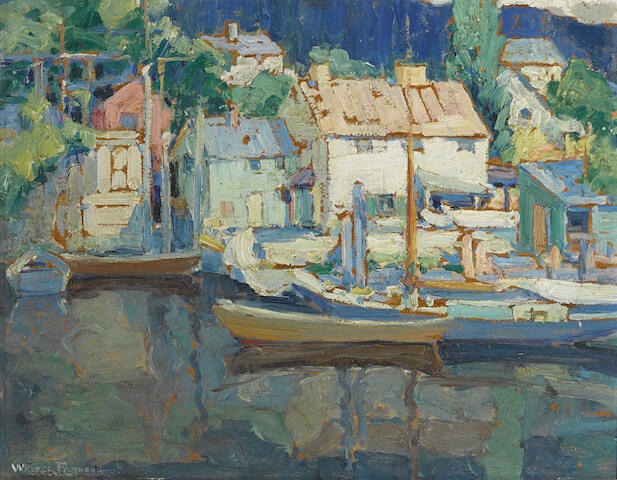
farndon, walter new england harbor | seascape | sotheby's n09484lot8xnxnen:
Walter Farndon, 1876 - 1964
NEW ENGLAND HARBOR
Oil on Masonite
14 by 18 inches, (35.6 by 45.7 cm)

Walter Farndon, 1876-1964, was a New England plein-air painter best-known for impasto, Impressionist, sometimes near-Expressionist harbor and shore scenes, though he also painted portraits and figures. Born in Coventry, England, Farndon came to the United States, studying at the National Academy of Design, where he was later elected an Associate in 1928, and an Academician in 1937. He also studied with Robert Henri, and was a member of the Society of Independent Artists. He painted in Ridgefield, New Jersey in the 1920s.

Walter Farndon (American, 1876-1964) Harbor 14 x 18in
Walter Farndon, (American, 1876-1964)
Harbor 
signed 'Walter Farndon' (lower left)
oil on board
14 x 18in

Walter Farndon (American, 1876-1964), see above

lever, hayley st. ives harbor | landscape | sotheby's n09484lot8zpd8en:
Hayley Lever, 1876 - 1958
ST. IVES HARBOR
Oil on panel
6 1/4 by 9 3/8 inches, (15.9 by 23.8 cm)

Hayley Lever, 1876 - 1958, see above

feininger, t. lux ships in the balt | maritime | sotheby's n09484lot8t2f6en:
T. Lux Feininger, 1910-2011
SHIPS IN THE BALTIC
Watercolor and charcoal on paper
11 by 18 1/2 inches (28 by 47 cm)

T. Lux Feininger, 1910-2011, see below

jacobsen, antonio belmont | maritime | sotheby's n09484lot8zg2hen:
Antonio Jacobsen, 1850-1921
BELMONT
Oil on paperboard
20 by 35 3/4 inches, (50.8 by 90.8 cm)

Antonio Nicolo Gasparo Jacobsen (November 2, 1850 – February 2, 1921) was a Danish-born American maritime artist known as the "Audubon of Steam Vessels". He was born in Copenhagen, Denmark where he attended the Royal Academy of Design before heading across the Atlantic Ocean. He arrived in the United States in August 1873 and settled in West Hoboken, New Jersey (now Union City, New Jersey), across the Hudson River from Manhattan and New York Harbor. Jacobsen got his start painting pictures of ships on safes, and as his reputation grew, he was asked to do portraits of ships by their owners, captains and crew members, with many of his works sold for five dollars.


Jacobsen painted more than 6,000 portraits of sail and steam vessels, making him "the most prolific of marine artists". Many of his commissions came from sea captains, and Jacobsen was chosen both for the accuracy of his work and his low fee. More

jacobsen, antonio the apache | maritime | sotheby's n09484lot8zmvben:
Antonio Jacobsen, 1850-1921
THE APACHE
Oil on canvas
30 by 50 inches, (76.2 by 127 cm)

Antonio Jacobsen, 1850-1921, see above


Paul Signac, 1863 - 1935
SAINT-TROPEZ. LA JETÉE ET LE PHARE, c. 1930
Watercolor, gouache and charcoal on paper laid down on card
10 7/8 by 17 1/8 in., 27.5 by 43.6 cm

Paul Signac, (born Nov. 11, 1863, Paris, France—died Aug. 15, 1935, Paris) French painter who, with Georges Seurat, developed the technique called pointillism.

When he was 18, Signac gave up the study of architecture for painting and, through Armand Guillaumin, became a convert to the colouristic principles of Impressionism. In 1884 Signac helped found the Salon des Indépendants. There he met Seurat, whom he initiated into the broken-colour technique of Impressionism. The two went on to develop the method they called pointillism, which became the basis of Neo-Impressionism. They continued to apply pigment in minute dabs of pure colour, as had the Impressionists, but they adopted an exact, almost scientific system of applying the dots, instead of the somewhat intuitive application of the earlier masters. In watercolours Signac used the principle in a much freer manner. After 1886 he took part regularly in the annual Salon des Indépendants, to which he sent landscapes, seascapes, and decorative panels. Being a sailor, Signac traveled widely along the European coast, painting the landscapes he encountered. In his later years he painted scenes of Paris, Viviers, and other French cities.

Signac produced much critical writing and was the author of From Eugène Delacroix to Neo-Impressionism (1899) and Jongkind (1927). The former book is an exposition of pointillism, while the latter is an insightful treatise on watercolour painting. More

Harbour Scene with Figures
12 X 20 in (30.48 X 50.8 cm)
watercolour
Creation Date:  1886
Signed


Thomas Bush Hardy
Portsmouth Harbour, c. 1893
15.25 X 38.5 in (38.74 X 97.79 cm)
Watercolor on paper

ROUGH SEAS, DOVER HARBOR

21 X 41 in (53.34 X 104.14 cm)


Images are copyright of their respective owners, assignees or others
Acknowledgement: Sothebey's, 

29 Classic Works of Art, Marine and Seascape Paintings - Know the artists, and the stories behind their paintings- #3

Dean Morrissey
The Lightship
Hand Signed
Limited Edition Print Of: 550
Size: 20"w X 15"h
Private collection

The Inhabitants Of His "great Kettles" Book Series Have A Far Greater Impact On Our World Than We Could Imagine. The Spring Solstice, For Instance, Is When The Cool Beacon Of Winter Is Replaced With The Warm Summer Sun. Designed To Bring About Lighter, Longer Days, It Is The Job Of The Lantern Keeper, Maura Bump, And Her Vessel The Lightship To See That The Golden Amber Ball Is Fixed Radiantly In The Sky And That The Long-awaited Spring Arrives. More on this priny

Artist and author Dean Morrissey, 69, died March 4, 2021 in Marshfield MA. He was a prolific cover illustrator, and also wrote and illustrated his own acclaimed children’s books, including Ship of Dreams (1994); The Great Kettles (1997); The Christmas Ship (2000); The Moon Robbers (2001) and The Winter King (2002), both with Stephen Krensky; The Monster Trap (2004); The Crimson Comet (2006); and The Wizard Mouse (2011). His honors include four Chesley Awards and a Spectrum Gold Award.

Dean Walter Morrissey was born October 1, 1951 in Quincy MA. He was self-taught as a painter, and renowned for his realistic renderings of fantasy scenarios. He began his professional illustration career with a cover for Dragon magazine in 1978, and by the mid-’80s was regularly painting book covers for genre publishers. In the ’90s he shifted focus to creating and illustrating his own stories. More on Dean Morrissey

JAMES BARD American, 1815-1897 
Portrait of the sidewheeler Neversink
Signed lower right "Drawn & Painted by James Bard 1866"
Oil on canvas, 28.5" x 44"
Private collection

Sold for US$52,575 i November 2019

Sidewheeler is a river boat, propelled by two large paddle wheels, one on each side.

James Bard was a marine artist of the 19th century. He is known for his paintings of watercraft, particularly of steamboats. His works are sometimes characterized as naïve art. Although Bard died poor and almost forgotten, his works have since become valuable. Bard had a twin brother, John (1815–1856) and they collaborated on earlier works. 

James Bard and John Bard were born in 1815 in New York City. Their father had been born in England. Their mother was born in Scotland. They had at least two brothers, two three sisters. Sometime before 1843, Bard married Harriet DeGroot, who was six years older than he was. They had six children, but between 1843 and 1856 five of them died. Only their daughter Ellen survived. Harriet's brother, Albert DeGroot, later became a steamboat captain and a wealthy man, who commissioned a number of works by James Bard. More on James Bard

FREDERICK JOHN MULHAUPT American, 1871-1938 
"Grey Day Guinea Boats"
Oil on board
8" x 10"
Private collection

Sold for  $20,000 USD in July 2015

The Guinea Boat, writen by Alaric Bond is set on England’s southeast coast at the start of the Napoleonic Wars, The book contains a wealth of fascinating information about the seagoing – and smuggling – life, worked seamlessly into the story. Love, family and loyalty are pitted against the need to survive in a world where smuggling is a way of life and is often carried on alongside honest trade. More on The Guinea Boat

Frederick Mulhaupt; known for his skillful depictions of the landscape and seascapes of Cape Ann, Massachusetts, Frederick Mulhaupt was very much a part of that region's art community in the early part of the 20th century.  His paintings, especially the working harbor scenes, captured the essence of the area, which was already a favorite spot of famous painters such as Winslow Homer and Fitz Hugh Lane. More on Frederick Mulhaupt

Thomas Buttersworth (Isle of Wight 1768-1842 London)
The arrival of H.M. King George IV in the Firth of Forth, on August 1822, aboard H.M.Y. Royal George, accompanied by the Royal flotilla, for the first visit of a reigning Monarch to Scotland since 1650
signed 'T Buttersworth' (lower left)
Oil on canvas
14 x 22 in
Private collection

Sold for GBP 8,750 in Nov 2013

George IV (George Augustus Frederick; 12 August 1762 – 26 June 1830) was King of the United Kingdom of Great Britain and Ireland and King of Hanover from 29 January 1820 until his death in 1830. At the time of his accession to the throne, he was acting as prince regent for his father, King George III, having done so since 5 February 1811 during his father's final mental illness. More on George IV

HMS Royal George was a 100-gun first-rate ship of the line of the Royal Navy, built at Woolwich Dockyard and launched on 18 February 1756. The largest warship in the world at the time of launching, she saw service during the Seven Years' War including being Admiral Sir Edward Hawke's flagship at the Battle of Quiberon Bay and later taking part in the Battle of Cape St Vincent. She sank undergoing routine maintenance work whilst anchored off Portsmouth on 29 August 1782 with the loss of more than 800 lives, one of the most serious maritime losses to occur in British waters. More on HMS Royal George

THOMAS BUTTERSWORTH, SR. English, 1768-1842 
Cutters Racing in the Channel of the Seven Sisters
Oil on canvas
18" x 24"
Private collection

Estimated for  $20,000 USD - $30,000 USD in July 2015

The Seven Sisters are a series of chalk cliffs by the English Channel. They form part of the South Downs in East Sussex, between the towns of Seaford and Eastbourne in southern England. They are within the Seven Sisters Country Park which is bounded by the coast, the Cuckmere and the A259 road. They are the remnants of dry valleys in the chalk South Downs, which are gradually being eroded by the sea. More on The Seven Sisters

Thomas Buttersworth (5 May 1768 – November 1842) was an English seaman of the Napoleonic wars period who became a marine painter. He produced works to commission, and was little exhibited during his lifetime. 

Butterworth was born on the Isle of Wight. He enlisted in the Royal Navy in London in 1795, and served on HMS Caroline during the wars with France, before being invalided home from Menorca in 1800.

The National Maritime Museum in London has 27 watercolours by him, several of which are mounted on sheets from 18th century printed signal and muster books. He went on to paint numerous naval battle scenes and pictures such as the ‘'Inshore Squadron off Cadiz in 1797'’ which are thought to show scenes he witnessed. On being appointed Marine Painter to the East India Company he painted ship portraits on commission. It had been thought that he died in 1830, but recent research has found that he painted Queen Victoria's visit to Edinburgh in 1842 before he died in London later that year.

His son James Edward Buttersworth (1817–1894) also became a maritime painter. More on Thomas Buttersworth

WILLIAM GAY YORKE New York/Canada/England, 1817-1892 
Tugboat Honeysuckle
Oil on canvas,
22" x 34"
Private collection

Sold $15,000 USD in July 2015

USS Honeysuckle (1862) was a steamer acquired by the Union Navy during the American Civil War. She was used by the Navy as a gunboat to patrol navigable waterways of the Confederacy to prevent the South from trading with other countries. At war's end, she was converted to a storeship before eventually being decommissioned.

Honeysuckle sailed to Tampa, Florida, at war's end, and thence to New York where she decommissioned 30 June 1865. Sold to a private buyer, she became merchant ship Honeysuckle late in 1865 and remained active until 1900. More on the USS Honeysuckle

William Howard Yorke grew up fast under the tutelage of his artist-father William Gay Yorke in the Port of Liverpool. Born in Canada, he came to the port city as a child in 1855 with his family, where he remained the rest of his career and life. Yorke’s earliest known painting, a ship portrait of BENARES in the Mystic Seaport Maritime Museum collection is dated 1858, making the child an artist at eleven!. While it is known that his father left for America in 1871, the son stayed behind.

A serious devotion to his profession made Yorke a success, especially among the captains and working sailors from the ships he portrayed, with many of his paintings traveling home with them to America, and other ports abroad. His finely detailed ship portraits would be precise enough to earn their admiration, and artistic enough to appeal to a broad audience in Liverpool. More on William Howard Yorke

ANTONIO NICOLO GASPARO JACOBSEN Danish/American, 1850-1921 
The American passenger vessel Caroll
Oil on canvas
20" x 36"
Private collection

Sold for $7,000.00 in Jul 2015

The Caroll. In 1863 William P. Williams of New York commissioned a quintet of wooden steamships in the belief that as the civil war continued it would create a market for new steamers for either civil or naval purposes.  

Williams’ gamble paid off, all five were purchased by the U.S. The steamers Galatea  Glaucus, Nereus, Neptune, and Proteus were all named for sea gods in Greek mythology and all became U.S.S. Galatea etc.  Every one of the vessels was engaged in enforcing the blockade of the southern ports. On July 12 1865, four of the vessels were acquired by agents for the Baltimore and Ohio Railway, The Proteus was re-named the Carroll, to be used as a first-class steamship service between Baltimore and Liverpool which began in 1865. By 1868 it was clear that the vessels were too small and slow to provide the service.

In 1870-71 the three vessels were sold to F. Nickerson and Company of Boston who were already operating a Boston – Halifax – Charlottetown service. The ex-naval vessel was put on the run about 1872. By the end of 1892 the Boston, Halifax and Prince Edward Island Steamship Company was insolvent.  The two worn out steamers were sold out of service and were scrapped in Boston Harbour in 1894. More on The Caroll

Antonio Nicolo Gasparo Jacobsen (November 2, 1850 – February 2, 1921) was a Danish-born American maritime artist known as the "Audubon of Steam Vessels". He was born in Copenhagen, Denmark where he attended the Royal Academy of Design before heading across the Atlantic Ocean. He arrived in the United States in August 1873. He settled in West Hoboken, New Jersey (now Union City, New Jersey), across the Hudson River from Manhattan and New York Harbor, its port filled with ships from America and around the world. Jacobsen got his start painting pictures of ships on safes, and as his reputation grew, he was asked to do portraits of ships by their owners, captains and crew members, with many of his works sold for five dollars.

Jacobsen painted more than 6,000 portraits of sail and steam vessels, making him "the most prolific of marine artists". Many of his commissions came from sea captains, and Jacobsen was chosen both for the accuracy of his work and his low fee. More on Antonio Nicolo Gasparo Jacobsen

GERRIT ALBERTUS BENEKER American, 1882-1934 
"Blue Day, Provincetown"
Oil on canvas
20" x 16"
Private collection

Sold for $$13,000.00 in Jul 2015

Provincetown is a New England town located at the extreme tip of Cape Cod in Barnstable County, Massachusetts, in the United States. A small coastal resort town with a year-round population of 3,664 as of the 2020 United States Census. Provincetown has a summer population as high as 60,000. The locale is known for its beaches, harbor, artists, tourist industry. More on Provincetown

Gerrit Albertus Beneker (January 26, 1882 – October 23, 1934) was an American painter and illustrator best known for his paintings of industrial scenes and for his poster work in World War I. He was born in Grand Rapids, Michigan. He first studied at the Chicago Art Institute, later he transferred to the Art Students League in New York.[

In July 1918, Beneker was hired, under the title of "Expert Aid, Navy Department", to create posters and illustrations for the war effort. It was in this period that he painted his most familiar work, "Sure We'll Finish the Job", which sold over three million copies. Later he spent four years painting workers as part of a labor-management relations improvement projects. More on Gerrit Albertus Beneker

WILLIAM PIERCE STUBBS American, 1842-1909 
The three-masted schooner Maggie G. Hart
Oil on canvas
22" x 36"
Private collection

Sold for $6,000.00 in Jul 2015

William Pierce Stubbs (1842–1909). American sea painter William Pierce Stubbs was born in Bucksport, Maine in 1842. As the son of sea captain Rhis childhood years were filled with a fascination for the sea and the great sailing ships. Little is known about the early period of his life, but from the knowledgeable quality shown in his skilled ship portraits, it is evident that he served at least some time at sea.

With no formal art training, Stubbs achieved considerable success as a ship's portraitist. In 1876, he opened his first studio in Boston. He was painting marine portraits exclusively by 1877.

In 1894 the artist developed a growing melancholia and was committed to the Worcester state hospital where he died in 1909. More on William Pierce Stubbs


WALTER LOFTHOUSE DEAN Massachusetts, 1854-1912 
Marblehead Harbor with Eastern Yacht Club and Marblehead Light
Signed lower left "W.L. Dean"
Oil on canvas
12" x 18"

WALTER LOFTHOUSE DEAN Massachusetts, 1854-1912 
PEACE,THE WHITE SQUADRON IN BOSTON HARBOR, 1891
American warship "Chicago" in Boston Harbor
Oil on Canvas
9 × 6.25 ft or 274 × 191 cm

The "White Squadron" was a transitional unit in the United States Navy, during the late 19th century. Composed of the protected cruisers USS Atlanta, USS Boston, USS Chicago, and dispatch boats USS Dolphin, USS Bennington and USS Yorktown. Rear Admiral John G. Walker served as its Commander with Chicago as his flagship. It was influential in the beginning of steel shipbuilding in the United States.

In 1891, the White Squadron commenced a tour of the Great Lakes More

Walter Lofthouse Dean (June 4, 1854 - March 13, 1912) was an American marine-landscape painter, commodore of the Boston Yacht Club and Vice President of the Boston Art Club. While Dean is primarily known for marine paintings from the Boston, Massachusetts region, he also developed many charcoal, pen and pencil drawings, watercolors and oil paintings of non-marine topics, including still life, architecture and landscapes. Dean was a recognized artist while he was alive and was listed in the 1903 Men of Massachusetts, along with Who's Who in American Art. Dean's most famous painting, Peace (see above: ,PEACE,THE WHITE SQUADRON IN BOSTON HARBOR), is owned by the US Government and was exhibited at the Chicago World's Fair in May–October 1893. More

WILLIAM ZORACH American, 1887-1966 
Provincetown
Signed in pencil lower right "William Zorach" 
Woodcut on woven paper
size 11.5" x 9"

William Zorach (February 28, 1887 – November 15, 1966) was a Lithuanian-born American sculptor, painter, printmaker, and writer. He won the Logan Medal of the arts. Gorfinkel was born into a Lithuanian family and emigrated with his family to the United States in 1894. Zorach stayed in Ohio for almost 15 years pursuing his artistic endeavors. He worked as a lithographer and went on to study painting at the Cleveland School of Art. In 1908, Zorach moved to New York in enroll in the National Academy of Design. In 1910, Zorach moved to Paris, to continue his artistic training at the La Palette art school.

Zorach was marry to Marguerite on December 24, 1912, in New York City. Both William and Marguerite were heavily influenced by cubism and fauvism. They are credited as being among the premiere artists to introduce European modernist styles to American modernism. During the next seven years, Zorach established himself as a painter.

Zorach was elected to the American Academy of Arts and Letters in 1953, and received a D.F.A. from Bates College in 1964. He taught at the Art Students League of New York, between 1929 and 1960. He continued to actively work as an artist until his death in Bath, Maine, on November 15, 1966. More

William James Aylward, Coming to America
William James Aylward
COMING TO AMERICA
Dimensions: 28 x 40 in
Medium: oil on canvas
Signed

William James Aylward
Night Battle
20 X 30 in (50.8 X 76.2 cm)
Ooil on panel

WILLIAM JAMES AYLWARD American, 1875-1956 
"Studding Sails"
Signed lower left "To W.H. Greuby W.J. Aylward"
Titled verso
Possibly presented to William Henry Grueby of Grueby Pottery
Oil on board
14" x 14"

William James Aylward (September 5, 1875 - February 26, 1956) was a war artist for the United States Army during World War I. He was born September 5, 1875 in Milwaukee, Wisconsin and developed an early interest in things nautical because his father built and owned Great Lakes ships. Much of the work from his early career reflects that influence. He studied art at the Art Institute of Chicago, at the Art Students' League in New York City. 

Aylward began his professional career by writing and illustrating 18th century marine history for magazines. He combined his interest in the sea and his abilities as an illustrator to produce advertisements featuring nautical themes. Aylward was an award-winning artist and received a number of prestigious prizes such as the Salmagundi Club's Shaw Purchase Prize and the Philadelphia Color Club's Beck Prize for his work before the war.

During the war Aylward concentrated his efforts on recording the activities of the ports and transportation systems developed to support industrial warfare. Some of his best wartime work was done at the port of Marseilles after the armistice when he had the time to paint in some detail. Following the war, he exhibited at the Paris Salon in 1924 and the National Academy of Design in 1925.

He died February 26, 1956 and is buried in Bath National Cemetery, Bath, New York. More

JEROME HOWES American, b. 1955 
Yachting scene with the Sandy Hook lighthship in the background
Signed lower right "Jerome Howes"
Oil on board
12" x 24


JEROME HOWES American, b. 1955 
"Yachts Racing, Nantucket, Mass." Lighthouse in background
Signed lower left "Jerome Howes"
Oil on masonite
18" x 24"

JEROME HOWES American, b. 1955 
Portrait of the ship Race Point
Signed lower right "Jerome Howes". 
Oil on masonite
22" x 40"


Jerome Howes, b. 1955 . Largely self-taught, Jerome Howes devoted himself to painting in 1994 and quickly gained a wide-spread following on his native Cape Cod, and Nantucket and Martha’s Vineyard. He specializes in marine subjects, having acquired a deep appreciation of the marine art tradition from his father, a paintings and antiques dealer in Brewster, Massachusetts, who had an extensive private collection of 19th Century ship portraits. More

ATTRIBUTED TO THOMAS WILLIS Connecticut, 1850-1925 
Two-masted American schooner at sea
Unsigned 
Oil on canvas with applied silkwork
18" x 24"


Thomas Willis (1850-1925) American. Born in Connecticut, the artist moved to New York City where he was employed in the manufacture and sales of silk thread. In 1880, he ventured into business for himself, taking commissions from owners to portray their well-known New York area yachts. As his reputation grew, he received many commissions from the elite New York Yacht Club.

Proving himself an adept creator of oil on canvas backgrounds (often with Long Island Sound as backdrop), he employed fine satin and plush velvet for the vessels' hulls. With intricate embroidery to accurately describe flags, rigging, and details, his unique artform may only be subscribed as a success.

From the most proper Victorian Age, works by Willis are individual pieces of Americana which serve as mementoes of the magnificent yachts in the great ‘city of ships’ around the turn of the century, during a height of upper class society widest involvement in maritime endeavors. Recently his grandson corrected his date of death as 1925, from previous published versions listing it as 1912. More

HENRY JARVIS PECK American, 1880-1964 
The ship Eleanor of Glasgow tied up at dock
Signed lower right "Henry J. Peck"
Charcoal with gouache on paper
7.5" x 19.5


Henry Jarvis Peck, 1880 - 1964. Painter, illustrator, etcher and writer, Henry Jarvis Peck was born in Galesburg, Illinois on June 10, 1880.

Peck was a pupil of the Rhode Island School of Design and then with the artist and illustrator Eric Pape at his school in Annisquam, Massachusetts, for two years.  Later he studied with George L.Noyes, also in Annisquam.

In December 1901, Peck went to Wilmington, Delaware to study with Howard Pyle for three years. Peck worked with Pyle for about three years.  He returned to the East Coast - Warren, Rhode Island in particular - during the summers, and the influence of the New England environment can be seen in his work. 

Peck spent time in France in 1918, eventually returning to Rhode Island.  There he established a studio while also maintaining a studio in New York for a number of years. 

He painted primarily marine and rural subjects in addition to writing and illustrating several works in collaboration with his brother, Walter. Peck was a member of the Providence Art Club, the Providence Water Color Club, the South County Art Association and the North Shore Art Association. Socially, the artist was a member of the Greenroom Club, a local theatrical group, and he also played violin with the Wilmington Orchestra.  

The artist died in Kingston, Massachusetts in 1964.  More

GORDON HOPE GRANT American, 1875-1962 
The ship model builder
Signed in pencil lower right margin "Gordon Grant"
Numbered in pencil lower left 69/100
Etching on paper
8" x 11"


Gordon Grant (1875-1962) Born in San Francisco. At age 12 sailed around the Horn to London, England to study art at the Heatherly and Lambeth Schools. Returning to his native city in the 1890s, he was an illustrator for the Examiner. He maintained a studio in NYC at 137 East 66th Street throughout most of his career, but was active in California as a member and exhibitor of the California Printmakers and California Society of Etchers. Grant was the author-illustrator of Ships Under Sail (1941) and The Secret Voyage (1943). He died in NYC on May 7, 1962. More

VERNON GEORGE BROE Maine, 1930-2011 
Four catboats at sunset
Signed lower left "Vern Broe"
Oil on canvas board
9" x 12"

VERNON GEORGE BROE Maine, 1930-2011 
Catboats in a cove
Signed lower left "Vern Broe"
Oil on canvas board
9" x 12"


Vernon George Broe was an American painter who was born in 1930. Several works by the artist have been sold at auction, including 'Catboats at dusk' sold at Eldred's Auction and Appraisal Services 'Contemporary Paintings' in 2014. The artist died in 2011. More

AMES GALE TYLER Connecticut, 1855-1931 
Fisherman Company
Signed and dated lower right "J.G. Tyler 1883"
Oil on panel
10" x 15"


James G. Tyler (1855-1931) was one of the most notable maritime painters and illustrators of his day. At the age of 15, he moved from Oswego, New York to New York City in order to study under the great marine artist Archibald Cary Smith. This brief tutelage was the only formal art training Tyler ever received.

Tyler worked in New York and Providence, RI, but lived mainly in Greenwich, CT from the mid 1870s until his death in 1931. He received a number of important commissions during his lifetime, and was a regularly contributing writer and illustrator for some of the major publications of the time.

From 1900 to 1930, Tyler traveled each year to Newport, Rhode Island, where he painted scenes from and associated with the America's Cup Race. Most of these paintings were commissioned; the remaining works were widely exhibited and critically acclaimed. He depicted a wide variety of boats, harbor and coastal scenes, seascapes, and nocturnal scenes, with ships returning to port under cover of night. More

AFTER MARSHALL JOHNSON Early 20th Century 
A full-rigged ship off the coast
Signed with a pictograph of an anchor
Inscribed verso "Copy of Johnson"
Oil on canvas
25" x 30"

Marshall Johnson (1850-1921) Born in Boston, Johnson later went to Lowell Institute becoming a member of the Boston Art Club also associating with Copley School. At eighteen he sailed on South America-bound SUNBEAM but his ship burned at sea.

He also studied under William Edward Norton, the influential American artist who placed atmosphere and the spiritual aspects of a painting as among the most important priorities of the artist. To further his art in 1887 he traveled to Europe studying in Holland, France and England. Upon his return he maintained a studio in old Boston's India Wharf until his death in 1921. More

MARIAN WILLIAMS STEELE American, 1912-2001 
"South Seas"
Signed lower right "Marian Williams Steele"
Oil on canvas
16" x 20.25"

Marian Williams Steele, American (1916-2001), was a renowned and prolific impressionist landscape, portrait, and marine painter.  Born in Trenton, New Jersey, Mrs. Steele graduated from the Trenton School of Industrial Arts and the Pennsylvania Academy of Fine Arts in Philadelphia.  Upon graduation, she was awarded the William Emlen Cresson Memorial Traveling Scholarship for European study and the first ever Charles Toppan Prize.  After returning from Europe, she began studying and painting at the Albert C. Barnes Foundation in Philadelphia by special invitation.

Most of Mrs. Steele's career was spent as a resident of both Cambridge and Gloucester, Massachusetts.  She later became a full-time Gloucester resident and painted almost exclusively on the North Shore.  Because of her reputation, she was also briefly drawn from her home to paint numerous celebrities and sports figures.

She maintained a busy studio at her home on Good Harbor Beach in Gloucester until she died on February 8, 2001 at the age of eighty-nine. More

GEORGE CHEREPOV American, 1909-1987 
"Marty at Fisher's Island"
Depicts a fisherman checking his rod while standing on a docked fishing boat
Signed lower right "G. Cherepov"
Oil on canvas
18" x 24"

George Cherepov (1909–87) was a painter of Russian origin known for his use of color in a wide variety of subjects, including landscapes, seascapes, and still lifes. He was born in Lithuania in 1909. He studied painting with Konstantin Wisotsky in Riga and Alexis Hansen in Dubrovnik. Thereafter, he travelled and exhibited in many galleries and museums of central Europe. In 1952 he emigrated to the United States. He conducted courses on oil painting and published books on the techniques of oil painting. Cherepov died in Pennsylvania in 1987. More

AMERICAN SCHOOL 20th Century 
Brant Point, Nantucket, Massachusetts
Features two vessels in dry-dock to the left of the old Brant Point Light, and a steam/sail vessel and sidewheeler in a busy Nantucket Harbor
Unsigned
Oil on board
9.5" x 19"

SAMUEL R. CHAFFEE American, 1850-1913 
Beached vessel at sunset
Signed lower left "Chaffee"
Pastel on paper
8.5" x 17.5"

Samuel Roscoe Chaffee (1850 – 1913). He was born September 21, 1850 in Seekonk Massachusetts and educated in the District Schools of Seekonk. He left home at 14 to become a clerk in the shoe store Allen j. Brown. Where he remained until 1877. He bought out the business but failed and was forced to sell in 1881 whereby he became and artist. He married 1878 in Swansea Mass. Chaffee is an artist who left his legacy as a painter of watercolors. Carefully rendered watercolors of birch trees, streams and wooded haunts bespeak of an artist who achieved a good command of the medium given that he was totally self-taught.

After a number of struggles, including the unsuccessful ownership of a shoe store; Chaffee opened a studio in the S. R. Chaffee’s watercolors are known for their clarity and composition. A review of his 1890 Tilden an Thurber Exhibition by the local art critics notes” He takes naturally to soft, floating outlines, adding a rich harmonized color to some of the brighter landscapes.” More

STEEL ENGRAVING "PROSPETTO GENERALE ICONOGRAFICO DIMOSTRANTE..." 18th Century 
Believed to be an Italian book plate. Depicts a shipbuilding platform
Dated in title 1783 and 1786
Also marked "Gills Cason Sotto-Arch. dell Arsenale detin"
20" x 23.75"