26 Ancient Egyptian Artefacts - With footnotes - 3

An Egyptian Basalt Bust of Tuthmosis III, 18th Dynasty, reign of Tuthmosis III, 1479-1426 B.C. | lot | Sotheby's:
An Egyptian Basalt Bust of Tuthmosis III, 18th Dynasty, reign of Tuthmosis III, 1479-1426 B.C.
Height 4 3/4 in. 12.1 cm.

Probably from an enthroned statue of the king, wearing a ribbed ceremonial beard with chin-straps in relief, and the nemes-headcloth with alternating wide and narrow stripes and striated lappets and queue, his face with mouth indented at the corners, straight nose, and wide-set eyes with long contoured eyebrows and cosmetic lines in relief, the nipples recessed for inlay, a trace of the back-pillar below the queue.

A Fragmentary Egyptian Red Granite head of Amenhotep III, 18th Dynasty, reign of Amenhotep III, 1390-1353 B.C. | lot | Sotheby's:
A Fragmentary Egyptian Red Granite head of Amenhotep III, 18th Dynasty, reign of Amenhotep III, 1390-1353 B.C.
Height 9 5/8 in. 24.4 cm.

From an over life-size statue of the king, his face with full lips, broad nostrils, almond-shaped eye with prominent upper lid folded over the lower at the outer corner, and thick arched tapering eyebrow in relief, a small part of the nemes-headcloth and ceremonial beard remaining, the beard-strap incised.
An Egyptian Steatite Figure of the Lady Iset, Chantress of Sobek, 19th Dynasty, Reign of Ramesses I/early in the Reign of Ramesses II, circa 1292-1250 B.C. | lot | Sotheby's:
An Egyptian Steatite Figure of the Lady Iset, Chantress of Sobek, 19th Dynasty, Reign of Ramesses I/early in the Reign of Ramesses II, circa 1292-1250 B.C.
Height 16 in. 40.6 cm.

Wife of the scribe Imen-heru, seated on a cushioned seat with her hands resting on her thighs, and wearing sandals, long wraparound pleated gown clinging to her body and fastened below the chest, bracelets, broad beaded collar, and long wig, parted in the center, bound in a diadem with lotus flower in front, arranged in a herringbone pattern down the sides and back, and falling over the shoulders in short fringes, the back pillar and back of the seat finely engraved in sunk relief with three columns of inscription starting with the hetep-di-nesut offering formula (“an offering given by the King”) and naming “Isis of the sovereign isle of the gods,” the sides of the seat engraved at a later stage with representations of Itset’s children, on the right with two columns of inscriptions and the figures of two striding priests, one called Nakht(?), “prophet of Paibib,” the other “wab-priest of Paibib”, his name unspecified, and on the left side of the throne with two striding women each introduced as a “chantress of Ptah” in the accompanying inscriptions, raising her left hand in a gesture of adoration, and holding a lotus flower in her right hand.

An Egyptian Sandstone Relief Fragment, Karnak, early in the reign of Akhenaten, circa 1353-1345 B.C. | lot | Sotheby's:
An Egyptian Sandstone Relief Fragment, Karnak, early in the reign of Akhenaten, circa 1353-1345 B.C.
8 1/4 x 11 x 2 1/8 in. 21 x 27.9 x 5.4 cm.

Probably from a talatat, carved in sunk relief with two bowing figures, perhaps bent over in toil.

An Egyptian Limestone Votive Relief Fragment, late Ptolemaic/early Roman Period, circa 50 B.C./100 A.D. | lot | Sotheby's:
An Egyptian Limestone Votive Relief Fragment, late Ptolemaic/early Roman Period, circa 50 B.C./100 A.D.
6 1/2 x 7 x 2 in. 16.5 x 17.3 x 5.1 cm.

Carved in high relief with the god Tutu in the form of a sphinx, striding to right on a serpent, Maat feathers on his paws, the vulture goddess Nekhbet.

An Egyptian Polychrome Limestone Relief Fragment, early 18th Dynasty, circa 1540-1400 B.C.
11 7/16 by 13 3/16 in. 29 by 33.5 cm.

Carved in shallow relief with two lector priests on the day of a burial, the priest on the left pouring libations of purifying water, the priest on the right standing on the stern of a boat that carried the deceased on the voyage to Abydos.

An Egyptian Limestone Votive Bust of a King, early Ptolemaic Period, circa 305-200 B.C. | lot | Sotheby's:
An Egyptian Limestone Votive Bust of a King, early Ptolemaic Period, circa 305-200 B.C., possibly Ptolemy II Philadelphos (285-246 B.C.), 
Height 6 in. 15.2 cm.

Wearing a fragmentary nemes-headcloth with uraeus, his face with mouth rounded at the corners and large eyes with contoured upper lids.

An Egyptian Bronze Figure of Isis with Horus, 25th/26th Dynasty, 750-525 B.C. | lot | Sotheby's:
An Egyptian Bronze Figure of Isis with Horus, 25th/26th Dynasty, 750-525 B.C.
Height without tenon 7 5/8 in. 19.4 cm.

Seated and holding her child Horus in her lap, and wearing a long close-fitting dress, beaded collar, finely striated tripartite wig with uraeus, vulture headdress, diadem of uraei, and horns and sun-disk (the latter with restoration), her broad face with smiling mouth and large wide-set eyes.

An Egyptian Bronze Figure of a Goddess, 26th/30th Dynasty, 664-342 B.C. | lot | Sotheby's:
An Egyptian Bronze Figure of a Goddess, 26th/30th Dynasty, 664-342 B.C.
Height from modern base 4 7/8 in. 12.4 cm.

Probably Isis, standing on a rectangular base with her arms held at her sides, and wearing a long close-fitting dress, bracelets and armlets, broad collar, finely striated tripartite wig passing behind her ears, uraeus, and diadem of uraei surmounted by horns and sun-disk, her face with slightly smiling mouth with full lips, and large eyes with tapering eyebrows.

An Egyptian bronze figure of Osiris, 26th Dynasty, 664-525 B.C. | lot | Sotheby's:
An Egyptian bronze figure of Osiris, 26th Dynasty, 664-525 B.C.
Height 14 3/4 in. 37.5 cm.

Standing and holding the crook and flail, and wearing a close-fitting cloak, beard and atef-crown with large uraeus and fragmentary plumes.

An Egyptian Limestone Figure of a Nile Perch, Ptolemaic Period, 304-30 B.C. | lot | Sotheby's:
An Egyptian Limestone Figure of a Nile Perch, Ptolemaic Period, 304-30 B.C.
Length 6 3/4 in. 17.1 cm.

With finely engraved scales and formerly inlaid eyes.

An Egyptian Serpentine Ushabti of Kefri, Mistress of the House, late 18th Dynasty, circa 1330-1292 B.C. | lot | Sotheby's:
An Egyptian Serpentine Ushabti of Kefri, Mistress of the House, late 18th Dynasty, circa 1330-1292 B.C.
Height 7 13/16 in. 19.8 cm

Holding hoes and a seed-sack behind her left shoulder, and wearing a pectoral in the form of a ba-bird with outstretched wings, broad beaded collar, long enveloping wig of horizontally striated curls, and floral diadem centering a lotus blossom above the forehead, her face with full lips indented at the corners, straight nose, and almond-shaped eyes with long incised eyebrows and cosmetic lines, the seven lines of inscription in sunk relief naming the owner and reciting a spell on her behalf followed by verses from chapter VI of the Book of the Dead.

The ushabti was a funerary figurine used in Ancient Egypt. Ushabtis were placed in tombs among the grave goods and were intended to act as servants or minions for the deceased, should he/she be called upon to do manual labor in the afterlife. The figurines frequently carried a hoe on their shoulder and a basket on their backs, implying they were intended to farm for the deceased. They were usually written on by the use of hieroglyphs typically found on the legs. Called “answerers,” they carried inscriptions asserting their readiness to answer the gods' summons to work. The practice of using ushabtis originated in the Old Kingdom (c. 2600 to 2100 BCE) with the use of life-sized reserve heads made from limestone, which were buried with the mummy. Most ushabtis were of minor size, and many produced in multiples – they sometimes covered the floor around a sarcophagus. Exceptional ushabtis are of larger size, or produced as a one of-a-kind master work.


Due to the ushabti's commonness through all Egyptian timeperiods, and world museums' desire to represent ancient Egyptian art objects, the ushabti is one of the most commonly represented objects in Egyptology displays. Produced in huge numbers, ushabtis, along with scarabs, are the most numerous of all ancient Egyptian antiquities to survive. More

An Egyptian Serpentine Ushabti of Kenj, 19th Dynasty, 1292-1190 B.C. | lot | Sotheby's:
An Egyptian Serpentine Ushabti of Kenj, 19th Dynasty, 1292-1190 B.C.
Height 7 in. 17. 8 cm.

Holding hoes and seed-sack, another agricultural implement with criss-crossing ropes tucked into the back of his kilt below the proper right shoulder, and wearing a long-sleeved shirt, long pleated kilt with over-fold, broad beaded collar, and double wig composed of zig-zag and echeloned curls, his face with slightly aquiline nose and wide-set eyes, a column of inscription on the over-fold and five lines of inscription on the kilt behind naming the owner and reciting chapter VI from the Book of the Dead.

An Egyptian Pale Blue Faience Ushabti of Neferibresaneith, 26th Dynasty, reign of Amasis, 570-526 B.C. | lot | Sotheby's:
An Egyptian Pale Blue Faience Ushabti of Neferibresaneith, 26th Dynasty, reign of Amasis, 570-526 B.C.
Height 7 1/4 in. 18.4 cm

Wab priest of the king, Royal Chancellor of Lower Egypt, Administrator of the Palace, and son of Shepen-Bastet, holding the hoe, pick, and seed-sack over his left shoulder, and wearing a braided beard with curled tip and striated tripartite wig, his finely modeled face with full lips indented at the corners, straight nose, and long contoured eyebrows and cosmetic lines, the nine lines of inscription beginning and ending at the back pillar.

Ushabtis of Neferibresaneith are among the most beautiful faience works of the period known as the Saite Renaissance. Everything is perfectly carved: the modeling of the body softly wrapped in the shroud, the details of the hair, the anatomy of the face, the attribute-tools, and especially the long inscription, which is composed of clear, evenly engraved signs. Following the usual typology of these figurines, the man is standing upright, his body entirely wrapped in a pall; only the hands protrude from the shroud at chest level and hold a hoe, a pick, and the string of a seed sack suspended from the left shoulder and hanging in the back. The square face, which conveys a serene, barely “smiling” expression, is framed by a tripartite wig, while a false beard adorns the chin. The inscription occupies horizontal lines placed on the legs of the figurine, on both sides of the supporting pillar. It indicates the name of the deceased and of his mother (Shepenhoubastet), but it does not give his complete titles. This figure, named Neferibresaneith, was a well-known notable under the Saite dynasty. The text is completed by the long version of Chapter 6b of the Book of the Dead, which forces an ushabti to carry out many tasks for the deceased in the afterlife.


Other ancient sources reveal that in the reign of Pharaoh Amasis, Neferibresaneith was the Wab priest to the king, royal chancellor of Lower Egypt, and administrator of the palace. His tomb was found at Saqqara (a shaft grave located near the pyramids of the Old Kingdom) in 1929: the ushabtis of Neferibresaneith, which had been deposited on the lid of the anthropoid sarcophagus, were subsequently sold by the Egyptian Antiquities Service and are currently housed in many public and private collections worldwide. From the small but numerous stylistic and textual differences (the rendering of the face and the modeling of the chest and body are not exactly the same, the engraved text is not always identical, and some hieroglyphic signs show differences between one example and another), these ushabtis can be divided into four groups, each “descending” from a different matrix. After the statuette was removed from the mold, the finishing touches were done by hand. This demonstrates that the pieces were mass-produced, probably by several craftsmen, or that they were executed in different workshops. The three examples presented here seem to have been made from three different molds. More

A Large Egyptian Wood Mummy Mask, 25th/early 26th Dynasty, circa 750-600 B.C. | lot | Sotheby's:
A Large Egyptian Wood Mummy Mask, 25th/early 26th Dynasty, circa 750-600 B.C.
Height 13 1/4 in. 33.7 cm.

Wearing a short beard, the central portion of the tripartite wig remaining, his broad idealized face with full outlined lips rounded at the corners, shallow philtrum, straight nose, and inlaid almond-shaped eyes with long slightly flaring cosmetic lines, the inlay of the pupils and long finely-arched eyebrows missing; faint traces of red pigment on the face, and blue pigment on the lower edge of the wig.

Ancient Egyptians believed that it is very important to preserve a body of the dead because the soul has to have a place where to dwell after the death. Preservation of the dead body was done by mummification. It was also considered very important for the soul to be able to recognize the body so it can return to it. For that reason death masks were used. Death mask were made in the likeness of the deceased and from the different materials. Early masks were made from wood, in two pieces and connected with pegs. After that Egyptians used, so called, cartonnage, a material made from papyrus or linen and soaked in plaster and then molded on a wooden mold. That was, of course, a cheap variant intended for lower class. Royal death masks were made from precious metals, first of all - gold or gold leaves on bronze. One of the most famous funerary masks is the mask of the Tutankhamen. All death masks were made to resemble deceased but with a slightly enlarged eyes and a faint smile and also showed fashion of the moment with painted jewelry and makeup. These death masks later evolved into a full body inner coffins in the human shape with same decorations and ornaments More

A Monumental Granite Figure of Sekhmet Enthroned, Thebes, 18th Dynasty, reign of Amenhotep III, 1403-1365 B.C. | lot | Sotheby's:
A Monumental Granite Figure of Sekhmet Enthroned, Thebes, 18th Dynasty, reign of Amenhotep III, 1403-1365 B.C.
Height: 82 1/2 in.; 209.5 cm

The lion-headed goddess seated against a back pillar with her hands resting by her knees, the right hand open, the left hand holding an ankh, and wearing a long close-fitting dress, broad collar, and striated tripartite wig covering her mane, the stylized whiskers and ruff carved in shallow relief, the high projection behind the head with channel for insertion of the sun-disk and uraeus, her throne carved on each side with block borders and the union of the emblematic plants of Upper and Lower Egypt, and on the front with two columns of inscription in sunk relief containing the prenomen and nomen of Amenhotep III: the “good God, the Lord of performing Rituals, Neb-maat-re,” and “The Son of Re, whom Re loves, Amenhotep, Ruler of Thebes,” in both declaring him “beloved of Sekhmet-Selkyt.”

In Egyptian mythology, Sekhmet  was originally the warrior goddess as well as goddess of healing for Upper Egypt, when the kingdom of Egypt was divided. She is depicted as a lioness, the fiercest hunter known to the Egyptians. It was said that her breath formed the desert. She was seen as the protector of the pharaohs and led them in warfare.

Her cult was so dominant in the culture that when the first pharaoh of the twelfth dynasty, Amenemhat I, moved the capital of Egypt to Itjtawy, the centre for her cult was moved as well. Religion, the royal lineage, and the authority to govern were intrinsically interwoven in Ancient Egypt during its approximately three millennia of existence.


Sekhmet also is a Solar deity, sometimes called the daughter of the sun god Ra and often associated with the goddesses Hathor and Bast. She bears the Solar disk and the uraeus which associates her with Wadjet and royalty. With these associations she can be construed as being a divine arbiter of the goddess Ma'at (Justice, or Order) in the Judgment Hall of Osiris, associating her with the Wadjet (later the Eye of Ra), and connecting her with Tefnut as well. More

Amenhotep III, also known as Amenhotep the Magnificent was the ninth pharaoh of the Eighteenth dynasty. According to different authors, he ruled Egypt from June 1386 to 1349 BC or June 1388 BC to December 1351 BC/1350 BC[4] after his father Thutmose IV died. Amenhotep III was the son of Thutmose by a minor wife Mutemwiya.[5]

His reign was a period of unprecedented prosperity and artistic splendour, when Egypt reached the peak of its artistic and international power. When he died in the 38th or 39th year of his reign, his son initially ruled as Amenhotep IV, but then changed his own royal name to Akhenaten. More

An Egyptian Limestone Votive Relief, 30th Dynasty/ early Ptolemaic Period, circa 380-200 B.C. | lot | Sotheby's:
An Egyptian Limestone Votive Relief, 30th Dynasty/ early Ptolemaic Period, circa 380-200 B.C.
Height 8 5/8 in. 21.9 cm.

A finely carved shallow relief with a serpent-headed god striding to right and wearing a short kilt and long tripartite wig. 

Relief plaques, usually set on pillars in sanctuary precincts, are the commonest sculptural dedications. They may show the donor, often with his family, making a sacrifice or offering, and the deity is often shown also, at a larger size, receiving them.

Nehebkau (Nehebu-Kau, Nehebkhau), 'He Who Unites the Kas', was a benevolent snake god who the Egyptians believed was one of the original primeval gods. He was linked to the sun god, swimming around in the primeval waters before creation, then bound to the sun god when time began. He was a god of protection who protected the pharaoh and all Egyptians, both in life and in the afterlife. More

An Egyptian Limestone Sarcophagus Mask, 30th Dynasty/early Ptolemaic Period, circa 380-250 B.C. from the lid of a large anthropoid sarcophagus, wearing a wide tripartite wig, the idealized face with full outlined lips, straight nose, and almond-shaped eyes with long contoured eyebrows and cosmetic lines in relief; remains of blue and black pigment. 17 by 20 in. by 43.2 by 51 cm.:
An Egyptian Limestone Sarcophagus Mask, 30th Dynasty/early Ptolemaic Period, circa 380-250 B.C.
17 by 20 in. by 43.2 by 51 cm.

From the lid of a large anthropoid sarcophagus, wearing a wide tripartite wig, the idealized face with full outlined lips, straight nose, and almond-shaped eyes with long contoured eyebrows and cosmetic lines in relief; remains of blue and black pigment.

The Ptolemaic dynasty  was a Macedonian Greek royal family which ruled the Ptolemaic Kingdom in Egypt during the Hellenistic period. Their rule lasted for 275 years, from 305 BC to 30 BC. They were the last dynasty of ancient Egypt.

Ptolemy, one of the seven somatophylakes (bodyguards) who served as Alexander the Great's generals and deputies, was appointed satrap of Egypt after Alexander's death in 323 BC. In 305 BC, he declared himself King Ptolemy I, later known as "Soter" (saviour). The Egyptians soon accepted the Ptolemies as the successors to the pharaohs of independent Egypt. Ptolemy's family ruled Egypt until the Roman conquest of 30 BC.


All the male rulers of the dynasty took the name Ptolemy. Ptolemaic queens, some of whom were the sisters of their husbands, were usually called Cleopatra, Arsinoe or Berenice. The most famous member of the line was the last queen, Cleopatra VII, known for her role in the Roman political battles between Julius Caesar and Pompey, and later between Octavian and Mark Antony. Her apparent suicide at the conquest by Rome marked the end of Ptolemaic rule in Egypt. More

An Egyptian Polychrome Limestone Ushabti of the Squire Paser, 18th Dynasty circa 1550-1292 B.C. | lot | Sotheby's:
An Egyptian Polychrome Limestone Ushabti of the Squire Paser, 18th Dynasty circa 1550-1292 B.C.
Height 9 in. 23 cm.

Holding hoes and a seed-sack over his left shoulder, and striated tripartite wig, the seven lines of inscription in sunk relief naming the owner, mentioning his title, and reciting Spell VI of the Book of the Dead.

The Ancient Egyptian Noble Paser was vizier, in the reigns of Seti I and Ramesses II, during the 19th dynasty. He would later also become High Priest of Amun.


Paser was part of the close entourage of Seti I's son, the then Prince Ramesses. More

An Egyptian Wood Mummy Mask, Late Period, 716-30 B.C. | lot | Sotheby's:
An Egyptian Wood Mummy Mask, Late Period, 716-30 B.C.
Height 25.5 cm.

The oval face with full lips and aquiline nose, the central portion of the wig remaining; remains of red and black pigment.

An Egyptian Polychrome and Gilt Cartonnage Mummy Mask, late Ptolemaic Period, circa 100-30 B.C. | lot | Sotheby's:
An Egyptian Polychrome and Gilt Cartonnage Mummy Mask, late Ptolemaic Period, circa 100-30 B.C.
Height 12 1/2 in. 31.3 cm.

Wearing a tripartite wig and broad collar painted in black and touches of red on the white ground with numerous rows of foliate and other beads, the face with long black-painted eyebrows and cosmetic lines.

An Egyptian Polychrome and Gilt Cartonnage Mummy Mask, late Ptolemaic Period, circa 100-30 B.C. | lot | Sotheby's:
An Egyptian Polychrome and Gilt Cartonnage Mummy Mask, late Ptolemaic Period, circa 100-30 B.C.
Height 18 1/8 in. 46 cm.

Wearing a broad collar and wig with headband knotted in back and Eye of Horus in relief in front, the stylized hair falling in linked spirals over the forehead, the gilt face with eyes and eyebrows painted black and white, the lappets decorated on the left with a seated figure of Nephthys and on the right with a seated figure of Isis, a diminutive figure of a woman wearing a diademed tripartite wig on the back; traces of bitumen.

Nephthys or Nebthet is a member of the Great Ennead of Heliopolis in Egyptian mythology, a daughter of Nut and Geb. Nephthys was typically paired with her sister Isis in funerary rites because of their role as protectors of the mummy and the god Osiris and as the sister-wife of Set. More

A Large Egyptian Polychrome Wood Figure of Ptah-Soker-Osiris , Ptolemaic Period, 304-30 B.C. | lot | Sotheby's:
A Large Egyptian Polychrome Wood Figure of Ptah-Soker-Osiris , Ptolemaic Period, 304-30 B.C.
Height 27 1/2 in. 70 cm.

The god standing on a rectangular base decorated with rosettes on the sides and three columns of inscription on top invoking the protection of Ptah and Osiris, and wearing a broad beaded collar with Horus-head terminals, beard, and tripartite wig surmounted by a crown of horns with plumes and sun-disk, a panel of five columns of inscription on the body in front surmounted by a kneeling figure of the goddess Maat holding plumes.

A figure of either the god Osiris or of the composite deity Ptah-Soker-Osiris could be found, along with heart scarabs, both gold and faience.

An Egyptian Wood Figure of a Crocodile, Sacred to the God Sobek, Late 12th/ 13th Dynasty, circa 1800-1640 B.C. | lot | Sotheby's:
An Egyptian Wood Figure of a Crocodile, Sacred to the God Sobek, Late 12th/ 13th Dynasty, circa 1800-1640 B.C.
Length 8 1/8 in. 15.6 cm.

Possibly from the lid of a crocodile coffin, resting on a fragmentary base with head lifted and jaws agape, the markings of the thick hide finely carved. 

Sobek was an ancient Egyptian deity with a complex and fluid nature. He is associated with the Nile crocodile and is either represented in its form or as a human with a crocodile head. Sobek was also associated with pharaonic power, fertility, and military prowess, but served additionally as a protective deity with apotropaic qualities, invoked particularly for protection against the dangers presented by the Nile river. More

An Egyptian Pale Blue Faience Amulet of Thoth, 26th/ 30th Dynasty, 664-342 B.C. | lot | Sotheby's:
An Egyptian Pale Blue Faience Amulet of Thoth, 26th/ 30th Dynasty, 664-342 B.C.
Height 2 3/4 in. 7 cm.

The ibis-headed god striding on a rectangular base with recess, perhaps for an insertion, behind the back pillar, and wearing a pleated kilt and striated tripartite wig, a small pendant loop on the wig’s right side, a ribbed simulated suspension hole on the pillar, the head finely modeled.

Thoth was one of the deities of the Egyptian pantheon. In art, he was often depicted as a man with the head of an ibis or a baboon, animals sacred to him. His feminine counterpart was Seshat, and his wife was Ma'at.

Thoth's chief temple was located in the city of Khmun, later called Hermopolis Magna during the Greco-Roman era (in reference to him through the Greeks' interpretation that he was the same as their god Hermes) and Shmounein in the Coptic rendering, and was partially destroyed in 1826. In that city, he led the Ogdoad pantheon of eight principal deities. He also had numerous shrines within the cities of Abydos, Hesert, Urit, Per-Ab, Rekhui, Ta-ur, Sep, Hat, Pselket, Talmsis, Antcha-Mutet, Bah, Amen-heri-ab, and Ta-kens.


Thoth played many vital and prominent roles in Egyptian mythology, such as maintaining the universe, and being one of the two deities who stood on either side of Ra's boat. In the later history of ancient Egypt, Thoth became heavily associated with the arbitration of godly disputes, the arts of magic, the system of writing, the development of science, and the judgment of the dead. More


An Egyptian Turquoise Faience Figure of a Baboon, late 18th/20th Dynasty, circa 1390-1075 B.C. | lot | Sotheby's:
An Egyptian Turquoise Faience Figure of a Baboon, late 18th/20th Dynasty, circa 1390-1075 B.C.
Height 6 1/8 in. 15.5 cm.

Sacred to the moon god Thoth, seated on a pylon-shaped support rounded at the back and resting his forepaws on his knees, the tail curved around to one side, his cape-like mass of fur composed of echeloned vertically-striated lappets against a horizontally-striated ground, a naos pendant suspended on the chest, with incised mouth, recessed eyes beneath prominent arched brows, and human-like ears, a mortise for insertion of a headdress, probably the crescent and moon-disk, on the crown, a deep tapering recess under the support. 


Acknowledgement: Sothebys

12 Classic Works of Art, Marine and Seascape Paintings - 8

Attributed to Bonaventura Peeters (Antwerp 1614-1652)
A Dutch man-of-war and other ships in choppy waters before
the town of Veere
oil on panel
56.3 x 91 cm.

Bonaventura Peeters or Bonaventura Peeters the Elder (23 July 1614 – 25 July 1652) was a Flemish painter, draughtsman and etcher and one of the leading marine artists in the Low Countries in the first half of the 17th century. More

File:Bonaventura Peeters (I) - Seascape with Sailors Sheltering from a Rainstorm.jpg
Bonaventura Peeters (1614–1652) 
Seascape with Sailors Sheltering from a Rainstorm, c. 1640s
Oil on oak panel
33.2 × 45.7 cm (13.1 × 18 in)
National Maritime Museum 

A group of sailors huddle, in a cave, beneath a rugged cliff. Torrential rain falls diagonally from the thick black clouds which hover menacingly above. A smooth, flat sea is rendered in silvery-grey tones. While darker areas suggest the shadows of the boats. Additionally, pale brown and green areas in the shallows hint at the emergence of rocks from beneath the surface of the water. The sailors, on the left, are composed into a tight group. Interactions between them are intimated by facial expressions and physical gestures. They are variously occupied. On the far left one drinks from a barrel. Next to him a man huddles wrapped in a shawl. While other figures stand nearby or are seated. They are accompanied by a small dog on the right. One of the seated figures is looking out towards a sailor, who remains on one of the boats. He, in turn, looks over towards the sheltering group. Their boats, with sails lowered and furled, are anchored in the shallow water. While, previously, the figures have been interpreted as smugglers sheltering from a storm, a more convincing reading suggests that they are in fact fishermen. Their humble appearance lends to the idea that Peeters’s intention was to portray them as quasi-heroic figures, happily living an idealized, rural existence. More


Antonio Jacobsen (American/Danish, 1850-1921)
Antilia, 1893
Oil on canvas
22 x 36 inches (55.9 x 91.4 cm)
Signed, dated, and inscribed lower right: A. Jacobsen 1893 / 705. Palisade at West Hoboken / NJ

Antilia, 1893. A Norwegian steamer, chartered by Bahamas company, specially designed for colonial trade between Nassau and New York.

Antonio Nicolo Gasparo Jacobsen (November 2, 1850 – February 2, 1921) was a Danish-born American maritime artist known as the "Audubon of Steam Vessels". Jacobsen was born in Copenhagen, Denmark where he attended the Royal Academy of Design before heading across the Atlantic Ocean. He arrived in the United States in August 1873. and settled in West Hoboken, New Jersey (now Union City, New Jersey), across the Hudson River from Manhattan and New York Harbor, its port filled with ships from America and around the world. Jacobsen got his start painting pictures of ships on safes, and as his reputation grew, he was asked to do portraits of ships by their owners, captains and crew members, with many of his works sold for five dollars.

Jacobsen painted more than 6,000 portraits of sail and steam vessels, making him "the most prolific of marine artists". Many of his commissions came from sea captains, and Jacobsen was chosen both for the accuracy of his work and his low fee. More

Maritime, Antonio Jacobsen (American/Danish, 1850-1921). Athens, 1878.Oil on canvas. 24 x 42 inches (61.0 x 106.7 cm). Signed, da...
Antonio Jacobsen (American/Danish, 1850-1921)
Athens, 1878

Oil on canvas
24 x 42 inches (61.0 x 106.7 cm)
Signed, dated, and inscribed lower right: Antonio Jacobsen NY 1878 / 257. 8 Av

Athens, built by New York Shipbuilding Co., Camden | ex- Somerset, 1917 purchased from Merchants & Miners Transportation Co. renamed City of Athens, 2 May 1918 rammed and sunk by the French cruiser Gloire with the loss of 106 lives.

Maritime, Aloysius C. O'Kelly (American/British, 1853-1926). Tugboats inthe East River, New York, circa 1910. Oil on canvas. 20-1...(Total: 2 Items)
Aloysius C. O'Kelly (American/British, 1853-1926)
Tugboats in the East River, New York, circa 1910

Oil on canvas
20-1/8 x 29 inches (51.1 x 73.7 cm)
Signed lower right: Aloys O'Kelly


Aloysius O'Kelly (3 July 1853 in Dublin – 1936) was an Irish painter. He was the youngest of four boys and one girl to the Kelly family of Dublin. It was his mother who directed him towards a career in the arts. His uncle on his mother's side was John Lawlor, a successful sculptor, and his cousin, Michael Lawlor, was also a sculptor employed in London. Aloysius' brothers, Charles and Stephen, also became artists.

O'Kelly traveled to Paris in order to enroll at the École des Beaux-Arts in 1874, where he studied under Bonnat and Gérôme. He traveled to Brittany in 1876 painting its aesthetic coastlines, fishing ports and villages.

In October 1881, Charles Stewart Parnell, a member of Parliament and leader of the Irish Party, was arrested and imprisoned in Kilmainham. Two days following his arrest, Aloysius' brother, James J. O'Kelly, along with some other Party members, including John Dillon, were imprisoned where they remained until May 1882. A number of Aloysius' drawings during this period portrayed the political situation dealing with his brother's incarceration.

O'Kelly lived in Concarneau, Connemara and eventually the United States, painting rural scenes in the prior and city life in New York City. More

Western, William Ritschel (American, 1864-1949). Swept Ashore. Oil oncanvas. 19 x 26 inches (48.3 x 66.0 cm). Signed lower right...
William Ritschel (American, 1864-1949)
Swept Ashore
Oil on canvas
19 x 26 inches (48.3 x 66.0 cm)
Signed lower right: Wm Ritschel

William Frederic Ritschel (1864–1949) was a California impressionist painter who was born in Nuremberg, Germany on July 11, 1864. As a youth, he worked as a sailor and began sketching seascapes. He studied art under Karl Raupp (1837–1918) and Wilhelm von Kaulbach (1805–1874) at the Royal Academy of Munich before immigrating to New York City in 1895. In 1911, he settled in Carmel-by-the-Sea, California and began painting Monterey Peninsula. He died in Carmel in 1949. More

John J. Holmes (British, 20th Century) The Royal Yacht Britannia
John J. Holmes (British, 20th Century)
The Royal Yacht Britannia 
signed 'John J Holmes' (lower right)
oil on board
59.5 x 90cm (23 7/16 x 35 7/16in).

Her Majesty's Yacht Britannia is the former royal yacht of the British monarch, Queen Elizabeth II, in service from 1954 to 1997. She was the 83rd such vessel since the restoration of King Charles II in 1660. More

John J Holmes Marine artist. Lives in Tynemouth, Berwick-Upon Tweed. He moved to Edinburgh in his mid-twenties, working in research and teaching laboratories. Consequently, a large number of his illustrations appear in text books and scientific journals.

In 1985 he retired to dedicate more time to his painting. In a relatively short time he has built up a reputation for accuracy and detail, a skill he attributes to the long hours spent peering into microscopes! However, he also manages to capture the mood and atmosphere of his subjects whether they be animals in the wild or landscapes such as the Border Moors.

His work often has a nautical theme, with ships, particularly sailing ships, being one of his favourite subjects. - See more
David Brackman | lot | Sotheby's:
David Brackman - 1932-2008 - BRITISH
AMERICA'S CUP, 1870, MAGIC VERSUS CAMBRIA
signed David Brackman and dated 04 (lower left)
oil on canvas
34 by 54 in.
86.4 by 137.2 cm

Cambria was the first, though unsuccessful, challenger attempting to lift the America's Cup from the New York Yacht Club. In 1868, James Lloyd Ashbury commissioned Michael Ratsey of Cowes to build a 188 ton schooner, Cambria.

Cambria had a highly successful racing season in 1869, winning the Round the Isle of Wight Race. Ashbury was encouraged by Cambria‍ '​s success in race, particularly because the champion American schooner Sappho had finished last. In October 1868 Ashbury wrote to the New York Yacht Club offering to be the first challenger for the America's Cup. He subsequently exchanged letters with Gordon Bennett, sportsman and owner of the New York Herald, challenging him to a trans-Atlantic race, prior to competing for the cup on behalf of the Royal Thames Yacht Club.

In July 1870 Ashbury raced Cambria across the Atlantic Ocean from Ireland to New York in challenge against Bennett's yacht, Dauntless. Cambria won the race by arriving first off Sandy Hook lightship in 23 days 5 hours and 17 minutes; 1 hour 43 minutes ahead of Dauntless.

The race for the America's Cup was held on 8 August, with Cambria facing 14 yachts of the New York Yacht Club. The race was won by Magic, with Cambria finishing eighth. More

The 1870 America's Cup was the first America's Cup to be hosted in the United States. James Lloyd Ashbury's yacht Cambria sailed to New York on behalf of the Royal Thames Yacht Club. The New York Yacht Club entered 17 schooners, and the race was won by Franklin Osgood's Magic. More

David Brackman, British (1932 - ). Born 1932 in London David Brackman is considered one of the most outstanding marine artists working today. David's love of the Sea started as a result of being evacuated to the East Coast of England during the second world war. It was there as a child that he was drawn to the drama and beauty of the sea.  Although his work was very successful, he won a gold medal at one of the best model exhibitions in London, he was needed by the family business. Again he achieved great success, this time it was as a fashion designer. 

As soon as family commitments allowed he gave up the fashion business and spent several years sailing his yacht “Panache” around the waters of Britain, Europe and down to around the Mediterranean. His one frustration happened when he and a small crew were casting off at the start of a trans-Atlantic voyage. David cut his hand so badly that he was cast ashore as the last rope was cut off.

David’s work is in the possession of the Royal Family and some of the finest private collections, museums and boardrooms in the world. More

Montague Dawson R.S.M.A., F.R.S.A. | lot | Sotheby's:
Montague Dawson R.S.M.A., F.R.S.A. - 1895-1973 - BRITISH
SEA BEAUTY (THE FLYING CLOUD) 
signed MONTAGUE DAWSON (lower left); titled SEA BEAUTY PN 1546 ('THE FLYING CLOUD') / BUILT IN 1851 1.783 TONS on the stretcher
oil on canvas
24 by 36 in.
61 by 91.4 cm

Clippers were the fastest sailing ships at sea through the 1850s.  Crisscrossing the world’s oceans, they followed the trade routes between the United Kingdom and its eastern colonies as well as the trans-Atlantic trade routes between New York and San Francisco. 

Among these yacht-like vessels, Flying Cloud was the most celebrated. Built for the firm Enoch Train  & Co., by Donald McKay of East Boston in 1851, at 225ft long, 40ft 8 in. broad  she was the largest merchant sailing ship at sea, and from her maiden voyage, was also among the fastest. Flying Cloud sailed between New York and San Francisco, rounding Cape Horn, reducing the trip’s average length of 120 days to eighty nine days and twenty one hours. In 1854, she beat her own record by thirteen hours, arriving in San Francisco to cheering crowds.  Flying Cloud’s speed was essential during America’s gold rush and she, like many clippers, was in high demand to carry precious cargo.  As valuable as gold was, tea was perhaps even more prized, and soon after Flying Cloud’s record-breaking run, she was reprovisioned for the China trade runs. On August 7, 1854, heavy with one million dollars of tea, she struck a coral reef in the South China Sea.  Rather than take time to dock and repair, Flying Cloud’s crew battled the incoming water from the rip in the hull with around-the-clock pumping, bringing her safely back to New York on November 24th.  Throughout these adventures, Flying Cloud was captained by the tenacious Josiah P. Cressy, and his wife Eleanor was her navigator (As a woman, her profession was remarkable for its time; she learned to sail from her father in the waters off Marblehead, Massachusetts). Little could stop Captain Cressy in his quest for speed, and Dawson captures his aptly-named vessel, set against a blue sky, her full white sails overlapping the clouds as she flies across the horizon of white-capped, glittering waves.  More

Montague Dawson RMSA, FRSA (1890–1973) was a British painter, renowned as a maritime artist. His most famous paintings depict sailing ships, usually clippers or warships of the 18th and 19th centuries. Dawson was the son of a keen yachtsman and the grandson of the marine painter Henry Dawson (1811–1878), born in Chiswick, London. Much of his childhood was spent on Southampton Water where he was able to indulge his interest in the study of ships. For a brief period around 1910 Dawson worked for a commercial art studio in Bedford Row, London, but with the outbreak of the First World War he joined the Royal Navy. Whilst serving with the Navy in Falmouth he met Charles Napier Hemy (1841–1917), who considerably influenced his work. In 1924 Dawson was the official artist for an Expedition to the South Seas by the steam yacht St.George. During the expedition he provided illustrated reports to the Graphic magazine.

During these years his artwork was also published in the newspaper The Sphere. His works are featured in the Royal Naval Museum and the National Maritime Museum. Dawson was present at the final surrender of the German High Seas Fleet and many of his illustrations depicting the event were published in theSphere.

After the War, Dawson established himself as a professional marine artist, concentrating on historical subjects and portraits of deep-water sailing ships often in stiff breeze or on high seas. During the Second World War, he was employed as a war artist and again worked for The Sphere. Dawson exhibited regularly at the Royal Society of Marine Artists, of which he became a member, from 1946 to 1964, and occasionally at the Royal Academy between 1917 and 1936. By the 1930s he was considered one of the greatest living marine artists, whose patrons included two American Presidents, Dwight D Eisenhower and Lyndon B Johnson, as well as the British Royal Family. Also in the 1930s, he moved to Milford-Upon-Sea in Hampshire, living there for many years. Dawson is noted for the strict accuracy in the nautical detail of his paintings which often sell for six figures.

The work of Montague Dawson is represented in the National Maritime Museum, Greenwich and the Royal Naval Museum, Portsmouth. More

Montague Dawson R.S.M.A., F.R.S.A. | lot | Sotheby's:
Montague Dawson R.S.M.A., F.R.S.A. - 1895-1973 - BRITISH
THE SOUTHERN CROSS
signed MONTAGUE DAWSON (lower left); inscribed on the stretcher THE WINNER IN SUNLIT SEAS THE "SOUTHERN CROSS" 950 TONS  BUILT AT  BOSTON IN 1851
oil on canvas
23 7/8 by 36 in.
60.6 by 91.4 cm

The Southern Cross, 938 tons and 170 ft long, was built by E & HO Briggs of South Boston in 1851 for Baker & Morrill.  Commanded by Captain Levi Stevens, Southern Cross made her maiden voyage to San Francisco in May 1851, and was immediately recognized for her impressive speed of up to twenty-two knots. She held the remarkable record of fifty-six days for her voyage from San Francisco to Calcutta and 106 days spent crossing from Manilla to New York in 1853. (Basil Lubbock, The China Clippers, Glasgow, 1919 (reissued 1981), p. 68-9).  After over a decade of successful voyages, during the Civil War Southern Cross fell prey to the Confederate raider CSS Florida, known as the “Prince of Privateers.”  On January 16, 1863, Florida broke through the Federal blockade of Mobile, and began a seven-month cruise in which she captured twenty-two vessels, including Southern Cross, which was burned.  As such, the present work stands as Dawson’s testament to the innovative design, power and speed of the magnificent Southern Cross in her glory racing across the sea.   More

Robert Salmon | lot | Sotheby's:
Robert Salmon - 1775 - 1850 - BRITISH
AN OUTWARD-BOUND, EIGHTEEN-GUN MERCHANTMAN AT THE TAIL OF THE BANK, PORTRAYED IN THREE POSITIONS
signed with initials R.S. and dated 1814 (lower right)
oil on canvas
16 3/4 by 25 1/2 in.
42.5 by 64.8 cm

“Tail of the Bank.” In the early nineteenth century, a large sandbank prevented the easy sailing of ships up the Clyde and the “Tail of the Bank” formed a natural anchorage where ships could wait for further assistance.  With this composition, Salmon depicts a single ship in three separate views, and with the port broadside view (center foreground), shown hove-to to allow a pilot aboard.  At her foremast is a house-flag with the letter “B,” and at the mainmast a long pennant in naval style, suggesting she has been given the letters of a marque as a privateer and may capture enemy ships.  Further formidable clues are the eighteen guns she carries and her camouflaging black and white trim which at a distance would suggest she is a Naval frigate.  Around 1814, the year Salmon completed the present work, such vessels were critical in Britain’s efforts against Napoleon’s naval advances and its war with America.  In their patriotic duty, merchant captains could earn great sums as they picked off the enemy’s commercial vessels as the spoils were divided between them and the British government. More

Robert Salmon (1775 – c. 1845) was a maritime artist, active in both England and America. Salmon completed nearly 1,000 paintings, all save one of maritime scenes or seascapes. He is widely considered the Father of American Luminism More

Montague Dawson R.S.M.A., F.R.S.A. | lot | Sotheby's:
Montague Dawson R.S.M.A., F.R.S.A. - 1895-1973 - BRITISH
A CLIPPER SHIP ON THE HIGH SEAS
signed MONTAGUE DAWSON (lower left)
oil on canvas
30 1/2 by 34 1/2 in.
77.5 by 87.5 cm

Montague Dawson R.S.M.A., F.R.S.A. | lot | Sotheby's:
Montague Dawson R.S.M.A., F.R.S.A. - 1895-1973 - BRITISH
GAY WEATHER: ONE-DESIGNS RACING INSHORE AND OUT OF THE TIDE OFF THE ISLE OF WIGHT
signed Montague Dawson (lower left); titled Gay weather on a label on the reverse
oil on canvas
36 by 24 in.
91.5 by 61 cm

While Dawson is celebrated for his paintings of majestic clipper ships on open seas (as above), another important aspect of his oeuvre is his scenes of yacht racing in the Solent, the strait between England’s South Coast and the Isle of Wight.  The present work’s vertical composition and cropped perspective affords a thrilling view of yachts in close pursuit of one another: each competitor’s tall, taut sails, the smooth cloth and sleek vessel, rendered with fine brushwork, contrasting with the swaths of blue-green paint of the choppy water.  The subject may have resonated particularly with Dawson, who grew up on Southampton Water, the son of a yachtsman. More

2
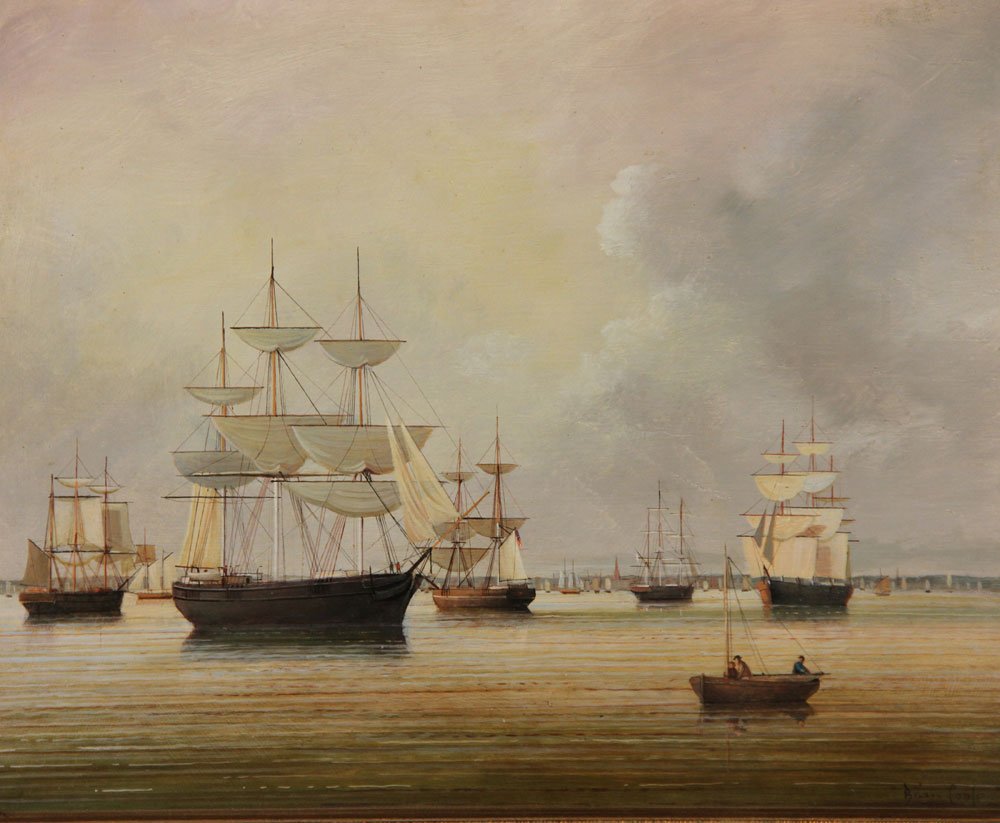
Brian Coole (British, 1939)
Manhattan as seen from Hudson River c. 1820, 
Oil on Panel
12" h x 15" w

Brian Coole, born in Edgeware, Middlesex, England, February 14th 1939. Irish parentage, strongest affiliation USA. Still living.

Entirely self-taught. Visits to public museums and galleries give his claimed influences of William Wyllie through a spectrum ranging to Rembrandt and Canaletto, although in the US, his work is compared to that of Fitz Hugh Lane.

Was commissioned, in 2001 to paint Three historical ship portraits for The Royal Naval Museum (United Kingdom)"" for permanent display. More

10 Prints. Henri Matisse (1869-1954), Portfolio: Dix Danseuses

Danseuse assise, from: Dix danseuses (Duthuit-Matisse 480) 
lithograph, 1927, on Arches wove paper, signed in pencil, numbered 18/130, (there were also five on China and 15 on Japan paper), published by Galerie d'Art Contemporain, Paris, the full sheet

Danseuse debout, acoudée, from: Dix Danseuses
lithograph, 1925-26
Arches wove paper, signed in pencil, numbered 83/130
L. 460 x 280 mm., S. 505 x 330 mm.

allongee3.jpg - 162936 Bytes
Danseuse allongée, Tête accoudée, from Dix danseuses (Dethuit 486)
lithograph, 1927, on watermarked Arches paper, 
signed in pencil, numbered 53/130
L. 155 x 416 mm., S. 326 x 502 mm. 

Danseuse étendue (Dancer Extended), from Dix Danseuses (Ten Dancers)
  Lithograph, on Japanese paper
10 X 16.5 in (25.4 X 41.91 cm)
Creation Date:  1927
Edition Number:  10/15
Signed

Danseuse au Divan au Pliee en Deux 
Original lithograph 
Year: 1927 
Framed Size: 30" x 24" 
Sheet Size: 19 1/2" x 12 1/2" 
Hand signed 

Danseuse au Fauteuil en Bois
Original lithograph
Year: 1927
Edition: 113/130
Sheet Size: 19 3/8" x 13"
Hand signed in pencil

Danseuse couchée, from Dix Danseuses
Lithograph on wove paper
 13 X 19.62 in (33.02 X 49.85 cm)
Creation Date:  1925
Edition Number:  52/130
Signed

<span style='display:block; text-align:left; font-size:10px; font-weight:normal; line-height:14px; vertical-align:middle;'>Danseuse Étendue au Divan [Mains À la Nuque] </span>
Danseuse Étendue au Divan [Mains À la Nuque] 1927
Original lithograph printed in black ink on China paper.
Signed in pencil lower right Henri Matisse.
10 15/16 x 18 1/16 inches

Lithograph - Henri Matisse - Danseuses Endormie au Divan
Danseuses Endormie au Divan, c. 1925-6
Lithograph on Arches paper 
Signed by the artist in pencil and numbered
12 ¾ x 19 ¾ in. (32.4 x 50.2 cm.)

Lithograph - Henri Matisse - Danseuse au Tabouret, from Dix Danseuses,
Danseuse au Tabouret, from Dix Danseuses, 1925-26
Lithograph
17 7/8 x 10 3/4 inches
Sheet: 25 3/8 x 18 1/2 inches
Edition of 130
Signed and numbered


14 Paintings, Art for today, Impressionist & Modern Art, Marc Chagall, Henri de Toulouse-Lautrec, Pablo Picasso, Pierre Bonnard,

Marc Chagall 1887 - 1985 L'HOMME AU PARAPLUIE Signed Marc Chagall (lower left) Gouache on paper 26 by 20 in. 66.3 by 51 cm Executed in 1927-28.:
L'HOMME AU PARAPLUIE
Signed Marc Chagall (lower left)
Gouache on paper
26 by 20 in.
66.3 by 51 cm
Executed in 1927-28.

Executed in 1927-28, L’Homme au parapluie is an important early example of Chagall’s lifelong fascination with the pageantry of the circus. Chagall first developed an interest in this theme during his formative years in Vitebsk, and later in Paris, where he frequently attended performances at the Cirque d’Hiver Bouglione in the company of Ambroise Vollard. More

Marc Chagall 1887 - 1985 LE VIOLONISTE Signed Chagall (lower left) Gouache, India ink and charcoal on paper 19 1/4 by 25 1/4 in. 49.5 by 65 cm Executed in 1926-27.:
LE VIOLONISTE
Signed Chagall (lower left)
Gouache, India ink and charcoal on paper
19 1/4 by 25 1/4 in.
49.5 by 65 cm
Executed in 1926-27.

Although this picture is specifically concerned with the musician, Chagall's pictorial characters had many levels of significance.  To him, they represented the many faces of man's emotional character, both fun-loving and tragic.  He once wrote, "I have always considered the clowns, acrobats, and actors as being tragically human who, for me, would resemble characters from certain religious paintings. More

Marc Chagall 1887 - 1985 LA MÈRE ET L'ENFANT Signed Chagall and dated 1947-51 (lower right); signed Marc Chagall and dated 1947-51 on the reverse Oil on canvas 36 1/4 by 28 3/4 in. 92 by 73 cm Painted in 1947-51.:
LA MÈRE ET L'ENFANT
Signed Chagall and dated 1947-51 (lower right); signed Marc Chagall and dated 1947-51 on the reverse
Oil on canvas
36 1/4 by 28 3/4 in.
92 by 73 cm
Painted in 1947-51. 

Painted in the late 1940s, La Mère et l’enfant embodies the new optimism and hope that characterizes Chagall’s work from this important period of transition. Having initially struggled to adapt to life in the United States, Chagall had achieved great success there, culminating in the 1946 retrospective at The Museum of Modern Art in New York. By this time he was also slowly beginning to recover from the tragedy of Bella’s death in 1944, and had begun a relationship with Virginia Haggard McNeil with whom he would father a son. More

Henri de Toulouse-Lautrec 1864 - 1901 À ARMENONVILLE, EN CABINET PARTICULIER Signed with the monogram TL (upper left) Peinture à l'essence on board 26 3/8 by 20 1/2 in. 67 by 52.2 cm Painted in 1899:
À ARMENONVILLE, EN CABINET PARTICULIER
Signed with the monogram TL (upper left)
Peinture à l'essence on board
26 3/8 by 20 1/2 in.
67 by 52.2 cm
Painted in 1899.

Armenonville, en cabinet particulier, 1899, belongs to the great series of voyeuristic depictions of intimate encounters that fascinated Toulouse-Lautrec throughout 1890s.  While many of these scenes took place in brothels, the artist also depicted these heated scenarios as they played out in theater boxes, cafés, and other spaces of social engagement.  A brilliant interpreter of his time, Lautrec focused his attention on the game of pursuit that lead to sexual confrontation. More

Pablo Picasso 1881 - 1973 NU AUX JAMBES CROISÉES Signed Picasso and dated 1903 (upper left) Pastel and black crayon on paper 22 1/2 by 18 in. 57.5 by 45.8 cm Painted in 1903.:
NU AUX JAMBES CROISÉES
Signed Picasso and dated 1903 (upper left)
Pastel and black crayon on paper
22 1/2 by 18 in.
57.5 by 45.8 cm
Painted in 1903.

Picasso created this stunning pastel nude in Barcelona in 1903.  The year marked the apotheosis of Picasso’s celebrated Blue period (late 1901-1904), and the present work is imbued with a sense of fragility and melancholy that was to become synonymous with this phase of his career.  The pictures of the Blue period are often characterized by poignant images of forlorn women and despondent men, often isolated and lost in thought. More

Pablo Picasso 1881 - 1973 VIOLON Oil, sand and charcoal on canvas 21 5/8 by 17 in. 55 by 43.2 cm Painted in autumn-winter 1912.:
VIOLON
Oil, sand and charcoal on canvas
21 5/8 by 17 in.
55 by 43.2 cm
Painted in autumn-winter 1912.

Painted in 1912, Violon belongs to an immensely important period of artistic development for Picasso which saw the beginning of his shift from analytic to synthetic cubism. Using the motif of a guitar – or as in the present painting, a violin – Picasso embarked on a series of works in which he developed the cubist idiom of the previous decade, exploring a range of materials from the cut paper and newspaper of his papiers collés to the sand of Violon and the thick cardboard of his cutouts. More

Pablo Picasso 1881 - 1973 VUE D'UNE FENÊTRE Dated 2 Mai XXIX (on the reverse) Oil on canvas 51 1/8 by 76 7/8 in. 130 by 195 cm Painted on May 2, 1929:
VUE D'UNE FENÊTRE
Dated 2 Mai XXIX (on the reverse)
Oil on canvas
51 1/8 by 76 7/8 in.
130 by 195 cm
Painted on May 2, 1929.

With its powerful grisaille palette and extraordinary attention to spatial perspective, this composition of the artist's studio-sanctuary is one of Picasso's rare forays into architectural subject matter.  The picture dates from the beginning of May 1929 and has select stylistic precedents in his oeuvre.  More

Pablo Picasso 1881 - 1973 LA FEMME AU TAMBOURIN  Aquatint with grattoir, 1939, Baer’s fifth (final) state, signed in pencil, numbered 8/30, published by Galerie Louise Leiris, Paris, in 1943, on Arches wove paper, framed Plate: 26 1/4 by 20 1/4 in. 66.6 by 51.3 cm Sheet: 30 1/8 by 22 1/2 in. 76.5 by 57 cm Conceived in 1939 and printed in 1943.:
LA FEMME AU TAMBOURIN 
Aquatint with grattoir, 1939, Baer’s fifth (final) state, signed in pencil, numbered 8/30, published by Galerie Louise Leiris, Paris, in 1943, on Arches wove paper, framed
Plate: 26 1/4 by 20 1/4 in. 66.6 by 51.3 cm
Sheet: 30 1/8 by 22 1/2 in. 76.5 by 57 cm
Conceived in 1939 and printed in 1943.

Picasso conceived this striking portrait of Dora Maar when Europe was on the brink of war in 1939.  With images of the Spanish Civil war still fresh in his memory, the subject of a nation at peril seemed too overwhelming for him to face yet again.  Instead, he turned his attention to his immediate environment, featuring still-lifes constructed from the contents of his studio and many portraits of his lover, Dora Maar. More

Pablo Picasso 1881 - 1973 LA GOMMEUSE Signed Picasso (upper left); inscribed Recuerdo a Mañach en el día de su santo and fully painted on the reverse Oil on canvas 31 7/8 by 21 1/4 in. 81.3 by 54 cm Painted in Paris in 1901.:
LA GOMMEUSE
Signed Picasso (upper left); inscribed Recuerdo a Mañach en el día de su santo and fully painted on the reverse
Oil on canvas
31 7/8 by 21 1/4 in.
81.3 by 54 cm
Painted in Paris in 1901.

Picasso's extraordinary La Gommeuse is among the rare and coveted pictures created during the artist's Blue Period (1901-1904). The painting dates from the second half of 1901, following Picasso's widely-praised exhibition at Vollard's gallery that June and amidst the sobering aftermath of his friend Casagemas' suicide earlier in the year. More

Pablo Picasso 1881 - 1973 NU, LES BRAS CROISÉS Dated 13.2.60 & 18.2.60 on the reverse Oil on canvas 39 3/8 by 31 7/8 in. 100 by 81 cm Painted on February 18, 1960.:
NU, LES BRAS CROISÉS
Dated 13.2.60 & 18.2.60 on the reverse
Oil on canvas
39 3/8 by 31 7/8 in.
100 by 81 cm
Painted on February 18, 1960.

The woman featured in this striking painting is Jacqueline Roque, Picasso's devoted second wife who remained with him until the time of his death in 1973. Picasso's renderings of Jacqueline constitute the largest group of images of any of the women in his life. More

Pablo Picasso 1881 - 1973 FEMME DANS UN FAUTEUIL Signed Picasso and dated XXIX (lower right) Oil on canvas 32 by 20 in. 81.2 by 58 cm Painted on March 2, 1929.:
FEMME DANS UN FAUTEUIL
Signed Picasso and dated XXIX (lower right)
Oil on canvas
32 by 20 in.
81.2 by 58 cm
Painted on March 2, 1929

One of the most loaded images of Picasso's Surrealist production is his terrifyingly fantastic depiction of his wife, Olga, abstracted beyond the point of recognition.  Femme dans un fauteuil is among Picasso's most memorable pictures from 1929, as it is emblematic of both the personal and professional forces at play that year.  Olga had spent the first weeks of 1929 in a clinic recovering from a haemorrhaging condition, and now reemerged in Picasso's daily life. More

Pablo Picasso 1881 - 1973 FEMME ENDORMIE Signed Picasso (lower right), dated Boisgeloup 28 juin XXXIII (lower left) & dedicated Pour Bibi Souvenir Souvenirs (upper right) Oil on canvas 4 by 8 in. 10 by 18 cm Painted in 1933.:
FEMME ENDORMIE
Signed Picasso (lower right), dated Boisgeloup 28 juin XXXIII (lower left) & dedicated Pour Bibi Souvenir Souvenirs (upper right)
Oil on canvas
4 by 8 in.
10 by 18 cm
Painted in 1933

A recumbent Marie-Thérèse is the subject of this intimate canvas from 1933.   This theme dominated the artist's most successful pictures of the 1930s, when he was swept up in a romance with a much younger woman who satisfied his every physical desire.  In paintings, sculpture, etchings and drawings Picasso celebrated his lover's body, even sharing her form with his friends in his art. More

Pierre Bonnard 1867 - 1947 NU S'HABILLANT Signed Bonnard (lower left) Oil on canvas 29 by 17 3/4 in. 74 by 45 cm Painted in 1925:
NU S'HABILLANT
Signed Bonnard (lower left)
Oil on canvas
29 by 17 3/4 in.
74 by 45 cm
Painted in 1925.

Painted in luminous yellows, blues and pinks, the present work is one of Bonnard’s major nudes. Bonnard’s paintings of the female nude are the most renowned within his oeuvre. The primary model for these canvases was the eccentric Marthe de Meligny, a young woman of elusive origin whom Bonnard met in Paris in 1893 and would become his wife in 1925. More

Pierre Bonnard 1867 - 1947 LES COQUELICOTS Signed Bonnard (lower left)  Oil on canvas 27 3/4 by 22 7/8 in. 70.5 by 58 cm Painted circa 1914-15.:
LES COQUELICOTS
Signed Bonnard (lower left)
Oil on canvas
27 3/4 by 22 7/8 in.
70.5 by 58 cm
Painted circa 1914-15.

Les Coquelicots belongs to a group of Bonnard’s still lifes featuring the white vase with a cherry motif, often filled with a bouquet of flowers. The vibrancy of his palette and the richness and spontaneous arrangement of the flowers in this work represent a lively and colorful celebration of nature. Discussing this subject matter, Bonnard revealed to a friend in 1943: "I often see interesting things to paint around me, but for me to have the desire to paint them, they must have a special seduction – beauty – what one could call beauty. More