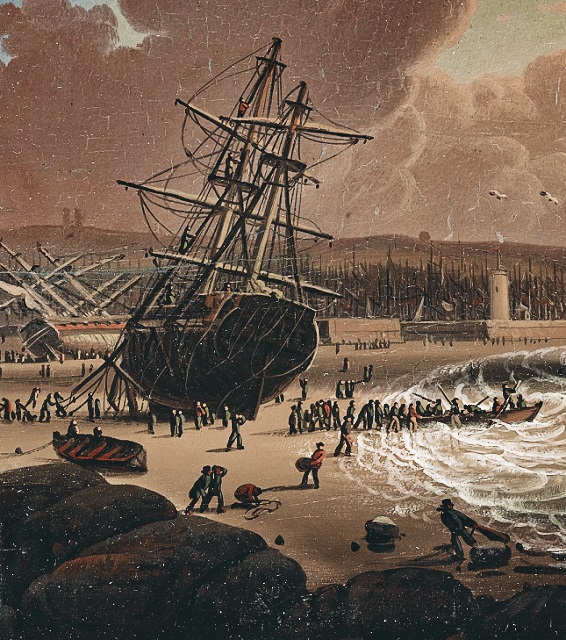
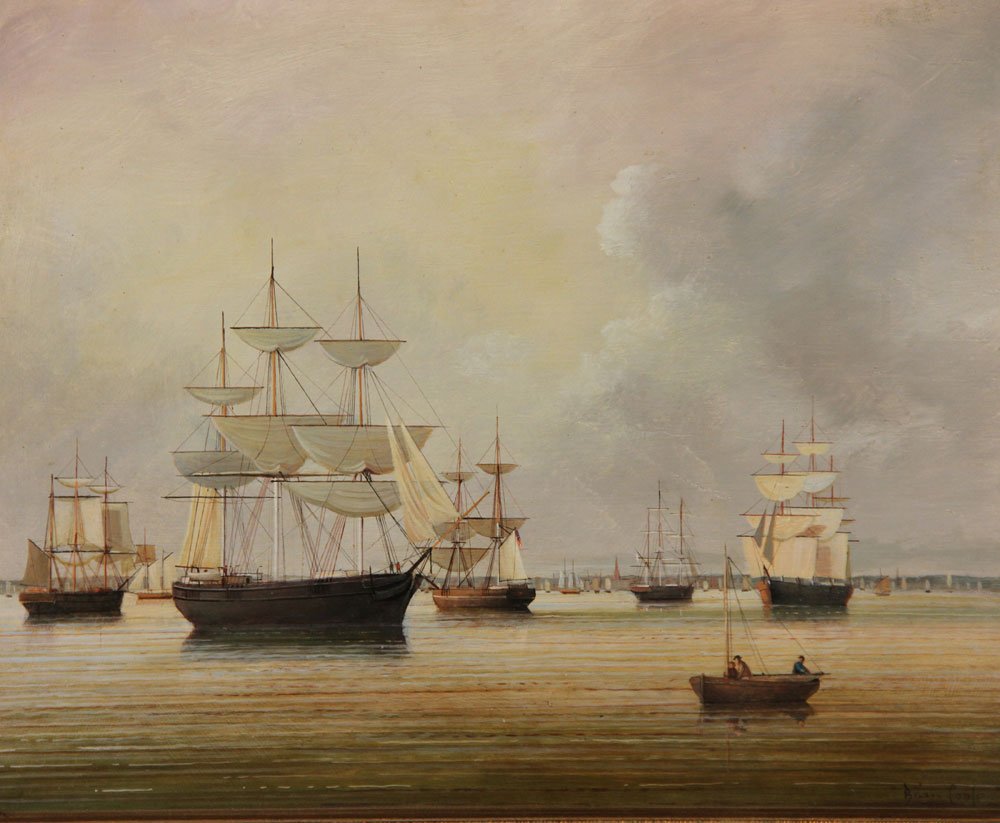
Showing posts with label Robert Salmon. Show all posts

16 Classic Marine Paintings - With Footnotes, #21

Harry Hudson Rodmell, (1896–1984)
Gale Force 8: Trawler in a Rough Sea, mid-20th C–late 20th C
Oil on paper marouflage on board
457 x 55.9 cm
National Maritime Museum, London

A trawler is fishing vessel that uses a trawl, a conical net that snares fish by being dragged through the water or along the bottom.

Harry Hudson Rodmell (28 May 1896 – 3 March 1984) was an English painter and Commercial artist, specialising in marine art. He studied at Hull School of Art before enlisting in the Royal Engineers during World War I. After demobilisation, he was recruited by Ronald Massey, a London agent seeking nautical illustrations for publicity material. Subsequently he produced work for many of the major shipping lines including P & O, Canadian Pacific and the British India Line. His longest running commission was a series of calendars for the tugboat company William Watkins Ltd.

After serving with the Royal Observer Corps during World War II, his graphic design work was largely replaced by commissioned oil paintings of new vessels. These were often produced from plans so that a painting could be completed before the vessel was launched. More Rodmell

Harry Hudson Rodmell, (1896–1984)
Tramp Steamer
Oil on canvas
64 x 55 cm
Sewerby Hall Museum and Art Gallery, Bridlington, England

Tramp steamer, one of the two principal types of merchant ships as classified by operating method (the other is the ocean liner). The tramp steamer, in contrast to the liner, operates without a schedule, going wherever required to deliver its cargoes. The tramp is a descendant of the early merchant ships whose masters (who were also their owners) loaded them with cargo at home to sell abroad, and vice versa. Tramps are used mainly for carrying bulk commodities or homogeneous cargoes in whole shiploads, with each voyage separately negotiated between the ship’s owner and the shipper, usually through a broker. More on Tramp steamers

Harry Hudson Rodmell (28 May 1896 – 3 March 1984), see above

Arthur John Trevor Briscoe, (1873–1943)
Clewing Up the Mainsail in Heavy Weather, c. 1925
Oil on canvas
66 x 101.8 cm
National Maritime Museum

The waist of a ship, looking forward, is depicted in a heavy sea. The mainmast intersects the image to the left, with two bare-footed figures in rolled-up shirt-sleeves hauling on the mainsail clew-line, while on the far left another man in boots looks aloft, probably to men working on the unseen main yard above. The viewer is looking down on the action from the height of a deckhouse roof and the image is off-centre and at an angle to create a sensation of a heaving deck. The sky is light to the top right and the sea is shown coming over the lee gunwale, in this demonstration of all the actions associated with a sailing ship in a heavy sea. More on this painting

Arthur John Trevor Briscoe (1873–1943), see below

Edward Moran, 1829 - 1901
“First Recognition of the American Flag by a Foreign Government” 
Oil on canvas
U.S. Naval Academy

First Recognition of the American Flag by a Foreign Government, 14 February 1778 Painting in oils by Edward Moran, 1898. It depicts the Continental Navy Ship Ranger, commanded by Captain John Paul Jones, receiving the salute of the French fleet at Quiberon Bay, France, 14 February 1778. Earlier in the month, after receipt of news of the victory at Saratoga, France recognized the independence of the American colonies and signed a treaty of alliance with them. More on First Recognition of the American Flag

Andrew Doria was a brig purchased by the Continental Congress in November 1775. She is most famous for her participation in the Battle of Nassau—the first amphibious engagement by the Continental Navy and the Continental Marines—and for being the first United States vessel to receive a salute from a foreign power. More on The Andrew Doria

Edward Moran (August 19, 1829 in Bolton, Lancashire, England – June 8, 1901 in New York City) was an American artist of maritime paintings. Moran was born in England on August 19, 1829. Following in the footsteps of his father's profession, he learned to operate a hand-loom at a young age, though he would often be found sketching with charcoal on the white fabric instead of plying the shuttle. His family first emigrated to Maryland in 1844, and then to Philadelphia a year later.

It was in Philadelphia around 1845 that Edward apprenticed under James Hamilton and landscape painter Paul Weber; Hamilton guided Moran specifically in the style of marine paintings. In the 1850s Moran began to make a name for himself in the Philadelphia artistic scene; working in the same studio as his younger brother, famous American painter Thomas Moran, Edward received commissions and even completed some lithographic work. In 1862, he traveled to London and became a pupil in the Royal Academy. 

In 1885, at the height of his career, Moran began on what would be considered his most important work - a series of 13 paintings representing the Marine History of the United States. He chose to have thirteen paintings in the series because of the significance of the number in American history (13 colonies, 13 stars and stripes on the original US flag, etc.). The subjects include Leif Ericsson, Christopher Columbus, Hernando de Soto, Henry Hudson, and Admiral Dewey, among others.[3] Not long after their completion, the series was displayed at the 1893 World's Fair in Chicago. More on Edward Moran

Constantinos Volanakis, (Crete 1837 -. Piraeus June 29, 1907) 
The burning of a Turkish frigate
Oil on canvas
92 x 135 cm. (36.2 x 53.1 in.)
Private collection

"The Burning of a Turkish Frigate" depicts a strategic battle scheme used by Greek revolutionary fighters to attack their Turkish oppressors which eventually lead to the liberation of Greece. The tactic of attaching a small boat laden with explosives to the side of a frigate was used by maritime heroes such as Canaris, Papamanolis and Barbatsis. One of the most famous of such ambushes was the destruction of the 'Mansourija'. On the evening of 27 May 1821 the thirty-three-year-old freedom fighter Dimitris Papamanolis sailed his small vessel up to the port side of the frigate and set it ablaze. The devastating fire spread throughout the Turkish ship killing 600 sailors. More on this painting

Konstantinos Volanakis (1837, Heraklion - 29 June 1907, Piraeus) was a Greek painter who became known as the "father of Greek seascape painting". He completed his basic education on Syros in 1856. Afterward, urged on by his brothers, he went to Trieste and became an accountant for a family of Greek merchants who were related to his family by marriage. While there, he made sketches of ships and harbors in his account books. Rather than dismiss him, the family recognized his artistic talent, and made arrangements for him to study at the Academy of Fine Arts, Munich, under Karl von Piloty, joining a group of Greek students. His instructors discouraged any sort of landscape painting, because it was "in decline", so he concentrated on portraits.

His break came in 1869, three years after the Battle of Lissa, when Emperor Franz Joseph held a drawing competition to memorialize the event. Volanakis won the contest, receiving 1000 gold Florins and free travel cruises with the Austrian navy for three years. He took full advantage of this, producing numerous canvases and sketches. He married in 1874. Nine years later he returned to Greece and settled in Piraeus, where his family had a pottery factory.

From then until 1903, he was a teacher at the Athens School of Fine Arts. He also operated his own private school. In 1889, he was awarded the Silver Cross of the Order of the Redeemer. He was, however, very poor in his later years, due to his very large family and declining interest in his art. In an effort to increase his income, he reversed the usual method of painting first, then framing, by working with a group of framers who would make luxurious carved frames first, then creating paintings to fit them.

He died from complications related to a major hernia. Most of his works are in private collections. More Volanakis

Arthur Briscoe, (1873-1943)
Ships

Arthur John Trevor Briscoe (1873–1943) studied at the Slade School and at Julien's in Paris. He was a keen sailor and lived aboard his yacht for some years with his first wife and young son. He also sailed in square-riggers that were the inspiration for many of his paintings. He was a brilliant etcher as well as being successful in oils and watercolours. He was also a first-class cartoonist, his work regularly illustrated in 'Yachting Monthly', and he exhibited at the Royal Academy. More on Arthur John Trevor Briscoe

Thomas Devany Forrestall, b. 1936
COVEBAY, SPRING, c. 1974
Watercolour
14.0 x 18.7 in
Private Collection

Thomas DeVany Forrestall, painter (b at Middleton, NS 11 Mar 1936)After graduating in 1958 from MOUNT ALLISON UNIVERSITY, Tom Forrestall was assistant curator at the Beaverbrook Art Gallery in Fredericton (1959), but became a full-time painter the following year. His realistic works, often done in egg tempera, convey his ideas of the East Coast landscape and its dwellings. From the early 1960s, Forrestall experimented with panels shaped from triangles to T-forms, each chosen to fit his painterly ideas. He has also painted a large number of out-of-doors watercolours which express much the same ideas as his egg tempera works, but in a more relaxed and joyous mood. His watercolours, in contrast to his more metaphysical and individual canvases, form one long series and deal with a sense of place. He became an Officer of the Order of Canada in 1986. More on Thomas DeVany Forrestall

Marc-Aurèle Fortin, 1888 - 1970
SAILING SHIP OFF THE COAST
Watercolour and charcoal
26.6 x 42.3 in
Private Collection

Marc-Aurèle Fortin (March 14, 1888 – March 2, 1970) was a Québécois painter, born in 1888 in Ste-Rose, Quebec. He studied art in Montreal and worked at the Montreal Post Office, and at an Edmonton bank. He studied art abroad. He was known for painting watercolour landscapes of the St. Lawrence Valley. He travelled around the St. Lawrence Valley by bicycle. Fortin believed that "Canadian artists should take their inspiration from the countryside and progress towards a national art... We should excel in landscapes, exactly as the French do".

He was part of the first Atelier exhibition at Henry Morgan Galleries in April 1932 together with Atelier founder John Goodwin Lyman, André Biéler, and Edwin Holgate. Fortin was exhibited by Galerie L'Art français from the 1940s.

His works are displayed at the Montreal Museum of Fine Arts in Montreal. He was a member of the Royal Canadian Academy of Arts. He died in 1970. More Marc-Aurèle Fortin

Fritz Brandtner, 1896 - 1969
FISHING BOATS
Coloured inks
7.9 x 8.1 in
Private Collection

Friedrich Wilhelm Brandtner (28 July 1896 – 1969), known during his life as Fritz Brandtner, was a German-Canadian artist and art instructor. At one time or another he worked as painter, printmaker, graphic artist, illustrator, muralist, and set designer.

Brandtner emigrated to Canada from Germany in 1928. Following a short stay in Winnipeg he settled in Montreal in 1934. A prolific artist and thinker, he actively participated in the cultural life of Canada. He was a member of the Contemporary Arts Society in Montreal, serving as its first secretary. He was also a passionate art-educator. More on Friedrich Wilhelm Brandtner

 William "St. Thomas" Smith
VILLAGE ON A ROCKY SHORE
Watercolour
27.1 x 41.3 in
Private Collection

William "St. Thomas" Smith (1862-1947) was born in Belfast, Ireland and died at St. Thomas, Ontario. His family emigrated to Canada when he was a child and settled at Beaverton, Ontario. He received his art training at the Ontario College of Art and reputedly it was there he received the nickname of "St. Thomas" to differentiate him from another art student also named "William Smith". Later he worked in the studio of J. W. L. Forster and formed a close friendship with Curtis Williamson. Their choice of Barbizon subjects influenced his early paintings. After marrying a local artist and teacher, Smith settled permanently in St. Thomas, Ontario and by 1887, was part of the art staff at Alma College. He traveled widely in Canada, Great Britain and Europe during his long career. Most of his work was in the medium of watercolour usually choosing landscape and seascapes as subjects. St. Thomas Smith was one of the early impressionistic painters and specialized in using a watercolour wet paper technique to achieve atmospheric effects. His art was exhibited at the Ontario Society of Artists, the Royal Canadian Academy, the Toronto Industrial Exhibition and many commercial galleries. Smith’s career was highlighted by an honorary degree from the University of Western Ontario in 1940 and a retrospective by our institution in 1947. More on William St. Thomas Smith

Dominic Serres, R.A. (Auch 1722 - 1793 London)
HIS MAJESTY’S SHIPS PHOENIX, ROEBUCK AND TARTAR, ACCOMPANIED BY THREE SMALLER VESSELS, FORCING THEIR WAY THROUGH THE CHEVAL-DE-FRISE ON THE HUDSON RIVER BETWEEN FORTS WASHINGTON AND LEE, NEW YORK, 9 OCTOBER 1776, c. 1779
Oil on canvas
25 by 47 7/8 in.
Private Collection

The painting depicts an important action during the Revolutionary War, shortly after the Declaration of Independence in 1776. Having defeated the Continental Army at the Battle of White Plains, General Howe ordered a small squadron of British war ships, under the command of Captain Hyde Parker in H.M.S. Phoenix, to occupy the Hudson River and prevent the remaining Continental troops on Manhattan Island from receiving supplies in preparation for his assault on Fort Washington. Serres illustrates the Phoneix, together with H.M.S. Roebuck, under the command of Captain A.S. Hammond, H.M.S. Tartar, commanded by Captain George Jackson, and three smaller vessels forcing their way through a cheval-de-frise, comprised of artificial barriers and sunken vessels defending the north part of the river. 

Dominic Serres, R.A. (Auch 1722 - 1793 London)
Detail; HIS MAJESTY’S SHIPS PHOENIX, ROEBUCK AND TARTAR, ACCOMPANIED BY THREE SMALLER VESSELS, FORCING THEIR WAY THROUGH THE CHEVAL-DE-FRISE ON THE HUDSON RIVER BETWEEN FORTS WASHINGTON AND LEE, NEW YORK, 9 OCTOBER 1776, c. 1779
Oil on canvas
25 by 47 7/8 in.
Private Collection

Dominic Serres, R.A. (Auch 1722 - 1793 London)
Detail

On the right lies Fort Washington, on a large outcrop at the northern end of Manhattan, with its several shore batteries engaging the enemy at close range, whilst from the left the British forces are bombarded by the guns of Fort Lee, sitting atop the New Jersey Palisades. Despite the heavy bombardment Captain Parker and his fleet passed successfully through, capturing two gunboats in the process, and he was subsequently knighted in 1779 for his heroic efforts.

Dominic Serres the Elder RA (1722 - 1793)
English Frigates in the Channel, c. 1789
Pen and grey ink and watercolour on a laid paper
124 mm x 181 mm
Royal Academy of Arts

In the 18th century, Frigate referred to ships that were usually as long as a ship of the line and were square-rigged on all three masts (full rigged), but were faster and with lighter armament, used for patrolling and escort. In the definition adopted by the British Admiralty, they were rated ships of at least 28 guns, carrying their principal armaments upon a single continuous deck — the upper deck — while ships of the line possessed two or more continuous decks bearing batteries of guns. More on Frigates

Dominic Serres RA (1722–1793), also known as Dominic Serres the Elder, was a French-born painter strongly associated with the English school of painting, and with paintings with a naval or marine theme. Such were his connections with the English art world, that he became one of the founding members of the Royal Academy in 1768, and was later briefly (from 1792 until his death) its librarian.

Born in Auch, Gascony, he was initially expected to train as a priest but instead travelled to Spain and became a ship's captain, sailing to Cuba. He was taken prisoner by the British navy towards the end of the 1740s and eventually settled in London in about 1758, where it is believed he trained as a painter in Northamptonshire and later in London under Charles Brooking. If Serres did not settle in London until 1758, however, he could not have studied for long under Charles Brooking, since Brooking was buried on 25 March 1759.

Reflecting his early career, many of his paintings have naval themes. Working for a publisher documenting the events in the Seven Years' War (1756–1763), he painted a series of depictions including the capture of Havana in 1762. He also painted events in the American Revolutionary War, such as the disastrous Penobscot Expedition launched by the Americans in 1779. In 1780, he was appointed Marine Painter to King George III.

Serres died in 1793, and was buried at St. Marylebone Old Church. His eldest son John Thomas Serres (1759–1825) also became a prolific marine artist. More on Dominic Serres

Robert Salmon (1775 - c. 1845)
STORMY SEAS, c. 1827
Oil on panel
12 1/4 by 17 3/4 in.
Private Collection

Robert SalmonAmerican, born England, 1775 - c. 1845, was born in Whitehaven, a port situated on the northwest coast of England. Although his artistic beginnings are unknown, his career can be divided into two periods. Between 1800 and 1828 he lived in England and Scotland, and his work faithfully recorded the environs of Liverpool and Greenock. Salmon's style at this time reflected the influence of Dutch maritime painters. In many of his paintings, he adopted the low horizon and clear, sparkling light effects typical of Dutch seascapes.

After 1828 Salmon moved to Boston. Although he was regarded as an eccentric, solitary man, he was highly thought of as an artist, and he soon became a leading maritime painter in the area. His paintings were admired for their detailed panoramic views of Boston's wharves and shorelines. While in Boston, Salmon also worked in the lithography studio of William S. Pendleton with Fitz Hugh Lane, during which time his maritime paintings became a model for Lane's work. More on Robert Salmon

Robert Salmon, (1775 - c. 1845)
A STORM OFF THE COAST, c. 1815
Oil on panel
23.5 x 29.21 cm. (9.3 x 11.5 in.)
Private collection


Acknowledgement: WADDINGTONS, Sotheby's

Please visit my other blogs: Art CollectorMythologyMarine ArtPortrait of a Lady, The OrientalistArt of the Nude and The Canals of VeniceMiddle East Artists365 Saints and 365 Days, also visit my Boards on Pinterest

Images are copyright of their respective owners, assignees or others. Some Images may be subject to copyright

I don't own any of these images - credit is always given when due unless it is unknown to me. if I post your images without your permission, please tell me.

I do not sell art, art prints, framed posters or reproductions. Ads are shown only to compensate the hosting expenses.

If you enjoyed this post, please share with friends and family.

Thank you for visiting my blog and also for liking its posts and pages.

Please note that the content of this post primarily consists of articles available from Wikipedia or other free sources online.


12 Classic Works of Art, Marine and Seascape Paintings - 8

Attributed to Bonaventura Peeters (Antwerp 1614-1652)
A Dutch man-of-war and other ships in choppy waters before
the town of Veere
oil on panel
56.3 x 91 cm.

Bonaventura Peeters or Bonaventura Peeters the Elder (23 July 1614 – 25 July 1652) was a Flemish painter, draughtsman and etcher and one of the leading marine artists in the Low Countries in the first half of the 17th century. More

File:Bonaventura Peeters (I) - Seascape with Sailors Sheltering from a Rainstorm.jpg
Bonaventura Peeters (1614–1652) 
Seascape with Sailors Sheltering from a Rainstorm, c. 1640s
Oil on oak panel
33.2 × 45.7 cm (13.1 × 18 in)
National Maritime Museum 

A group of sailors huddle, in a cave, beneath a rugged cliff. Torrential rain falls diagonally from the thick black clouds which hover menacingly above. A smooth, flat sea is rendered in silvery-grey tones. While darker areas suggest the shadows of the boats. Additionally, pale brown and green areas in the shallows hint at the emergence of rocks from beneath the surface of the water. The sailors, on the left, are composed into a tight group. Interactions between them are intimated by facial expressions and physical gestures. They are variously occupied. On the far left one drinks from a barrel. Next to him a man huddles wrapped in a shawl. While other figures stand nearby or are seated. They are accompanied by a small dog on the right. One of the seated figures is looking out towards a sailor, who remains on one of the boats. He, in turn, looks over towards the sheltering group. Their boats, with sails lowered and furled, are anchored in the shallow water. While, previously, the figures have been interpreted as smugglers sheltering from a storm, a more convincing reading suggests that they are in fact fishermen. Their humble appearance lends to the idea that Peeters’s intention was to portray them as quasi-heroic figures, happily living an idealized, rural existence. More


Antonio Jacobsen (American/Danish, 1850-1921)
Antilia, 1893
Oil on canvas
22 x 36 inches (55.9 x 91.4 cm)
Signed, dated, and inscribed lower right: A. Jacobsen 1893 / 705. Palisade at West Hoboken / NJ

Antilia, 1893. A Norwegian steamer, chartered by Bahamas company, specially designed for colonial trade between Nassau and New York.

Antonio Nicolo Gasparo Jacobsen (November 2, 1850 – February 2, 1921) was a Danish-born American maritime artist known as the "Audubon of Steam Vessels". Jacobsen was born in Copenhagen, Denmark where he attended the Royal Academy of Design before heading across the Atlantic Ocean. He arrived in the United States in August 1873. and settled in West Hoboken, New Jersey (now Union City, New Jersey), across the Hudson River from Manhattan and New York Harbor, its port filled with ships from America and around the world. Jacobsen got his start painting pictures of ships on safes, and as his reputation grew, he was asked to do portraits of ships by their owners, captains and crew members, with many of his works sold for five dollars.

Jacobsen painted more than 6,000 portraits of sail and steam vessels, making him "the most prolific of marine artists". Many of his commissions came from sea captains, and Jacobsen was chosen both for the accuracy of his work and his low fee. More

Maritime, Antonio Jacobsen (American/Danish, 1850-1921). Athens, 1878.Oil on canvas. 24 x 42 inches (61.0 x 106.7 cm). Signed, da...
Antonio Jacobsen (American/Danish, 1850-1921)
Athens, 1878

Oil on canvas
24 x 42 inches (61.0 x 106.7 cm)
Signed, dated, and inscribed lower right: Antonio Jacobsen NY 1878 / 257. 8 Av

Athens, built by New York Shipbuilding Co., Camden | ex- Somerset, 1917 purchased from Merchants & Miners Transportation Co. renamed City of Athens, 2 May 1918 rammed and sunk by the French cruiser Gloire with the loss of 106 lives.

Maritime, Aloysius C. O'Kelly (American/British, 1853-1926). Tugboats inthe East River, New York, circa 1910. Oil on canvas. 20-1...(Total: 2 Items)
Aloysius C. O'Kelly (American/British, 1853-1926)
Tugboats in the East River, New York, circa 1910

Oil on canvas
20-1/8 x 29 inches (51.1 x 73.7 cm)
Signed lower right: Aloys O'Kelly


Aloysius O'Kelly (3 July 1853 in Dublin – 1936) was an Irish painter. He was the youngest of four boys and one girl to the Kelly family of Dublin. It was his mother who directed him towards a career in the arts. His uncle on his mother's side was John Lawlor, a successful sculptor, and his cousin, Michael Lawlor, was also a sculptor employed in London. Aloysius' brothers, Charles and Stephen, also became artists.

O'Kelly traveled to Paris in order to enroll at the École des Beaux-Arts in 1874, where he studied under Bonnat and Gérôme. He traveled to Brittany in 1876 painting its aesthetic coastlines, fishing ports and villages.

In October 1881, Charles Stewart Parnell, a member of Parliament and leader of the Irish Party, was arrested and imprisoned in Kilmainham. Two days following his arrest, Aloysius' brother, James J. O'Kelly, along with some other Party members, including John Dillon, were imprisoned where they remained until May 1882. A number of Aloysius' drawings during this period portrayed the political situation dealing with his brother's incarceration.

O'Kelly lived in Concarneau, Connemara and eventually the United States, painting rural scenes in the prior and city life in New York City. More

Western, William Ritschel (American, 1864-1949). Swept Ashore. Oil oncanvas. 19 x 26 inches (48.3 x 66.0 cm). Signed lower right...
William Ritschel (American, 1864-1949)
Swept Ashore
Oil on canvas
19 x 26 inches (48.3 x 66.0 cm)
Signed lower right: Wm Ritschel

William Frederic Ritschel (1864–1949) was a California impressionist painter who was born in Nuremberg, Germany on July 11, 1864. As a youth, he worked as a sailor and began sketching seascapes. He studied art under Karl Raupp (1837–1918) and Wilhelm von Kaulbach (1805–1874) at the Royal Academy of Munich before immigrating to New York City in 1895. In 1911, he settled in Carmel-by-the-Sea, California and began painting Monterey Peninsula. He died in Carmel in 1949. More

John J. Holmes (British, 20th Century) The Royal Yacht Britannia
John J. Holmes (British, 20th Century)
The Royal Yacht Britannia 
signed 'John J Holmes' (lower right)
oil on board
59.5 x 90cm (23 7/16 x 35 7/16in).

Her Majesty's Yacht Britannia is the former royal yacht of the British monarch, Queen Elizabeth II, in service from 1954 to 1997. She was the 83rd such vessel since the restoration of King Charles II in 1660. More

John J Holmes Marine artist. Lives in Tynemouth, Berwick-Upon Tweed. He moved to Edinburgh in his mid-twenties, working in research and teaching laboratories. Consequently, a large number of his illustrations appear in text books and scientific journals.

In 1985 he retired to dedicate more time to his painting. In a relatively short time he has built up a reputation for accuracy and detail, a skill he attributes to the long hours spent peering into microscopes! However, he also manages to capture the mood and atmosphere of his subjects whether they be animals in the wild or landscapes such as the Border Moors.

His work often has a nautical theme, with ships, particularly sailing ships, being one of his favourite subjects. - See more
David Brackman | lot | Sotheby's:
David Brackman - 1932-2008 - BRITISH
AMERICA'S CUP, 1870, MAGIC VERSUS CAMBRIA
signed David Brackman and dated 04 (lower left)
oil on canvas
34 by 54 in.
86.4 by 137.2 cm

Cambria was the first, though unsuccessful, challenger attempting to lift the America's Cup from the New York Yacht Club. In 1868, James Lloyd Ashbury commissioned Michael Ratsey of Cowes to build a 188 ton schooner, Cambria.

Cambria had a highly successful racing season in 1869, winning the Round the Isle of Wight Race. Ashbury was encouraged by Cambria‍ '​s success in race, particularly because the champion American schooner Sappho had finished last. In October 1868 Ashbury wrote to the New York Yacht Club offering to be the first challenger for the America's Cup. He subsequently exchanged letters with Gordon Bennett, sportsman and owner of the New York Herald, challenging him to a trans-Atlantic race, prior to competing for the cup on behalf of the Royal Thames Yacht Club.

In July 1870 Ashbury raced Cambria across the Atlantic Ocean from Ireland to New York in challenge against Bennett's yacht, Dauntless. Cambria won the race by arriving first off Sandy Hook lightship in 23 days 5 hours and 17 minutes; 1 hour 43 minutes ahead of Dauntless.

The race for the America's Cup was held on 8 August, with Cambria facing 14 yachts of the New York Yacht Club. The race was won by Magic, with Cambria finishing eighth. More

The 1870 America's Cup was the first America's Cup to be hosted in the United States. James Lloyd Ashbury's yacht Cambria sailed to New York on behalf of the Royal Thames Yacht Club. The New York Yacht Club entered 17 schooners, and the race was won by Franklin Osgood's Magic. More

David Brackman, British (1932 - ). Born 1932 in London David Brackman is considered one of the most outstanding marine artists working today. David's love of the Sea started as a result of being evacuated to the East Coast of England during the second world war. It was there as a child that he was drawn to the drama and beauty of the sea.  Although his work was very successful, he won a gold medal at one of the best model exhibitions in London, he was needed by the family business. Again he achieved great success, this time it was as a fashion designer. 

As soon as family commitments allowed he gave up the fashion business and spent several years sailing his yacht “Panache” around the waters of Britain, Europe and down to around the Mediterranean. His one frustration happened when he and a small crew were casting off at the start of a trans-Atlantic voyage. David cut his hand so badly that he was cast ashore as the last rope was cut off.

David’s work is in the possession of the Royal Family and some of the finest private collections, museums and boardrooms in the world. More

Montague Dawson R.S.M.A., F.R.S.A. | lot | Sotheby's:
Montague Dawson R.S.M.A., F.R.S.A. - 1895-1973 - BRITISH
SEA BEAUTY (THE FLYING CLOUD) 
signed MONTAGUE DAWSON (lower left); titled SEA BEAUTY PN 1546 ('THE FLYING CLOUD') / BUILT IN 1851 1.783 TONS on the stretcher
oil on canvas
24 by 36 in.
61 by 91.4 cm

Clippers were the fastest sailing ships at sea through the 1850s.  Crisscrossing the world’s oceans, they followed the trade routes between the United Kingdom and its eastern colonies as well as the trans-Atlantic trade routes between New York and San Francisco. 

Among these yacht-like vessels, Flying Cloud was the most celebrated. Built for the firm Enoch Train  & Co., by Donald McKay of East Boston in 1851, at 225ft long, 40ft 8 in. broad  she was the largest merchant sailing ship at sea, and from her maiden voyage, was also among the fastest. Flying Cloud sailed between New York and San Francisco, rounding Cape Horn, reducing the trip’s average length of 120 days to eighty nine days and twenty one hours. In 1854, she beat her own record by thirteen hours, arriving in San Francisco to cheering crowds.  Flying Cloud’s speed was essential during America’s gold rush and she, like many clippers, was in high demand to carry precious cargo.  As valuable as gold was, tea was perhaps even more prized, and soon after Flying Cloud’s record-breaking run, she was reprovisioned for the China trade runs. On August 7, 1854, heavy with one million dollars of tea, she struck a coral reef in the South China Sea.  Rather than take time to dock and repair, Flying Cloud’s crew battled the incoming water from the rip in the hull with around-the-clock pumping, bringing her safely back to New York on November 24th.  Throughout these adventures, Flying Cloud was captained by the tenacious Josiah P. Cressy, and his wife Eleanor was her navigator (As a woman, her profession was remarkable for its time; she learned to sail from her father in the waters off Marblehead, Massachusetts). Little could stop Captain Cressy in his quest for speed, and Dawson captures his aptly-named vessel, set against a blue sky, her full white sails overlapping the clouds as she flies across the horizon of white-capped, glittering waves.  More

Montague Dawson RMSA, FRSA (1890–1973) was a British painter, renowned as a maritime artist. His most famous paintings depict sailing ships, usually clippers or warships of the 18th and 19th centuries. Dawson was the son of a keen yachtsman and the grandson of the marine painter Henry Dawson (1811–1878), born in Chiswick, London. Much of his childhood was spent on Southampton Water where he was able to indulge his interest in the study of ships. For a brief period around 1910 Dawson worked for a commercial art studio in Bedford Row, London, but with the outbreak of the First World War he joined the Royal Navy. Whilst serving with the Navy in Falmouth he met Charles Napier Hemy (1841–1917), who considerably influenced his work. In 1924 Dawson was the official artist for an Expedition to the South Seas by the steam yacht St.George. During the expedition he provided illustrated reports to the Graphic magazine.

During these years his artwork was also published in the newspaper The Sphere. His works are featured in the Royal Naval Museum and the National Maritime Museum. Dawson was present at the final surrender of the German High Seas Fleet and many of his illustrations depicting the event were published in theSphere.

After the War, Dawson established himself as a professional marine artist, concentrating on historical subjects and portraits of deep-water sailing ships often in stiff breeze or on high seas. During the Second World War, he was employed as a war artist and again worked for The Sphere. Dawson exhibited regularly at the Royal Society of Marine Artists, of which he became a member, from 1946 to 1964, and occasionally at the Royal Academy between 1917 and 1936. By the 1930s he was considered one of the greatest living marine artists, whose patrons included two American Presidents, Dwight D Eisenhower and Lyndon B Johnson, as well as the British Royal Family. Also in the 1930s, he moved to Milford-Upon-Sea in Hampshire, living there for many years. Dawson is noted for the strict accuracy in the nautical detail of his paintings which often sell for six figures.

The work of Montague Dawson is represented in the National Maritime Museum, Greenwich and the Royal Naval Museum, Portsmouth. More

Montague Dawson R.S.M.A., F.R.S.A. | lot | Sotheby's:
Montague Dawson R.S.M.A., F.R.S.A. - 1895-1973 - BRITISH
THE SOUTHERN CROSS
signed MONTAGUE DAWSON (lower left); inscribed on the stretcher THE WINNER IN SUNLIT SEAS THE "SOUTHERN CROSS" 950 TONS  BUILT AT  BOSTON IN 1851
oil on canvas
23 7/8 by 36 in.
60.6 by 91.4 cm

The Southern Cross, 938 tons and 170 ft long, was built by E & HO Briggs of South Boston in 1851 for Baker & Morrill.  Commanded by Captain Levi Stevens, Southern Cross made her maiden voyage to San Francisco in May 1851, and was immediately recognized for her impressive speed of up to twenty-two knots. She held the remarkable record of fifty-six days for her voyage from San Francisco to Calcutta and 106 days spent crossing from Manilla to New York in 1853. (Basil Lubbock, The China Clippers, Glasgow, 1919 (reissued 1981), p. 68-9).  After over a decade of successful voyages, during the Civil War Southern Cross fell prey to the Confederate raider CSS Florida, known as the “Prince of Privateers.”  On January 16, 1863, Florida broke through the Federal blockade of Mobile, and began a seven-month cruise in which she captured twenty-two vessels, including Southern Cross, which was burned.  As such, the present work stands as Dawson’s testament to the innovative design, power and speed of the magnificent Southern Cross in her glory racing across the sea.   More

Robert Salmon | lot | Sotheby's:
Robert Salmon - 1775 - 1850 - BRITISH
AN OUTWARD-BOUND, EIGHTEEN-GUN MERCHANTMAN AT THE TAIL OF THE BANK, PORTRAYED IN THREE POSITIONS
signed with initials R.S. and dated 1814 (lower right)
oil on canvas
16 3/4 by 25 1/2 in.
42.5 by 64.8 cm

“Tail of the Bank.” In the early nineteenth century, a large sandbank prevented the easy sailing of ships up the Clyde and the “Tail of the Bank” formed a natural anchorage where ships could wait for further assistance.  With this composition, Salmon depicts a single ship in three separate views, and with the port broadside view (center foreground), shown hove-to to allow a pilot aboard.  At her foremast is a house-flag with the letter “B,” and at the mainmast a long pennant in naval style, suggesting she has been given the letters of a marque as a privateer and may capture enemy ships.  Further formidable clues are the eighteen guns she carries and her camouflaging black and white trim which at a distance would suggest she is a Naval frigate.  Around 1814, the year Salmon completed the present work, such vessels were critical in Britain’s efforts against Napoleon’s naval advances and its war with America.  In their patriotic duty, merchant captains could earn great sums as they picked off the enemy’s commercial vessels as the spoils were divided between them and the British government. More

Robert Salmon (1775 – c. 1845) was a maritime artist, active in both England and America. Salmon completed nearly 1,000 paintings, all save one of maritime scenes or seascapes. He is widely considered the Father of American Luminism More

Montague Dawson R.S.M.A., F.R.S.A. | lot | Sotheby's:
Montague Dawson R.S.M.A., F.R.S.A. - 1895-1973 - BRITISH
A CLIPPER SHIP ON THE HIGH SEAS
signed MONTAGUE DAWSON (lower left)
oil on canvas
30 1/2 by 34 1/2 in.
77.5 by 87.5 cm

Montague Dawson R.S.M.A., F.R.S.A. | lot | Sotheby's:
Montague Dawson R.S.M.A., F.R.S.A. - 1895-1973 - BRITISH
GAY WEATHER: ONE-DESIGNS RACING INSHORE AND OUT OF THE TIDE OFF THE ISLE OF WIGHT
signed Montague Dawson (lower left); titled Gay weather on a label on the reverse
oil on canvas
36 by 24 in.
91.5 by 61 cm

While Dawson is celebrated for his paintings of majestic clipper ships on open seas (as above), another important aspect of his oeuvre is his scenes of yacht racing in the Solent, the strait between England’s South Coast and the Isle of Wight.  The present work’s vertical composition and cropped perspective affords a thrilling view of yachts in close pursuit of one another: each competitor’s tall, taut sails, the smooth cloth and sleek vessel, rendered with fine brushwork, contrasting with the swaths of blue-green paint of the choppy water.  The subject may have resonated particularly with Dawson, who grew up on Southampton Water, the son of a yachtsman. More

2
Brian Coole (British, 1939)
Manhattan as seen from Hudson River c. 1820, 
Oil on Panel
12" h x 15" w

Brian Coole, born in Edgeware, Middlesex, England, February 14th 1939. Irish parentage, strongest affiliation USA. Still living.

Entirely self-taught. Visits to public museums and galleries give his claimed influences of William Wyllie through a spectrum ranging to Rembrandt and Canaletto, although in the US, his work is compared to that of Fitz Hugh Lane.

Was commissioned, in 2001 to paint Three historical ship portraits for The Royal Naval Museum (United Kingdom)"" for permanent display. More