
 Posts
Posts


William Joy (British, 1803-1867) and John Cantiloe Joy (British, 1806-1866)
Moored vessels
signed and dated 'JOY, 1857' (lower right)
watercolour
29.3 x 42cm (11 9/16 x 16 9/16in).
George William Joy (July 7, 1844 in Dublin, Ireland – October 28, 1925 in Purbrook, Hampshire) was an Irish painter in London. Joy was the son of William Bruce Joy, MD, and the brother of sculptor Albert Bruce-Joy, descendents of an old Huguenot family which settled in Antrim in 1612.
He was initially destined for the military and was also an accomplished violin player. After a foot injury at young age, his father declared him unfit for military service. Joy was then educated at Harrow School and eventually pursued a career as an artist. He studied in London's South Kensington School of Art and later at the Royal Academy under John Everett Millais, Frederic Leighton and George Frederic Watts; among his fellow students was Hubert von Herkomer.
In 1868 Joy went to Paris where for two years he was a student of Charles-François Jalabert and Léon Bonnat. There he met masters like Gérôme, Cabanel, Jules Breton, Jules Lefebvre und Philippe Rousseau.
Going back to London, Joy established himself as a history and genre painter, and became a frequent exhibitor at the Royal Academy, the Salon des artistes français and the Royal Hibernian Academy. He became a member of the Royal Institute of Oil Painters in 1895.
To satisfy his early military ambitions, Joy entered the Artists Rifles where he was known as a good shot, representing Ireland several times. He spent many winters in Swanage from 1896 and eventually retired to Purbrook. Both of his sons were killed in 1915 during World War I. More
John Cantiloe Joy (British, 1806-1866) was his brother

William Joy (British, 1803-1867) and John Cantiloe Joy (British, 1806-1866)
The Donegal at sea
signed and dated 'JOY 85' (lower right) watercolour
36 x 50.7cm (14 3/16 x 19 15/16in).
 Nicholas Pocock (1740–1821)
HMS Donegal is on the left of the painting, engaging the Jupiter
Oil on canvas
National Maritime Museum
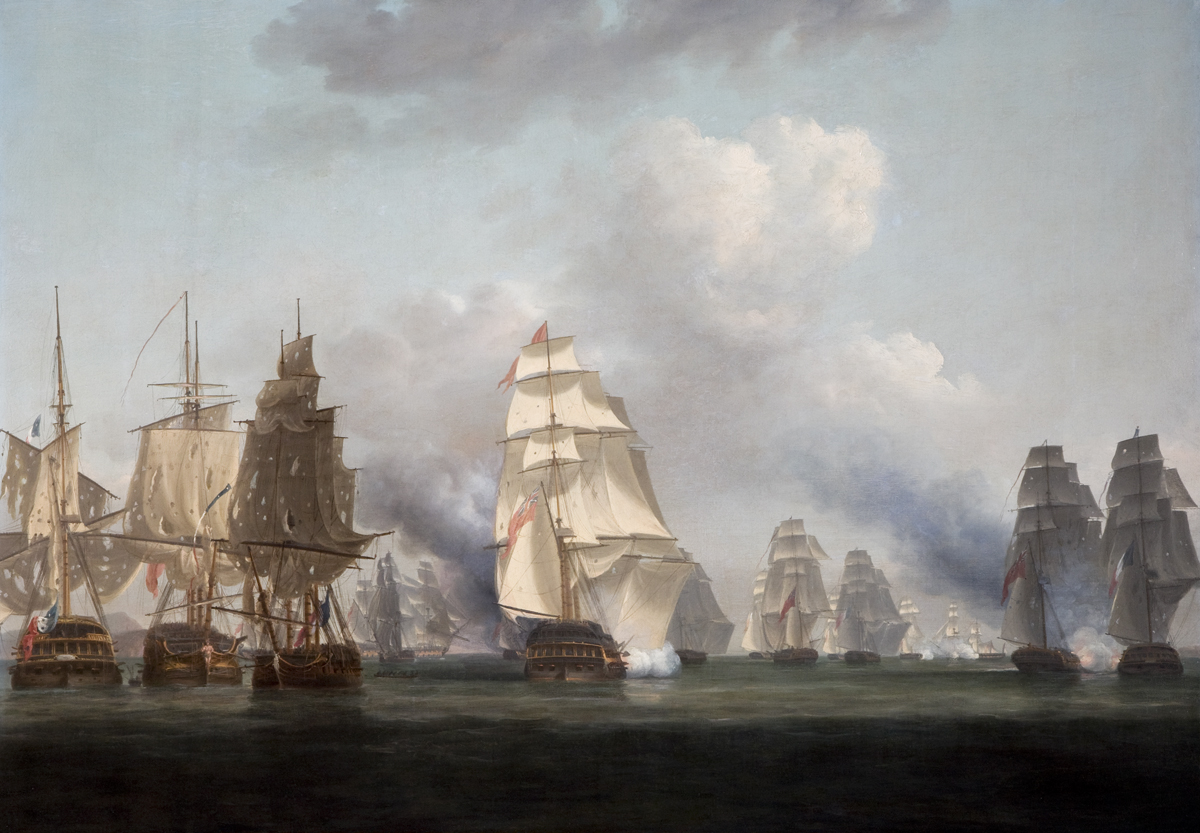 Nicholas Pocock (1740–1821)
Battle of Tory island
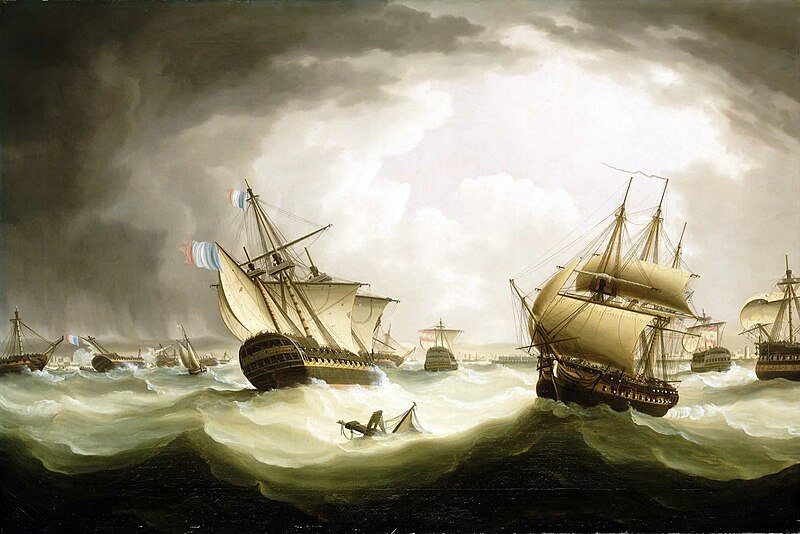 Thomas Buttersworth
Battle in Cádiz harbour
Oil on Canvas
 Nicholas Pocock (1740–1821)
Destruction of the French squadron of Admiral Leissègues at Santo-Domingo - 6 February, c. 1806
The large ship right of centre, with her mizzenmast falling, is the 120-gun L’Imperial, engaging Duckworth’s 74-gun Superb.
HMS Donegal was launched in 1794 as Barra, a Téméraire class 74-gun ship of the line of the French Navy. She was renamed Pégase in October 1795, and Hoche in December 1797. The British Royal Navy captured her on 12 October 1798 and recommissioned her as HMS Donegal.
William Joy (British, 1803-1867) and John Cantiloe Joy (British, 1806-1866), see above
HMS Donegal is on the left of the painting, engaging the Jupiter
Oil on canvas
National Maritime Museum
Admiral Sir John Duckworth was watering and refitting his squadron off the Caribbean island of St Kitt's when he learnt that a large French force was intending to attack the British colony of Jamaica. In a successful action on 6 February 1806, he managed to run two of the French ships ashore and capture the remaining three. Duckworth's action secured the way for the capture of Curacao, Martinique, Cayenne, and Guadeloupe. This painting was commissioned for Admiral Charles Middleton and records an event which took place during his time as First Lord of the Admiralty. More
Nicholas Pocock (2 March 1740 – 9 March 1821) was a British artist known for his many detailed paintings of naval battles during the age of sail. More
Hoche took part in the French attempt to land in County Donegal, in the west of Ulster, to support the Irish Rebellion of 1798. She formed the flagship of an expedition under Commodore Jean-Baptiste-François Bompart, consisting of Hoche and eight frigates. The ships were chased by a number of British frigates after they had left the port of Brest on 16 September. Despite throwing them off, they were then pursued by a fleet of larger ships under the command of Commodore Sir John Borlase Warren. Both sides were hampered by the heavy winds and gales they encountered off the west coast of Ireland, and Hoche lost all three of her topmasts and had her mizzensail shredded, causing her to fall behind. The French were finally brought to battle off Tory Island on 12 October 1798.
Battle of Tory island
Attack of the French Squadron under Monsr. Bompart Chef d'Escadre, upon the Coast of Ireland, by a Detachment of His Majesty's Ships under the Command of Sir J. B. Warren, Oct. 12th 1798
Nicholas Pocock (2 March 1740 – 9 March 1821) , see above
The battle started at 07:00 in the morning, with Warren giving the signal for HMS Robust to steer for the French line and attack Hoche directly. Hoche then came under fire from HMS Magnanime. The British ships raked the isolated Hoche as they passed before pressing on sail to pursue the French frigates, now sailing towards to the south-west. With Hoche heavily damaged, Bompart finally surrendered. The captured Hoche was taken into service and renamed HMS Donegal, after the action in which she had been captured. Donegal was initially deployed in the English Channel, but following the outbreak of hostilities with Spain, she was assigned to watch the French squadron at Cadiz.
Battle in Cádiz harbour
Oil on Canvas
The painting appears to be located off the harbour of Cadiz and shows a French ship in starboard-quarter view, with the top of her masts partly gone with a dismasted Spanish ship in stern view behind, both trying to make the harbour. A British ship is shown in the foreground on the right, in port-bow view with a dismasted Spanish ship in stern view in the distance. In the central foreground part of a sail and mast from a wrecked ship are just visible above the waves and on the left the ships in distress on the coast include a French one sinking. In the far distance ships are also shown safe within the harbour. Buttersworth produced a number of variants of similar subjects but this one may refer to the bold but fruitless post-Trafalgar sortie from Cadiz by a small squadron under Admiral Cosmao-Julien. More
Thomas Buttersworth (5 May 1768 – November 1842) was an English seaman of the Napoleonic wars period who became a marine painter. He produced works to commission, and was little exhibited during his lifetime. More
In 1805 Donegal accompanied Vice-admiral Nelson in his pursuit of the combined fleets across the Atlantic to the West Indies and back. She was able, on 23 October, to capture the partially dismasted Spanish first rate Rayo which had escaped Trafalgar.
Donegal was then part of a squadron off Cadiz under Vice-admiral John Duckworth. Duckworth took his squadron to Barbados and eventually sighting the French off San Domingo on 6 February. The Battle of San Domingo, in which the British won, broke out. After the battle, Donegal had lost her fore-yard and had 12 killed and 33 wounded.
Destruction of the French squadron of Admiral Leissègues at Santo-Domingo - 6 February, c. 1806
The large ship right of centre, with her mizzenmast falling, is the 120-gun L’Imperial, engaging Duckworth’s 74-gun Superb.
Nicholas Pocock (2 March 1740 – 9 March 1821) , see above
On 23 February 1809 Donegal was part of a squadron under Rear-admiral Stopford, when they chased three enemy frigates into the Sable d'Olonne, leading to the Battle of Les Sables-d'Olonne. By April 1809 Donegal was sailing with Admiral James Gambier's fleet in the Basque Roads. During the Battle of the Basque Roads, Donegal's first-lieutenant James Askey commanded the fire ship Hercule in the attack on the French fleet, with the assistance of midshipman Charles Falkiner, also of Donegal.
On 6 November 1810, Donegal captured the French privateer lugger Surcouf off Cape Barfleur.
On 13 November 1810, the frigates Diana and Niobe attacked two French frigates (Elisa and Amazone), which sought protection under the shore batteries near Saint-Vaast-la-Hougue. Revenge and Donegal arrived two days later and together the four ships fired upon the French for as long as the tide would allow. The operation cost Donegal three men wounded.
Donegal spent most of 1811 off Cherbourg, before being reduced to ordinary at Portsmouth later that year. She was later moved and spent 1814 in ordinary at Chatham. After the end of the Napoleonic era, she was refitted and brought back into service as a flagship, serving well into the 1830s; Donegal was eventually broken up in 1845. More

William Joy (British, 1803-1867) and John Cantiloe Joy (British, 1806-1866)
Vessels moored in a calm
signed and dated 'JOY, 1857' (lower right)
watercolour
30 x 45.5cm (11 13/16 x 17 15/16in).
William Joy (British, 1803-1867) and John Cantiloe Joy (British, 1806-1866) , see above

Samuel Owen (British, 1768-1857)
Shipping on the Thames
watercolour
20.5 x 15.3cm (8 1/16 x 6in).
Samuel Owen (1769 - 8 December 1857) was an English marine painter and illustrator. Nothing is recorded of him before 1791, when he exhibited "A Sea View" at the Royal Academy. This was followed in 1797, after the victory of Cape St. Vincent, by "A View of the British and Spanish Fleets", and, in 1799, by three drawings. These, with three other drawings exhibited in 1802 and 1807, complete the number of his exhibits at the Royal Academy.
In 1808 he joined the "Associated Artists in Water-Colours", and sent eleven drawings of shipping and marine subjects to the first exhibition of that short-lived body. He also exhibited twelve works in 1809, and six in 1810, but after that date resigned his membership. His works were carefully drawn and freshly coloured, with great attention to the details of shipping.
Owen died at Sunbury in Surrey, on the 8th December 1867, in his 89th year, but had long before ceased to practise his art. More

Samuel Owen (British, 1768-1857)
Moored ships in a calm
signed and dated 'S. OWEN 1820' (on spar, lower right)
watercolour
30 x 22.2cm (11 13/16 x 8 3/4in)

Unknown
Bombardment of Sidon, September 27th 1840

Unknown
The destruction of the Egyptian fleet at Navarino, October 1827

Montague Dawson
Searching the Seas - H.M.S. Victory
39.25 X 65.5 in (99.7 X 166.37 cm)
Oil on canvas
 Montague Dawson
Far Away - The Black Adder
24 X 36 in (60.96 X 91.44 cm)
Medium: oil on canvas
Samuel Owen (British, 1768-1857), see above
Unknown
Bombardment of Sidon, September 27th 1840
During the oriental crisis of 1840, as the result of the conflict in the eastern Mediterranean between Egypt and the Ottoman Empire, a mixed squadron of British, Turkish and Austrian ships under the command of the British Admiral Sir Charles John Napier (1786–1860), bombarded the city of Sidon on September 26th. The next day, allied Austrian and British troops landed and conquered Sidon. More
Unknown
The destruction of the Egyptian fleet at Navarino, October 1827
The Battle of Navarino was a naval battle fought on 20 October 1827, during the Greek War of Independence (1821–32), in Navarino Bay (modern-day Pylos), on the west coast of the Peloponnese peninsula, in the Ionian Sea.
An Ottoman armada, which, in addition to imperial warships, included squadrons from the eyalets (provinces) of Egypt, Tunis and Algiers, was destroyed by an Allied force of British, French and Russian vessels. It was the last major naval battle in history to be fought entirely with sailing ships, although most ships fought at anchor. The Allies' victory was achieved through superior firepower and gunnery. More
Montague Dawson
Searching the Seas - H.M.S. Victory
39.25 X 65.5 in (99.7 X 166.37 cm)
Oil on canvas
HMS Victory is a 104-gun first-rate ship of the line of the Royal Navy, ordered in 1758, laid down in 1759 and launched in 1765. She is best known as Lord Nelson's flagship at the Battle of Trafalgar in 1805.
She was also Keppel's flagship at Ushant, Howe's flagship at Cape Spartel and Jervis's flagship at Cape St Vincent. After 1824, she served as a harbour ship.
In 1922, she was moved to a dry dock at Portsmouth, England, and preserved as a museum ship. She has been the flagship of the First Sea Lord since October 2012 and is the world's oldest naval ship still in commission. More
Montague Dawson RMSA, FRSA (1890–1973) was a British painter who was renowned as a maritime artist. His most famous paintings depict sailing ships, usually clippers or warships of the 18th and 19th centuries. More
Far Away - The Black Adder
24 X 36 in (60.96 X 91.44 cm)
Medium: oil on canvas
Blackadder was a clipper ship built in 1870 by Maudslay, Sons & Field at Greenwich for John Willis.
Blackadder was dismasted on her maiden voyage due to failures in the mast fittings and rigging. She "was able to reach the Cape under jury rig 63 days out." John Willis took legal action against the builders which dragged on to such an extent that her sister ship, Hallowe'en, was not handed over to Willis until nearly 18 months after her launch. After John Willis died in 1900, Blackadder was bought by J. Aalborg of Kragerø in Norway. On 5 November 1905 she was wrecked whilst on passage from Barry to Bahia loaded with coal. More
Montague Dawson RMSA, FRSA (1890–1973), see above

Montague Dawson
The Sir Lancelot, c. 1965
24 X 36 in (60.96 X 91.44 cm)
Oil on canvas
Sir Lancelot was a clipper ship which sailed in the China trade and the India-Mauritius trade. Built in 1865 by Robert Steele & Co, Greenock, Sir Lancelot was "a beautiful tea clipper". Typical of all of Steele's ships, celebrated for their beauty of model, perfection of build, and superb finish. In the poem By the Old Pagoda Anchorage, she is referred to as "Sir Lancelot of a hundred famous fights with wind and wave.
In the Clipper Race of 1869, Robinson and Sir Lancelot established a new record between China and London. She arrived in Hong Kong on 10 January 1869 and undertook a number of "intermediate" passages to Bangkok, Saigon and Yokohama (probably carrying rice), arriving in Foochow on 20 June. This made her late loading tea. Sir Lancelot sailed at 7.00 am on 17 July and passed Anjer on 7 August. By 1 September, Cape Agulhas bore North East, 12 miles. St Helena was passed on 11 September and The Lizard 10 October. She was at Gravesend at 2.00 pm on 13 October and docked on 14 October. This was a total passage time of 89 days. Taking into account the season and the distance, the Sir Lancelot's 1869 passage was the fastest from China to England.
The opening of the Suez Canal in 1869, races between the clippers lost their real significance and ships concentrated on passages to New York.
The Sir Lancelot took sugar and rice from Mauritius to the Indian coast or the Gulfs and salt to Calcutta or Rangoon. It took six cargoes a year, when speed meant money, and when almost every passage saw the breaking of a record.
In 1886 Sir Lancelot was bought by the Parsee merchant Visram Ibrahim and C.W.Brebner took command. Captain Brebner survived four cyclones in Sir Lancelot before she was sold to Persian owners in 1895.
The Sir Lancelot was lost in the Bay of Bengal on 1 October 1895 during a cyclone near Sand Heads, Calcutta whilst on passage from the Red Sea with a cargo of salt bound for Calcutta. More
Montague Dawson RMSA, FRSA (1890–1973), see above
Searching the Seas - H.M.S. Victory
39.25 X 65.5 in (99.7 X 166.37 cm)
Oil on canvas
HMS Victory is a 104-gun first-rate ship of the line of the Royal Navy, ordered in 1758, laid down in 1759 and launched in 1765. She is best known as Lord Nelson's flagship at the Battle of Trafalgar in 1805.
She was also Keppel's flagship at Ushant, Howe's flagship at Cape Spartel and Jervis's flagship at Cape St Vincent. After 1824, she served as a harbour ship.
In 1922, she was moved to a dry dock at Portsmouth, England, and preserved as a museum ship. She has been the flagship of the First Sea Lord since October 2012 and is the world's oldest naval ship still in commission. More
Montague Dawson RMSA, FRSA (1890–1973), see above

Edward William Cooke
HMS 'Victory', Portsmouth Harbour
Oil on Canvas
244 mm x 291 mm
National Maritime Museum, Greenwich, London
Edward William Cooke, R.A., F.R.S., F.Z.S., F.S.A., F.G.S. (27 March 1811 – 4 January 1880) was an English landscape and marine painter, and gardener. Cooke was born in Pentonville, London, the son of well-known line engraver George Cooke; his uncle, William Bernard Cooke (1778–1855), was also a line engraver of note, and Edward was raised in the company of artists. He was a precocious draughtsman and a skilled engraver from an early age, displayed an equal preference for marine subjects and published his "Shipping and Craft" – a series of accomplished engravings – when he was 18. He benefited from the advice of many of his father’s associates, notably Clarkson Stanfield and David Roberts. Cooke began painting in oils in 1833, took formal lessons from James Stark in 1834 and first exhibited at the Royal Academy and British Institution in 1835, by which time his style was essentially formed.
He went on to travel and paint with great industry at home and abroad, indulging his love of the 17th-century Dutch marine artists with a visit to the Netherlands in 1837. He returned regularly over the next 23 years, studying the effects of the coastal landscape and light, as well as the works of the country's Old Masters, resulting in highly successful paintings.
Cooke was "particularly attracted by the Isle of Wight, and on his formative visit of 1835 he made a thorough study of its fishing boats and lobster pots; above all he delighted in the beaches strewn with rocks of various kinds, fishing tackle, breakwaters and small timber-propped jetties." More
Images are copyright of their respective owners, assignees or others


