Showing posts with label Pocock. Show all posts

25 Classic Works of Art, Marine and Seascape Paintings - with footnotes -10

William Lee Hankey
The Louvain Basin, Boulogne
20.25 X 24 in (51.44 X 60.96 cm)
Oil on canvas
Private collection

William Lee Hankey (1869–1952) RWS, RI, ROI, RE, NS was a British painter and book illustrator.[2] He specialised in landscapes, character studies and portraits of pastoral life, particularly in studies of mothers with young children such as "We’ve Been in the Meadows All Day".

He was born in Chester and worked as a designer after leaving school. He studied art in the evenings at the Chester School of Art, then at the Royal College of Art. Later in Paris he became influenced by the work of Jules Bastien-Lepage, who also favoured rustic scenes depicted in a realistic but sentimental style. He first exhibited at the Royal Academy in 1896 and was President of the London Sketch Club from 1902 to 1904. He stayed in France in the early 1900s, painting many of his works in Brittany and Normandy, where he depicted a peasant lifestyle which was already disappearing in England. From 1904 until well after World War I he maintained a studio at the Etaples art colony.

It was Hankey's black and white and coloured etchings of the people of Étaples, several developed from his paintings, which gained him a reputation as 'one of the most gifted of the figurative printmakers working in original drypoint during the first thirty years of the 20th century'. One that is particularly striking for its stylistic presentation was "The Refugees", his contribution to raising awareness of the consequences for ordinary people of the German invasion of France and Belgium in 1914. He went on to serve with the Artists' Rifles from 1915 to 1918.

In Britain he had been associated with the Newlyn School, a group of English artists based in the titular village in Cornwall who were themselves influenced by the romantic poets such as Wordsworth and Keats. More on William Lee Hankey

Konstantinos Volanakis, (1837–1907)
Sailing boats in the sunrise
16.14 X 12.99 in (41 X 33 cm)
Oil on panel
Private collection

Vasileios Chatzis, Patra 1870 - 1915
In calm waters
15.16 X 30.12 in (38.5 X 76.5 cm)
oil on canvas
Creation Date:  1997

Vasileios Chatzis, (Patra 1870 - 1915). After spending his childhood in Patra, he studied at Athens School of Fine Arts (1886-1893) under professors Nikiphoros Lytras and Konstantinos Volanakis. He began to exhibit in 1899 when he participated in the Exhibition of Athens and then presented  his works in group exhibitions in Athens and Alexandria.
During the Balkan Wars of 1912-1913, he embarked, by government order, on warships and captured scenes of the actions carried out by the Greek fleet. Known mainly as a painter of seascapes, he was also dealt with landscapes and the depiction of scenes from lives of farmers and fishermen, sometimes appearing to be an adherent of academicism or of open air approaches.More on Vasileios Chatzis

Konstantinos Volanakis (1837–1907)
Harbour scene
27.36 X 21.65 in (69.5 X 55 cm)
Oil on canvas
Private collection

Konstantinos Volanakis (1837, Heraklion - 29 June 1907, Piraeus) was a Greek painter who became known as the "father of Greek seascape painting". He completed his basic education on Syros in 1856. Afterward, urged on by his brothers, he went to Trieste and became an accountant for a family of Greek merchants who were related to his family by marriage. While there, he made sketches of ships and harbors in his account books. Rather than dismiss him, the family recognized his artistic talent, and made arrangements for him to study at the Academy of Fine Arts, Munich, under Karl von Piloty, joining a group of Greek students.  His instructors discouraged any sort of landscape painting, because it was "in decline", so he concentrated on portraits.

His break came in 1869, three years after the Battle of Lissa (see Blow), when Emperor Franz Joseph held a drawing competition to memorialize the event. Volanakis won the contest, receiving 1000 gold Florins and free travel cruises with the Austrian navy for three years. He took full advantage of this, producing numerous canvases and sketches. He married in 1874. Nine years later, despite warnings from Gyzis that it would ruin his career, he returned to Greece and settled in Piraeus, where his family had a pottery factory, citing pressure from his wife, whose health was suffering from the cold winters in Germany.

From then until 1903, he was a teacher at the Athens School of Fine Arts. He also operated his own private school. In 1889, he was awarded the Silver Cross of the Order of the Redeemer. He was, however, very poor in his later years, due to his very large family and declining interest in his art. In an effort to increase his income, he reversed the usual method of painting first, then framing, by working with a group of framers who would make luxurious carved frames first, then creating paintings to fit them. More on Konstantinos Volanakis

Konstantinos Volanakis (1837–1907)
Naval battle at Lissa, c. Date 1869
Oil on canvas
283 × 169 cm (111.4 × 66.5 in)
National Gallery - Alexandros Soutsos Museum

The Battle of Lissa took place on 20 July 1866 in the Adriatic Sea near the Dalmatian island of Lissa and was a decisive victory for an outnumbered Austrian Empire force over a numerically superior Italian force. It was the first major sea battle between ironclads and one of the last to involve deliberate ramming.

The Italian navy fired roughly 1450 shots during the engagement, but failed to do any serious damage to any Austrian ship while losing two battleships. One of the main reasons for this poor performance was internal rivalry between the Italian fleet commanders. The engagement was made up of several small battles: the main battle was between seven Austrian and four Italian ironclads and showed the ability of Austrian commander Tegetthoff to divide his more numerous opponents and then destroy the isolated ironclads. More on The Battle of Lissa

Spyros Vassiliou (1903-1985) 
The red boat, c. 1970
20.87 X 28.74 in (53 X 73 cm)
 Acrylic on canvas
Private collection

Spyros Vassiliou (1903-1985) was a Greek painter, printmaker, illustrator, and stage designer. He became widely recognized for his work starting in the 1930s, when he received the Benaki Prize from the Athens Academy. The recipient of a Guggenheim Prize for Greece (in 1960), Spyros Vassiliou's works have been exhibited in galleries throughout Europe, in the United States, and Canada. More on Spyros Vassiliou

Jan Abrahamsz. Beerstraaten (Amsterdam 1622-1666)
A Mediterranean ‘capriccio’ harbour with figures conversing on a quay
and a Dutch three-master mooring beyond, c. 1665
Oil on canvas
75.5 x 65.5 cm.
Private collection

Jan Abrahamsz Beerstraaten (1622 in Amsterdam – July 1666 in Amsterdam) was a Dutch painter of marine art and landscapes, particularly of events of the First Anglo-Dutch War and Dutch-Swedish War. 

There is some confusion about the identity of four landscape painters named Beerstraaten; Johannes, this Jan Abrahamsz, Abraham, and Anthonie. Jan Abrahamsz, painter, married in Amsterdam on 30 August 1642. From this marriage eleven children were born, and when he married a second time in 1665, a daughter was born. Currently, The RKD records Johannes as the same person, and Abraham Beerstraaten is considered to be his oldest son.

Anthonie Beerstraaten was related to this painter. The RKD has registered two paintings signed Anthonie van Beerstraten: one is a view of a southern seaport from 1664 (currently location Enkhuizen) and the other a view of a church in Aarlanderveen in the former city hall of Alphen aan den Rijn. Based on these two paintings C. Hofstede de Groot an early Dutch art historian, classified paintings signed A. Beerstraaten as by Anthonie if they were a poorer grade than ones already attributed to Abraham. More on Jan Abrahamsz Beerstraaten

Fausto Pratella, (Italian, Napels 1888-1946 Napels)
Fishermen in the bay of Naples
Oil painting on canvas
51.2 x 59.1 in. (130 x 150 cm.)
Private collection

Fausto Pratella was born in Naples on October 10, 1888. Son of Attilio Pratella.
After he took courses at the Academy in Naples, his father's teachings and advice were of great help to him.

The first painting he exhibited in official exhibitions was "Sunset," which was purchased by the Naples City Hall in 1909.

He then exhibited assiduously at regional and national Neapolitan exhibitions, sometimes at the Venetian Internationals, and at the First Quadrennial in Rome.

One of his "Landscapes" is in the "Paolo and Adele Giannoni" Gallery in Novara, and many others are placed in private collections.

His painting "Lungomare" is in the Ricci Oddi Gallery of Modern Art in Piacenza. More on Fausto Pratella

Henri Logelain, (Belgian, Ixelles 1889-1968 Ixelles)
Antwerp harbour
Oil painting on canvas
27.6 x 33.9 in. (70 x 86 cm.)
Private collection

Henri Logelain studied at the Academy of Fine Arts in Brussels and in Rome at the Academia Belgica . He exhibited his works from the year 1911. He taught at the Academy of Fine Arts in Louvain as well as at the School of Decorative Arts in Vilvoorde . Logelain was a member of the free workshop L'Effort where he met Auguste Oleffe , of the Royal Belgian Society of Watercolourists and of the Belgian Society of Painters of the Sea .

Originally a watercolourist , his favorite subjects are landscapes, still lifes, seascapes, urban views and portraits. A neo-impressionist painter , he experienced a Fauve period around 1910. He traveled to the Belgian Congo in 1938 and made many portraits of Congolese there. More on Henri Logelain

Maurice Blieck, (Belgian, Laken 1876-1922 Brussels)
Bridge at the river with steamer
Oil painting on canvas
15.4 x 20.9 in. (39 x 53 cm.)
Private collection

Maurice Emile Blieck 'Maurice Blieck': A Belgian painter and etcher of landscapes, marine views and portraits, Maurice Emile Blieck first studied art at the Academy of Brussels. In 1896 he completed his education in both Paris and London and began formally exhibiting his art in these cities at this time. Establishing his reputation first as a painter, Maurice Blieck began etching around 1905.

 During the early twentieth century Maurice Blieck lived and worked in both Belgium and France. Around 1912 he worked upon a series of etchings detailing the Flemish town of Ypres. Ypres, Rue de Nazareth hails from this set. Several years later this town became a center for some of the heaviest fighting and destruction of the First World War. As most of the city was destroyed by four years of artillery fire this fine etching thus represents both a valuable historical and artistic record. More on Maurice Blieck

File:Battle of Scheveningen (Slag bij Ter Heijde)(Jan Abrahamsz. Beerstraten).jpg
Jan Abrahamsz, Beerstraaten (1622–1666) 
The battle of Terheide, 10 august 1653, c. between 1653 and 1666
Oil on canvas
Height: 176 cm (69.3 in). Width: 281.5 cm (110.8 in).
Rijksmuseum Amsterdam


The Battle of Scheveningen was the final naval battle of the First Anglo-Dutch War. It took place on 31 July 1653 between the fleets of the Commonwealth of England and the United Provinces, and had no clear victory. More

Nicholas Pocock BRISTOL 1740 - 1821 MAIDENHEAD THE BRITISH FLEET AT SEA - THE NEARER SHIP FLYING THE ROYAL STANDARD Watercolour over pencil 110 by 163 mm:
Nicholas Pocock
BRISTOL 1740 - 1821 MAIDENHEAD
THE BRITISH FLEET AT SEA - THE NEARER SHIP FLYING THE ROYAL STANDARD
Watercolour over pencil
110 by 163 mm

Pocock was born in Bristol and spent his early life at sea. In circa 1778 he settled in London and devoted himself to painting. He was successful and was patronised by the Navy Board, Admiral Lord Hood, Lord Bridport, Lord Gambier, Lord Barham and many other great navel men. 

Circle of Abraham Storck (Amsterdam 1644-1708)
A parade of Dutch ships in choppy waters
oil on canvas
48.4 x 63.9 cm


File:Storck, Four Days Battle.jpg
Abraham Storck (1644–1708)
The 'Royal Prince' and other Vessels at the Four Days Battle,  in the Second Anglo-Dutch war, 1–4 June 1666, circa 1670
Oil on canvas
78.5 × 110.5 cm (30.9 × 43.5 in)
National Maritime Museum

The Second Anglo-Dutch War (4 March 1665 – 31 July 1667), fought between England and the United Provinces, was part of a series of four Anglo-Dutch Wars fought between the English (later British) and the Dutch in the 17th and 18th centuries for control over the seas and trade routes, where England tried to end the Dutch domination of world trade. After initial English successes, the war ended in a decisive Dutch victory. English and French resentment would soon lead to renewed warfare. More on The Second Anglo-Dutch War

Abraham Storck (or Sturckenburch) (bapt. 17 April 1644 in Amsterdam – buried 8 April 1708), was a Dutch painter, who enjoyed a reputation for his marine paintings, topographical views and Italianate harbour scenes. Storck was also an outstanding draughtsman

Circa 1666 Storck established his workshop producing naval, harbor scenes as well as landscape paintings and city scapes. In 1670 he traveled with his brother Jacob and worked in Germany. In 1694, at age 49, he married the widow Neeltje Pieters van Meyservelt. At the end of his life he lived on Kattenburg near the harbour.

Storck produced fantastical views of Mediterranean ports, which place merchant shipping amidst architectural ruins, depicted in the crystal-clear colours of Italian art of the period. This type of scene anticipated the popular 18th-century Italian capriccio. He depicted ships' rigging and technical details with considerable accuracy, which likely shows the influence of the van de Veldes. His Dutch harbour and river views often include recreational and ceremonial aspects of shipping. He paid particular attention to the display of pleasure yachts, ceremonial gatherings of ships, the passengers and bystanders.

Storck painted some winter scenes, which are inspired by the example of Jan Abrahamsz Beerstraaten and his son Anthonie Beerstraaten, a selfportrait, and some allegories. More on Abraham Storck

Abraham Storck (1644–1708)
The frigate Pieter and Paul on the IJ., c. 1698-1700
Oil on canvas
53 × 63 cm (20.9 × 24.8 in)
Amsterdam Museum

In 1703 Russia’s military success against Turkey allowed Peter I to claim a lucrative trade route to Europe – via the Baltic Sea. But to protect the Baltic land he needed a strong Navy. During his Grand Embassy Peter studied the art of shipbuilding. In Amsterdam “Peter and Paul” frigate was built and launched specially for Peter so he could watch the full building cycle. Peter received a certificate that stated that Peter Mikhailov “studied the art of shipbuilding to the extent that we are knowledgeable in it”. More on The frigate Pieter and Paul

James Hamilton MacKenzie ARSA RSW ARE (British, 1875-1926) Harbour Scene, Possibly Nantes 45 x 60 cm. (17 11/16 x 23 5/8 in.)
James Hamilton MacKenzie ARSA RSW ARE (British, 1875-1926)
Harbour Scene, Possibly Nantes 
Oil on canvas
45 x 60 cm. (17 11/16 x 23 5/8 in.)
Private collection

James Hamilton Mackenzie (1875 - 1926) was born in Glasgow and studied at the Glasgow School of Art where he won a scholarship that took him to Florence and Tuscany. He was a long time member of Glasgow Art Club. During the First World War he served in East Africa. His drawings and paintings are featured in The Studio's special war edition of 1918.

He worked abroad during his career notably in Belgium as well as Italy. He was fluent in oil, watercolours, pastels and as an etcher. His Scottish paintings are mostly of landscapes but also include fishing villages.

His career was ended tragically in a fatal accident on a train near Bathgate when he was only 51. He was elected to the Royal Scottish Society of Painters in Watercolour, RSW, in 1910, and an Associate of the RSA in 1923. More on James Hamilton MacKenzie

Montague Dawson, USS Constellation
USS CONSTELLATION
Montague Dawson RMSA, FRSA (1890–1973)
22 X 31 in (55.88 X 78.74 cm)
Color Lithograph
Private collection

USS Constellation, constructed in 1854, is a sloop-of-war/corvette and the second United States Navy ship to carry the name. According to the U.S. Naval Registry the original frigate was disassembled on 25 June 1853 in Gosport Navy Yard in Norfolk, Virginia, and the sloop-of-war/corvette was constructed in the same yard using material salvaged from the earlier ship. Constellation is the last sail-only warship designed and built by the Navy. Despite being a single-gundeck "sloop," she is actually larger than her frigate namesake, and more powerfully armed with fewer but much more potent shell-firing guns.

The sloop was launched on 26 August 1854 and commissioned on 28 July 1855 with Captain Charles H. Bell in command. More

Montague Dawson RMSA, FRSA (1890–1973) was a British painter who was renowned as a maritime artist. His most famous paintings depict sailing ships, usually clippers or warships of the 18th and 19th centuries. Montague was the son of a keen yachtsman and the grandson of the marine painter Henry Dawson (1811–1878), born in Chiswick, London. Much of his childhood was spent on Southampton Water where he was able to indulge his interest in the study of ships. For a brief period around 1910 Dawson worked for a commercial art studio in Bedford Row, London, but with the outbreak of the First World War he joined the Royal Navy. Whilst serving with the Navy in Falmouth he met Charles Napier Hemy (1841–1917), who considerably influenced his work. In 1924 Dawson was the official artist for an Expedition to the South Seas by the steam yacht St.George. During the expedition he provided illustrated reports to the Graphic magazine.

After the War, Dawson established himself as a professional marine artist, concentrating on historical subjects and portraits of deep-water sailing ships. During the Second World War, he was employed as a war artist. Dawson exhibited regularly at the Royal Society of Marine Artists, of which he became a member, from 1946 to 1964, and occasionally at the Royal Academy between 1917 and 1936. By the 1930s he was considered one of the greatest living marine artists, whose patrons included two American Presidents, Dwight D Eisenhower and Lyndon B Johnson, as well as the British Royal Family. Also in the 1930s, he moved to Milford-Upon-Sea in Hampshire, living there for many years. Dawson is noted for the strict accuracy in the nautical detail of his paintings which often sell for six figures.

The work of Montague Dawson is represented in the National Maritime Museum, Greenwich and the Royal Naval Museum, Portsmouth. More on Montague Dawson

Montague Dawson, THE SOUTHERN CROSS
THE SOUTHERN CROSS
Montague Dawson RMSA, FRSA (1890–1973)
23.88 X 36 in (60.64 X 91.44 cm)
Oil on canvas
Private collection

SS Southern Cross (1886) was a steam-powered sealing vessel that operated primarily in Norway and Newfoundland and Labrador.

She was lost at sea returning from the seal hunt on March 31, 1914, killing all 174 men aboard in the same storm that killed 78 crewmen from the SS Newfoundland, a collective tragedy that became known as the "1914 Newfoundland Sealing Disaster". More on SS Southern Cross

Montague Dawson, The Glorious American - The 'Constitution'
THE GLORIOUS AMERICAN - THE 'CONSTITUTION'
By Montague Dawson RMSA, FRSA (1890–1973)
40 X 49.75 in (101.6 X 126.36 cm)
Oil on canvas
Private collection

USS Constitution is a wooden-hulled, three-masted heavy frigate of the United States Navy, named by President George Washington after the Constitution of the United States of America. Launched in 1797, Constitution was one of six original frigates built in the North End of Boston, Massachusetts, at Edmund Hartt's shipyard. Her first duties with the newly formed U.S. Navy were to provide protection for American merchant shipping during the Quasi-War with France and to defeat the Barbary pirates in the First Barbary War.

Constitution is most famous for her actions during the War of 1812 against the United Kingdom, when she captured numerous merchant ships and defeated five British warships: HMS Guerriere, Java, Pictou, Cyane, and Levant. The battle with Guerriere earned her the nickname of "Old Ironsides" and public adoration that has repeatedly saved her from scrapping. She continued to serve as flagship in the Mediterranean and African squadrons, and circled the world in the 1840s. During the American Civil War, she served as a training ship for the United States Naval Academy. She carried US artwork and industrial displays to the Paris Exposition of 1878. More on USS Constitution

Montague Dawson, The 'Cutty Sark'
THE 'CUTTY SARK'
Montague Dawson RMSA, FRSA (1890–1973)
20 X 30 in (50.8 X 76.2 cm)
Oil on canvas
Private collection

Cutty Sark is a British clipper ship. Built on the Clyde in 1869 for the Jock Willis Shipping Line, she was one of the last tea clippers to be built and one of the fastest, coming at the end of a long period of design development which halted as sailing ships gave way to steam propulsion.

The opening of the Suez Canal (also in 1869) meant that steam ships now enjoyed a much shorter route to China, so Cutty Sark spent only a few years on the tea trade before turning to the trade in wool from Australia, where she held the record time to Britain for ten years. Improvements in steam technology meant that gradually steamships also came to dominate the longer sailing route to Australia and the ship was sold to the Portuguese company Ferreira and Co. in 1895, and renamed Ferreira. She continued as a cargo ship until purchased by retired sea captain Wilfred Dowman in 1922, who used her as a training ship operating from Falmouth, Cornwall. After his death, Cutty Sark was transferred to the Thames Nautical Training College, Greenhithe in 1938 where she became an auxiliary cadet training ship alongside HMS Worcester. By 1954 she had ceased to be useful as a cadet ship and was transferred to permanent dry dock at Greenwich, London on public display.

Cutty Sark is listed by National Historic Ships as part of the National Historic Fleet (the nautical equivalent of a Grade 1 Listed Building). She is one of only three remaining original composite construction (wooden hull on an iron frame) clipper ships from the nineteenth century in part or whole, the others being the City of Adelaide, which arrived in Port Adelaide, South Australia on 3 February 2014 for preservation, and the beached skeleton of Ambassador of 1869 near Punta Arenas, Chile. More on the Cutty Sark

James Kay RSA RSW (British, 1858-1942) Launch on the Clyde 30 x 45 cm. (11 13/16 x 17 11/16 in.)
James Kay RSA RSW (British, 1858-1942)
Launch on the Clyde 
Oil on canvas
30 x 45 cm. (11 13/16 x 17 11/16 in.
Private collection

SS River Clyde was a 3,913 GRT British collier built by Russell & Co of Port Glasgow on the Firth of Clyde and completed in March 1905. In the First World War the Admiralty requisitioned her for the Royal Navy and in 1915 she took part in the Gallipoli landings. After the war she was repaired and sold to Spanish owners, with whom she spent a long civilian career trading in the Mediterranean before being scrapped in 1966. More on SS River Clyde

James Kay (22 October 1858 - 26 September 1942) was a Scottish artist notable for his paintings of the landscapes and shipping around the River Clyde. Born on the Isle of Arran, Kay spent much of his working life with a studio in Glasgow and living at Portincaple on Loch Long in Argyll and Bute. He was elected to the Royal Scottish Society of Painters in Watercolour (RSW) in 1906 and to the Royal Scottish Academy in 1938. He had one daughter, artist Violet McNeish Kay. More on James Kay

ANGELO BROMBO (1893-1962, Venice) 
Venice Canal
Oil on canvas 
15-1/2 in. x 11-1/2 in. (40x30cm)
Private collection

Angelo Brombo (Italian 1893-1962)
Venice
Oil on canvas
11 7/8 x 15 3/4 inches / 30.16 x 40.005 cm; 
Private collection

Artist Angelo Brombo (Chioggia 1893 - Venice 1962) born into his profession as a decorator inherited from his family by his father Eugenio, who kept the shop under the arcades in Vena fondamenta in the district of Santa Maria where he worked until 1940. From 1925 to 1929 he taught design at the School of Applied Art in Chioggia. His debut was at an exhibition in 1922 where he participated in Chioggia. From 1927 onward he took part in numerous solo and group exhibitions in Italy and abroad. Among these at the Opera Bevilacqua La Masa, 1930, 31, 32 and an exhibition at the Napoleon hall of the Palazzo Reale in Venice with over fifty works in 1945. In 1944 he moved with his family to Venice where he continued to paint until his death in 1962. More on Angelo Brombo

EDGAR FORKNER (American 1867-1945)
Ships in Marina
Oil on canvas
22 1/4 x 28 1/8 inches / 61.59 x 71.43 cm
Private collection

EDGAR FORKNER (American 1867-1945). Nationally known water-colorist, Edgar Forkner was born in 1867 in Richmond, Indiana. Equally adept at painting floral still-lives and harbor scenes, Forkner exhibited over twenty years in the Hoosier Salon Exhibition wining numerous awards for best watercolor. He received his training at the Art Student League in New York studying with J. Carroll Beckwith, Irving Wiles, William Merritt Chase and Frank Vincent Dumond.

An early member of the “Richmond Group”, Forkner worked with John Bundy and others to help establish the Art Association of Richmond. After a few years in Richmond, he traveled to Chicago where he taught watercolor in Auditorium Tower studios. Later he lived in Seattle, Washington becoming active in the Seattle art colony painting harbor scenes along the Pacific coast.

His works are in the permanent collection of the Richmond Art Museum, Richmond, Indiana; Seattle Art Museum and the Chicago Art Institute. His Hoosier Salon award winner, Old Vase of Flowers, was exhibited in the 1933 Chicago World’s Fair. In appreciate of his artistic contributions, The Seattle Art Museum, held a tribute in memory of Edgar Forkner on July 14, 1945 over the radio. Considered a pioneer painter in two art colonies, Mr. Forkner contributed greatly to the artistic legacy and heritage of American regional art. More on EDGAR FORKNER

GEORGE KENNEDY BRANDRIFF (American 1890-1936)
French Tuna Boats II, c. 1929
Oil on board 
5 3/8 x 6 3/8 inches / 13.65 x 16.19 cm
Private collection

George Kennedy Brandriff (American 1890-1936) 
French Tuna Boats, c. 1929
Oil on board 
5 3/8 x 6 3/8 inches / 13.65 x 16.19 cm
Private collection
 
George Kennedy Brandriff was born on Feb. 13, 1890 in Millville, NJ. After moving to Orange, CA in 1913, Brandriff worked as a piano salesman. Shortly after his arrival he enrolled at the USC College of Dentistry and in 1918 opened a dental office in Hemet, CA. Without the benefit of formal training, he had been painting all his life. He later had a few art lessons from Anna Hills, Carl Oscar Borg, Jack Wilkinson Smith, and in 1928 abandoned dentistry to devote full-time to art. After building a studio-home in Laguna Beach, Brandriff taught painting (Orrin White was one of his pupils) and served as president of the local art association. His subject matter included beach scenes, marines, mountain landscapes, still lifes, and figures. More on George Kennedy Brandriff


Please visit my other blogs: Art CollectorMythologyMarine ArtPortrait of a Lady, The OrientalistArt of the Nude and The Canals of VeniceMiddle East Artists365 Saints and 365 Days, also visit my Boards on Pinterest

Images are copyright of their respective owners, assignees or others. Some Images may be subject to copyright

I don't own any of these images - credit is always given when due unless it is unknown to me. if I post your images without your permission, please tell me.

I do not sell art, art prints, framed posters or reproductions. Ads are shown only to compensate the hosting expenses.

If you enjoyed this post, please share with friends and family.

Thank you for visiting my blog and also for liking its posts and pages.

Please note that the content of this post primarily consists of articles available from Wikipedia or other free sources online.


Acknowledgement:   Michaan Acknowledgement: 19th Century European PaintingsMichaanOld Master & British Paintings

22 Artists Embedded With Napoleon's French Campaign In Egypt And Syria - Part I

Rumors became rife as 40,000 soldiers and 10,000 sailors were gathered in French Mediterranean ports. A large fleet was assembled at Toulon: 13 ships of the line, 14 frigates, and 400 transports. To avoid interception by the British fleet under Nelson, the expedition's target was kept secret. It was known only to Bonaparte himself, his generals.


Pierre Martinet (1781-?)
Boarding of the French army in Toulon to Egypt
Left: Bonaparte and his generals. 1798.

MARTINET, Pierre (born 1781). French Painter. Military subjects, scenes with figures. A student of Jacques Swebach, he submitted works to the Paris Salon from 1808 to 1812. He painted battle scenes and popular or fashionable subjects, treated in a lively way but also sometimes with a degree of confusion. More on MARTINET, Pierre

On 19 May. Bonaparte's fleet embarked, from Toulon headed for Malta.  When the fleet arrived off Malta, Napoleon demanded that the Knights of Malta allow his fleet to enter the port and take on water and supplies. The island of Malta was an important strategic stronghold in the Mediterraenean Sea and Napoleon Bonaparte knew that controlling it would boost France's naval capacity in the region, particularly with the British Mediterranean Fleet under Admiral Horatio Nelson anchored in nearby Sicily.

The invading French fleet at Malta, 1798
I have no further description, at this time

Grand Master von Hompesch replied that only two foreign ships would be allowed to enter the port at a time. Under that restriction, revictualling the French fleet would take weeks, and it would be vulnerable to the British fleet of Admiral Nelson. Napoleon therefore ordered the invasion of Malta.

The French Revolution had significantly reduced the Knights of Malta's income and their ability to put up serious resistance. Half of the Knights were French, and most of these knights refused to fight.

Charles Etienne Pierre Motte (1785 - 1836)
Debarquement a l'Ile de Malte (Bonaparte landing on Malta)
Hand-coloured.; Medium includes gum arabic.
Lithograph, coloured
399 mm x 517 mm
National Maritime Museum, Greenwich, London

Charles Motte obtained his patent allowing him to exercise the profession of lithographer printer on October 31, 1817 1 . He is also one of the first printers to have obtained it, this measure having been implemented that same year.

In 1827, he persuaded the young Eugène Delacroix to illustrate the first French edition of Johann Wolfgang von Goethe 's Faust , himself taking on the task of lithographing the plates and coloring them in watercolour .

He lithographed drawings by Jean-Baptiste Mauzaisse (1784-1844) (portraits of Jean-Jacques Rousseau , Napoleon, etc.), Victor-Jean Adam ( Advent of the Empire ), Ludwig Rullmann (portraits of Maurice de Nassau and Maurice of Saxony ), Hippolyte Bellangé ("  Entry of the French into Milan  "), Achille Devéria (1800-1857), Edmond Savouré ("  View of Saumur in 1836  "), Henry Monnier , by Louis Stanislas Marin-Lavigne , etc.

The lithographic workshop of Motte collaborated in the printing of the Egyptian Grammar of Champollion . He died in Paris onDecember 5, 1836, shortly after the printing of the first part.

Céleste Devéria took over from her father and was certified as a lithographer printer on December 14, 1837. More on Charles Motte

French troops disembarked in Malta at seven points on the morning of 11 June. Gen. Louis Baraguey d'Hilliers landed soldiers and cannon in the western part of the main island of Malta, under artillery fire from Maltese fortifications. The French troops met some initial resistance but pressed forward. The Knights' ill-prepared force in that region, numbering only about 2,000, regrouped. The French pressed on with their attack. After a fierce gun battle lasting twenty-four hours, most of the Knights' force in the west surrendered.

Sir William Quiller Orchardson 1832–1910
Napoleon on Board the Bellerophon 1880
Oil paint on canvas
1651 x 2489 mm
Tate

Edinburgh-born William Quiller Orchardson entered the Trustees’ Academy in 1845, aged thirteen. He was immediately noted for his talent and his independence, as he allegedly refused to adhere to the custom of drawing classical statues and instead preferred to work from real-life models. He stayed on as a mature student until 1855 – the year the painter of this sketch-like portrait, his friend John Pettie, joined the Academy. In 1862, Orchardson, Pettie and Tom Graham moved to London, where they shared a home. Soon, Orchardson became a regular exhibitor at the Royal Academy and his reputation was quickly established. A kind and sociable man, he became famous for his cleverly observed genre scenes of high society, often characterised by their subtle storytelling and psychological realism. More on William Quiller Orchardson

Napoleon then opened negotiations. Faced with vastly superior French forces and the loss of western Malta, von Hompesch surrendered the main fortress of Valletta.

Capture of Malta by General Bonaparte, commanding the French fleet, June 12, 1798.

Thirteen days after leaving Malta and continuing to successfully elude detection by the Royal Navy for the time being, the fleet was in sight of Alexandria, where it landed on 1 July, though his plan had been to land elsewhere. 

Guillaume-François Colson (1785–1850)
Feeder Napoleon In Alexandria On 3 July 1798 His grace towards an Arab family, c. 1812
Oil on canvas
365 × 500 cm (143.7 × 196.9 in)
National Museum of Versailles

Guillaume François Colson, a French historical painter, and pupil of David, was born in Paris in 1785, and died there in 1860.

Among other works, he painted the 'Entry of General Bonaparte into Alexandria,' which is at Versailles.

He also painted various family portraits and scenes of the upper classes in his idle moments, which could be seen as forerunners to artists such as Boudin and the Impressionists who were working decades later. More on Guillaume François Colson

Bonaparte left Alexandria on 6 July. General Dugua marched on Rosetta, with orders to seize and hold the entrance to the port housing the French fleet, which had to follow the route to Cairo down the river's left bank and rejoin the army at Rahmanié. On 8 July, Bonaparte arrived at Demenhour, where he found the forces had met up, and awaited the fleet with their provisions. The fleet arrived on 12 July and the army began to march again at night, followed by the fleet.

Sudden heavy winds forced the fleet to the army's left and straight into the enemy fleet, which was supported by musket fire from 4,000 Mamluks, reinforced by peasants and Arabs. The French fleet had numerical superiority but still lost its gunboats to the enemy. Attracted by the sound of gunfire, Bonaparte ordered his land force to the charge and attacked the village of Chebreiss, which was captured after two hours of fierce fighting. The enemy fled in disorder towards Cairo, leaving 600 dead on the battlefield.

Louis-François Baron Lejeune 001.jpg
Louis-François, Baron Lejeune (1775–1848)
The Battle of the Pyramids, 1808
Oil on canvas
National Museum of Versailles

Louis-François, Baron Lejeune, (born February 3, 1775, probably at Strasbourg, France—died February 29, 1848, Toulouse), military general, painter, and lithographer who was chiefly responsible for introducing lithography to France as an artistic medium.

Lejeune took part in many of the Napoleonic campaigns, and his vigorous battle pictures, executed mainly from sketches and studies made in the field, enjoyed a great vogue. The campaign of 1806 took him to Munich, where he visited the workshop of Alois Senefelder, inventor of lithography. Fascinated, Lejeune drew on the stone his famous Cosaque and immediately pulled 100 proofs of it, one of which he later submitted to Napoleon.

Lejeune also painted many landscapes and portraits. In 1837 he became director of the École des Beaux-Arts and curator of the museum at Toulouse. More on Louis-François, Baron Lejeune

After a day's rest at Chebreiss, the French land force continued the pursuit. On 20 July, it arrived half a mile from the village of Embabé. There Bonaparte drew up his 25,000 troops for battle approximately nine miles (15 km) from the Pyramids of Giza. 

Wojciech Kossak (1857–1942)
Battle of the Pyramids
Date 1896
Oil on canvas
70 × 105 cm (27.6 × 41.3 in)
Current location
National Museum in Warsaw

Wojciech Horacy Kossak (31 December 1856 – 29 July 1942) was a noted Polish painter and member of the celebrated Kossak family of artists and writers. He was the son of painter Juliusz Kossak, and twin brother of freedom fighter Tadeusz Kossak, and the father of two highly talented literary daughters, Maria Pawlikowska-Jasnorzewska and Magdalena Samozwaniec and of a painter son, Jerzy Kossak.

Wojciech Horacy Kossak was born in Paris on New Year's Eve of 1856 just before midnight, while his twin brother, Tadeusz Kossak, just after, on 1 January 1857. The family eventually left France. His middle name was in honour of his godfather, French painter Horace Vernet. Kossak began his education upon his family's return to Poland. He attended the Three Crosses Square Gymnasium in Warsaw and later the Gimnazjum św. Anny in Kraków. He simultaneously studied painting with his father Juliusz.

Between 1871–1873, Wojciech studied at the Kraków School of Drawing and Painting (later School of Fine Arts) - under Władysław Łuszczkiewicz, followed by a stint until 1875 at the Munich Academy of Fine Arts, with professors Alexander Strähuber and Alexander Wagner. More on Wojciech Horacy Kossak

This was the start of the so-called Battle of the Pyramids, also known as the Battle of Embabeh, a French victory over an enemy force of about 21,000 Mamluks. The French defeated the Mamluk cavalry with a giant infantry square, with cannons and supplies safely on the inside. In all 300 French and approximately 6,000 Egyptians were killed. The battle gave rise to dozens of stories and drawings.

Francois-Louis-Joseph Watteau (1758–1823)
The Battle of the Pyramids
c. 1798-1799
Oil on canvas
94 × 120.4 cm (37 × 47.4 in)
Museum of Fine Arts, Valenciennes

François Louis Joseph Watteau (18 August 1758, Lille – 1 December 1823, Lille), known like his father as the Watteau of Lille, was a French painter, active in his birthplace. From 1808 to his death he was deputy curator of the Palais des Beaux-Arts de Lille, which his father had helped to found. More on François Louis Joseph Watteau

Antoine-Jean Gros (1771–1835)
Battle of the Pyramids, July 21, 1798, c. 1810
Oil on canvas
389 x 311 cm
National Museum of Versailles

Antoine-Jean Gros (16 March 1771 – 25 June 1835) was a French painter of historical subjects. He was given title of Baron Gros in 1824.

Gros studied under Jacques-Louis David in Paris and began an independent artistic career during the French Revolution. Forced to leave France, Gros moved to Genoa. His portrait of the French commander Napoleon Bonaparte at the Battle of Arcole (1796) brought Gros to public attention and gained the patronage of Napoleon.

After traveling with Napoleon's army for several years, he returned to Paris in 1799. In addition to producing several large paintings of battles and other events in Napoleon's life, Gros was a successful portraitist. More on Antoine-Jean Gros

Jean-Léon Gérôme (1824–1904)
Before the Sphinx  1867-1868
Oil on canvas
Hearst Castle

Jean-Léon Gérôme (11 May 1824 – 10 January 1904) was a French painter and sculptor in the style now known as academicism. His paintings were so widely reproduced that he was "arguably the world's most famous living artist by 1880." The range of his oeuvre included historical painting, Greek mythology, Orientalism, portraits, and other subjects, bringing the academic painting tradition to an artistic climax. He is considered one of the most important painters from this academic period. He was also a teacher with a long list of students. More on Jean-Léon Gérôme

On 22 July, the notables of Cairo came to Giza to meet Bonaparte and offered to hand over the city to him. Three days later, he moved his main headquarters there. 

Léon Cogniet (1794–1880)
The 1798 Egyptian Expedition Under the Command of Bonaparte, Date 1835
Oil on canvas
Ceiling at the Musée du Louvre

Léon Cogniet (29 August 1794, Paris – 20 November 1880, Paris) was a French history and portrait painter. He is probably best remembered as a teacher, with over one hundred well-known students. 

He was born in Paris. His father was a painter and wallpaper designer. In 1812, he enrolled at the École des Beaux-arts, where he studied with Pierre-Narcisse Guérin. He also worked in the studios of Jean-Victor Bertin. After failing an attempt to win the Prix de Rome in 1816, he won the following year with his depiction of Helen Rescued by Castor and Pollux and received a stipend to study at the French Academy in Rome until 1822. Before leaving, he had his first exhibition at the Salon.

In 1827, he created a series of murals on the life of Saint Stephen for the church of Saint-Nicholas-des-Champs. From 1833 to 1835, he painted a scene from Napoleon's expedition to Egypt on one of the ceilings at the Louvre. Between 1840 and 1860, he operated a popular painting workshop for women, directed by his sister Marie Amélie and one of his students, Catherine Caroline Thévenin (1813–1892), who later became his wife. After 1843, he concentrated almost entirely on teaching, with an occasional portrait. After 1855, he essentially gave up painting.

After 1831, he taught design at the Lycée Louis-le-Grand. He also taught at the École polytechnique from 1847 to 1861. In 1851, he was appointed a Professor at the École des Beaux-arts, a position he held until 1863, when he retired, slowly giving up his private students and becoming more reclusive.

He died forgotten in the 10th arrondissement of Paris in 1880 and is interred at Père-Lachaise. More on Léon Cogniet

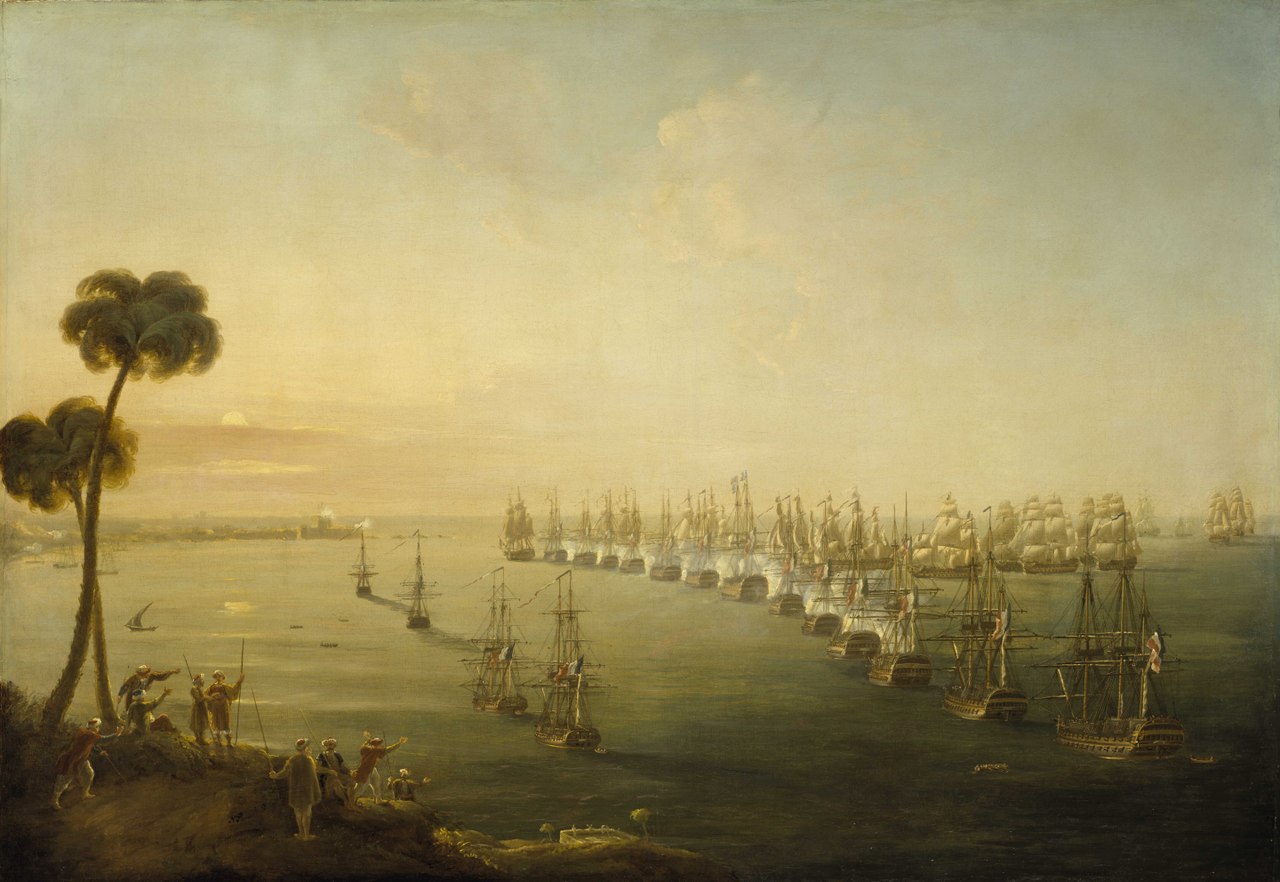
On 1 August Nelson discovered the French warships anchored in a strong defensive position in the Bay of Abukir. The French believed that they were open to attack only on one side, the other side being protected by the shore. 

File:Whitcombe - Battle of the Nile- start of the battle.jpg
Thomas Whitcombe (1763–1824)
The opening stages of the Battle of the Nile, 1798, c. 1816
Color aquatint
21.5 × 30 cm (8.5 × 11.8 in)
National Maritime Museum

Thomas Whitcombe (possibly 19 May 1763 – c. 1824) was a prominent British maritime painter of the Napoleonic Wars. Among his work are over 150 actions of the Royal Navy, and he exhibited at the Royal Academy, the British Institution and the Royal Society of British Artists. His pictures are highly sought after today.

Thomas Whitcombe was born in London between 1752 and 19 May 1763, with the latter date frequently cited. Little is known of his background or training, although speculation based on the locations depicted in his paintings may provide some clues.

It is known that he was in Bristol in 1787 and later travelled to the South Coast; there are few ports or harbours from this region that do not feature in his work. In 1789 he toured Wales and in 1813 he travelled to Devon, painting scenes around Plymouth harbour. During his career he also painted scenes showing the Cape of Good Hope, Madeira, Cuba and Cape Horn. Between 1783 and 1824 he lived in London, including addresses in Covent Garden and Somers Town during the course of his exhibiting career.

His date of death, like that of his birth is uncertain; it was not before 1824, and possibly as late as 1834. More on Thomas Whitcombe

Nicholas Pocock (1741–1821)
The Battle of the Nile, 1 August 1798, c. 1808
Oil on canvas
71.12 × 101.2 cm (28 × 39.8 in)
National Maritime Museum

Nicholas Pocock (2 March 1740 – 9 March 1821) was a British artist known for his many detailed paintings of naval battles during the age of sail. 

Pocock was born in Bristol in 1740, the son of a seaman. He followed his father's profession and was master of a merchant ship by the age of 26. During his time at sea, he became a skilled artist by making ink and wash sketches of ships and coastal scenes for his log books.

In 1778, Pocock's employer, Richard Champion, became financially insolvent due to the effects of the American Revolutionary War on transatlantic trade. As a result, Pocock gave up the sea and devoted himself to painting. The first of his works were exhibited by the Royal Academy in 1782.

Pocock's naval paintings incorporated extensive research, including interviewing eyewitnesses about weather and wind conditions as well as the positions, condition, and appearance of their ships; and drawing detailed plans of the battle and preliminary sketches of individual ships. He was also present himself at the Glorious First of June in 1794, on board the frigate HMS Pegasus.

In addition to his large-scale oil paintings depicting naval battles, Pocock also produced many watercolours of coastal and ship scenes. More on Nicholas Pocock

However, during the Battle of the Nile the arriving British fleet under Horatio Nelson managed to slip half of their ships in between the land and the French line, thus attacking from both sides. In a few hours 11 out of the 13 French ships of the line and 2 out of the 4 French frigates were captured or destroyed; the four remaining ships fled. 

Daniel Orme (1766-circa 1832)
Nelson coming on deck at the battle of the Nile, 1 August 1798
circa 1800
Oil on canvas
149.86 × 198.12 cm (59 × 78 in)
National Maritime Museum

Daniel Orme (1766–circa 1832) was an artist in England. He was born in Manchester in 1766. His father encouraged his interest in an artistic career. From 1785 to 1814 he lived in London, during which he studied at the Royal Academy. He became a painter and engraver in London. In 1814 he moved back to Manchester. He has two paintings in the National Maritime Museum. More on Daniel Orme

Thomas Luny (1759–1837)
The Battle of the Nile, August 1st 1798
c. 1830
Oil on canvas
84 × 128 cm (33.1 × 50.4 in)

Thomas Luny (1759–1837), born in Cornwall, was an English artist and painter, mostly of seascapes and other marine-based works. Specimens of his work are exhibited at the National Maritime Museum at Greenwich, in the Royal Albert Memorial Museum in Exeter, and at The Mariners' Museum in Newport News, Virginia. More on Thomas Luny

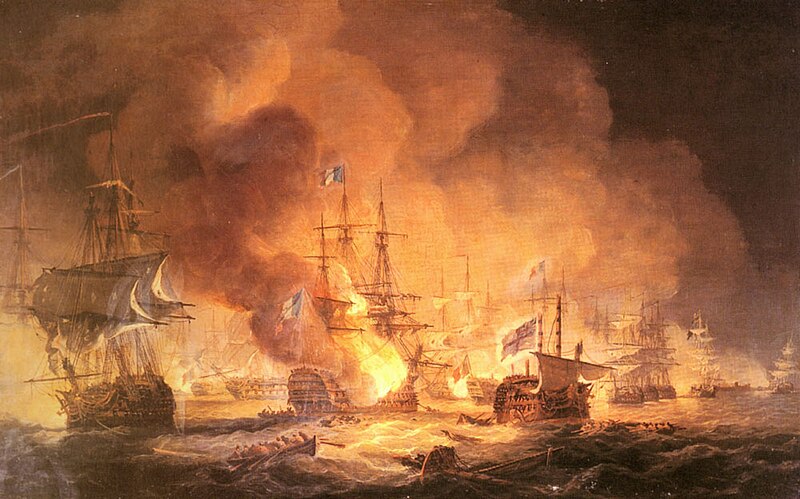
File:The Battle of the Nile.jpg
George Arnald (1763 – 1841)
The Destruction of L'Orient at the Battle of the Nile, 1 August 1798, c. 1825-27
Oil on canvas
185.5 × 269 cm (73 × 105.9 in)
National Maritime Museum

Orient explodes at the Battle of the Nile. Franklin is the ship in the extreme left of the picture, and was almost set on fire herself by falling debris.

George Arnald ARA (1763 – 21 November 1841) was a British painter who specialised in landscapes, including topographical views to illustrated county histories. He is best known for his celebrated painting depicting the Battle of the Nile. More on George Arnald ARA

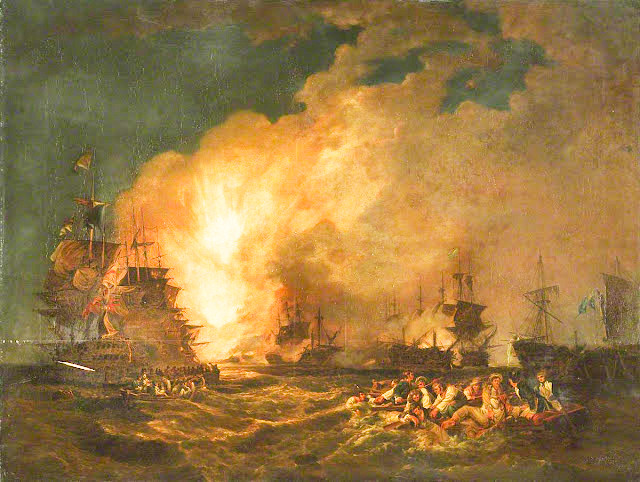
Mather Brown (1761–1831)
A painting of the height of the Battle of the Nile, 1798
Date 1825
Oil on canvas
103.4 × 123.2 cm (40.7 × 48.5 in)
National Maritime Museum

Mather Brown (baptized October 11, 1761 – May 25, 1831) was a portrait and historical painter, born in Boston, Massachusetts, but active in England. 

Brown was taught by his aunt and around 1773 (age 12) became a pupil of Gilbert Stuart. He arrived in London in 1781 to further his training in Benjamin West's studio, entered the Royal Academy schools in 1782 with plans to be a miniature painter, and began to exhibit a year later.

In 1784, he painted two religious paintings for the church of St. Mary’s-in-the-Strand, which led Brown to found a partnership with the painter Daniel Orme for the commercialization of these and other works through exhibition and the sale of engravings. Among these were large paintings of scenes from English history, as well as scenes from Shakespeare's plays. However, despite their success he began to concentrate on portraiture. More on Mather Brown

This frustrated Bonaparte's goal of strengthening the French position in the Mediterranean Sea, and instead put it totally under British control. 

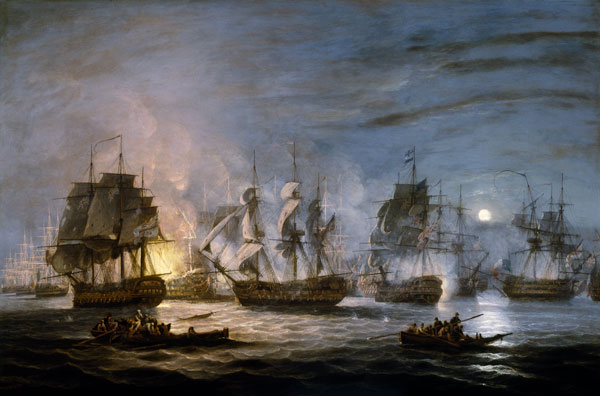
File:Luny Thomas Battle Of The Nile August 1st 1798 At 10pm.jpg
Thomas Luny (1759–1837)
Battle of the Nile, August 1st 1798 at 10 pm, c. 1834
Oil on canvas
70.5 × 45 cm (27.8 × 17.7 in)
Private collection

Philip James de Loutherbourg (1740–1812)
The Battle of the Nile
Oil on canvas
National Maritime Museum

Philip James de Loutherbourg RA (31 October 1740 – 11 March 1812), whose name is sometimes given in the French form of Philippe-Jacques, the German form of Philipp Jakob, or with the English-language epithet of the Younger, was a French-born British painter who became known for his large naval works, his elaborate set designs for London theatres, and his invention of a mechanical theatre called the "Eidophusikon". He also had an interest in faith-healing and the occult, and was a companion of the confidence-trickster Alessandro.

Loutherbourg decided to become a painter, and in 1755 placed himself under Charles-André van Loo in Paris and later under Francesco Giuseppe Casanova. His talent developed rapidly, and he became a figure in the fashionable society of the day. In 1767 he was elected to the French Academy, although below the age required by the rules of the institution, and painted landscapes, sea storms, and battles, all of which work had a celebrity above those of the specialists then working in Paris. He made his debut with the exhibition of twelve pictures, including Storm at Sunset, Night, and Morning after Rain. More on Philip James de Loutherbourg

After the naval defeat at Aboukir, Bonaparte's campaign remained land-bound. However, his army still succeeded in consolidating power in Egypt, although it faced repeated nationalist uprisings, and Napoleon began to behave as absolute ruler of all Egypt.

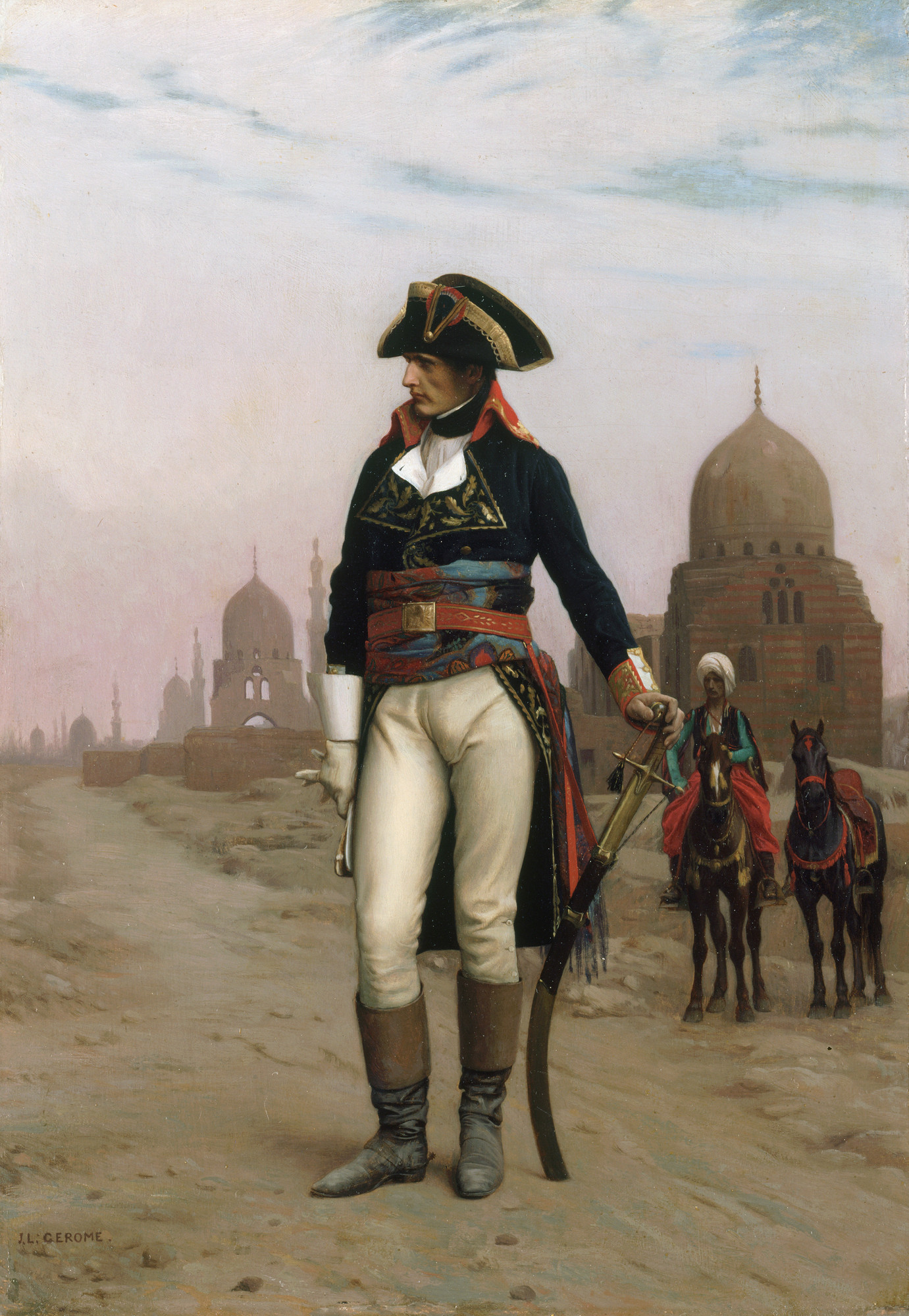
Jean-Léon Gérôme (1824–1904)
General Bonaparte in Cairo, Napoleon in Egypt, circa 1863
Oil on panel
35.8 × 25 cm (14.1 × 9.8 in)
Princeton University Art Museum

In a largely unsuccessful effort to gain the support of the Egyptian population, Bonaparte issued proclamations that cast him as a liberator of the people from Ottoman and Mamluk oppression, praising the precepts of Islam and claiming friendship between France and the Ottoman Empire. 

Alexandre-Marie Colin
Napoleon Bonaparte (1769-1821) Celebrating the Birthday of the Prophet Mohammed during his Campaign on Egypt (1798-1801)
I have no further description, at this time

Alexandre-Marie Colin, (1798-1875) a French painter of historical and genre subjects, was born in Paris in 1798. He was a pupil of Girodet. His religious and historical paintings are characterised by a style based on a careful study of the old masters, while his genre pieces are vigorous and lifelike. Amongst these latter may be noticed his 'French Fish-Market' (1832) in the Berlin Gallery, and his 'Gipsies Resting.' Amongst the former may be named a 'Christopher Columbus,' a 'Flight into Egypt,' and an 'Assumption of the Virgin.' He died in 1875. More on Alexandre-Marie Colin

Anne-Louis Girodet de Roussy-Trioson, French, 1767-1824
The Revolt of Cairo, c. 1810
Oil and ink on paper, laid down on canvas
12 1/8 x 17 3/4 in. (30.8 x 45.1 cm)
Art Institute of Chicago

Anne-Louis Girodet de Roucy-Trioson, (January 5, 1767 – December 9, 1824) was a French painter and pupil of Jacques-Louis David, who was part of the beginning of the Romantic movement by adding elements of eroticism through his paintings. Girodet is remembered for his precise and clear style and for his paintings of members of the Napoleonic family. More on Anne-Louis Girodet de Roucy-Trioson

This could however not prevent the growing anti-French sentiments because the use of alcohol and unveiling of woman was introduced to a muslim community. Ultimately this led to a revolt in which the ‘infidels’ were to be slaughtered. Napoleon drove the insurgents back to the main mosque of Caïro using his artillery.

Levy, Henri Leopold (1840-1904)
Napoleon Bonaparte in the Grand Mosque at Cairo (detail)
Oil on canvas
Musee des Beaux-Arts, Mulhouse, France

Levy, Henri Leopold (1840-1904)
Napoleon Bonaparte (1769-1821) in the Grand Mosque at Cairo
Oil on canvas
Musee des Beaux-Arts, Mulhouse, France

Henri Léopold Lévy (23 September 1840,  29 December 1904) was a French painter. Lévy came from a family of artisans, his father was a sought-after interior designers. He attended the École des Beaux-Arts, where he was, among other things, a student of Alexandre Cabanel, Eugène Fromentin and François-Édouard Picot. He was awarded a gold medal at the 1965 the Salon de Paris.

The French forces killed thousands of Egyptians and to restore order, Napoleon executed some surviving insurgents with public beheadings. French losses of 300 soldiers still were minimal compared to the Egyptian losses. While secretly the remaining prisoners in Cairo were beheaded and thrown in the river at night, Napoleon granted pardon to local sheiks and imans of the El Azhar mosque speaking the words : “I know that many of you have been weak, but I like to believe that none of you is guilty”.

Pierre-Narcisse Guérin (1774–1833)
Bonaparte fait grace aux revolutes du Caire 23. Octobre 1798
Napoleon Bonaparte Pardoning the Rebels at Cairo, 23rd October 1798, c. 1808

Oil on canvas
365 × 500 cm (143.7 × 196.9 in)
Palace of Versailles

Pierre-Narcisse, baron Guérin (13 March 1774 – 6 July 1833) was a French painter born in Paris.

A pupil of Jean-Baptiste Regnault, he carried off one of the three grands prix offered in 1796, in consequence of the competition not having taken place since 1793. In 1799, his painting Marcus Sextus (Louvre) was exhibited at the Salon and excited wild enthusiasm. Part of this was due to the subject – a victim of Sulla's proscription returning to Rome to find his wife dead and his house in mourning – in which an allusion was found to the turmoil of the French Revolution.

Guérin on this occasion was publicly crowned by the president of the Institute, and went to Rome to study under Joseph-Benoît Suvée. In 1800, unable to remain in Rome on account of his health, he went to Naples, where he painted The Shepherds in the Tomb of Amyntas . In 1802 Guérin produced Phaedra and Hippolytus (Louvre); in 1810, after his return to Paris, he again achieved a great success with Andromache and Pyrrhus (Louvre); and in the same year also exhibited Aurora and Cephalus (Pushkin Museum) and Bonaparte and the Rebels of Cairo (Versailles). These paintings suited the popular taste of the First Empire, being highly melodramatic and pompously dignified.

The Restoration brought to Guérin fresh honours; he had received from the first consul in 1803 the cross of the Legion of Honour, and in 1815 Louis XVIII named to the Académie des Beaux-Arts. His style changed to accord with popular taste. In Aeneas Relating to Dido the Disasters of Troy (Louvre), Guérin adopted a more sensuous, picturesque style.

Guérin was commissioned to paint for the Madeleine a scene from the history of St Louis, but his health prevented him from accomplishing what he had begun, and in 1822 he accepted the post of director of the French Academy in Rome, which in 1816 he had refused. On returning to Paris in 1828, Guérin, who had previously been made chevalier of the order of St. Michel, was ennobled. He now attempted to complete Pyrrhus and Priam, a work which he had begun at Rome, but in vain; his health had finally broken down, and in the hope of improvement he returned to Italy with Horace Vernet. Shortly after his arrival at Rome Baron Guérin died, on 6 July 1833, and was buried in the church of La Trinité de Monti by the side of Claude Lorrain.

A heroic portrait by Guerin hangs in the Basilica of the National Shrine of the Assumption of the Blessed Virgin Mary in Baltimore. An 1821 gift of King Louis XVIII of France, it depicts the Descent from the Cross. More on Pierre-Narcisse, baron Guérin

Bonaparte_aux_pyramides_Orange
Maurice Orange (1867-1916)
Bonaparte in Egypt contemplating the mummy of a king, c. 1895
Oil on canvas
Musée du Vieux Granville

Maurice Orange (9 March 1867, Granville - 28 February 1916, Paris) was a French painter and artist. He gained a scholarship to the École des Beaux-Arts in 1885, where he studied under Jean-Léon Gerome and François Flameng. He was mainly inspired by historical subjects, especially the Napoleonic era, though he also produced portraits, landscapes, townscapes and sketches, often adding drawings to his letters.

From 1887 to 1914 he took part in the Salon des Artistes Français. He won medals and travel bursaries to Spain, Greece, Italy, Portugal, Africa and above all Egypt became a major influences on him. He worked in oils, watercolour, gouache, pastel and charcoal. He died of typhoid fever in 1916. More on Maurice Orange

Napoleon discovered the strength of the dromedary as a transportation tool. The dromedary used by Napoleon was transported to the Paris zoo and after his demise embalmed in the African museum. In January 1799, Napoleon instituted the dromedary regiment formed of 4 squadrons of 100 man each.  The regiment were considered mounted infantry, not cavalry, and fought dismounted.

Jean-Léon Gérôme (1824–1904)
Napoleon and his General Staff in Egypt
Oil on panel
23 x 34 in (58.4 x 88.2 cm)
Private Collector

Then, accompanied by his colleagues from the Institut, Berthollet, Monge, Le Père, Dutertre, Costaz, Caffarelli, and followed by a 300-man escort, Bonaparte set out for the Red Sea and after three days' marching across the desert he and his caravan arrived at Suez. After giving orders to complete the fortifications at Suez, Bonaparte crossed the Red Sea and on 28 December 1798 moved into Sinai to look for the celebrated fountains of Moses 17 kilometres from Suez. 

Despite all the important scientific work that was done by his scientists with the discovery of the Rosetta stone as a major contribution to egyptology, they made one big mistake in estimating the feasability of constructing the Suez canal. The team assumed a height difference between the red sea and the mediterranean water level which would endanger the Egyptian delta with flooding in case of a direct connection.

When the Ottomans in Constantinople received news of the French fleet's destruction at Aboukir, they believed this spelled the end for Bonaparte and his expedition. Sultan Selim III decided to wage war against France, and sent two armies to Egypt. The Ottomans planned two offensives against Cairo: from Syria, across the desert of Salhayeh-Belbays-El Kankah, and from Rhodes by sea landing in the Aboukir area or the port city of Damietta.

Part II


Please visit my other blogs: Art CollectorMythologyMarine ArtPortrait of a Lady, The OrientalistArt of the Nude and The Canals of VeniceMiddle East Artists365 Saints365 Days, and Biblical Icons, also visit my Boards on Pinterest and deviantart

Images are copyright of their respective owners, assignees or others. Some Images may be subject to copyright

I don't own any of these images - credit is always given when due unless it is unknown to me. if I post your images without your permission, please tell me.

I do not sell art, art prints, framed posters or reproductions. Ads are shown only to compensate the hosting expenses.

If you enjoyed this post, please share with friends and family.

Thank you for visiting my blog and also for liking its posts and pages.

Please note that the content of this post primarily consists of articles available from Wikipedia or other free sources online.