Showing posts with label Icon. Show all posts

10 Works, The Art of War, Abbott Handerson Thayer's An Angel Flew Over Gaza, with footnotes

After Abbott Handerson Thayer
An Angel Flew Over Gaza 1
AI Generated
nightcafe

After Abbott Handerson Thayer
An Angel Flew Over Gaza 2
AI Generated
Width: 1024, Height: 1024
openart

The angels came to Gaza in the time of death and devastation! They flew over the city filled with death and destruction. The then came down to help the dead, the wounded, the orphaned and the suffering. The children who lost their families. The mothers who cried for help that wasn’t coming.

After Abbott Handerson Thayer
An Angel Flew Over Gaza 3
AI Generated
Width: 1024, Height: 1024
nightcafe


They wrapped their wings around the broken hearts, offering solace and comfort. With gentle whispers, they reassured the frightened souls that they were not alone.

After Abbott Handerson Thayer
An Angel Flew Over Gaza 4
AI Generated
Width: 1024, Height: 1024
openart


The angels brought healing to the wounded, mending their broken bodies and easing their pain. They brought love and care to the orphans, becoming their guiding light in the darkness. They listened to the sorrowful cries of the mothers, holding their hands and wiping away their tears.

After Abbott Handerson Thayer
An Angel Flew Over Gaza 5
AI Generated
nightcafe

After Abbott Handerson Thayer
An Angel Flew Over Gaza 6
AI Generated
Available at deviantart

In the midst of despair, the angels brought hope. They reminded the people of Gaza that the world still cared, that there was light beyond the darkness. They stood as beacons of strength, urging the people to endure and to never lose faith.

After Abbott Handerson Thayer
An Angel Flew Over Gaza 7
AI Generated
nightcafe

With their angelic presence, they inspired unity and resilience in the community. Strangers became neighbors, and neighbors became family. Together, they rebuilt homes and restored hope, their spirits lifted by the angels' unwavering support.

After Abbott Handerson Thayer
An Angel Flew Over Gaza 8
AI Generated
Available at deviantart


Though the angels could not change the reality of the devastation, their compassion and empathy brought a sense of peace. They reminded the people that even in the darkest times, there is always a glimmer of light, a ray of hope.

After Abbott Handerson Thayer
An Angel Flew Over Gaza 9
AI Generated
Available at deviantart

And so, the angels continued to watch over Gaza, providing comfort to those who needed it most. They became the symbol of humanity's capacity for kindness, reminding us of our obligation to extend a helping hand to one another.

After Abbott Handerson Thayer
An Angel Flew Over Gaza 10
AI Generated
Available at deviantart

In times of death and devastation, the angels of Gaza showed us that even amidst turmoil, love and compassion have the power to heal and rebuild.


Abbott Handerson Thayer (August 12, 1849 – May 29, 1921) was an American artist, naturalist, and teacher. As a painter of portraits, figures, animals, and landscapes, he enjoyed a certain prominence during his lifetime, and his paintings are represented in major American art collections. He is perhaps best known for his 'angel' paintings, some of which use his children as models.

During the last third of his life, he worked together with his son, Gerald Handerson Thayer, on a book about protective coloration in nature, titled Concealing-Coloration in the Animal Kingdom. First published by Macmillan in 1909, then reissued in 1918, it may have had an effect on military camouflage during World War I. However it was roundly mocked by Theodore Roosevelt and others for its assumption that all animal coloration is cryptic.

Thayer also influenced American art through his efforts as a teacher, training apprentices in his New Hampshire studio. More on Abbott Handerson Thayer


01 Work, The art of War, Nicolas Poussin's The Victory of Joshua over the Amalekites, with Footnotes

Nicolas Poussin  (1594–1665)
The Victory of Joshua over the Amalekites, c. between 1623 and 1626
Oil on canvas
height: 97.5 cm (38.3 in); width: 134 cm (52.7 in)
Hermitage Museum, Saint Petersburg

The Amalekites, descendants of Amalek, were an ancient biblical nation living near the land of Canaan. They were the first nation to attack the Jewish people after the Exodus from Egypt, and they are seen as the archetypal enemy of the Jews.

Joshua was successor to Moses, who led the Israelites through the Desert and into the Promised Land, Palestine.

Palestine, however, was not uninhabited. According to the Old Testament a local tribe, the Amalekites, lived on the east bank of the River Jordan and in the region between the Dead Sea and Hebron.

Presumably the largest population group in the land Canaan, as Palestine was known, the Amorites were defeated by Joshua in a series of battles. More on the battle  with the Amalekites

Joshua's Battle Against the Amalekites was produced as a pendant to The Battle between the Israelites and the Amorites by the same artist during his time in Rome. He fell into dire financial straits after the 1625 death of his patron, the poet Giovan Battista Marino and cardinal Francesco Barberini (1597–1679)'s departure from the city - this forced him to sell both works. They were both acquired by Catherine II of Russia to be kept in Poussin's cousin Gaspar Dughet's home on via Paolina in Rome. The pair was split up in 1927.

Normative Judaism's views on warfare are defined by restraint that is neither guided by avidness for belligerence nor is it categorically pacifist. Traditionally, self-defense has been the underpinning principle for the sanctioned use of violence, with the maintenance of peace taking precedence over waging war. While the biblical narrative about the conquest of Canaan and the commands related to it have had a deep influence on Western culture, mainstream Jewish traditions throughout history have treated these texts as purely historical or highly conditioned, and in either case not relevant to contemporary life. However, some minor strains of radical Zionism promote aggressive war and justify them with biblical texts. More on Judaism and warfare

Nicolas Poussin (June 1594 – 19 November 1665) was a French painter who was a leading painter of the classical French Baroque style, although he spent most of his working life in Rome. Most of his works were on religious and mythological subjects painted for a small group of Italian and French collectors. He returned to Paris for a brief period to serve as First Painter to the King under Louis XIII and Cardinal Richelieu, but soon returned to Rome and resumed his more traditional themes. In his later years he gave growing prominence to the landscape in his paintings. His work is characterized by clarity, logic, and order, and favors line over color. Until the 20th century he remained a major inspiration for such classically-oriented artists as Jacques-Louis David, Jean-Auguste-Dominique Ingres and Paul Cézanne. More on Nicolas Poussin


Please visit my other blogs: Art CollectorMythologyMarine ArtPortrait of a Lady, The OrientalistArt of the Nude and The Canals of VeniceMiddle East Artists365 Saints365 Days, and Biblical Icons, also visit my Boards on Pinterest

Images are copyright of their respective owners, assignees or others. Some Images may be subject to copyright

I don't own any of these images - credit is always given when due unless it is unknown to me. if I post your images without your permission, please tell me.

I do not sell art, art prints, framed posters or reproductions. Ads are shown only to compensate the hosting expenses.

If you enjoyed this post, please share with friends and family.

Thank you for visiting my blog and also for liking its posts and pages.

Please note that the content of this post primarily consists of articles available from Wikipedia or other free sources online.


Religious Art from the Bible, Otto van Veen's Christian knight against the seven deadly sins and death itself Paintings from the Bible

Otto van Veen
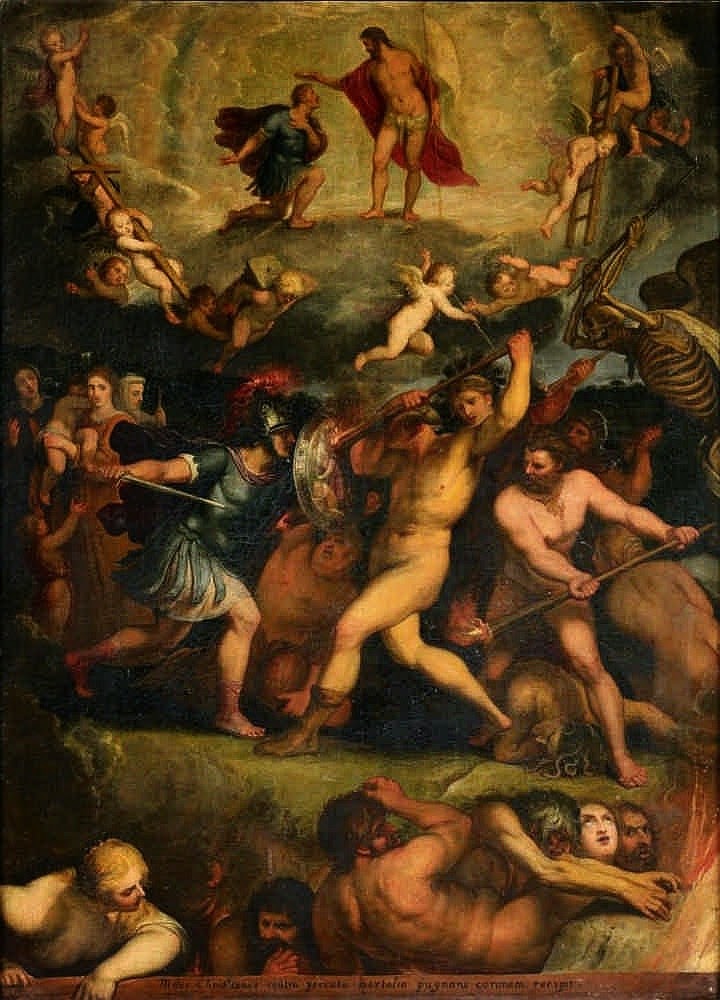
Miles Christianus contra peccata mortalia pugnans coronam recipit.
(The dramatic battle of the Christian knight against the seven deadly sins and death itself)
Oil on canvas
159 x 116cm. 
Private collection

Otto van Veen was one of Antwerp's leading figure painters and he was the teacher of Peter Paul Rubens. His work "Miles Christianus", which depicts the dramatic battle of the Christian knight against the seven deadly sins (wrath, greed, sloth, pride, lust, envy, and gluttony) and death itself,  Presumably it was created between 1609 and 1629 for a Cologne cleric and in the 19th century it came to the collection of Johann Jakob Merlo who is known for his fundamental article "Nachrichten von dem Leben und den Werken Kölnischer Künstler" (news of the lives and works of Cologne artists) from 1850. After his death in 1890 the painting was sold by auction and after decades of uncertainty it was rediscovered in a private collection only a few years ago. 

Above the young hero there is a host of angels who show him the weapons of Christ in order to fortify him. The ground is split and in the abyss there are men who abandoned themselves to vices. They make desperate gestures, are surrounded by flames and have to bear the torture of damnation. On high we see the future lying ahead of the hero: there is Christ who rewards the kneeling young man with the crown of the Blessed.

The motif of the painting itself has its origin in the letter of Paul to the Ephesians in the bible: Eph.6, 10-17. 

Otto van Veen worked at the court of the prince-bishop of Liège, Gerard von Groesbeck, in Rome, at the Prague Court of Emperor Rudolf II. and at the Munich Court of the Wittelsbacher before he finally came to Cologne in 1583 where he became court painter of the Cologne elector Ernst of Bavaria. More on Otto van Veen


Please visit my other blogs: Art CollectorMythologyMarine ArtPortrait of a Lady, The OrientalistArt of the Nude and The Canals of VeniceMiddle East Artists365 Saints and 365 Days, also visit my Boards on Pinterest

Images are copyright of their respective owners, assignees or others. Some Images may be subject to copyright

I don't own any of these images - credit is always given when due unless it is unknown to me. if I post your images without your permission, please tell me.

I do not sell art, art prints, framed posters or reproductions. Ads are shown only to compensate the hosting expenses.

If you enjoyed this post, please share with friends and family.

Thank you for visiting my blog and also for liking its posts and pages.

Please note that the content of this post primarily consists of articles available from Wikipedia or other free sources online.


02 Paintings, Joshua Reynolds Repainted Rembrandt's Masterpiece, Susanna and the Elders

Rembrandt  (1606–1669)
Susanna and the Elders, c. 1647
Oil on mahagony
Height: 76.6 cm (30.1 in); Width: 92.8 cm (36.5 in)
Gemäldegalerie

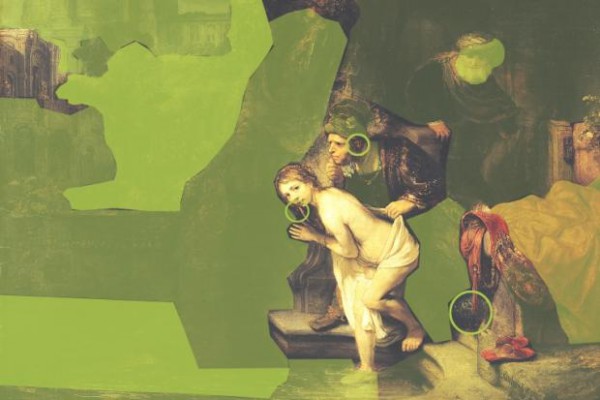
Berlin's Gemäldegalerie announced they've made a shocking discovery about the museum's Rembrandt masterpiece Susanna and the Elders (1647), Focus reports. An X-ray analysis of the oil painting has revealed that the it had at one time undergone extensive alterations.

According to the daily Berliner Morgenpost art restorer Claudia Laurenze-Landsberg, who conducted the analysis, noticed tiny pigments on the canvas that didn't exist in the 17th century. What's more, some parts of the painting were in a style that she didn't recognize as Rembrandt's. She found out that in the 18th century large parts of the painting were simply painted over, and entire sections were washed out using solvents and re-painted in a more modern, light shade. More on this painting

Sir Joshua Reynolds RA FRS FRSA (16 July 1723 – 23 February 1792) was an influential eighteenth-century English painter, specialising in portraits. He promoted the "Grand Style" in painting which depended on idealization of the imperfect. He was a founder and first president of the Royal Academy of Arts, and was knighted by George III in 1769. More on Sir Joshua Reynolds

The altered areas of the painting are represented in green
Photo: Claudia Laurenze-Landsberg via Berliner Morgenpost

Rembrandt Harmenszoon van Rijn (15 July 1606 – 4 October 1669) was a Dutch painter and etcher. He is generally considered one of the greatest painters and printmakers in European art and the most important in Dutch history. His contributions to art came in a period of great wealth and cultural achievement that historians call the Dutch Golden Age when Dutch Golden Age painting dominated Europe, was extremely prolific and innovative, and gave rise to important new genres in painting.

Having achieved youthful success as a portrait painter, Rembrandt's later years were marked by personal tragedy and financial hardships. Yet his etchings and paintings were popular throughout his lifetime, his reputation as an artist remained high, and for twenty years he taught many important Dutch painters. His self-portraits form a unique and intimate biography, in which the artist surveyed himself without vanity and with the utmost sincerity.

In his paintings and prints he exhibited knowledge of classical iconography, which he molded to fit the requirements of his own experience; thus, the depiction of a biblical scene was informed by Rembrandt's knowledge of the specific text, his assimilation of classical composition, and his observations of Amsterdam's Jewish population. Because of his empathy for the human condition, he has been called "one of the great prophets of civilization. More on Rembrandt


Please visit my other blogs: Art CollectorMythologyMarine ArtPortrait of a Lady, The OrientalistArt of the Nude and The Canals of VeniceMiddle East Artists365 Saints and 365 Days, also visit my Boards on Pinterest

Images are copyright of their respective owners, assignees or others. Some Images may be subject to copyright

I don't own any of these images - credit is always given when due unless it is unknown to me. if I post your images without your permission, please tell me.

I do not sell art, art prints, framed posters or reproductions. Ads are shown only to compensate the hosting expenses.

If you enjoyed this post, please share with friends and family.

Thank you for visiting my blog and also for liking its posts and pages.

Please note that the content of this post primarily consists of articles available from Wikipedia or other free sources online.