Showing posts with label Cleopatra. Show all posts

01 painting, The amorous game, Italian School, early 18th Century's Anthony and Cleopatra , with Footnotes #106

Italian School, early 18th Century
Anthony and Cleopatra
Oil on canvas, an oval made into a rectangle
122,5 x 103,5 cm ; 48¼ by 40¾ in.
Private collection

Sold for 18,900 EUR in June 2021

Anthony and Cleopatra are arguably the most famous lovers in history. Marcus Antonius of Rome stood at the pinnacle of power, fighting to be the most powerful man in the known world; and Cleopatra VII Philopator was the queen of one ancient civilization, Egypt, and heir to the unmatched cultural achievements of another, Greece.

Their love affair, their war together, their defeat and, finally, their suicides have been told and retold for centuries. More on Anthony and Cleopatra

Italy was the main centre of artistic developments throughout the Renaissance (1300-1600), beginning with the Proto-Renaissance of Giotto and reaching a particular peak in the High Renaissance of Leonardo da Vinci, Michelangelo and Raphael, whose works inspired the later phase of the Renaissance, known as Mannerism. Italy retained its artistic dominance into the 17th century with the Baroque (1600-1750), and into the 18th century with Neoclassicism (1750-1850). In this period, cultural tourism became a major prop to Italian economy. Both Baroque and Neoclassicism originated in Rome and spread to all Western art. Italy maintained a presence in the international art scene from the mid-19th century onwards, with movements such as the Macchiaioli, Futurism, Metaphysical, Novecento Italiano, Spatialism, Arte Povera, and Transavantgarde.

Italian art has influenced several major movements throughout the centuries and has produced several great artists, including painters, architects and sculptors. Today, Italy has an important place in the international art scene, with several major art galleries, museums and exhibitions; major artistic centres in the country include Rome, Florence, Venice, Milan, Turin, Genoa, Naples, Palermo, Lecce and other cities. Italy is home to 58 World Heritage Sites, the largest number of any country in the world. More on Italian art


Please visit my other blogs: Art Collector, Mythology, Marine Art, Portrait of a Lady, The Orientalist, Art of the Nude and The Canals of Venice, Middle East Artists, 365 Saints, 365 Days, and Biblical Icons, also visit my Boards on Pinterest and my art stores at  deviantart and Aaroko

Images are copyright of their respective owners, assignees or others. Some Images may be subject to copyright

I don't own any of these images - credit is always given when due unless it is unknown to me. if I post your images without your permission, please tell me.

Ads are shown only to compensate the hosting expenses.

If you enjoyed this post, please share with friends and family.

Thank you for visiting my blog and also for liking its posts and pages.

Please note that the content of this post primarily consists of articles available from Wikipedia or other free sources online.


14 Ancient Egyptian Engravings & Carvings- With footnotes - 6

An Egyptian wood mummy mask for a man 
Third Intermediate - Late Period, circa 1069-332 B.C.
53cm high
Private collection

The face with traces of gesso, the facial features carved with the eyes and brows detailed in black paint, with large ears, a false beard, the wig with black paint remaining. More

An Egyptian polychrome wood figure of a female offering-bearer 
Middle Kingdom, 11th-12th Dynasty, circa 2133-1786 B.C.
23.5cm high
Private collection

Shown striding forward wearing a close fitting long garment, the left arm raised to steady the offering basket carried on her head, with ochre coloured skin, the details of the face finely painted. More

An Egyptian limestone wall-painting fragment from the tomb of Ken-Amun 
Thebes, New Kingdom, 18th Dynasty, Reign of Amenhotep II, circa 1427-1400 B.C.
 24.9cm high
Private collection

The decoration composed of polychrome on plaster, depicting a young man in profile with a short Nubian hairstyle with locks of black hair falling at the forehead and cheeks, the skin in reddish brown with finely-painted brow and eye, the broad collar painted in blue, green and pinkish-cream, the background ochre, set in a perspex frame,

Kenamun was the overseer of the cattle of Amun and chief steward of Amenhotep II. His mother, Amenemipet, was a wet nurse of Amenhotep II. 

The tomb was known of from the early 19th Century and was visited by Champollion and Lepsius among others. In the late 1920s the Metropolitan Museum of Art, New York, fully documented and published the content of the tomb with drawings by N. de Garis Davies. 

This fragment depicts a man with a Nubian hairstyle, which was only in fashion among soldiers under Amenhotep II.
A large Egyptian alabaster shabti 
New Kingdom, late 18th - early 19th Dynasty, circa 1400-1200 B.C.
32cm high
Private collection

The male figure shown in daily dress with added painted details, wearing a duplex wig, the arms crossed over the chest, wearing pleated drapery with short sleeves and a long kilt projecting over the feet, a now faded column of hieroglyphic text down the front of the kilt. More

An ancient Egyptian shabti  was a funerary figurine used in Ancient Egypt. Ushabtis were placed in tombs among the grave goods and were intended to act as servants or minions for the deceased, should he/she be called upon to do manual labor in the afterlife. The figurines frequently carried a hoe on their shoulder and a basket on their backs, implying they were intended to farm for the deceased. They were usually written on by the use of hieroglyphs typically found on the legs. More

An Egyptian limestone relief fragment 
New Kingdom, late 18th Dynasty, circa 1300 B.C.
16.5cm x 15cm
Private collection

Carved in relief with the seated figures of Ptah, titled 'King of the two lands' and 'Great Seat' by the hieroglyphs above, and 'the Goddess of the West', called 'Hathor, mistress of the West', with part of a large lotus flower in front of Ptah, probably from the top of an offering, the columns of hieroglyphic text: 'For the Ka of ...' (the name of the deceased is missing).

In Egyptian mythology, Ptah is the god  responsible for the fashioning and maintenance of the physical universe, of Memphis, god of craftsmen and architects. In the triad of Memphis, he is the spouse of Sekhmet and the father of Nefertum. He was also regarded as the father of the sage Imhotep.

Ptah is the Creator god par excellence, by his willfulness, thought the world. It was first conceived by Thought, and realized by the Word. Ptah conceives the world by the thought of his heart and gives life through the magic of his Word. That which Ptah commanded was created, with which the constituents of nature, fauna, and flora, are contained. He also plays a role in the preservation of the world and the permanence of the royal function.

Profile of the god Ptah - Relief of the small temple of Hathor at Memphis,  nineteenth dynasty
Private Collection

In the Twenty-Fifth Dynasty, the Nubian pharaoh Shabaka would transcribe on a stela known as the Shabaka Stone, an old theological document found in the archives of the library of the temple of the god at Memphis. This document has been known as the Memphite Theology, and shows the god Ptah, the god responsible for the creation of the universe by thought and by the word.

Ptah is the patron of craftsmanship, metalworking, carpenters, shipbuilders, and sculpture. From the Middle Kingdom onwards, he was one of five major Egyptian gods with Ra, Isis, Osiris and Amun. More

Hathor from the crypt at Dendera Temple 
(Photo by Yvonne Buskens, 2010)
Private Collection

Hathor  is an Ancient Egyptian goddess who personified the principles of joy, feminine love, and motherhood. She was one of the most important and popular deities throughout the history of Ancient Egypt. Hathor was worshiped by royalty and common people alike in whose tombs she is depicted as "Mistress of the West" welcoming the dead into the next life. In other roles she was a goddess of music, dance, foreign lands and fertility who helped women in childbirth, as well as the patron goddess of miners.

Hathor is commonly depicted as a cow goddess with horns in which is set a sun disk with Uraeus. Twin feathers are also sometimes shown in later periods as well as a menat necklace.

The Ancient Greeks sometimes identified Hathor with the goddess Aphrodite. More


Egyptian limestone figure of a concubine
New Kingdom, c. 1570 - 1075 BC
Private Collection

Egyptian limestone figure of a concubine, New Kingdom, c. 1570 - 1075 BC, wearing a Nubian wig and head band, her arms pendant at her sides. She lays on the lower portion of a sarcophagus, antique collection notes in black ink. Her features are  detailed with remnants of black pigment in the eyes and on her hair. From Heliopolis (Matarieh), H: 3 3/4 in (9.5cm). 'Concubine' figures are found in the tombs of both men and women and probably served various functions such as providing the deceased with a partner in the afterlife or fertility for the living. An inscription on the thigh of one of these figures states 'May a birth be granted to your daughter She', indicating this particular figurine was placed in a man's tomb by his daughter who he could help her conceive. More

Egyptian sandstone relief
Ptolemaic Period
Private Collection

Egyptian sandstone relief, Ptolemaic Period, c. 332 - 30 BC, with a large solar disk flanked by uraei, several hieroglyphic characters around, including one in the form of a facing human head, which is beautifully carved. The signs are deeply carved with much detail. A substantial amount of original pigment remains with the facing head sign. A very attractive display piece with a very clever custom magnetic stand. 14 in x 7 ¾ in x 2 ½ in. More

EGYPTIAN SANDSTONE RELIEF
Architectural Fragment
Private Collection

EGYPTIAN SANDSTONE RELIEF - Fragment of Architectural Sunk Relief showing the head of a Queen and part of an accompanying inscription, possibly Egypt – New Kingdom, 18th Dynasty, Amarna Period, reign of Akhenaten, ca. 1353-1336 B.C. Roughly 8 1/2" x 10" x 3". Worn. More

Egyptian stucco figurine of Isis with child Horus
Private Collection

An Egyptian stucco figurine of Isis with the child Horus, c. 1200 - 332 BC, mold made, the goddess is depicted in classic pose seated on her throne, wearing a long tight-fitting gown and a headdress consisting of a solar disk and ram's horns, suckling the child Horus who sits on her lap in her arms, H: 4 7/8 in (12.5cm). More

Egyptian Intaglio with Cleopatra as Isis
Private Collection

51-30 BC. An iron bezel with inset gold cameo depicting queen Cleopatra, as the goddess Isis, wearing tripartite wig, vulture headdress with uraeus and sun disc between cow horns; broad collar around neck. 1.25 grams, 21mm (1/4") From the Dolman collection; acquired in the early 1920s.   Cleopatra VII Philopator was the last member of the Ptolemaic dynasty to rule over Egypt and was famously associated with both Julius Caesar and Marc Antony before she committed suicide after her defeat by Octavian Caesar, later the Emperor Augustus, at the battle of Actium. Cleopatra was the only member of the dynasty to speak the native Egyptian language and strongly identified herself with the Egyptian religion, patronising important temples such as that dedicated to the goddess Hathor at Denderah. She closely identified herself with the goddess Isis, and her coinage hailed her as the ‘New Isis,’ and she was actively worshipped as such in Egypt. After the ‘Donations of Alexandria’ she was never in public without her Isis robes. Caesar had even recognised Cleopatra as Isis in a triumph held in Rome and dedicated a gold statue of her as Isis in the temple of Venus Genetrix in the Forum. Religion was an integral part of Cleopatra’s political propaganda, for the sect of Isis had spread throughout the ancient Mediterranean world, and to be ‘internationally’ recognised as the goddess gave Cleopatra greater political prestige in the East. When Antony became a crucial part of her plans, Cleopatra’s propaganda ensured that he was revered by Greek Egyptians as Dionysus and by native Egyptians as Osiris, the ‘king of kings’. More

Egyptian Pectoral Plaque with Isis and Mut
Private Collection

Ptolemaic Period, 332-30 BC. A carved steatite trapezoidal pectoral plaque with holes to the upper edge and rear face; raised reeded border with winged sun-disc above profile high-relief figures of Isis wearing the horned headdress of Hathor and Mut in feathered headdress. 124 grams, 85mm (3 1/2"). More

An Egyptian cartonnage panel, Late Period
Private Collection

An Egyptian cartonnage panel, Late Period, c. 664 - 30 BC, depicting a large winged scarab above, a seated winged deity below, each flanked by two mummiform deities (Sons of Horus) and bordered by multicolored lines and rosettes. W: 11 2/5 in (29cm), H: 9 1/5 in (23.3cm). More


Acknowledgement: Ancient Resource, 

Images are copyright of their respective owners, assignees or others

30 works - Art and the Egyptian Woman over the decades

Elisabeth Jerichau Baumann
A young Egyptian woman, c.  E. Jerichau 1870
Pencil on paper
26 x 29 cm
Private collection

In the winter of 1869-1870, Elisabeth Jerichau Baumann traveled to Constantinople, Athens, Smyrna, Alexandria and Cairo. It was on this trip that she, as one of the first painters ever, got access to a harem in Constantinople.

Anna Maria Elisabeth Lisinska Jerichau-Baumann (21 November 1819 – 11 July 1881) was a Polish-Danish painter. She was married to the sculptor Jens Adolf Jerichau.

Elisabeth Jerichau-Baumann was born in Å»oliborz,a borough of Warsaw. Her father Philip Adolph Baumann (1776–1863), a mapmaker, and her mother, Johanne Frederikke Reyer (1790–1854), were of German extraction.

At the age of nineteen, she began her studies at the Kunstakademie Düsseldorf which at the time was one of the most important art centres in Europe and her early subject matter was drawn from Slovak life. She is associated with the Düsseldorf school of painting. She began exhibiting there and in 1844 attracted public attention for the first time. After she moved to Rome, her paintings were primarily of local life. When Baumann was not travelling, she spent many hours a day in her studio in Rome. She was particularly fond of the Italian painters. Baumann had great success abroad, however, and had a special following in France where she was twice represented at the World Fair in Paris, first in 1867 and again in 1878. In 1852 she exhibited some of her paintings in London, and Queen Victoria requested a private presentation in Buckingham Palace. Among the portraits presented to the Queen was her painting of Hans Christian Andersen, completed in 1850. More on Elisabeth Jerichau Baumann

Scota
It is said that Scota was in fact Meritaten, the eldest daughter of Pharoah Akhenaten and Queen Nefertiti.

The story of how Scotland got it’s name is an interesting one. Meritaten, nicknamed Scotia, was an ancient Egyptian queen of the eighteenth dynasty (14th century BC), and the first of six daughters born to Pharaoh Akhenaten and his Great Royal Wife, Nefertiti. Her name means “She who is beloved of Aten”; Aten being the sun-god her father worshipped. Scotia settled in what is now Scotland, after the Hyksos were expelled from Egypt.

Mummy Portrait of a Woman, from Fayum, Romano-Egyptian, 138-161 AD 
(encaustic wax & amp; paint on wood)
Metropolitan Museum of Art, New York, USA / Bridgeman Images.

John Frederick Lewis RA 
1804-1875
A Veiled Egyptian Girl, Cairo
Watercolour and bodycolour 
15 ½ x 11 ¼ inches; 396 x 285 mm
Drawn in the 1840s

John Frederick Lewis RA (London 14 July 1804 – 15 August 1876) was an Orientalist English painter. He specialized in Oriental and Mediterranean scenes in exquisitely detailed watercolour or oils. Lewis lived for several years in a traditional mansion in Cairo, and (after his return to England) painted highly detailed works showing both realistic genre scenes of Middle Eastern life and more idealized scenes in upper class Egyptian interiors with no traces of Western cultural influence yet apparent.

His very careful and loving representation of Islamic architecture, furnishings, screens, and costumes set new standards of realism, which influenced other artists, including the leading French Orientalist painter Jean-Léon Gérôme in his later works. Unlike many other Orientalist painters who took a salacious interest in the women of the Middle East, he "never painted a nude", and his wife modelled for several of his harem scenes. More on John Frederick Lewis

Emile Vernet Lecomte (French 1821-1900) 
A Young Egyptian (Aimee)
Oil on Canvas 
51 3/8 x 34 5/8in (130.5x88cm)
Private collection

Emile Lecomte-Vernet, born Charles Émile Hippolyte Lecomte, is from a family of famous painters. He began by painting portraits of the wealthy bourgeoisie and the aristocracy . It begins at the Paris Salon in 1843 where he received a bronze medal. Very quickly, he developed a taste for orientalism. His first paintings on this theme are exhibited at the Salon of 1847 ( Syrian head and Syrian woman ) and he produced numerous portraits of Oriental women. News of his time did not leave him indifferent either and so he painted pictures with subject the Crimean War (1853-1855) or the massacre of the Maronites by the Druze in Syria in 1860-1861. More on Emile Lecomte-Vernet

Bianchi Mosè (1840/1904)
Cleopatra, before 1865
Oil on canvas
112 cm x 137 cm
Lombardy Cultural Heritage

Mosè Bianchi (Monza, 1840–1904) was an Italian painter and printmaker. The award of a grant in 1867 enabled him to visit Venice and then Paris in 1869. He took part with some success at the Brera exhibitions and the Vienna Exhibition of 1873. It was in this period that he began to paint genre scenes in 18th-century settings and numerous portraits, soon becoming one of the artists most in demand with the Milanese middle classes. More on Mosè Bianchi

Georges Clairin  (1843–1919)
Portrait of Sarah Bernhardt as Cleopatra, c. 1893
Oil on canvas
Height: 234 cm (92.1 in); Width: 140 cm (55.1 in)
National Museum of Fine Arts of Cuba

Egyptian motif jewelry with Turquoise set in Silver for the role, fueling a Revival of Egyptian styled jewelry.

Georges Jules Victor Clairin (11 September 1843, Paris – Pouldu,  2 September 1919) was a French Oriental painter and illustrator. He was influenced by oriental painting and Moorish architecture, and visited North Africa many times, in particular Morocco and Egypt. In Paris he led the life of a socialite, and befriended the glamorous actress Sarah Bernhardt, his friend for 50 years, and is today best known for his 'in costume' and informal intimate portratits of her. More on Georges Jules Victor Clairin

Jean-Léon Gérôme - 1866 
Caesar and Cleopatra
Oil on canvas 
Height: 183 cm (72.05 in.), Width: 129.5 cm (50.98 in.) 
Private collection

Cleopatra confronts Gaius Julius Caesar after emerging from a roll of carpet. The Egyptian Queen had been driven from the palace in Alexandria by her brother/husband Ptolemy XIII. She had to disguise herself to regain entry and treat with Caesar for protection and restoration of her throne.

Jean-Léon Gérôme (11 May 1824 – 10 January 1904) was a French painter and sculptor in the style now known as Academicism. The range of his oeuvre included historical painting, Greek mythology, Orientalism, portraits and other subjects, bringing the Academic painting tradition to an artistic climax. He is considered one of the most important painters from this academic period, and in addition to being a painter, he was also a teacher with a long list of students. More on Jean-Léon Gérôme - 1866 More


Léon Joseph Florentin Bonnat (20 June 1833 – 8 September 1922) 
An Egyptian Peasant Woman and Her Child, c. (1869-1870)
Oil on canvas
73 1/2 x 41 1/2 in. (186.7 x 105.4 cm)
Metropolitan Museum of Art

Bonnat is said to have studied this peasant woman and child from life while he was in Egypt for the opening ceremony of the Suez Canal in 1869. The painting was praised at the Paris Salon the following year and again when it was first exhibited in New York in 1876. When Catharine Lorillard Wolfe bequeathed the picture to the Metropolitan it was deemed "a true and vital portrait of two clearly realized individuals [with] a wonderful dignity, sobriety, strength, and beauty." More on this painting

Léon Joseph Florentin Bonnat (20 June 1833 – 8 September 1922) was a French painter. He won a medal of honor in Paris in 1869, going on to become one of the leading artists of his day. Bonnat went on to win the Grand Officer of the Légion d'honneur and became a professor at the Ecole des Beaux Arts in 1882. In May 1905 he succeeded Paul Dubois as director of the Ecole des Beaux-Arts. Julius Kaplan characterised Bonnat as "a liberal teacher who stressed simplicity in art above high academic finish, as well as overall effect rather than detail." Bonnat's emphasis on overall effect on the one hand, and rigorous drawing on the other, put him in a middle position with respect to the Impressionists and academic painters like his friend Jean-Léon Gérôme. In 1917, Bonnat was elected into the National Academy of Design as an Honorary Corresponding member. More

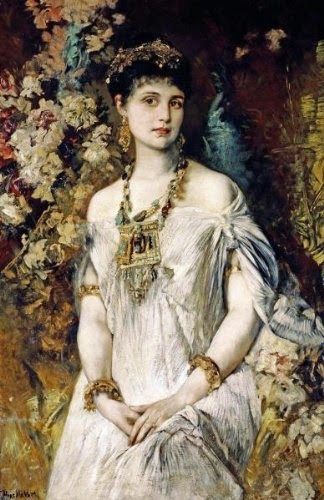
Hans Makart (1840–1884)
An Egyptian Princess 1875
Oil on panel
129 × 84 cm (50.8 × 33.1 in)
Private collection

The Egyptian Princess is one of the five paintings executed whilst Hans Makart was in Egypt in 1875. It was a visit that would produce some of the most significant pieces of his oeuvre. The present picture depicts an Egyptian Princess in jewelled garb, seated in contemplation, her hands resting delicately on her lap. Makart was inspired to paint this subject after reading Eber's bestseller of the same name, and this painting reflects the desire and interest in the Orient, which was permeating Europe at this time.

Makart was known as 'the magician of colours' and this is illustrated in the present work. The contrast between the black of her hair and her skin-tone, for example, would have emphasised this idea of 'otherness', of a world which was still very much undiscovered. More on this painting

Hans Makart 
Woman In Egyptian Costume
Oil on panel
18 x 12.383
I have no further description, at this time

Hans Makart (28 May 1840 – 3 October 1884) was a 19th-century Austrian academic history painter, designer, and decorator; most well known for his influence on Gustav Klimt and other Austrian artists, but in his own era considered an important artist himself and a celebrity figure in the high culture of Vienna, attended with almost cult-like adulation. More on Hans Makart

Edward William Lane, 1801-1876
Two ladies attired in veils and long robes. 
Engraving
I have no further description, at this time

This is a portrait of an upper-class woman in "An Account of the Manners and Customs of the Modern Egyptians" written by British orientalist Edward William Lane in 1833. More on this work

Edward William Lane (17 September 1801 – 10 August 1876) was a British orientalist, translator and lexicographer. He is known for his Manners and Customs of the Modern Egyptians and the Arabic-English Lexicon, as well as his translations of One Thousand and One Nights and Selections from the Kur-án.

During his lifetime, Lane also wrote a detailed account of Egypt and the country's ancient sites, but the book, titled Description of Egypt, was published posthumously. It was first published by the American University in Cairo Press in 2000 and has been republished several times since then. More on Edward William Lane

Engraved by Adolphe Mouilleron
Women of Middle Egypt, c. 1848
 illustration from The Valley of the Nile, 
pub. by Lemercier
I have no further description, at this time

Adolphe Mouilleron: Born and raised in Paris. He began exhibiting there at the Salon in 1846. Highly regarded for both his paintings and original lithographs, Mouilleron was awarded a medals for his art from the Paris Salon in 1849, 1852 and 1855. He was appointed to the Legion d'honneur in 1852. In 1856 Adolphe Mouilleron moved to Amsterdam and worked in that city for several years.

 A large part of Mouilleron's artistic work dealt with creating lithographs after the designs of such contemporary artists as Jean Louis Ernest Meissonier, Robert Fleury, Bonington, Chasseriau, Diaz, Dupre, Decamps and others. He did, however, create a number of fine, original compositions based upon his own designs. "L'Orage" is a superb example of his individual, artistic talents.

Mouilleron, co-founded "Les Artistes Contemporains" (1845-1855), along with Eugene Leroux, Celestin Nanteuil, Francois-Louis Francais and Henri Baron. He was also a contributor to the lithographic series, "Les Artistes Anciens et Modernes" which ran from about 1850 to 1860. More on Adolphe Mouilleron
G. Lékégian & Cie. (Photographer)
A Egyptian woman in 1860
Photograph
24 x 19 cm.
The New York Public Library. Photography Collection

Gabriel Lekegian (1853 – c. 1920), also known as G. Lékégian, was an Armenian painter and photographer, active in Constantinople and Cairo from the 1880s to the 1920s. Little is known about his life, but he left an important body of work under the name of his studio ‘Photographie Artistique G. Lekegian & Cie’. With a large number of now historical photographs of Ottoman Egypt, he documented the country at the turn of the 19th century. Among other collections, his photographs are held in the New York Public Library and the Victoria and Albert Museum, London. More on Gabriel Lekegian

Emile Vernet-Lecomte, 
Mother and Child before the Pyramids, 1872, 
Oil on canvas, 
130,8 x 88,7 cm,
Private collection

Emile Lecomte-Vernet, (1714-1789), , is a French orientalist  painter. He began by painting portraits of the wealthy bourgeoisie and the aristocracy . He received a bronze medal at the Paris Salon in 1843. His first orientalist paintings were exhibited at the Salon of 1847 (Syrian woman); this produced produced numerous requests for portraits of Oriental women. News of his time does not leave indifferent either; and so he painted pictures of the Crimean War (1853-1855) and the massacre of the Maronites by the Druze in Syria in 1860-1861. More on Emile Lecomte-Vernet

Rudolph Carl Huber (circle of)
Nude woman sitting on carpet with her back against a wall, Cairo, Egypt, 1875-1876
Ken & Jenny Jacobson Orientalist Photography Collection

The Ken and Jenny Jacobson Orientalist Photography collection comprises over 4,500 photographic images of the Middle East and North Africa. The majority of the images were created between 1850 and 1920 and record a period when the "Orient," increasingly open and accessible to the West, exerted a compelling allure on western viewers, travelers, scholars and entrepreneurs alike. Works by 164 different photographers and studios present an overwhelmingly western vision of and response to Egypt, the Maghreb and the Levant. More on The Ken and Jenny Jacobson Orientalist Photography

Carl Rudolf Huber (attributed), 
Gruppenakt to 1875/76, 
Photo Institute Bonartes

Carl Rudolf Huber (15 August 1839 in Schleinz , community Walpersbach , Lower Austria ; 28 August 1896 in Vienna) was an Austrian painter and graphic designer. He studied at the Academies of Fine Arts in Vienna and Dusseldorf . In 1875 he, together with Leopold Carl Müller , Hans Makart and Franz von Lenbach he travelled to Egypt. From 1880 he was a professor at the Academy of Fine Arts Vienna. More on Carl Rudolf Huber 

Jean-Léon Gérôme (French, 1824-1904) 
Jeune fille égyptienne: Egyptian girl 

signed 'J.L.GEROME.' (lower right) 
oil on canvas 
18 3/8 x 15 in. (46.7 x 38.1 cm.) 
Painted circa 1877. 

Jean-Léon Gérôme (11 May 1824 – 10 January 1904) was a French painter and sculptor in the style now known as Academicism. The range of his oeuvre includedhistorical painting, Greek mythology, Orientalism, portraits and other subjects, bringing the Academic painting tradition to an artistic climax. He is considered one of the most important painters from this academic period, and in addition to being a painter, he was also a teacher with a long list of students. More on Jean-Léon Gérôme

Elisabeth Baumann  (1818–1881)
An Egyptian Fellah Woman with her Baby, c. 1872
Oil on canvas
Height: 985 mm (38.77 in); Width: 1,292 mm (50.86 in)
Statens Museum for Kunst

Anna Maria Elisabeth Lisinska Jerichau-Baumann (November 21, 1819 – July 11, 1881, Copenhagen) was a Polish-born Danish painter. She is associated with the Düsseldorf school of painting. She began exhibiting there and in 1844 attracted public attention for the first time. After she moved to Rome, her paintings were primarily of local life. It was here that she met her future husband, Jens Adolf Jerichau, whom she married in 1846. 

She had great international success, including a special following in France where she was twice represented at the World Fair in Paris, first in 1867 and again in 1878. In 1852 she exhibited some of her paintings in London, and Queen Victoria requested a private presentation in Buckingham Palace.

Between 1869-1875 Elisabeth traveled extensively in the Eastern Mediterranean and Middle-East As a woman she was able to gain access to the harems of the Ottoman Empire and painted scenes of harem life from personal observation. She had to curb her desire to paint the women of the harems as Europeans liked to imagine them because they insisted on being painted in the latest Paris fashions. 

In 1869, she was admitted into the harem of Mustafa Fazil PaÅŸa, in Egypt. More on Elisabeth Baumann

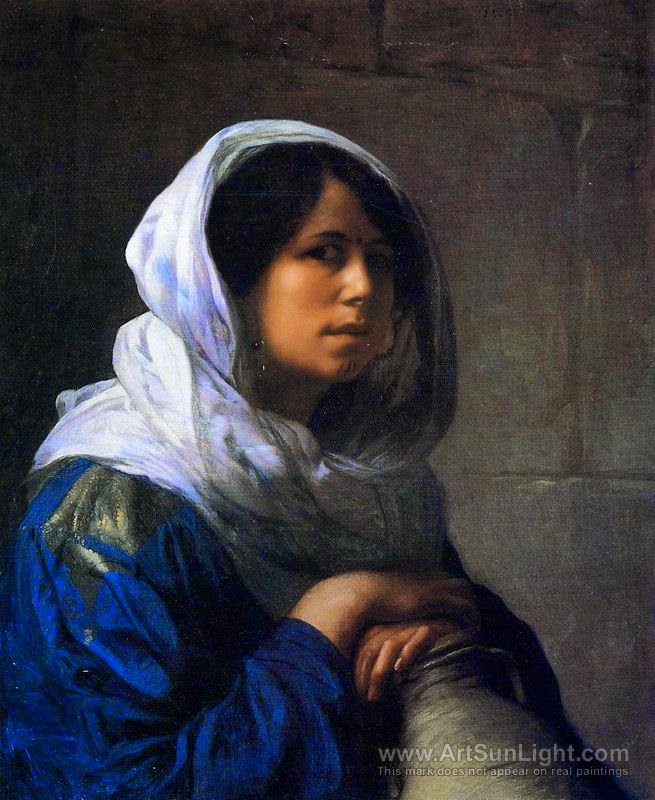
Jean-Léon Gérôme  (1824–1904)
Egyptian water carrier, circa 1882
Oil on canvas
Height: 46.4 cm (18.2 in); Width: 38.2 cm (15 in)
Museum of John Paul II Collection

Jean-Léon Gérôme, see above

Leopold Carl Muller, Viennese
'Egyptian girl with a butterfly' , c. 1885
Oil on canvas
I have no further description, at this time

Müller, Leopold Carl 1834-1892. 
"Nefusa", c. 1885/86. 
Oil on canvas, 
80 x 60 cm.
Wien, Österr. Galerie im Belvedere.


Leopold Carl Muller, a Viennese artist, was both an excellent painter and a humble man. When his students tried to copy his famous 'Marketplace outside Cairo' he suggested they choose something better to paint.

He made nine trips to Cairo beginning in 1873. This painting was done on his last trip in 1885 and shows a girl playing with a small butterfly which has landed on her dress
. More on Leopold Carl Muller

Edwin Long, R.A. (British, 1829-1891) 
Egypt, c. 1887

Oil on canvas 
54½ x 36 in. (138.4 x 92.7 cm). 
Private collection 

The present work belongs to Long's well-known Daughters of our Empire series commissioned by Agnews in 1887 for the Royal Jubilee of Queen Victoria. The series included twenty national beauties which included five of England and fifteen of the other countries in the British Empire. Each personage was depicted in their national costume as interpretated by Long. More on this painting

Edwin Longsden Long RA (12 July 1829 – 15 May 1891) was an English genre, history, biblical and portrait painter. He was born in Bath, Somerset, the son of E. Long, an artist, and was educated at Dr. Viner's School in Bath. Adopting the profession of a painter, Long came to London and studied in the British Museum. He was subsequently a pupil in the school of James Mathews Leigh in Newman Street London, and practiced first as a portrait artist.

Long spent much time in Spain where he was greatly influenced by the paintings of Velasquez and other Spanish masters, and his earlier pictures, such as 'La Posada' (1864) and 'Lazarilla and the blind beggar' (1870), were painted under Spanish influence. In 1874, he visited Egypt and Syria, and subsequently his work took a new direction. He became thoroughly imbued with middle-eastern archaeology and painted oriental scenes like 'The Egyptian Feast' (1877), 'The Gods and their makers' (1878) etc. More on Edwin Longsden Long

Charles Landelle 1812-1908
Egyptian Woman
oil on canvas

Charles Landelle 1812-1908
Egyptian woman with oranges 
Oil on canvas
132.4 by 87.7cm., 152 by 34.5cm.
Private collection

Zachary Charles Landelle, born 2 June 1821 in Laval, died 13 December 1908 in Chennevières-sur-Marne), is a genre painter and portraitist French. Employee son of the prefecture Laval , he followed his father to Paris in 1827.

He developed his talent at École des Beaux-Arts in Paris, where he was admitted in 1837 as a student of Paul Delaroche and Ary Scheffer . His portraits and large religious paintings were an immediate success. In 1841 he exhibited his first painting, a self-portrait. It was noticed by Louis-Philippe and immediately recognized by critics. Napoleon III greatly admire his work and bought two paintings of Beatitudes (1852) to offer to the city of Laval. In 1855, Emperor decorated him with the Legion of Honor for "Rest of the Virgin" That he acquires personally. It is the dedication and fortune. It is the portrait of high society talented ( Portrait of Alfred de Musset , Palace of Versailles , Portrait of Mounet Sully , Museum of Arts and Children of Fécamp ). The museums, churches ( Saint-Sulpice , Saint-Germain l'Auxerrois ), public buildings, national palaces ( the Elysee ) are adorned with his great compositions. In 1848 , the City of Paris bought his Sainte-Cécile which is kept at the church of Saint-Nicolas-des-Champs. More on Edwin Longsden Long

John Collier (1850-1934)
The Pharaoh's Handmaidens, c. 1883

Oil on canvas
Private collection

The Honourable John Maler Collier OBE RP ROI (27 January 1850 – 11 April 1934) was a leading English artist, and an author. He painted in the Pre-Raphaelite style, and was one of the most prominent portrait painters of his generation. He studied painting at the Munich Academy where he enrolled on 14 April 1875 at the age of 25. More on John Maler Collier

John Singer Sargent
An Egyptian Woman, c, 1890-1891
Oil on canvas
64.8 x 53.3 cm (25 1/2 x 21 in.)
Metropolitan Museum, New York 

John Singer Sargent - 1891
Egyptian Woman
(also known as Coin Necklace)
Oil on canvas 
Height: 64.8 cm (25.51 in.), Width: 50.8 cm (20 in.)
Private collection.

John Singer Sargent (January 12, 1856 – April 14, 1925) was an American artist, considered the "leading portrait painter of his generation" for his evocations of Edwardian era luxury. During his career, he created roughly 900 oil paintings and more than 2,000 watercolors, as well as countless sketches and charcoal drawings. His oeuvre documents worldwide travel, from Venice to the Tyrol, Corfu, the Middle East, Montana, Maine, and Florida.

His parents were American, but he was trained in Paris prior to moving to London. Sargent enjoyed international acclaim as a portrait painter, although not without controversy and some critical reservation; an early submission to the Paris Salon, his "Portrait of Madame X", was intended to consolidate his position as a society painter, but it resulted in scandal instead. From the beginning his work was characterized by remarkable technical facility, particularly in his ability to draw with a brush, which in later years inspired admiration as well as criticism for a supposed superficiality. His commissioned works were consistent with the grand manner of portraiture, while his informal studies and landscape paintings displayed a familiarity with Impressionism. In later life Sargent expressed ambivalence about the restrictions of formal portrait work, and devoted much of his energy to mural painting and working en plein air. He lived most of his life in Europe. More John Singer Sargent

Eliot Elisofon 
Woman in veil, Cairo 1947
Life Magazine

Eliot Elisofon (April 17, 1911 - April 7, 1973) was an American documentary photographer and photojournalist. He is a founding member of the Photo League in 1936. He was one of the most active and productive members; he gave guest lectures (1938–43); co-organized the Men at Work project with Lewis Hine (1940); served periodically as president between 1939 and 1941; taught courses on photojournalism and flash photography (1940–41); and participated in numerous exhibitions. Elisofon’s childhood struggles inspired his mission as a photographer; whether photographing the neighborhood he grew up in, the poor communities in the South, or exploring other countries, the human condition remained central to his work. His humble upbringing drove Elisofon to succeed and to improve the world around him. From his perspective: "art, to be true art, must grow out of human beings and it must help human beings live a better and fuller life. It must extend the field of feeling and vision we are born with.” More on Eliot Elisofon

Timothy Joseph Allen
Fayum Portrait of Silvia, c. 2007
Oil on Board
20 x 20
Collection of the Artist

Timothy Joseph Allen is a practicing figurative painter, a web designer and a teacher.  Born in Atlanta, Georgia, raised in Nashville, Tennessee, schooled in Versailles, Kentucky and educated in Greencastle and Bloomington, Indiana, his move to Rome in 1998 was the obvious next step.

He began teaching at AUR in the Fall of 2006 and his range of courses have included Intermediate Drawing, Italian Sketchbook, Web Design and Art of Rome. 


Please visit my other blogs: Art Collector, Mythology, Marine Art, Portrait of a Lady, The Orientalist, Art of the Nude and The Canals of Venice, Middle East Artists, 365 Saints and 365 Days, also visit my Boards on Pinterest

Images are copyright of their respective owners, assignees or others. Some Images may be subject to copyright

I don't own any of these images - credit is always given when due unless it is unknown to me. if I post your images without your permission, please tell me.

I do not sell art, art prints, framed posters or reproductions. Ads are shown only to compensate the hosting expenses.

If you enjoyed this post, please share with friends and family.

Thank you for visiting my blog and also for liking its posts and pages.

Please note that the content of this post primarily consists of articles available from Wikipedia or other free sources online.