Kamel Moustafa (Egypt, 1917-1982)
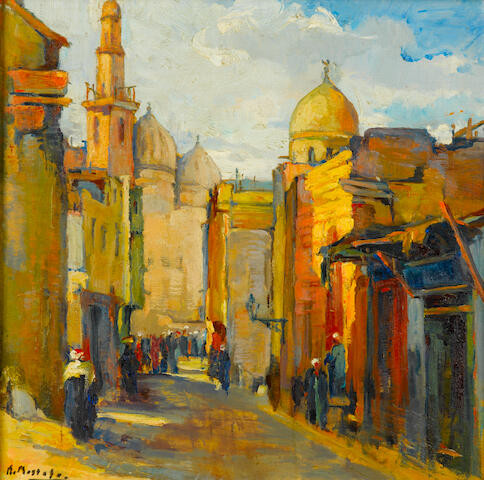
Cairo Street Scene
oil on board, signed lower left
48 x 49cm (18 7/8 x 19 5/16in).
Although this work is undated it has been suggested that it was executed in the early 1950s.
Kamel Moustafa belongs to the second generation of Modern Egyptian artists who sit between the Pioneers such as Mahmoud Said, Youssef Kamel and Mohammed Naghi and the Surrealists, Abdul Hadi El-Gazzar, Samir Rafi and Hamed Nada.
Following the 1952 revolution this new group of artists found themselves operating in a new window of freedom whose aim was to express national personality through symbolism. They emphasised the aesthetics of the new Egyptian society, which for the first time had managed to break away from foreign rule, local nepotism and privileged society.
The artist was born and studied in Alexandria where his talent was first recognized. He was later encouraged by Mahmoud Said to join the Cairo School of Fine Arts in 1936 and graduated five years later. From 1936 the artist spent ten years working in Cairo painting a wide-range of subjects in an impressionist style including traditional scenes from the city and rural life; weddings, souks, markets, folk dances and other elements of traditional Egyptian life.
Between 1946 and 1950 Moustafa travelled to Italy for further study, returning in the early 1950s to resume his work until his death in Alexandria in 1982.
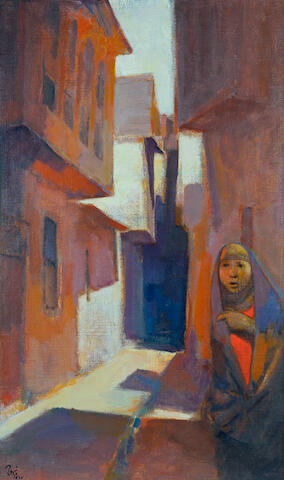
Faeq Hassan (Iraq, 1914-1992)
Baghdad Scene
oil on canvas, signed and dated 1967 in Arabic lower left
further signed and dated in Arabic and signed Faik H on the reverse,
115.3 x 69cm (45 3/8 x 27 3/16in).
Faeq Hassan was born in Baghdad in 1914 and died in 1992. He graduated from the École des Beaux-Arts, Paris in 1938. He founded the Painting Department at the Fine Arts Institute in 1939-1940. Founded the Pioneers Group (or S.P) in 1950. He participated in its exhibitions until 1967 when he joined in founding the Corner Group and participated in its first exhibition. Took part in the Friends of Art Society in 1943 and 1946. Participated in the Avicenna Exhibition in Baghdad in 1952. Organized a number of one - man exhibitions in Baghdad, in 1962-1967 and 1971. Participated in most national exhibitions outside Iraq. Joined nine artists in the Iraq Art Exhibition in Beirut in 1965. Member of the Iraqi Artists Society. More
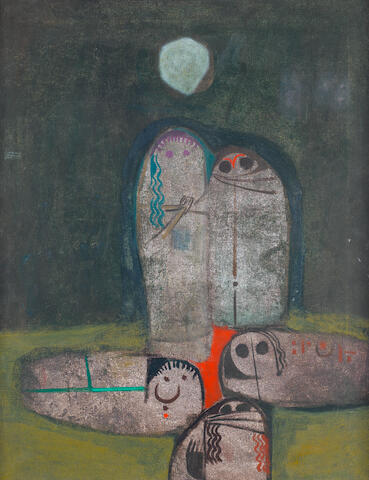
Dia Azzawi (Iraq, born 1939)
Marsh Women
oil on canvas
signed and dated 1968 on reverse
84.2 x 64.2cm (33 1/8 x 25 1/4in).
The Marsh Arabs, also known as the Maʻdān (Arabic: معدان), are inhabitants of the Tigris-Euphrates marshlands in the south and east of Iraq and along the Iranian border. Comprising members of many different tribes and tribal confederations that had developed a unique culture centered on the marshes' natural resources. Many of the marshes' inhabitants were displaced when the wetlands were drained during and after the 1991 uprisings in Iraq.
Madan means "dweller in the plains (ʻadan)" and was used disparagingly by desert tribes to refer to those inhabiting the Iraqi river basins. There was a considerable historic prejudice against the Maʻdān, partly as they were considered to have Persian or Indian origin by the sunni Iraqi people, even though there are %100 Arabs, and mostly because of they refused to bow to the sunni dictatorship. More
Born in Baghdad in 1939, Dia Azzawi started his artistic career in 1964, after graduating from the Institute of Fine Arts in Baghdad and completing a degree in archaeology from Baghdad University in 1962.
In 1969, Azzawi (with Rafa Nasiri, Mohammad Muhriddin, Ismail Fattah, Hachem al-Samarchi and Saleh al Jumaie) formed the New Vision group (al-Ru’yya al-Jadidah), uniting fellow artists ideologically and culturally as opposed to stylistically. Through his involvement with the New Vision group Azzawi found inspiration in contemporary subjects and issues, particularly the plight of the Palestinians. He was also briefly a member of Shakir Hassan Al Said’s One Dimension group (Jama’t al-Bu’d al-Wahid).
From 1968 to 1976, Azzawi was the director of the Iraqi Antiquities Department in Baghdad. He has lived in London since 1976, where he served as art advisor to the city’s Iraqi Cultural Centre, from 1977 to 1980. Azzawi’s move to London led him to rediscover book art (dafatir), an art form that he has encouraged other artists from Iraq and the region to explore.
With exhibitions of his work have been held in international, private and public collections including the Museums of Modern Art in Baghdad, Damascus and Tunis; Jordan National Gallery of Fine Arts, Amman; Mathaf: Arab Museum of Modern Art, Doha; Barjeel Art Foundation, Sharjah; Kinda Foundation, Saudi Arabia; Una Foundation, Casablanca; Arab Monetary Fund, Abu Dhabi; Development Fund, Kuwait; Jeddah International Airport; British Museum, Tate Modern, and Victoria and Albert Museum, London; Institut du Monde Arabe, Bibliothèque Nationale de France and Colas Foundation, Paris; Harba Collection, Iraq and Italy; Gulbenkian Collection, Barcelona; and Library of Congress and the World Bank, Washington, DC. More
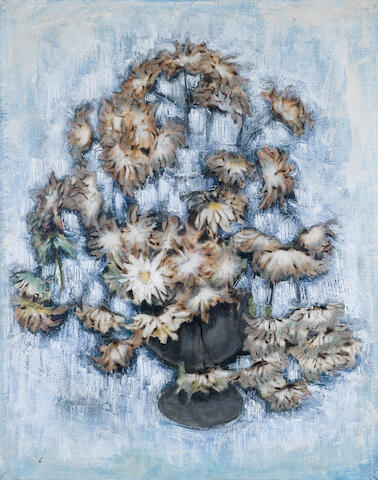
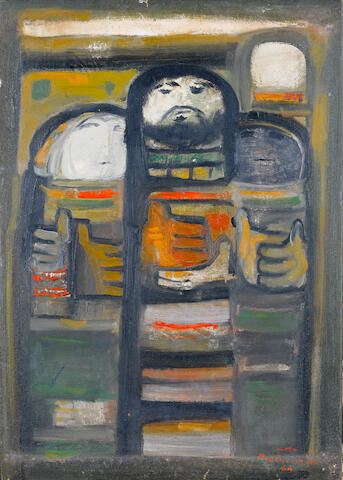
Louay Kayyali (Syria, 1934-1978)
Untitled,
Oil on canvas
96 x 76.5cm (37 13/16 x 30 1/8in)
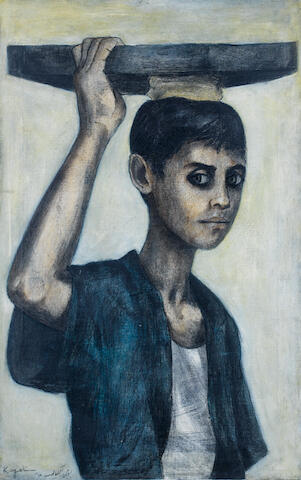
Louay Kayyali (Syria, 1934-1978)
The Young Ka'ik Seller
oil on canvas
signed and dated '65 in Arabic and signed in English lower left
further signed, titled and dated in Arabic and signed and dated in English on the reverse
76 x 48cm (29 15/16 x 18 7/8in)
Louay Kayali (1934–1978) was a Syrian modern artist. He was born in Aleppo, Syria in 1934 and studied art in the Accademia di Belle Arti after having studied at the Al-Tajhiz School where his work was first exhibited in 1952. He met Syrian artist Wahbi Al-Hariri there and the two would share a friendship for the rest of Kayali's life. Al-Hariri would become his mentor as he was for artist Fateh Moudarres (Below) that Hariri introduced to Kayali in 1955. Moudarress and Kayali would together represent Syrian modern art at the Venice Biennial Fair. He suffered from depression and died in 1978 from burns incurred from his bed catching fire, reportedly from a cigarette. More
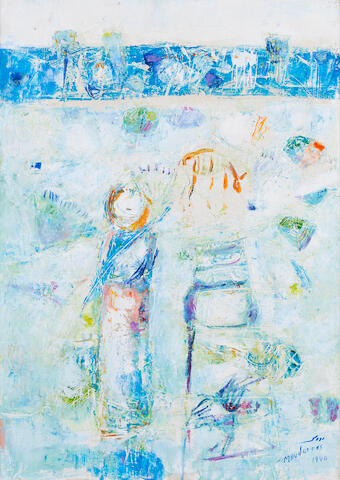
Fateh Moudarres (Syria, 1922-1999)
Untitled
oil on canvas
signed in Arabic and signed and dated '64 in English lower right
70 x 49.7cm (27 9/16 x 19 9/16in)
Fateh Moudarres (Syria, 1922-1999)
A Song from the Syrian Countryside
oil on canvas
signed and dated 1975 in Arabic and signed in English lower right
further signed, dated and titled in Arabic and signed, dated and inscribed Damas-Syrie in English on the reverse,
69.2 x 49.2cm (27 1/4 x 19 3/8in).
The present composition depicts the life of the simple peasants, showing the country bride and wedding party. In such a scene one might expect to see joyful celebration, but instead there is a palpable aura of sadness, as Moudarres reveals something of his feelings about suffering and helplessness of these women in the rural areas.
Fateh al-Moudarres (1922–1999) was a Syrian painter . Born in Aleppo, Syria, Fateh Moudarres originally taught himself realist techniques before becoming interested in surrealism. He became one of the leaders of the modern art movement in Syria. Moudarres studied at the Accademia di Belle Arti in Rome. After he completed his studies, he returned to Syria where he grew and honed his skills under the auspices of long-time friend, mentor, and tutor Wahbi Al-Hariri.
Growing up, Fateh Moudarres spent much time in the countryside, but the agricultural crisis of the 1960s forced him to relocate to Damascus. The city at that time was experiencing a period of unprecedented growth and fast becoming an increasingly cramped and hostile environment in which to live. These conditions were compounded by the political and social unrest sweeping the Arab World. Against this backdrop Moudarres, along with several his artist contemporaries, often sought to depict the everyday people and the problems they encountered. He was especially moved by the life of ordinary people in the Syrian countryside. More on Fateh al-Moudarres
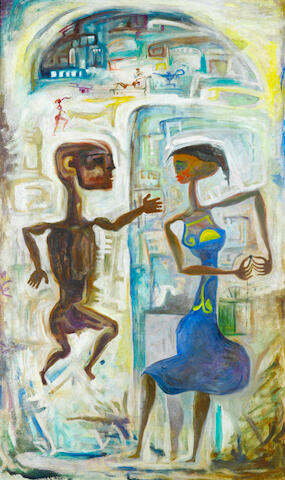
Hamed Nada (Egypt, 1924-1990)
Tying Him Down to Her
oil on canvas
128.5 x 76.5cm (50 9/16 x 30 1/8in).
.
Hamed Nada is considered a third generation surrealist and was a member of the Group of Contemporary Arts founded by Hussein Youssef Amin in 1944.
The group's members strove to create new forms of art based entirely on traditional Egyptian themes using elements unique to Egyptian culture. Nada's work evolved following the revolution in 1952, during a newly created atmosphere of optimism and freedom.
Nada's work from this period is far removed from that of his contemporaries and his earlier paintings which were much more tragic in their nature. The period following the revolution saw him cast aside the darker themes and concentrate on more positive subjects. The colours became more vibrant and his works displayed far more movement and rhythm than before.
Though the painting is undated, the style reflects Nada's work of the late seventies and early eighties.""Tying him down to her"" depicts a woman rolling-up a small ball of thread with which she intends to ensnare her husband. If she fails the male figure who is already beginning to float upwards will disappear into the ether above which consists of wild dancing women and the dark crowded buildings of a city.
The female figure is depicted in stark contrast to her male counterpart. Her shapely figure is rooted to the ground, and she is within an ethereal box containing windows and a patch of earth to her right, suggestive of the life they may have together. It is clear that if she fails in her bid then her dreams will disappear and her target will float away into the bacchanalian scene above.
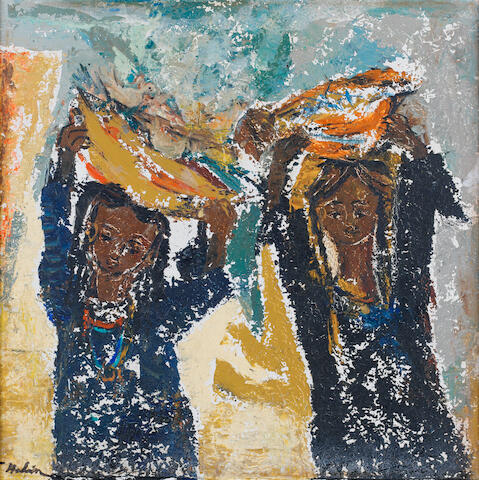
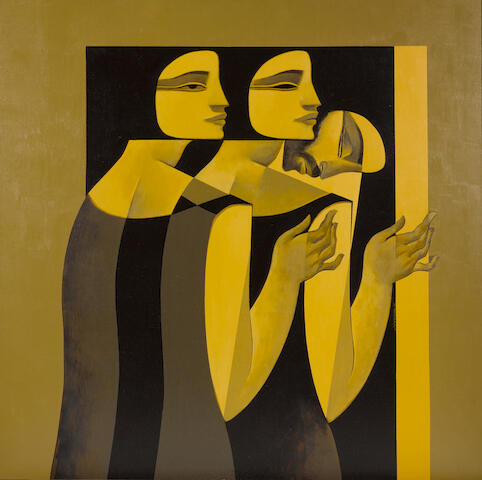
Tahia Halim (Egypt, 1919-2003)
Two Girls
oil on board
signed lower left,
46.5 x 46.5cm (18 5/16 x 18 5/16in).
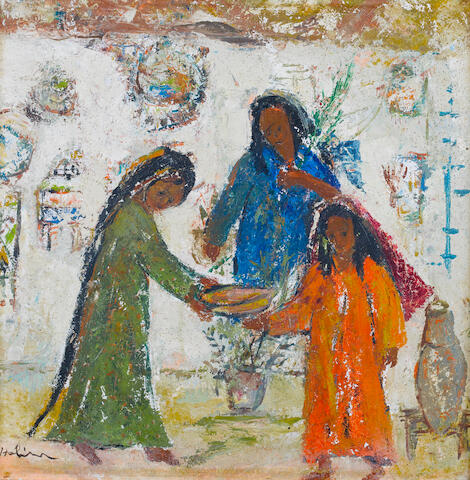
Tahia Halim (Egypt, 1919-2003)
Three Girls
oil on board
signed lower left,
46.5 x 46.5cm (18 5/16 x 18 5/16in)
Both works by the artist were executed in the 1960s during the artist's Nubian period. Halim visited Nubia twice in the early 1960s, once with her friend and colleague Cleopatra Shahata in 1961 and again with a group of fifty academics and artists in 1962 on a trip organised by Tharwat Okasha, the then Minister for Culture and National Guidance.
Both trips were to leave lasting impressions on Halim who worked closely with the inhabitants of Nubia to document and study their ways of life, their traditions and rituals. The main reason this trip was organised was to preserve in some way the area around Aswan which was due to be flooded upon completion of the High Dam. More on these paintings
Tahia Mohammed Halim, (Egypt, 1919-2003), was an Egyptian painte, and one of the pioneers of the Modern Expressive Movement in Egyptian Art in the 1960s, where she excelled in expressing the Egyptian character’s idiosyncrasies in her works. She has many works concerning the Nile, boats and the popular and national subjects for which she has been granted several honorary awards in Egypt and abroad.
Tahia Halim was born in Sudan, where her family were living. Her primary education was inside the Royal Palace of Cairo, where she was raised, as her father was the laureate of King Fuad I of Egypt.
Tahia Halim studied art under important drawing teachers as the Lebanese painter Yussef Trabelsi and the Greek artist Gerom; then under the Egyptian artist Hamed Abdullah at his studio 1943, they married in 1945, then left for Paris to join the Julian Academy (1949-1951). After returning to Egypt, they taught art, together, in their private studio, in Down Town (near Tahrir Square) in Cairo. Tahia Halim received two devotion scholarships of Art Production in 1960 and in 1975. More on Tahia Mohammed Halim
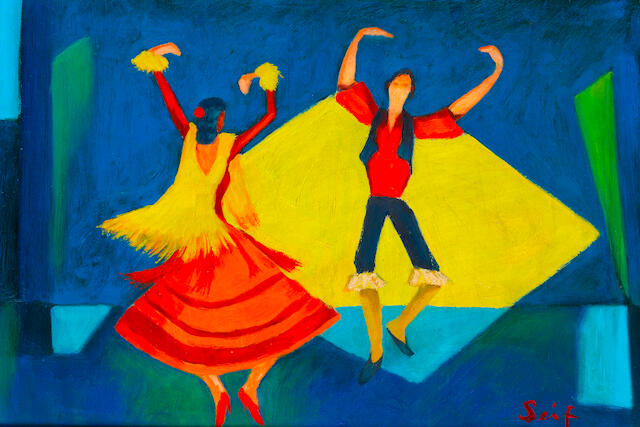
Seif Wanly (Egypt, 1906-1979)
Spanish Ballet Dancers
oil on board
signed lower right
on the reverse is a lable dedicating this work to the ex-Govenor of Alexandria, Mr. Hussein Sobhy
31.8 x 47.1cm (12 1/2 x 18 9/16in).
Seif Waly (March 31, 1906 – February 15, 1979) was an Egyptian painter, born Mohammed Seif al-Din Waly into an aristocratic family, of Turkish origin, in Alexandria, Egypt. He was introduced to modern art after studying at the studio of the Italian artist Otorino Becchi. In 1942 he set up his own studio with his brother Adham Wanly (below) and together they participated in more than 17 exhibitions, notably in the Biennale of Venice and in São Paulo, Brazil. Today an entire floor of the Mahmoud Said Museum in Alexandria is dedicated to Seif and Adham Wanly.
His work is collected by several Museums, including Mathaf: Arab Museum of Modern Art in Doha, Darat AL Funoon in Amman.
He died in 1979 at Stockholm at age of 72. More
Adham Wanly (Egypt, 1908-1959)
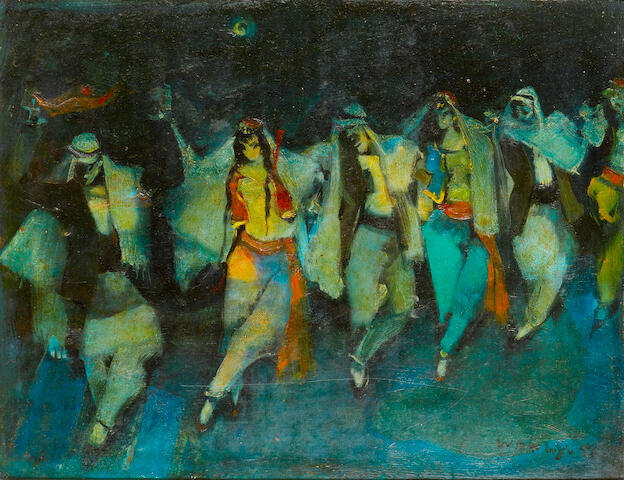
Nocturne Dabaka Dancers
oil on board
signed and dated '56 lower right
49.2 x 64cm (19 3/8 x 25 3/16in).
The dabka, literally 'stamping of the feet' is a type of line dance popular at weddings and celebrations throughout the Middle East. In Wanly's work the figures are gracefully depicted, appearing almost to float across the canvas.
Adham Wanly (1908 in Alexandria, Egypt – 1959) was an Egyptian painter who learnt in the atelier of the Italian Otorino Becchi 1932, then set up his own atelier with his brother Seif Wanly (above), and participated in many local and international exhibition specially Venice, São Paulo (Brasil), Alexandria Biennale.
The Museum of Modern Art in Alexandria displays many of his paintings. The artist is mostly famous for recording the life of the theater and circus. He specialized in the ballet and opera as featured in the Cairo Opera House and the Theatre Mohamed Ali, in Alexandria. The paintings render the stage lights and movements of the people involved and he is able to express the light and agility in various ways. He had a talent in caricature in which he used in mockery of himself and the people of his time. There is now a museum in his memory. More

Suad Al Attar (Iraq, born 1942)
Unknown
oil and gold leaf on canvas
Suad Al Attar (Iraq, born 1942)
Unknown
oil and gold leaf on canvas
Suad Al Attar (Iraq, born 1942)
Unknown
oil on canvas
Suad Al Attar (Iraq, born 1942)
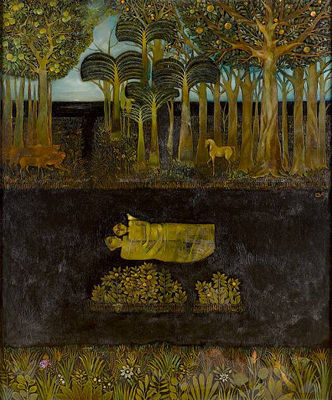
Garden of Eden, c. 1993
Suad Al Attar (Iraq, born 1942)
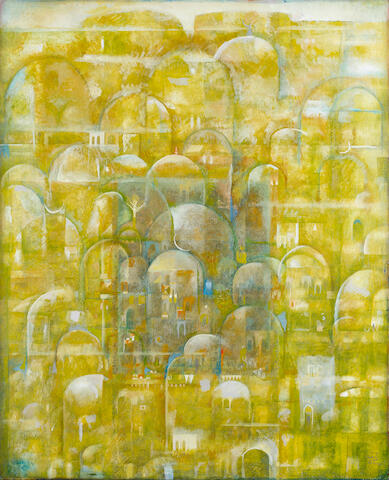
City of Domes
oil and gold leaf on canvas
signed and dated 2009 in English and signed in Arabic lower right
100 x 81cm (39 3/8 x 31 7/8in).
Suad al-Attar (born 1942) is a renowned Iraqi painter whose work is in private and public collections worldwide, including The British Museum and the Gulbenkian Collection. She has held over twenty solo exhibitions, including one in Baghdad that became the first solo exhibition in the country's history for a woman artist. Her many awards include the first prize at the International Biennale in Cairo in 1984 and an award of distinction at the Biennale held in Malta in 1995.
Suad left Baghdad with her husband and children in 1976, and settled in London. For her, the perpetual sense of longing for "home" has always been balanced by an awareness of the freedom that comes with distance. This freedom—a condition that gained added significance following the regime’s rise to power under Saddam Hussein in the late 1970s—has enabled her to explore her relationship with her homeland and to develop a personal visual language with which to express it.
Elements of this language are to be found within the traditions of Middle Eastern art. The winged creatures of Assyrian reliefs, Sumerian sculptures and the illuminated manuscripts of the Baghdadi School were instrumental. However, this awareness of her Arab heritage did not result in slavish imitation, but was forged with her own romantic imagination and an appreciation of western figurative traditions to create enigmatic images in which narrative and symbolism are intertwined.
A substantial monograph documenting her career was published in London in 2004. Much of Suad’s painting is characterised by an intense dreamlike and poetic sensibility that draws on motifs and symbols from within the traditions of Middle Eastern art. In recent years, these richly-coloured representations of paradise and of sleeping cities bathed in turquoise blue, have disappeared from her work as she has become increasingly preoccupied with the plight of Iraq. More on Suad al-Attar
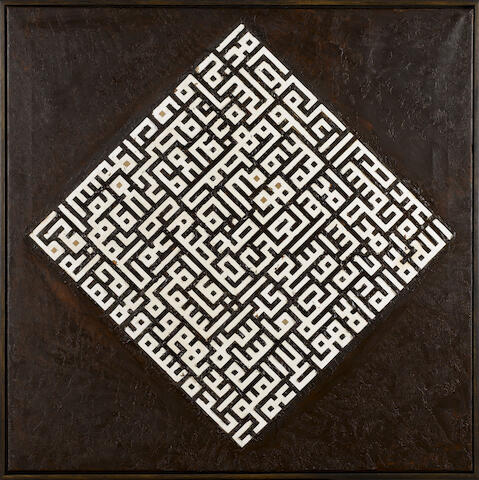
Issam El-Said (Iraq, 1938-1988)
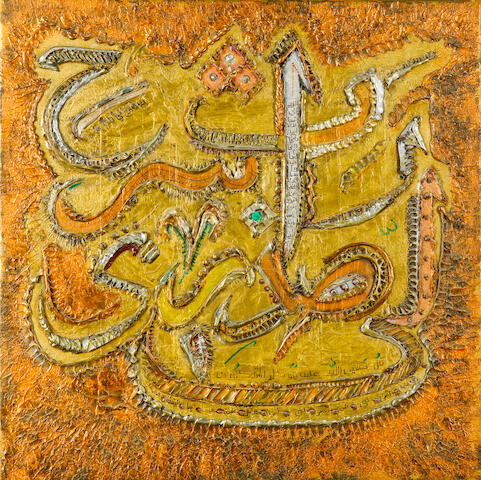
Ayat al-Kursi, c. 1979
oil on canvas
stamp of the Issam El-Said Foundation on reverse
91 x 91 cm.
Issam El-Said (Iraq, 1938-1988)
Untitled
oil, acrylic and ink on canvas
signed and dated '81 in Arabic lower left
60.8 x 60.8cm (23 15/16 x 23 15/16in).
Issam El-Said (1938 - 1988). Born in Baghdad in 1939 El-Said studied architecture at Cambridge University before concentrating on painting printmaking and sculpture. By expressing the Islamic tradition in contemporary idiom his works help to create a bridge between the artistic cultures of the West and of Islam.
"Art is to serve a purpose and allow people to develop their own creative instincts from it. We have become far removed from such ideas. In the old days, art began as a craft; it was used towards a given end. This is not the case today. Take the architect for example, he is a master-builder of yesterday, but he has lost touch with his basic tools: earth, wood, brick, concrete. Things have become too abstract; so abstract that we can no longer relate to them on a practical level." - Issam Al Said
Issam Al Said exemplifies an attempt of reconciliation, one where belief, traditional crafts and modern aesthetics seek a common ground. His paintings express aspects of spirituality as well as the mathematical principles that lay at the base of traditional Islamic non-figurative art. More on Issam El-Said
Aydin Aghdashloo (Iran, born 1940)
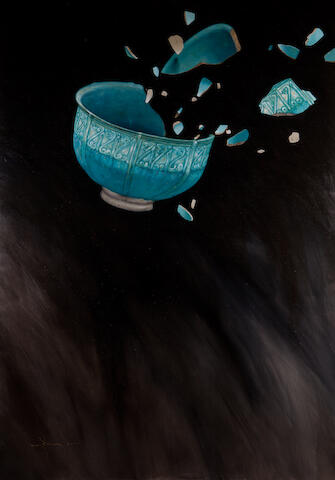
Memories of Destruction
oil on canvas
signed and dated 2010 lower left
200 x 140cm (78 3/4 x 55 1/8in)
Aydin Aghdashloo (born October 30, 1940; Rasht, Iran) is an Iranian painter, author, art critic, art historian and graphic designer. He currently lives in Tehran, Iran, and lectures in different Iranian Universities besides his professional work.
Early in his career, Aghdashloo took great interest in the Renaissance and Sandro Botticelli's paintings in particular. He even used to test his own skills by copying Botticelli's works to the last detail. His admiration for Renaissance paintings lead to the creation of his "Memories of Destruction" series in the early 1970s which became his most celebrated and famous series. In these series Aghdashloo depicts destruction of identity and beauty by painting a complete Renaissance masterpiece and then partially destroy or deface it.
"Memories of Destruction" continued after 1979 but went through a transformation in which Islamic art became his main model instead of Renaissance art, while in both periods he uses Islamic and Renaissance models simultaneously.
He also uses Persian miniatures extensively in his paintings after 1979. The crumpled Persian miniature series are the best example. More on Aydin Aghdashloo
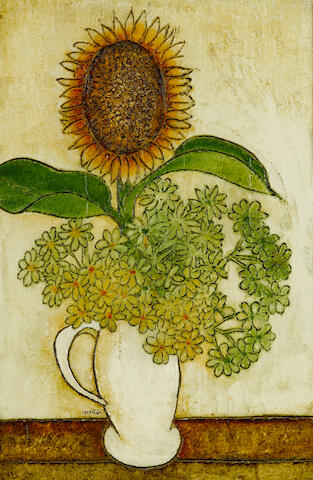
Parvaneh Etemadi (Iran, born 1947)
Sunflowers
cement and acrylic on board
signed and dated 1970 in Farsi lower left
73.6 x 48.7cm (29 x 19 3/16in)
Parvaneh Etemadi, (Iranian, 1947)
Woman and Urn, c. 1977
cement and oil on panel
signed and dated in Farsi (lower left), signed 'p. etemadi' and dated in Farsi (on the reverse)
31.30 in. (79.50 cm.) (height) by 46.85 in. (119.00 cm.) (width)
Parvaneh Etemadi, (Iranian, 1947)
THE EXIT OF FARHAD AND SHIRIN, 2012
100 X 70 CM — EDITION OF 6
Parvaneh Etemadi, (Iranian, 1947)
THE EXIT OF FARHAD AND SHIRIN, 2012
100 X 70 CM — EDITION OF 6
Parvaneh Etemadi, born in Tehran in 1948, with nearly five decades of lively presence on the scene of visual arts, Parvaneh Etemadi is one of the most successful and popular Iranian artists both in the eyes of art virtuosos and laymen.
Even though she was born in Tehran, Etemadi she spent her early childhood in the city of Birjand (in south of Khorasan close to the vast barren eastern Iranian plateau). After finishing both her primary and secondary education in Tehran she began to study at the Fine Art College of Tehran University (1967). This coincided with the foundation of Ta’la’r-e Iran (Hall of Iran, later changed to Talar Ghandriz) by a group of visual arts activists; a significant event attracting many young artists including Parvaneh who not only participated in more than 10 group exhibitions displayed there from 1967 to 1977, but also held her first solo exhibition at the same hall (Ghandriz) in 1969.
During the first period of her artistic activity she appeared as an abstract painter. Her abstract works were free compositions of forms appearing in pleasing proportions with extensive touches of cold opaque colors, nevertheless designed and worked out candidly and resolutely.
This second period of her artistic activity which took shape in the seventies was a synthesis of constructivism of her first period with a return to figurative art. The works of this period with their rough sketchy textures of oil color on a cement infrastructure and their modern minimal structure, together with the least application of line and color as well as design and figure emerged as plain agreeable charming still lives
In the third period of her works (from 1980 onwards) was a return to the imaginary basement of her grandmother with trunks of old forgotten outfits and textiles. During this period, by virtue of her perfect brilliant technique, a colorful pallet of warm shinny harmonious and balanced colors, she reproduced fine garments and textiles of silk and termeh designed with familiar flowers, fruit and home utensils in very gorgeous still lives.
In her collages which mark the fourth period of her work, Etemadi began a new venture. Her compositions now made up of cut photocopied pieces of her previous color pencil paintings glued on the surface of wide canvases with still more colorful and varied pallet appeard as a kind of artistic improvisation of fantastic free dancing outfits often breaking through the surface and the frame of the canvas as though refusing to be imprisoned in any limited fixed form.
After 2000, Parvaneh Etemadi ventured new experiences. Participation in an installation calling public attention to the environment in Hanover, Germany in the same year, working with ceramic and combining it with calligraphy displayed in an applied art exhibition held at House of Iranian Artists and finally beginning a new period (still continuing) exhibited under the title Once upon a Time held at Golestan Gallery in 2004 showing the peak of her collages, this time combined with ancient Iranian myths, fables and literature. More on Parvaneh Etemadi
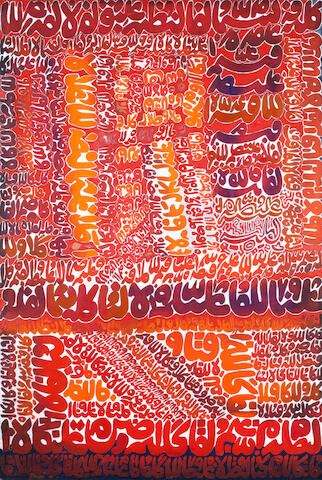
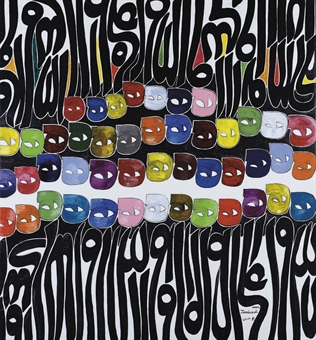
Charles Hossein Zenderoudi (Iran, b. 1937)
Untitled
oil and metallic paint on canvas
signed on reverse
146 x 97cm (57 1/2 x 38 3/16in)
Charles Hossein Zenderoudi (Iranian, b. 1937)
Tchaar-Bagh
signed and dated 'Hossein Zenderoudi 81' and signed in Farsi (lower right)
signed, titled and dated 'HOSSEIN ZENDEROUDI 1981 TCHAAR BAGH' and signed in Farsi (on the reverse)
oil and acrylic on canvas
82 5/8 x 76¾in. (210 x 195cm.)
Painted in 1981
Charles Hossein Zenderoudi (born 1937 Tehran) is one of Iran's most accomplished modern artists, and as a founding father of the highly influential Saqqa Khaneh movement, has been a pioneering figurehead of Iranian neo-traditionalism.
His choice of subject matter, calligraphy, has historically been the most established mode of formal artistic expression prevalent in Iran, but, by emphasizing form over meaning, and by stripping the written word down to its aesthetic, structural, fundaments, Zenderoudi subverts the traditional values of Persian calligraphy. Zenderoudi's text is intentionally illegible and carries no literal meaning, freeing it from the constraint of linguistic limitation, and imbuing it with a sense of universality which rescues the archaic practice of calligraphy from obscurity, giving it renewed relevance in a contemporary context.
Zenderoudi's compositions pay homage to centuries of Persian religious imagery and employ a systematic repetition of letter-forms that finds its genesis in the mystical practice of Sufi numerologists, who believed in the spiritual significance of singular letters and worked these principles into hugely intricate talismanic charts. Zenderoudi's methodical compositions, whilst not accurately following the grammar or axioms of numerology, capture the aesthetic and conceptual qualities of its cryptic nature.
Zenderoudi's early works focused on dense talismanic imagery, mixing iconography, freehand script and numerals. The density of these compositions sought to capture the visual intensity of popular religious expression in Iran, where banners, standards, altars, murals and mosques exuberantly adorn the urban landscape.
Works from the present series, composed in the early 1970's, mark a shift towards a more compositionally terse, technical and measured approach to calligraphy. The crowded iconography of the early works is replaced by a greater focus on larger letter-forms, which exhibit a formal refinement lacking in their earlier counterparts.
Measured but spontaneous, technical yet effuse, Zenderoudi' manipulates Persian calligraphy with effortless ease, boasting a visual scope which faithfully captures the salient elements of Iran's traditional popular religious aesthetic. Rendered with the use of rich and vibrant colours, his canvases replicate the tonal and textural qualities of the votive art so common to the Iranian urban landscape. More on Charles Hossein Zenderoudi
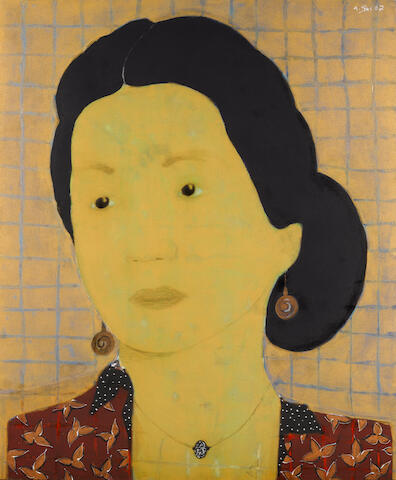
Adel El-Siwi (Egypt, born 1952)
Umm Kalthom
acrylic on canvas laid down on board
signed and dated '07 upper righ
170 x 140cm (66 15/16 x 55 1/8in).
Umm Kulthum December 31, 1898, (or May 4, 1904) died February 3, 1975) was an internationally renowned Egyptian singer, songwriter, and film actress active from the 1920s to the 1970s. She was given the honorific title Kawkab El Sharq "Planet of the Orient".
Umm Kulthum was known for her extraordinary vocal ability and style, and she was one of the greatest and most influential singers of the 20th century, where she has sold over 80 million records worldwide. Umm Kulthum is considered a national icon in her native Egypt and has been dubbed as The voice of Egypt and Egypt's fourth pyramid. She remains the most revered legendary singer in Egypt and the entire Arabic-speaking world. More on Umm Kulthum
Adel El Siwi ( Behera , 1952) is an artist Egyptian. Adel was born in 1952 in Behera , in Egypt . He studied at the Faculty of Medicine of Cairo in 1976. Meanwhile, independently attended the Faculty of Fine Arts in Cairo. Since 1979 painting becomes a full-time business. In 1980 he moved to Milan , where he lived for the next ten years. In 1990 he returned to Cairo, where he still lives. After the debut exhibition in a gallery in Cairo, he showed his works around the world, from Egypt to Germany from Lebanon to Italy, until arriving in Mexico and Brazil. Parallel to the artistic success, his work dealt with other issues, such as the translation into Arabic of the Treatise on Painting by Leonardo da Vinci. In addition, he worked as art director for the big screen and has signed publications on contemporary art. More on Adel El-Siwi
Safwan Dahoul (Syria, born 1961)
Reve/ Dream
acrylic on canvas
signed and dated 2007 in English and signed in Arabic lower right, further signed, dated, titled, and inscribed with the size in English and signed in Arabic on the reverse
180 x 179cm (70 7/8 x 70 1/2in).
Safwan Dahoul completed his first Dream in 1987, he has painted the same woman in the same muted monochromatic colours on what he assumes has been more than 1,000 canvases (although he never kept count). Every time, he titled it Dream. More on Dream
Safwan was born in Hama, Syria in 1961. He graduated from the Fine Arts Faculty of Damascus in 1985 and continued his experimentation and education till 1997 when he was awarded a Doctorate in Plastic Arts from the Higher Plastic Arts Institute of Mons, Belgium. During his career, Safwan has exhibited and sold out most of his solo shows throughout the Middle East and Europe. More on Safwan Dahoul
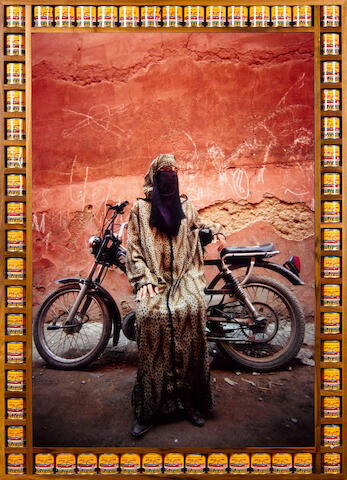
Hassan Hajjaj (Morocco, born 1961)
Sista
c-print on board set into a wooden frame with metal tins
signed, titled, dated 2000 and numbered 5 of 7 in English on reverse, further signed in Arabic
129.8 x 94cm (51 1/8 x 37in).
Sista: is a woman who carries herself with pride.
Hassan Hajjaj (b. Larache, Morocco in 1961) is a contemporary artist who lives and works between London, UK and Marrakech, Morocco, and is known as the “Andy Warhol of Marrakech.”
Hajjaj's work is in the collections of the Brooklyn Museum, New York; the British Museum, London; the Nasher Museum of Art, Duke University, Durham, NC; the Newark Museum, New Jersey; Los Angeles Museum of Contemporary Art, Los Angeles; the Victoria & Albert Museum, London; the Farjam Collection, Dubai; Institut des Cultures d’Islam, Paris; Kamel Lazaar Foundation, Tunisia; and Virginia Museum of Fine Art, Richmond, VA.
Hajjaj was the winner of the 2011 Sovereign Middle East and African Art Prize and was shortlisted for Victoria and Albert Museum's Jameel Prize in 2009. In 2013, Rose Issa Projects published a monograph of the artist exploring his upbringing in Morocco and London, his experiences in fashion and interior design, and his adventures in the music industry influence the vibrant colours, joyful spirit, and visual rhythm of his highly sought-after images.
Hajjaj's first feature-length film, Karima: A Day in the Life of a Henna Girl, premiered at the Los Angeles County Museum of Art in May 2015. The film takes viewers into the world of one Hajjaj’s most iconic series, Kesh Angels, depicting the henna girls of Marrakesh. The film will be subsequently shown at Art Basel in Basel, Switzerland in June 2015, curated by Cairo-based film curator and lecturer Maxa Zoller. More on Hassan Hajjaj
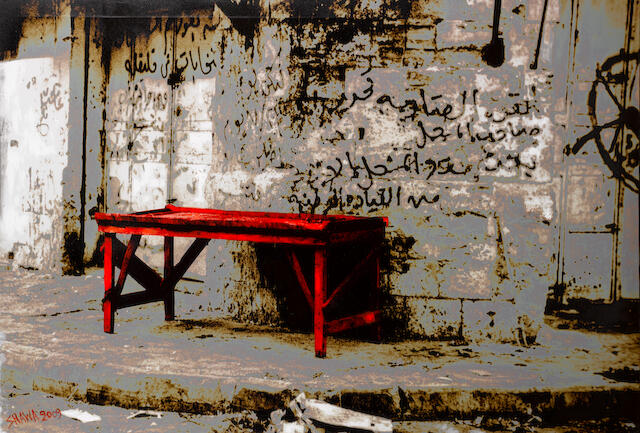
Laila Shawa (Palestine, born 1940)
Red Table
digital print and mixed media on canvas
signed and dated 2009
100 x 148cm (39 3/8 x 58 1/4in).
Laila Shawa (Born Gaza 1940) is a Palestinian artist. Her work has been described as reflecting a view of the politics of her country highlighting perceived injustices and persecution. Often her work uses photographs that are used as the base for silkscreen printing. Her work has been internationally exhibited and has work on display in many public (e.g. The British Museum) and private collections.
In 2012 to go alongside the AKA Peace Exhibition at the ICA Art Below showcased selected works from the AKA Peace series on the London Underground including Shawa's. "AKA Peace" originally conceived by photographer Bran Symondson and now curated by artist Jake Chapman, is an exhibition of new works made specially for The Peace One Day Project 2012, bringing together a group of Contemporary Artists, all of whom agreed to transform a decommissioned AK-47 assault rifle, refashioning into artworks. More on Laila Shawa
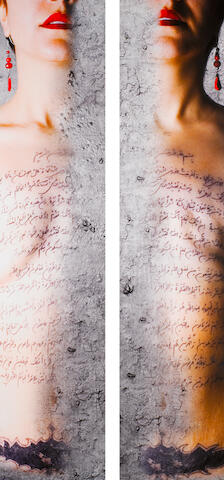
Mania Akbari (Iran, born 1974)
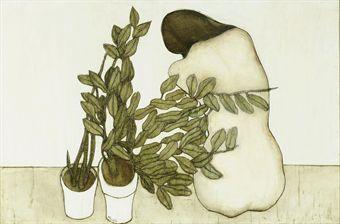
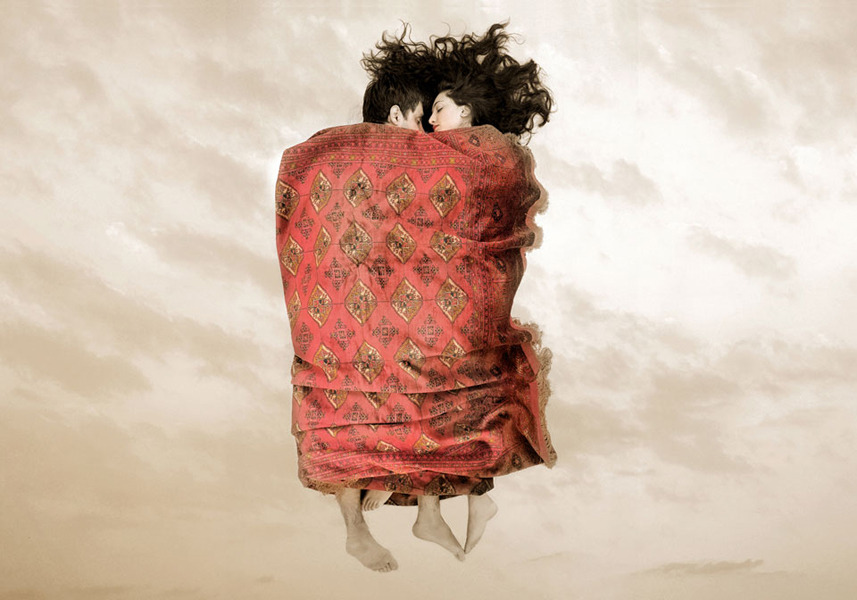
Untitled, c. 2008
Diptych, digital print on canvas,
180 x 40cm (70 7/8 x 15 3/4in); entire work 180 x 80cm (70 7/8 x 31 1/2in).
Private collection
Mania Akbari (born 1974) is an internationally acclaimed Iranian filmmaker, actress, artist and writer whose works mostly deal with themes of sexual identity, women, marriage, abortion, infidelity and lesbianism. Her style, unlike the long tradition of melodrama in Iranian cinema, is rooted in modern visual arts and the avant-garde. Akbari, because of the themes discussed in her films and her opposition to censorship, is considered as one of the most controversial filmmakers in Iran. As an actress, she is probably best known for her role on Abbas Kiarostami's Ten. More on Mania Akbari
Please visit my other blogs: Art Collector, Mythology, Marine Art, Portrait of a Lady, The Orientalist, Art of the Nude and The Canals of Venice, Middle East Artists, 365 Saints, 365 Days, and Biblical Icons, also visit my Boards on Pinterest
Images are copyright of their respective owners, assignees or others.
Some Images may be subject to copyright
I don't own any of these images - credit is always given when due unless
it is unknown to me. if I post your images without your permission, please tell
me.
I do not sell art, art prints, framed posters or reproductions. Ads are
shown only to compensate the hosting expenses.
If you enjoyed this post, please share with friends and family.
Thank you for visiting my blog and also for liking its posts and pages.
Please note that the content of this post primarily consists of articles
available from Wikipedia or other free sources online.

 Posts
Posts