Showing posts with label Venus. Show all posts

02 Works, The Art of War, Moretto da Brescia's Entombment with footnotes

After Moretto da Brescia
A Proper Burial
AI Generated

The Greeks believed that it was incredibly important that the dead were treated with respect and that everyone, no matter their social status or wealth, received a proper burial. Once the person had died, their eyes and mouth were closed. The body would be washed, perfumed and wrapped in a long shroud.

After Moretto da Brescia
A Proper Burial
AI Generated
nightcafe

Alessandro Bonvicino(c. 1498 – possibly 22 December 1554), more commonly known as Moretto da Brescia (the Moor of Brescia), was an Italian Renaissance painter from Brescia, where he also mostly worked. His dated works span the period from 1524 to 1554, but he was already described as a master in 1516. He was mainly a painter of altarpieces that tend towards sedateness, mostly for churches in and around Brescia, but also in Bergamo, Milan, Verona, and Asola; many remain in the churches they were painted for. The majority of these are on canvas.

He also painted a few portraits, but these are more influential. A full-length Portrait of a Man in the National Gallery, London, dated 1526, seems to be the earliest Italian independent portrait at full length, all the more unexpected as the subject, though clearly a wealthy nobleman, shows no sign of being from a princely ruling family. More on Moretto da Brescia

14 Works, The Art of War, Franz von Stuck's Night Raid, with footnotes

After Franz von Stuck
Alma rushing to put get to the battle
AI Generated
Available at deviantart

The enemy launched a surprise assault in the dead of the night. Alma deftly tightens her grip on her trusty sword, her mind becomes laser-focused. Years of training and countless battles have honed her instincts, making her a force to be reckoned with. She knows that this is not merely a clash of weapons but a test of her mettle, her determination, and her unwavering resolve.

After Franz von Stuck
With Just a Shield and Sword
AI Generated
Available at deviantart

As she deftly adjusts her armor, Alma's mind becomes laser-focused. Years of training and countless battles have honed her instincts, making her a force to be reckoned with. She knows that this is not merely a clash of weapons but a test of her mettle, her determination, and her unwavering resolve.

After Franz von Stuck
Alma takes command
AI Generated
Available at deviantart

The moonlight illuminates their determined faces as Alma takes command, rallying her comrades to stand strong. Though unarmed with their protective gear, their spirits blaze with unwavering resolve. Alma reminds them of their training, their shared purpose, and the lives they fight to defend. They lock eyes, each warrior knowing that they hold the lives of their comrades in their hands.

After Franz von Stuck
The unprepared fall
AI Generated
Available at deviantart

Alma's heart sinks as she recognizes the faces of those who have fallen. Some were once vibrant and full of life, now lying still and cold on the blood-soaked ground. These were warriors who had trained alongside her, shared stories around the campfire, and dreamt of a brighter future. Now, their dreams have been abruptly extinguished.

After Franz von Stuck
They charge towards the enemy
AI Generated
Available at deviantart

With a collective breath, they charge towards the enemy, their movements fluid and synchronized. Every step carries the weight of their unbreakable bond, their trust in each other's abilities. Alma leads by example, her sword slashing through the air with calculated precision.

After Franz von Stuck
Taking cover behind their horses
AI Generated
Available at deviantart

As Alma and her warriors move forward, their resolve burns brighter than ever. With each battle, their preparedness becomes a shield against the chaos and uncertainty of war. No longer caught off guard, they emerge as a force to be reckoned with, fighting not only for victory but to honor the memory of those who fell due to unpreparedness.

After Franz von Stuck
Taking cover behind any shield
AI Generated
Available at deviantart

After Franz von Stuck
Holding the line
AI Generated
Available at deviantart

By holding the enemy back, they can maintain control over their crucial areas, limit the enemy's options, and safeguard their own forces, allowing for potential counteroffensives or reinforcements.

After Franz von Stuck
They have stopped the enemy advance
AI Generated
Available at deviantart

The enemy advance seems to have been stopped, but Alma's fight is not just against them. It is a fight for understanding and unity. Someday her people and their adversaries can find common ground and live in peace.

After Franz von Stuck
The Survivors
AI Generated
Available at deviantart

Grief washes over Alma and her surviving comrades as they mourn the loss of their fallen brothers and sisters. They had fought side by side, relying on each other's strength and unwavering support. Their absence leaves an immeasurable void, a stark reminder of the importance of preparedness in the face of battle.

After Franz von Stuck
Its time to mourn
AI Generated
Available at deviantart

Alma gathers her remaining warriors, ensuring that they take a moment to pay tribute to the fallen. She reflects on the harsh reality that their lives were cut short due to a lack of readiness. They were caught off guard, unprepared for the sudden onslaught. Alma vows that their sacrifice will not be in vain.

After Franz von Stuck
Helping the wounded
AI Generated
Available at deviantart

Helping the wounded involves a range of activities and services aimed at stabilizing and treating injuries, alleviating pain, preventing further harm, and facilitating recovery. 

After Franz von Stuck
Helping the wounded
AI Generated
Available at deviantart

They administer immediate relief, such as stopping bleeding, securing airways, and preventing shock.

With heavy hearts and a renewed sense of purpose, Alma and her surviving comrades bury the fallen. They honor them with a solemn ceremony, vowing to carry their memory and legacy forward.

After Franz von Stuck
Wounded Amazon, c.1904
Oil on canvas
62.8 × 72.7 cm (24.7 × 28.6 in)
Harvard Art Museums

As both a founder of the Munich Secession and an influential teacher at the city’s Royal Academy, Franz von Stuck was a central figure in Munich’s art world at the turn of the twentieth century. His modern interpretation of the antique in works such as this sculpture and painting brought him particular success. Wounded Amazon (2002.96) depicts a battle between Amazons and centaurs; the particular subject is not found in classical mythology but is of the artist’s own invention. Though he was clearly influenced by the antiquities in Munich’s Glyptothek museum, Stuck based the painting on photographic studies of a model posed in his studio. Ever since he had featured the goddess Athena on the poster for the first Munich Secession exhibition in 1893, classical female warriors had appeared in his work as symbols of the new art. There are two other versions of this painting, and the artist eventually produced three life-sized versions of the sculpture (2003.132). One was installed outside Villa Stuck, the home he had designed for himself in Munich. More on this painting

Franz Stuck (February 23, 1863 – August 30, 1928) was a German painter, sculptor, engraver, and architect. Born at Tettenweis near Passau, Stuck displayed an affinity for drawing and caricature from an early age. To begin his artistic education he relocated in 1878 to Munich, where he would settle for life. From 1881 to 1885 Stuck attended the Munich Academy.
In 1889 he exhibited his first paintings at the Munich Glass Palace, winning a gold medal for The Guardian of Paradise. In 1892 Stuck co-founded the Munich Secession, and also executed his first sculpture, Athlete. The next year he won further acclaim with the critical and public success of what is now his most famous work, the painting The Sin. Also during 1893, Stuck was awarded a gold medal for painting at the World's Columbian Exposition in Chicago, and was appointed to a royal professorship. In 1895 he began teaching painting at the Munich Academy.

Having attained much fame by this time, Stuck was ennobled on December 9, 1905 and would receive further public honours from around Europe during the remainder of his life. He continued to be well respected among young artists as professor at the Munich Academy, even after his artistic styles became unfashionable. More on Franz von Stuck


Please visit my other blogs: Art Collector, Mythology, Marine Art, Portrait of a Lady, The Orientalist, Art of the Nude and The Canals of Venice, Middle East Artists, 365 Saints, 365 Days, and Biblical Icons, also visit my Boards on Pinterest and deviantart

Images are copyright of their respective owners, assignees or others. Some Images may be subject to copyright

I don't own any of these images - credit is always given when due unless it is unknown to me. if I post your images without your permission, please tell me.

I do not sell art, art prints, framed posters or reproductions. Ads are shown only to compensate the hosting expenses.

If you enjoyed this post, please share with friends and family.

Thank you for visiting my blog and also for liking its posts and pages.

Please note that the content of this post primarily consists of articles available from Wikipedia or other free sources online.


02 Works, The Art of War, Sebastiano Ricci's Camillus Rescuing Rome from Brennus and Paul Joseph Jamin's Spoils of the Battle, with footnotes

Sebastiano Ricci,1659-1734
Camillus Rescuing Rome from Brennus, ca. between 1716 and 1720
Oil on canvas
17 1/8 × 23 1/8 inches (43.5 × 58.7 cm)
Detroit Institute of Arts

Sebastiano Ricci (1 August 1659 – 15 May 1734) was one of the principal figures in the revival of Venetian painting in the 1700s. Ricci's dramatic and sumptuous work appealed to ecclesiastical and royal patrons across Europe. His painting was indebted both to Paolo Veronese and other Italian painters of the 1500s and looked ahead to the next generation of Venetian artists including Giambattista Tiepolo and Antonio Guardi. 

Ricci began his training in Venice but following a charge of attempted murder, he departed for Bologna in 1681. Over the next fifteen years, Ricci was almost constantly on the move and is known to have worked in Parma, Rome, and Milan. His brushes with the law persisted but Ricci established his career as a decorative painter producing frescos and paintings for churches and palaces. 

Ricci finally returned to Venice in 1696 and received many commissions in the region. He also accepted important commissions in Vienna and Florence and in 1711 traveled to England with his nephew Marco, also an established painter. The luminous, decorative works Ricci produced for the British aristocracy secured his international reputation. In his later years, he increasingly collaborated with his nephew, creating works across Europe until shortly before his death in 1734. More on Sebastiano Ricci

In the Battle of the Allia, Brennus defeated the Romans and entered Rome itself. He captured the entire city of Rome except for the Capitoline Hill, which was successfully held against them. According to legend Marcus Manlius Capitolinus was alerted to the Gallic attack by the sacred geese of Juno. However, seeing their city devastated, the Romans attempted to buy their salvation from Brennus. The Romans agreed to pay one thousand pounds weight of gold. According to Livy, during a dispute over the weights used to measure the gold, Brennus threw his sword onto the scales and uttered the famous words "Vae victis!", which translates to "woe to the
conquered!". More on The Battle of the Allia

Paul Joseph Jamin  (1853–1903)
Brennus and His Share of the Spoils", also known as: "Spoils of the Battle", c. 1893
Oil on canvas
162 × 118 cm (63.7 × 46.4 in)
Private collection

Paul Joseph Jamin (9 February 1853 – 10 July 1903) was a French painter of the Academic Classicism school.

Jamin was born in Paris in 1853. He was a student of Gustave Boulanger.

His paintings were shown frequently at the Salon throughout the last quarter of the nineteenth century. One of his best-known paintings is Le Brenn et sa part de butin (1893), which depicts the Gaulish chieftain Brennus viewing his captives after the looting of Rome. Above painting

Jamin died in Paris on 10 July 1903. More on Paul Joseph Jamin

The argument about the weights had so delayed matters that the exiled dictator Marcus Furius Camillus had extra time to muster an army, return to Rome and expel the Gauls, saving both the city and the treasury, and telling Brennus, "not by gold, but by iron, is the nation to be recovered".The Gauls were first ejected from the city, then utterly annihilated in a regular engagement eight miles outside of town on the road to Gabii. Camillus was hailed by his troops as another Romulus, father of his country 'Pater Patriae' and second founder of Rome. More on Camillus Rescuing Rome from Brennus


Please visit my other blogs: Art Collector, Mythology, Marine Art, Portrait of a Lady, The Orientalist, Art of the Nude and The Canals of Venice, Middle East Artists, 365 Saints, 365 Days, and Biblical Icons, also visit my Boards on Pinterest and deviantart

Images are copyright of their respective owners, assignees or others. Some Images may be subject to copyright

I don't own any of these images - credit is always given when due unless it is unknown to me. if I post your images without your permission, please tell me.

I do not sell art, art prints, framed posters or reproductions. Ads are shown only to compensate the hosting expenses.

If you enjoyed this post, please share with friends and family.

Thank you for visiting my blog and also for liking its posts and pages.

Please note that the content of this post primarily consists of articles available from Wikipedia or other free sources online.


01 Work, The art of War, Pieter Paul Rubens' The Battle of the Amazons, with Footnotes

Circle of Pieter Paul Rubens (Siegen1577-Antwerp1640)
The Battle of the Amazons, c. about 1630
Oil on canvas
112 x 158 frame 130 x 176

For sale for 36 000 € in Jan 2024

The tangle of naked bodies, some mutilated, gives the idea of the extreme violence used in battle and the terrified expressions of the horses are of rare intensity. Their anguished gazes are the most exciting moment of the spectacular composition. The author of this great work demonstrates all his pictorial abilities by giving a great sensation of movement and volume to all the protagonists. More on this painting

Born on June 28, 1577, Flemish artist Peter Paul Rubens was one of the most celebrated and prolific artists in Europe during his lifetime as well as the entire Baroque era. His patrons included royalty and churches, and his art depicted subjects from religion, history and mythology. Known for such works as "The Descent from the Cross," "Wolf and Fox Hunt," "Peace and War," "Self-Portrait with Helena and Peter Paul" and "The Garden of Love," Rubens's style combined a knowledge of Renaissance classicism with lush brushwork and a lively realism. He died in 1640. More on Peter Paul Rubens


Please visit my other blogs: Art Collector, Mythology, Marine Art, Portrait of a Lady, The Orientalist, Art of the Nude and The Canals of Venice, Middle East Artists, 365 Saints, 365 Days, and Biblical Icons, also visit my Boards on Pinterest

Images are copyright of their respective owners, assignees or others. Some Images may be subject to copyright

I don't own any of these images - credit is always given when due unless it is unknown to me. if I post your images without your permission, please tell me.

I do not sell art, art prints, framed posters or reproductions. Ads are shown only to compensate the hosting expenses.

If you enjoyed this post, please share with friends and family.

Thank you for visiting my blog and also for liking its posts and pages.

Please note that the content of this post primarily consists of articles available from Wikipedia or other free sources online.


01 Work, The Art of War, Maximilian Pirner's The End of All Things, with footnotes

Maximilian Pirner
The End of All Things - Finis, c. 1887
Oil on canvas
height 100 cm, width 130 cm
National Gallery Prague

Maximilian Pirner's "The End of All Things" is a haunting and thought-provoking work of art that expertly combines technical skill with emotional depth. It is a testament to the power of art to explore the human condition and to challenge our perceptions of the world around us. More on this painting

Maximilian Pirner (13 February 1853 in SuÅ¡ice – 2 April 1924 in Prague) was a Czech painter. He was a member of the Vienna Secession, and associated with the Mánes Union of Fine Arts.

He was enrolled from 1872 to 1874 at the Academy of Fine Arts, Prague and from 1875 to 1879 at the Academy of Fine Arts, Vienna, where he studied with his countryman, Josef Matyáš Trenkwald. He remained in Vienna until 1887, although he was not an active participant in the local artistic community. At that time, he became a teacher at the Academy in Prague and was named a Professor there in 1896.

Pirner's usual themes were classical mythology. Pirner completed a number of sketches of female figures, many of them nudes. He also did stained glass windows and medals.

Described by one critic as having achieved "mastery of the sinuous line". Pirner also had his detractors. One contemporary critic, while acknowledging Pirner's talent, considered him an "over-sophisticated mystic. More on Maximilian Pirner


Please visit my other blogs: Art Collector, Mythology, Marine Art, Portrait of a Lady, The Orientalist, Art of the Nude and The Canals of Venice, Middle East Artists, 365 Saints, 365 Days, and Biblical Icons, also visit my Boards on Pinterest

Images are copyright of their respective owners, assignees or others. Some Images may be subject to copyright

I don't own any of these images - credit is always given when due unless it is unknown to me. if I post your images without your permission, please tell me.

I do not sell art, art prints, framed posters or reproductions. Ads are shown only to compensate the hosting expenses.

If you enjoyed this post, please share with friends and family.

Thank you for visiting my blog and also for liking its posts and pages.

Please note that the content of this post primarily consists of articles available from Wikipedia or other free sources online.


01 Work, The Art of War, Louis Masreliez's An Allegory of War, with footnotes

Louis Masreliez (1748 – 19 March 1810)
An Allegory of War
Oil on canvas
36 1/8 x 52 1/8 in. (92.5 x 132 cm.)
Private collection

Sold for USD 62,500 in Apr 2021

The present Allegory of War depicts a furious Minerva, Roman goddess of War, dismounting her horse-drawn chariot, shield in one hand, thunderbolt in the other, charging toward a distant battle. Above her flies the winged, bearded, bare-chested Boreas, ancient god of the cold North Wind, accompanied by winged zephyrs, who blow snowflakes from their mouths onto the ground below.

The historic Battle of Narva (an Estonian city on the border with Russia) was an early victory for Swedish troops in the Great Northern War (1700-1721), in which they fended off an attack by Russian military forces that outnumbered the Swedish army four-to-one. The Swedish military repelled the Russian offensive in part by advancing under cover of the terrible weather conditions: the Swedes struck at the exact moment a deep-freeze hit the region, the winds shifted, and a violent snowstorm blew directly at the Russian forces, blinding them with its intensity. The Russians, suffering devastating losses, soon capitulated. More on this painting

Louis Masreliez (1748 – 19 March 1810), born Adrien Louis Masreliez, was a French born, Swedish painter and interior designer.

Masreliez was born in Paris and came to Sweden at the age of 5 in 1753. He was the son of French ornamental sculptor Adrien Masreliez (1717–1806) and the elder brother of sculptor Jean Baptiste Masreliez (1753–1801).

He began his education at the Royal Swedish Academy of Fine Arts (Ritakademien) at the age of 10. Since the academy did not teach painting, he studied in Stockholm at the workshop of ornament painter Lorens Gottman (1708–1779).

In 1769 he was given a study grant which he used to travel to Paris, Bologna and Rome to study. In Rome he spent time with several of the French, Italian and German artists who would shape the Neoclassicism decorative style. In 1783, Louis Masreliez was called back to Sweden after his twelve-year absence. Following his returned to Sweden, he became a member (ledamot) of the Royal Swedish Academy of Arts. The following year he was made a professor of art history. He became rector of the Academy in 1802 and director in 1805.

His work is represented in the Swedish Nationalmuseum, the Gothenburg Museum of Art, and the Royal Palace. More on Louis Masreliez


Please visit my other blogs: Art Collector, Mythology, Marine Art, Portrait of a Lady, The Orientalist, Art of the Nude and The Canals of Venice, Middle East Artists, 365 Saints, 365 Days, and Biblical Icons, also visit my Boards on Pinterest

Images are copyright of their respective owners, assignees or others. Some Images may be subject to copyright

I don't own any of these images - credit is always given when due unless it is unknown to me. if I post your images without your permission, please tell me.

I do not sell art, art prints, framed posters or reproductions. Ads are shown only to compensate the hosting expenses.

If you enjoyed this post, please share with friends and family.

Thank you for visiting my blog and also for liking its posts and pages.

Please note that the content of this post primarily consists of articles available from Wikipedia or other free sources online.


01 Painting, The amorous game, Part 64 - With Footnotes

Lavinia Fontana
Mars and Venus, c. 1595
Oil on canvas
Madrid, Fundación Casa de Alba

In a bedroom a man and a young woman pose as Mars and Venus. She is completely naked and looks back: she stares at us and hands us a narcissus flower. He has only his helmet on his head and a drape covers his private parts: he looks at her and, almost frightened, puts his hand on her bottom. More on this painting

The Roman myth of Venus and Mars is of Venus, the Goddess of Love having a passionate affair with Mars, the God of War. 

Lavinia Fontana (August 24, 1552 – August 11, 1614) was a Bolognese Mannerist painter best known for her portraiture. She was trained by her father Prospero Fontana and was active in Bologna and Rome. She is regarded as the first female career artist in Western Europe as she relied on commissions for her income. Her family relied on her career as a painter, and her husband served as her agent and raised their eleven children. She was perhaps the first woman artist to paint female nudes.

Fontana and her family moved to Rome in 1603 at the invitation of Pope Clement VIII. She gained the patronage of the Buoncompagni, of which Pope Gregory XIII was a member. She was subsequently appointed as Portraitist in Ordinary at the Vatican. Lavinia thrived in Rome as she had in Bologna and Pope Paul V himself was among her sitters. She was the recipient of numerous honors. 

She was elected into the Accademia di San Luca of Rome. She died in the city on August 11, 1614 and was subsequently buried at Santa Maria sopra Minerva. More on Lavinia Fontana


Images are copyright of their respective owners, assignees or others. Some Images may be subject to copyright

I don't own any of these images - credit is always given when due unless it is unknown to me. if I post your images without your permission, please tell me.

I do not sell art, art prints, framed posters or reproductions. Ads are shown only to compensate the hosting expenses.

If you enjoyed this post, please share with friends and family.

Thank you for visiting my blog and also for liking its posts and pages.

Please note that the content of this post primarily consists of articles available from Wikipedia or other free sources online.

12 Painting - Classic Works of Art by the Old Masters, Jacopo Pontormo (May 24, 1494 – January 2, 1557), With Footnotes

Pontormo (1494–1557)
Portrait of Maria Salviati de' Medici with Giulia de' Medici, circa 1537
Oil on panel
Height: 88 cm (34.6 in). Width: 71.3 cm (28.1 in). Depth: 1 cm (0.4 in).
The Walters Art Museum

Maria still wears the sober clothing of mourning for her deceased husband, while Pontormo’s elegant style of painting conveys her aristocratic grace through the rendering of her impossibly long fingers. Furthermore, her fashionably pale skin, made matte by overcleaning in the past, was meant to indicate a privileged life led out of the sun, but it is also known that she was ill. Giulia has also been painted as pale, extremely so, perhaps to draw attention away from her African ancestry. More on this painting More on this painting

Maria Salviati was the wife of famous military leader Giovanni delle Bande Nere de' Medici (d. 1526) and the mother of Cosimo I (1519-1574), grand duke of Tuscany. The little girl holding her hand here is probably Giulia, a Medici relative who was left in Maria's care after the murder of the child's father, Duke Alessandro de' Medici (1511-1537). 

As Alessandro was born of a liaison between a Medici cardinal and a servant who, tradition has it, was African, this formal portrait may be the first of a girl of African ancestry in European art. The child was painted over sometime during the 19th century but was rediscovered during a 1937 cleaning of the work.

Although Maria still wears the clothing of mourning for her deceased husband, Pontormo's elegant style conveys her aristocratic grace through her impossibly long fingers and her fashionably pale color (indicative of a life led out of the sun), which she shares with Giulia. More on Maria Salviat 

Jacopo da Pontormo, original name Jacopo Carrucci  (born May 24, 1494, Pontormo, near Empoli, Republic of Florence —buried Jan. 2, 1557, Florence), Florentine painter who broke away from High Renaissance classicism to create a more personal, expressive style that is sometimes classified as early Mannerism.

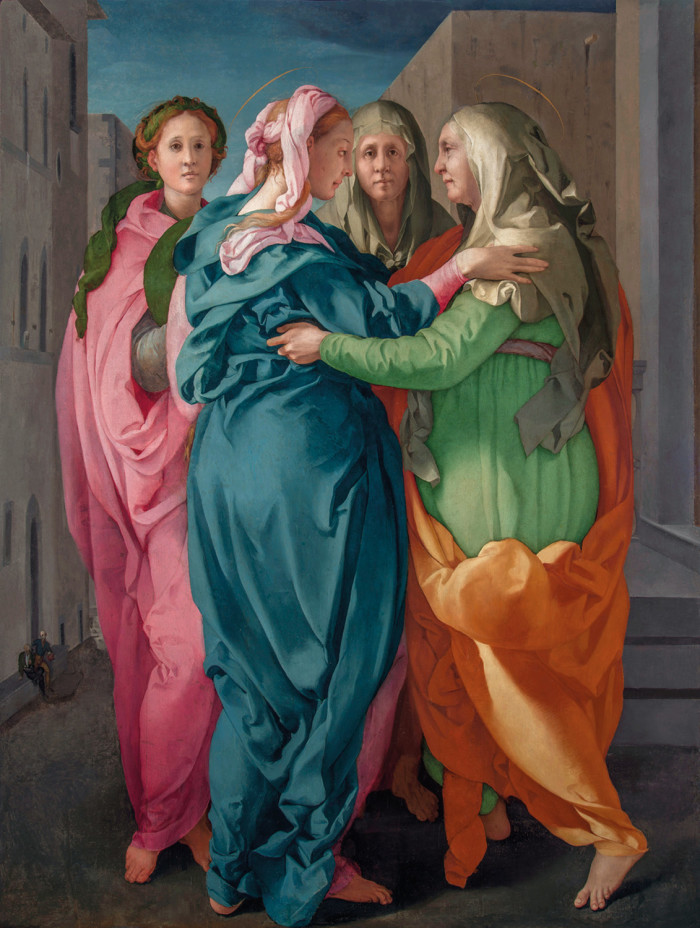
Pontormo was the son of Bartolommeo Carrucci, a painter. According to the biographer Giorgio Vasari, he was apprenticed to Leonardo da Vinci and afterward to Mariotto Albertinelli and Piero di Cosimo. At the age of 18 he entered the workshop of Andrea del Sarto, and it is this influence that is most apparent in his early works. An example of Pontormo's early style is a fresco depicting the Visitation of the Virgin and St Elizabeth, with its dancelike, balanced figures, painted from 1514 to 1516. 


Pontormo (1494–1557)
Visitation of the Virgin and St Elizabeth, c. 1514-1516
Fresco
392 × 337 cm (154.3 × 132.7 in)
Santa Annunziata, Florence

The Visitation is the visit of Mary with Elizabeth as recorded in the Gospel of Luke, Luke 1:39–56. It is also the name of a Christian feast day commemorating this visit, celebrated on 31 May in the West (2 July in calendars of the 1263–1969 period, and in the modern regional calendar of Germany as well as the Anglican Communion) and 30 March among Eastern Christians. 

This early Visitation makes an interesting comparison with his painting of the same subject (below), which was done about a decade later for the parish church of St. Michael in Carmignano, about 20 km west of Florence. Placing these two pictures together—one from his early style, and another from his mature period—throws Pontormo's artistic development into sharp relief. In the earlier work. 

Pontormo Visitation
Pontormo (1494–1557)
Visitation, c.1529
Oil on Wood
20.2 x 15.6 cm
Church of San Francesco e Michele, Carmignano, Italy

In 1518 he completed an altarpiece in the Church of San Michele Visdomini, Florence, that reflects in its agitated—almost neurotic—emotionalism a departure from the balance and tranquillity of the High Renaissance. His painting of Joseph in Egypt (c. 1515), one of a series for Pier Francesco Borgherini, suggests that the revolutionary new style appeared even earlier.

File:Jacopo Pontormo 032.jpg
Pontormo (1494–1557)
Joseph in Egypt, c. 1517-1518
Oil on canvas
44 × 49 cm (17.3 × 19.3 in)
National Gallery in London

The Joseph canvases offer another example of Pontormo's developing style. Done around the same time as the earlier Visitation, these works (such as Joseph in Egypt, above) show a much more mannerist leaning. According to Giorgio Vasari, the sitter for the boy seated on a step is his young apprentice, Bronzino.

Pontormo (1494–1557)
Martyrdom of St Maurice and the Theban Legion, c. 1528-30
Oil on wood
65 x 73 cm
Galleria Palatina (Palazzo Pitti), Florence

This picture represents a mass slaughter, including a series of crucifixions in the background. The battle scene on the left side of the panel recalls Leonardo's cartoon for the Battle of Anghiari, known today only through copies. Elsewhere there are reflections of Michelangelo's work, including the cartoon for the Battle of Cascina. Nevertheless, Pontormo always retains his own voice. More on this painting

Theban Legion was garrisoned at Thebes in Egypt, until the emperor Maximian ordered them to march to Gaul, to assist him against the rebels of Burgundy. The Theban Legion was commanded by Maurice (Mauritius), Candidus, Innocent, and Exuperius, all of whom are venerated as saints. At Saint-Maurice, Switzerland, then called Agaunum, the orders were given—since the Legion had refused to perform sacrifice according to the imperial cult —to "decimate" it by putting to death a tenth of its men. This act was repeated twice before the entire legion was put to death. More on the Theban Legion

Pontormo was primarily a religious painter, but he painted a number of sensitive portraits and in 1521 was employed by the Medici family to decorate their villa at Poggio a Caiano with mythological subjects. 

Pontormo (1494–1557)
Christ before Pilate, c. 1523-25
Fresco
300 x 290 cm
Certosa, Galuzzo

In the Passion cycle (1522–25) (above) for the Certosa near Florence, he borrowed ideas from the German artist Albrecht Dürer, whose engravings and woodcuts were circulating in Italy. His mature style is best exemplified in the Deposition (below) painted soon after this for Santa Felicità, Florence.

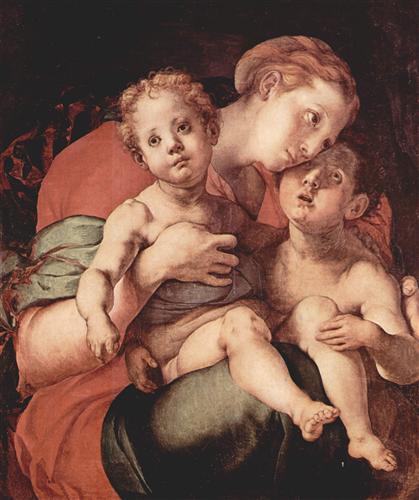
Madonna and Child with the Young Saint John - Jacopo Pontormo
Jacopo Pontormo
Madonna and Child with the Young Saint John, c.  1527
Oil on Wood
Galleria degli Uffizi, Florence, Italy

The composition is a great plastic concentration, echoing Michelangelo's Tondo Doni. The elongated forms derive from a typology of a heroic nature, possibly drawn from Michelangelo's Medici tombs in San Lorenzo, but Leonardo's influence is also still present, in the affectionate attitude of the Madonna bending towards the Child.

The figures are solid and well-defined, and the chiaroscuro, rendered with feeling, moulds the golden flesh surfaces with a yellowish light. More on this painting

File:Jacopo Pontormo - Kreuzabnahme Christi.jpg
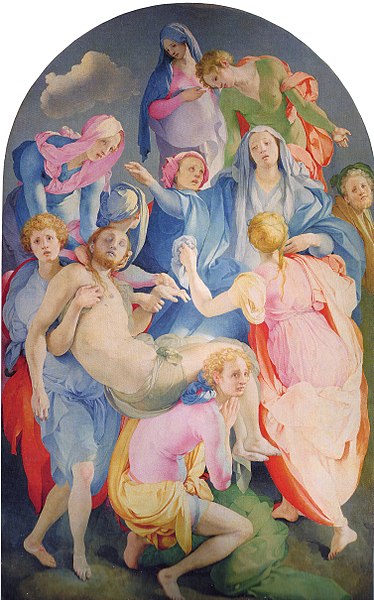
Pontormo (1494–1557)
The Deposition, from 1526 until 1528
Oil on canvas
313 × 192 cm (123.2 × 75.6 in)
Chiesa Santa Felicità, Florence

This painting suggests a whirling dance of the grief-stricken. They inhabit a flattened space, comprising a sculptural congregation of brightly demarcated colors. The vortex of the composition droops down towards the limp body of Jesus off center in the left. Those lowering Christ appear to demand our help in sustaining both the weight of his body (and the burden of sin Christ took on) and their grief. No Cross is visible; the natural world itself also appears to have nearly vanished: a lonely cloud and a shadowed patch of ground with a crumpled sheet provide sky and stratum for the mourners. If the sky and earth have lost color, the mourners have not; bright swathes of pink and blue envelop the pallid, limp Christ. More on this painting

Pontormo (1494–1557)
Madonna and Child with Saints, c. 1518
Oil on wood
214 x 185 cm
San Michele Visdomini, Florence

Pontormo executed this painting for the chapel of Francesco di Giovanni Pucci in the church San Michele Visdomini in Florence. The painting, usually mentioned as the Pucci Altarpiece, portrays the Virgin with St John the Evangelist, Joseph, holding the baby Jesus, the young St John, St Francis and St James, the latter being the artist's self-portrait.

The figures are arranged in two areas, divided by a vertical axis, which forms the height of a triangle, at whose apex is the Virgin's head. 

The compositions of both the right part and the left part, although symmetrical and populated by an identical number of figures, are organized very differently. The complex twisting of the bodies and the many different directions of the gestures suggest the use of a grid of extremely complicated and dynamic geometrical schemes. The lines of vision go in all possible directions; in no instance do they cross or match, this emphasizing the psychological isolation of the figures. The facial features and expressions of the older Joseph and St John the Evangelist, as well as the laughing putti, are exaggeratedly pronounced. In short, everything combines to create an atmosphere of restless instability. More on this painting

Pontormo (1494–1557)
Madonna and Child with St. Joseph and Saint John the Baptist, c. 1521-27
Oil on canvas transferred from wood
120 x 99 cm
The Hermitage, St. Petersburg

In this superb example of Pontormo's style, the theme of a premonition of the predestined Passion grows smoothly from the centre to the edges and from the surface into the depth. From the infant amusing himself wit a young goldfinch, our gaze shifts to the Virgin's sad face, then to the resigned faces of Joseph and John the baptist, before finally plunging into the agitated gloom of the firmament, in front of the ominous cross looms More on this painting

Pontormo became more and more of a recluse in later life. A diary survives from 1554 to 1557, but the important frescoes in San Lorenzo on which he worked during the last decade of his life are now known only from drawings; in these the influence of Michelangelo is apparent. Numerous drawings survive, and paintings are to be found in various galleries in Europe and America, as well as in Florence. More on Jacopo da Pontormo


Pontormo (1494–1557)
The Annunciation detail Virgin Annunciate, c. from 1527 until 1528
Fresco
Capponi Chapel, church of Santa Felicita in Florence

The Annunciation is a wall painting by the Italian mannerist artist Jacopo Pontormo, executed in 1527–1528 as part of his commission to decorate the Capponi Chapel in the church of Santa Felicita, Florence.

It is frescoed around the window on the wall adjacent to Pontormo's masterpiece, the famous Deposition from the Cross. Pontormo depicts the Annunciation, the revelation to Mary by the Archangel Gabriel that she would conceive a child to be born the Son of God, in a lively composition, with both figures in an elastic contrapposto. More on this painting

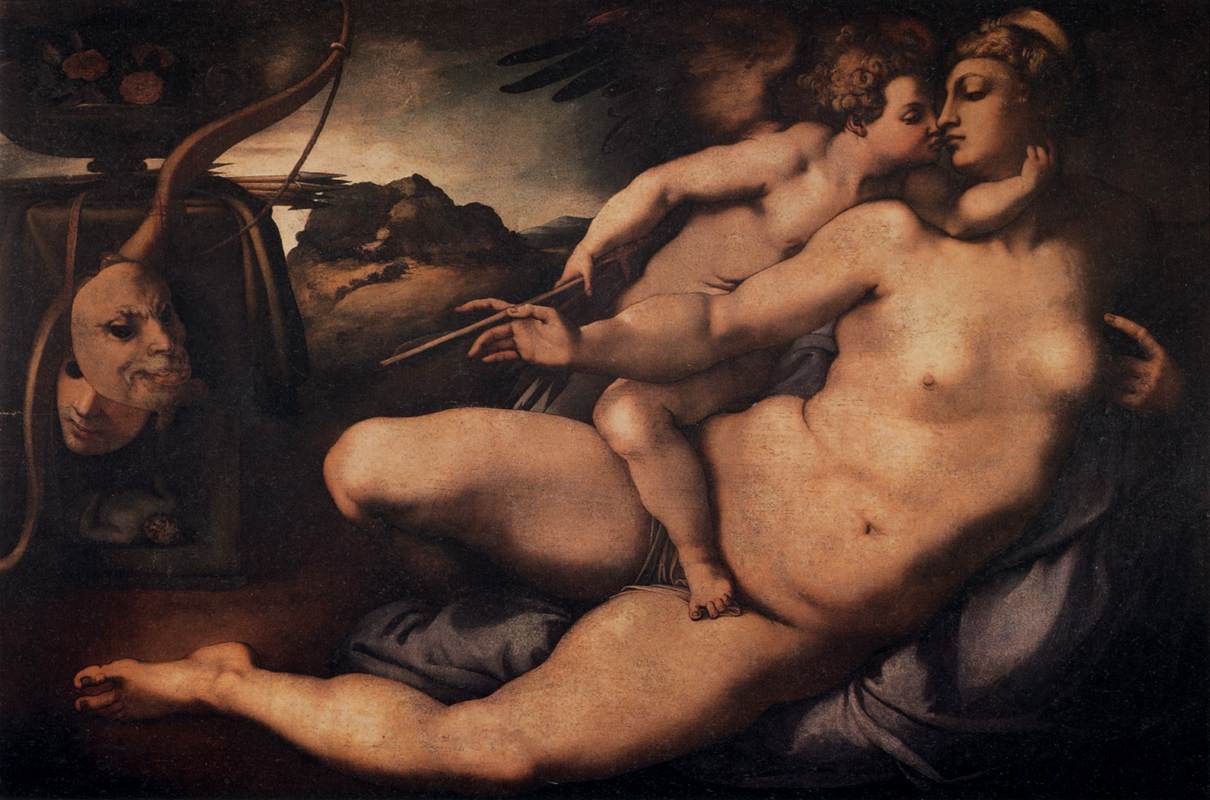
Pontormo (1494–1557)
Venus and Cupid, c. 1532-34
Oil on wood
128 x 197 cm
Galleria degli Uffizi, Florence

Venus turns her massive body into the picture plane, confronting the viewer with it and with the incestuous kiss she gives her young son - a juxtaposition recalling more conventional allegories of Charity. Her coolly classical face resembles the second of the two masks, symbols of the misleading nature of dreams. More on this painting


Please visit my other blogs: Art Collector, Mythology, Marine Art, Portrait of a Lady, The Orientalist, Art of the Nude and The Canals of Venice, Middle East Artists, 365 Saints, 365 Days, and Biblical Icons, also visit my Boards on Pinterest and deviantart

Images are copyright of their respective owners, assignees or others. Some Images may be subject to copyright

I don't own any of these images - credit is always given when due unless it is unknown to me. if I post your images without your permission, please tell me.

I do not sell art, art prints, framed posters or reproductions. Ads are shown only to compensate the hosting expenses.

If you enjoyed this post, please share with friends and family.

Thank you for visiting my blog and also for liking its posts and pages.

Please note that the content of this post primarily consists of articles available from Wikipedia or other free sources online.