Germain Fabius Brest, 1823 - 1900, FRENCH
ON THE BOSPHORUS
Oil on canvas
117 by 89cm., 46 by 35in.
Private Collection
Encouraged by his teacher in Marseille, Emile Loubon, Fabius Brest spent four years, from 1855 until 1859, living in Turkey, recording in a series of paintings views of Constantinople, the surrounding countryside, and the Black Sea coast. The time he spent there continued to inspire his work for the rest of his career, and provided the subjects for many of his Salon submissions throughout the 1860s and 1870s. More
Germain Fabius Brest (born 1823 - died in 1900) is a French orientalist painter. He studied his art with painters Emile Loubon, Marseille, and Constant Troyon in Paris.
On the advice of Loubon who made a living in Palestine. He then traveled to Turkey from 1855 to 1859, from where he returned with many landscape paintings.
The east, and especially architecture orientale remained his main sources of inspiration throughout his life. More Germain Fabius Brest
Marc-Aurèle Fortin, 1888 - 1970
Barge, Port of Montreal
Watercolour and pencil, c. 1934
10.25 x 13.75 in
Private Collection
Marc-Aurèle Fortin (March 14, 1888 – March
2, 1970) was a Québécois painter, born in 1888
in Ste-Rose, Quebec. He studied art in Montreal and worked at the Montreal
Post Office, and at an Edmonton bank. He studied art abroad. He was known for
painting watercolour landscapes of the St. Lawrence Valley. He travelled around
the St. Lawrence Valley by bicycle. Fortin believed that "Canadian artists
should take their inspiration from the countryside and progress towards a
national art... We should excel in landscapes, exactly as the French do".
He was
part of the first Atelier exhibition at Henry Morgan Galleries in April 1932
together with Atelier founder John Goodwin Lyman, André Biéler, and Edwin
Holgate. Fortin was exhibited by Galerie L'Art français from the 1940s.
His works are displayed at the Montreal Museum
of Fine Arts in Montreal. He was a member of the Royal Canadian Academy of
Arts[3] He died in 1970. More
Marc-Aurèle Fortin, 1888 - 1970
ANTIBES, LE PORT
Watercolour
28 x 37 cm
Private Collection
Marc-Aurèle Fortin, 1888 - 1970, see above
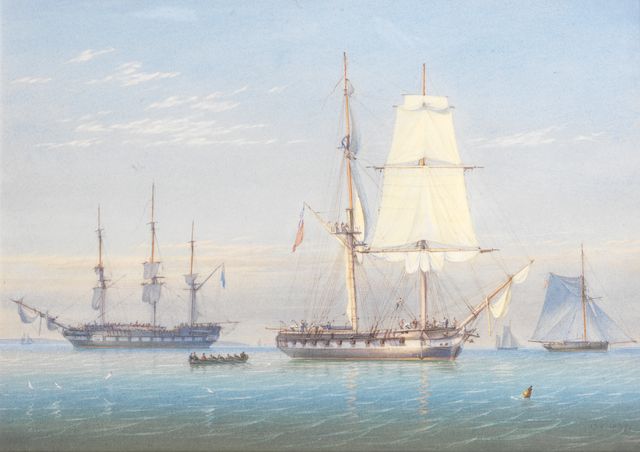
Montague Dawson, (1890–1973)
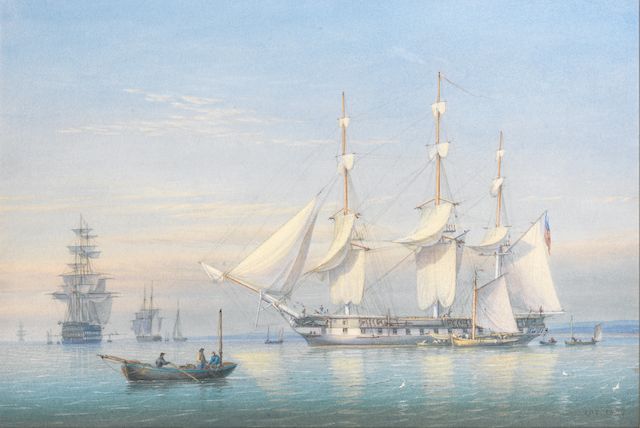
A merchant convoy under escort, c. 1918
pencil, watercolour and bodycolour
6 x 7 ½ in. (15.2 x 19 cm.)
Private Collection
Montague Dawson RMSA, FRSA (1890–1973) was a British
painter who was renowned as a maritime artist. His most famous paintings depict
sailing ships, usually clippers or warships of the 18th and 19th centuries.
Montague was the son of a keen yachtsman and the grandson of the marine painter
Henry Dawson (1811–1878), born in Chiswick, London. Much of his childhood was
spent on Southampton Water where he was able to indulge his interest in the
study of ships. For a brief period around 1910 Dawson worked for a commercial
art studio in Bedford Row, London, but with the outbreak of the First World War
he joined the Royal Navy. Whilst serving with the Navy in Falmouth he met
Charles Napier Hemy (1841–1917), who considerably influenced his work. In 1924
Dawson was the official artist for an Expedition to the South Seas by the steam
yacht St.George. During the expedition he provided illustrated reports to the
Graphic magazine.
After the
War, Dawson established himself as a professional marine artist, concentrating
on historical subjects and portraits of deep-water sailing ships. During the
Second World War, he was employed as a war artist. Dawson exhibited regularly
at the Royal Society of Marine Artists, of which he became a member, from 1946
to 1964, and occasionally at the Royal Academy between 1917 and 1936. By the
1930s he was considered one of the greatest living marine artists, whose
patrons included two American Presidents, Dwight D Eisenhower and Lyndon B
Johnson, as well as the British Royal Family. Also in the 1930s, he moved to
Milford-Upon-Sea in Hampshire, living there for many years. Dawson is noted for
the strict accuracy in the nautical detail of his paintings which often sell
for six figures.
The work of Montague Dawson is represented in
the National Maritime Museum, Greenwich and the Royal Naval Museum, Portsmouth. More Montague Dawson
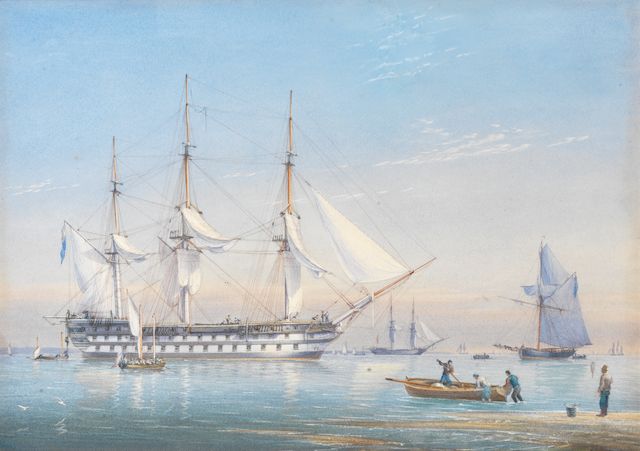
Nicholas Pocock, 1740 - 1821
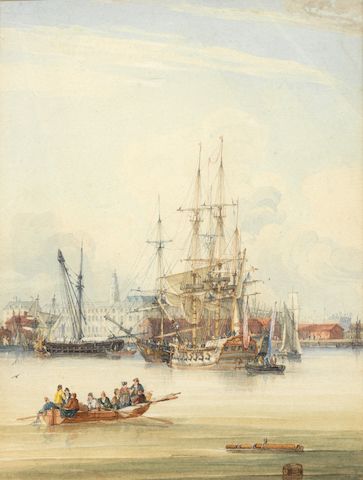
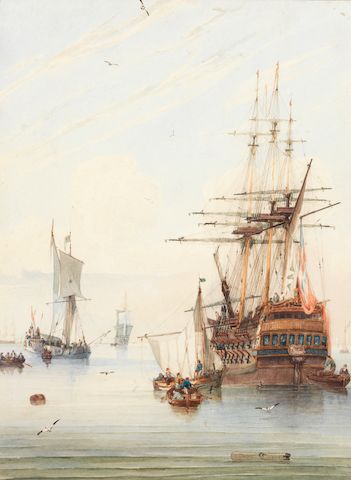
View of Southampton, taken from the shore towards Netley Abbey, c. 1908
Oil on canvas
19 ¼ x 29 ½ in. (48.9 x 74.9 cm.)
Private Collection
Nicholas Pocock (2 March 1740 – 9 March
1821) was a British artist
known for his many detailed paintings of naval battles during the age of sail.
Pocock was born in Bristol in 1740, the son of a seaman. He followed his
father's profession and was master of a merchant ship by the age of 26. During
his time at sea, he became a skilled artist by making ink and wash sketches of
ships and coastal scenes for his log books.
In 1778,
Pocock's employer, Richard Champion, became financially insolvent due to the
effects of the American Revolutionary War on transatlantic trade. As a result,
Pocock gave up the sea and devoted himself to painting. The first of his works
were exhibited by the Royal Academy in 1782. Later that year, Pocock was
commissioned to produce a series of paintings illustrating George Rodney's
victory at the Battle of the Saintes. In 1789, he moved to London, where his
reputation and contacts continued to grow. He was a favourite of Samuel Hood
and was appointed Marine Painter to King George.
Pocock's
naval paintings incorporated extensive research, including interviewing
eyewitnesses about weather and wind conditions as well as the positions,
condition, and appearance of their ships; and drawing detailed plans of the
battle and preliminary sketches of individual ships.
In addition to his large-scale oil paintings
depicting naval battles, Pocock also produced many watercolours of coastal and
ship scenes. More
Alberto Pasini, 1826 - 1899, ITALIAN
Golden Horn, Istambul, circa 1876
Oil on panel
22.5 x 35.5 cm;
Private Collection
Alberto Pasini (Busseto, 3 September 1826 – Cavoretto, 15 December 1899) was an Italian painter. He was enrolled at the age of 17 years, in the Academy of Fine Art of Parma, studying landscape painting and drawing. In Parma, he was helped early on by Antonio Pasini, who painted for the local nobility and collaborated with the publishing house established by Giovanni Battista Bodoni. By 1852, he exhibited a series of thirty designs, made into lithographs, depicting various castles around Piacenza, Lunigiana and Parma. He was noticed by the artist Paolo Toschi, who encouraged Pasini to travel to Paris, where Pasini first joined the workshop of Charles and Eugène Ciceri, of the so-called School of Barbizon.
In 1853 his lithograph of The Evening gained him admittance to the Paris Salon, and to the workshop of the famous Théodore Chassériau. The eruption of the Crimean War offered a new opportunity, when in February 1855, this latter painter recommended Pasini to replace him on the entourage of the French plenipotentiary minister Nicolas Prosper Bourée to Persia. Pasini accompanied him, returning through the north of Persia and Armenia before reaching the port of Trebizond. In subsequent trips, he visited Egypt, the Red Sea, Arabia, Istanbul, and Persia. Pasini parlayed his exposures during this trip into numerous highly detailed paintings of orientalist subjects. He left again for Istanbul in October 1867, summoned by the French Ambassador Bourée. He returned to Turkey in 1876 to execute the four paintings commissioned by Sultan Abdul Aziz. He was about to return to Istanbul the next year, when his patron, the Sultan, died.
Alberto Pasini, 1826 - 1899, ITALIAN
Market in Istanbul (Constantinople), c. 1868
Oil on canvas
Height: 23.5 cm (9.3 in). Width: 90 cm (35.4 in).
Thyssen-Bornemisza Museum, Madrid, Spain
In 1865, he spent some time in Cannes, painted landscapes of the Riviera. During the Franco-Prussian War of 1870, he returned to Italy, settling in Cavoretto, on the hills around Turin. He continued to travel, closer to his home, with trips to Venice and two sojourns in Spain in 1879 and 1883. More Alberto Pasini
Emil Jakob Schindler, 1842 - 1892
Küstenlandschaft in Dalmatien (Dalmatian Coastline), c. 1890
Oil on Canvas
Emil Jakob Schindler (April 27, 1842 – August 9, 1892) was an Austrian landscape painter. He was born into a family of manufacturers that had been established in Lower Austria since the 17th Century. He was supposed to pursue a career in the military, but rejected that for a career in the arts. In 1860, he entered the Academy of Fine Arts, Vienna, where he studied with Albert Zimmermann. He found his models, however, in the Dutch Masters such as Meindert Hobbema and Jacob Izaaksoon van Ruisdael. In 1873, he travelled to Venice, followed by trips to Dalmatia and Holland.
In 1875, he married the operetta singer Anna von Bergen (1857–1938), who may have been pregnant at the time of the wedding. Their financial situation was somewhat desperate and they had to share an apartment with a colleague of Schindler's, Julius Victor Berger.
Emil Jakob Schindler, 1842 - 1892
Küstenlandschaft in Dalmatien (Dalmatian Coastline), c. 1887
Oil on Canvas
View of Ragusa (Dubrovnik), painted in 1887 during Jakob Emil Schindler second journey to the Dalmatian coast. The people shown in the foreground are the artist’s wife, the Hamburg singer Anna Sofie Moll-Schindler-Bergen, and their daughter Alma Mahler and Franz Werfel. The figures on the right in the middle of the work are the painter Carl Julius Rudolf Moll, shown dressed as a gardener, and Schindler’s second daughter, Margarethe. Schindler had rented a house in Dubrovnik which is clearly visible at the edge of the cliffs. During severe Sirocco winds the waves would break over the cliff, creating a magical spectacle. More View of Ragusa
In 1881, he won the Reichel Prize, which came with a cash award of 1,500 Gulden, enabling the family to rent their own apartment. Winning the prize also served to attract clients and their financial condition continued to improve. After 1885, he spent his summers at the artists colony in Plankenberg Castle near Neulengbach. Two years later, he received a commission from Rudolf, Crown Prince of Austria to sketch the coastal towns in Dalmatia and Greece, as part of a project called "The Austro-Hungarian Monarchy in Words and Pictures" (24 volumes). That same year, he became an honorary member of the Vienna Academy. In 1888, the Munich Academy followed suit.
He died as the result of appendicitis. The city of Vienna gave him an "Ehrengrab" (Honor Grave) at the Zentralfriedhof, designed by the sculptor Edmund von Hellmer. Three years later, Hellmer created a statue of him for the Stadtpark.[1] A street in the Währing District named after him. More Emil Jakob Schindler
William Edward Norton, (American, 1843-1916)
Bustling Fishing Port
Oil on canvas
22 3/4 x 29 3/4 in. (57.8 x 75.5 cm)
Private Collection
William Edward Norton (1843-1916), American. Born in Boston to a New England family of shipbuilders, Norton's interest in ships led him initially to a career at sea. After his sea service, he enrolled at both Harvard Medical School and the Lowell Institute, where his interest in art led him to study under the master American landscape painter, George Inness.
Later opening a studio in Boston, Norton enjoyed immediate success. From the sale of his paintings he financed further art studies in Europe. While painting in London, he found wide acceptance in many of the major European galleries, including the Paris salon, the most prestigious venue for an artist of his day to exhibit. He was awarded an honorable mention by the salon in 1900.
Returning to America he continued to receive strong recognition, representing the United States at the International Exposition of 1900 and winning the coveted Osorne Prize for marine painting in 1905 & 1906. Today, this important American artist's work continues to attract connoisseurs of quality marine paintings in both Europe and America. More William Edward Norton
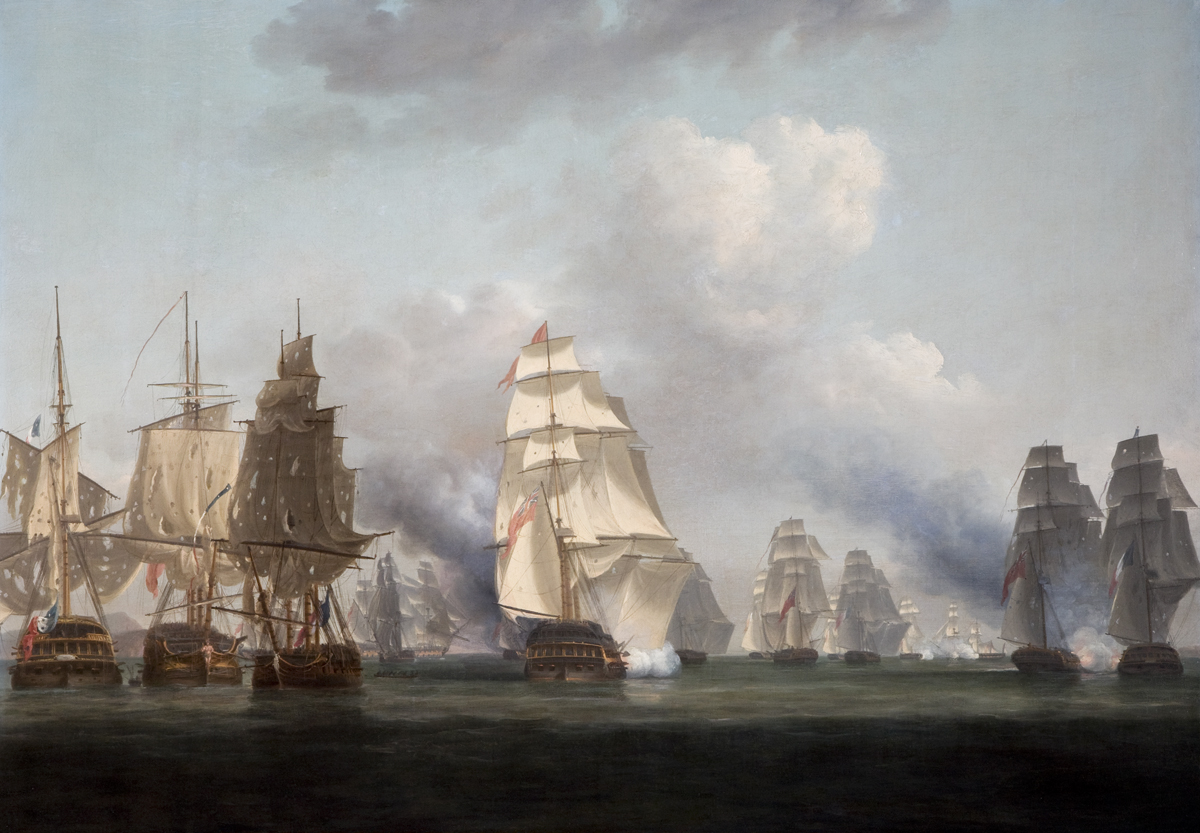
Thomas Buttersworth, 1768 - 1842
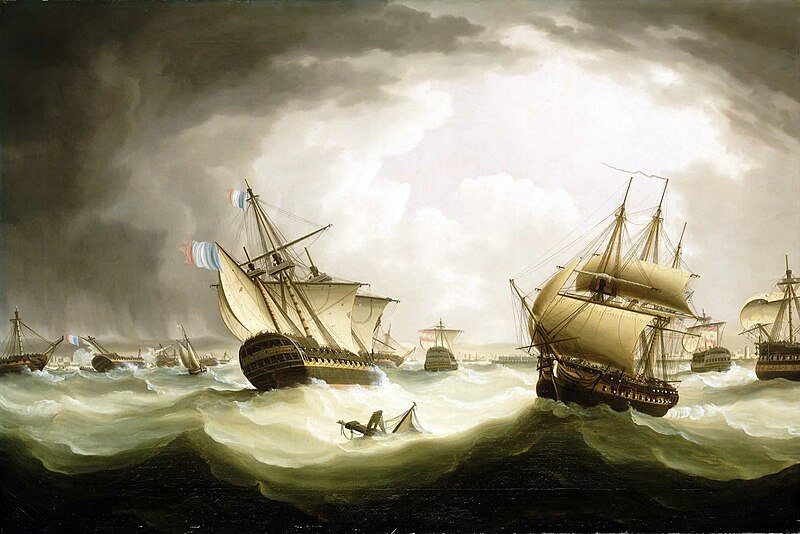
An Austrian frigate in two positions off the harbour at Cadiz
Oil on canvas
22 x 30 in. (55.9 x 76.2 cm.)
Private Collection
Thomas Buttersworth (5 May 1768 – November 1842) was an English seaman of the Napoleonic wars period who became a marine painter. He produced works to commission, and was little exhibited during his lifetime.
Butterworth was born on the Isle of Wight. He enlisted in the Royal Navy in London in 1795, and served on HMS Caroline during the wars with France, before being invalided home from Minorca in 1800.
The National Maritime Museum in London has 27 watercolours by him, several of which are mounted on sheets from 18th century printed signal and muster books. He went on to paint numerous naval battle scenes and pictures such as the ‘'Inshore Squadron off Cadiz in 1797'’ which are thought to show scenes he witnessed. On being appointed Marine Painter to the East India Company he painted ship portraits on commission. It had been thought that he died in 1830, but recent research has found that he painted Queen Victoria’s visit to Edinburgh in 1842 before he died in London later that year. More Thomas Buttersworth
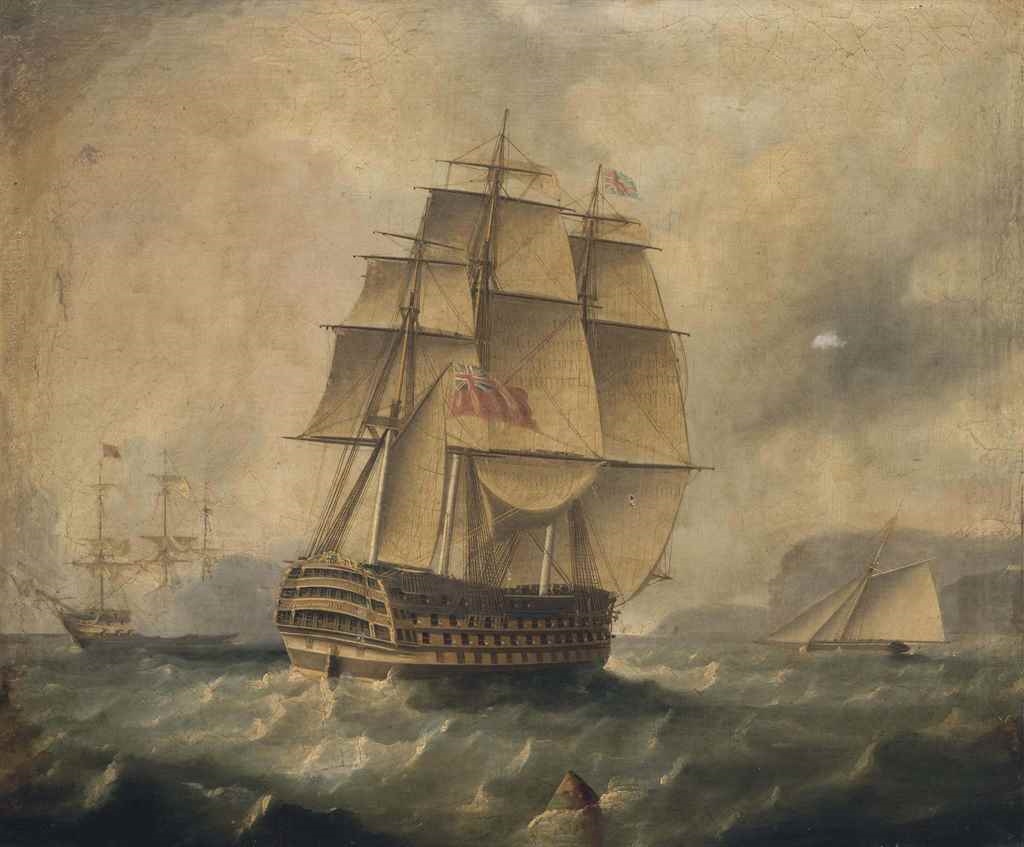
Thomas Buttersworth, 1768 - 1842
British '74' engaging the enemy, with a pilot cutter beyond
Oil on canvas laid down on board
25 x 30 in. (63.5 x 76.2 cm.)
Private Collection
Thomas Buttersworth (5 May 1768 – November 1842), see above
Walter Lofthouse Dean, (American, 1854-1912)
A Summer Day on the Dutch Shore
Oil on canvas
20 x 30 in. (50.7 x 76.3 cm)
Private Collection
Walter Lofthouse Dean (June 4, 1854 – March 13, 1912) was an American marine-landscape painter, commodore of the Boston Yacht Club and Vice President of the Boston Art Club. While Dean is primarily known for marine paintings from the Boston, Massachusetts region, he also developed many charcoal, pen and pencil drawings, watercolors and oil paintings of non-marine topics, including still life, architecture and landscapes. Dean was a recognized artist while he was alive and was listed in the 1903 Men of Massachusetts, along with Who's Who in American Art. Dean's most famous painting, Peace, is owned by the US Government and was exhibited at the Chicago World's Fair in May–October 1893. More Walter Lofthouse Dean
Sir William Russell Flint, 1880-1969 (United Kingdom)
Sireny watch (Sirens observed), c. 1959
Watercolor on paper
27.5 x 37
Private Collection
Sir William Russell Flint (4 April 1880 – 30 December 1969) was a Scottish artist and illustrator who was known especially for his watercolour paintings of women. He also worked in oils, tempera, and printmaking. He was born in Edinburgh then educated at Daniel Stewart's College and Edinburgh Institution. From 1894 to 1900 Flint apprenticed as a lithographic draughtsman while taking classes at the Royal Institute of Art, Edinburgh. From 1900 to 1902 he worked as a medical illustrator in London while studying part-time at Heatherley's Art School. He furthered his art education by studying independently at the British Museum.
Flint was elected president of Britain’s Royal Society of Painters in Watercolours (now the Royal Watercolour Society) in 1936 to 1956, and knighted in 1947. More
Jan Hillebrand Wijsmuller, (Dutch, 1855-1925)
Horse-drawn Cart on Beach
Oil on board
12 x 18 in. (30.5 x 45.8 cm)
Private Collection
Jan Hillebrand Wijsmuller (13 February 1855 in Amsterdam – 23 May 1925 in Amsterdam) was a Dutch painter. He belongs to The 2. Golden Age of Dutch Painting.
He is an impressionist of the School of Allebé, better known as Amsterdam Impressionism, part of the international movement of the Impressionism. From the art historical point of view he is one of the 2nd generation of the Hague School. He used the bright color palette of the French Impressionists, too – but from the perspective of a Dutchman. More Jan Hillebrand Wijsmuller
Giuseppe Laezza, (Italian, 1835-1905)
Fisherman's Family Beside a Beached Vessel
Oil on canvas
10 x 19 1/4 in. (25.2 x 49.0 cm)
Private Collection
Giuseppe Laezza (1835-1905) was an Italian painter, mainly of landscapes. He resided in Naples where in 1877 he exhibited: Dopo il tramonto; San Germano; Cassino, and Una mala pesca alla Marinella. Among his works are: A Procession of Children to the Festival of Ponti Rossi, End of the Grape Harvest; Panorama of Sorrento;Curiosity of a Painter; and Un bagno pubblico a San Giovanni a Teduccio, exhibited at Turin in 1884. He became a professor at Naples. He died in poverty. More Giuseppe Laezza
Giuseppe Laezza, (Italian, 1835–1905)
Marina di Napoli con pescatori e veduta del Vesuvio
Naples Marina with fishermen and view of Vesuvius
Oil on panel
23.8 x 41 cm. (9.4 x 16.1 in.)
Private Collection
Fausto Zonaro (18 September 1854 – 19 July 1929) was
an Italian painter, best known for his Realist style paintings of life and
history of the Ottoman Empire. Born in Masi, a municipality in the Province of
Padua, then part of the Austrian Empire. He was the eldest child of the mason
Maurizio. Maurizio intended that his son should also be a mason, yet at a young
age, Fausto showed a great ability at drawing. With his parents’ consent, he
enrolled first in the Technical Institute in Lendinara, then in the Cignaroli
Academy in Verona. Fausto opened a small art school and studio in Venice.
He
actively displayed works in exhibition and gained respect of critics. He
painted mainly genre works in oil and watercolor. The turning point in Zonaro’s
career occurred however in 1891, when he fell in love with Elisabetta Pante, a
pupil of his in Venice, And together they traveled to Istanbul, capital of the
Ottoman Empire. They were partly inspired by Edmondo de Amicis’ orientalist
travel book Constantinopoli.
Fausto Zonaro, 1854 - 1929, ITALIAN
VIEW OF THE BOSPHORUS
Oil on panel
23 by 40cm., 9 by 15¾in.
Private Collection
In 1892,
Zonaro and Pante married, and lived in the Istanbul neighborhood of Pera. Over
time he gained patronage in aristocratic circles. Munir Pasha, the Minister of
Protocol, who invited him to visit Yıldız Palace and meet the prestigious local
artist Osman Hamdi Bey. He was employed in teaching painting to the Pasha's
wife, and in this way Zonaro and Pante got to know the important artistic
figures of Istanbul of that time. In 1896 he was nominated as the court painter
thanks to the intervention of the Russian ambassador.
Zonaro remained in Istanbul until 1909, when he returned to
Italy following the Young Turk Revolution that overthrew his patron Abdulhamid
II and the shift to constitutional monarchy. There would be no Ottoman court
painter after him. He settled in Sanremo where he continued to paint small
works depicting the Italian Riviera and the nearby French Riviera until his
death. More
Fausto Zonaro, 1854 - 1929, ITALIAN
VIEW OF THE BOSPHORUS
Oil on panel
23 by 40cm., 9 by 15¾in.
Private Collection
Please visit my other blogs: Art Collector, Mythology, Marine Art, Portrait of a Lady, The Orientalist, Art of the Nude and The Canals of Venice, Middle East Artists, 365 Saints, 365 Days,
and Biblical Icons,
also visit my Boards on Pinterest and my art
stores at deviantart and Aaroko
Images are copyright of their respective owners, assignees or others.
Some Images may be subject to copyright
I don't own any of these images - credit is always given when due unless
it is unknown to me. if I post your images without your permission, please tell
me.
Ads are shown only to compensate the hosting expenses.
If you enjoyed this post, please share with friends and family.
Thank you for visiting my blog and also for liking its posts and pages.
Please note that the content of this post primarily consists of articles
available from Wikipedia or other free sources online.

 Posts
Posts