Showing posts with label Ancient Egyptian. Show all posts

10 Ancient Egyptian Engravings & Carvings- With footnotes - 7

Egyptian Tomb Model of Bakery and Brewery
Middle Kingdom
 8.1" L x 11" W (20.6 cm x 27.9 cm)

Ancient Egypt, Middle Kingdom, late 11th Dynasty to early 12th Dynasty, ca. 2060 to 1900 BCE. A wooden and plaster model made for a tomb showing two men sealing and stoppering beer jars and a third kneading bread dough. The figures are wood and their components are a hard, white plaster, painted in shades of red. They are mounted on a piece of wood that likely came from an old box or chest recycled by the artist.

Egyptian Tomb Model of Bakery and Brewery
Detail

During the Sixth Dynasty, it became common to place wooden models of lifelike scenes in Egyptian tombs; by the Middle Kingdom, they were placed in the tomb chamber, around the coffin, although some very rich tombs had a separate chamber just for wooden models. 

Egyptian Tomb Model of Bakery and Brewery
Detail

Baking and brewing were frequent subjects of tomb models, symbolizing the range of food offerings that would have been described on the stelae and tomb reliefs that led to the main tomb chamber. These figures were also made to work throughout the afterlife, creating the bread and beer that the deceased would need. More

Egyptian Polychrome Temple Fragment of Woman
Middle Kingdom
2.3" W x 6.3" H (5.8 cm x 16 cm)

Egypt, Middle Kingdom, ca. 2050 to 1640 BCE. A pottery temple fragment showing a standing woman in relief with remains of orange and red pigment especially on its lower half that give us a clue to how brightly it would have originally been painted. 

The woman is depicted facing forward with her hands at her sides. Her torso and head are well proportioned and graceful, but her feet, arms, and hands in particular are too large for her body. Middle Kingdom sculpture often emphasized hands and feet; when originally painted, this statue probably had fingernails and toenails. During the Middle Kingdom, we see statues of women who are portrayed very similarly to this one - small breasts and the symmetrical face with the large wig, all beauty standards of the time. These idealized forms probably corresponded to a desire to depict people as they would like to be resurrected. More

Egyptian Painted Wood Sarcophagus Panel of Nut
Late Period, ca. 715 to 330 BCE
62" L x 16" H (157.5 cm x 40.6 cm), with case 66-3/4"H x 20-1/4"W (169.5 cm x 51.4 cm).

Egypt, Late Period, ca. 715 to 330 BCE. Painted wood panel from the back of a sarcophagus depicting the goddess Nut, with bright colors, especially the deep red. Professionally mounted in wood case with glass cover. Case includes brackets for wall mounting. 

Nut (also Nunut, Nuit) was the goddess and personification of the Sky and the celestial realm. She is regarded as the barrier separating the ordered cosmos of the world from the forces of chaos. In some depictions, Nut was portrayed as a woman arched on her toes and fingertips over the earth; her sacred body representing a star-filled sky. Nut's fingers and toes as such were believed to touch the four cardinal directions: north, south, east, and west. According to Egyptian mythology, Nut is a daughter of Shu ("he who rises up" or the personification of air) and Tefnut (goddess of moisture, dew, and rain); her husband and brother is Geb (god of the earth, father of snakes, whose laughter could bring about earthquakes and fertile crops), and she has four children: Osiris, Set, Isis, and Nephthys. Nut was also granddaughter of Ra or Atum, the creator god. The Coffin Texts describe Nut as "she of the braided hair who bore the gods". In one fascinating myth, Nut gives birth to the Sun-god each day, and he passes over her body during the day only to be swallowed at night and reborn the next morning. More

Egyptian Pottery Jarlet - Protective God Bes
Late Period, Dynasties 26 to 31, ca. 664 to 332 BCE
3.25" W x 3.75" H (8.3 cm x 9.5 cm)

Egypt, Late Period, Dynasties 26 to 31, ca. 664 to 332 BCE. A fine brownware pottery molded juglet depicting the head of Bes, a protector deity, with small perforated lug or handle to the left side of his head. Bes is depicted as a dwarf with a lion's mane, his tongue extended in an open 'bearded' mouth. 

Bes, the bandy-legged leonine dwarf god, was an apotropaic deity, the protector of the home, children, and women in pregnancy and childbirth. In his role as protector of the home he was thought to dispel bad dreams, and by increasing virility in men and fertility in women, he was seen as a symbol of fecundity.When depicted in full form, he is generally depicted nude, wearing a lion's mane, a plumed headdress, and a tail. He is also seen dancing, brandishing a sword, or frightening off evil spirits by playing music. Bes continued to be a popularly depicted protective deity well into the Graeco-Roman Period. More Bes

Ptolemaic Egyptian Terracotta - Probably Serapis
Greco-Roman/Ptolemaic period, from Alexandria, ca. 323 to 30 BCE
2.85" W x 5.2" H (7.2 cm x 13.2 cm)

Egypt, Greco-Roman/Ptolemaic period, from Alexandria, ca. 323 to 30 BCE. This is an interesting and fairly unique terracotta figure, depicting a bearded man's face in the body of what may be a knotted phallus. Atop the man's head is a modius, a flat-topped cylindrical headdress that probably represents a grain measure, symbolizing fertility. The figure is clearly mold-made from two pieces, with fine details.

Serapis or Sarapis is a Graeco-Egyptian god. The cult of Serapis was introduced during the 3rd century BC on the orders of Ptolemy I of Egypt as a means to unify the Greeks and Egyptians in his realm. The god was depicted as Greek in appearance, but with Egyptian trappings, and combined iconography from a great many cults, signifying both abundance and resurrection. A serapeum was any temple or religious precinct devoted to Serapis. The cultus of Serapis was spread as a matter of deliberate policy by the Ptolemaic kings, who also built an immense serapeum in Alexandria.


Bust of Serapis. Marble
Early 3rd century AD, found in Carthage, Tunisia.
H. 62 cm (2 ft. ¼ in.)
Louvre Museum

However, there is evidence which implies that cult of Serapis existed before the Ptolemies came to power in Alexandria. The common assertion that Ptolemy "created" the deity is derived from sources which describe him erecting a statue of Sarapis in Alexandria: this statue enriched the texture of the Sarapis conception by portraying him in both Egyptian and Greek style. Though Ptolemy I may have created the cult of Sarapis and endorsed him as a patron of the Ptolemaic dynasty and Alexandria, Sarapis was a syncretistic deity derived from the worship of the Egyptian Osiris and Apis and also gained attributes from other deities, such as chthonic powers linked to the Greek Hades and Demeter, and benevolence linked to Dionysus.

Serapis continued to increase in popularity during the Roman period, often replacing Osiris as the consort of Isis in temples outside Egypt. In 389, a Christian mob led by the Patriarch Theophilus of Alexandria destroyed the Alexandrian serapeum, but the cult survived until all forms of pagan religion were suppressed under Theodosius I in 391. More Serapis

Romano-Egyptian Plaster Mummy Bust
1st century BCE to 1st century CE
14" W x 15.75" H (35.6 cm x 40 cm)

Ancient Egypt, Romano-Egyptian Period, ca. 1st century BCE to 1st century CE. A large plaster bust of a young man, painted brightly; he wears a well-depicted chiton/tunica painted a dark red; above that, his face is sensitive, with the huge eyes so characteristic of Egyptian art, a long, straight nose, and a small mouth. His hair is black, with a low hairline, and pulled back in tight lines. 

This piece was created for a funerary monument, designed to be placed up against a surface. Made of plaster, this type of monument, similar to a mummy mask, was reserved for elites. They also represented a dramatic change, departing from centuries of tradition. For the first time in the Roman period, Egyptian mummies were buried with lifelike representations rather than the mummiform masks seen in previous periods. To the Roman viewer, this piece may also have had similarities to gods like Apollo - an idealized image of the young man in death, created at great expense to memorialize him and for those who mourned him. More

Egyptian Alexandrian Terracotta Figure of Nude Isis
1st century BCE to 1st century CE
7.875" H (20 cm); 8.875" H (22.5 cm)

Egypt, Alexandria, 1st century BCE to 1st century CE. An alluring terracotta figure depicting the goddess Isis, standing in the nude with arms at her sides, presenting a beautiful visage with naturalistic features and long tresses cascading past her shoulders, topped with an Isis crown comprised of a solar disk framed by cow horns, her chief attribute. Nice remains of red, white, and blue pigments. 

Isis is oftentimes depicted in a sheath dress, but in this example the artist elected to depict her in the nude, revealing the ideal of Egyptian womanhood with all her feminine grace. Isis was daughter to Geb, god of the Earth, and Nut, goddess of the Sky, and wife of Osiris. Oftentimes shown as the mother of Horus, she is also known as a protector of children. In addition to being revered as the ideal mother and wife, Isis was revered as the patroness of magic and nature, a supporter of sinners, slaves, and artisans as well as a friend to rulers and the wealthy. More Isis

Romano-Egyptian Terracotta Votive - Jupiter w/ Eagle
 30 BCE to 2nd century CE
3.6" W x 5" H (9.1 cm x 12.7 cm) 

Egypt, Romano-Egyptian period, ca. 30 BCE to 2nd century CE. This hollow terracotta figural shows Jupiter (Zeus) seated with an eagle. This is the Aetos Dios, a giant golden eagle that served as the king of the gods' personal messenger and companion. These two together were a powerful symbol in Romanized Egypt, and indeed had been since the Ptolemies (Ptolemy III used this symbol on coinage). A plaque like this was made for votive purposes, to be given as an offering in a temple. More


Acknowledgement: Artemis Gallery,  Invaluable

Images are copyright of their respective owners, assignees or others. Some Images may be subject to copyright

I do not sell art, art prints, framed posters or reproductions. Ads are shown only to compensate the hosting expenses.

If you enjoyed this post, please share with friends and family.


27 Ancient Egyptian Artifacs

Ancient Egyptian
Late Period wood left hand from sarcophagus 
Circa 600-332 BC.
Size: 7 3/8 inches high


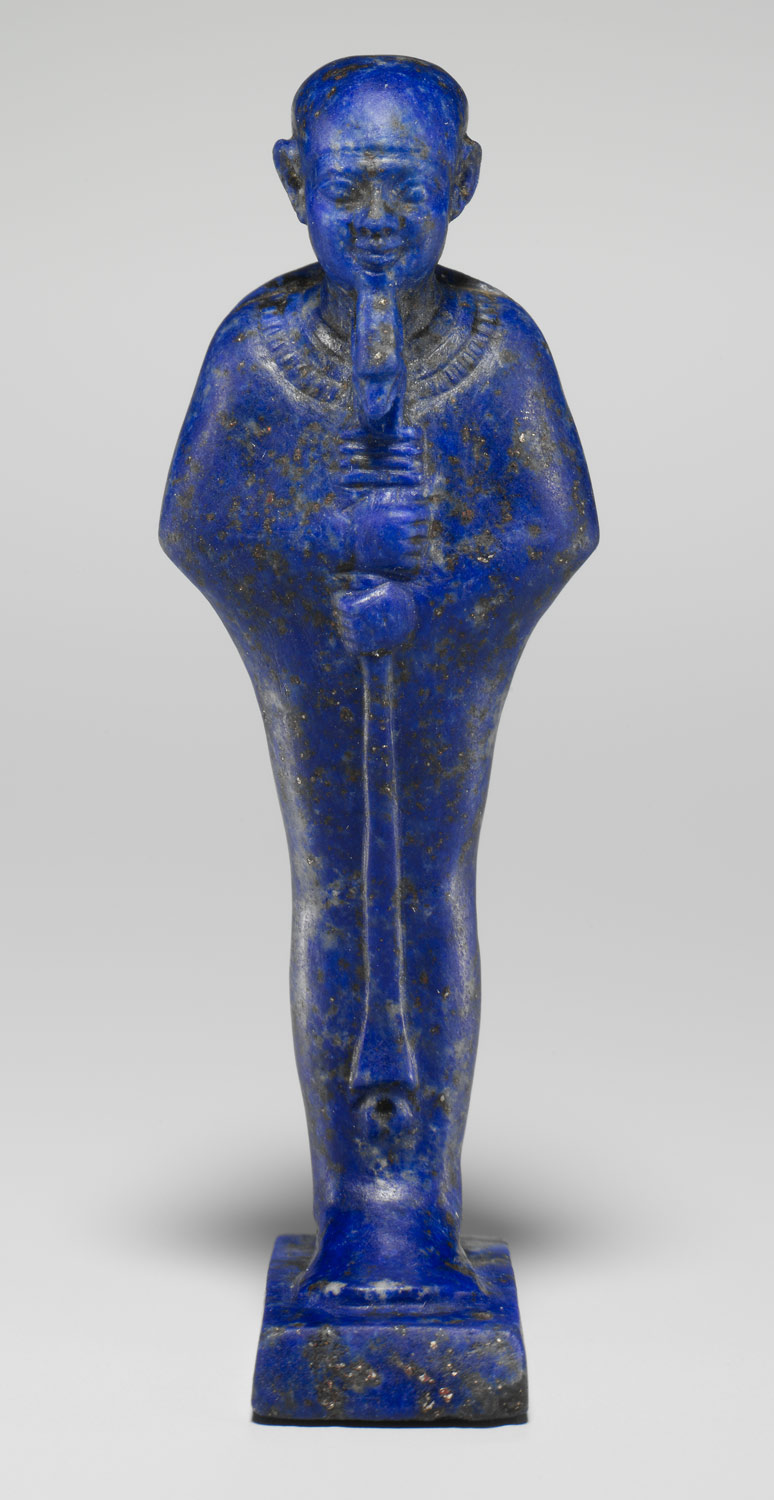
Egyptian Cult image of the god Ptah
Dynasty 22–early Dynasty 26 (ca. 945–600 B.C.)
Lapis lazuli;
H. 2 1/4 in. (5.6 cm)


Ancient Egyptian Wood Ptah-Sokar
Ptah-Sokar Osiris, mummiform figure wearing tripartite wig and beard, the symbols of royalty
Late period, Circa 700-30 B.C. 
Size: 14 inches high figure only, 19-1/4 inches high overall

Ancient Egyptian 
Limestone fragment of a king's Torso 
Late Period, ca. 700 B.C.
Size of the figure without the stand 7 inches high (17.8 cm high)

Two Egyptian Shabtis with Hieroglyphics, fragmentary
XXVI Dynasty period. Ca. 664BC - 525 BC. 
Size 3 - 3 1/2 inches high.

Ancient Egyptian
Date: 700-30 BC
A stone figure of a man Mesopotamian in style. 
Size 1 1/2 inches high. 
Egyptian glazed faience amulet of Bes in the round.
Size 1 1/4 inches high.


Three Ancient Egyptian amulet
Circa 700-30 BC. 
Bes, Anubis, and Isis
Size 19-27 mm.

Egyptian Black Basalt Head
Carved black basalt head wearing flared wig, relief facial features and ears. The reverse incised with two hieroglyphs
Egypt Late period, ca. 700-30 B.C.
Size: 3 1/2 inches high.


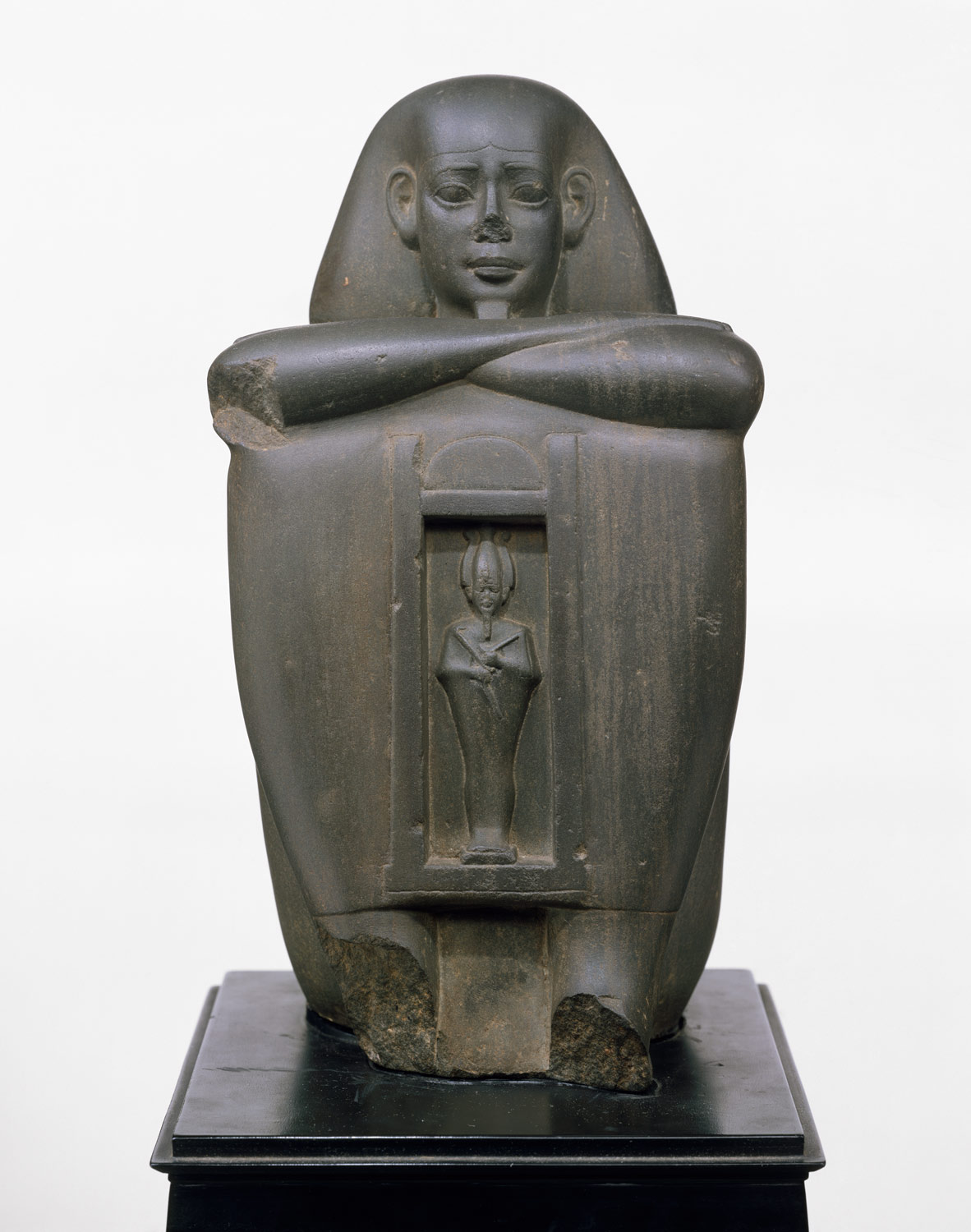
Egyptian Block statue of a governor, Late Period, Dynasty 26 (ca. 664–525 B.C.)
Graywacke; 
14 in. (30.5 cm)

Block statues—images of squatting men with knees drawn up against the chest and folded arms resting on the knees—appeared first as a sculptural type in the early Middle Kingdom (ca. 2000 B.C.) and remained popular until well into the Ptolemaic Period (after 200 B.C.). The statues are thought to represent persons participating in religious rites, and the addition of a shrine with a deity image in front of this statue's legs underlines this religious aspect of the image.

The sculptor has avoided representing any superfluous detail. Only shallow edges indicate the hairline and the bottom of the man's dress over his lower legs. Eyes, eyebrows, ears, and mouth are boldly but sparingly delineated so as not to detract from the prominent features of the piece: the smoothly shaped, agile body and long, elegantly disposed limbs. According to the inscription on the back pillar, the statue depicts a governor of the Saite nome (a district in the Nile delta). The text also records a prayer to Osiris, the god of the underworld, whose figure stands in the shrine.


Egypt, presumably Middle Kingdom (circa 2100-1700 BC)
Burial object in the form of a model boat
Four rowers and a funerary priest
Used to transport the soul of the deceased to the netherworld
Height (boat with steles): circa 38 cm; length: 62 cm

This ancient Egyptian model boat originates presumably from the Middle Kingdom (circa 2100-1700 BC) and is made from painted wood. The impressive form of the boat forms two stylized lotus flowers at the bow and at the hulk. Before the ends are seated two rowers in front of each other. In the center a funerary priest is standing with outstretched arms. The figures and the four steles can be removed. The bark was originally a burial object, which served to transport the soul of the dead to the netherworld.

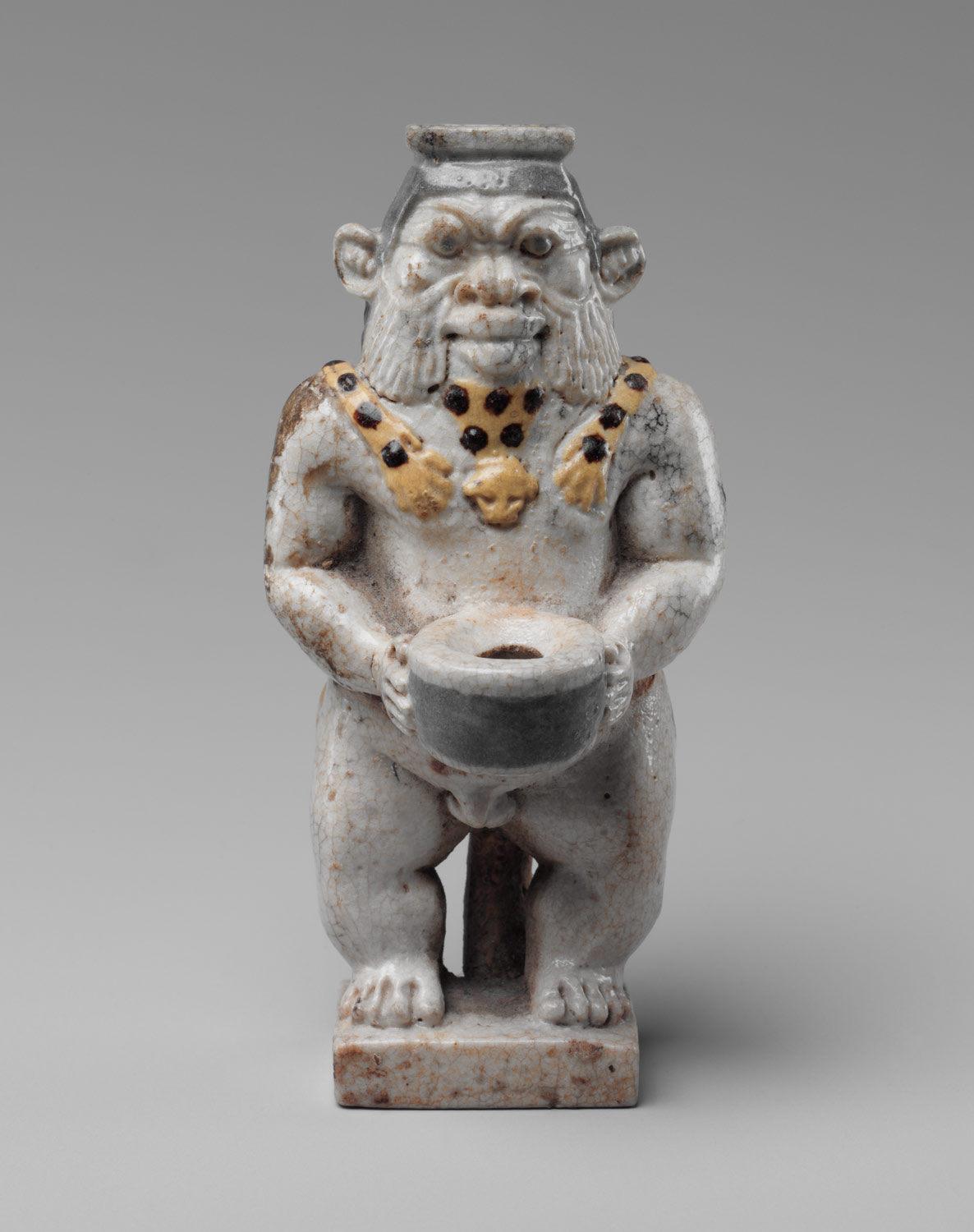
Egyptian Cosmetic container in the form of a Bes image holding the cap of a kohl tube
Late Period, Dynasty 27, ca. 525–404 B.C.
H. 3 5/8 in. (9.2 cm), W. 1 3/4 in. (4.4 cm)

This squat human form with leonine features is commonly identified as the god Bes, but several other minor Egyptian gods were also represented by this image. These were protective deities, so they appear frequently as apotropaic figures in the decoration of furniture and personal belongings. Here, the god stands holding the cap of a kohl container, which has a small round hole in the top for insertion of an applicator. It seems likely that the hollow cap fit over a tube that could be detached for easy filling.

Ancient Egyptian Mummy Mas
Late Period, ca. 700 B.C.
Carved wood mummy mask with painted surface over gesso
black and white eyes, eyebrows painted black 
Size: 10 1/4 inches high x 5 1/2 inches wide (26 cm high x 14 cm wide)
Ancient Egyptian Wood Mummy Mask 
Sarcophagus Mask in carved solid wood with remnants of paint , having relief carved facial features.
Late Period Egypt Circa. 700-30 BC. 
Size: 11 1/2 inches High x 8 inches wide x 3 inches deep (29.2 cm)


Egypt, Late Period, 26th Dynasty or later
Mask of a wooden coffin with drilled mouth corners
23 x 13 x 5.8 cm (height x width x depth)

The wooden mask originates from the Late Period of ancient Egypt, the 26th Dynasty or later (664–525BCE or later). It is a separately crafted, distinctive face of an anthropoid (‘human-like’) wooden coffin, which has once been attached to the coffin. This object is crafted of one piece of wood and is of very elaborate craftsmanship. The sides are vertically chopped and flat, so it can be assumed that further single parts existed that depicted the lateral wig rags and ear parts and merged together like a puzzle in the end. On the forehead, in the right cheek and left lower jaw are squint drilled holes that were used to fix the face with wood dowels on the lid of the coffin. In the peg holes on the cheek, remains of an old peg can be found. The drilled mouth corners are a typical characteristic of late period sculpture.


Egypt, presumably Ptolemaic period, approximately 550-31 BC
Mask of a mummy sarcophagus
Dimensions: 24 x 15 cm (height x width)

This mask originates from a mummy sarcophagus and presumably dates back to the Ptolemaic period in Egypt approximately 550-31 BC. The face has an oval shape and is painted in polychrome colors on a gesso primer. Under a low forehead the almond shaped large eyes are rimmed in black. The pupils are equally painted in black and the eyeballs in white. The nose is long and narrow.

ANCIENT EGYPTIAN LIMESTONE RELIEF FRAGMENT
LATE PTOLEMAIC / EARLY ROMAN PERIOD, CIRCA 1ST CENTURY B.C.
carved in bold relief with ram-headed Khnum
god of creation and fertility, facing right and wearing a kilt, broad collar, beard, and tripartite wig, a column of inscription at left referring to the deity
13 3/8 by 18 in. 34 by 45.7 cm.

Egyptian, Late Period temple
This sandstone relief features a well-carved face of the deity Hathor with defined lips, eyes, ears and headdress.
This relief once rested on the top of a column and supported the roof of an ancient temple. The edges are bevelled, which would have allowed the remaining three sides to join to form a square with the face of Hathor on each side. The top is flattened to further support the roof
24 inches wide x 21 inches high
ca. 664 - 50 B.C. 

Ancient Egyptian 
Wood head if a man 
Late Period Circa 600-300 BC
Size  3 7/8 inches high


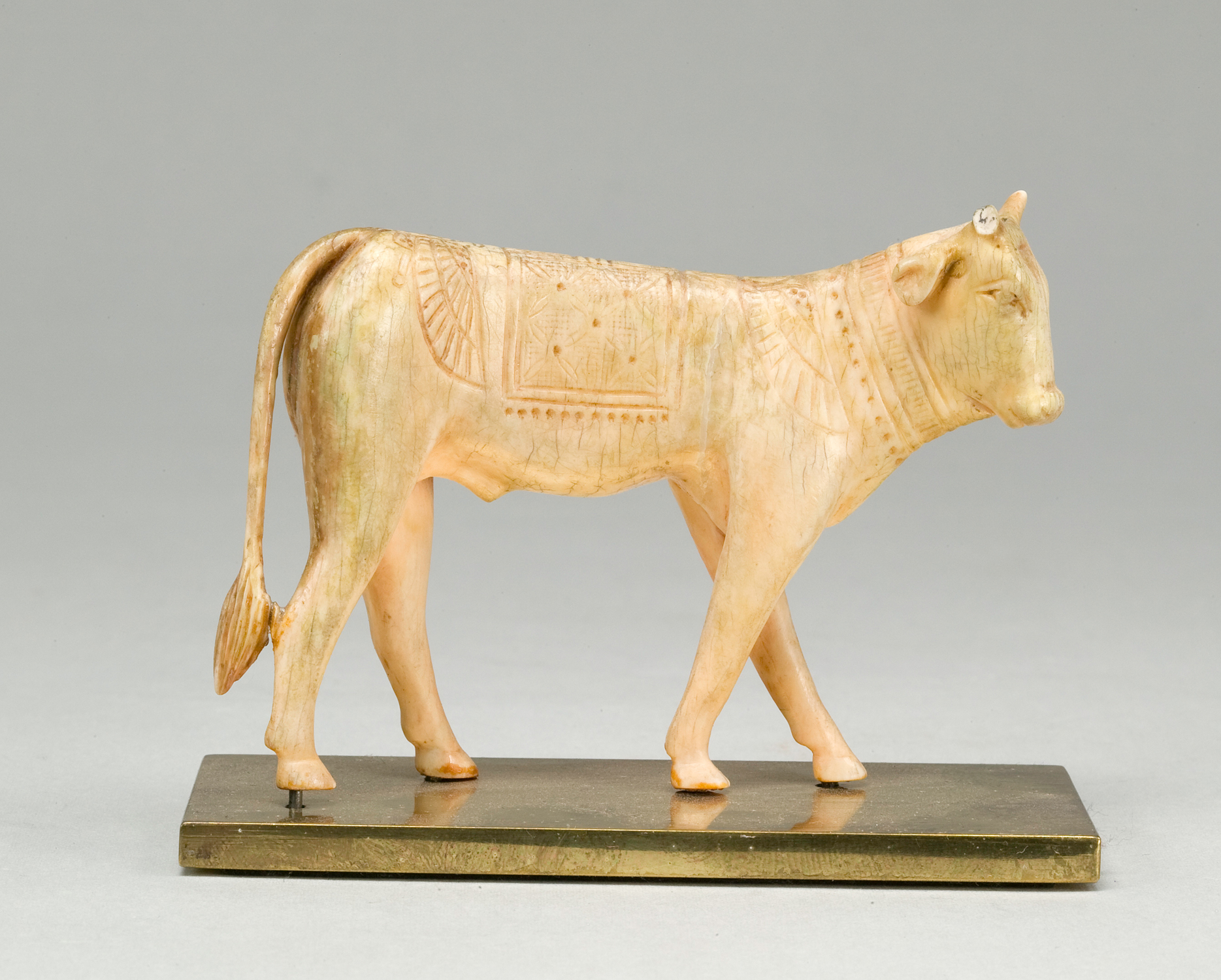
Egyptian Apis bull
Late Period, Dynasty 26–30, ca. 664–332 B.C.
Ivory
 H. 2 7/16 in. (6.1 cm)


One of the most important animal deities of ancient Egypt was the sacred Apis bull, whose worship is attested from Dynasty I. Near the Ptah temple at Memphis, Egypt's old capital, a living representative of the Apis bull was stabled. He was paraded out at festive occasions to participate in ceremonies of fertility and regeneration. The bull that played this important role was selected for displaying color patterns, such as a white triangle on the forehead and black patches resembling winged birds on the body. In the ivory figure, the white triangle is indicated by a sunken area on the head, while engravings of a vulture with wings spread and a winged scarab flank an elaborate blanket on the back. When Apis bulls died, they were embalmed and buried with all honors. Beginning with the reign of Amenhotep III (1390–1352 B.C.) in Dynasty 18, the place of Apis burials was a huge and growing underground system of chambers called the Serapeum in the Memphite necropolis, Saqqara. The mothers of Apis bulls had their own cult and burial place.

Ancient Egyptian
Bronze Oxyrhincus Fish of the Nile 
A cast bronze Oxyrhincus (Nile perch) wearing horned crown of Hathor, with a central sun disc and a small Uraeus serpent head, suspension loop behind the crown, and with integral plinth bases. Incised linear detailed to the gills and upper fins
Late period, ca. 700-30 B.C. 
size 4 5/8 inches length. (11.74 cm Length)


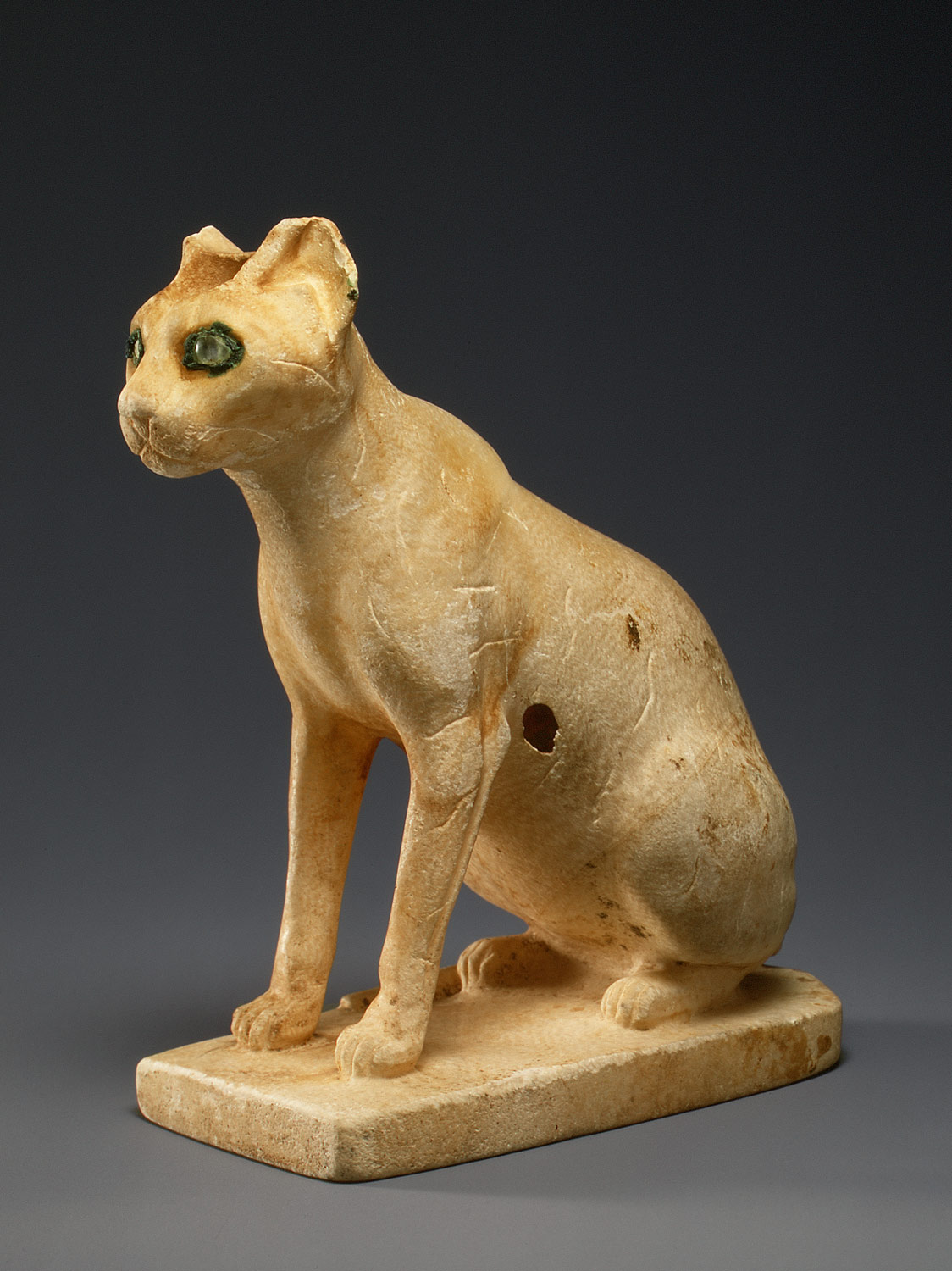
Egyptian Cosmetic Jar in the Form of a Cat
Middle Kingdom, Dynasty 12, ca. 1991–1783 B.C.
Egyptian alabaster (calcite) with inlaid eyes of rock crystal and copper; 
H. 5 1/2 in. (11.4 cm)

Egyptians are credited with the domestication of a number of animals, including the cat, which first appears in painting and relief toward the end of the Old Kingdom (ca. 2300 B.C.). This cosmetic jar is the earliest known three-dimensional image of a cat. Egyptian artists were very observant of the world around them, and their representations of animals are detailed and lifelike. 

Egyptian Bronze
Cat seated with the tail curled around to the forepaws, and wearing an incised neck-cord, the small head with finely modeled eyes and erect ears with striated markings
21st/26th Dynasty, 1075-525 B.C.. 
Height 4 3/16 in. 10.7 cm

Ancient Egyptian Bronze and Marble Sacred Ibis 
XXVth - XXVIth Dynasty (circa 700-550 B.C.)
Body of highly polished veined marble, the head and right leg of cast bronze
The ibis (symbolic of wisdom and sacred to the god Thoth) is now extinct in Egypt.
6.25 x 8.5 in.


Egypt, Late to Ptolemaic Period
Statuette of a hawk, representing the god Horus
Dimensions: 16.7 x 23 x 6.5 cm (width x height x depth)

This statuette, which emerged during the Late to the Ptolemaic Period (between 664 and 30 BCE), is very finely engraved and depicts an upright standing Horus hawk. The elaborately worked, scissor-tailed feathers are falling onto the tail. Today, the feathering depicts a greyish to light green colour covering. The face, as well as the petticoat, are painted in ochre and the feet entirely in red. The bent beak is also painted in red, while the human eyes and brows are painted over in black. The piece subsequently was an attachment to a shrine, possibly of a stele, indicated by the cone holes in the feet.

Ancient Egypt
Coptic textile fragment with a male a female figure in the center within borders
c.500 AD. 
Size 14 x 12 inches


Egypt, Third Intermediate Period, 21st to 23rd Dynasty
Lid of a canopic jar in the shape of a human head with smooth wig
Dimensions: height 10.3 cm; diameter max. 11 cm; diameter inside 5.3 cm
Provenance: Private Collection Bruno Wertz

This lid of a canopic jar, in the shape of the human-headed Horus son Amset, was crafted of fired, light brown clay and originates from the Third Intermediate Period, the 21st to the 23rd Dynasty (1070/69-714/712 BCE) from Egypt. The rotund, vertically slanting wig is voluminous, but exhibits next to a light foundation, no more remainders of colour. The face is, in comparison to the magnificent head of hair, slender and painted in yellow colour. The nose is knobbly, the mouth wide and endowed with full lips. Eye brows, lids and pupils have been additionally emphasized with black colour, next to the dim carving. The ears are relatively small and placed relatively far back. A short, wide beard is attached to the chin in slightly high relief. The lid is hollow on the inside and moulded with a relatively thin wall. An additional chunk of clay has been applied to the inside in the area of the face to ensure the stability of the thin wall in this area.


Egypt, Kingdom of Kush to early Sais Period, 
late 25th to early 26th Dynasty
Canopic jar of a woman named Seta-Imen-gui with lid
With partially identifiable hieroglyphics
Dimensions: 16.8 x 18 x 15.9 cm (width x height x depth)

This object is a canopic jar, probably consisting of sycomore wood. It dates to the Kingdom of Kush to the early Sais Period, the late 25th to the early 26th Dynasty (late 7th Century BCE). The inside is entirely covered with a thin, today light brownish stucco layer. The flat lid was drilled on two sides to be mounted on the jar with wooden pegs. One of these pegs is surviving. Remains of a brown linen cloth are preserved in the inside of the canopic jar. It does not show any adherences that could provide hints of the function of the textile. Whether the cloth belonged to the canopic jar at all remains unclear. Such late dated jars were occasionally used for the storage and protection of mummified organs. The present jar is decorated with images on the exterior. A revolving dark red frame and two lying jackals are painted on the lid. Each of the jackals carries the inscription of the name ‘Anubis’. One column of hieroglyphics is located in the centre, and it reads from right-to-left ‘anubis, who is on his mountain, who is supervising you forever’. Three of the exterior sides of the jar are decorated in similar ways. They have three perpendicular yellow stripes on the left and on the right. An image of a god is applied in the centre, framed by a column of hieroglyphics on each side. The identified hieroglyphics lead to the female deceased named Seta-Imen-gui. One of the exterior sides remains undecorated in plain wood.