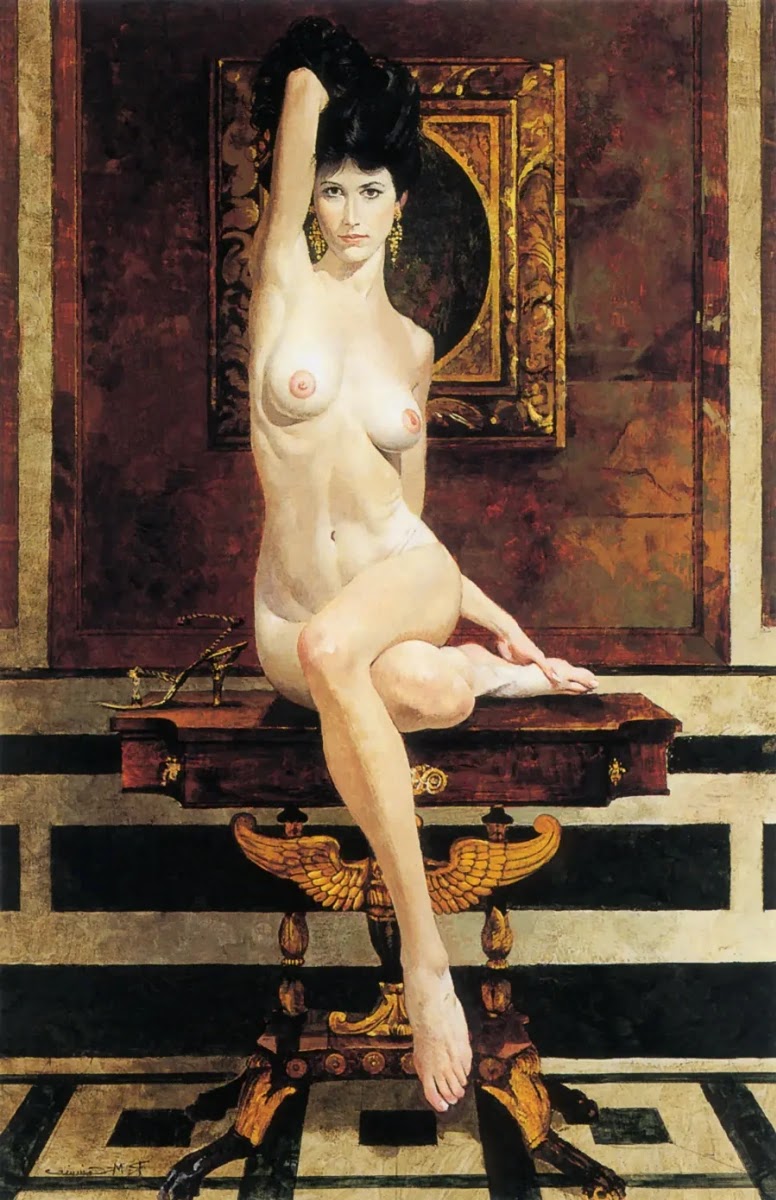
07 Paintings by Csok, Istvan (1865-1961) of his "Studio Interior", with footnotes

Csok, Istvan (1865-1961)
Studio Interior, c. 1905
Oil on canvas
106 x 185 cm.
Hungarian National Gallery, Budapest

The first picture - shown here - was taken in 1905 (Above). The success of the picture at the time is clearly shown by the fact that Csók made several copies of the composition in many versions, some of its details can be seen again in his later pictures. A 1910 version is attached.

Csók István 1865-1961 
Studio Corner (Painter and his Model)
Oil, wood
66x82 cm
Private collection

Csók István 1865-1961 
Studio Corner (Painter and his Model)
Oil, wood
Private collection

Csók István 1865-1961 
Studio Corner (Painter and his Model)
Oil, wood
68×81 cm
Private collection

István Csók. Hungarian, (1865 - 1961)
Studio corner, late 1920's
Oil on Wood
Private collection

István Csók. Hungarian, (1865 - 1961)
Studio corner
Oil on Wood
Private collection

Istvan Csók
Nu allongé
Oil on cardboard
43 x 57,5 cm
Private collection

István Csók (13 February 1865, Sáregres – 1 February 1961) of Methuselah-like longevity, belonged to the generation of Hungarian artists who were now studying in their own country, at the Budapest College of Decorative Arts. The child of a well-to-do miller's family, he was a young man leading the carefree life of the Bohemian art student when he came up against the incomprehension surrounding Pál Szinyei Merse's return at the beginning of the 1880s. Since the vivid and exciting colouring of the near-Impressionistic style of the painter of Picnic in May was decidedly to his liking, he left the institution and went to Munich. At Simon Hollósy's private school he came into contact with the spirit of the new movement that was getting under way - naturalism. The products of his first period belong under that heading. He went to stay in Paris and then, after getting married, settled there from 1903 onwards: that was when he painted the pictures that teem with ever richer colours. After 1910, when he had returned to Hungary, his oeuvre took a new direction: the pictures he painted of his family and surroundings celebrate the joys of a balanced middle-class life. His art, which glorifies beauty, was increasingly revered; from 1920 he was the president of the Szinyei Society and between 1923 and 1933 he was a liberal-minded professor at the Academy of Fine Art. His portraits, nudes and still-lifes recall the mature Renoir, both in their cheerful colours and in their swirling brushstrokes. He contemplated the world with wise understanding, and was thus pensioned off by the conservative regime, but placed on a pedestal after 1945 by the new order; he was twice awarded the Kossuth Prize in the last period of his life.d to freeze to death in the snow. The original painting was destroyed in World War II. More on István Csók


Please visit my other blogs: Art CollectorMythologyMarine ArtPortrait of a Lady, The OrientalistArt of the Nude and The Canals of VeniceMiddle East Artists365 Saints and 365 Days, also visit my Boards on Pinterest

Images are copyright of their respective owners, assignees or others. Some Images may be subject to copyright

I don't own any of these images - credit is always given when due unless it is unknown to me. if I post your images without your permission, please tell me.

I do not sell art, art prints, framed posters or reproductions. Ads are shown only to compensate the hosting expenses.

If you enjoyed this post, please share with friends and family.

Thank you for visiting my blog and also for liking its posts and pages.

Please note that the content of this post primarily consists of articles available from Wikipedia or other free sources online.


01 Painting, Streets of Paris, Victor Gabriel Gilbert's Marché aux fleurs, with footnotes, Part 87

Victor Gabriel Gilbert, French, 1847 - 1935
Marché aux fleurs
Oil on canvas
25¾ by 21½ in.; 65.4 by 54.6 cm
Private collection

Sold for 44,100 USD in January 2023

Victor Gilbert was celebrated as the foremost painter of Parisian marchés during the final decades of the 19th century, when daily markets proliferated throughout the French capital to satisfy the growing upper and middle classes. 

Located on Place Louis Lépine between the Notre-Dame Cathedral and Sainte-Chapelle chapel, the flower market has attracted avid gardeners and curious passersby since 1830. Both covered and open-air, the market is mainly formed by pavilions from the 1900s. 

Victor Gabriel Gilbert born in Paris the 13 February 1847 and died in the 21 July 1933. He was a French painter. He is buried in Montmartre cemetery in Paris. In 1860 he apprenticed to a painter and decorator. He followed with evening art classes under the direction of Father Levasseur, the School of the City of Paris. In the late 1870s, his taste for naturalism is developed and he turned to genre painting with scenes of streets, cafes, markets, especially that of Halles . He obtained a second class medal at the Salon of 1880 and a silver medal at the 1889 World Fair . It becomes a member of the French Society of Artists in 1914.

Victor Gilbert was appointed Knight of the Legion of Honour in 1897, and received the Prix Léon Bonnat in 1926. More on Victor Gabriel Gilbert


Please visit my other blogs: Art CollectorMythologyMarine ArtPortrait of a Lady, The OrientalistArt of the Nude and The Canals of VeniceMiddle East Artists365 Saints365 Days, and Biblical Icons, also visit my Boards on Pinterest

Images are copyright of their respective owners, assignees or others. Some Images may be subject to copyright

I don't own any of these images - credit is always given when due unless it is unknown to me. if I post your images without your permission, please tell me.

I do not sell art, art prints, framed posters or reproductions. Ads are shown only to compensate the hosting expenses.

If you enjoyed this post, please share with friends and family.

Thank you for visiting my blog and also for liking its posts and pages.

Please note that the content of this post primarily consists of articles available from Wikipedia or other free sources online.


01 Painting, Streets of Paris, Jean Beraud's Pont de Bercy, with footnotes, Part 86

Jean Beraud
Pont de Bercy
Oil on canvas
46.5 x 56 cm (18¹/₄ x 22 inches)
Private collection

Estimated for  £80,000 GBP - £120,000 GBP in November 2005

The Pont de Bercy is a bridge over the Seine in Paris. It links the 12th and 13th arrondissement of Paris by extending the Boulevard de Bercy and Boulevard Vincent-Auriol. In addition to the roadway, the bridge also carries Line 6 of the Paris Métro, between Quai de la Gare station and Bercy station.

The Pont de Bercy was built at the site of another bridge, a suspension bridge opened in 1832 to replace a ferry that had become overcrowded and thus exceeded its tonnage limit. 

In 1904, the bridge was enlarged by 5.5 metres to support Line 6 of the Paris Métro. In 1986, the decision was made to further enlarge the bridge in order to create three additional lanes for traffic. More on The Pont de Bercy 

Jean Béraud (January 12, 1849 – October 4, 1935) was a French painter renowned for his numerous paintings depicting the life of Paris, and the nightlife of Paris society. Pictures of the Champs Elysees, cafés, Montmartre and the banks of the Seine are precisely detailed illustrations of everyday Parisian life during the "Belle Époque". He also painted religious subjects in a contemporary setting.

Béraud became a student of Léon Bonnat, and exhibited his paintings at the Salon for the first time in 1872. However, he did not gain recognition until 1876, with his On the Way Back from the Funeral. He exhibited with the Society of French Watercolorists at the 1889 World's Fair in Paris.

Béraud's paintings often included truth-based humour and mockery of late 19th-century Parisian life, along with frequent appearances of biblical characters in then contemporary situations. Paintings such as Mary Magdalene in the House of the Pharisees aroused controversy when exhibited, because of these themes.

Towards the end of the 19th century, Béraud dedicated less time to his own painting but worked on numerous exhibition committees, including the Salon de la Société Nationale. Béraud never married and had no children. He died in Paris on October 4, 1935, and is buried in Montparnasse Cemetery beside his mother. More on Jean Béraud


Please visit my other blogs: Art CollectorMythologyMarine ArtPortrait of a Lady, The OrientalistArt of the Nude and The Canals of VeniceMiddle East Artists365 Saints365 Days, and Biblical Icons, also visit my Boards on Pinterest

Images are copyright of their respective owners, assignees or others. Some Images may be subject to copyright

I don't own any of these images - credit is always given when due unless it is unknown to me. if I post your images without your permission, please tell me.

I do not sell art, art prints, framed posters or reproductions. Ads are shown only to compensate the hosting expenses.

If you enjoyed this post, please share with friends and family.

Thank you for visiting my blog and also for liking its posts and pages.

Please note that the content of this post primarily consists of articles available from Wikipedia or other free sources online.


01 Painting, The amorous game, Victor Guerrier's Au café, with Footnotes, #83

Victor Guerrier
Au café
Oil on canvas
73 x 100 cm (28³/₄ x 39³/₈ inches)
Private collection

Sold for  7 500EUR in Octobre 2017

Victor Guerrier, (French, 1893-1968)  was born and trained in Lyon living much of his life at Saint Cyr au Mont d’Or. He began his career as an illustrator but made his name painting Belle Epoque subjects and Parisian life between the wars. 

Clearly inspired by the work of Impressionist masters such Manet and Toulouse-Lautrec his work captures and celebrates the diversity of life in Paris at the turn of the century; from the nightclubs of Montmartre to the cafés of the Champ-Elysses, Guerrier depicts French high society in its pomp. There is often a subtle narrative to the work, where a stolen glance speaks volumes. Further evidence of Manet’s work is evident in his figures, who often stare directly at the viewer, creating images that are, at once, engaging and arresting, while the fashions of the age are beautifully rendered with a vivid palette and deftly applied impasto. 

Guerrier also worked in the Alps and Algeria producing a number of Orientalist subjects along with a series of paintings in St Paul de Vence. He exhibited at the Salon de Printemps. More on Victor Guerrier


Please visit my other blogs: Art CollectorMythologyMarine ArtPortrait of a Lady, The OrientalistArt of the Nude and The Canals of VeniceMiddle East Artists365 Saints365 Days, and Biblical Icons, also visit my Boards on Pinterest

Images are copyright of their respective owners, assignees or others. Some Images may be subject to copyright

I don't own any of these images - credit is always given when due unless it is unknown to me. if I post your images without your permission, please tell me.

I do not sell art, art prints, framed posters or reproductions. Ads are shown only to compensate the hosting expenses.

If you enjoyed this post, please share with friends and family.

Thank you for visiting my blog and also for liking its posts and pages.

Please note that the content of this post primarily consists of articles available from Wikipedia or other free sources online.


01 Painting, The amorous game, Jacob Toorenvliet's seated couple drinking wine, With Footnotes #82

Jacob Toorenvliet  (1640–1719)
A seated couple drinking wine 
Oil on canvas
38 x 31.7 cm.; 15 x 12½ in.
Private collection

Sold for 8,750 GBP in September 2019

Here, two figures are seated before a stone wall around a wooden table. Behind the male figure at left, who with his left hand reaches for the chin of the female beside him and raises a glass in his right, is an evening vista. Great detail has been used to render the still life of melons and fruit on the table, the costumes of the two figures, as well as their lively expressions that suggest that they are engaged in conversation. More on this painting

Jacob Toorenvliet (1640–1719) was a Dutch Golden Age painter of genre works.

Toorenvliet was born in Leiden, to Abraham Toorenvliet (1620–1692), a glass painter and drawing instructor. The younger Toorenvliet first studied art with Frans van Mieris the Elder and Matthijs Naiveu, who were also studying with his father, a respected drawing teacher. Later, like his fellow students, he studied with Gerrit Dou, his father's brother-in-law, until 1659, when he started on his Grand Tour.

Torenvliet was active in a number of different cities throughout his career, mainly in Italy and the Netherlands. He was in Vienna in 1663, and in Rome for a portrait commission in 1669. From 1670 to 1673 they lived in Venice, making another trip to Rome in 1671, where Torenvliet became a member of the Bentvueghels with the bent name of Jazon. He went to Vienna again in 1673, staying until 1674, and mainly painted figures on copper. He was in Leiden again in 1679, Amsterdam in 1680, and back in Leiden in 1686, where he remained. He joined the Guild of Saint Luke in Leiden, and held a number of senior offices in it from 1695 to 1712, in addition to cofounding the Leiden Drawing Academy in 1694 with Willem van Mieris and Carel de Moor. He died in Oegstgeest in 1719. More on Jacob Toorenvliet


Please visit my other blogs: Art CollectorMythologyMarine ArtPortrait of a Lady, The OrientalistArt of the Nude and The Canals of VeniceMiddle East Artists365 Saints and 365 Days, also visit my Boards on Pinterest

Images are copyright of their respective owners, assignees or others. Some Images may be subject to copyright

I don't own any of these images - credit is always given when due unless it is unknown to me. if I post your images without your permission, please tell me.

I do not sell art, art prints, framed posters or reproductions. Ads are shown only to compensate the hosting expenses.

If you enjoyed this post, please share with friends and family.

Thank you for visiting my blog and also for liking its posts and pages.

Please note that the content of this post primarily consists of articles available from Wikipedia or other free sources online.


01 painting, Portrait of a Lady, Harold Von Schmidt's Friendly Persuasion, with Footnotes

Harold Von Schmidt, 1893-1982
Friendly Persuasion, c. 1922
Gouache on board
15 by 33 inches
Private collection

Sold for  $1,300 USD in April 2017

The Friendly Persuasion is an American novel published in 1945 by Jessamyn West. It was adapted as the motion picture Friendly Persuasion in 1956. The book is about a Quaker farming family living near the town of Vernon in southern Indiana along "the banks of the Muscatatuck, where once the woods stretched, dark row on row." More on Friendly Persuasion

Even though the painting appears to show a scene from Jessamyn West's story; the painting is dated over 20 years before the book was published!

Harold von Schmidt (May 19, 1893 – June 3, 1982) was an American illustrator, who specialized in magazine interior illustrations.

Born in Alameda, California in 1893, he was orphaned at the age of five. After a year in an orphanage, he went to live with his Aunt Lily Von Schmidt, an artist in her own right. As a youth, von Schmidt worked as a cowhand and a construction worker. In 1920 and 1924, he was on the United States Olympic Rugby team along with his cousin Charles Lee Tilden Jr. Although the United States team won the gold medal both years, von Schmidt did not play in the only game in 1920, and was sidelined by an injury in the final practice in 1924.

Von Schmidt began his art studies at the California School of Arts and Crafts while he was still in high school. In 1924, he entered the Grand Central School of Art in New York City. He moved to the suburban community of New Rochelle which was a well-known artist colony and home to many of the top commercial illustrators of the day such as Frank and J. C. Leyendecker and Norman Rockwell. Also in residence was N. C. Wyeth would become leaders in the field.

He later married and moved to Westport, Connecticut.

Harold von Schmidt's work appeared primarily in Collier's Weekly, Cosmopolitan, Liberty, The Saturday Evening Post, and Sunset. Although he preferred magazine work and illustrated few books, he spent two years preparing sixty illustrations for a deluxe edition of Willa Cather's Death Comes for the Archbishop. In 1948, he was recruited by Albert Dorne to be one of the founding faculty for the Famous Artists School. He was awarded the first gold medal by the trustees of the National Cowboy Hall of Fame in 1968.

Harold died on June 3, 1982 in Westport, Connecticut. More on Harold von Schmidt


Please visit my other blogs: Art CollectorMythologyMarine ArtPortrait of a Lady, The OrientalistArt of the Nude and The Canals of VeniceMiddle East Artists365 Saints and 365 Days, also visit my Boards on Pinterest

Images are copyright of their respective owners, assignees or others. Some Images may be subject to copyright

I don't own any of these images - credit is always given when due unless it is unknown to me. if I post your images without your permission, please tell me.

I do not sell art, art prints, framed posters or reproductions. Ads are shown only to compensate the hosting expenses.

If you enjoyed this post, please share with friends and family.

Thank you for visiting my blog and also for liking its posts and pages.

Please note that the content of this post primarily consists of articles available from Wikipedia or other free sources online.


01 Painting, The amorous game, Friedrich Sturm's Paolo and Francesca, With Footnotes #83


Friedrich Sturm, Vienna 1823 - 1898 Weissenbach an der Triesting
Paolo and Francesca
Oil on canvas
122,5 x 102,3 cm ; 48 ¼ by 40 ¼ in.
Private collection

Sold for 6,300 EUR in November 2022

In the late eighteenth century, a romantic admiration for Dante spread throughout Europe and a whole generation of artists was inspired by his writings. Sturm, like artists such as Ingres before him, chose to illustrate the theme of the famous Canto V of Dante’s Inferno, which relates the last moments of Francesca da Rimini and her brother-in-law Paolo Malatesta – more precisely, the point just before the tragedy when Paolo’s brother, Gianciotto Malatesta, takes the two lovers by surprise. Sturm, a talented painter, elegantly conveys the drama of the scene, which is both tragic and tender, charming and chilling, in this harmoniously composed mise-en-scène. More on this painting

Friedrich Sturm, also Fritz Sturm (1823–1898) was an Austrian artist known for his decorative art and paintings of animals and flowers.

Sturm was born in Vienna. He started out as a student of his father, who was a porcelain and enamel painter, and then attended the Academy of Fine Arts, Vienna. He then went on a study trip to Serbia and Hungary, where he worked as a theatre artist, portrait painter and painter of church art. He turned to fresco painting and specialized as a flower and animal artist. He decorated numerous Viennese buildings with wall and ceiling paintings, and he also painted on silk for the salon of the Empress of Austria. From 1853 to 1859 he sent his pictures to the monthly exhibitions of the Austrian Art Association. With the opening of the Museum of Art and Industry in Vienna in 1868 he became a professor at the associated School of Applied Arts, now the University of Applied Arts, and headed its department of plant, animal and ornament art until 1892. Women were also allowed to take part in his flower painting classes. From 1881 to 1889 he was director of the facility. He was retired due to illness in 1892. He died on 1 November 1898 in Weissenbach an der Triesting. More on Friedrich Sturm


Please visit my other blogs: Art CollectorMythologyMarine ArtPortrait of a Lady, The OrientalistArt of the Nude and The Canals of VeniceMiddle East Artists365 Saints365 Days, and Biblical Icons, also visit my Boards on Pinterest

Images are copyright of their respective owners, assignees or others. Some Images may be subject to copyright

I don't own any of these images - credit is always given when due unless it is unknown to me. if I post your images without your permission, please tell me.

I do not sell art, art prints, framed posters or reproductions. Ads are shown only to compensate the hosting expenses.

If you enjoyed this post, please share with friends and family.

Thank you for visiting my blog and also for liking its posts and pages.

Please note that the content of this post primarily consists of articles available from Wikipedia or other free sources online.


01 Painting, The amorous game, Jacob Toorenvliet's Inequal love, With Footnotes #83

Jacob Toorenvliet, Leiden 1625 - 1719 Oegstgeest
Inequal love/ Le couple mal assorti
Oil on copper
28 x 22,2 cm ; 11 by 8 ¾ in.
Private collection

Sold for 5,040 EUR in November 2022

The painting shows the theme of the ill-matched couple, a popular theme in the arts of the period, though generally the one making the proposition is a man to a courtesan, not a woman to a man. The theme generally shows the man offering the woman a ring in combination with a purse of money. 

Jacob Toorenvliet (1640–1719) was a Dutch Golden Age painter of genre works.

Toorenvliet was born in Leiden, to Abraham Toorenvliet (1620–1692), a glass painter and drawing instructor. The younger Toorenvliet first studied art with Frans van Mieris the Elder and Matthijs Naiveu, who were also studying with his father, a respected drawing teacher. Later, like his fellow students, he studied with Gerrit Dou, his father's brother-in-law, until 1659, when he started on his Grand Tour.

Torenvliet was active in a number of different cities throughout his career, mainly in Italy and the Netherlands. He was in Vienna in 1663, and in Rome for a portrait commission in 1669. From 1670 to 1673 they lived in Venice, making another trip to Rome in 1671, where Torenvliet became a member of the Bentvueghels with the bent name of Jazon. He went to Vienna again in 1673, staying until 1674, and mainly painted figures on copper. He was in Leiden again in 1679, Amsterdam in 1680, and back in Leiden in 1686, where he remained. He joined the Guild of Saint Luke in Leiden, and held a number of senior offices in it from 1695 to 1712, in addition to cofounding the Leiden Drawing Academy in 1694 with Willem van Mieris and Carel de Moor. He died in Oegstgeest in 1719. More on Jacob Toorenvliet


Please visit my other blogs: Art CollectorMythologyMarine ArtPortrait of a Lady, The OrientalistArt of the Nude and The Canals of VeniceMiddle East Artists365 Saints365 Days, and Biblical Icons, also visit my Boards on Pinterest

Images are copyright of their respective owners, assignees or others. Some Images may be subject to copyright

I don't own any of these images - credit is always given when due unless it is unknown to me. if I post your images without your permission, please tell me.

I do not sell art, art prints, framed posters or reproductions. Ads are shown only to compensate the hosting expenses.

If you enjoyed this post, please share with friends and family.

Thank you for visiting my blog and also for liking its posts and pages.

Please note that the content of this post primarily consists of articles available from Wikipedia or other free sources online.


03 Works, Robert McGinnis' interpretations of Richard Scott Prather's novels Adrienne, Renee and Rose Garland, with Footnotes #83

Robert McGinnisis
Detail; Cover art from the paperback novel "Adrienne" by Richard S. Prather
Digital print on stretched canvas
29 x 14 x 1 in
Private collection

Robert McGinnisis
Cover art from the paperback novel "Adrienne" by Richard S. Prather
Digital print on stretched canvas
29 x 14 x 1 in
Private collection

Robert McGinnisis
Cover art from the paperback novel "Renee" by Richard S. Prather
Digital print on stretched canvas
22 x 30 x 1 in
Private collection

Robert E. McGinnis
Rose Garland, c. 2000
Mixed media on board
19 1/2 x 15 5/8 inches 
Private collection

Richard Scott Prather (September 9, 1921 – February 14, 2007) was an American mystery novelist, best known for creating the "Shell Scott" series. He also wrote under the pseudonyms David Knight and Douglas Ring.

Prather was born in Santa Ana, California. He served in the United States Merchant Marine during World War II, from 1942 through the end of the war, in 1945. That year he began working as a civilian chief clerk of surplus property at March Air Force Base in Riverside, California. He left that job to become a full-time writer in 1949. The first Shell Scott mystery, Case of the Vanishing Beauty, was published in 1950. It would be the start of a long series that numbered more than three dozen titles featuring the Shell Scott character.

At Prather's death in 2007, he had completed but not published his last Shell Scott Mystery. His final novel, The Death Gods, was published October 2011, in print and ebook formats by Pendleton Artists, with permission of the Richard S. Prather Estate and Linda Pendleton. More on Richard Scott Prather

Robert Edward McGinnis (born February 3, 1926) is an American artist and illustrator. McGinnis is known for his illustrations of more than 1,200 paperback book covers, and over 40 movie posters, including Breakfast at Tiffany's (his first film poster assignment) Barbarella, and several James Bond and Matt Helm films

McGinnis became an apprentice at Walt Disney Studios, then studied fine art at Ohio State University. After wartime service in the Merchant Marine he entered advertising and a chance meeting with Mitchell Hooks in 1958 led him to be introduced to Dell Publishing began a career drawing a variety of paperback covers for books written by such authors as Donald Westlake (writing as Richard Stark), Edward S. Aarons, Erle Stanley Gardner, Richard S. Prather, and the Michael Shayne and Carter Brown series.

McGinnis later did artwork for Ladies' Home Journal, Woman's Home Companion, Good Housekeeping, TIME, Argosy, Guideposts, and The Saturday Evening Post.

McGinnis's attention to detail was such that when he was assigned to do the artwork for Arabesque he requested Sophia Loren's tiger stripe dress be sent for him for a model to wear so he could get the right appearance.

In 1985 McGinnis was awarded the title of "Romantic Artist of the Year" by Romantic Times magazine for his many romance novel paperback covers.

He is a member of the Society of Illustrators Hall of Fame. McGinnis is the subject of a documentary film, Robert McGinnis: Painting the Last Rose of Summer, by Paul Jilbert. More on Robert Edward McGinnis


Please visit my other blogs: Art CollectorMythologyMarine ArtPortrait of a Lady, The OrientalistArt of the Nude and The Canals of VeniceMiddle East Artists365 Saints365 Days, and Biblical Icons, also visit my Boards on Pinterest

Images are copyright of their respective owners, assignees or others. Some Images may be subject to copyright

I don't own any of these images - credit is always given when due unless it is unknown to me. if I post your images without your permission, please tell me.

I do not sell art, art prints, framed posters or reproductions. Ads are shown only to compensate the hosting expenses.

If you enjoyed this post, please share with friends and family.

Thank you for visiting my blog and also for liking its posts and pages.

Please note that the content of this post primarily consists of articles available from Wikipedia or other free sources online.


04 Photographs, Albert Watson's Lisa Taylor, Nina, Monica Gripman and Heloise, 1977, With Footnotes #82

Albert Watson (Scottish, b. 1942)
Detail; Lisa Taylor, New York, 1977
Gelatin silver print on Agfa paper
12 x 10 inches (30.5 x 25.4 cm)
Private collection

Albert Watson (Scottish, b. 1942)
Lisa Taylor, New York, c. 1977
Gelatin silver print on Agfa paper
12 x 10 inches (30.5 x 25.4 cm)
Private collection

Lisa Taylor is a model and actress from New York City. In the 1970s, she was a frequent presence in the pages of Vogue and appeared on the cover four times. She was the face of brands like Calvin Klein, Dior, and Oscar de la Renta. She is known for her roles in Eyes of Laura Mars (1978), Where the Buffalo Roam (1980) and Windy City (1984).

Taylor was born 1951 at Oyster Bay, New York. She quit her studies after a short stint at Pine Manor Junior College in Boston. Later she moved to New York, studied dance briefly.

Taylor never wanted to be a model, a job she had called "prissy and stupid", but wanted to finance dance classes so rather than being discovered she approached star maker Eileen Ford directly and began working immediately.

A staple of the late 70s and early 80s model scene alongside the likes of Cheryl Tiegs and Christie Brinkley, she retired from the business but re-emerged in 1992 when Calvin Klein made her, at 40, the new look of his clothing line.

She graduated from the Purnell School and attended Pine Manor College.

Taylor signed with the Ford modeling agency in 1971 at the age of 19. One of her jobs was the cover of the college issue of Mademoiselle.

In 1982, she quit her modelling career and moved to West Coast of the United States to get rid of a debilitating drug and alcohol habit.

Taylor is very vocal about the use of drugs in the fashion industry. More on Lisa Taylor

Albert Watson (Scottish, b. 1942)
Nina, New York, c. 1977
Gelatin silver print on Agfa paper
12 x 10 inches (30.5 x 25.4 cm)
Private collection

I was unable to identify Nina!

Albert Watson
Monica Gripman
Gelatin silver print on Agfa paper
Height: 55.91 in (142 cm), Width: 42.13 in (107 cm)
Private collection

I couldn't find any background information on Monica Gripman!

Albert Watson (Scottish, b. 1942)
Heloise, New York, c. 1977
Gelatin silver print on Agfa paper
12 x 10 inches (30.5 x 25.4 cm)
Private collection

Albert Watson OBE (born 1942) is a Scottish fashion, celebrity and art photographer. He has shot over 100 covers of Vogue and 40 covers of Rolling Stone magazine since the mid-1970s, and has created major advertising campaigns for clients such as Prada, Chanel and Levis. Watson has also taken some well-known photographs, from the portrait of Steve Jobs that appeared on the cover of his biography, a photo of Alfred Hitchcock holding a plucked goose, and a portrait of a nude Kate Moss taken on her 19th birthday.

Watson's prints of his photography are exhibited in galleries and museums worldwide. Photo District News named him one of the 20 most influential photographers of all time, along with Richard Avedon and Irving Penn, among others. Watson has won numerous honors, including a Lucie Award, a Grammy Award, the Hasselblad Masters Award and three ANDY Awards. He was awarded The Royal Photographic Society's Centenary Medal and Honorary Fellowship in recognition of a sustained, significant contribution to the art of photography in 2010. Queen Elizabeth II awarded Watson an Order of the British Empire in June 2015 for 'services to photography'. More on Albert Watson


Please visit my other blogs: Art CollectorMythologyMarine ArtPortrait of a Lady, The OrientalistArt of the Nude and The Canals of VeniceMiddle East Artists365 Saints and 365 Days, also visit my Boards on Pinterest

Images are copyright of their respective owners, assignees or others. Some Images may be subject to copyright

I don't own any of these images - credit is always given when due unless it is unknown to me. if I post your images without your permission, please tell me.

I do not sell art, art prints, framed posters or reproductions. Ads are shown only to compensate the hosting expenses.

If you enjoyed this post, please share with friends and family.

Thank you for visiting my blog and also for liking its posts and pages.

Please note that the content of this post primarily consists of articles available from Wikipedia or other free sources online.