A Mediterranean capriccio harbour scene

Jacobus Storck (Amsterdam 1641-1687)
A Mediterranean capriccio harbour scene, c. 1679
Oil on canvas
132 x 200.5cm (51 15/16 x 78 15/16in).
Private collection

Based on the similarity of palette, style and compositions between the works of Jacobus and his younger brother Abraham, it is thought that they shared a family studio. The careful characterisation of the figures and the detail of the costume in the present painting suggests that Abraham may have assisted with the staffage. This was not uncommon, as Abraham is also thought to have painted the figures in other marine landscapists' work.

The topographical details incorporated in many of the capricci by Jacobus and Abraham suggest that they must have travelled widely within the Netherlands, as well as to a number of German cities, along the Rhine and to Italy. The Italian influence is evident in the present painting, with the church of San Giovanni e Paolo and Colleoni monument in Venice providing the inspiration for the architecture in this coastal port.

A drawing by Abraham Storck, signed and dated 1676, showing the church, cupola and sculpture on the left of the present painting, is now the Prints and Drawings collection at the National Gallery of Scotland, Edinburgh.

Abraham Storck (or Sturckenburch) (bapt. 17 April 1644 in Amsterdam – buried 8 April 1708), was a Dutch painter, who enjoyed a reputation for his marine paintings, topographical views and Italianate harbour scenes. Storck was also an outstanding draughtsman

Circa 1666 Storck established his workshop producing naval, harbor scenes as well as landscape paintings and city scapes. In 1670 he traveled with his brother Jacob and worked in Germany. In 1694, at age 49, he married the widow Neeltje Pieters van Meyservelt. At the end of his life he lived on Kattenburg near the harbour.

Storck produced fantastical views of Mediterranean ports, which place merchant shipping amidst architectural ruins, depicted in the crystal-clear colours of Italian art of the period. This type of scene anticipated the popular 18th-century Italian capriccio. He depicted ships' rigging and technical details with considerable accuracy, which likely shows the influence of the van de Veldes. His Dutch harbour and river views often include recreational and ceremonial aspects of shipping. He paid particular attention to the display of pleasure yachts, ceremonial gatherings of ships, the passengers and bystanders.

Storck painted some winter scenes, which are inspired by the example of Jan Abrahamsz Beerstraaten and his son Anthonie Beerstraaten, a selfportrait, and some allegories. More on Abraham Storck


Please visit my other blogs: Art Collector, Mythology, Marine Art, Portrait of a Lady, The Orientalist, Art of the Nude and The Canals of Venice, Middle East Artists, 365 Saints and 365 Days, also visit my Boards on Pinterest

Images are copyright of their respective owners, assignees or others. Some Images may be subject to copyright

I don't own any of these images - credit is always given when due unless it is unknown to me. if I post your images without your permission, please tell me.

I do not sell art, art prints, framed posters or reproductions. Ads are shown only to compensate the hosting expenses.

If you enjoyed this post, please share with friends and family.

Thank you for visiting my blog and also for liking its posts and pages.

Please note that the content of this post primarily consists of articles available from Wikipedia or other free sources online.


8 Rarely Seen Works by Henri Matisse, Lyonel Feininger, Pablo Picasso, Pierre Bonnard, and Pierre-Auguste Renoir

1871 - 1956
HORN PLAYER IN THE VILLAGE
signed Feininger (lower left) and dated Donnerstag d. 1. April. 1915 (lower right)
watercolour and pen and ink on paper
image size: 20.3 by 26.4cm.; 8 by 10 3/8 in.
sheet size: 24.1 by 30.7cm.; 9 1/2 by 12 1/8 in.
Executed on 1st April 1915.

Pablo Picasso
1881 - 1973
LE CHEVALIER ET LES PAGES
dated Vallauris jeudi 22.2.51. (lower centre)
pen and brush and ink, wash and gouache on paper
50.3 by 65.7cm.
19 3/4 by 25 7/8 in.
Executed in Vallauris on 22nd February 1951.

Henri Matisse
1869 - 1954
FEMME À L'OMBRELLE
signed Henri Matisse (lower left); signed Henri Matisse and dedicated à M et Mme Abel Desjardins, souvenir affectueux, Dec. 1919 on the reverse
oil on canvasboard
23.7 by 19cm.
9 1/4 by 7 1/2 in.
Painted in Nice in 1919.

Painted in 1919, portraying his model seated in front of an open window in his Mediterranean studio. The model posing in a chair was a popular subject during this period, and the supple curves of her body and the rich, textural contrasts of her clothing are beautifully executed in the present work. Indeed, Matisse makes his model, the young Antoinette Arnoud, the focus of this lively and unusually direct composition. She is depicted close-up, filling the pictorial field as she reclines against the chair that is loosely sketched in the background. She assumes a rather flirtatious pose, with her rose coloured parasol held at a jaunty angle and Matisse achieves a heightened sense of immediacy through his use of a broad diagonal set against the green vertical of the shuttered French door which frames the composition. This concentration on his model, and the attention that Matisse pays in rendering the elegant florals of her dress, anticipate some of his later portraits of fashionable women and illustrate his skill in harmonising bold colour planes with decorative patterns. More

Pablo Picasso
1881 - 1973
NATURE MORTE
signed Picasso (upper left); dated 6 Avl 44 on the reverse
oil on canvas
60 by 92cm.
23 5/8 by 36 1/4 in.
Painted on 6th April 1944.

In early April 1944 Picasso painted several still-lifes featuring a candle and a cafetiere on a table-top, executed in his studio on the rue des Grands-Augustins. Because of the restrictive circumstances of occupied Paris, Picasso made a habit of painting at night or behind heavily shaded windows, and the chromatic severity of many of his pictures from this time conveys the ambiance of these conditions. Like other works from this series, this seemingly simple composition of a traditional genre reflects multi-layered symbolism. As is the case with so much of Picasso’s art, he imbues the most innocent subject matter with an erotic undertone. In the case of Nature morte, the images of the cafetiere and the fruit bowl carry Freudian connotations, acting as symbols of male and female sexuality. More

Pablo Picasso
1881 - 1973
DEUX PERSONNAGES (LA LECTURE)
signed Picasso (lower left) and dated Boisgeloup 30 mars XXXIV (along the top); dated Boisgeloup 30 mars XXXIV on the stretcher
oil on canvas
81 by 65cm.
32 by 25 1/2 in.
Painted in Boisgeloup on 30th March 1934.

Picasso's striking portrayal of two women reading belongs to the extraordinary group of canvases inspired by Marie-Thérèse Walter, his beloved mistress during the early 1930s. Distinguished by their rich colouration, harmonic curves and sweeping arabesques, these exceptional pictures are renowned as Picasso's most euphoric, sexually-charged, fantastical and inspired compositions, and they rank among the most instantly recognizable works of 20th century art. Of all the manifestations of Picasso's exceptionally prolific career, it is during his 'Marie-Thérèse period' when his creative force was at its most powerful. Among the most evocative of these pictures is Deux personnages also known as La Lecture, created when Marie-Thérèse was firmly at the centre of Picasso's artistic and private universe. More

Henri Matisse
1869 - 1954
FEMME À L'OMBRELLE VERTE
signed Henri Matisse (lower right)
oil on canvasboard
41 by 33cm.
16 1/8 by 13cm.
Painted in Nice in 1919.

Femme à l'ombrelle verte was painted during the early months of 1919 at the Hôtel Méditerranée et de la Côte d’Azur in Nice. Matisse took his first room at the Méditerranée in November 1918 and, returning to Nice each autumn, would continue to reside there for the next three years, deriving inspiration from the Italian-style ceilings, old rococo decor and sunlit interiors. As Jack Cowart writes, describing Matisse’s room there: ‘This hotel would become for Matisse a most fertile, expansive environment… His first room had shuttered, double French doors opening out onto a balcony with a carved or cast balustrade [...]. Models were chosen to pose on the balcony, holding brightly colored red, green, or orange umbrellas. These parasols not only shaded them from the sun but also provided a soft irradiation of colored light that Matisse would capture on canvas’ (J. Cowart, ‘The Place of Silvered Light’, in Henri Matisse, The Early Years in Nice, 1916-1930 (exhibition catalogue), op. cit., p. 24). More

Pierre Bonnard
1867 - 1947
CABANONS AU CANNET
signed Bonnard (lower left)
oil on canvas
68 by 94cm.
26 3/4 by 37in.
Painted in 1933.

The present work depicts a view near Bonnard’s house Le Bosquet at Le Cannet, and is a wonderful example of the rich nature and captivating light of the south of France that provided an important source of inspiration for the artist. Situated above Cannes on the Côte d’Azur, Le Bosquet was surrounded by lush vegetation that could be seen from the house. Both the villa and the town itself offered the artist a wide array of subjects to paint, resulting in powerful, boldly coloured compositions. As Jörg Zutter wrote: ‘By 1931 Le Bosquet was Bonnard’s favourite place to work and in 1939 it became the couple’s permanent home. The house and its surroundings provided an ideal work environment for the artist, who continued to paint studies of Marthe, often standing in the bathroom or lying in the tub. He also painted still lifes, self-portraits, interiors and the views onto the countryside from different windows and doors’ (J. Zutter in Pierre Bonnard: Observing Nature (exhibition catalogue), National Gallery of Australia, Canberra, 2003, p. 61). More

Pierre-Auguste Renoir
1841 - 1919
FEMME À LA TOQUE NOIRE OR TÊTE DE JEUNE FEMME OR PORTRAIT DE FEMME EN BUSTE AU CHAPEAU NOIR
signed Renoir (lower right)
pastel on paper
60.8 by 46.5cm.
24 by 18 1/4 in.
Executed circa 1890.

Whilst Renoir’s work of the early 1880s had been defined by his return to a classically-inspired and more formal style that reasserted the importance of the drawn line in his work, by 1890 he had returned to a warmer and more delicate handling. In Femme à la toque noire this new warmth is emphasised by Renoir’s exquisite use of the pastel. Renoir worked in this medium throughout his life and its powdery effervescence was well-suited to his singular style. Pastel allowed him to reconcile the fresh spontaneity afforded by drawing, with the colour that was so fundamental to his aesthetic. François Daulte suggests: ‘If he frequently used that medium to depict those near and dear to him, it was because pastel, which combines color with line, gave him the possibility of working rapidly to capture in all their vividness the rapid flash of intelligence and the fleeting show of emotion’ (F. Daulte, Pierre-Auguste Renoir: Water-colours, Pastels, and Drawings in Colour, London, 1959, p. 10). In the present work Renoir’s choice of medium imbues the painting with spontaneous intimacy and brings a fresh vivacity to his subject.  More

1841 - 1919
PORTRAIT DE CLAUDE MONET
signed Renoir (lower left)
charcoal on paper
52 by 41cm.
20 1/2 by 16in.
Drawn circa 1890.

Renoir’s earliest depictions of his fellow artist date from this first period of Impressionism. In the summer of 1873 he visited Monet at his house at Argenteuil and painted the artist at work in his garden and a year later - in the months after the exhibition - he joined the Monet family there once more, painting a touching portrait of the artist’s wife and young son in the garden of their home. He also painted a number of more formal portraits including a picture of the artist at his easel, Claude Monet (fig. 1), now in the Musée d'Orsay in Paris. Over the following decades the two artists maintained their friendship, although by the time Renoir drew this portrait of Monet around 1890, they had ceased exhibiting their work with the original Impressionist group. They both had already attained considerable commercial success, and Renoir in particular was now regarded as the most sought-after portrait painter in Paris. More

1881 - 1973
LA RENCONTRE
signed P. Ruiz Picasso (lower left)
pastel on paper
54 by 42cm.
21 1/4 by 16 1/2 in.
Executed in Barcelona in 1899.

La Rencontre illustrates Picasso’s immediate responsiveness to this world of new influences. Embracing the modern sensibility that would characterise his depictions of Parisian life the following year, the work is characteristic of Picasso’s acute and perceptive observation of his surroundings. It also reveals his increasing receptivity to new modes of expression. The pastel is applied thickly – almost sensuously - in bold swathes of colour which Picasso uses to delineate space and evoke atmosphere. This new approach to form and colour is reflected in the development of his drawing over this period as he gradually abandoned the academic technique of modelling in favour of bolder lines and the use of blocks of white or black to suggest depth. This shift was influenced by the prevailing spirit of Catalan modernisme and specifically by his work on graphic projects – most famously in the design for a menu for Els 4 Gats – which emphasised a flatter, more linear style and the use of colour to create a dynamic of depth and movement in the composition. As John Richardson observed of this critical period, it ‘reveals an astonishingly rapid advance not just in acuity of observation and technique but in drama and style. Everything has more of an edge to it’ (J. Richardson, A Life of Picasso. Volume I: 1881-1906, London, 1991, p. 109).  More


12 Works by Lyonel Feininger, June 7, 2014

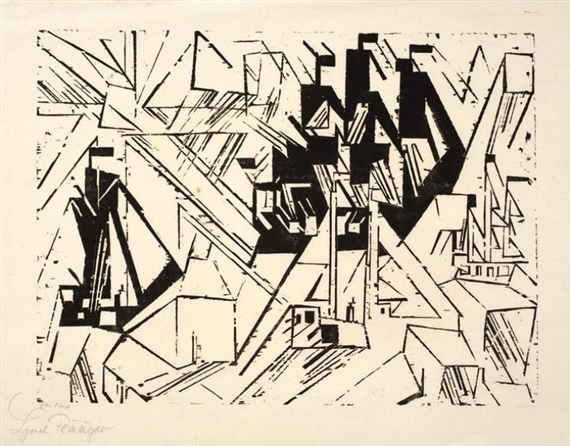
The son of German parents, Lyonel Feininger was born in New York in 1871. He moved to Germany in 1887, studied in Hamburg, Berlin, and Paris, and worked as a caricaturist and draftsman in Berlin for fourteen years before beginning to paint in the Cubist style. In 1919 he was appointed "master" at the Bauhaus in Weimar. Later he immigrated to the United States when the National Socialists declared his work "degenerate."

Marine
Dimensions:  11.02 X 14.8 in (28 X 37.6 cm)
Medium:  Woodcut on laid paper
Creation Date:  1918
Edition Number:  One of 125 prints
Signed


Lyonel Feininger's art holds an intrinsic beauty and importance recognized internationally. Famous for his Cubist paintings, Feininger was an essential member of the Bauhaus school. Most recognizable for his Cubist architectural scenes, Feininger's range of art stretches to woodcuts, cartoons, drawings, pen and ink, and watercolor, depicting subjects ranging from people to still-life to sketches of landscape vistas.

PARISER HÄUSER (HOHE HÄUSER IN PARIS)
Dimensions: 14.65 X 10.63 in (37.2 X 27 cm)
Medium: woodcut
Creation Date: 1920
Signed
Edition Number: edition of circa 30-35


Feininger strove to "transform in the mind and crystallize what one sees." Reality in his work does not rely strictly upon the representation of observed impressions but in the appropriation and transformation of perceptions into spatial and plastic, multidimensional pictorial structures. Feininger's work is built up of layers of prismatic and crystalline forms, one above the other

RATHAUS VON ZOTTELSTEDT, 1“ („RATHAUS“)
Dimensions: 4.53 X 5.47 in (11.5 X 13.9 cm)
Medium: Woodcut on Japan laid paper
Creation Date: 1918
Signed
Edition Number: print aside from the edition of 55


Only their mutual interpretation produces the object, and it leads into the depth of the pictorial space rather than to its surface. Aside from the use of pictorial space for purely architectural depiction, the fundamental innovation in his work is the creation of formal volume through the overlapping of color planes.


WINDMÜHLE


Dimensions: 10.04 X 12.01 in (25.5 X 30.5 cm)
Medium: Woodcut on Japan laid paper
Creation Date: 1919
Signed
Edition Number: from the edition of 80

Spatial depth and volume, intrinsic to Feininger's work, changed with his development as an artist. In his first paintings, compositions deal with earthbound energies trying to disengage themselves. Conflict between the aspiring verticals and the gravitating horizontals result in diagonal forms, exuding a dynamic ascent. As the war ended, the tension which had held him since 1910 began to relax.

GHOSTIES
Dimensions: 3.43 X 3.7 in (8.7 X 9.4 cm)
Medium: Watercolour and pen and India ink on letterhead paper
Creation Date: 1952
Signed

His great seriousness gave way to a more serene and lyrical mood, softer and finer. In the pictures he created in the second half of the 1920s, Feininger achieved ever greater calm and clarity of form. lesliesacks

SAILING BOATS (WITH MOON); UNTITLED
Woodcut on very fine Japan paper, print on Kazo paper
Edition Number: possibly trial proof

SHIP ALONG THE SHORE
Dimensions: 5.51 X 7.48 in (14 X 19 cm)
Medium: Woodcut on japanese paper
Creation Date: 1920
Signed

SEASCAPE
Dimensions: 12.13 X 18.9 in (30.8 X 48 cm)
Medium: Watercolour, India ink and wash as well as pen and ink and pencil drawing on laid paper with watermark
Creation Date: 1954
Signed

SAILING SHIP
Dimensions: 7.5 X 11.25 in (19.05 X 28.58 cm)
Medium: Watercolor and pen and ink on paper
Creation Date: 1934
Signed

EDGED SPACES
Dimensions: 30 X 24 in (76.2 X 60.96 cm)
Medium: oil over pencil on canvas
Creation Date: 1954
Signed

SAILING SHIP UNDER CLOUD
Dimensions: 12.62 X 18.88 in (32.07 X 47.94 cm)
Medium: watercolor and pen and black ink on paper
Creation Date: 1948
Signed

HARBOR WITH LIGHTHOUSE
Dimensions: 9.5 X 14 in (24.13 X 35.56 cm)
Medium: watercolor and pen
Signed


14 Rare Works by Marc Chagall, June 7, 2015

Marc Chagall  was born in Vitebsk, Byelorussia, in 1887 to a poor Hasidic family. The eldest of nine children, Marc Chagall studied first in a heder before moving to a secular Russian school, where he began to display his artistic talent. With his mother's support, and despite his father's disapproval, Chagall pursued his interest in art, going to St. Petersburg in 1907 to study art with Leon Bakst. 

Marc Chagall 
1887-1985 (Russian, French) 
L'oiseau bleu, c.1960 
oil, Chinese ink snd gouache on masonite 
h:26 w: 18 cm. 
estati signature stamp upper right 

Influenced by contemporary Russian painting, Chagall's distinctive, child-like style, often centering on images from his childhood, began to emerge. From 1910 to 1914, Marc Chagall lived in Paris, and there absorbed the works of the leading cubist, surrealist, and fauvist painters

Marc Chagall 
1887-1985 (Russian, French) 
Roméo et Juliette, 1964 
color lithograph, the deluxe edition, before letters, aside from the edition of 200, published by the Tourist Francaise, Paris, printed by Mourlot, Paris 
h:63 w: 99 cm. 
signed and dated lower right 

Strong and often bright colors portray the world with a dreamlike, non-realistic simplicity, and the fusion of fantasy, religion, and nostalgia infuses his work with a joyous quality. Animals, workmen, lovers, and musicians populate his figures; the "fiddler on the roof" recurs frequently, often hovering within another scene. Chagall's work of this period displays the influence of contemporary French painting, but his style remains independent of any one school of art. He exhibited regularly in the Salon des Independants.

Marc Chagall 
1887-1985 (Russian, French) 
Recto - Nocturnal visit (left); Profile of the artist (right); 
Verso - Summer (left); Winter (right), c.1950 
pencil and pastel crayons on paper (double-sided work) 
h:11 w: 17 cm. 
titled and inscribed several times 

During the war, he resided in Russia, and in 1917, endorsing the revolution, he was appointed Commissar for Fine Arts in Vitebsk and then director of the newly established Free Academy of Art. The Bolshevik authorities, however, frowned upon Chagall's style of art as too modern, and in 1922, Marc Chagall left Russia, settling in France one year later. He lived there permanently except for the years 1941 - 1948 when, fleeing France during World War II, he resided in the United States. Chagall's horror over the Nazi rise to power is expressed in works depicting Jewish martyrs and Jewish refugees. 

Marc Chagall 
1887-1985 (Russian, French) 
XX Siecle - Hommage a Marc Chagall, 1969 
color lithograph 
h:50 w: 36 cm. 
signed lower right and numbered '28/75' lower left 

Marc Chagall 
1887-1985 (Russian, French) 
Les ateliers de Chagall (portfolio with text by Robert Marteau), 1976 
color lithgraph as frontispiece, published by Mourlot 
h:43 w: 32 cm. 
signed lower right, numbered '23/250' lower left 

Marc Chagall 
1887-1985 (Russian, French) 
Nature morte bleue, Paris, 1957 
color lithograph 
h:39 w: 28 cm. 
signed lower right, numbered '58/90' lower left 

Marc Chagall 
1887-1985 (Russian, French) 
Le Ciel des Amoureux, Paris, 1964 
color lithograph on arches paper 
h:76 w: 56 cm. 
signed lower right, numbered '9/30' lower left 

Marc Chagall 
1887-1985 (Russian, French) 
Couple et panier de fruits, Paris, April, 1976 
color lithograph 
h:66 w: 53 cm. 
signed lower right, numbered '26/50' lower left 

Marc Chagall 
1887-1985 (Russian, French) 
Acrobats at play, 1963 
color lithograph 
h:49 w: 37 cm. 
signed lower right and numbered '6/40' lower left 

Marc Chagall 
1887-1985 (Russian, French) 
S'étant attardé à Gaza chez une courtisane, et guetté par les habitants qui voulaient le tuer, Samson enlève les portes de la ville, les charge sur son dos et va les déposer au sommet d'une montagne (Judges, XVI, 1-3), 1958 
hand colored etching 
h:54 w: 39 cm. 
initialled lower right, numbered '49/100' lower left 

Marc Chagall 
1887-1985 (Russian, French) 
Le Couple, pl.12 (from Songes), 1981 
etching with aquatint, published by Cramer, Geneva 
h:52 w: 38 cm. 
signed lower right, numbered 'VII/X' lower left 

Marc Chagall 
1887-1985 (Russian, French) 
Scene biblique pour Marcel Arland, 1957 
Chinese ink, wax and pastel crayons on frontispiece of the book Verve, vol.VIII, no.33 et 34, Paris, 1956 
h:35 w: 51 cm. 
signed, dated and inscribed lower right

Marc Chagall 
1887-1985 (Russian, French) 
Peintre et son chevalet, 1974 
tempera, Chinese ink and pastel crayons on frontispiece of book Chagall Lithographe, vol.IV 
h:49 w: 31 cm. 
signed lower right, dated and inscribed lower left 

Marc Chagall 
1887-1985 (Russian, French) 
Untitled, pl.25 (from Louis Aragon: Celui qui dit les choses sans rien dire), 1976 
etching with aquatint, edition of 25, published by Maeght, Paris 
h:44 w: 36 cm. 
signed lower right, numbered '15/25' lower left 


Tamar Daughter-in-Law of Judah from The Bible Series, 1960
Paradise 1
from The Bible Series, 1960

Esther
from The Bible Series, 1960

Exhortation Of Joshua
SOLD

Adam and Eve are Banished From Paradise
from The Bible Series, 1960
Hagar and Ishmael in the Desert
from The Bible Series, 1960
Spirit of the Circus
L'ame Du Cirque

Daphnis & Chloe
Chagall Poster Rider on a Red HorseChagall Poster Zircus
Flute Player
"Le Joueur de Flute"
Derrière le miroir n° 182