Showing posts with label Shabtis. Show all posts

24 Anciant Egyptian Artifacs - 2

AN EGYPTIAN GESSO-PAINTED WOOD UPPER SECTION OF A SARCOPHAGUS INNER COVER
Roman period, Circa 1st-4th Century AD
sculpted in relief and decorated with polychrome paints depicting a noble woman with central scarab at apex
Dimensions: 60cm

AN EGYPTIAN CEDAR WOOD AND BRONZE INLAY ANTHROPOID SARCOPHAGUS LID UPPER SECTION
Late Period, Dynasty XXVI, Circa 600 B.C.
Solid cedar casing for a noble man gesso covered and painted, with black tripartite wig, the visage in red flanked by exposed ears, the eye lines and brows inlaid in bronze, the eyes of white and black inlays, the lips drawn into a slight smile above a rounded chin and projecting false beard, shoulders with four bands of polychrome plumage above a yellow band at the chest
Dimensions: 62cm

AN EGYPTIAN WOOD PAINTED ANTHROPOID SARCOPHAGUS LID, New Kingdom, Dynasty XXI, Circa 1069-945 B.C.
gesso covered and painted sections with hands in relief emerging at the chest on either side of a red and yellow cross, a central scarab flanked by two flowers with blue petals, various panels painted with scenes including a seated individual wearing a tight-fitting white tunic below a sun-disc and an ankh below a section of outstretched wings, another panel with rows of hieroglyphs, conserved and stabilised
Dimensions: 189cm

AN EGYPTIAN LIMESTONE STELE FRAGMENT
New Kingdom, Dynasty XVIII, Circa 1550-1292 B.C.
Sculpted in relief depicting two noble ladies both with long black hair and wearing head ornamentation, applied polychrome pigments, set in a plaster mount and wooden frame
Dimensions: 40x21cm

AN EGYPTIAN WOODEN COSMETIC PALLET
New Kingdom, Circa 1550-1069 B.C.
Carved in the form of a prostrate naked lady holding a detachable lidded vessel in the form of a swan
Dimensions: 69cm

AN EGYPTIAN CEDAR WOOD PAINTED FIGURE OF A WOMAN
Middle Kingdom, Circa 2061-1782 B.C.
Sculpted with bare feet and her left leg advanced above a rectangular red painted platform, wearing a long blue and white robe. Her slender torso nipped in at the waist and with full bust below a broad collar at her neck, her visage of clear features with a slender nose full lips and low brow decorated with yellow and traces of red and white colour, below a short cropped Nubian wig of tight curls
Dimensions: 28.5cm

FOUR EGYPTIAN WOODEN TOMB MODELS OF FARMERS
Middle Kingdom, Circa 2040-1640 B.C.
Gesso-painted in red and white the visage clearly delineated, with eyebrows short, cropped hair, eye outline in white
Dimensions: 12-25.5cm

A ROMANO-EGYPTIAN MUMMIFORM FALCON
Circa 1st Century B.C.-1st Century A.D.
Mummified bird encapsulated within a plaster and gesso body painted with overlapping red feathers above white tips, the head with a hooked beak and applied facial details in black and red on a white ground
Dimensions: 28.5cm

AN EGYPTIAN LIMESTONE FIGURE OF AN HIPPOPOTAMUS
Middle Kingdom, Ca 2061-1690 B.C.
Raised above a rectangular base in dynamic posture with its muzzle at the ground, clearly defined features to its face and feet showing ears, eyes, nostrils and mouth including wrinkles to its neck, the surface showing geological magnesium concretion
Dimensions: 10x6cm

AN EGYPTIAN BRONZE OSIRIS
Late Period, Dynasty XXVI, c. 664 to 525 B.C.
Cast in mummiform, wearing a plumed atef-crown  with uraeus above a long false beard, his hands emerging from his cloak, holding a crook and flail
Dimensions: 20cm

AN EGYPTIAN PALE AZURE GLAZED FAÏENCE SHABTI
Late Period, Circa 600-300 B.C.
Depicted mummiform on an integral plinth, the arms crossing at the chest, with hands emerging from within the vestment, holding a hoe and seed-bag wearing a tripartite wig, the smiling visage with plaited false beard, the body inscribed with eight rows of hieroglyphs
Dimensions: 12.5cm

TWO EGYPTIAN FAÏENCE SHABTI
Third Intermediate period, Dynasty XXI, Circa. 1070-945 B.C. and Late Period, Circa 600-300 B.C.
The blue and turquoise figures depicted mummiform, the anterior inscribed with rows of hieroglyphs
Dimensions: 9 & 12cm

TWO EGYPTIAN FAÏENCE SHABTIS
Late Period, Dynasty XXVI, Circa 672-525 B.C.
Turquoise and blue in colour, one with truncated base both on an integral plinth, wearing a tripartite wig and plaited false beard, the hands emerging and grasping a pick with a seed bag over the left shoulder, inscribed with rows of hieroglyphs
Dimensions: 8.5-17.5 

THREE EGYPTIAN FAÏENCE SHABTIS
Late Period, Dynasty XXVI, Circa 672-525 B.C.
Turquoise and blue, all with truncated base and on an integral plinth, wearing a tripartite wig and plaited false beard, the emerging hands grasping a pick with a seed bag over the left shoulder, inscribed with rows of hieroglyphs
Dimensions: 9.5-12.2 

AN EGYPTIAN LIMESTONE SHABTI
New Kingdom, Circa 1350 to 1069 B.C.
Mummiform with truncated base with hands emerging from folds at the chest below a rounded visage, remnant red and black pigment
Dimensions: 15cm

AN EGYPTIAN FAÏENCE HIPPOPOTAMUS AND CONCUBINE TORSO
Middle Kingdom, Circa 2000 B.C.
Hippopotamus in blue with an expressive visage of clear features, the torso of a concubine also in blue with her right arm raised to her chest holding forth her bosom
Dimensions: Hippo 12.5x5.5cm, Conccubine 7x7cm

TWO EGYPTIAN FAÏENCE AND GLASS SONS OF HORUS
Ptolemaic Period Circa 300-200 B.C.
The anterior in relief with flat rear, depicting Qebehsenuef, the hawk headed son of Horus
Dimensions: 6.5-8cm 

AN EGYPTIAN TURQUOISE FAÏENCE NEFERTUM AMULET
Dynasty XXVI, Circa 672-525  B.C.
The striding god with truncated legs wearing a lotus headdress with a rising cobra at his forehead, hands clenched by his side, wearing a shendyet-kilt, before an integral plinth, pierced for suspension
Dimensions: 8.2cm

AN EGYPTIAN MOSAIC GLASS 'NEW COMEDY' THEATRICAL MASK INLAY
Ptolemaic to Roman Period, Circa 1st Century B.C.-1st Century A.D.
Rectangular opaque section of a deep blue matrix, the anterior and rear featuring a female visage framed with three yellow flowers and fringed with a coiffure of red curls tied in a topknot and extending to two plaits, the white face with outline of the eye complete with pupil and heavy eye lid flanked by a straight nose above an open red lipped mouth
Dimensions: 3.8x2cm

A ROMANO-EGYPTIAN GLASS FURNITURE INLAY OF TUERIS
Roman Period, Circa 1st B.C.-1st A.D.
Anterior in relief, blue, green and brown in colour, depicting the pregnant hippopotamus-headed deity standing with the left leg advanced wearing a tripartite wig and her right hand resting on a sa
Dimensions: 10x4cm

A ROMANO-EGYPTIAN SANDSTONE HEAD
Circa 1st Century B.C.-1st Century A.D.
Yellow friable stone in the form of a priest or nobleman, some loss and in need of stabilisation

Dimensions: 13cm

AN EGYPTIAN LIMESTONE BUST OF A NOBLEMAN
New Kingdom, Circa 1549-1070 B.C.
Wearing a plain wig covering the ears, the visage with almond shaped eyes and high arching brows a broad nose and full lips above a strong chin

Dimensions: 16.5cm

AN EGYPTIAN LIMESTONE SCULPTURE OF A NOBLE MAN
Middle Kingdom, Circa 2040-1640 B.C.
In relief with flat rear and truncated legs his straight arms at his sides with hands closed wearing a short kilt, below shoulder length hair, the visage with heavy lidded closed eyes above his exposed torso

Dimensions: 23cm


Acknowledgment: East Australian

27 Ancient Egyptian Artifacs

Ancient Egyptian
Late Period wood left hand from sarcophagus 
Circa 600-332 BC.
Size: 7 3/8 inches high


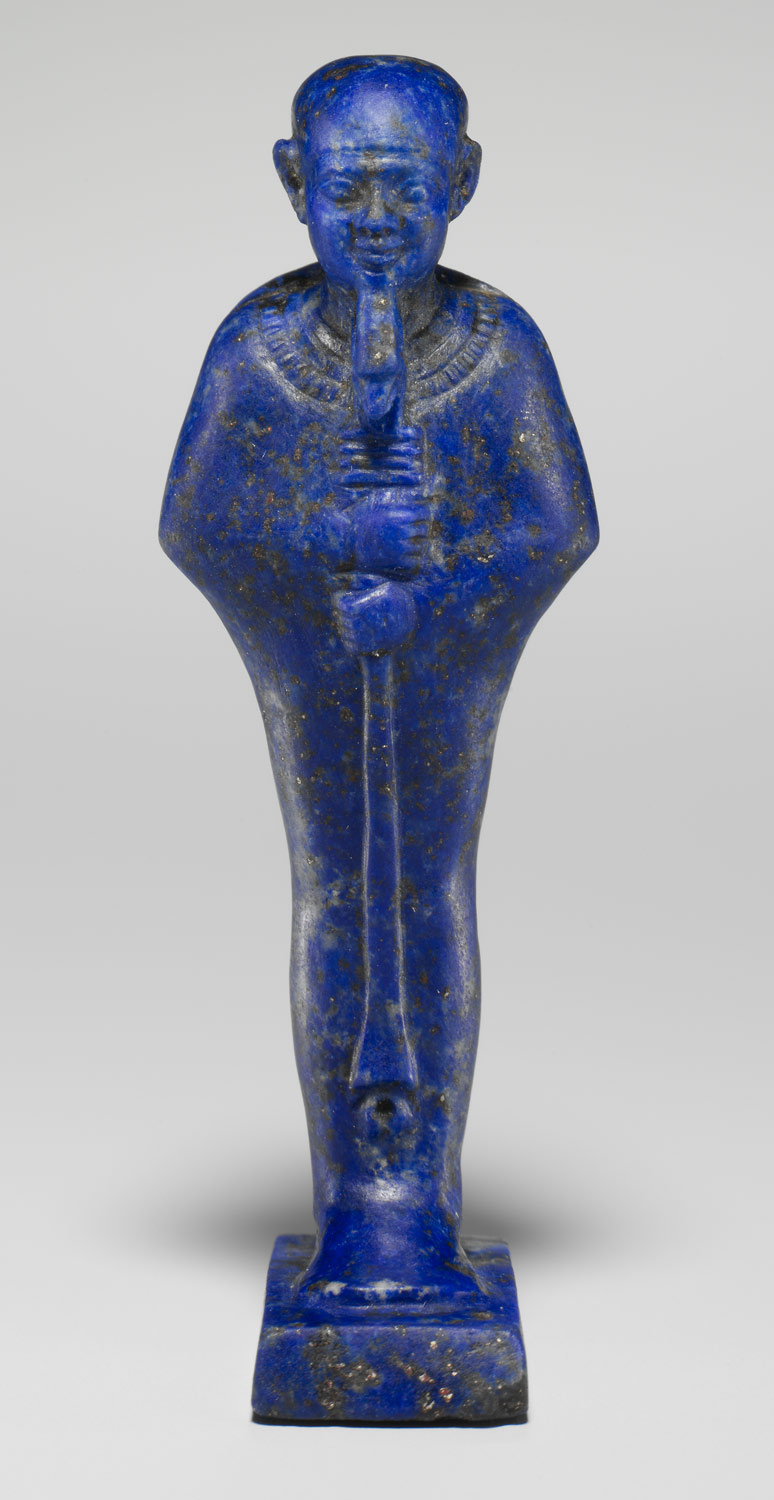
Egyptian Cult image of the god Ptah
Dynasty 22–early Dynasty 26 (ca. 945–600 B.C.)
Lapis lazuli;
H. 2 1/4 in. (5.6 cm)


Ancient Egyptian Wood Ptah-Sokar
Ptah-Sokar Osiris, mummiform figure wearing tripartite wig and beard, the symbols of royalty
Late period, Circa 700-30 B.C. 
Size: 14 inches high figure only, 19-1/4 inches high overall

Ancient Egyptian 
Limestone fragment of a king's Torso 
Late Period, ca. 700 B.C.
Size of the figure without the stand 7 inches high (17.8 cm high)

Two Egyptian Shabtis with Hieroglyphics, fragmentary
XXVI Dynasty period. Ca. 664BC - 525 BC. 
Size 3 - 3 1/2 inches high.

Ancient Egyptian
Date: 700-30 BC
A stone figure of a man Mesopotamian in style. 
Size 1 1/2 inches high. 
Egyptian glazed faience amulet of Bes in the round.
Size 1 1/4 inches high.


Three Ancient Egyptian amulet
Circa 700-30 BC. 
Bes, Anubis, and Isis
Size 19-27 mm.

Egyptian Black Basalt Head
Carved black basalt head wearing flared wig, relief facial features and ears. The reverse incised with two hieroglyphs
Egypt Late period, ca. 700-30 B.C.
Size: 3 1/2 inches high.


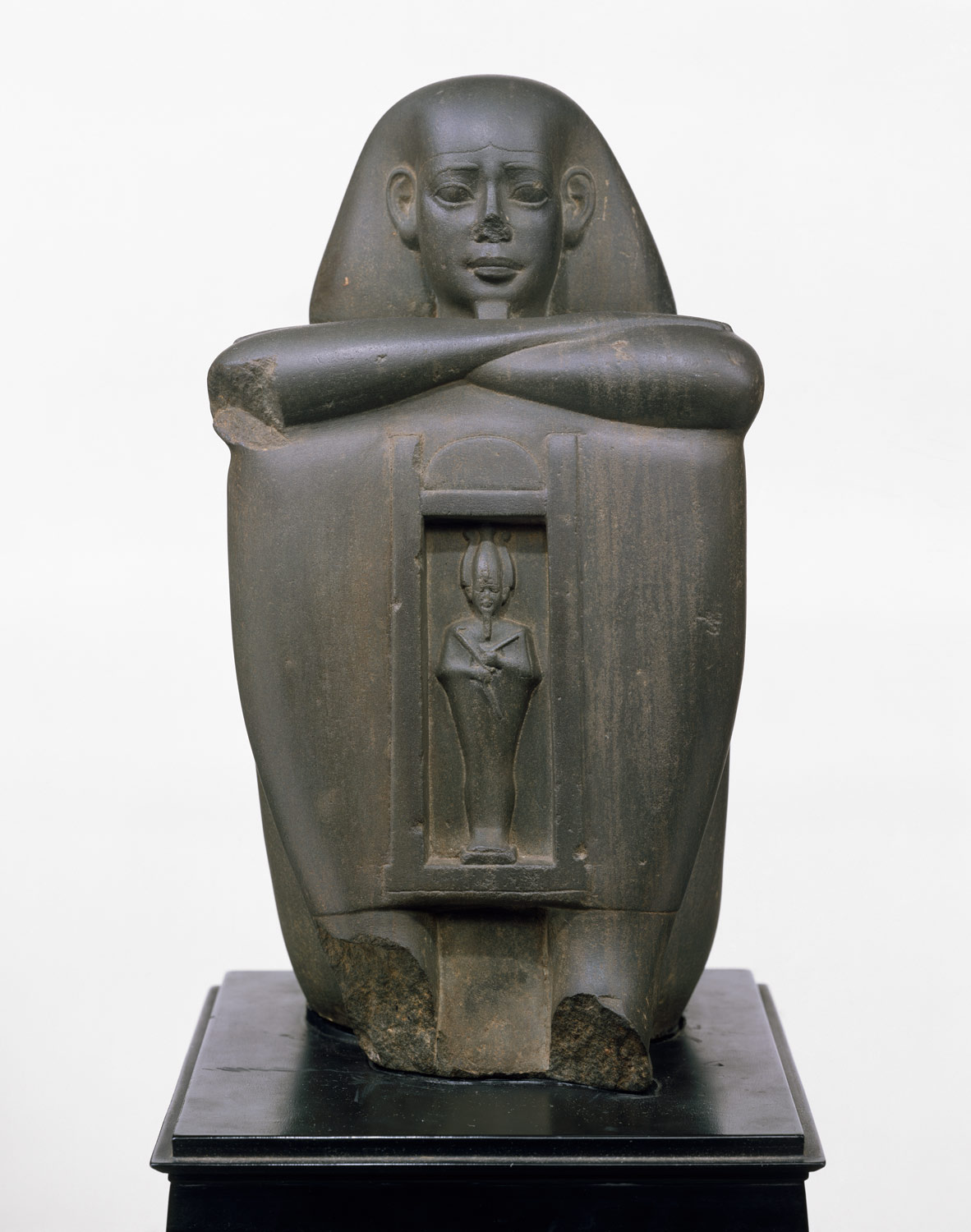
Egyptian Block statue of a governor, Late Period, Dynasty 26 (ca. 664–525 B.C.)
Graywacke; 
14 in. (30.5 cm)

Block statues—images of squatting men with knees drawn up against the chest and folded arms resting on the knees—appeared first as a sculptural type in the early Middle Kingdom (ca. 2000 B.C.) and remained popular until well into the Ptolemaic Period (after 200 B.C.). The statues are thought to represent persons participating in religious rites, and the addition of a shrine with a deity image in front of this statue's legs underlines this religious aspect of the image.

The sculptor has avoided representing any superfluous detail. Only shallow edges indicate the hairline and the bottom of the man's dress over his lower legs. Eyes, eyebrows, ears, and mouth are boldly but sparingly delineated so as not to detract from the prominent features of the piece: the smoothly shaped, agile body and long, elegantly disposed limbs. According to the inscription on the back pillar, the statue depicts a governor of the Saite nome (a district in the Nile delta). The text also records a prayer to Osiris, the god of the underworld, whose figure stands in the shrine.


Egypt, presumably Middle Kingdom (circa 2100-1700 BC)
Burial object in the form of a model boat
Four rowers and a funerary priest
Used to transport the soul of the deceased to the netherworld
Height (boat with steles): circa 38 cm; length: 62 cm

This ancient Egyptian model boat originates presumably from the Middle Kingdom (circa 2100-1700 BC) and is made from painted wood. The impressive form of the boat forms two stylized lotus flowers at the bow and at the hulk. Before the ends are seated two rowers in front of each other. In the center a funerary priest is standing with outstretched arms. The figures and the four steles can be removed. The bark was originally a burial object, which served to transport the soul of the dead to the netherworld.

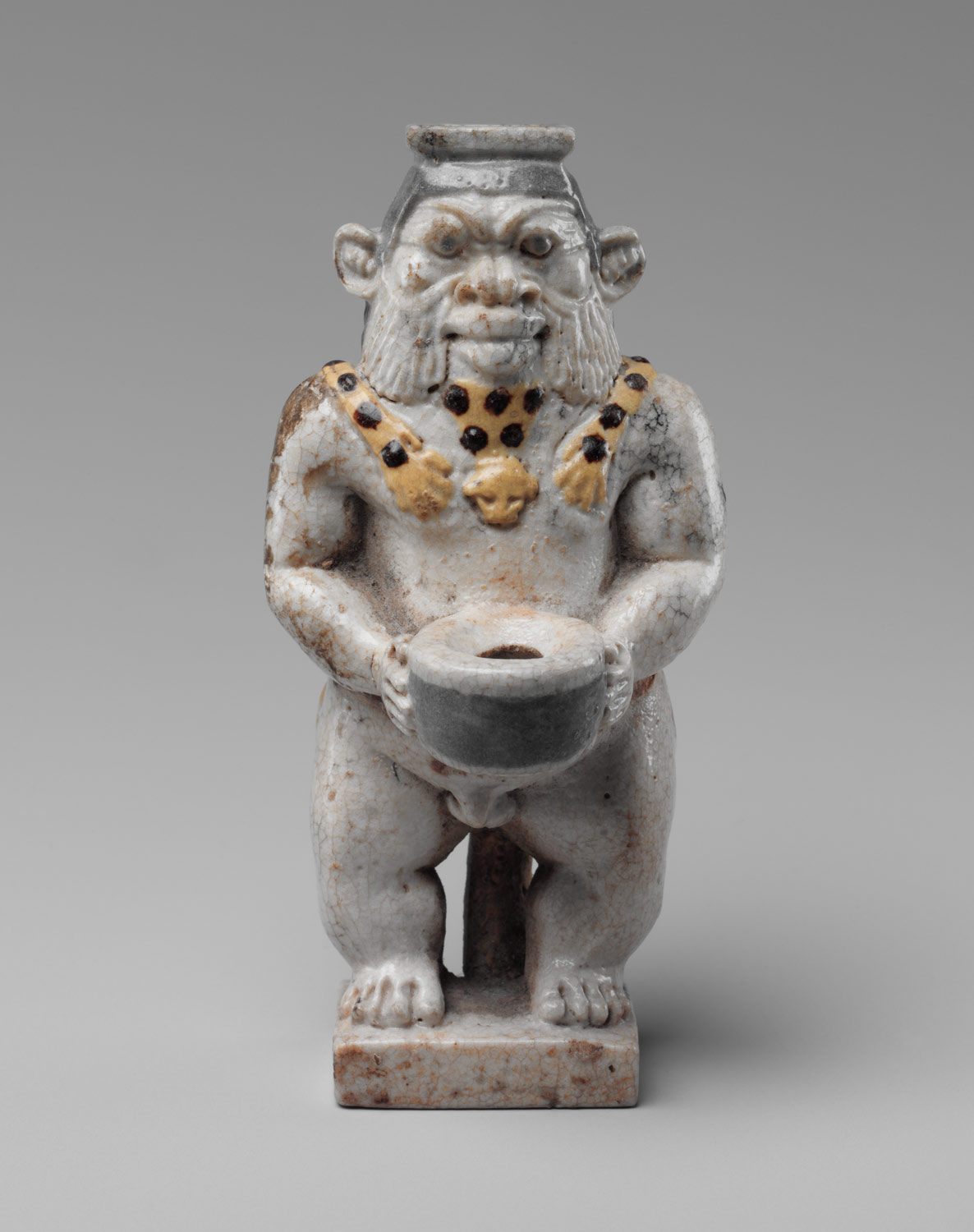
Egyptian Cosmetic container in the form of a Bes image holding the cap of a kohl tube
Late Period, Dynasty 27, ca. 525–404 B.C.
H. 3 5/8 in. (9.2 cm), W. 1 3/4 in. (4.4 cm)

This squat human form with leonine features is commonly identified as the god Bes, but several other minor Egyptian gods were also represented by this image. These were protective deities, so they appear frequently as apotropaic figures in the decoration of furniture and personal belongings. Here, the god stands holding the cap of a kohl container, which has a small round hole in the top for insertion of an applicator. It seems likely that the hollow cap fit over a tube that could be detached for easy filling.

Ancient Egyptian Mummy Mas
Late Period, ca. 700 B.C.
Carved wood mummy mask with painted surface over gesso
black and white eyes, eyebrows painted black 
Size: 10 1/4 inches high x 5 1/2 inches wide (26 cm high x 14 cm wide)
Ancient Egyptian Wood Mummy Mask 
Sarcophagus Mask in carved solid wood with remnants of paint , having relief carved facial features.
Late Period Egypt Circa. 700-30 BC. 
Size: 11 1/2 inches High x 8 inches wide x 3 inches deep (29.2 cm)


Egypt, Late Period, 26th Dynasty or later
Mask of a wooden coffin with drilled mouth corners
23 x 13 x 5.8 cm (height x width x depth)

The wooden mask originates from the Late Period of ancient Egypt, the 26th Dynasty or later (664–525BCE or later). It is a separately crafted, distinctive face of an anthropoid (‘human-like’) wooden coffin, which has once been attached to the coffin. This object is crafted of one piece of wood and is of very elaborate craftsmanship. The sides are vertically chopped and flat, so it can be assumed that further single parts existed that depicted the lateral wig rags and ear parts and merged together like a puzzle in the end. On the forehead, in the right cheek and left lower jaw are squint drilled holes that were used to fix the face with wood dowels on the lid of the coffin. In the peg holes on the cheek, remains of an old peg can be found. The drilled mouth corners are a typical characteristic of late period sculpture.


Egypt, presumably Ptolemaic period, approximately 550-31 BC
Mask of a mummy sarcophagus
Dimensions: 24 x 15 cm (height x width)

This mask originates from a mummy sarcophagus and presumably dates back to the Ptolemaic period in Egypt approximately 550-31 BC. The face has an oval shape and is painted in polychrome colors on a gesso primer. Under a low forehead the almond shaped large eyes are rimmed in black. The pupils are equally painted in black and the eyeballs in white. The nose is long and narrow.

ANCIENT EGYPTIAN LIMESTONE RELIEF FRAGMENT
LATE PTOLEMAIC / EARLY ROMAN PERIOD, CIRCA 1ST CENTURY B.C.
carved in bold relief with ram-headed Khnum
god of creation and fertility, facing right and wearing a kilt, broad collar, beard, and tripartite wig, a column of inscription at left referring to the deity
13 3/8 by 18 in. 34 by 45.7 cm.

Egyptian, Late Period temple
This sandstone relief features a well-carved face of the deity Hathor with defined lips, eyes, ears and headdress.
This relief once rested on the top of a column and supported the roof of an ancient temple. The edges are bevelled, which would have allowed the remaining three sides to join to form a square with the face of Hathor on each side. The top is flattened to further support the roof
24 inches wide x 21 inches high
ca. 664 - 50 B.C. 

Ancient Egyptian 
Wood head if a man 
Late Period Circa 600-300 BC
Size  3 7/8 inches high


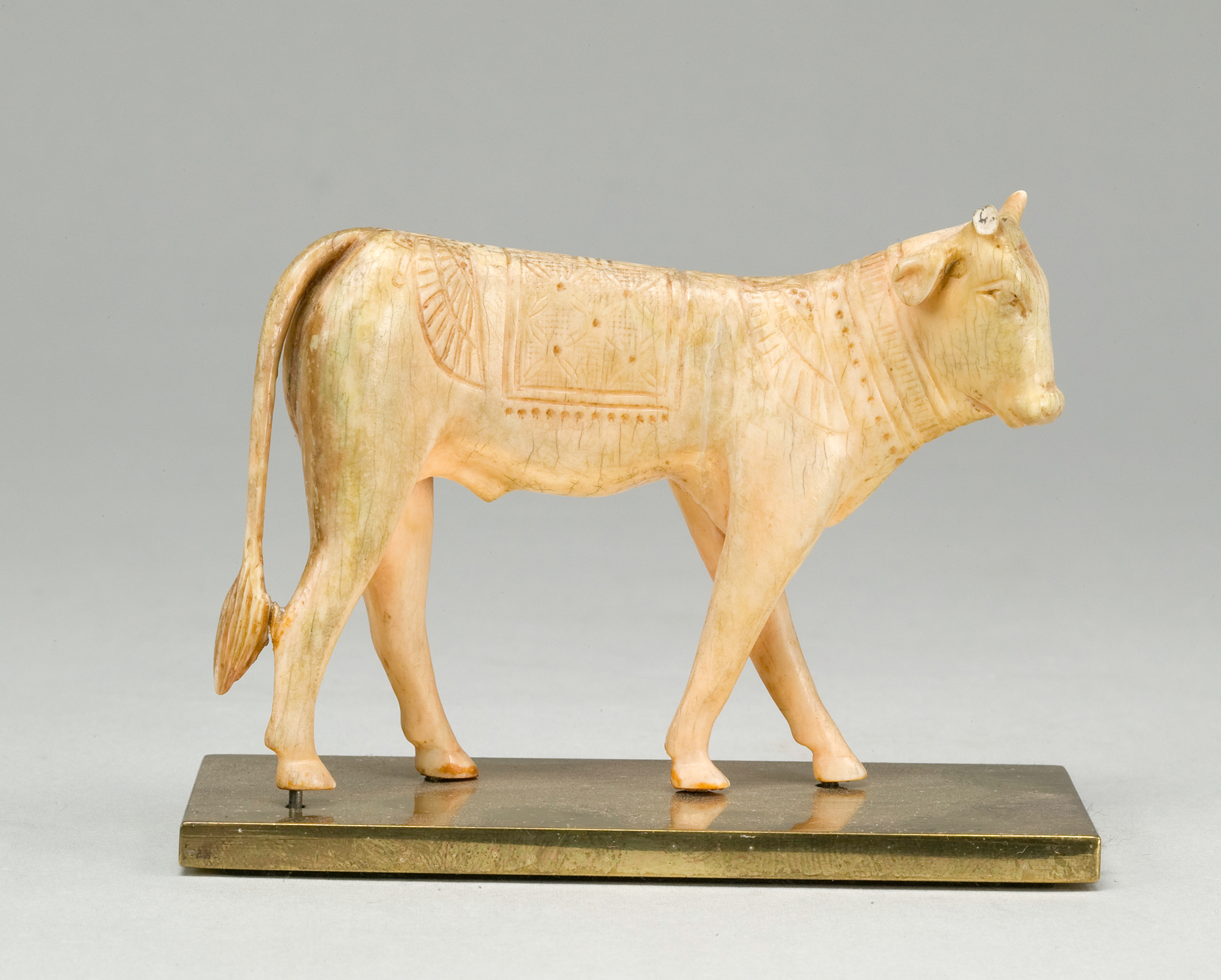
Egyptian Apis bull
Late Period, Dynasty 26–30, ca. 664–332 B.C.
Ivory
 H. 2 7/16 in. (6.1 cm)


One of the most important animal deities of ancient Egypt was the sacred Apis bull, whose worship is attested from Dynasty I. Near the Ptah temple at Memphis, Egypt's old capital, a living representative of the Apis bull was stabled. He was paraded out at festive occasions to participate in ceremonies of fertility and regeneration. The bull that played this important role was selected for displaying color patterns, such as a white triangle on the forehead and black patches resembling winged birds on the body. In the ivory figure, the white triangle is indicated by a sunken area on the head, while engravings of a vulture with wings spread and a winged scarab flank an elaborate blanket on the back. When Apis bulls died, they were embalmed and buried with all honors. Beginning with the reign of Amenhotep III (1390–1352 B.C.) in Dynasty 18, the place of Apis burials was a huge and growing underground system of chambers called the Serapeum in the Memphite necropolis, Saqqara. The mothers of Apis bulls had their own cult and burial place.

Ancient Egyptian
Bronze Oxyrhincus Fish of the Nile 
A cast bronze Oxyrhincus (Nile perch) wearing horned crown of Hathor, with a central sun disc and a small Uraeus serpent head, suspension loop behind the crown, and with integral plinth bases. Incised linear detailed to the gills and upper fins
Late period, ca. 700-30 B.C. 
size 4 5/8 inches length. (11.74 cm Length)


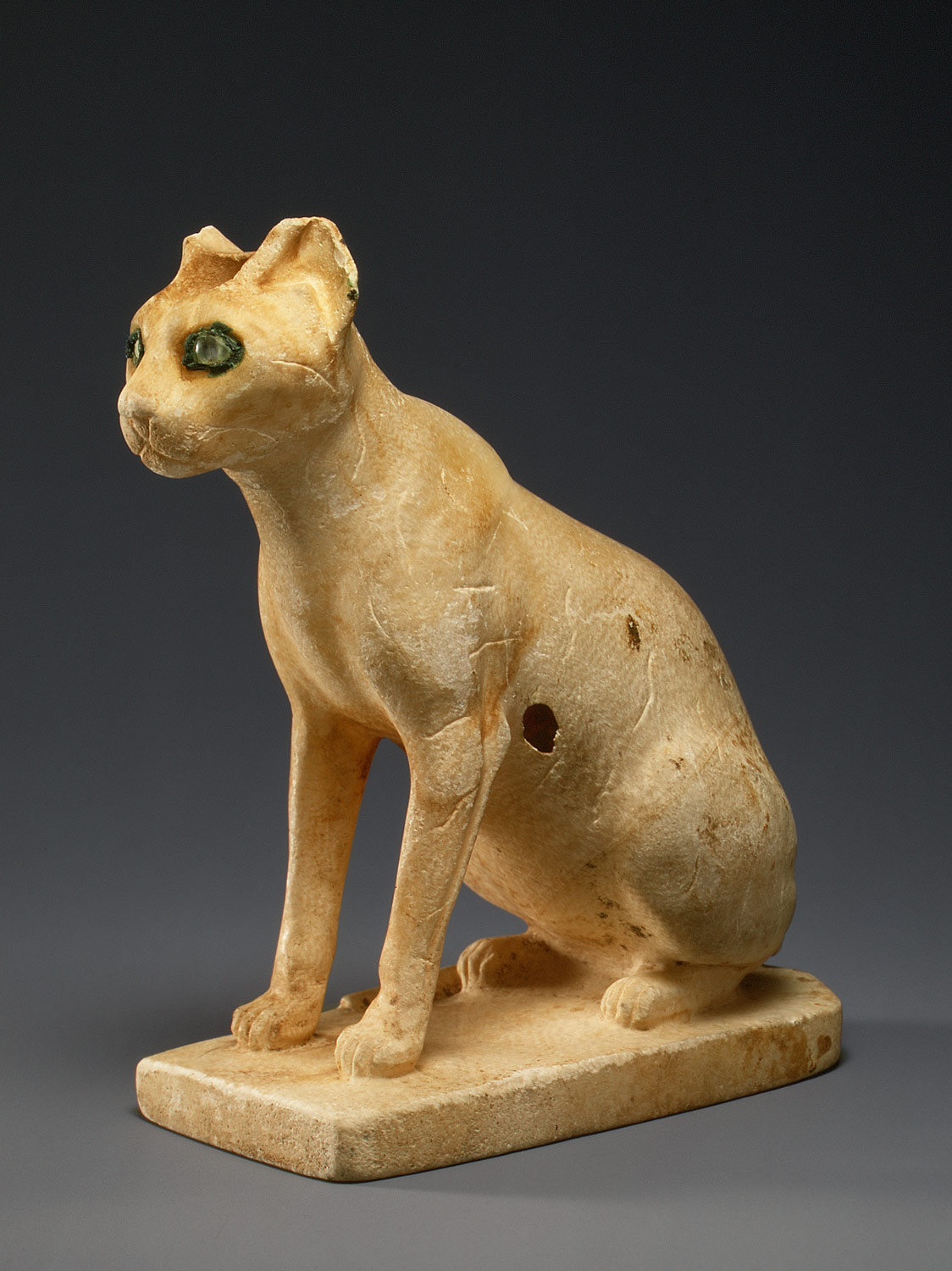
Egyptian Cosmetic Jar in the Form of a Cat
Middle Kingdom, Dynasty 12, ca. 1991–1783 B.C.
Egyptian alabaster (calcite) with inlaid eyes of rock crystal and copper; 
H. 5 1/2 in. (11.4 cm)

Egyptians are credited with the domestication of a number of animals, including the cat, which first appears in painting and relief toward the end of the Old Kingdom (ca. 2300 B.C.). This cosmetic jar is the earliest known three-dimensional image of a cat. Egyptian artists were very observant of the world around them, and their representations of animals are detailed and lifelike. 

Egyptian Bronze
Cat seated with the tail curled around to the forepaws, and wearing an incised neck-cord, the small head with finely modeled eyes and erect ears with striated markings
21st/26th Dynasty, 1075-525 B.C.. 
Height 4 3/16 in. 10.7 cm

Ancient Egyptian Bronze and Marble Sacred Ibis 
XXVth - XXVIth Dynasty (circa 700-550 B.C.)
Body of highly polished veined marble, the head and right leg of cast bronze
The ibis (symbolic of wisdom and sacred to the god Thoth) is now extinct in Egypt.
6.25 x 8.5 in.


Egypt, Late to Ptolemaic Period
Statuette of a hawk, representing the god Horus
Dimensions: 16.7 x 23 x 6.5 cm (width x height x depth)

This statuette, which emerged during the Late to the Ptolemaic Period (between 664 and 30 BCE), is very finely engraved and depicts an upright standing Horus hawk. The elaborately worked, scissor-tailed feathers are falling onto the tail. Today, the feathering depicts a greyish to light green colour covering. The face, as well as the petticoat, are painted in ochre and the feet entirely in red. The bent beak is also painted in red, while the human eyes and brows are painted over in black. The piece subsequently was an attachment to a shrine, possibly of a stele, indicated by the cone holes in the feet.

Ancient Egypt
Coptic textile fragment with a male a female figure in the center within borders
c.500 AD. 
Size 14 x 12 inches


Egypt, Third Intermediate Period, 21st to 23rd Dynasty
Lid of a canopic jar in the shape of a human head with smooth wig
Dimensions: height 10.3 cm; diameter max. 11 cm; diameter inside 5.3 cm
Provenance: Private Collection Bruno Wertz

This lid of a canopic jar, in the shape of the human-headed Horus son Amset, was crafted of fired, light brown clay and originates from the Third Intermediate Period, the 21st to the 23rd Dynasty (1070/69-714/712 BCE) from Egypt. The rotund, vertically slanting wig is voluminous, but exhibits next to a light foundation, no more remainders of colour. The face is, in comparison to the magnificent head of hair, slender and painted in yellow colour. The nose is knobbly, the mouth wide and endowed with full lips. Eye brows, lids and pupils have been additionally emphasized with black colour, next to the dim carving. The ears are relatively small and placed relatively far back. A short, wide beard is attached to the chin in slightly high relief. The lid is hollow on the inside and moulded with a relatively thin wall. An additional chunk of clay has been applied to the inside in the area of the face to ensure the stability of the thin wall in this area.


Egypt, Kingdom of Kush to early Sais Period, 
late 25th to early 26th Dynasty
Canopic jar of a woman named Seta-Imen-gui with lid
With partially identifiable hieroglyphics
Dimensions: 16.8 x 18 x 15.9 cm (width x height x depth)

This object is a canopic jar, probably consisting of sycomore wood. It dates to the Kingdom of Kush to the early Sais Period, the late 25th to the early 26th Dynasty (late 7th Century BCE). The inside is entirely covered with a thin, today light brownish stucco layer. The flat lid was drilled on two sides to be mounted on the jar with wooden pegs. One of these pegs is surviving. Remains of a brown linen cloth are preserved in the inside of the canopic jar. It does not show any adherences that could provide hints of the function of the textile. Whether the cloth belonged to the canopic jar at all remains unclear. Such late dated jars were occasionally used for the storage and protection of mummified organs. The present jar is decorated with images on the exterior. A revolving dark red frame and two lying jackals are painted on the lid. Each of the jackals carries the inscription of the name ‘Anubis’. One column of hieroglyphics is located in the centre, and it reads from right-to-left ‘anubis, who is on his mountain, who is supervising you forever’. Three of the exterior sides of the jar are decorated in similar ways. They have three perpendicular yellow stripes on the left and on the right. An image of a god is applied in the centre, framed by a column of hieroglyphics on each side. The identified hieroglyphics lead to the female deceased named Seta-Imen-gui. One of the exterior sides remains undecorated in plain wood.