Showing posts with label Samuel Atkins. Show all posts

15 Classic Works of Art, Marine Paintings, Safe Harbours - With Footnotes, #19

Adolf Kaufmann, (1848-1916)
Gdansk; Harbor; August 1902
Oil on board
15;6 x 12;8 inch;
Private collection

Adolf Kaufmann (* 15. May 1848 in Troppau , Austrian Silesia ; † 25. November 1916 in Vienna) was an Austrian landscape - and marine painter, initially self-taught. He completed his studies with Emile van Marcke de Lummen (1827-1890) in Paris and undertook numerous study trips within Europe and the Orient. He lived in Paris, the city that exerted a special fascination for him, Berlin , Dusseldorf and Munich . After Germany he traveled to Russia , Norway , Poland and Holland .

In 1890 he settled permanently in Vienna.  With the Austrian landscape painters Carl Freiherr von Merode (1853-1909) and Henry Lester, he founded a "school of painting for women". He returned to his life again and and began to travel to Paris, Normandie, the Brittany and by Belgium . In France, he signed his work with the pseudonym A. Guyot.

Adolf Kaufmann (1848–1916)
Reges life in the fishing port (Danzig?), c. 1916
Oil on Canvas
98 x 100 cm


The Free City of Danzig was a semi-autonomous city-state that existed between 1920 and 1939, consisting of the Baltic Sea port of Danzig (now Gdańsk, Poland) and nearly 200 towns in the surrounding areas. It was created on 15 November 1920 in accordance with the terms of theTreaty of Versailles after the end of World War I. More

Due to his outstanding talent Kaufmann enjoyed great prestige in Paris. He received numerous medals as awards and honors, especially on the occasion of the Paris World Exhibition . Many art lovers bought his paintings. As a member of the Vienna Academy of Fine Arts, he was frequently exhibited at major exhibitions in the Künstlerhaus in Munich Glass Palace and the Great Berlin Art Exhibition. The Vienna Society took to his works enthusiasticly. In 1909 he became a full member of the Vienna Künstlerhaus. In 1910 he left to Holland in 1912 to Amsterdam and South Tyrol. In 1913 he traveled again to Holland and thereafter to Norway, where his Fjord pictures emerged. In 1914 he undertook his last trip to northern Italy.

Adolf Kaufmann's works were often acquired by representatives of the aristocracy, the Austrian imperial family, Napoleon III, Crown Princess Stephanie , Archduke Friedrich , Czar Nicholas II. Of Russia, Queen Isabella II. Of Spain and the Grand Ducal art collection Baden-Baden . These works are represented in numerous collections and museums, such as the Museum Opava, the Art Museum of Istanbul and the Leopold Museum in Vienna. More

Theresa Bernstein (March 1, 1890 – February 13, 2002)
Sailors in Parade
Oil on board
27 x 35 1/4 in.
 Private collection

Theresa Bernstein (March 1, 1890 – February 13, 2002) was a Polish-born American artist, painter, and writer. She was born in Kraków, an only child of Isidore and Anne Bernstein, who emigrated to the United States. She studied with Harriet Sartain, Elliott Daingerfield, Henry Snell, Daniel Garber and others at the Philadelphia School of Design for Women now Moore College of Art & Design.

She graduated in 1911 with an award for general achievement (the college awarded her an honorary doctorate in 1992). After enrolling at the Art Students League in New York City, where she took life and portraiture classes with William Merritt Chase, she traveled for a second time to Europe with her mother, her first trip abroad having been made in 1905. She admired Robert Henri's style of depicting the city's everyday drama.

Bernstein was a member of the National Association of Women Artists and the North Shore Art Association. Her works were exhibited extensively with the National Academy of Design and the Society of Independent Artists (which she co-founded with John Sloan). More

Charles Herbert Woodbury (July 14, 1864 – January 21, 1940)
The Breaker
Oil on board
36 1/4 x 40 in.
 Private collection

Charles Herbert Woodbury (July 14, 1864 – January 21, 1940), United States marine painter, was born in Lynn, Massachusetts, where his earliest work was part of the oeuvre of the group later known as the Lynn Beach Painters. While an undergraduate at MIT he became a regular exhibitor at, and at 19 the youngest member of, the Boston Art Club . After graduation from the Massachusetts Institute of Technology (with degree in Mechanical Engineering), in 1886 Woodbury had great success painting up the New England coast and in the towns and beaches of Nova Scotia and exhibiting the results. 

From January to June 1891 he was a pupil of the Académie Julian in Paris, after which he went to Holland, where he studied the techniques of the modern Dutch painters. Upon his return to New England he settled in Boston at his winter studio and spent his summers in the small fishing village of Ogunquit, Maine; there he founded one of the most successful of the summer art colony schools that even survived his death. He was one of the most sought-after teachers of his generation, having begun teaching on a regular basis while a freshman at M.I.T. 

Charles Herbert Woodbury (July 14, 1864 – January 21, 1940)
The Red Bathing Suit
Oil on board
 Private collection

Ironically, he had little formal training himself other than a few months of classes at the Academy Julian in Paris. Like Winslow Homer, another New England painter with an affinity for summers in Maine, he preferred "to work out his salvation with little help from others in his profession". Nevertheless, Woodbury maintained a close friendship with John Singer Sargent and a pleasant acquaintance with many of his contemporaries including J. Alden Weir and Childe Hassam. He was president of the Boston Water Color Club, and became associate of the National Academy of Design, New York in 1906 and a full member in 1907. His wife, Marcia Oakes Woodbury, born in 1865 at South Berwick, Maine, also became known as a painter. She died at the age of 49 in 1913. More

Frederick Judd Waugh (1861 – 1940) 
The Setting Sun
Oil on board
48 x 60 in.
 Private collection

Frederick Judd Waugh (September 13, 1861 in Bordentown, New Jersey – September 10, 1940) was an American artist, primarily known as a marine artist. During World War I, he designed ship camouflage for the U.S. Navy, under the direction of Everett L. Warner.

Waugh was the son of a well-known Philadelphia portrait painter, Samuel Waugh. He studied at the Pennsylvania Academy of Fine Arts with Thomas Eakins, and at the Académie Julian in Paris, with Adolphe-William Bouguereau. After leaving Paris, he moved to England, residing on the island of Sark in the English Channel, where he made his living as a seascape painter.
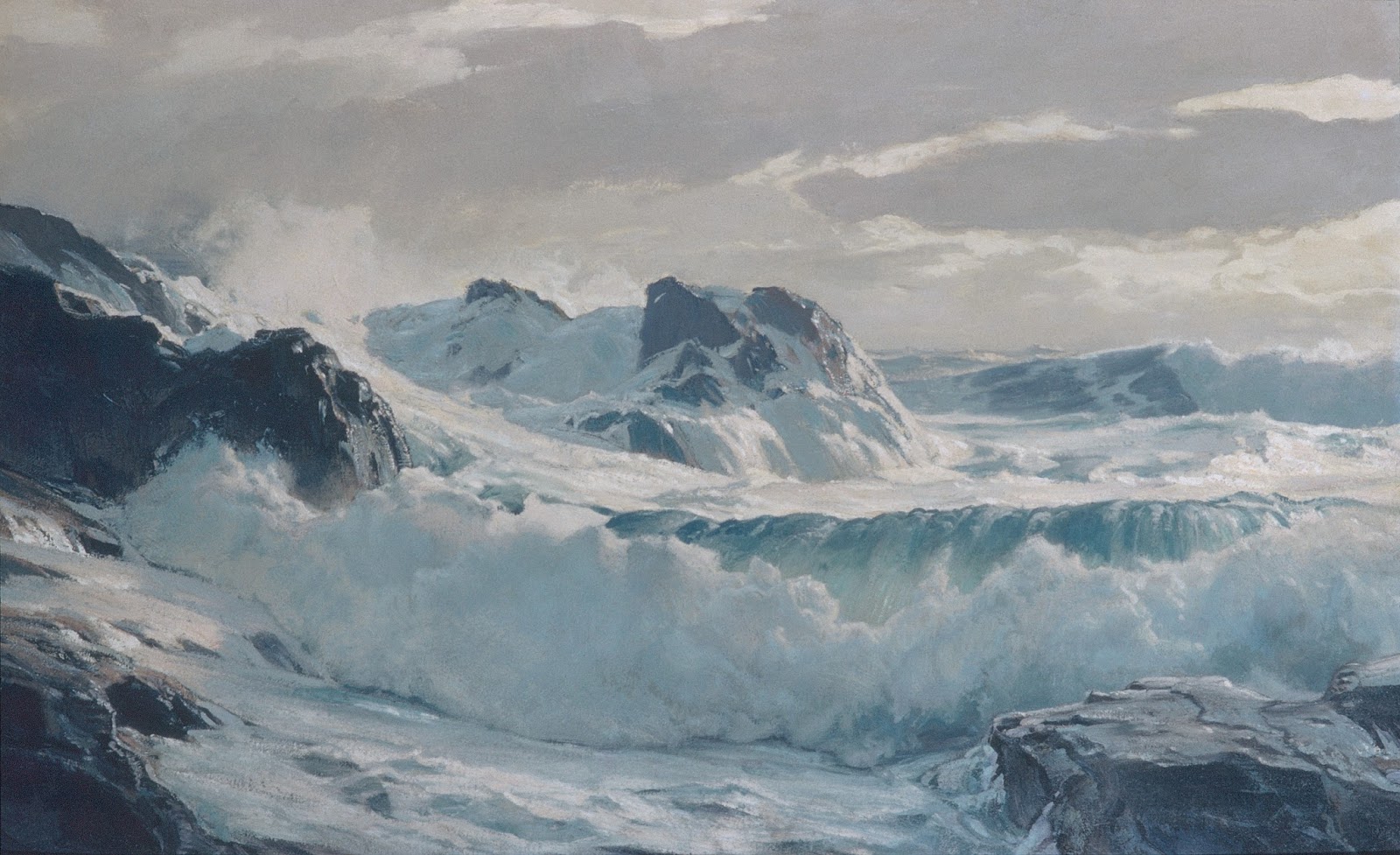

Frederick Judd Waugh (1861 – 1940) 
Wild Weather, c. 1930
Medium:Oil on masonite
Dimensions:29 7/8 x 48 1/8 in. (75.9 x 122.2 cm)

In 1908, Waugh returned to the U.S. and settled in Montclair Heights, New Jersey. He had no studio, until art collector William T. Evans offered him one in exchange for one painting a year. In later years, he lived on Bailey Island, Maine, and in Provincetown, Massachusetts. 

In 1918, Waugh was recommended to serve as a camouflage artist (or camoufleur) for the U.S. Navy, as a member of the Design Section of its marine camouflage unit (Behrens 2002, 2009). That section was located in Washington, D.C., and was headed by American painter Everett L. Warner (Warner 1919). More

Albert Bierstadt (January 7, 1830 – February 18, 1902) 
Coastal Landscape
Oil on paper laid down on board
7 1/8 x 17 1/2 in.
 Private collection

Albert Bierstadt (January 7, 1830 – February 18, 1902) was a German-born American painter best known for his lavish, sweeping landscapes of the American West. To paint the scenes, Bierstadt joined several journeys of the Westward Expansion. Though not the first artist to record these sites, Bierstadt was the foremost painter of these scenes for the remainder of the 19th century.

Born in Germany, Bierstadt was brought to the United States at the age of one by his parents. He later returned to study painting for several years in Düsseldorf. He became part of the Hudson River School in New York, an informal group of like-minded painters who started painting along this scenic river. Their style was based on carefully detailed paintings with romantic, almost glowing lighting, sometimes called luminism. An important interpreter of the western landscape, Bierstadt, along with Thomas Moran, is also grouped with the Rocky Mountain School. More

Elihu Vedder (February 26, 1836 – January 29, 1923)
Off Pier Head, Viareggio, Italy, c. 1881-1886
24 x 37 3/4 in.
Oil on canvas
 Private collection

Viareggio is a city and comune in northern Tuscany, Italy, on the coast of the Tyrrhenian Sea. The city traces its roots back to the first half of the 16th century when it became the only gate to the sea for the Republic of Lucca. The oldest building in Viareggio, known as Torre Matilde, dates back to this time and was built by the Lucchesi in 1541 as a defensive fortification to fight the constant menace of corsair incursions. More

Elihu Vedder (February 26, 1836 – January 29, 1923) was an American symbolist painter, book illustrator, and poet, born in New York City. He is best known for his fifty-five illustrations for Edward FitzGerald's translation of The Rubaiyat of Omar Khayyam (deluxe edition, published by Houghton Mifflin).

Vedder trained in New York City with Tompkins H. Matteson, then in Paris with François-Édouard Picot. Finally, he completed his studies in Italy - where he was strongly influenced not only by Italian Renaissance work but also by the modern Macchiaioli painters and the living Italian landscape. He first visited Italy from 1858 until 1860, becoming deeply emotionally attached to fellow painter Giovanni Costa. Their idyllic trips through the Italian countryside were cut short because Vedder's father cut off his financial allowance.

Vedder returned to the USA, penniless, during the American Civil War, and made a small living by undertaking commercial illustrations. He was involved in the bohemian 'Pfaff's' coffee house group, and painted some of his most memorable paintings notable for their visionary nature, romantic imagery and often Oriental influences.

Elihu Vedder (February 26, 1836 – January 29, 1923)
Greek Girls Bathing, c. 1872–77
Oil on canvas
18 1/4 x 58 3/4 in. (46.4 x 149.2 cm)
The Metropolitan Museum of Art

Although Vedder possessed a feverish imagination, little of it is evident in this painting, which he made for the financier J. Pierpont Morgan. The general effect of the picture is that of an antique sculptured frieze. Behind the graceful young figures, the shallow stage is bounded by a sea of gently rolling waves, and, in front, concentric arcs of foam mark a receding swell. More

At the end of the Civil War, he left America to live in Italy. He married Caroline Rosekrans. Elihu Vedder and his wife had four children, only two of whom survived. His daughter Anita Herriman Vedder played a vital role in handling the business of her father, who was notorious for his general aloofness towards details. Elihu's son Enoch Rosekrans Vedder was a promising architect. Elihu had a home in Rome and - after the financial success of his 1884 Rubaiyat work - on the Isle of Capri.

Elihu Vedder (February 26, 1836 – January 29, 1923)
Greek Girls Bathing, c. 1872–77
Detail

Vedder visited England many times, and was influenced by the Pre-Raphaelites. He was also influenced by the work of English and Irish mystics such as William Blake and William Butler Yeats. In 1890 Vedder helped establish the In Arte Libertas group in Italy.

Tiffany commissioned him to design glassware, mosaics and statuettes for the company. He decorated the hallway of the Reading Room of the Washington Library of Congress, and his mural paintings can still be seen there. More

Samuel Atkins, (fl. 1787–1808)
A view off Dover
watercolor on paper
8-1/4 x 11-3/4 in.(15.8 x 29.8 cm.)
Private collection

Dover is a town and major ferry port in South East England. It faces France across the strait of Dover, the narrowest part of the English Channel. The surrounding chalk cliffs are known as the White Cliffs of Dover. More


Samuel Atkins (fl. 1787–1808), was a British marine painter. Atkins contributed to the Royal Academy between 1787 and 1796. From 1796 to 1804 he was in the East Indies, when he returned to England, and continued to exhibit until 1808. He worked in oil and water-colour. The water-colour collections of South Kensington and the British Museum have each an example of his work. It is rather early in manner, low in tone, quiet, and truthful. A picture of ‘Shakespeare's Cliff, Dover,’ has been engraved after him by R. and D. Havell. Nagler attributes to this Samuel Atkins the originals of two engravings of sea-subjects after ‘— Atkins:’ ‘Ships in Sight of Harbour,’ engraved in aquatint by H. Merke; and ‘A Sea Piece,’ by F. Janinet. A water-colour drawing also, ‘Seascape with Ships,’ he gives to this painter. More

Thomas Buttersworth (5 May 1768 – November 1842)
The battle of Cape St. Vincent
Watercolor on paper
14 x 19-1/2 in. (35.5 x 49.5 cm.)
Private collection

The Battle of Cape St Vincent (14 February 1797) was one of the opening battles of the Anglo-Spanish War (1796–1808), as part of the French Revolutionary Wars, where a British fleet under Admiral Sir John Jervis defeated a larger Spanish fleet under Admiral Don José de Córdoba y Ramos near Cape St. Vincent, Portugal. More

Thomas Buttersworth (5 May 1768 – November 1842) was an English seaman of the Napoleonic wars period who became a marine painter. He produced works to commission, and was little exhibited during his lifetime. More

Robert Cleveley, (1747-1809)
 Battle of Cape St. Vincent,  c. 1797
National Maritime Museum

The Battle of Cape St Vincent (14 February 1797), see above

Robert Cleveley (1747, Deptford – 28 September 1809, Dover) was an English maritime painter. His father and twin brother (John Cleveley the Elder, c.1712–1777, and John Cleveley the Younger, 1747–1786) were also artists, with John the Younger (and possibly Robert too, to judge from his style) gaining some training in watercolours from Paul Sandby, previously a teacher at the Royal Military Academy, Woolwich.

John the Elder had tried and failed to make a living in working in a dockyard, and so did Robert, as a caulker. However, mocked by other dockyard workers for wearing gloves whilst working, John did not enjoy his time there, giving it up and in 1770 volunteering for the navy as a clerk. His first service as a clerk was briefly under Captain William Locker (who acted as patron to artists probably known to John the Elder), then soon afterwards under Captain George Vandeput on his voyage in the Asia to the West Indies and North America, during which time Vandeput became a lifelong friend. The Asia returned in 1777, and from then to the end of his life Robert followed a double career as purser on board various ships stationed in the Home Fleet and as a marine painter. This meant he could exhibit his works as "Robert Cleveley of the Royal Navy". More

Thomas Buttersworth, (5 May 1768 – November 1842)

Shipping off Gravesend and Naval Cutters off Portsmouth
Oil on board
6 x 8-1/4 in. (15.2 x 20.9 cm.)
Private collection

Gravesend is an ancient town in northwest Kent, England, situated on the south bank of the Thames Estuary and opposite Tilbury in Essex.

Its geographical situation has given Gravesend strategic importance throughout the maritime and communications history of South East England. A Thames Gateway commuter town, it retains strong links with the River Thames, not least through the Port of London More

Thomas Buttersworth (5 May 1768 – November 1842), see above

French School, late 18th Century
A harbour with elegant figures on the quayside
oil on canvas 
55.5 x 73.1cm (21 7/8 x 28 3/4in)
Private collection

Images are copyright of their respective owners, assignees or others

18 Classic Works of Art, Marine and Seascape Paintings - with footnotes -11

Derek George Montague Gardner (British, 1914-2007) The battle between the H.M.S. Shannon and the U.S.S. Chesapeake 13-1/4 x 19 in. (33.6 x 48.2 cm.), sight. [not examined out of the frame]
DEREK GEORGE MONTAGUE GARDNER, (British, 1914-2007)
The battle between the H.M.S. Shannon and the U.S.S. Chesapeake 
Oil on Canvas
13-1/4 x 19 in. (33.6 x 48.2 cm.)

This painting: During the War of 1812, the duel between the Royal Navy's frigate H.M.S. Shannon and the American frigate Chesapeake became a critical moment of the war. Cruising off the eastern seaboard in May, Captain Philip Broke of the Shannon had spotted the American frigates Chesapeake and Constitution refitting in Boston. Broke immediately challenged Captain Lawrence of the Chesapeake to come out and fight, sending a verbal challenge. However, this challenge went unanswered and Broke soon began to despair of Chesapeake ever leaving the harbor, and so he later sent a written challenge, and at noon on 1st June 1813, the Chesapeake stood out of Boston Roads for battle. A furious action followed lasting a mere fifteen minutes; Captain Broke was mortally wounded leading his boarding party, and casualties on both vessels were very high. Soon overwhelmed, Chesapeake surrendered and Shannon took her as a prize into Halifax, Nova Scotia.


Derek George Montague Gardner (13 February 1914 – 11 February 2007) is best known as an English painter. After a career as a civil engineer before and after serving in the Royal Navy in the Second World War, he became widely recognised as one of the leading English painters of marine subjects.

He was educated at Oundle School, where he won a prize for his drawing. He left school in 1931, and trained as a civil engineer in Glasgow with the London Midland & Scottish Railway. He later joined Sir William Arrol & Co. He joined the RNVR as a 20-year-old midshipman, and took up painting watercolours of warships. He became a docks engineer at North Shields in 1938. More

Derek George Montague Gardner (British, 1914-2007) The H.M.S. Suberb 9-1/2 x 13-3/4 in. (24.1 x 34.9 cm.), sight. [not examined out of the frame]
Derek George Montague Gardner (British, 1914-2007)
The H.M.S. Suberb 
Watercolor on paper
9-1/2 x 13-3/4 in. (24.1 x 34.9 cm.)

HMS Superb was a 74-gun Bellona-class third-rate ship of the line of the Royal Navy, launched on 27 October 1760 at Deptford Dockyard. The Superb was Admiral Edward Hughes's flagship in India in 1782 during a notable series of engagements with the French under Suffren.

On 20 June 1783 Bellona took part in the Battle of Cuddalore before returning to Bombay for copper sheathing along her hull. On 7 November she developed a severe leak through the sheathing into the bilge, and sank in Tellicherry Roads off the Bombay coast. More

Derek George Montague Gardner (British, 1914-2007) The H.M.S. Royal Sovereign off of Fort Manoel, Valletta, Malta 13-1/2 x 20 in. (34.2 x 50.8 cm.), sight. [not examined out of the frame]
Derek George Montague Gardner (British, 1914-2007)
The H.M.S. Royal Sovereign off of Fort Manoel, Valletta, Malta 
Watercolor on paper
13-1/2 x 20 in. (34.2 x 50.8 cm.

HMS Royal Sovereign was a 100-gun first rate ship of the line of the Royal Navy, which served as the flagship of Admiral Collingwood at the Battle of Trafalgar (see below). She was the third of seven Royal Navy ships to bear the name. Designed by Sir Edward Hunt, she was launched at Plymouth Dockyard on 11 September 1786, at a cost of £67,458, and was the only ship built to her draught. She was known by her crew as the "West Country Wagon" due to her poor manoeuvrability and speed. More

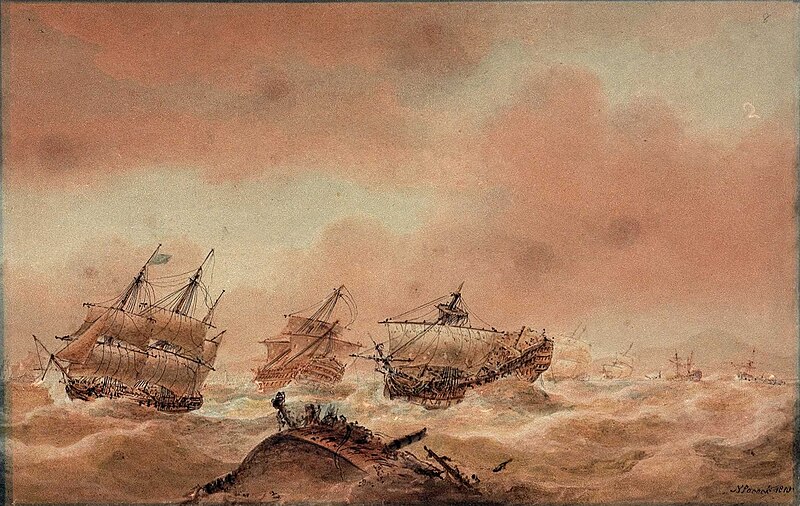
File:Nicholas Pocock, The Day after Trafalgar – The 'Victory' Trying to Clear the Land with the 'Royal Sovereign' in Tow to the 'Euryalus' (1810).jpg
Nicholas Pocock (1740–1821)
H.M.S. Euryalus, c. 1810
Watercolor and pen with black Indian ink on paper
17.6 × 27.5 cm (6.9 × 10.8 in)
National Maritime Museum, London, United Kingdom

Storm, the Day after the Battle of Trafalgar, the "Victory" under courses endeavouring to Clear the Land. The "Royal Sovereign" in Tow by the "Euryalus". The view is towards the coast of Spain off Cadiz, with the lighthouse at Rota in the centre left distance, and 'Victory' heading towards it in stern view over the tow-line. To the right are disabled enemy ships, including prizes, some being cast away in the post-Trafalgar storm. More

HMS Euryalus was a Royal Navy 36-gun Apollo-class frigate, which saw service in the Battle of Trafalgar and the War of 1812. During her career she was commanded by three prominent naval personalities of the Napoleonic and post-Napoleonic period, Henry Blackwood, George Dundas and Charles Napier. After the end of the Napoleonic Wars she continued on active service for a number of years, before spending more than two decades as a prison hulk. She ended her career in Gibraltar where, in 1860, she was sold for breaking up. More

HMS Victory is a 104-gun first-rate ship of the line of the Royal Navy, ordered in 1758, laid down in 1759 and launched in 1765. She is best known as Lord Nelson's flagship at the Battle of Trafalgar in 1805.

She was also Keppel's flagship at Ushant, Howe's flagship at Cape Spartel and Jervis's flagship at Cape St Vincent. After 1824, she served as a harbour ship.

In 1922, she was moved to a dry dock at Portsmouth, England, and preserved as a museum ship. She has been the flagship of the First Sea Lord since October 2012 and is the world's oldest naval ship still in commission. More

Nicholas Pocock (2 March 1740 – 9 March 1821) was a British artist known for his many detailed paintings of naval battles during the age of sail. Pocock was born in Bristol in 1740, the son of a seaman. He followed his father's profession and was master of a merchant ship by the age of 26. During his time at sea, he became a skilled artist by making ink and wash sketches of ships and coastal scenes for his log books.

In 1778, Pocock's employer, Richard Champion, became financially insolvent due to the effects of the American Revolutionary War on transatlantic trade. As a result, Pocock gave up the sea and devoted himself to painting. The first of his works were exhibited by the Royal Academy in 1782.

Later that year, Pocock was commissioned to produce a series of paintings illustrating George Rodney's victory at the Battle of the Saintes. In 1789, he moved to London, where his reputation and contacts continued to grow. He was a favourite of Samuel Hood and was appointed Marine Painter to King George.


Pocock's naval paintings incorporated extensive research, including interviewing eyewitnesses about weather and wind conditions as well as the positions, condition, and appearance of their ships; and drawing detailed plans of the battle and preliminary sketches of individual ships. He was also present himself at the Glorious First of June in 1794, on board the frigate HMS Pegasus.

In addition to his large-scale oil paintings depicting naval battles, Pocock also produced many watercolours of coastal and ship scenes. More


Derek George Montague Gardner (British, 1914-2007) Nelson's Santa Cruz Squadron 15 x 20 in. (38.1 x 50.8 cm.), sight. [not examined out of the frame]
DEREK GEORGE MONTAGUE GARDNER, (British, 1914-2007)
Nelson's Santa Cruz Squadron
Watercolor on paper
15 x 20 in. (38.1 x 50.8 cm.)

The Battle of Santa Cruz de Tenerife was an amphibious assault by the Royal Navy on the Spanish port city of Santa Cruz de Tenerife in the Canary Islands. Launched by Rear-Admiral Horatio Nelson on 22 July 1797, the assault was defeated, and on 25 July the remains of the landing party withdrew under a truce, having lost several hundred men. Nelson himself had been wounded in the arm, which was subsequently partially amputated: a stigma that he carried to his grave as a constant reminder of his failure. More

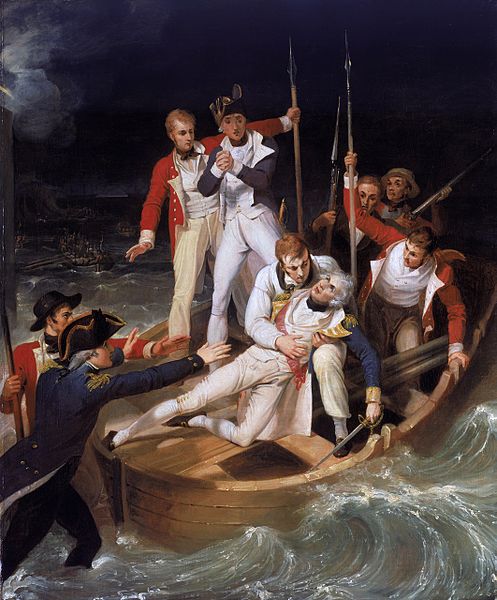
File:Sir Horatio Nelson when wounded at Teneriffe.jpg
Richard Westall (1765–1836)
Nelson wounded at Tenerife, 24 July 1797, c. 1806
Oil on canvas
86.6 × 71 cm (34.1 × 28 in)
National Maritime Museum, London, United Kingdom

In the painting, Nelson's barge is shown beached in the surf, in port-bow view. Hit on the point of landing he reeled and staggered back into the boat where he lies, having transferred his sword to his left hand. He is supported by a sailor and there is blood on the sailor's shirt and on the lining of Nelson's coat. Lieutenant Josiah Nisbet, Nelson's stepson, stands behind him and is saving his life by staunching the blood. Behind him and to the left are two other lieutenants. Also in the barge and to the right of the group is a third lieutenant grasping a boarding pike, with two sailors behind him. In the left foreground standing in the shallow water is Captain Thompson, arms outstretched towards Nelson, together with another lieutenant. In the left background is a bow view of another boat approaching the beach. In the right foreground the artist has used the waves to enhance the dramatic impact. Westall has conveyed the staged effect by employing a dramatic language of gesture and expression. This painting of the incident was made in 1806. It was commissioned by John M'Arthur, as a plate for 'The Life of Admiral Lord Nelson, KB', which he published with James Stanier Clarke in 1809, and which was the first major biography of Nelson. More

Richard Westall RA (2 January 1765 – 4 December 1836) was an English painter and illustrator of portraits, historical and literary events, best known for his portraits of Byron. He was also Queen Victoria's drawing master. Born oin Reepham near Norwich, Richard Westall moved to London after the death of his mother and the bankruptcy of his father in 1772. Westall was apprenticed to a heraldic silver engraver in 1779, where he was encouraged to become a painter by John Alefounder; he then began studying at the Royal Academy School of Arts from 10 December 1785. He exhibited at the Academy regularly between 1784 and 1836, became an Associate in November 1792 and was elected an Academician on 10 February 1794. From 1790 to 1795 he shared a house with Thomas Lawrence (later Sir), the future Royal Academy president, each of the artists placing their name on one of the entrances. More

Samuel Atkins (British, fl.1787-1808)
The loss of the Romney 
watercolor and pencil, heightened with body color 
9-1/4 x 13-3/4 in. (23.4 x 34.9 cm.),

The loss of the Romney, 50 guns off the Texel on the evening of November 19th 1804. Showing the flag of truce run up when calling on enemy boats for assistance.

HMS Romney was a 50-gun fourth rate of the Royal Navy. She served during the American War of Independence, and the French Revolutionary and Napoleonic Wars in a career that spanned forty years.

Launched in 1762, the Romney spent most of her early career in North American waters, serving on the Newfoundland station, often as the flagship of the commander-in-chief. The ship was involved in the tensions leading up to the American Revolution when she was sent to support the Boston commissioners enforcing the Townshend Acts in 1768. Her actions involved impressing local sailors, confiscating a vessel belonging to John Hancock and providing a refuge for the unpopular commissioners when rioting broke out. She remained in American waters for part of the ensuing war, but towards the end operated in European waters after the French entry to the conflict.


The Romney was laid up in ordinary or under repair for most of the subsequent years of peace, but returned to active service on the outbreak of war with Revolutionary France. She was in the Mediterranean supporting Lord Hood's occupation of Toulon in 1793, and remained there for several years. During this time she captured the 44-gun French Sibylle. The Romney briefly returned to North America and then served in the Red Sea. Assigned to blockade the Dutch coast, the Romney ran aground in November 1804 while sailing to join the fleet off Den Helder. She broke up after attempts to float her off failed. More

Samuel Atkins (fl. 1787–1808), was a British marine painter. Atkins contributed to the Royal Academy between 1787 and 1796. From 1796 to 1804 he was in the East Indies, when he returned to England, and continued to exhibit until 1808. He worked in oil and water-colour. The water-colour collections of South Kensington and the British Museum have each an example of his work. It is rather early in manner, low in tone, quiet, and truthful. A picture of ‘Shakespeare's Cliff, Dover,’ has been engraved after him by R. and D. Havell. Nagler attributes to this Samuel Atkins the originals of two engravings of sea-subjects after ‘— Atkins:’ ‘Ships in Sight of Harbour,’ engraved in aquatint by H. Merke; and ‘A Sea Piece,’ by F. Janinet. A water-colour drawing also, ‘Seascape with Ships,’ he gives to this painter. More

Samuel Atkins (British, fl.1787-1808) The blockade of Toulon 14-1/2 x 21 in. (36.8 x 53.3 cm.), sight. [not examined out of the frame]
Samuel Atkins (British, fl.1787-1808)
The blockade of Toulon
depicting three British frigates on a reach, holding a battle line.
signed lower left: "Atkins"
watercolor on paper
14-1/2 x 21 in. (36.8 x 53.3 cm.)

The Action of 5 November 1813 was a brief naval clash during the Napoleonic Wars, between part of the British Mediterranean Fleet led by Vice-Admiral Sir Edward Pellew, and a French force under Rear-Admiral Julien Cosmao-Kerjulien. The engagement took place outside the French port of Toulon.

The clash occurred when a French fleet under Vice-Admiral Maxime Julien Émeriau de Beauverger took advantage of a favourable wind and the temporary absence of the British blockading force, to leave port to carry out exercises. Émeriau abandoned the exercises when the wind changed, but while returning to port his rear came under attack from the recently returned British inshore squadron. The British attack was reinforced by newly arrived ships from the main fleet, but the French were able to escape into Toulon after exchanging cannon fire with the British. Casualties on both sides were light. More

Blockade of Toulon, 1810-1814.jpg
Thomas Luny (1759–1837)
Blockade of Toulon, 1810-1814: Pellew's action, 5 November 1813, c. 1830
Oil on canvas
85.1 × 128.3 cm (33.5 × 50.5 in)
National Maritime Museum, London , United Kingdom

Thomas Luny (1759–1837), born in Cornwall, was an English artist and painter, mostly of seascapes and other marine-based works. At the age of eleven, Luny left Cornwall to live in London. There he became the apprentice of Francis Holman, a marine painter who would have a great and long lasting artistic influence on Luny.

In September 1777, Luny left Holman's studio for a while, to journey to France. It was around this time that Luny was frequently exhibiting at the Royal Academy, in a total of twenty-nine exhibitions between 1780 and 1802. In Leadenhall Street, Luny became acquainted with a "Mr. Merle", a dealer and framer of paintings who promoted Luny's paintings for over twenty years, to great success. Luny also found a wealthy source of business in Leadenhall Street, where the British East India Company had their headquarters; their officers commissioned many paintings and portraits from Luny. This relationship between the Company and Luny also had several non-monetary benefits for Luny; it seems probable that, considering the great detail and realistic look of many of his sketches of locations such as Naples, Gibraltar, and Charleston, South Carolina, Luny was occasionally invited as a guest on the Company's ships on special occasions and voyages.

Several years later, in 1807, Luny decided to move again, this time to Teignmouth in Devon. There he received a number of commissions, and he continued to be as successful in his work as he had been in London. Luny was by that time suffering with arthritis in both of his hands. This had no obvious impact on the quality or pace of his artistic work. In fact, of his lifetime oeuvre of over 3,000 works, over 2,200 were produced between 1807 and his death. He died on 30 September 1837. More

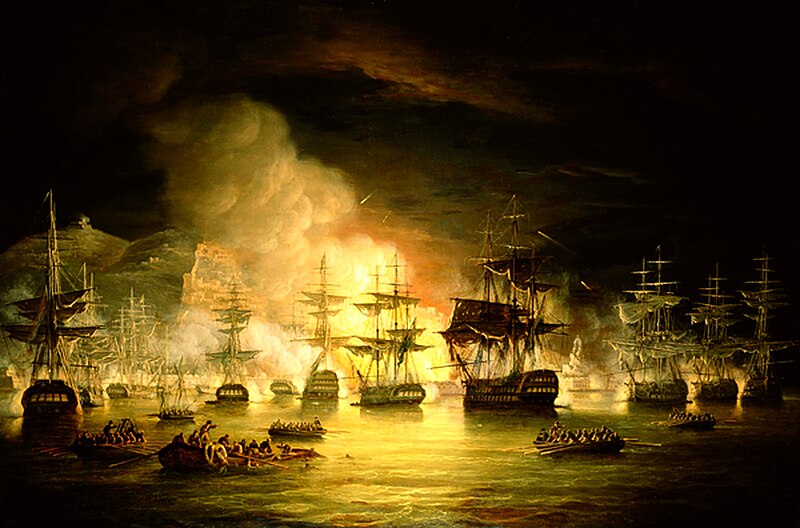
File:Sm Bombardment of Algiers, August 1816-Luny.jpg
Thomas Luny (1759–1837)
Bombardment of Algiers by Lord Exmouth in August 1816, c. 1820
Oil on canvas
122 × 183 cm (48 × 72 in)

The Bombardment of Algiers (27 August 1816) was an attempt by Britain to end the slavery practices of the Dey of Algiers. An Anglo-Dutch fleet under the command of Admiral Lord Exmouth bombarded ships and the harbour defences of Algiers.

There was a continuing campaign by various European navies and the American navy to suppress the piracy against Europeans by the North African Barbary states. The specific aim of this expedition, however, was to free Christian slaves and to stop the practice of enslaving Europeans. To this end, it was partially successful, as the Dey of Algiers freed around 3,000 slaves following the bombardment and signed a treaty against the slavery of Europeans. However, this slavery did not end completely until the European conquest of Africa. More

Martinus Schouman - Het bombardement van Algiers.jpg
Martinus Schouman (1770–1848)
The bombardment of Algiers, to support the ultimatum for the release of white slaves 26-27 August 1816, c. 1823
Oil on Cloth
95 × 159.5 cm (37.4 × 62.8 in)
Rijksmuseum, Amsterdam, Netherlands

Martinus Schouman (1770– 1848) was a 19th-century painter from the Northern Netherlands. Schouman was born in Dordrecht. According to the RKD he was the pupil and grandnephew of Aert Schouman and the brother of Aert II. His pupils were Pieter Arnout Dijxhoorn, Jan de Greef (1784-1834), Pieter Martinus Gregoor, Matthijs Quispel, Johannes Christiaan Schotel, and his son Izaak Schouman. He is known for marines and landscapes and was a member of the Dordrecht artist's society Pictura and the Royal society of the fine arts in Brussels. He died in Breda. More

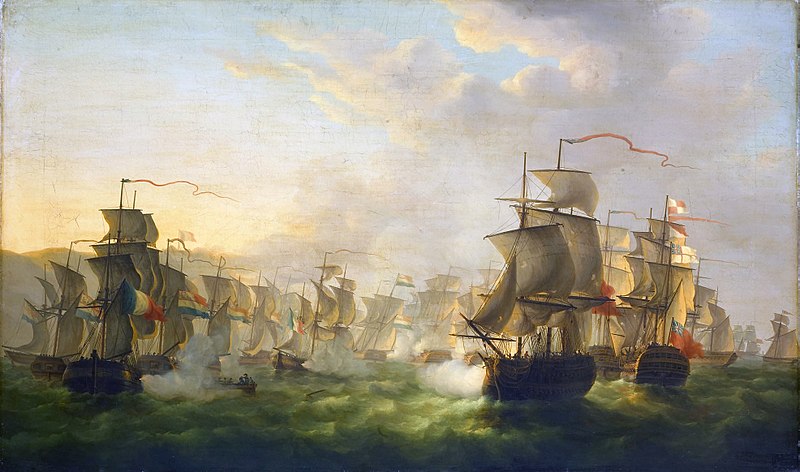
File:The Dutch and English fleets meet on the way to Boulogne - Het treffen tussen de Hollandse en de Engelse vloot tijdens de tocht van de Hollandse flottille naar Boulogne, 1805 (Martinus Schouman, 1806).jpg
Martinus Schouman (1770–1848)
The Dutch and English fleets meet on the way to Boulogne, c. 1805
Rijksmuseum, Amsterdam, Netherlands

This painting documents the meeting of the British and Dutch fleets during the later stages of Napoleon's planning for his invasion of Britain. 

HAUGHTON FORREST (1826-1925) 
Wreck of Sir Robert Peel, Eliza and Pandora, Tynemouth 1854 
oil on board 
titled and dated verso 
30.5 x 46.5cm 

Extract from Captain Champion's letter to Messrs. Gilchrist and Alexander, the agents for the vessel :

"With feelings of deep regret I have to inform you the ship Sir Robert Peel is on shore, and likely to become a total wreck, at a place called Avoca Bay, as I am informed by a shepherd distant from Sydney Heals about fifty miles north. We have had the weather exceedingly stormy and thick fogs, and when the ship struck by our reckoning we were fifty miles from land and in the latitude of Sydney, so that in two days we have had a current setting to the north upwards of sixty mile's."

The Rose did not arrive from Morpeth, until one p.m. on Thursday. The Tamar having conveyed the intelligence of the Sir Robert Peel being on shore, Captain Pattison put into Broken Bay, and despatched the chief officer to the Customs Station, when Mr. Williams and his boats' crew accompanied them overland to the wreck, a distance of about eight miles. Nothing more had occurred than what had already been reported. and having found that the Thistle had been there they returned, finding that no assistance was required. More

Haughton Forrest (30 December 1826 – 20 January 1925) was an Australian artist. He was born in Boulogne-sur-Mer, France and subsequently lived in Berkshire, Jamaica and Germany, before obtaining a commission in the Honourable Artillery Company and later the 31st Royal Monmouth Light Infantry. He married in 1858 and moved to Brazil in 1875 before migrating to Tasmania. He held a number of municipal appointments in Sorell, including Superintendent of Police, before moving to Wellington Hamlets, near Hobart in 1881, devoting himself fully to art.


Forrest painted both marine scenes and landscapes. In 1899, his pictures of Mount Wellington and Hobart were included in the first set of pictorial stamps produced in Australia. More

A.V. GREGORY (1867-1957) 
The Monah, Crossing the Bass Strait 1908 
gouache and watercolour on paper 
signed and dated lower right: A.V. GREGORY '08 
30.5 x 53cm

The Bass Strait Triangle is the waters that separate the states of Victoria and Tasmania, including Bass Strait, in south-eastern Australia. The term Bass Strait Triangle (inspired by the Bermuda Triangle) appears to have been first used following the Valentich Disappearance in 1978 although the region had a bad reputation (never ascribed to supernatural forces, however) long before that.

Arthur Victor Gregory  (1867-1957), was an Australian visual artist who was born in 1867. Numerous works by the artist have been sold at auction, including 'Off Point Lonsdale Through the Rip (The Majanka)' sold at Leonard Joel, Melbourne 'European and Australian Art' in 2008. The artist died in 1957. More

A.V. GREGORY (1867-1957) 
The S.S. Laranah 1915 
gouache and watercolour on paper 
signed and dated lower left: A.V. GREGORY 15
30.5 x 53cm


LARANAH 701 gross tons. Lb: 54.9 x 8.6 metres. Steel, single screw cargo ship built as the Island Queen by De Merwede at Hardinxveld for Shipping Investments Co Ltd (C.H.Pile), London, aka British Channel Island Shipping Co. Date of completion: 18 March 1914. Triple expansion engine making 8.5 knots. 1914 Sold to W.Holyman & Sons. Served WW2. Sold 1956 to Panama interests. Fate: hit object & sank 10nm N Lubang Island, South-West of Manilla 8th October 1959 (another source states sank 18 October 1959) More

A.V. GREGORY (1867-1957) 
The Marrawah - Passing Point Lonsdale 1911 
gouache and watercolour on paper 
signed and dated lower left: A. V. GREGORY 11
29 x 52cm


MARRAWAH 600 gross tons. Lb: 179.2' x 29.1' x 11.2' (50.3 x 8.6 metres). Steel steamship, passenger-cargo as built by Van Vliet at Hardinxveld for Shipping Investments Ltd (C H Pile), London. Single screw, triple expansion engine, 87 nhp. 19?? purchased by Holyman & Sons, Launceston. Began a regular service to Naracoopa jetty, King Island 1916. Known definitely December 1920 as trading between Melbourne and Stanley on Tasmania's North-west coast, via King Island in Bass Strait. Sold to Howard Smith in 1936. Serviced Bundaberg - Brisbane transporting sugar. November 1941 requisitioned as a minesweeper in Bass Strait. February 1943 and passed to U S Navy control (small ships). Returned to owners at War's end and laid up. 1947 sold to Riverside Dock & Engineering Co., Sydney. Stripped at Sydney 1950 and made as an Australian miltiary target off Sydney Heads 10th May 1951. More


Images are copyright of their respective owners, assignees or others