Showing posts with label Pál Fried. Show all posts

03 Works , Pal Fried's Spanish Dancers, with footnotes

Pal Fried (Hungarian/American, 1893 - 1976)
Fandango
Oil on canvas
29 - 1/2" x 23 - 1/2"
Private collection

Sold for $1,845 in Jun 2013

Fandango is a lively partner dance originating in Portugal and Spain, usually in triple meter, traditionally accompanied by guitars, castanets, or hand-clapping. Fandango can both be sung and danced. 

Pal Fried (Hungarian/American, 1893 - 1976)
Spanish Dancers
Oil on canvas
28 3/4" x 22 3/4" 2"
Private collection

Sold for $300.00 in Feb 2024

Pal Fried (Hungarian/American, 1893 - 1976)
Spanish Dancers #2
Oil on canvas
28 3/4" x 22 3/4" 2"
Private collection

Sold for $800 USD in Jan 2022

Pál Fried (16 June 1893 in Hungary – 6 March 1976 in New York City) was a Hungarian artist best known for his eroticized paintings of female dancers and nudes.

Fried was born in Budapest in 1893. He received his art education at the Académie hongroise des arts (Hungarian Academy of Arts) where he was a pupil of Hugo Pohl who became one of his major influences. While under Pohl's direction, he executed many portraits of female nudes and Orientalist works. Later he studied in Paris at the Académie Julian, where he was the pupil of Claude Monet and Lucien Simone. In Paris, he was greatly influenced by the French Impressionists, especially Pierre-Auguste Renoir and Edgar Degas. This inspired him to prepare many paintings of ballerinas, dancers and circus performers.

Fried emigrated to the United States in 1946 after World War II, where he taught at the New York Academy of Art. He prepared portraits of American celebrities such as Marilyn Monroe. Through his work in portraiture, he gained considerable financial success.

He worked in oils and pastels and experimented with light and movement. His oil paintings were usually of dancers, nudes, and portraits, and while his subjects were primarily female, he also painted Paris, seascapes, cowboys and landscapes of the American West as well as Orientalist subject matter. He signed his paintings, as is usual in Hungarian, with his surname first as "Fried Pál". At times, this particular artist would make several, almost identical versions of the same oil painting, except he would use slightly different facial expressions and/or would try different colour schemes. More on Pál Fried 


Please visit my other blogs: Art CollectorMythologyMarine ArtPortrait of a Lady, The OrientalistArt of the Nude and The Canals of VeniceMiddle East Artists365 Saints365 Days, and Biblical Icons, also visit my Boards on Pinterest and my art stores at  deviantart and Aaroko

Images are copyright of their respective owners, assignees or others. Some Images may be subject to copyright

I don't own any of these images - credit is always given when due unless it is unknown to me. if I post your images without your permission, please tell me.

Ads are shown only to compensate the hosting expenses.

If you enjoyed this post, please share with friends and family.

Thank you for visiting my blog and also for liking its posts and pages.

Please note that the content of this post primarily consists of articles available from Wikipedia or other free sources online.

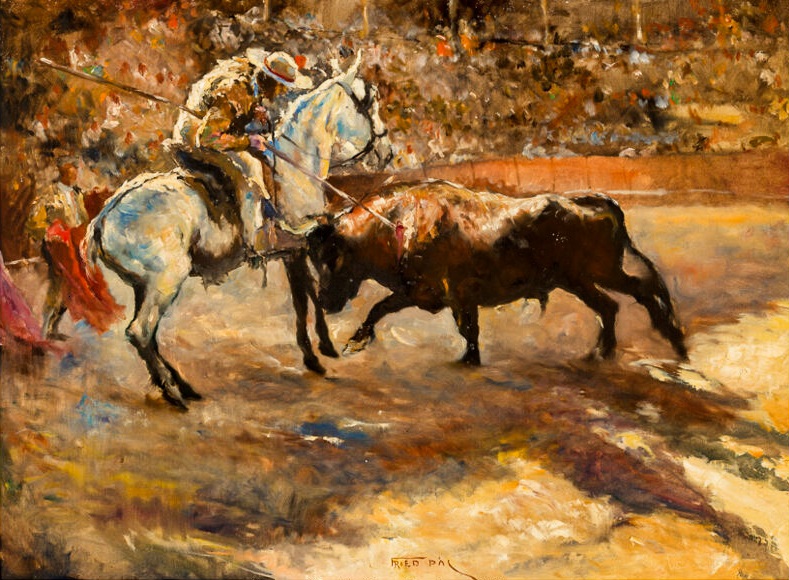
1 Work , Pal Fried's The Picador, with footnotes

Pal Fried (Hungarian/American, 1893-1976)
The Picador
Oil on canvas
28 x 38 inches (71.1 x 96.5 cm)
Private collection

A picador is one of the pair of horse-mounted bullfighters in a Spanish-style bullfight that jab the bull with a lance. They perform in the tercio de varas, which is the first of the three stages in a stylized bullfight.

If the public feels that a picador is better than the bull the public will whistle, boo or jeer as they see fit. This is because they do not want the bull to lose all its strength and energy as this can lead to a dull bullfight.

The picador is obliged to give the bull two lances in a first category bullring, but the matador may request that the second be waived in second and third category rings. The bull may receive three lances if it is particularly ferocious.

The aim of the bull to charge the picador is often cited as the biggest test of its courage. A bull that does not charge may be punished with a black banderilla, which although somewhat longer than a normal banderilla is largely symbolic and a mark of shame for the breeder. More on a picador

Pál Fried (16 June 1893 in Hungary – 6 March 1976 in New York City) was a Hungarian artist. His oil paintings were usually of dancers, nudes, and portraits, and his subjects were almost always women, although he also painted Paris, seascapes, and cowboys and landscapes of the American West. He signed his paintings, as is usual in Hungarian, with his surname first as "Fried Pál". At times, this particular artist would make several, almost identical versions of the same oil painting, except he would use slightly different facial expressions and/or would try different colour schemes.

Fried immigrated to the United States in 1946 after World War II, and became a U.S. citizen in 1953. He lived in Los Angeles and New York City. More on Pál Fried


Please visit my other blogs: Art CollectorMythologyMarine ArtPortrait of a Lady, The OrientalistArt of the Nude and The Canals of VeniceMiddle East Artists365 Saints and 365 Days, also visit my Boards on Pinterest

Images are copyright of their respective owners, assignees or others. Some Images may be subject to copyright

I don't own any of these images - credit is always given when due unless it is unknown to me. if I post your images without your permission, please tell me.

I do not sell art, art prints, framed posters or reproductions. Ads are shown only to compensate the hosting expenses.

If you enjoyed this post, please share with friends and family.

Thank you for visiting my blog and also for liking its posts and pages.

Please note that the content of this post primarily consists of articles available from Wikipedia or other free sources online.