Showing posts with label Leonardo da Vinci. Show all posts

01 Work, The Art of War, Leonardo da Vinci's Alma's Triumph at The Battle of Anghiari, with footnotes

After Leonardo da Vinci
Alma's Triumph at The Battle of Anghiari
AI Generated
playground

The Battle of Anghiari was fought on 29 June 1440, between the forces of Milan and the League of some Italian states led by the Republic of Florence in the course of the Wars in Lombardy. The battle was a victory for the Florentines, who secured their domination of central Italy. More on The Battle of Anghiari

"Alma's Triumph at The Battle of Anghiari" is a powerful and captivating depiction inspired by Leonardo da Vinci's famous artwork, "The Battle of Anghiari." This reimagination showcases Alma, a remarkable Bedouin warrior woman, as she fearlessly fights against her attackers on the battlefield.

Clad in Arab armor, Alma stands out amidst the chaos, her appearance marked by the physical toll of the ongoing conflict. Mud and blood cover her legs, arms, and midriff, bearing witness to the arduous nature of the battle she has endured. A veneer of weariness overlays her battle-hardened spirit, a testament to her unyielding determination to protect her people and land.

Mounted atop her majestic Arabian stallion, Alma exudes both grace and strength. Her posture suggests unwavering resolve as she raises her sword, poised to strike at her adversary. The anticipation and focus in her expression reveal her combat prowess and the expertise honed through countless battles.

The scene is painted with intensity and dynamism, capturing the frenzy and violence of war. The disarrayed battlefield, with its chaotic blend of charging horses, flailing weapons, and billowing battlefield dust, adds to the immersive quality of the artwork. Alma's figure stands out amidst the flurry of action.

Through this portrayal, the artist pays tribute to the fierce and valiant nature of Alma, an embodiment of the Bedouin warrior tradition. Alma symbolizes the strength and resilience of the Arab people, willing to fight against all odds.

The painting's color palette reflects the intensity of the battle. Warm tones dominate the scene, representing the fire and passion that drives Alma's unwavering commitment to her cause. The contrast of vibrant reds against desaturated grays and browns heightens the drama and adds depth to the composition.

This artwork, through its depiction of Alma's triumph, becomes a timeless representation of the indomitable spirit and heroism exhibited by women warriors throughout history. It reminds viewers of the significance of honoring those who, against all odds, rise above adversity and fight for what they believe in.

Leonardo da Vinci, (born April 15, 1452, Anchiano, near Vinci, Republic of Florence — died May 2, 1519, Cloux, France), Italian painter, draftsman, sculptor, architect, and engineer whose genius, perhaps more than that of any other figure, epitomized the Renaissance humanist ideal. His Last Supper (1495–98) and Mona Lisa (c. 1503–19) are among the most widely popular and influential paintings of the Renaissance. His notebooks reveal a spirit of scientific inquiry and a mechanical inventiveness that were centuries ahead of their time.

The unique fame that Leonardo enjoyed in his lifetime and that, filtered by historical criticism, has remained undimmed to the present day rests largely on his unlimited desire for knowledge, which guided all his thinking and behaviour. An artist by disposition and endowment, he considered his eyes to be his main avenue to knowledge; to Leonardo, sight was man’s highest sense because it alone conveyed the facts of experience immediately, correctly, and with certainty. Hence, every phenomenon perceived became an object of knowledge, and knowing how to see became the great theme of his studies. He applied his creativity to every realm in which graphic representation is used: he was a painter, sculptor, architect, and engineer. But he went even beyond that. He used his superb intellect, unusual powers of observation, and mastery of the art of drawing to study nature itself, a line of inquiry that allowed his dual pursuits of art and science to flourish. More Leonardo da Vinci


Please visit my other blogs: Art Collector, Mythology, Marine Art, Portrait of a Lady, The Orientalist, Art of the Nude and The Canals of Venice, Middle East Artists, 365 Saints, 365 Days, and Biblical Icons, also visit my Boards on Pinterest and deviantart

Images are copyright of their respective owners, assignees or others. Some Images may be subject to copyright

I don't own any of these images - credit is always given when due unless it is unknown to me. if I post your images without your permission, please tell me.

If you enjoyed this post, please share with friends and family.

Thank you for visiting my blog and also for liking its posts and pages.

Please note that the content of this post primarily consists of articles available from Wikipedia or other free sources online.

07 Works, The Art of War, Leonardo da Vinci's Alma and her Archers Arrive in Gaza, with footnotes

After Leonardo da Vinci
Alma and her Archers Arrive in Gaza 1
AI Generated
1024 × 1024
Available at deviantart

The painting captures the essence of strength, grace, and defiance as these fierce Bedouin warrior women fight valiantly for their homeland.

After Leonardo da Vinci
Alma and her Archers Arrive in Gaza 2
AI Generated
Width: 1024, Height: 1024
openart

The scene is set against a backdrop of a vast desert, its golden sand stretching as far as the eye can see. The atmosphere is charged with tension and anticipation.

After Leonardo da Vinci
Alma and her Archers Arrive in Gaza 3
AI Generated
Width: 1024, Height: 1024
openart

Each Bedouin warrior woman is depicted with meticulous detail and precision, paying homage to Leonardo da Vinci's technique. Their faces bear a determined expression, their piercing eyes filled with unwavering resolve. Their hair cascades down their backs.

After Leonardo da Vinci
Alma and her Archers Arrive in Gaza 4
AI Generated
1024 × 1024
Available at deviantart

After Leonardo da Vinci
Alma and her Archers Arrive in Gaza 5
AI Generated
Width: 1024, Height: 1024
openart

In perfect synchronization, the warriors release their arrows simultaneously, displaying their exceptional archery skills. The arrows soar through the air with an almost ethereal grace, leaving a trail of bright streaks behind them. The deadly accuracy of their aim is evident as the projectiles find their targets with precision, striking down the enemy forces.

After Leonardo da Vinci
Alma and her Archers Arrive in Gaza 6
AI Generated
1024 × 1024
Available at deviantart

Leonardo da Vinci's influence is evident in the painting's attention to detail, chiaroscuro, and skillful use of light and shadow. The composition captures the dynamic movement and intensity of the battle, drawing the viewer into the heart of the action.

After Leonardo da Vinci
Alma and her Archers Arrive in Gaza 7
AI Generated
1024 × 1024
NightCafe

The painting serves not only as a celebration of these courageous and skilled warriors but also as a reminder of the powerful role women have played throughout history. It is a tribute to the strength, resilience, and bravery of the Bedouin warrior women, who fought fiercely to protect their land, culture, and way of life.

Alma was by far the most distinguished of women because of her many superior qualities, especially because of the bravery she demonstrated in defense of her people.

Islam elevated the status of women, treating them on an equal footing with a man. Women had a newfound independent identity, in the physical and spiritual spheres.

Islamic history is full of warrior women who fiercely fought for what they believed in, defended what they cherished, and defied all expectations and became legends.

The Warrior Woman is an ancient archetype that is not well known because the stories have been both forgotten and suppressed. Mythology is full of warrior goddesses.

Traditionally, the Bedouin were among the most dangerous of desert tribes, fighting among themselves when outsiders weren’t available. Constantly on the move to find new pastures for their livestock, they learned to live with the minimum of possessions and little external support in the harshest of lands. Loyalty to tribe and family was all that helped a warrior survive. More on Desert Warriors

Leonardo da Vinci, (born April 15, 1452, Anchiano, near Vinci, Republic of Florence — died May 2, 1519, Cloux, France), Italian painter, draftsman, sculptor, architect, and engineer whose genius, perhaps more than that of any other figure, epitomized the Renaissance humanist ideal. His Last Supper (1495–98) and Mona Lisa (c. 1503–19) are among the most widely popular and influential paintings of the Renaissance. His notebooks reveal a spirit of scientific inquiry and a mechanical inventiveness that were centuries ahead of their time.

The unique fame that Leonardo enjoyed in his lifetime and that, filtered by historical criticism, has remained undimmed to the present day rests largely on his unlimited desire for knowledge, which guided all his thinking and behaviour. An artist by disposition and endowment, he considered his eyes to be his main avenue to knowledge; to Leonardo, sight was man’s highest sense because it alone conveyed the facts of experience immediately, correctly, and with certainty. Hence, every phenomenon perceived became an object of knowledge, and knowing how to see became the great theme of his studies. He applied his creativity to every realm in which graphic representation is used: he was a painter, sculptor, architect, and engineer. But he went even beyond that. He used his superb intellect, unusual powers of observation, and mastery of the art of drawing to study nature itself, a line of inquiry that allowed his dual pursuits of art and science to flourish. More Leonardo da Vinci


Please visit my other blogs: Art Collector, Mythology, Marine Art, Portrait of a Lady, The Orientalist, Art of the Nude and The Canals of Venice, Middle East Artists, 365 Saints, 365 Days, and Biblical Icons, also visit my Boards on Pinterest and deviantart

Images are copyright of their respective owners, assignees or others. Some Images may be subject to copyright

I don't own any of these images - credit is always given when due unless it is unknown to me. if I post your images without your permission, please tell me.

I do not sell art, art prints, framed posters or reproductions. Ads are shown only to compensate the hosting expenses.

If you enjoyed this post, please share with friends and family.

Thank you for visiting my blog and also for liking its posts and pages.

Please note that the content of this post primarily consists of articles available from Wikipedia or other free sources online.


02 Works, The Art of War, Leonardo da Vinci's Pain and Solace, with footnotes

After Leonardo da Vinci
Pain and Solace
AI Generated
playground

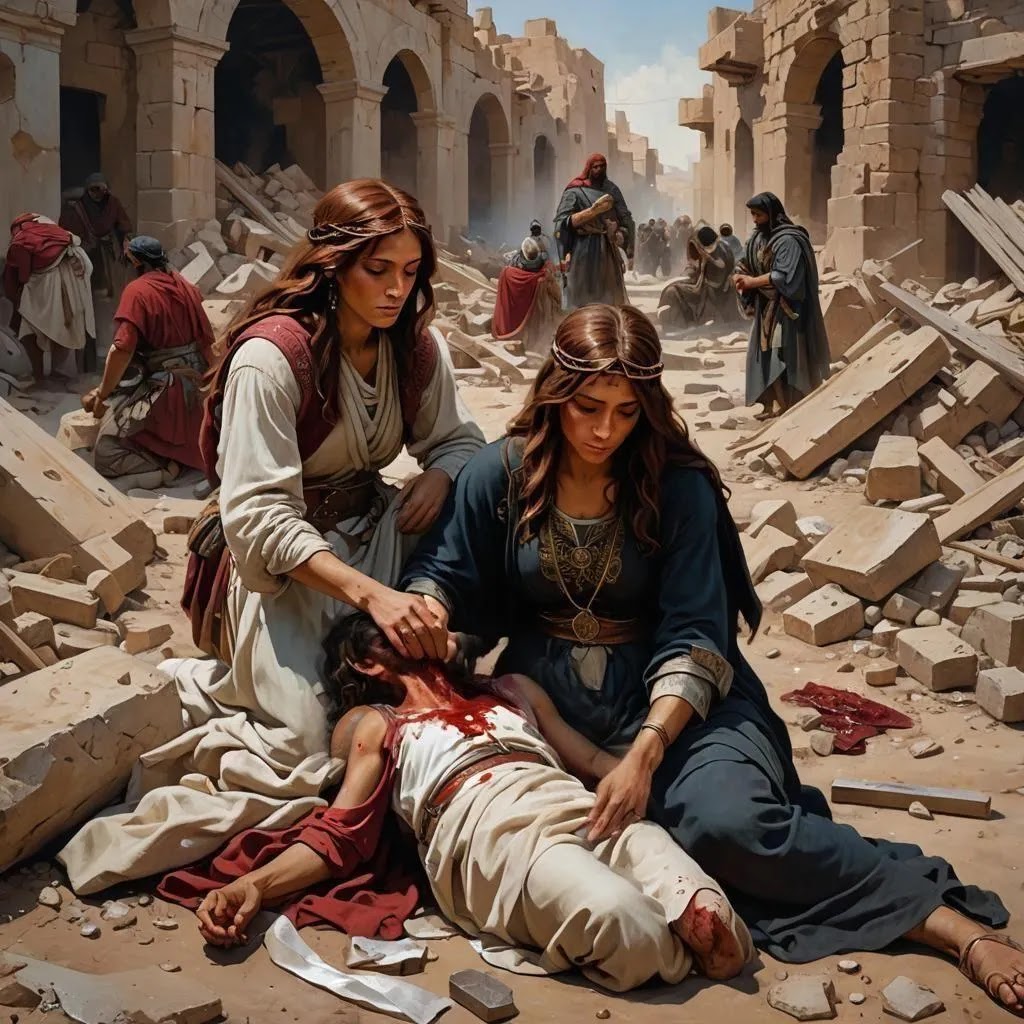
The backdrop of the painting showcases the devastation caused by the fierce battle, with ruins and debris scattered all around. The city's crumbling buildings, battered walls, and fallen structures serve as a stark reminder of the tumultuous nature of warfare. The artist's skilled brushwork brings out the texture and depth of the rubble, immersing the viewer in the chaos of the scene.

In the foreground, Mary Magdalene is depicted in a serene and compassionate manner, her face expressing a mix of concern and tenderness. Clad in a flowing robe with hues of earthy tones, her presence stands out amidst the darker and more muted colors of the battle scene. Her gentle touch and kneeling position symbolize Mary Magdalene's dedication to offering solace and healing even amidst the darkest of times.

After Leonardo da Vinci
Pain and Solace
AI Generated
playground

At the center of Mary Magdalene's attention is Alma, the wounded Arab Bedouin warrior. Alma's battered and bloodied form portrays the harsh reality of war, reflecting the physical toll it takes on individuals. The painting focuses on the vulnerability and humanity of Alma, emphasizing the connection between the two figures. Despite their cultural and social differences, Mary Magdalene's act of compassion transcends boundaries, drawing attention to the universal need for empathy and healing in times of conflict.

Overall, "Pain and Solace" encapsulates Leonardo da Vinci's unique artistic style, combining vivid details with a sense of ethereal beauty. Through the contrasting elements of destruction and compassion, the painting invites viewers to contemplate the profound impact that acts of kindness and empathy can have, even in the most challenging circumstances.


Leonardo da Vinci, (born April 15, 1452, Anchiano, near Vinci, Republic of Florence — died May 2, 1519, Cloux, France), Italian painter, draftsman, sculptor, architect, and engineer whose genius, perhaps more than that of any other figure, epitomized the Renaissance humanist ideal. His Last Supper (1495–98) and Mona Lisa (c. 1503–19) are among the most widely popular and influential paintings of the Renaissance. His notebooks reveal a spirit of scientific inquiry and a mechanical inventiveness that were centuries ahead of their time.

The unique fame that Leonardo enjoyed in his lifetime and that, filtered by historical criticism, has remained undimmed to the present day rests largely on his unlimited desire for knowledge, which guided all his thinking and behaviour. An artist by disposition and endowment, he considered his eyes to be his main avenue to knowledge; to Leonardo, sight was man’s highest sense because it alone conveyed the facts of experience immediately, correctly, and with certainty. Hence, every phenomenon perceived became an object of knowledge, and knowing how to see became the great theme of his studies. He applied his creativity to every realm in which graphic representation is used: he was a painter, sculptor, architect, and engineer. But he went even beyond that. He used his superb intellect, unusual powers of observation, and mastery of the art of drawing to study nature itself, a line of inquiry that allowed his dual pursuits of art and science to flourish. More Leonardo da Vinci


Please visit my other blogs: Art Collector, Mythology, Marine Art, Portrait of a Lady, The Orientalist, Art of the Nude and The Canals of Venice, Middle East Artists, 365 Saints, 365 Days, and Biblical Icons, also visit my Boards on Pinterest and deviantart

Images are copyright of their respective owners, assignees or others. Some Images may be subject to copyright

I don't own any of these images - credit is always given when due unless it is unknown to me. if I post your images without your permission, please tell me.

I do not sell art, art prints, framed posters or reproductions. Ads are shown only to compensate the hosting expenses.

If you enjoyed this post, please share with friends and family.

Thank you for visiting my blog and also for liking its posts and pages.

Please note that the content of this post primarily consists of articles available from Wikipedia or other free sources online.


01 Work, The Art of War, Leonardo da Vinci's The Battle is Over, with footnotes

After Leonardo da Vinci
The Battle is Over
AI Generated
nightcafe

The battle is over, and the enemy has fled, leaving the city in ruins. Alma's heart pounded as she spotted her companion sitting amidst the destruction. She hurried over to him. Kneeling by his side, she gently wrapped her arm around his shoulder.

"Thank the stars you're alive," she whispered, her voice filled with both exhaustion and concern.

His eyes fluttered open, and a weak smile tugged at the corners of his lips. "Alma," he rasped, pain evident in his voice. "I...I thought I wouldn't make it."

Tears welled up in Alma's eyes as she carefully examined his injuries. Blood stained his clothes, and his once-strong frame now seemed fragile and haggard. But she refused to let despair overtake her.

With steady hands, Alma retrieved a cloth and a small vial of salve from her bag. She dampened the cloth with clean water from her canteen and began to gently cleanse the wounds on his battered body. Each touch was gentle, yet purposeful, as she tried to alleviate his pain.

As she worked on tending his wounds, Alma's mind raced with thoughts of the battles they had fought together, the losses they had endured, and the glimmer of hope that had guided them through the darkest of times. The city may be in ruins, but as long as they had each other, they had the strength to rebuild and heal.


Leonardo da Vinci, (born April 15, 1452, Anchiano, near Vinci, Republic of Florence — died May 2, 1519, Cloux, France), Italian painter, draftsman, sculptor, architect, and engineer whose genius, perhaps more than that of any other figure, epitomized the Renaissance humanist ideal. His Last Supper (1495–98) and Mona Lisa (c. 1503–19) are among the most widely popular and influential paintings of the Renaissance. His notebooks reveal a spirit of scientific inquiry and a mechanical inventiveness that were centuries ahead of their time.

The unique fame that Leonardo enjoyed in his lifetime and that, filtered by historical criticism, has remained undimmed to the present day rests largely on his unlimited desire for knowledge, which guided all his thinking and behaviour. An artist by disposition and endowment, he considered his eyes to be his main avenue to knowledge; to Leonardo, sight was man’s highest sense because it alone conveyed the facts of experience immediately, correctly, and with certainty. Hence, every phenomenon perceived became an object of knowledge, and knowing how to see became the great theme of his studies. He applied his creativity to every realm in which graphic representation is used: he was a painter, sculptor, architect, and engineer. But he went even beyond that. He used his superb intellect, unusual powers of observation, and mastery of the art of drawing to study nature itself, a line of inquiry that allowed his dual pursuits of art and science to flourish. More Leonardo da Vinci

Alma was by far the most distinguished of women because of her many superior qualities, especially because of the bravery she demonstrated in defense of her people.

Islam elevated the status of women, treating them on an equal footing with a man. Women had a newfound independent identity, in the physical and spiritual spheres.

Islamic history is full of warrior women who fiercely fought for what they believed in, defended what they cherished, and defied all expectations and became legends.

The Warrior Woman is an ancient archetype that is not well known because the stories have been both forgotten and suppressed. Mythology is full of warrior goddesses.

Traditionally, the Bedouin were among the most dangerous of desert tribes, fighting among themselves when outsiders weren’t available. Constantly on the move to find new pastures for their livestock, they learned to live with the minimum of possessions and little external support in the harshest of lands. Loyalty to tribe and family was all that helped a warrior survive. More on Desert Warriors


Please visit my other blogs: Art Collector, Mythology, Marine Art, Portrait of a Lady, The Orientalist, Art of the Nude and The Canals of Venice, Middle East Artists, 365 Saints, 365 Days, and Biblical Icons, also visit my Boards on Pinterest and deviantart

Images are copyright of their respective owners, assignees or others. Some Images may be subject to copyright

I don't own any of these images - credit is always given when due unless it is unknown to me. if I post your images without your permission, please tell me.

I do not sell art, art prints, framed posters or reproductions. Ads are shown only to compensate the hosting expenses.

If you enjoyed this post, please share with friends and family.

Thank you for visiting my blog and also for liking its posts and pages.

Please note that the content of this post primarily consists of articles available from Wikipedia or other free sources online.


01 Work, The Art of War, Leonardo da Vinci's Hunger, with footnotes

After Leonardo da Vinci
Hunger
AI Generated
playground

Hunger is more complicated than empty bellies: interconnected issues of poverty, inequality, conflict, climate change, gender discrimination, and weak government and health systems all play a role in driving hunger. More on hunger

Alma's expression reflects both weariness and strength as she gazes off into the distance. Her piercing eyes convey a mixture of exhaustion and determination, revealing the hardships and sacrifices she has endured. Despite her dire circumstances, she clings to a glimmer of hope, never letting go of her inner strength.

In the background, the remnants of war are depicted through a landscape of destruction. Crumbling buildings and broken infrastructure serve as a stark reminder of the toll war takes on both people and their surroundings. The once vibrant city is now reduced to ruins, further emphasizing the chaotic and devastating nature of conflict.

Amid the desolation, a ray of light softly illuminates the scene, symbolizing the presence of hope and resilience even in the darkest of times. It falls upon Alma's determined face, accentuating the strength and unwavering spirit that sustains her.
"Mercy Amidst Chaos" portrays the indomitable spirit of Alma and evokes empathy for the untold stories of countless individuals affected by war. It juxtaposes the darkness and destruction of conflict with the resilience and hope that can be found even in the most challenging circumstances. Through this painting, the artist invites viewers to reflect on the human toll of war and to cherish the enduring spirit of compassion and mercy that can ultimately bring healing to a wounded world.

Leonardo da Vinci, (born April 15, 1452, Anchiano, near Vinci, Republic of Florence — died May 2, 1519, Cloux, France), Italian painter, draftsman, sculptor, architect, and engineer whose genius, perhaps more than that of any other figure, epitomized the Renaissance humanist ideal. His Last Supper (1495–98) and Mona Lisa (c. 1503–19) are among the most widely popular and influential paintings of the Renaissance. His notebooks reveal a spirit of scientific inquiry and a mechanical inventiveness that were centuries ahead of their time.

The unique fame that Leonardo enjoyed in his lifetime and that, filtered by historical criticism, has remained undimmed to the present day rests largely on his unlimited desire for knowledge, which guided all his thinking and behaviour. An artist by disposition and endowment, he considered his eyes to be his main avenue to knowledge; to Leonardo, sight was man’s highest sense because it alone conveyed the facts of experience immediately, correctly, and with certainty. Hence, every phenomenon perceived became an object of knowledge, and knowing how to see became the great theme of his studies. He applied his creativity to every realm in which graphic representation is used: he was a painter, sculptor, architect, and engineer. But he went even beyond that. He used his superb intellect, unusual powers of observation, and mastery of the art of drawing to study nature itself, a line of inquiry that allowed his dual pursuits of art and science to flourish. More Leonardo da Vinci


Please visit my other blogs: Art Collector, Mythology, Marine Art, Portrait of a Lady, The Orientalist, Art of the Nude and The Canals of Venice, Middle East Artists, 365 Saints, 365 Days, and Biblical Icons, also visit my Boards on Pinterest and deviantart

Images are copyright of their respective owners, assignees or others. Some Images may be subject to copyright

I don't own any of these images - credit is always given when due unless it is unknown to me. if I post your images without your permission, please tell me.

I do not sell art, art prints, framed posters or reproductions. Ads are shown only to compensate the hosting expenses.

If you enjoyed this post, please share with friends and family.

Thank you for visiting my blog and also for liking its posts and pages.

Please note that the content of this post primarily consists of articles available from Wikipedia or other free sources online.


03 Works, The Art of War, Leonardo da Vinci's Mercy Amidst Chaos, with footnotes

After Leonardo da Vinci
Mercy Amidst Chaos 1
AI Generated
nightcafe

"Mercy Amidst Chaos" is an oil painting that captures a poignant moment in the midst of a fierce battle. Inspired by Leonardo da Vinci's mastery of composition and emotional depth, this artwork juxtaposes the tenderness of the Virgin Mary and Mary Magdalene with the tragedy of war.

After Leonardo da Vinci
Mercy Amidst Chaos 2
AI Generated
nightcafe

In the center of the composition lies an Arab Bedouin warrior woman, her dark red hair flowing, wounded and bleeding. She lies amidst the debris and ruins, symbolizing the price paid in times of conflict. Her bravery and strength are evident, even in her vulnerability. This warrior woman represents the resilience and humanity that can be found in any culture, even amidst the chaos of war.

After Leonardo da Vinci
Mercy Amidst Chaos 3
AI Generated
nightcafe

Both the Virgin Mary and Mary Magdalene kneel alongside the wounded woman, their faces filled with compassion and concern. Their presence exudes maternal care and empathy, as they gently tend to her wounds and offer solace amidst the surrounding destruction. Their inclusion pays homage to the universality of suffering and the healing power of compassion, transcending religious and cultural boundaries.

Leonardo da Vinci, (born April 15, 1452, Anchiano, near Vinci, Republic of Florence — died May 2, 1519, Cloux, France), Italian painter, draftsman, sculptor, architect, and engineer whose genius, perhaps more than that of any other figure, epitomized the Renaissance humanist ideal. His Last Supper (1495–98) and Mona Lisa (c. 1503–19) are among the most widely popular and influential paintings of the Renaissance. His notebooks reveal a spirit of scientific inquiry and a mechanical inventiveness that were centuries ahead of their time.

The unique fame that Leonardo enjoyed in his lifetime and that, filtered by historical criticism, has remained undimmed to the present day rests largely on his unlimited desire for knowledge, which guided all his thinking and behaviour. An artist by disposition and endowment, he considered his eyes to be his main avenue to knowledge; to Leonardo, sight was man’s highest sense because it alone conveyed the facts of experience immediately, correctly, and with certainty. Hence, every phenomenon perceived became an object of knowledge, and knowing how to see became the great theme of his studies. He applied his creativity to every realm in which graphic representation is used: he was a painter, sculptor, architect, and engineer. But he went even beyond that. He used his superb intellect, unusual powers of observation, and mastery of the art of drawing to study nature itself, a line of inquiry that allowed his dual pursuits of art and science to flourish. More Leonardo da Vinci


Please visit my other blogs: Art Collector, Mythology, Marine Art, Portrait of a Lady, The Orientalist, Art of the Nude and The Canals of Venice, Middle East Artists, 365 Saints, 365 Days, and Biblical Icons, also visit my Boards on Pinterest and deviantart

Images are copyright of their respective owners, assignees or others. Some Images may be subject to copyright

I don't own any of these images - credit is always given when due unless it is unknown to me. if I post your images without your permission, please tell me.

I do not sell art, art prints, framed posters or reproductions. Ads are shown only to compensate the hosting expenses.

If you enjoyed this post, please share with friends and family.

Thank you for visiting my blog and also for liking its posts and pages.

Please note that the content of this post primarily consists of articles available from Wikipedia or other free sources online.


08 Works, The Art of War, Leonardo da Vinci and Anselm Feuerbach imbedded with Alma and her Warrior, with footnotes

After Leonardo da Vinci
The warriors assemble
AI Generated
Available at deviantart

In the midst of a rugged field, where grains of sand mingle with tufts of grass, Alma and her troop of  Bedouin women stand tall. Clad in ornate, oriental armor, each woman exudes a sense of power and resilience. The armor shimmers with a blend of gold and bronze hues, reflecting the warm desert sunlight. Engraved with delicate motifs, it tells stories of ancient battles and victories.

After Leonardo da Vinci
More women join With Alma's Troop
AI Generated
Available at deviantart

As the warriors approach the enemy more women join them to help protect their families and children!

After Anselm Feuerbach
The women draw their bows
AI Generated
Available at deviantart

After  Leonardo da Vinci
Alma Fires Her Arrows
AI Generated
Available at deviantart

As the enemy approaches, the warrior women draw their bows with grace and precision. With arrows coated in determination, they unleash a volley towards their foes, their movements fluid and swift. The whistling sound of arrows fills the air, like whispers of defiance against impending chaos.

After Anselm Feuerbach
The arrows find their targets
AI Generated
nightcafe

After Anselm Feuerbach
Their arrows find their targets
AI Generated
Available at deviantart

Amidst the chaos, their archery skills are unmatched. The arrows find their targets with deadly accuracy, piercing the hearts of their enemies. Their faces, smudged with streaks of war paint, bear a steely determination, yet their eyes gleam with an untamed fire that demonstrates their undying spirit.

After Leonardo da Vinci
Alma and her Troop Advance
AI Generated
nightcafe

After Leonardo da Vinci
Alma
AI Generated
nightcafe

The field around them becomes a canvas of dust and destruction, as the clash of battle unfolds. Their footsteps leave imprints behind, blending with the kick-up of dirt, creating a dance of primal energy. The earth beneath them trembles at their presence, witnessing both their breathtaking beauty and unwavering courage.

In the midst of the turmoil, a powerful sense of sisterhood resonates among them. Each woman stands by her comrades, weaving an unbreakable bond. They fought not only for themselves but for the protection of their tribe, their heritage, and their way of life.


Alma was by far the most distinguished of women because of her many superior qualities, especially because of the bravery she demonstrated in defense of her people.

Islam elevated the status of women, treating them on an equal footing with a man. Women had a newfound independent identity, in the physical and spiritual spheres.

Islamic history is full of warrior women who fiercely fought for what they believed in, defended what they cherished, and defied all expectations and became legends.

The Warrior Woman is an ancient archetype that is not well known because the stories have been both forgotten and suppressed. Mythology is full of warrior goddesses.

Traditionally, the Bedouin were among the most dangerous of desert tribes, fighting among themselves when outsiders weren’t available. Constantly on the move to find new pastures for their livestock, they learned to live with the minimum of possessions and little external support in the harshest of lands. Loyalty to tribe and family was all that helped a warrior survive. More on Desert Warriors


Please visit my other blogs: Art Collector, Mythology, Marine Art, Portrait of a Lady, The Orientalist, Art of the Nude and The Canals of Venice, Middle East Artists, 365 Saints, 365 Days, and Biblical Icons, also visit my Boards on Pinterest and deviantart

Images are copyright of their respective owners, assignees or others. Some Images may be subject to copyright

I don't own any of these images - credit is always given when due unless it is unknown to me. if I post your images without your permission, please tell me.

I do not sell art, art prints, framed posters or reproductions. Ads are shown only to compensate the hosting expenses.

If you enjoyed this post, please share with friends and family.

Thank you for visiting my blog and also for liking its posts and pages.

Please note that the content of this post primarily consists of articles available from Wikipedia or other free sources online.


08 Works, The Art of War, Henry Zaidan's Alma at The Battle of Herod's Gate, After Leonardo da Vinci, with footnotes

 After Leonardo da Vinci
Alma at The Battle of Herod's Gate
AI Generated
playground

Riding their Arabian stallions, Alma and her companion charge into battle with swords raised high. The horses themselves are a symbol of Arab culture and heritage, illustrating the deep connection between the Bedouin people and their majestic steeds. The powerful motion of the horses, their manes flowing in the wind, adds a sense of energy and movement to the composition.

 After Leonardo da Vinci
Arriving at Herod's Gate
AI Generated
Available at deviantart

Herod's Gate is one of the seven open Gates of the Old City of Jerusalem. It connects the Muslim Quarter inside of the old city to the eponymic Palestinian neighbourhood of Bab az-Zahra, situated just outside.

 After Leonardo da Vinci
In front of Harold's Gate
AI Generated
Available at deviantart

This modest gate, which opens from a wall tower, is one of the newest gates of Jerusalem. At the time when Suleiman the Magnificent built the city walls in the 1530s, a small wicket gate was situated in the eastern, lateral wall of the tower, which was rarely opened. Formerly, the sprawling residential area within this gate was known as Bezetha (effectually translated as "New City"), settled during the late Second Temple period to accommodate Jerusalem's growing population.  More on Harold's Gate

 After Leonardo da Vinci
Warriors at Herod's Gate
AI Generated
Available at deviantart

As they took their positions, a wave of determination washed over them, willing them to stand their ground against any potential threats. The defenders were a mix of highly trained and skilled individuals, each bringing their unique expertise to the table.

After Leonardo da Vinci
Alma at The Battle of Herod's Gate
AI Generated
Available at deviantart

In Leonardo da Vinci's The Battle of Herod's Gate, Alma and her Bedouin warrior women symbolize the bravery and resilience of a people fighting for their freedom and land. The painting immortalizes their struggle and serves as a testament to the indomitable spirit of those who dare to defy oppression.

After Leonardo da Vinci
Harold's Gate in Jerusalem
AI Generated
Available at deviantart

After Leonardo da Vinci
The Battle of Herod's Gate
AI Generated
Available at deviantart


 After Leonardo da Vinci
It is now time to leave
AI Generated
Available at deviantart

"Listen up, everyone!" Elma's voice emerged strong and resolute, cutting through the noise of the aftermath. Her troops turned their attention towards her, their weary eyes filled with a mix of exhaustion and anticipation for her next words.

"We have fought valiantly today," she declared, her voice carrying a sense of pride and determination. "But the time has come to rest, regroup, and plan our next moves."


Please visit my other blogs: Art Collector, Mythology, Marine Art, Portrait of a Lady, The Orientalist, Art of the Nude and The Canals of Venice, Middle East Artists, 365 Saints, 365 Days, and Biblical Icons, also visit my Boards on Pinterest and deviantart

Images are copyright of their respective owners, assignees or others. Some Images may be subject to copyright

I don't own any of these images - credit is always given when due unless it is unknown to me. if I post your images without your permission, please tell me.

I do not sell art, art prints, framed posters or reproductions. Ads are shown only to compensate the hosting expenses.

If you enjoyed this post, please share with friends and family.

Thank you for visiting my blog and also for liking its posts and pages.

Please note that the content of this post primarily consists of articles available from Wikipedia or other free sources online.