Showing posts with label Franz von Stuck. Show all posts

09 paintings on Halloween night with John William Waterhouse, Mariska Karto, Johfra Bosschart, Francisco de Goya, Jan or Frans Verbeeck, Norman Lindsay, Gustave Moreau, and Franz von Stuck, with Footnotes

John William Waterhouse  (1849–1917)
The Magic Circle, c. 1886
Oil on canvas
height: 182.9 cm (72 in); width: 127 cm (50 in)
Tate Britain 

This is one of Waterhouse's earlier works, and reflects his fascination with the exotic. The woman in this picture appears to be a witch or priestess, endowed with magic powers. Her dress and general appearance is highly eclectic, and is derived from several sources: she has the swarthy complexion of a woman of middle-eastern origin; her hairstyle is like that of an early Anglo-Saxon; her dress is decorated with Persian or Greek warriors. In her left hand she holds a crescent-shaped sickle, linking her with the moon and Hecate. With the wand in her right hand she draws a protective magic circle round her. Outside the circle the landscape is bare and barren; a group of rooks or ravens and a frog – all symbols of evil and associated with witchcraft – are excluded. But within its confines are flowers and the woman herself, objects of beauty. More on this painting

John William Waterhouse (April 6, 1849 – February 10, 1917) was an English painter known for working in the Pre-Raphaelite style. He worked several decades after the breakup of the Pre-Raphaelite Brotherhood, which had seen its heyday in the mid-nineteenth century, leading to his sobriquet "the modern Pre-Raphaelite". Borrowing stylistic influences not only from the earlier Pre-Raphaelites but also from his contemporaries, the Impressionists, his artworks were known for their depictions of women from both ancient Greek mythology and Arthurian legend.
Born in Italy to English parents who were both painters, he later moved to London, where he enrolled in the Royal Academy of Art. He soon began exhibiting at their annual summer exhibitions, focusing on the creation of large canvas works depicting scenes from the daily life and mythology of ancient Greece. Later on in his career he came to embrace the Pre-Raphaelite style of painting despite the fact that it had gone out of fashion in the British art scene several decades before. More on John William Waterhouse

Mariska Karto
Soul collectors, ca. 2021
Photograph on Aluminum
43 1/2 × 43 1/2 in | 110.5 × 110.5 cm
Private collection

Soul collectors are supernatural creatures, spirits, entities, angels, demons or deities in many religions whose responsibility is to escort newly deceased souls from Earth to the afterlife. Their role is not to judge the deceased, but simply to guide them. Appearing frequently on funerary art, psychopomps have been depicted at different times and in different cultures as anthropomorphic entities, horses, deer, dogs, whip-poor-wills, ravens, crows, vultures, owls, sparrows, and cuckoos. When seen as birds, they are often seen in huge masses, waiting outside the home of the dying. More on Soul collectors

Mariska Karto is a fine art photographer born in Suriname and raised in the Netherlands. The breadth of her oeuvre is a masterful homage to Classicism in art history. Her multidisciplinary skill as a figurative sketcher draws a connection to the meditative practises of Renaissance draughtsmen like Leonardo, and her knowledge of fabrics as a textile artist is comparable to the dexterity of Ingres and Titian. However it is Karto’s mastery of contemporary photography that leads viewers to witness realistic images compelled by classical tradition.

Her sensual portraits depict the beauty of the female form; soft, glowing skin that venerates these women as cult icons. She conjures up an environment of lushly draped fabrics.

Karto has impressed collectors and establishments around the world, and garnered a faithful following. Her wild success is consistently documented by prize competitions across the globe; most recently she was awarded First Prize Gold Award at the Prix De La Photographie De Paris in 2016. More on Mariska Karto

Johfra Bosschart
Witches sabbath, c. 1972
Oil on panel
98 x 67 cm
Private collection

Witches’ sabbath, nocturnal gathering of witches, a colourful and intriguing part of the lore surrounding them in Christian European tradition. The concept dates from the mid-14th century when it first appeared in Inquisition records. The sabbath, or sabbat, derived probably from the term for the seventh day used by the Jews, might be held on any day of the week, though Saturday was considered rare as being sacred to the Virgin Mary.

Reports of attendance at sabbaths varied; one confessed witch reported a gathering of 10,000. Witches reputedly traveled to the sabbath by smearing themselves with special ointment that enabled them to fly through the air, or they rode on a goat, ram, or dog supplied by the devil. 

Occurrences at the sabbath were represented by inquisitors as including obeisance to the devil by kissing him under his tail, dancing, feasting, and indiscriminate intercourse. More on the Witches’ sabbath

Franciscus Johannes Gijsbertus van den Berg (15 December 1919, in Rotterdam – 6 November 1998, in Fleurac) or just Johfra Bosschart was a Dutch modern artist. Johfra and his wife, Ellen Lórien, established in Fleurac (Dordogne - France) in 1962. They lived in the Netherlands before that. Johfra described his works as "Surrealism based on studies of psychology, religion, the Bible, astrology, antiquity, magic, witchcraft, mythology and occultism." More on Johfra Bosschart

Francisco de Goya  (1746–1828)
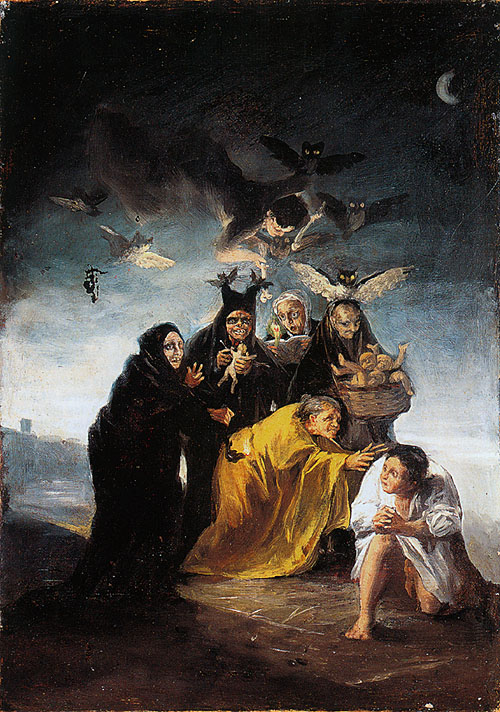
Witches, or Incantation, c. circa 1797-1798
Oil on canvas
height: 45 cm (17.7 in); width: 32 cm (12.5 in)
Museo Lázaro Galdiano
Francisco de Goya  (1746–1828)
Witches' Flight, Ca. 1798
Oil on canvas.
Museo Nacional del Prado

Three bare-chested characters wearing dunce caps hold a fourth, nude character in the air while another lies on the floor, covering his ears, A sixth figure flees, his head covered with a white cloth. With his hand, he makes the gesture intended to protect him from the evil eye. At the right of the scene, a donkey stands out against the neutral background. This was one of six canvases Goya sold to the Duke and Duchess of Osuna in 1798, as decoration for their country house in La Alameda. They are linked to the etchings from his Caprichos series, in which he presented scenes of witches and witchcraft similar to this one. This painting was acquired by the Prado Museum in 1999 with funds from the Villaescusa legacy. More on this painting

Francisco José de Goya y Lucientes (30 March 1746 – 16 April 1828) was a Spanish romantic painter and printmaker. He is considered the most important Spanish artist of late 18th and early 19th centuries and throughout his long career was a commentator and chronicler of his era. Immensely successful in his lifetime, Goya is often referred to as both the last of the Old Masters and the first of the moderns. He was also one of the great portraitists of modern times. More on Francisco José de Goya

Jan or Frans Verbeeck (Active Mechelen, 16th century)
The Witches' Sabbath
oil on panel
27 ¾ x 37 in. (70.5 x 93.9 cm.)
Private collection

While the influence of local traditions concerning witches and their degenerate night-time activities were rife in Germany and the Netherlands, and clearly had a great influence in informing the work produced by artists working in the region, in this Witches’ Sabbath the Verbeeck family reveal a more international trend of influence. Indeed, as Professor Vandenbroeck has discussed, it is likely that, as with many Netherlandish painters during the period, members of the Verbeeck family travelled to Italy. The impact of such travels can certainly be seen in the present work. While the iconographic programme and conception of the composition, as well as figures such as the crouching hooded figure at the left of the panel (which evidently references Dürer’s Saint Anthony of 1519), suggest the painter’s use of local visual traditions, other elements demonstrate wider knowledge. The figure at the summit of the dense clouds of smoke, looking back over her shoulder at the viewer, for example, suggests that the artist was familiar with the Libyan Sibyl from Michelangelo’s ceiling for the Sistine Chapel. The way in which the witches are clothed too suggests a knowledge of other figures from this scheme, like the women beneath the True Cross in the Sistine Last Judgement. Scenes of witchcraft in Italy were also known and Agostino Veneziano’s famous The Carcass (Lo Stregozzo) must have been known to the Verbeecks, given the inclusion of the skeletal mount ridden at the left of this picture. More on this painting

Frans Verbeeck or Frans Verbeeck the Elder (c. 1510 – 24 July 1570, Mechelen). There is very little known about Frans Verbeeck. He was a member of the Verbeeck family of artists based in Mechelen. There were about 15 painters recorded in the archives of Mechelen with the name Frans Verbeeck. There were also multiple artists with the name Jan Verbeeck active in Mechelen. Frans Verbeeck is the best-known of the artists in the family.

Frans Verbeeck became a master of the local painter's guild in Mechelen in 1531. He was dean of the guild on multiple occasions including in 1563, 1564 and 1565.

The Verbeeck family formed a dynasty of artists producing a large output of paintings in a workshop with multiple branches. They produced mainly compositions of a small scale using tempera rather than oil. Despite the difficulty of distinguishing between the artists in the Verbeeck group, some works have been attributed specifically to Frans Verbeeck. More on Frans Verbeeck 

Norman Lindsay
Witches Carnival
Watercolour
45 x 33.5cm
Private collection

Norman Alfred William Lindsay (22 February 1879 – 21 November 1969) was an Australian artist, etcher, sculptor, writer, editorial cartoonist, scale modeller, and an accomplished amateur boxer.

In 1895, Lindsay moved to Melbourne to work on a local magazine with his older brother Lionel. In 1901, he and Lionel, his older brother, joined the staff of the Sydney Bulletin, a weekly newspaper, magazine and review. His association there would last fifty years.

Lindsay travelled to Europe in 1909. In Naples he began 100 pen-and-ink illustrations for Petronius' Satyricon. Visits to the then South Kensington Museum where he made sketches of model ships in the Museum's collection stimulated a lifelong interest in ship models. The Lindsays returned to Australia in 1911.

Lindsay wrote the children's classic The Magic Pudding which was published in 1918. Many of his novels have a frankness and vitality that matches his art. In 1938, Lindsay published Age of Consent.

Cartoons, by Lindsay, were used both for recruitment and to promote conscription during World War I.
Lindsay also worked as an editorial cartoonist, notable for often illustrating the racist and right-wing political leanings that dominated The Bulletin at that time.

Lindsay influenced numerous artists, notably the illustrators Roy Krenkel and Frank Frazetta; he was also good friends with Ernest Moffitt. More on Norman Alfred William Lindsay

Gustave Moreau  (1826–1898)
Diomedes devoured by his horses, c. 1865
Oil on canvas
height: 140 cm (55.1 in); width: 95.5 cm (37.5 in)
Rouen Museum of Fine Arts

Diomedes was a barbaric king of the Bistonian tribe of Thrake who fed his mares on a diet of human flesh. Herakles was sent to fetch these horses as the eighth of his twelve Labours. He captured the beasts alive and left them in the care of his young squire Abderos while he went off to deal with King Diomedes. He returned to discover the boy had been devoured by the mares and in anger fed them their master's corpse which stilled their unnatural appetites.

Gustave Moreau (6 April 1826 – 18 April 1898) was a French Symbolist painter whose main emphasis was the illustration of biblical and mythological figures. Moreau was born in Paris. His father, Louis Jean Marie Moreau, was an architect, who recognized his talent. His first painting was a Pietà which is now located in the cathedral at Angoulême. He showed A Scene from the Song of Songs and The Death of Darius in the Salon of 1853. In 1853 he contributed Athenians with the Minotaur and Moses Putting Off his Sandals within Sight of the Promised Land to the Great Exhibition.
 
Moreau became a professor at Paris' École des Beaux-Arts in 1891 and among his many students were fauvist painters Henri Matisse and Georges Rouault. Jules Flandrin, Theodor Pallady and Léon Printemps also studied with Moreau.
 
During his lifetime, Moreau produced more than 8,000 paintings, watercolors and drawings, many of which are on display in Paris' Musée national Gustave Moreau at 14 rue de la Rochefoucauld (9th arrondissement). The museum is in his former workshop, and began operation in 1903. André Breton famously used to "haunt" the museum and regarded Moreau as a precursor of Surrealism. More on Gustave Moreau

Franz von Stuck, (1863-1928)
The Murderer, c. 1891
47 x 46 cm
Oil on canvas
I have no further description, at this time

Inspired by  Arnold Bocklin's painting, Murderer pursued by Furies, but with an even greater sense of excitement and drama, in 1891 Stuck painted his first version of the despair and remorse which pursue a criminal after his deed. The ancient Furies, the goddesses of vengeance, hide behind a rock as they lie in wait for the murderer who has just killed his victim. The sight of these ugly creatures is a foretaste of the torments awaiting the murderer. The figure of the murderer is derived from Klinger's etching 'Pursuit' in which a man in a similar pose runs away on a narrow path. More on this painting

Franz Stuck (February 23, 1863 – August 30, 1928) was a German painter, sculptor, engraver, and architect. Born at Tettenweis near Passau, Stuck displayed an affinity for drawing and caricature from an early age. To begin his artistic education he relocated in 1878 to Munich, where he would settle for life. From 1881 to 1885 Stuck attended the Munich Academy.

In 1889 he exhibited his first paintings at the Munich Glass Palace, winning a gold medal for The Guardian of Paradise. In 1892 Stuck co-founded the Munich Secession, and also executed his first sculpture, Athlete. The next year he won further acclaim with the critical and public success of what is now his most famous work, the painting The Sin. Also during 1893, Stuck was awarded a gold medal for painting at the World's Columbian Exposition in Chicago, and was appointed to a royal professorship. In 1895 he began teaching painting at the Munich Academy.
Having attained much fame by this time, Stuck was ennobled on December 9, 1905 and would receive further public honours from around Europe during the remainder of his life. He continued to be well respected among young artists as professor at the Munich Academy, even after his artistic styles became unfashionable. More on Franz von Stuck


Please visit my other blogs: Art CollectorMythologyMarine ArtPortrait of a Lady, The OrientalistArt of the Nude and The Canals of VeniceMiddle East Artists365 Saints and 365 Days, also visit my Boards on Pinterest

Images are copyright of their respective owners, assignees or others. Some Images may be subject to copyright

I don't own any of these images - credit is always given when due unless it is unknown to me. if I post your images without your permission, please tell me.

I do not sell art, art prints, framed posters or reproductions. Ads are shown only to compensate the hosting expenses.

If you enjoyed this post, please share with friends and family.

Thank you for visiting my blog and also for liking its posts and pages.

Please note that the content of this post primarily consists of articles available from Wikipedia or other free sources online.


14 Paintings by Franz von Stuck (February 23, 1863 – August 30, 1928)

Symbolism (c.1886-1900), a late 19th-century movement of Post-Impressionist painting, flourished throughout Europe between 1886 and 1900 in almost every area of the arts. Initially emerging in literature, including poetry, philosophy and theatre, it then spread to music and the visual arts. Symbolist art had strong connections with the Pre-Raphaelites and Romanticism, as well as the Aestheticism movement. Like all these movements, Symbolism was in large part a reaction against naturalism and realism, and became closely associated with mythological painting of all kinds. Symbolists sought a deeper reality from within their imagination, their dreams, and their unconscious. More on Symbolism

Franz von Stuck
Wild Chase, circa 1889 
Oil on panel
Height: 53 cm (20.87 in.), Width: 84 cm (33.07 in.) 
Städtische Galerie im Lenbachhaus - Munich (Germany)

One of Franz von Stuck's best-known paintings The Wild Chase depicts Wotan (Odin, the Allfather of the gods) on horseback leading a procession of the dead. It was completed about 1889, the year of Hitler's birth, and it has acquired a kind of semi-legendary status as the face of Wotan in the painting greatly resembles Hitler's. It's said Adolf Hitler saw this painting at thirteen and he was fascinated by Wotan, and later had this painting taken from the museum and placed in a special gallery. More

Franz Stuck (February 23, 1863 – August 30, 1928), ennobled as Franz von Stuck in 1906, was a German painter, sculptor, engraver, and architect. Born at Tettenweis near Passau, Stuck displayed an affinity for drawing and caricature from an early age. To begin his artistic education he relocated in 1878 to Munich, where he would settle for life. From 1881 to 1885 Stuck attended the Munich Academy.

Franz von Stuck
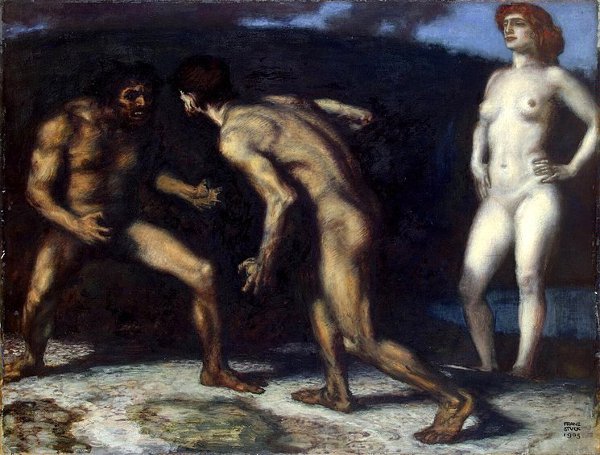
Fighting For A Woman/The Struggle for Woman, c. 1905
Oil on panel
90x117 cm
Hermitage Museum, St Petersburg, Russia

Influenced by the texts of Sigmund Freud, Stuck often depicted woman as dangerous, independent and predatory. This is probably most obvious in his depictions of the sphinx. While the men's attentions are is solely focused on impressing the woman, her gaze is enigmatically outward towards the viewer. Her posture evokes great pride in being the subject of a dispute.  More

Fight For The Female Artwork by Franz von Stuck Oil Painting & Art Prints on canvas for sale - PaintingSTAR.com Art Online Store:
Franz von Stuck
Fighting For A Woman/The Struggle for Woman, c. 1927
71 cm (27.95 in.), Width: 73 cm (28.74 in.)
Oil on panel

He first became well known by cartoons for Fliegende Blätter, and vignette designs for programmes and book decoration. In 1889 he exhibited his first paintings at the Munich Glass Palace, winning a gold medal for The Guardian of Paradise.

Franz von Stuck, Il Peccato, 1900 ca., Zagabria, Museum of Arts and Crafts
Franz von Stuck
The Sin
Oil on canvas
95 × 60 cm., 1893.
Neue Pinakothek (Munich / Germany )

Hitler bought many of Stuck’s paintings including the iconic The Sin, which he hung in his apartment in Munich until it was seized after WWII.

Like the Sphinx (Below), the female nude has her face obscured by shadow, and the eye is drawn to her breasts. The vast serpent twined around her body is reminiscent of Eve and the fall from Eden. It is at once compelling and disturbing. More

Franz von Stuck, (1863-1928)
Sensuality, 1891
Oil on Canvas
50.5 x 36.3 cm

The image is not Von Stuck’s, but the Bible’s; The serpent is phallic, but represents knowledge- which is separation from God or ‘self’ consciousness. It is Eve who covets the serpent and throughout hundreds of years of Christian culture ‘woman’ and ‘corruption’ really were synonymous- right from the vitriolic hysterics of the church fathers. But Von Stuck’s women are threatening, sensually unrepentant and complicit. Esoterically the ‘sin’ is not sexual in nature but occult, the serpent corresponding to Lumiel or Baphomet and Eve corresponding to the initial baptism of wisdom. More

stuck, franz von die sünde | allegorical | sotheby's n09218lot7mbssen:
Franz von Stuck - 1913 
DIE SÜNDE (THE SIN)
Oil on canvas
35 1/2 by 21 in., 90.2 by 53.3

Now widely considered to be an icon of the Symbolist art movement, Franz Stuck's Die Sünde (The Sin) drew large crowds even when it was first exhibited at the premiere exhibition of the Munich Secession in 1893, an association of artists which Stuck had co-founded a year before. First conceived in 1889 as Die Sinnlichkeit (Sensuality) (private collection), subsequent versions show subtle variations and evolve into the current composition, Stuck’s grand meditation on sin. Including the present work, twelve versions of the painting are now known, a testament to the image's fame and notoriety, and many of these are in public collections such as the Neue Pinakothek in Munich, the Nationalgalerie in Berlin, the Galleria di arte Moderna in Palermo, the Frye Museum in Seattle, and another remains enshrined as an icon in his Künstleraltar in the artist’s studio at the Villa Stuck in Munich, an elaborate home entirely of his design; his Gesamtkunstwerk, or total work of art. More

File:Franz von Stuck 004.jpg
Franz von Stuck, (1863-1928)
The Sin, c. 1893
Oil on Canvas
94.5 × 59.5 cm (37.2 × 23.4 in)
Neue Pinakothek, Munich, Germany

In 1892 Stuck co-founded the Munich Secession, and also executed his first sculpture, Athlete. The next year he won further acclaim with the critical and public success of what is now his most famous work, the painting The Sin. Also during 1893, Stuck was awarded a gold medal for painting at the World's Columbian Exposition in Chicago, and was appointed to a royal professorship. In 1895 he began teaching painting at the Munich Academy.

Franz von Stuck
The Sensuality, c. 1898
Etching & drypoint
18 x 22 cm
National Gallery of Canada

In 1897 Stuck married an American widow, Mary Lindpainter, and began work designing his own residence and studio, the Villa Stuck. His designs for the villa included everything from layout to interior decorations; for his furniture Stuck received another gold medal at the 1900 Paris World Exposition.

stuck, franz von the dragon slayer | figures | sotheby's l15101lot7y6mden:
Franz von Stuck, 1863 - 1928
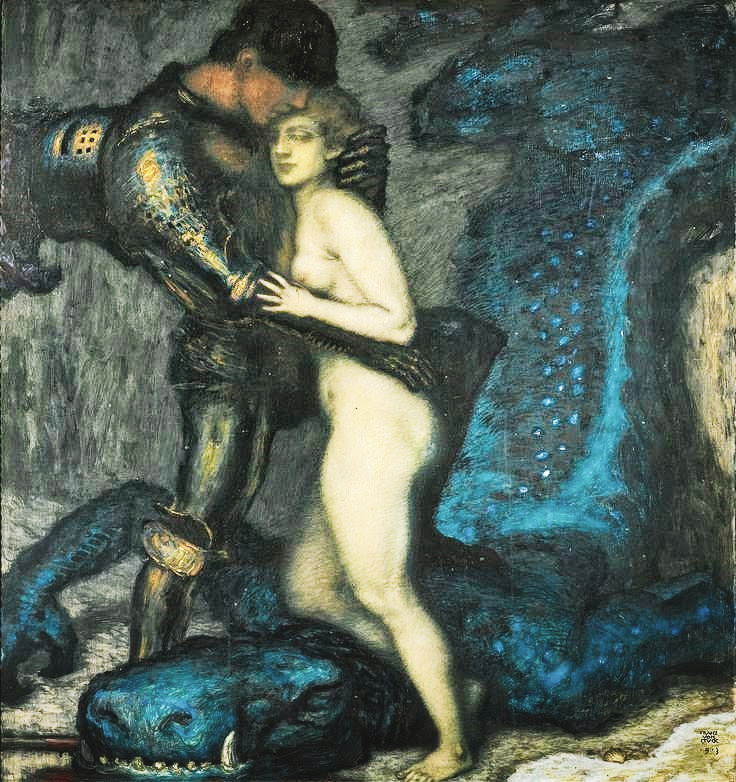
THE DRAGON SLAYER
Oil on panel
135 by 126cm., 53¼ by 49½in

The Dragon Slayer is a particularly charged rendition of an age-old theme. Although most of Stuck's paintings depict scenes from the Antique or the Bible, neither the title The Dragon Slayer nor the iconography reveal the exact story behind the present work. Stuck's fascination with Greek legends suggests the subject to be Perseus and Andromeda, although Medusa's head and Perseus's winged shoes are missing. As early as 1900 Stuck’s contemporary, Lovis Corinth (lots 3, 4 & 5), had painted the hero as a medieval knight rather than a Greek half-god, and his Perseus and Andromeda may have been a possible source of inspiration for the present work. Another obvious influence would have been the biblical story of St. George, who kills the dragon to save a virgin. More

Franz von Stuck, (1863-1928)
Sphinx, c. 1904
83 × 157 cm
Oil on canvas
Hessisches Landesmuseum, Darmstadt, Germany

In ancient times, the Sphinx was depicted with a lion's body and wings: only the head was human. Over the years, artists have depicted the Sphinx as a woman. This sexualisation probably reached its peak at the time of the Symbolist Gustave Moreau who made the Sphinx as a young princess with a tiara and jewelry and gave it an aura purity. Franz Von Stuck's Sphinx became full woman, carrying her head high, and proud of his nature. More

Franz Von Stuck 1863 -1928 |  Il bacio della Sfinge, 1895
Franz von Stuck
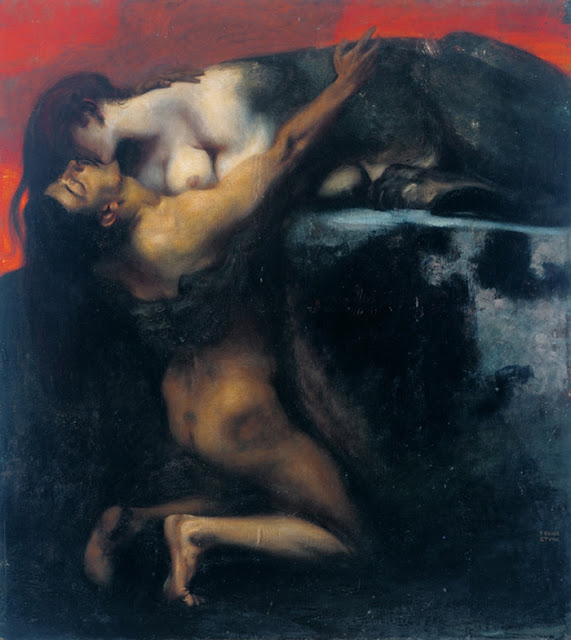
The Kiss of the Sphinx, c. 1895
Oil on canvas

In The Kiss of the Sphinx, the Sphinx is a woman who fully enjoys her sexuality, she is no longer hybrid monster, but seductress. Franz Von Stuck does not paint a fragile woman and a victim of his flesh, instead, by a dark romanticism, he painted the a woman who delights in her wickedness. Her proud posture dominate the men that come to meet her, exhibiting her chest as captious bait. More

Franz von Stuck
The Kiss of the Sphinx, c. 1905
Oil on canvas
160 cm (62.99 in.), Width: 144.8 cm (57.01 in.)
Museum of Fine Arts - Budapest (Hungary)

It is difficult to tell whether the Sphinx is kissing or devouring her male victim. His vulnerability and surrender, and her sexual aggression, are a marked reversal of traditional gender roles at the time, yet also display a fear of female sexuality. More

Franz von Stuck (1863–1928)
Kiss of a Sphinx
Pastel
Hermitage Museum - St-Petersburg (Russia)

Having attained much fame by this time, Stuck was ennobled on December 9, 1905 and would receive further public honours from around Europe during the remainder of his life. He continued to be well respected among young artists as professor at the Munich Academy, even after his artistic styles became unfashionable. Notable students of his over the years include Paul Klee, Hans Purrmann, Wassily Kandinsky, Alf Bayrle and Josef Albers.

Franz von Stuck, (1863-1928)
The Murderer, c. 1891
47 x 46 cm
Oil on canvas
I have no further description, at this time

Inspired by  Arnold Bocklin's painting, Murderer pursued by Furies, but with an even greater sense of excitement and drama, in 1891 Stuck painted his first version of the despair and remorse which pursue a criminal after his deed. The ancient Furies, the goddesses of vengeance, hide behind a rock as they lie in wait for the murderer who has just killed his victim. The sight of these ugly creatures is a foretaste of the torments awaiting the murderer. The figure of the murderer is derived from Klinger's etching 'Pursuit' in which a man in a similar pose runs away on a narrow path. More on this painting

Franz von Stuck died on August 30, 1928 in Munich; his funeral address memorialized him as "the last prince of art of Munich's great days". He is buried in the Munich Waldfriedhof next to his wife Mary.


Please visit my other blogs: Art CollectorMythologyMarine ArtPortrait of a Lady, The OrientalistArt of the Nude and The Canals of VeniceMiddle East Artists365 Saints and 365 Days, also visit my Boards on Pinterest

Images are copyright of their respective owners, assignees or others. Some Images may be subject to copyright

I don't own any of these images - credit is always given when due unless it is unknown to me. if I post your images without your permission, please tell me.

I do not sell art, art prints, framed posters or reproductions. Ads are shown only to compensate the hosting expenses.

If you enjoyed this post, please share with friends and family.

Thank you for visiting my blog and also for liking its posts and pages.

Please note that the content of this post primarily consists of articles available from Wikipedia or other free sources online.

11 Works:19th Century European Artists: Franz von Stuck, Carl Larsson, Maksymilian Gierymski, Leo Putz, Joaquín Sorolla, Wilhelm Kray, Maximilian Lenz, Andreas Schelfhout, George Hendrik Breitner, Auguste Léveque, Diyarbakirli Tahsin

Franz von Stuck, 1863 - 1928, GERMAN
THE DRAGON SLAYER, c. 1913
Oil on panel
135 by 126cm., 53¼ by 49½in
Private collection

Thee Dragon Slayer is a particularly charged rendition of an age-old theme. Although most of Stuck's paintings depict scenes from the Antique or the Bible, neither the title The Dragon Slayer nor the iconography reveal the exact story behind the present work. Stuck's fascination with Greek legends suggests the subject to be Perseus and Andromeda, although Medusa's head and Perseus's winged shoes are missing. As early as 1900 Stuck’s contemporary, Lovis Corinth (lots 3, 4 & 5), had painted the hero as a medieval knight rather than a Greek half-god, and his Perseus and Andromeda may have been a possible source of inspiration for the present work. Another obvious influence would have been the biblical story of St. George, who kills the dragon to save a virgin. More on Thee Dragon Slayer

Franz Stuck (February 23, 1863 – August 30, 1928) was a German painter, sculptor, engraver, and architect. Born at Tettenweis near Passau, Stuck displayed an affinity for drawing and caricature from an early age. To begin his artistic education he relocated in 1878 to Munich, where he would settle for life. From 1881 to 1885 Stuck attended the Munich Academy.

In 1889 he exhibited his first paintings at the Munich Glass Palace, winning a gold medal for The Guardian of Paradise. In 1892 Stuck co-founded the Munich Secession, and also executed his first sculpture, Athlete. The next year he won further acclaim with the critical and public success of what is now his most famous work, the painting The Sin. Also during 1893, Stuck was awarded a gold medal for painting at the World's Columbian Exposition in Chicago, and was appointed to a royal professorship. In 1895 he began teaching painting at the Munich Academy.
Having attained much fame by this time, Stuck was ennobled on December 9, 1905 and would receive further public honours from around Europe during the remainder of his life. He continued to be well respected among young artists as professor at the Munich Academy, even after his artistic styles became unfashionable. More on Franz von Stuck


Carl Larsson, 1853 - 1919, SWEDISH
THE LETTER, c. 1885
Oil on panel
45 by 54cm., 17¾ by 21¼in.
Private collection

Painted in September 1885, the present work captures all the delightful light-filled incident to be found in the drawing room in Lilla Hyttnäs in Sundborn, the cottage occupied at the time by Karin Larsson’s two great-aunts Ulla and Maria. The oil marks Carl Larsson’s first visit to the property, his and Karin's home-to-be, and records the traditional interior that he found there.
The prevailing style reflects the Gustavian taste of the day, as evident in the mahogany drawers and bureau, while Ulla, beautifully presented in her finely tailored dress, is perched on one of two Gustavian chairs engrossed in reading a letter, itself a traditional compositional pose. More on this painting

Maksymilian Gierymski, 1846-1874, POLISH
POLISH MILITIAMEN, c. 187[?]
Oil on canvas laid on panel
48 by 80cm., 19 by 31½in.
Private collection

Painted circa 1872, the present work was inspired both by Maksymilian Gierymski’s personal experience as a Polish insurgent fighting the Russian forces in the January Uprising of 1863,  and by the landscapes of  his homeland, which he revisited with his brother Aleksander in the summers of 1870-72.
Gierymski was a Munich-based painter and draughtsman, and together with Jozef Brandt and his younger brother Aleksander one of the greatest  Polish representatives of the so-called Munich school. He was a precursor of realism in Polish painting of the second half of the 19th century, an artist capable of finding beauty and poetry in the everyday prose of life and the mundane reality of provincial towns, often depicting autumn or winter landscapes or village scenes that constituted backgrounds for tired soldiers passing through them, as in the present work. More
Leo Putz, 1869 - 1940, GERMAN
BACKSTAGE, c. 1905
Oil on canvas
207 by 226cm., 81½ by 89in.
Private collection
Painted in 1905, this monumental early work of cancan dancers at ease backstage is among Putz's most ambitious compositions.

Inspired by his stay in Paris, Backstage is a masterful evocation of the French capital's demi-monde that was the source of fascination to so many painters, most famously Toulouse Lautrec. Putz would have frequented Pigalle's many cabarets and café concerts, including the Moulin Rouge, Moulin de la Galette and the Folies Bergère, which were synonymous with the dancers like La Goulue (Louise Weber) and Jane Avril who performed there. More on this painting
Leo Putz (18 June 1869, in Merano – 21 July 1940, in Merano) was a Tyrolean painter. His work encompasses Art Nouveau, Impressionism and the beginnings of Expressionism. Figures, nudes and landscapes are his predominant subjects.
He began his studies at the age of sixteen at the Academy of Fine Arts Munich. His father then sent him to the Académie Julian in Paris. After military service, he returned to Munich and studied with Paul Hoecker. He opened his first studio in 1897. That same year, he became a member of the Munich Secession. He worked with the weekly magazine Jugend and many of his paintings were reproduced on the magazine's title page. During this time, he also worked as a commercial artist, creating many posters in Art Nouveau style and billboards for the Moderne Galerie München.
He became an honorary citizen of Bavaria in 1909; a prerequisite for becoming a Professor, which appointment he received that same year. Between 1909 and 1914, he spent his summers at Schloss Hartmannsberg near Chiemgau to practice plein-air painting. It was there that he created his best-known works; the two series known as the "Boat Pictures" and the "Bathers". 
He accepted an invitation to move to Brazil in 1929. At the request of Lúcio Costa, he took a professorship at the Escola Nacional de Belas Artes in 1931. During his stay, his colors took on a more tropical flavor and the exotic plant life became a favorite subject.  He returned to Germany in 1933.
He became an opponent of National Socialism and his art was labelled "degenerate". Beginning in 1936, he was repeatedly interrogated by the Gestapo and was forced to flee back to his native region, the South Tyrol. In 1937, he was officially banned from working in Germany. For the remainder of his life, he concentrated on painting castles, villages and benign landscapes.
He died in 1940. More on Leo Putz 

Joaquín Sorolla, 1863 - 1923, SPANISH
RECOGIENDO LA BARCA, PLAYA DE VALENCIA (THE RETURN OF THE BOAT, VALENCIA BEACH), c. 1909
Oil on canvas
16 by 24cm., 6¼ by 9½in.
Private collection

Joaquín Sorolla y Bastida (27 February 1863 – 10 August 1923) was born in Valencia. He and his younger sister were orphaned 2 years later when both their parents died from a cholera outbreak.

From an early age it was clear that Sorolla had a passion for art. Instead of academic study, the young Sorolla would spend his school days making drawings in his copybooks and by the age of 15 he was winning major prizes for his paintings at the Academy of Valencia.

By his mid 20s Sorolla had firmly established himself on the national stage and by 30 he had displayed paintings in salons and international exhibitions in Madrid, Paris, Venice, Munich, Berlin, and Chicago. By the turn of the century Sorolla was recognised as one of the western world’s greatest living artists, receiving gold medals in several major international exhibitions.

Over the first decade of the 20th century Sorolla’s output was incredible, both in quality and quantity. As well as painting many striking portraits, his new found wealth enabled him to devote himself more fully to painting where and what he wanted. Throughout this decade Sorolla was completing hundreds of paintings each year, often canvases of 2 metres or more painted direct on the beach.

In 1909, the Hispanic Society of America hosted an exhibition of Sorolla’s works in New York City. Of the 356 paintings on show a total of 195 were sold.

In 1911 Sorolla started work on a major commission to produce a series of vast panels celebrating the life and customs of the different regions of Spain for the Hispanic Society’s new headquarters in New York. This enormous and exhausting endeavour was to dominate the next 8 years of Sorolla's life, although he still managed to find time to paint some of his most stunning beach scenes.

Sorolla suffered a paralyzing stroke in 1920 and died three years later. More on Joaquín Sorolla 

Wilhelm Kray, 1828 - 1889, GERMAN
THE SIRENS, c. 1874
Oil on canvas
91.5 by 133.5cm., 36 by 52½in.
Private collection

According to Greek myths, sirens were powerful and erotic creatures, and many unsuspecting sailors would fall prey to their seductive beauty. The common belief was that they would devour sailors after their ships would crash into the rocks, as most men couldn't resist the temptation of their sweet melodies and angelic faces. More on The Fisherman and The Siren

Wilhelm Kray ( December 29, 1828 in Berlin – July 29, 1889 in Munich ) was a German portrait , genre and landscape painter and illustrator .

Kray worked as a goldsmith before 1848 . From 1848 he studied at the Royal Prussian Academy of Arts in Berlin with Julius Schrader , Wilhelm Schirmer and Hermann Stilke . Between 1856 and 1872 he took part in the Berlin Academy exhibitions. In 1859/60 he was in Paris and visited the studio of Alexandre Cabanel and Paul Baudry . He then went back to Berlin, where he mainly worked as a portraitist. From 1867 to 1871 Kray was based in Rome. From there he made numerous trips to Naples. He became a member of the Deutscher Künstlerverein.  From 1878 he lived inVienna and took part in the international art exhibitions in the Munich Glass Palace from 1879 to 1888 . More on Wilhelm Kray

Maximilian Lenz, 1860-1948, AUSTRIAN
GODDESS IDUNA AND PEACOCK, c. 1932
Oil on canvas
88 by 212cm., 34¾ by 83½in.
Private collection

Iduna, or Iðunn, is the god in Norse mythology associated with fertility and youth. As here, she is typically depicted bearing apples. More

Andreas Schelfhout
1787 - 1870
DUTCH
COASTAL VIEW NEAR SCHEVENINGEN
signed A. Schelfhout lower right
oil on canvas
35.5 by 46cm., 14 by 18in.

George Hendrik Breitner
1857 - 1923
DUTCH
BUILDING SITE IN AMSTERDAM
signed G. H. Breitner lower right
oil on canvas
49 by 71cm., 19¼ by 28in.

Auguste Léveque
1864-1921
BELGIAN
BACCHANTES ENDORMIES
signed Levêque lower right
oil on canvas
82.5 by 132cm., 32½ by 52in.

Diyarbakirli Tahsin
1875-1937
TURKISH
BATTLESHIPS ON HIGH SEAS
signed Tahsin and in Arabic and dated 1919 lower right
oil on canvas
81 by 126.5cm., 32 by 49¾in.