10 Works, January 31 the anniversary of The Gunpowder Plot of 1605, or the Jesuit Treason

The Gunpowder Plot of 1605, or the Jesuit Treason, was a failed assassination attempt against King James I of England and VI of Scotland by a group of provincial English Catholics led by Robert Catesby.

Ernest Crofts, R.A. (1847-1911)
On the track of a fugitive, c. 1910
oil on canvas
48 x 36 in. (121.9 x 91.4 cm.)
Private collection

Ernest Crofts (15 September 1847 – 19 March 1911) was a British painter of historical and military scenes. Born in Leeds, Ernest studied at Rugby School, for several years, and then headed to Berlin where he developed his interest in art and decided upon a career as a painter. His first acquaintance with war was made in 1864 when he accompanied a Prussian doctor in the Schleswig-Holstein War, and the operations around Düppel.

He returned to London and became a pupil under A. B. Clay, but was back in Germany a few years later, this time in Düsseldorf which was the center for historical painting in Europe. In 1874, he exhibited Retreat, representing an episode in the Franco-Prussian War during the Battle of Gravelotte, and in the same year, another scene from the same conflict, One touch of nature makes the whole world kin which won him the Crystal Palace prize medal.
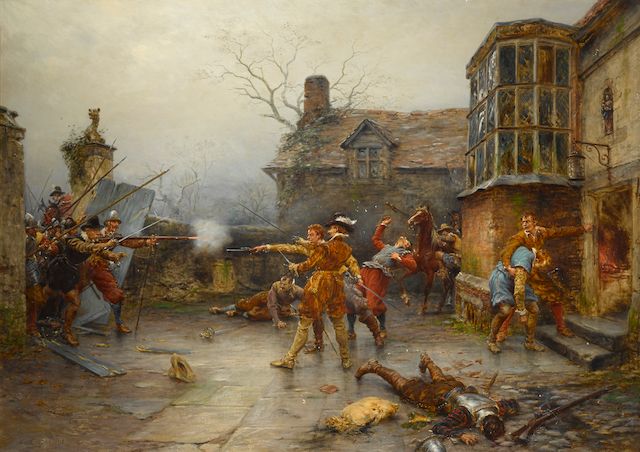
Ernest Crofts, RA (British, 1847-1911) The Gunpowder Plot: the conspirators' last stand at Holbeach House 51 x 72in (129.5 x 182.8cm)
Ernest Crofts, RA (British, 1847-1911)
The Gunpowder Plot: the conspirators' last stand at Holbeach House, c. 1892
Oil on canvas
51 x 72in (129.5 x 182.8cm)
Private collection

This painting depicts the last stand of the gunpowder plot conspirators at Holbeche House, near Dudley in Staffordshire. It is the smaller version of a larger exhibition piece that was shown at the Royal Academy in 1892. Artists often produced a smaller version of a work prior to committing it to a larger scale. More on this painting

Ernest Crofts was elected an Associate of the Royal Academy of Arts on 19 July 1878, the year that his picture, Wellington on his march from Quatre Bras to Waterloo was shown. The artist walked and sketched much of the area around the battlefield of Waterloo. In 1896, he was elected a full academician of the Royal Academy, and his Diploma Work, a Civil War scene, was entitled To the Rescue. Two years later he succeeded Philip Calderon as keeper and trustee of the RA. He was in effect chief director of the academy art schools as well as chief custodian of the Diploma Galley.

In 1901 the king commissioned him to paint a picture of the distribution of the war medals following the Boer War. Two years later, he painted a large scene of the funeral of Queen Victoria. One of his most ambitious works was the panel in the ambulatory of the Royal Exchange which portrayed Queen Elizabeth opening the first Royal Exchange in 1571. 

The artist died of pneumonia at Burlington House on 19 March 1911. More on Ernest Crofts

Crispijn van de Passe the Elder, (c.1564, Arnemuiden - buried 6 March 1637, Utrecht)
The craftsmen of the Gunpowder Plot
National Portrait Gallery

Crispijn van de Passe the Elder, (c.1564, Arnemuiden - buried 6 March 1637, Utrecht) was a Dutch publisher and engraver and founder of a dynasty of engravers. Most of their engravings were portraits, book title-pages, and the like, with relatively few grander narrative subjects. As with the other dynasties, their style is very similar, and hard to tell apart in the absence of a signature or date, or evidence of location. Many of the family could produce their own designs, and have left drawings.

Crispijn van de Passe I was born in Arnemuiden in Zeeland, and trained and worked in Antwerp, then the centre of the printmaking world, with hugely productive workshops. By 1585 he was a member of the artists' Guild of Saint Luke, and doing work for Christopher Plantin. The disruptions of the Dutch Revolt scattered these artists across Northern Europe; de Passe was an Anabaptist, which made his position especially difficult. He first moved to Aachen, until Protestants were also expelled from there. He started his own engraving and publishing business in Cologne in 1589, but again was forced to leave in 1611. He set up in business in Utrecht, by about 1612, where he created engravings for the English and other markets, and where he died in 1637. His works include a famous rendition of the English Gunpowder Plotters, although it is not known what basis he had for the likenesses. More on Crispijn van de Passe the Elder

The plan was to blow up the House of Lords during the State Opening of England's Parliament on 5 November 1605, as the prelude to a popular revolt in the Midlands during which James's nine-year-old daughter, Princess Elizabeth, was to be installed as the Catholic head of state. Catesby may have embarked on the scheme after hopes of securing greater religious tolerance under King James had faded, leaving many English Catholics disappointed. His fellow plotters were John Wright, Thomas Wintour, Thomas Percy, Guy Fawkes, Robert Keyes, Thomas Bates, Robert Wintour, Christopher Wright, John Grant, Ambrose Rookwood, Sir Everard Digby and Francis Tresham. Fawkes, who had 10 years of military experience fighting in the Spanish Netherlands in suppression of the Dutch Revolt, was given charge of the explosives.

Henry Perronet Briggs (1793–1844)
The Discovery of the Gunpowder Plot and the Taking of Guy Fawkes, circa 1823
Oil on canvas
149 × 199 cm (58.7 × 78.3 in)
Laing Art Gallery,  Newcastle upon Tyne, United Kingdom

Henry Perronet Briggs RA (1793 – 18 January 1844) was an English painter of portraits and historical scenes. Hewas born at Walworth, County Durham. While still at school at Epping he sent two engravings to the "Gentleman's Magazine" and in 1811 entered as a student at the Royal Academy, London, where he began to exhibit in 1814. From that time onwards until his death he was a constant exhibitor at the annual exhibitions of the Academy, as well as the British Institution, his paintings being for the most part historical in subject. After his election as a Royal Academician (RA) in 1832 he devoted his attention almost exclusively to portraiture. More on Henry Perronet Briggs

The plot was revealed to the authorities in an anonymous letter sent to William Parker, 4th Baron Monteagle, on 26 October 1605. During a search of the House of Lords at about midnight on 4 November 1605, Fawkes was discovered guarding 36 barrels of gunpowder—enough to reduce the House of Lords to rubble—and arrested. 

Embleton, Ron (1930-88)
The Gunpowder Plot
Catholic conspirators attempting to blow up the Houses of Parliament in 1605
Gouache on paper
Private Collection

Ronald Sydney Embleton (6 October 1930 – 13 February 1988) was a British illustrator who gained fame as a comics artist. In the 1950s and 1960s, Embleton also pursued a career as an oil painter, and he exhibited his works widely in Britain, Germany, Australia, Canada and the USA. He was a member of the London Sketch Club and the National Society of Painters, Sculptors and Printmakers, and in 1960 was elected a member of the Royal Institute of Oil Painters.

Following Embleton's death at age 57, his obituary in The Times described him as "responsible for some of the finest full-colour adventure series in modern British comics ... a grandmaster of his art." David Ashford and Norman Wright, writing in Book and Magazine Collector (March 2002), note that "his work for such diverse periodicals as Express Weekly, TV Century 21, Princess, Boys' World, and Look and Learn have earned him the respect of every practitioner in the field and the gratitude of all of us who admire the art of the comic strip." More on Ronald Sydney Embleton

Charles Gogin (1844–1931)
Guy Fawkes, c. 1870
Oil on cardboard
40.5 x 57.2 cm
York Museums Trust

Sir John Gilbert (1817 - 1897)
Guy Fawkes before King James, c. (1869-70)
90 x 52 cm (35,4 x 20,4 inches)
Watercolour on paper
Harrogate Museums and Art Gallery, North Yorkshire

Sir John Gilbert RA (21 July 1817 – 5 October 1897) was an English artist, illustrator and engraver.

Gilbert was born in Blackheath, Surrey, and taught himself to paint. His only formal instruction was from George Lance. Skilled in several media, Gilbert gained the nickname, "the Scott of painting". He was best known for the illustrations and wood-engravings he produced for the Illustrated London News.

Gilbert was initially apprenticed to a firm of estate agents, but taught himself art by copying prints. He was unable to enter the Royal Academy Schools, but mastered watercolour, oils, and other media. From 1836 he exhibited at the Society of British Artists, and at the RA from 1838. Starting with Punch, he moved on to the Illustrated London News. He designed an impressive number of wood-engravings (over 2000) for that publication and for The London Journal. He also produced many illustrations for books. He became president of the Royal Watercolour Society in 1871. He exhibited some 400 pictures in watercolour and oil exhibited at the various societies. In 1872 he was knighted. He became an RA in 1876, in the same year as Edward John Poynter. More on John Gilbert

After Sir John Gilbert

Guy Fawkes (1570-1606), GUNPOWDER PLOT, 1605 being interrogated by King James I and his council in the King's bedchamber at Whitehall, following discovery of the 'Gunpowder Plot' to blow up the Houses of Parliament, 5 November 1605. 
Wood engraving, 1861

Ronald Sydney Embleton 
The Gunpowder Plot Guy Fawkes interrogated by James I
43.1 x 29.3 cm | 17 x 11.5 inches
The London Picture Archive

Most of the conspirators fled from London as they learned of the plot's discovery, trying to enlist support along the way. Several made a stand against the pursuing Sheriff of Worcester and his men at Holbeche House; in the ensuing battle Catesby was one of those shot and killed. At their trial on 27 January 1606, eight of the survivors, including Fawkes, were convicted and sentenced to be hanged, drawn and quartered.

Ronald Sydney Embleton (6 October 1930 – 13 February 1988) was a British comics artist and illustrator whose work was much admired by fans and editors alike. David Ashford and Norman Wright, writing in Book and Magazine Collector (March 2002) note that "his work for such diverse periodicals as Express Weekly, TV Century 21, Princess, Boy's World and Look and Learn have earned him the respect of every practitioner in the field and the gratitude of all of us who admire the art of the comic strip." More on Ronald Sydney Embleton

Claes (Nicolaes) Jansz Visscher
The PUNISHMENT, c. 1606
The Execution of the Conspirators in the Gunpowder Plot
Etching
9 1/4 in. x 13 1/2 in. (235 mm x 342 mm) 
National Portrait Gallery, London

Details of the assassination attempt were allegedly known by the principal Jesuit of England, Father Henry Garnet. Although he was convicted of treason and sentenced to death, doubt has been cast on how much he really knew of the plot. As its existence was revealed to him through confession, Garnet was prevented from informing the authorities by the absolute confidentiality of the confessional. Although anti-Catholic legislation was introduced soon after the plot's discovery, many important and loyal Catholics retained high office during King James I's reign. The thwarting of the Gunpowder Plot was commemorated for many years afterwards by special sermons and other public events such as the ringing of church bells, which have evolved into the Bonfire Night of today. More on The Gunpowder Plot

The traditional death for traitors in 17th-century England was to be hanged from the gallows, then drawn and quartered in public. But, despite his role in the Gunpowder Plot - which the perpetrators hoped would kill King James and as many members of parliament as possible - it was not to be Fawkes's fate.

As he awaited his grisly punishment on the gallows, Fawkes leapt to his death - to avoid the horrors of having his testicles cut off, his stomach opened and his guts spilled out before his eyes. He died from a broken neck.

His body was subsequently quartered, and his remains were sent to "the four corners of the kingdom" as a warning to others. More on The traditional death for traitors

Claes Janszoon Visscher (1587 – 19 June 1652) was a Dutch Golden Age draughtsman, engraver, mapmaker, and publisher. He was the founder of the successful Visscher family mapmaking business. The firm that he established in Amsterdam would be passed down his generations until it was sold to Peter Schenk.

Visscher, who was born and died in Amsterdam, was also known as Nicolas Joannes Piscator or Nicolas Joannis Visscher II. He learned the art of etching and printing from his father, and helped grow the family printing and mapmaking business to one of the largest in his time. The times were with the Visschers for other reasons; due to the Protestant reformation, the older Bibles with their "Roman Catholic" illustrations were seen as outdated and apocryphal, but to liven up the new Protestant Bibles for the less well-read clergy, the Visschers produced illustrated maps and even landscapes of the places in the Bible. 

Aside from Bibles, Claes Visscher II primarily etched and published landscapes, portraits, and maps. He etched over 200 plates and his maps included elaborate original borders. Visscher died in 1652. More on Claes Janszoon Visscher


Please visit my other blogs: Art Collector, Mythology, Marine Art, Portrait of a Lady, The Orientalist, Art of the Nude and The Canals of Venice, Middle East Artists, 365 Saints and 365 Days, also visit my Boards on Pinterest

Images are copyright of their respective owners, assignees or others. Some Images may be subject to copyright

I don't own any of these images - credit is always given when due unless it is unknown to me. if I post your images without your permission, please tell me.

I do not sell art, art prints, framed posters or reproductions. Ads are shown only to compensate the hosting expenses.

If you enjoyed this post, please share with friends and family.

Thank you for visiting my blog and also for liking its posts and pages.

Please note that the content of this post primarily consists of articles available from Wikipedia or other free sources online.


17 Works of Chinese Antique Ivory

Pair of Chinese Antique Ivory Figures of a Royal Couple, Qing Dynasty (1644-1911), the emperor and empress each on an octagonal raised base, and wearing a large crown inlaid with lapis, turquoise and coral, the underside of each base bearing a four-character mark in a square cartouche, with carved wooden stands, ivory, h. 28", overall, h. 30-1/2", w. 6-1/2".

Chinese Antique Ivory Carving of a Peacock Perched on a Rock, Qing Dynasty (1644-1911), 19th century, set among pine branches and blooming peonies, marking on the underside, 15-1/4" x 4-3/4". With a carved and pierced wooden stand.

Chinese Carved Antique Ivory Group, Qing Dynasty (1644-1911), the carriage with a canopy conveying an empress, with a seated coachman and two horses, displayed on a custom-fitted carved wooden stand, ivory, h. 10-3/8", l. 12-3/4", overall, h. 11-3/4".

Chinese Antique Carved Ivory Figure of Guanyin, Qing Dynasty (1644-1911), the seated figure holding a bottle in its left hand, affixed to the pierced and carved wooden stand, ivory, h. 6-1/4", w. 3-1/2", overall, h. 8-1/2".

Pair of Chinese Antique Ivory Figures, Qing Dynasty (1644-1911), the two carved figures, one male and one female, each seated beneath a fruit-laden peach tree, a child depicted climbing up each tree handing the ripe peaches to the figure seated below, each marked on the underside with four characters and in a square cartouche, displayed on reticulated wooden stands, figure, h. 13-3/4", w. 4-5/8".

Significant Chinese Antique Ivory Figural Group, Qing Dynasty (1644-1911), depicting a scene from the Chinese literary masterwork Dream of the Red Chamber, by Cao Xueqin (1715-1763), affixed to a wooden base inlaid with phoenixes, with a plexiglass bonnet, ivory, h. 16", w. 13-3/4", l. 32-1/4", bonnet, h. 21-1/4". In the chapter depicted, the novel's primary protagonist, Jia Baoyu, attends the meeting of his sister, Jia Tanchun's poetry club. The ladies are writing poems about chrysanthemums and dining on fish, crabs and other delicacies. Jia Baoyu's wife Xue Baochai, writes a satirical verse on the subject of eating crabs. In the ivory vignette, the figure of Xue Baochai holds her poem out over the table. Jia Baoyu stands before a screen flanked by two finely carved reticulated lanterns. The terrace is fitted with such fineries associated with classical Chinese aristocracy as archaic bronzes, fine porcelains, supplies for writing and scholar's rocks.

Chinese Antique Ivory Carving, Qing Dynasty (1644-1911), carved depicting the emperor and ladies of the imperial court reveling in an elegant mountain pavilion, flanked by willow and pine trees overlooking a lotus pond, h. 10", w. 4-3/4".

Pair of Chinese Carved Antique Ivory Immortals, Qing Dynasty (1644-1911), the female example holding a child and peony stem, a phoenix with another child on its back standing beside her, the male example of an elderly sage holding a bough of the peaches of longevity, a dragon with a child on its back standing beside him, each affixed to a tiered wooden base, ivory, h. 45", w. 6", overall, h. 50", w. 12", wt. approx 40 lbs each.

Pair of Chinese Antique Ivory Carved Tusks, Qing Dynasty (1644-1911), each tusk decorated with a reticulated and finely rendered depiction of immortals in mountain forests, carefully carved in the round, with carved wooden stands, tusk, h. 14", w. 3-3/4".

Chinese Antique Ivory Canton Village Scene, Qing Dynasty (1644-1911), intricately carved and finely articulated with a scene of a mountain village with figures, horses and buildings set among trees, displayed on a carved and molded wooden stand, ivory, h. 7-3/4", l. 15", overall, h. 9", l. 16-1/4".

Chinese Carved Antique Ivory Tusk, Qing Dynasty (1644-1911), carved with dragons with red inlaid eyes, set among ruyi clouds, the tusk base inscribed with a Qianlong reign (1736-1795) mark in an oval cartouche, on a pierced and carved wooden stand, ivory, h. 24", w. 5-1/2", l. 80" along the curve, l. 57" tip to tip, overall, h. 33-1/4", wt. 51.2 lbs.

Chinese Carved Antique Ivory Ewer, Qing Dynasty (1644-1911), in the form of a standing phoenix with a meiping vase on its back, the vase surmounted with a lid with two rings, the phoenix carved with a scrolling floral decoration and reserves of the ewer adorned with dragons, a four-character mark on the underside of the vessel, h. 20-3/8", w. 5-1/8", l. 12".

Chinese Carved Antique Ivory Vase, Qing Dynasty (1644-1911), the intricately carved large vessel covered with a scrolling floral motif and reserves depicting the immortals around the body of the vessel, with two taotie lugs on the neck of the vase, each with a suspended ring, the underside with a four-character Qianlong mark, h. 20", w. 6".

Pair of Chinese Antique Ivory Urns, the pair of elaborately carved urns with dragon and ruyi cloud panels on the sides of each vessel, each urn with a pair of taotie lugs with a suspended ring, the lids topped with a dragon finial, displayed with carved wooden stands, urn, h. 17", w. 3-3/8".

Monumental Pair of Chinese Antique Ivory Palace Urns, Qing Dynasty (1644-1911), each of the two tiled decorative vessels with ruyi scepter handles and foo dog lugs, decorated with floral scrollwork, phoenixes, dragons and auspicious characters, with reserves on the body of each vessel depicting sages with mythical animals and groups of immortals, the lids topped with a figure of Guanyin, the goddess of mercy, astride an elephant, the pachyderm inlaid with lapis, coral and turquoise, and the lids marked with the goddess' name, each with a carved wood stand, vase, h. 62", overall, h. 68", w. 13", d. 17".


Images are copyright of their respective owners, assignees or others. Some Images may be subject to copyright

I do not sell art, art prints, framed posters or reproductions. Ads are shown only to compensate the hosting expenses.


If you enjoyed this post, please share with friends and family.


Acknowledgment: Invaluable

A Pictorial History of Jerusalem

A city called RuÅ¡alim in the Execration texts of the Middle Kingdom of Egypt (19th century BCE) is identified as Jerusalem. Jerusalem was then called UruÅ¡alim in the Amarna letters of Abdi-Heba (1330s BCE). The name "Jerusalem" is variously etymologized to mean "foundation of the god Shalem", the original tutelary deity of the city.


The ambitious Ophel excavation in Jerusalem has produced many finds, but precious little before the tenth century BC

Ceramic evidence indicates occupation of Jerusalem, as far back as the Copper Age (c. 4th millennium BCE), with evidence of a permanent settlement during the early Bronze Age (c. 3000–2800 BCE). It was founded by Northwest Semitic people with organized settlements from around 2600 BCE.


Details labeled on a model of the ancient city of Salem (Jerusalem) or the city David took from the Jebusites to establish as the center of his kingdom.

In the late Bronze Age, Jerusalem was the capital of an Egyptian vassal city-state, a modest settlement governing a few outlying villages and pastoral areas, with a small Egyptian garrison and ruled by appointees such as king Abdi-Heba. At the time of Seti I and Ramesses II, major construction took place as prosperity increased.


This period, when Canaan formed part of the Egyptian empire, Jerusalem is defined as lying within territory allocated to the tribe of Benjamin though occupied by Jebusites. David is said to have conquered these in the Siege of Jebus, and transferred his capital from Hebron to Jerusalem. 


Jerusalem is one of the oldest continuing cities in the world. There were people living there as early as the 4th millennium BC, but the fortress/city began to be famous after David captured it and made it his capital. During its long history, Jerusalem has been destroyed at least twice, besieged 23 times, attacked 52 times, and captured and recaptured 44 times.


King David reigned for 40 years. He died about 970 BCE. Jerusalem became the capital of a united Kingdom of Israel. During his reign, David had been too busy with court intrigue and hard-fought battles to think about renovating the city.

Jerusalem at the Time of David David’s City: 12–13 Acres Population: 2,400

His son was more ambitious. Solomon used Phoenician craftsmen and enforced labor to carry out the great construction program that resulted in the building of the First Temple and the palace in Jerusalem.


JERUSALEM:BIBLE ARCHITECTURE:Jerusalem as it was in the period from Solomon to Hezekiah


On Solomon's death, ten of the northern Tribes of Israel broke with the United Monarchy to form their own nations, kings, prophets, priests, traditions relating to religion, capitals and temples in northern Israel. The southern tribes, together with the Aaronid priesthood, remained in Jerusalem, with the city becoming the capital of the Kingdom of Judah, instead of th Kingdom of Israel.

During the  Judean kingdom renovations included Hezekiah's Tunnel, an aqueduct built by Judean king Hezekiah, the Broad Wall, a defensive fortification,  Monolith of Silwan, Tomb of the Royal Steward, and Israelite Tower. A huge water reservoir dating from this period was discovered in 2012 near Robinson's Arch, indicating the existence of a densely built-up quarter across the area west of the Temple Mount.

In 922BC the Egyptian pharaoh Sheshonk I led a raid into Judah, and sacked the city. He was followed in the next century by the Philistines and Arabs, and then in 786BC Joash of Israel invaded Judah and plundered the treasures of the Temple and the royal palace, and destroyed a number of newly built fortresses, and tore down part of the wall surrounding Jerusalem.


The First Temple period ended around 586 BCE, when the Babylonians conquered Judah and Jerusalem, laid waste to Solomon's Temple, and its king deported to Babylon. The long exile in Babylon began. 


JERUSALEM:BIBLE ARCHITECTURE: The city of Jerusalem in the Herodian period

During the Herodian period, Herod demolished everything that was there to build his temple and palace; built from Lebanese cedar, with a vestibule hall of columns, a throne room, residential quarters and a luxurious palace for the women of the harem. There would also have been extensive courtyards, onto which the palace rooms opened. The palace was quite independent of the city, with a high wall surrounding it. It was necessary to pass through a guard-house to enter it.

JERUSALEM:BIBLE ARCHITECTURE: A model of the city in King Herod's time. All available land would have been covered by buildings


In 538BC Cyrus II, founder of the Achaemenian dynasty of Persia, issued an order allowing the Jewish population to return to their homeland. The once magnificent city was a sorry sight. Nothing  remained but a few small buildings and a peasantry living in huts, where once there had been the Temple, palaces, houses and commercial buildings. 

Zerubbabel, of the house of David, began to rebuild Jerusalem. The Temple was restored by 515BC, and Jerusalem once more became the center of the new state. Its position was strengthened when Nehemiah restored the fortifications surrounding the city.

After the coming of Alexander the Great, Palestine was taken over by his marshal, Ptolemy I, who had occupied Egypt. In 198BC Jerusalem was taken over by the dynasty descended from Seleucus I, another of Alexander's marshal. In 167BC Antiochus IV desecrated the Temple, and a revolt against the Seleucid rulers broke out.  This revolt was led by the Maccabees, who were able to expel the Seleucids.

Jerusalem regained its position as the capital of an independent state, now ruled by the priestly Hasmonean family.

Rome had been expanding into the eastern Mediterranean, and in 63BC Pompey captured Jerusalem. By 40BC Herod, who had distinguished himself as governor of Galilee, was appointed a 'client king' of Judaea. During the reign of King Harold Jerusalem enjoyed its greatest period of greatness. The Temple Mount esplanade was enlarged with supporting walls (including the Western Wall, now called the Wailing Wall), the new Temple was built, and Jerusalem also acquired a Hellenistic amphitheater.

In 66AD the Jewish people rebelled against Rome and in 70AD the city was besieged and almost completely destroyed by the Roman forces under Titus. The Temple was reduced to ashes.


Jerusalem or the city of the Lord. This map was engraved by D.Nimmo and published by A . Fullarton & Co. The map was first published in 1835 by Samuel Arrosmith who was a bookseller in London. This publication is from 1840's. The city of Jerusalem is depicted as it would have looked at the time of Jesus. Prominently shown are the Temple mound, the hill of Zion and mount of Olives. Many other locations are depicted.The map is an original engraving on steel. More


History of the wall


More: Bible History, Bible Architecture, 

Images are copyright of their respective owners, assignees or others. Some Images may be subject to copyright

I do not sell art, art prints, framed posters or reproductions. Ads are shown only to compensate the hosting expenses.


If you enjoyed this post, please share with friends and family.

07 Photographs, Streets of Cairo & Ghizeh from the 17th &18 Century, Egypt, with footnotes

Francis Bedford, (1815-94)
The Sphinx, the Great Pyramid and two lesser Pyramids, Ghizeh, Egypt, 4 March 1862
Albumen print
23.1 x 29.5 cm
Acquired by King Edward VII when Prince of Wales, 1862
Royal Collection Trust, Her Majesty Queen Elizabeth II 2014

The Prince and his companions visited the pyramids on camels, which the Prince described as ‘not at all an unpleasant mode of conveyance’. They viewed the Sphinx just before sunset and decided to set up an encampment below the pyramids where they slept for the night in order to climb the Great Pyramid before sunrise the following day.

The Great Pyramid of Giza is the oldest and largest of the three pyramids in the Giza pyramid complex bordering what is now El Giza, Egypt. It is the oldest of the Seven Wonders of the Ancient World, and the only one to remain largely intact.

Based on a mark in an interior chamber naming the work gang and a reference to the fourth dynasty Egyptian Pharaoh Khufu, Egyptologists believe that the pyramid was built as a tomb over a 10- to 20-year period concluding around 2560 BC. Initially at 146.5 metres (481 feet), the Great Pyramid was the tallest man-made structure in the world for more than 3,800 years. Originally, the Great Pyramid was covered by limestone casing stones that formed a smooth outer surface; what is seen today is the underlying core structure. Some of the casing stones that once covered the structure can still be seen around the base. There have been varying scientific and alternative theories about the Great Pyramid's construction techniques. Most accepted construction hypotheses are based on the idea that it was built by moving huge stones from a quarry and dragging and lifting them into place. More on The Great Pyramid of Giza

Francis Bedford (1815 in London – 15 May 1894) was an English photographer. He began his career as an architectural draughtsman and lithographer, before taking up photography in the early 1850s.

He helped to found the Royal Photographic Society in 1853. In 1854, at Marlborough House Queen Victoria commissioned him to photograph objects in the royal collection.

Francis gave 'Lithographic Artist' as his profession. When the 1861 census was taken, Francis, now an 'Artist', was staying at a hotel in Peterborough. Ten years later he was living at 326 Camden Road, London. Francis now gave 'Photographic Artist' as his profession. He was still at the same address in 1881. More on Francis Bedford

Francis Frith, (1822-1898)
Illustrations of Egypt, ca.1870
Photograph

Francis Frith (also spelled Frances Frith, 7 October 1822 – 25 February 1898) was an English photographer of the Middle East and many towns in the United Kingdom.  Frith was born in Chesterfield, Derbyshire, attending Quaker schools at Ackworth and Quaker Camp Hill in Birmingham (ca. 1828–1838), before he started in the cutlery business. He suffered a nervous breakdown in 1843, recuperating over the next two years. In 1850 he started a photographic studio in Liverpool, known as Frith & Hayward. A successful grocer, and later, printer, Frith fostered an interest in photography, becoming a founding member of the Liverpool Photographic Society in 1853. Frith sold his companies in 1855 in order to dedicate himself entirely to photography. He journeyed to the Middle East on three occasions, the first of which was a trip to Egypt in 1856 with very large cameras (16" x 20"). He used the collodion process, a major technical achievement in hot and dusty conditions. More on Francis Frith

Pascal Sebah
The Sphynx
Photograph

The Great Sphinx of Giza: (The Terrifying One; literally: Father of Dread), commonly referred to as the Sphinx of Giza or just the Sphinx, is a limestone statue of a reclining sphinx, a mythical creature with the body of a lion and the head of a human. Facing directly from West to East, it stands on the Giza Plateau on the west bank of the Nile in Giza, Egypt. The face of the Sphinx is generally believed to represent the Pharaoh Khafre.

Cut from the bedrock, the original shape of the Sphinx has been restored with layers of blocks. It measures 73 metres (240 ft) long from paw to tail, 20.21 m (66.31 ft) high from the base to the top of the head and 19 metres (62 ft) wide at its rear haunches. It is the oldest known monumental sculpture in Egypt and is commonly believed to have been built by ancient Egyptians of the Old Kingdom during the reign of the Pharaoh Khafre (c. 2558–2532 BC). More on The Great Sphinx of Giza

Pascal Sébah (1823–1886) was a photographer in Constantinople (now Istanbul). He was born in Constantinople, then the capital of the Ottoman Empire, to a Syrian Catholic father and an Armenian mother. In 1857 he opened his first photography studio in Constantinople in the center of the city. By 1873 he was successful enough to open another studio in Cairo. He worked with Turkish painter Osman Hamdi Bey and exhibited at the 1873 Ottoman exhibition in Vienna, Austria.

After he died on 25 June 1886, the studio was managed by his brother Cosmi until Pascal's son, Jean Pascal Sébah, joined in 1888 and went on to run the studio. More on Pascal Sébah

Francis Frith, (1822-1898)
King Senefru Bent Pyramid at Dahshur, ca.1870
Photographic Illustrations of the Egypt

The Bent Pyramid, also known as the Rhomboidal or Blunted Pyramid, attests to an even greater increase in architectural innovations. As the name suggests, the angle of the inclination changes from 55° to about 43° in the upper levels of the pyramid. It is likely that the pyramid initially was not designed to be built this way, but was modified during construction due to unstable accretion layers. As a means of stabilising the structure, the top layers were laid horizontally, marking the abandonment of the step pyramid concept. More on the bent pyramid

Francis Frith, (1822-1898), see above

Francis Bedford, (1815-94) (photographer)
Mosque of Mehemet Ali [Mosque of Muhammad Ali, Cairo]
8 March 1862
Albumen print, mounted on card
24.8 x 29.5 cm
Acquired by the Prince of Wales (later King Edward VII), 1862
Royal Collection Trust, Her Majesty Queen Elizabeth II, 2014


The Great Mosque of Muhammad Ali Pasha or Alabaster Mosque is a mosque situated in the Citadel of Cairo in Egypt and commissioned by Muhammad Ali Pasha between 1830 and 1848.

Situated on the summit of the citadel, this Ottoman mosque, the largest to be built in the first half of the 19th century, is, with its animated silhouette and twin minarets, the most visible mosque in Cairo.

The mosque was built in memory of Tusun Pasha, Muhammad Ali's oldest son, who died in 1816.

This mosque, along with the citadel, is one of the landmarks and tourist attractions of Cairo and is one of the first features to be seen when approaching the city any direction. More on the Mosque of Muhammad Ali

Francis Bedford, (1815-94), see above

Unknown
View of the Tombs of the Memlook Kings, Cairo, Egypt
7.75 x 4.2 inches
From the collection of Dr Paula Sanders, Rice University

Francis Bedford, (1815-94) (photographer)
Tombs of the Memlooks at Cairo [Mausoleum and Khanqah of Emir Qawsun]
25 Mar 1862
Albumen print, mounted on card
24.1 x 29.0 cm
Acquired by the Prince of Wales (later King Edward VII), 1862
Royal Collection Trust/© Her Majesty Queen Elizabeth II 2014


ANOTHER of those picturesque but nameless mosque-tombs which are scattered over that part of the Desert which lies just without the walls of Cairo and forms its necropolis. Raised at a great cost by the caliph, or the bey for his tomb, it sometimes happened that he never rested there; but found in the utter want of protection for life and property under such governments as have cursed Egypt, a more ignoble and dishonoured grave, with no one to inherit, for none ventured to claim the dangerous honour of being his successor: his name was soon forgotten and his mosque-tomb left to fall into decay, like the dust of the common inhabitants of the earth around him. More on Tombs of the Memlooks

Francis Bedford, (1815-94), see above


Please visit my other blogs: Art Collector, Mythology, Marine Art, Portrait of a Lady, The Orientalist, Art of the Nude and The Canals of Venice, Middle East Artists, 365 Saints and 365 Days, also visit my Boards on Pinterest

Images are copyright of their respective owners, assignees or others. Some Images may be subject to copyright

I don't own any of these images - credit is always given when due unless it is unknown to me. if I post your images without your permission, please tell me.

I do not sell art, art prints, framed posters or reproductions. Ads are shown only to compensate the hosting expenses.

If you enjoyed this post, please share with friends and family.

Thank you for visiting my blog and also for liking its posts and pages.

Please note that the content of this post primarily consists of articles available from Wikipedia or other free sources online.