Montague Dawson, 1890–1973
Two Clippers - Nocturne
Oil on canvas
39 7/8 x 49 7/8 in.
Private Collection
A clipper was a very fast sailing ship of the middle third of the 19th century, generally either a schooner or a brigantine. The original Baltimore clippers were schooners. They had multiple types of sail plans but the most common was three masts and a square rig. They were generally narrow for their length, small by later 19th century standards, could carry limited bulk freight, and had a large total sail area. Clipper ships were mostly constructed in British and American shipyards, though France, Brazil, the Netherlands and other nations also produced some. Clippers sailed all over the world, primarily on the trade routes between the United Kingdom and its colonies in the east, in trans-Atlantic trade, and on the New York-to-San Francisco route round Cape Horn during the California Gold Rush. Dutch clippers were built beginning in the 1850s for the tea trade and passenger service to Java.
More on Clipper Ships
Montague Dawson RMSA, FRSA (1890–1973) was a British
painter who was renowned as a maritime artist. His most famous paintings depict
sailing ships, usually clippers or warships of the 18th and 19th centuries.
Montague was the son of a keen yachtsman and the grandson of the marine painter
Henry Dawson (1811–1878), born in Chiswick, London. Much of his childhood was
spent on Southampton Water where he was able to indulge his interest in the
study of ships. For a brief period around 1910 Dawson worked for a commercial
art studio in Bedford Row, London, but with the outbreak of the First World War
he joined the Royal Navy. Whilst serving with the Navy in Falmouth he met
Charles Napier Hemy (1841–1917), who considerably influenced his work. In 1924
Dawson was the official artist for an Expedition to the South Seas by the steam
yacht St.George. During the expedition he provided illustrated reports to the
Graphic magazine.
After the
War, Dawson established himself as a professional marine artist, concentrating
on historical subjects and portraits of deep-water sailing ships. During the
Second World War, he was employed as a war artist. Dawson exhibited regularly
at the Royal Society of Marine Artists, of which he became a member, from 1946
to 1964, and occasionally at the Royal Academy between 1917 and 1936. By the
1930s he was considered one of the greatest living marine artists, whose
patrons included two American Presidents, Dwight D Eisenhower and Lyndon B
Johnson, as well as the British Royal Family. Also in the 1930s, he moved to
Milford-Upon-Sea in Hampshire, living there for many years. Dawson is noted for
the strict accuracy in the nautical detail of his paintings which often sell
for six figures.
The work of Montague Dawson is represented in
the National Maritime Museum, Greenwich and the Royal Naval Museum, Portsmouth. More on Montague Dawson
Montague Dawson, 1890–1973
Ship Deck, Stormy Seas
Oil on canvas
28 x 42 in.
Private Collection
Montague Dawson, 1890–1973, see above
William Lionel Wyllie, R.A., 1851-1931
SPITHEAD, 4TH AUGUST 1889. H.I.M. THE EMPEROR OF GERMANY AND H.R.H. THE PRINCE OF WALES INSPECTING THE "TEUTONIC" MERCANTILE ARMED CRUISER, WHITE STAR LINE
Oil on canvas
24 by 102cm., 61 by 40in.
Private Collection
Teutonic. In 1887 competition to win the Blue Riband award for the fastest crossing of the Atlantic inspired Sir Thomas Ismay, owner of the famous White Star Line, to commission Harland & Wolf in Glasgow to build the liner Teutonic and her sister-ship Majestic. Over her eighteen-year service Teutonic made the 2,500 mile crossing to New York on average once a month carrying as many as 300 First Class passengers, 190 Second Class and 1,000 in steerage. In 1900 she transported troops to the Boer War and a year later she survived being hit by a tsunami. By 1913 she ceased to carry First Class passengers and was eventually refitted as a merchant cruiser. In 1913 she came within twenty feet of colliding with an iceberg in a thick fog off Newfoundland. Teutonic was finally scrapped in Germany in 1921. Wyllie was among the selected guests of Ismay, who sailed from Liverpool aboard Teutonic to her review at Spithead on 4 August 1891. Queen Victoria watched the review from the Royal Yacht but the Emperor of Germany and the Price of Wales inspected the ship with other dignitaries. More Teutonic
William Lionel Wyllie (London 5 July 1851 – 6 April 1931 London) was a prolific English painter of maritime themes in
both oils and watercolours. He has been described as "the most
distinguished marine artist of his day." His work is in the Tate, the
Royal Academy, the Imperial War Museum, the National Maritime Museum and many
other institutions around the world. More William Lionel Wyllie
Fabius Brest, (1823–1900)
Commercial ships or fishing on the Bosphorus, c. 1900
Oil on canvas
Private Collection
Fabius Brest (31 July 1823 in Marseille and died in the same city 5 November 1900) was a French orientalist painter.
Fabius Brest was the student painters Émile Loubon of Marseille , and Constant Troyon in Paris . On the advice of Loubon, who had made a trip to Palestine which had deeply affected him, Fabius took a trip to Turkey from 1855 to 1859. He returned with many paintings of landscapes. The Eastern, and especially oriental, architecture remained the main sources of inspiration throughout his life. More Fabius Brest
Percy Robert Craft, 1856 - 1934
Tucking a school of pilchards, c. 1897
Oil on canvas
Penlee House Gallery & Museum
Percy Robert Craft - 1856 - 1934 was born in Kent in 1856 and educated privately. He studied at Heatherley’s and the Slade in London, but there is no evidence to suggest that he travelled abroad to study, like so many of the other Newlyn artists.
In 1885, Craft and his wife came to Newlyn and lodged in the same house as Stanhope Forbes. Although Craft exhibited at the Royal Academy, he often struggled to sell his work.
However, he was the organiser, inspiration and director of the Newlyn artists’ informal Dramatic Society and was an excellent actor. He also sang, gave recitals and wrote poetry and music.
Percy Craft and his wife left Newlyn in the late 1890s and eventually moved to London, where Craft was particularly active in the organisation of exhibitions for the Royal British Colonial Society of Artists, of which many of the Newlyn artists were members. More Percy Robert Craft
Michael Zeno Diemer, 1867 - 1939, GERMAN
TALL SHIP OFF CRETE
Oil on canvas
90.5 by 120.5cm., 35½ by 47½in.
Private Collection
Michael Zeno Diemer (* 8. February 1867 in Munich ; † 28. February 1939 in Oberammergau ) was a German painter. He studied from 1884 in Munich with Gabriel Hackl and Sándor Liezen-Mayer . Diemer was known for his impressive battles scenes. An arisen in 1896 Panorama he described the battle for Bazeilles during the Battle of Sedan in the Franco-German War . It was shown in a specially constructed building in Mannheim. For the German Museum in Munich, he made several paintings, including a representation of a Roman aqueduct for the department "Hydraulic Engineering", an ideal image of a medieval herb garden and the landing of the Zeppelin in Munich 1909 . In Stuttgart he painted the Brauereigaststätte Ketterer with a cycle of 14 large-scale paintings on the history of Swabian Emigrants. Diemer also submitted numerous landscapes and marine pictures, watercolors (also including representations of airships), poster designs and postcard views.
Christoffer Wilhelm Eckersberg, 1783 - 1853
Danish gunboats attacking H.M.S Tigress at Agersø, c. 1808
pencil, pen and black ink, and watercolour on paper
11 ½ x 17 ¼ in. (29.2 x 43.8 cm.)
Private Collection
HMS Tigress was the American merchantman Numa and then French letter of marque Pierre Cézar that the Royal Navy acquired by capture and put into service as the gunbrig Tigress. She spent some time on the West African coast in the suppression of the slave trade. The Admiralty later renamed her as Algerine. She was broken up in 1818. More HMS Tigress
Christoffer Wilhelm Eckersberg (2
January 1783 – 22 July 1853) was a
Danish painter. He was born in Blåkrog in the Duchy of Schleswig (now in
Aabenraa Municipality, in the southern part of Jutland in Denmark), to Henrik
Vilhelm Eckersberg, painter and carpenter, and Ingeborg Nielsdatter. He went on
to lay the foundation for the period of art known as the Golden Age of Danish
Painting, and is referred to as the Father of Danish painting. More on Christoffer Wilhelm Eckersberg
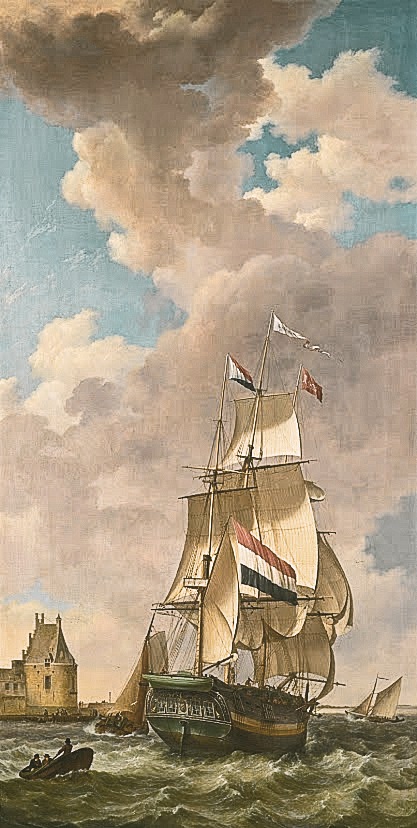
Johannes Hermanus Koekkoek, 1778 - 1851, DUTCH
A MERCHANTMAN OFF VEERE
Oil on canvas
164.5 by 84cm., 64½ by 33in
Private Collection
Veere is a municipality in the southwestern Netherlands, on Walcheren island in the province of Zeeland. The name Veere means "ferry": Wolfert Van Borsselen established a ferry there in 1281. Veere received its city rights in 1355.
The Admiralty of Veere was set up as a result of the Ordinance on the Admiralty of 8 January 1488 in an attempt to create a central naval administration in the Burgundian Netherlands. To this was subordinated the Vice-Admiralty of Flanders in Dunkirk. In 1560 under admiral Philip de Montmorency, Count of Hoorn, this admiralty relocated near Ghent and in 1561 the Habsburg naval forces were also moved to Veere.
Veere functioned as the staple port for Scotland between 1541 and 1799. More Veere
Johannes Hermanus Koekkoek, (Veere, 17 August 1778 – Amsterdam, 9 January 1851) was a Dutch painter and draughtsman. He was the head of an artistic family. His sons were all successful artists; the first two specialized in marine art, and Marinus was primarily a landscape painter. His grandson Johannes Hermanus Barend Koekkoek also became an artist.
ohannes Hermanus Koekkoek initially trained under Thomas Gaal, working in a wallpaper factory. He became primarily a marine art and genre art painter. He was active between 1793 and 1851, and worked in Middelburg, Durgerdam, Amsterdam (1833–1851), and Medemblik (1838) and Katwijk aan Zee. More Johannes Hermanus Koekkoek
Henry Scott Tuke, (british 1911-2005)
''DAWN MISTS, FOOCHOW''
The ''Ariel,'' and ''Taeping,'' WITH ''THERMOPYLAE''
Oil on canvas
14 x 20 in. (35.6 x 50.8cm)
Private Collection
Fuzhou, formerly romanized as Foochow, is the capital and one of the largest cities in Fujian province, China. On August 23, 1884, the Battle of Fuzhou broke out between the French Far East Fleet and the Fujian Fleet of the Qing dynasty. As the result, the Fujian Fleet, one of the four Chinese regional fleets, was destroyed completely in Mawei Harbor. More Fuzhou
The Taeping was a clipper ship built in 1863. Taeping participated in The Great Tea Race of 1866 and narrowly defeated the Ariel. The ship was wrecked September 22, 1871 on Ladd's Reef in the China Sea. More
Thermopylae was an extreme composite clipper ship built in 1868 by Walter Hood & Co of Aberdeen, to the design of Bernard Waymouth of London, for the China tea trade, and set speed records on her maiden voyage to Melbourne—63 days, In 1872, Thermopylae raced the clipper Cutty Sark from Shanghai back to London. Thermopylae won by seven days after Cutty Sark lost her rudder. From 1882 onward, Thermopylae took part in the Australian wool trade; however, on this route Cutty Sark proved faster.
In 1897 she was sold to Portugal for use as a naval training ship and renamed Pedro Nunes. On 13 October 1907, the Portuguese Navy towed her down the Tagus river using two warships, and before Amelia de Orleans, Queen of Portugal, she was torpedoed with full naval honours off Cascais. More Thermopylae
Henry Scott Tuke RA RWS (12 June 1858 – 13 March 1929), was an English visual artist; primarily a painter, but also a photographer. His most notable work was in the Impressionist style.
He was born into a Quaker family in Lawrence Street in York. In 1859 the family moved to Falmouth, where where his father, a physician, established a practice. Tuke's sister and biographer, Maria Tuke Sainsbury (1861–1947).
In 1875, Tuke enrolled in the Slade School of Art under Alphonse Legros and Sir Edward Poynter. Initially his father paid for his tuition but in 1877 Tuke won a scholarship, which allowed him to continue his training at the Slade and in Italy in 1880. From 1881 to 1883 he was in Paris where he met Jules Bastien-Lepage, who encouraged him to paint en plein air. While studying in France, Tuke decided to move to Newlyn Cornwall where many of his Slade and Parisian friends had already formed the Newlyn School of painters. He received several lucrative commissions there, after exhibiting his work at the Royal Academy of Art in London.
In 1885, Tuke returned to Falmouth where many of his major works were produced. Tuke became an established artist and was elected to full membership of the Royal Academy in 1914. Tuke suffered a heart attack in 1928 and died in March, 1929. Today he is remembered mainly for his oil paintings of young men, but in addition to his achievements as a figurative painter, he was an established maritime artist and produced as many portraits of sailing ships as he did human figures. Tuke was a prolific artist—over 1,300 works are listed and more are still being discovered. More Henry Scott Tuke
Niels Simonsen, 1807 - 1885
Turkish sailors on watch, c. 1837
Oil on canvas
24 ½ x 30 ½ in. (62.2 x 77.5 cm.)
Private Collection
Niels Simonsen (10 December 1807, Copenhagen – 11 December 1885, Frederiksberg) was a Danish artist, best known for his battle paintings. At the age of fourteen, he was apprenticed to a master decorative painter and began to take drawing lessons at the Royal Danish Academy of Fine Arts. Later, he took private lessons from J.L. Lund.
After a successful showing at the Charlottenborg Spring Exhibition in 1827, he turned to sculpture and received some orders. In 1830, he was awarded a small gold medal for his relief of Christ healing the sick, which is now displayed in Kongens Nytorv.
Although the fees for these commissions were substantial, portrait busts were his primary source of income. His failure to win any more official recognition for his work soon prompted him to turn to painting. He held his first exhibition in 1833. In 1834, he left Munich, where he came under the influence of the Academy of Fine Arts and developed friendships with the artists there.
Niels Simonsen (1807–1885)
Naval battle, c. 1844
Oil on canvas
70 x 83 cm
Private collection
From 1848 to 1851, during the First Schleswig War, he concentrated on large canvases of military scenes, several of which were acquired for the Royal Collection. After that, he went back to genre scenes and took a trip to Sweden and created a major work symbolizing the reconciliation of Denmark and Sweden after years of bitter contention for the island of Scania ("Trolovelse i Skaane").
In 1852, he was named a Knight in the Order of the Dannebrog and, From 1854 to 1883, he was a teacher at the Academys' Model School. He once again focused on battle painting during the Second Schleswig War and became a member of the Royal Swedish Academy of Arts. He made his last major trip to Rome in 1870. More Niels Simonsen
Constantinos Volanakis, 1837-1907, GREEK
HARBOUR BY NIGHT
Oil on canvas
41.5 by 53cm., 16 by 20¾in.
Private Collection
Konstantinos Volanakis (1837, Heraklion - 29 June 1907, Piraeus) was a Greek painter who became known as the "father of Greek seascape painting". He completed his basic education on Syros in 1856. Afterward, urged on by his brothers, he went to Trieste and became an accountant for a family of Greek merchants who were related to his family by marriage. While there, he made sketches of ships and harbors in his account books. Rather than dismiss him, the family recognized his artistic talent, and made arrangements for him to study at the Academy of Fine Arts, Munich, under Karl von Piloty, joining a group of Greek students. His instructors discouraged any sort of landscape painting, because it was "in decline", so he concentrated on portraits.
His break came in 1869, three years after the Battle of Lissa, when Emperor Franz Joseph held a drawing competition to memorialize the event. Volanakis won the contest (See below) , receiving 1000 gold Florins and free travel cruises with the Austrian navy for three years. He took full advantage of this, producing numerous canvases and sketches. He married in 1874. Nine years later he returned to Greece and settled in Piraeus, where his family had a pottery factory.
From then until 1903, he was a teacher at the Athens School of Fine Arts. He also operated his own private school. In 1889, he was awarded the Silver Cross of the Order of the Redeemer. He was, however, very poor in his later years, due to his very large family and declining interest in his art. In an effort to increase his income, he reversed the usual method of painting first, then framing, by working with a group of framers who would make luxurious carved frames first, then creating paintings to fit them.
He died from complications related to a major hernia. Most of his works are in private collections. More Volanakis
Konstantinos Volanakis (1837–1907)
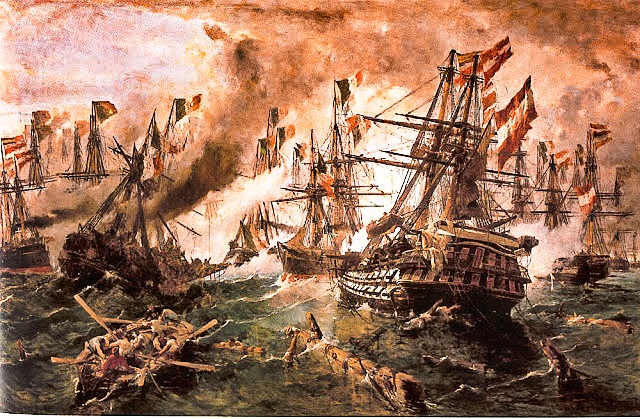
Naval battle at Lissa, c. 1869
Oil on canvas
283 × 169 cm (111.4 × 66.5 in)
Museum of Fine Arts, Budapest, Hungary
The Battle of Lissa took place on 20 July 1866 in the Adriatic Sea near the Dalmatian island of Vis (Italian: Lissa) and was a significant victory for an Austrian Empire force over a numerically superior Italian force. It was the first major sea battle between ironclads and one of the last to involve deliberate ramming. The Italian navy fired roughly 1450 shots during the engagement, but failed to sink any Austrian ship while losing two ironclads.
One of the main reasons for this poor performance was internal rivalry between the Italian fleet commanders: for example, Italian Vice Admiral Albini, with his ships, did not engage the enemy during the battle. The engagement was made up of several small battles: the main battle was between seven Austrian and twelve Italian ironclads and showed the ability of Austrian commander Tegetthoff to divide his more numerous opponents and then destroy the isolated ironclads.
More on The Battle of Lissa
Konstantinos Volanakis (1837, Heraklion - 29 June 1907, Piraeus), see above
William Lee-Hankey, 1869 - 1952
Honfleur
Oil on canvas
25 x 30 ½ in. (63.5 x 77.4 cm.)
Private collection
Honfleur is a commune in the Calvados department in northwestern France. It is located on the southern bank of the estuary of the Seine across from le Havre and very close to the exit of the Pont de Normandie. Its inhabitants are called Honfleurais.
It is especially known for its old, beautiful picturesque port, characterized by its houses with slate-covered frontages, painted many times by artists, including in particular Gustave Courbet, Eugène Boudin, Claude Monet and Johan Jongkind, forming the école de Honfleur (Honfleur school) which contributed to the appearance of the Impressionist movement. The Sainte-Catherine church, which has a bell tower separate from the principal building, is the largest church made out of wood in France. More Honfleur
William Lee Hankey (1869–1952)
RWS,RI,ROI,RE,NS was a
British painter and book illustrator. He specialised in landscapes, character
studies and portraits of pastoral life, particularly in studies of mothers with
young children.
He was
born in Chester and worked as a designer after leaving school. He studied art
in the evenings at the Chester School of Art, then at the Royal College of Art.
Later in Paris he became influenced by the work of Jules Bastien-Lepage, who
also favoured rustic scenes depicted in a realistic but sentimental style. He
first exhibited at the Royal Academy in 1896 and was President of the London
Sketch Club from 1902 to 1904. He stayed in France in the early 1900s, painting
many of his works in Brittany and Normandy. From 1904 until well after World
War I he maintained a studio at the Etaples art colony.
It was
Hankey's black and white and coloured etchings of the people of Étaples, which
gained him a reputation as 'one of the most gifted of the figurative
printmakers working in original drypoint during the first thirty years of the
20th century'. One that is particularly striking for its stylistic presentation
was "The Refugees", his contribution to raising awareness of the
consequences for ordinary people of the German invasion of France and Belgium
in 1914. He went on to serve with the Artists' Rifles from 1915 to 1918.
In Britain he had been associated with the
Newlyn School, a group of English artists based in the titular village in
Cornwall who were themselves influenced by the romantic poets such as
Wordsworth and Keats. More on William Lee Hankey
Thomas Buttersworth, 1768 - 1842
British '74' engaging the enemy, with a pilot cutter beyond
Oil on canvas laid down on board
25 x 30 in. (63.5 x 76.2 cm.)
Private collection
The "seventy-four" was a type of two-decked sailing ship of the line which nominally carried 74 guns. It was developed by the French navy in the 1740s and spread to the British Royal Navy where it was classed as third rate. From here, it spread to the Spanish, Dutch, Danish and Russian navies. The design was considered a good balance between firepower and sailing qualities, but more importantly, it was an appealing ideal for naval administrators and bureaucrats. Seventy-fours became a mainstay of the world's fleets into the early 19th century when they began to be supplanted by new designs and by the introduction of steam powered ironclads. More seventy-four
Thomas Buttersworth (5
May 1768 – November 1842)
was an English seaman of the Napoleonic wars period who became a marine
painter. He produced works to commission, and was little exhibited during his
lifetime.
Butterworth enlisted in the Royal Navy in London in 1795, and served on HMS Caroline during the wars with France, before being invalided home from Menorca in 1800.
The National Maritime Museum in London has 27 watercolours by him. He went on to paint numerous naval battle scenes and pictures such as the ‘'Inshore Squadron off Cadiz in 1797'’ which are thought to show scenes he witnessed. On being appointed Marine Painter to the East India Company he painted ship portraits on commission. More on Thomas Buttersworth
MONTAGUE DAWSON, (british 1890-1973)
"DEPARTING DAY"
Oil on canvas
24 x 44 1/4 in. (61 x 112.4cm)
Private Collection
MONTAGUE DAWSON, (british 1890-1973), see above
François-Étienne Musin, 1820 - 1888
The return of the fishermen
Oil on canvas
34 x 47in (86.5 x 119.5cm)
Private Collection
François-Etienne Musin (4 October 1820, Ostend - 24 October 1888, Sint-Joost-ten-Node) was a Belgian painter who specialized in seascapes. As a child, he paid more attention to the sea than his studies. His artistic talent was discovered when he was locked in the attic as punishment and used a piece of charcoal to draw a view of the Ostend docks on the wall.
In 1831, he received his first lessons from Michel Van Cuyck and François-Antoine Bossuet, who would later become famous for his vedute, but was still working for the Port of Ostend at that time. He later attended the local Beaux Arts Academy and graduated after winning a gold medal in 1835. By this time he had already gained some dangerous experience with ships and sailing while tending to his father's oyster beds.
He continued his studies at the Académie Royale des Beaux-Arts in Brussels, where he studied under François-Joseph Navez. While there, he made drawings of surgical procedures in the operating room of Doctor Louis-Joseph Seutin, with the intention of publishing them in a textbook. In 1839, he was drafted in the Army, but his father paid for a replacement (a common practice at the time). In 1840, he began to exhibit and moved to Brussels permanently in 1842, completing his studies the following year. His career was substantially advanced when King Leopold I bought two of his paintings in 1845.
He died of a stroke. His friends and family recalled him as a hedonist who was always in a good mood and ready to recount his many adventures. His paintings were unusually popular with forgers, leading his son to contrive various means of identifying the originals, including certificates of authenticity and wax stamps. More François-Etienne Musin
Hermanus Koekkoek the Younger
Fishing boats in a stiff breeze offshore
Oil on panel
14 1/2 x 22 1/4in (36.8 x 56.5cm)
Private Collection
Hermanus Koekkoek the Younger, Amsterdam 1836-1909 Londen. A pupil of his father Hermanus Sr, he lived and worked in Amsterdam and Nieuwer-Amstel (now Amstelveen). During the eighteen sixties he regularly stayed in London, where he settled permanently in 1869 and opened an art gallery in 1880. As well as his own paintings, Hermanus Jr sold a lot of work in England of family members, including his father and uncle B.C. Koekkoek. He himself painted sea, river and beach views and also worked under the pseudonyms 'Jan van Couver' and 'L. van Staaten'. He also worked with the landscape painter Lion Schulman both in England and the Netherlands. Around 1880 his work became less romantic and the influence of The Hague School is more evident. More Hermanus Koekkoek the Younger
MICHAEL ZENO DIEMER, (german 1867-1939)
ON THE HIGH SEAS
Oil on canvas
33 x 44in. (83.8 x 111.7cm)
Private Collection
MICHAEL ZENO DIEMER, (german 1867-1939), see above
ARTHUR BURGESS (1879-1957)
Crossing the Bar at Clarence River
Oil on board
29 x 44.5cm
Private Collection
The Clarence River, a mature wave dominated, barrier estuary, is situated in the Northern Rivers district of New South Wales, Australia.The river was named by Capt. Henry Rous in honour of The Prince William, 1st Duke of Clarence and St Andrews and Lord High Admiral of the Navy prior to his ascension as William IV. More
Arthur BURGESS, 1879—1957. Born in Australia, his father was an officer in the Australian Navy and, being an artist himself, encouraged his son to draw from an early age. He attended schools in New South Wales and Tasmania, and trained for three years in an architect's office, spending all his leisure hours sketching ships in Sydney harbour.
Just after his 21st birthday he emigrated to England. In November 1901 he signed into St Ives Arts Club as a guest of Julius OLSSON, and later became his pupil. The registers show he visited again in January 1912 and November 1914. Tovey includes a coloured plate of his painting, Drifting Home, St Ives, in his social history of the St Ives artists (p243) and another, Rowing Boats in a rocky cove (p244). During the War he became Official Naval Artist for the Australian Government.
In WWII he was commissioned by various shipowners to paint their merchant ships and convoys in ports all over the country. Having made rough sketches, he returned to his studio in Ludlow to complete the finished pictures (his studio in London having been bombed in the Blitz). His wife, Muriel BURGESS (nee Coldwell), was a pupil at the Forbes School whilst copying her father's portrait in 1936-37. More BURGESS
Jacob Adriaensz Bellevois (Rotterdam 1621-1675)
Ships foundering in rough seas off a rocky coastline
Oil on panel
72.8 x 107.8cm (28 11/16 x 42 7/16in).
Private Collection
Jacob Adriaensz Bellevois (1621, Rotterdam – 1676, Rotterdam), was a Dutch Golden Age marine painter. His teacher is not known, but the influence of Julius Porcellis (c. 1609–1645), who worked in Rotterdam, seems apparent in the monochrome tendencies evident in his style. Bellevois presumably lived and worked in Rotterdam at least until after the death of his first wife, Cornelia Vythoecs [Uithoeks], in 1652. Three years later he married Maria ’t Hert from Gouda. A document indicates that he was living in Gouda in 1671. Around 1673 or 1674 he is mentioned as being in Hamburg. He was buried in Rotterdam on September 19, 1676. More Bellevois
JOHANN JAN ZOETELIEF TROMP (1872-1947), DUTCH
BRINGING IN THE CATCH
Oil on canvas
27.25" x 37.25" — 69.2 x 94.6 cm
Private Collection
JOHANN JAN ZOETELIEF TROMP (1872-1947), DUTCH. Though Tromp trained as an artist at the Academy of Arts of The Hague and later at Rijks Academie of Amsterdam, he was clearly influenced by the work of his father-in-law Bernardus Johannes Blommers. Like his predecessors of the Hague School, Tromp depicted genre scenes populated by rural figures. In this beach scene, light glitters over the wave caps and garb of the women as they meander along the shoreline. A fine and bright play of colour, harmonized by delicate half-tones, is characteristic of Tromp’s ability to create works of intimate pictorial quality and to subtly render textures. More on JOHANN JAN ZOETELIEF TROMP
STEPHEN CHIZMARIK, AMERICAN 1898-1962
BOATS AT HARBOR OF TOWN
OIL ON CANVAS
H 24" W 36"
Private Collection
Born 1898 in Chertiz, Austria-Hungary, Stephan Chizmarik studied at the Detroit School of Fine Arts with John Walker. Primarily a painter of landscapes, Chizmarik exhibited at the Pennsylvania Academy of the Fine Arts and The Art Institute of Chicago. Depicting an idyllic winter scene featuring a setting that could represent any one of our region?s system of inset lakes, Chizmarik uses bright, colorful accents to heighten the spirit of a leisurely day on the ice. Chizmarik died in 1972 in Michigan. More on STEPHAN CHIZMARIK
J.M. Bang
The Battle of Copenhagen
Pen and ink and watercolor heightened with white on laid paper
18 3/4 x 25 1/4in (47.6 x 64.2cm)
Private Collection
The drawing shows the ship formations and action on the 30th of March 1801 with an inscription in Danish detailing ships and their captains below, and the other shows the Danish defenses of Copenhagen and the battle on the 2nd of April with an inscription in Danish of captains' and ship names.
The Battle of Copenhagen was an important engagement between Britain, who sought to maintain an embargo against those who would trade with France during the French Revolutionary Wars, and those in Europe who were hostile against the blockade. The commander of the defending fleet in this battle was Commodore Olfert Fischer with Admiral Sir Hyde Parker commanding the British fleet. This battle proved to be a significant defeat for the Danish-Norwegian allies, however, heavy damage was sustained to both sides. The Battle of Copenhagen is often considered to be the hardest ever fought by Vice Admiral Horatio Nelson, who led the main attack. More The Battle of Copenhagen
I have no information on J.M. Bang
John Cleveley the Elder (Southwark circa 1712-1777 Deptford)
The flotilla of ships, led by the Royal Charlotte in company with five other royal yachts, arriving off Harwich on 6 September 1761, after conveying Princess Charlotte of Mecklenburg-Strelitz to England for her marriage to George III
Oil on canvas
110.5 x 196.8cm (43 1/2 x 77 1/2in).
Private Collection
When George III selected Princess Charlotte of Mecklenburg-Strelitz to be both his bride and his queen, it was obvious that she would need to be conveyed to England in safety as well as in luxury. It was not surprising therefore that the vessel chosen for the task of crossing the notorious North Sea was the largest royal yacht of the day, hitherto named Royal Caroline, in honour of George's mother. After she was hastily renamed (on 27 July 1761) to celebrate the new bride, a special squadron of six royal yachts accompanied by six ships-of-war was quickly assembled at Harwich and, on 7 August, sailed for Cuxhaven under the command of Admiral of the Fleet Lord Anson. The future queen and her suite came aboard at the north German town of Stade where the young princess was so overwhelmed by the farewell ceremonies that she remarked 'And am I worthy of all these honours?' The return journey was beset by appalling weather and when the royal flotilla eventually made Harwich safely on 6 September, it had survived three severe storms and been almost wrecked on the coast of Norway on two occasions. Remaining on the yacht overnight, Charlotte disembarked early the next morning to travel to London where, after meeting her future husband for the first time, she and George were married at Saint James's Palace the very next day, 8 September, and crowned two weeks later. More on this painting
John Cleveley the Elder (c.1712 – 21 May 1777) was an English marine artist. Cleveley was born in Southwark. He was not from an artistic background, and his father intended him to follow the family trade of joinery, so he set up as a carpenter or shipwright in around 1742 at the Deptford Dockyard. Continuing his work in that area throughout his life (indeed, he is referred to as ‘carpenter belonging to His Majesty’s Ship Victory, in the pay of His Majesty’s Navy in letters of administration granted by the Admiralty in 1778 to his widow. From about 1745 he also worked as a painter, mostly ship portraits, dockyard scenes of shipbuilding and launches, and some other marine views. They combined his knowledge of shipbuilding with accurate architectural and topographical detail. Apparently mostly self-taught, it is possible that dockyard ship-painters also gave him some training in this area. He toured East Anglia, and produced some paintings from notes made on that trip. More John Cleveley the Elder
Acknowledgement: DuMouchelles, BONHAMS NEW YORK, Freeman's,
Please visit my other blogs: Art
Collector, Mythology, Marine
Art, Portrait of a Lady, The
Orientalist, Art of the Nude and The
Canals of Venice, Middle
East Artists, 365
Saints and 365 Days, also visit my Boards on Pinterest
Images are copyright of their respective owners, assignees or others.
Some Images may be subject to copyright
I don't own any of these images - credit is always given when due unless
it is unknown to me. if I post your images without your permission, please tell
me.
I do not sell art, art prints, framed posters or reproductions. Ads are
shown only to compensate the hosting expenses.
If you enjoyed this post, please share with friends and family.
Thank you for visiting my blog and also for liking its posts and pages.
Please note that the content of this post primarily consists of articles
available from Wikipedia or other free sources online.

 Posts
Posts




.jpg)